Prediction of setup times for an advanced
upper limb functional electrical
stimulation system
Smith, C, Kenney, LPJ, Howard, D, Waring, K, Sun, M, Luckie, HM, Hardiker, NR
and Cotterill, S
http://dx.doi.org/10.1177/2055668318802561
Title
Prediction of setup times for an advanced upper limb functional electrical
stimulation system
Authors
Smith, C, Kenney, LPJ, Howard, D, Waring, K, Sun, M, Luckie, HM,
Hardiker, NR and Cotterill, S
Type
Article
URL
This version is available at: http://usir.salford.ac.uk/id/eprint/49015/
Published Date
2018
USIR is a digital collection of the research output of the University of Salford. Where copyright
permits, full text material held in the repository is made freely available online and can be read,
downloaded and copied for noncommercial private study or research purposes. Please check the
manuscript for any further copyright restrictions.
Prediction of setup times for an
advanced upper limb functional
electrical stimulation system
Christine Smith
1, Laurence Kenney
2, David Howard
3, Karen Waring
2, Minxgu Sun
2,
Helen Luckie
2, Nicholas Hardiker
4and Sarah Cotterill
5Abstract
Introduction:Rehabilitation devices take time to don, and longer or unpredictable setup time impacts on usage. This paper reports on the development of a model to predict setup time for upper limb functional electrical stimulation. Methods:Participants’ level of impairment (Fugl Meyer-Upper Extremity Scale), function (Action Research Arm Test) and mental status (Mini Mental Scale) were measured. Setup times for each stage of the setup process and total setup times were recorded. A predictive model of setup time was devised using upper limb impairment and task complexity. Results:Six participants with stroke were recruited, mean age 60 (17) years and mean time since stroke 9.8 (9.6) years. Mean Fugl Meyer-Upper Extremity score was 31.1 (6), Action Research Arm Test 10.4 (7.9) and Mini Mental Scale 26.1 (2.7). Linear regression analysis showed that upper limb impairment and task complexity most effectively predicted setup time (51% as compared with 39%) (F(2,21)¼12.782, adjusted R2¼0.506;p<.05).
Conclusions:A model to predict setup time based on upper limb impairment and task complexity accounted for 51% of the variation in setup time. Further studies are required to test the model in real-world settings and to identify other contributing factors.
Keywords
Rehabilitation devices, stroke, physiotherapist, upper limb, graphical user interface
Date received: 22 December 2017; accepted: 24 August 2018
Introduction
Numerous studies have demonstrated the potential for functional electrical stimulation (FES) technology to
support upper limb recovery following stroke.1,2 FES
devices have the potential to free up valuable therapist time and allow patients to practise upper limb training protocols outside of formal therapy time and at their own pace. In order to align with principles known to drive functional recovery, notably the need to intensively practise a variety of challenging, functional tasks,3,4and offer sufficient flexibility to accommodate a broad range of patients, FES devices are becoming increasingly sophisticated. These advanced FES devices have mul-tiple channels, are usually controlled via sensors, provide some form of biofeedback and may incorporate
elec-trode arrays2,5 Although largely unreported, an
unin-tended consequence of this increase in complexity is
likely to have been an increase in setup time of some of these devices. For instance, systems that include a brain interface require calibration of the interface, and
Journal of Rehabilitation and Assistive Technologies Engineering
Volume 5: 1–9
!The Author(s) 2018 Article reuse guidelines: sagepub.com/journals-permissions DOI: 10.1177/2055668318802561 journals.sagepub.com/home/jrt
1
Department of Allied Health Professions, Sheffield Hallam University, Sheffield, UK
2
School of Health Sciences, University of Salford, Salford, UK
3
School of Computing, Science and Engineering, University of Salford, Salford, UK
4
School of Nursing, Midwifery, Social Work & Social Sciences, University of Salford, Salford, UK
5
Research & Development Department, Salford Royal NHS Foundation Trust, Salford, UK
Corresponding author:
Christine Smith, Faculty of Health & Wellbeing, Sheffield Hallam University, Collegiate Crescent Campus, Sheffield, South Yorkshire, S10 2BP, UK.
Email: [email protected]
some of the recent upper limb systems based on iterative learning control rely on person-specific dynamic model identification.2,6,7
There is a clear challenge in making such advanced systems flexible to patients’ needs whilst ensuring that
they are quick and easy for therapist and patient use8
Ease of use is a major barrier to FES devices being used in the patients’ home. In spite of the importance of short setup times, there is a scarcity of studies that have examined setup time for any form of
rehabilita-tion device9–11Even those that have reported setup time
tend to rely on self-reports and do not clearly define
setup time (when timing commenced and finished).12,13
The authors could not identify any papers reporting on setup time for upper limb rehabilitation devices.
Although it is clear that setup time should be as short as possible, one issue that has not been addressed in the literature is the need for setup time to be predict-able and tools for this purpose do not appear to exist. Predictability of setup time is important from a clinical perspective, as sessions with patients are usually time-limited. A lengthy setup time or one that is unpredict-able and variunpredict-able may have consequences for technol-ogy adoption.
In this paper, we present a model for the prediction of setup time for a new upper limb FES system, referred to as the FES Rehab Tool or FESRT (Figure 1). The FESRT is a clinic-based system designed to use elec-trical stimulation of weak or paralyzed muscles to sup-port a range of people with upper limb impairments following stroke to practise a variety of functional activities they would be unable to perform unaided.
The system is designed to be used under therapist supervision. The hardware consists of an eight-channel
stimulator (RehaStimTMHasomed); however, only four
channels were utilised for our study, two body-worn inertial measurement units (Xsens MTx) and a laptop computer. The laptop runs purpose-designed software, written in Matlab-Simulink environment, for setting up and running state machine (sequential) controllers, specific to the activity and participant’s impairments. The state machine controller considers a particular functional activity as a sequence of movement phases, each of which is associated with stimulation to user-defined muscles at specified levels of intensity. Progress through the movement phases is governed by user-defined rules. These rules may use, as their input(s), angle data from the body-worn sensors, a button press using the laptop keyboard and/or time since entering the
phase.14To manage the setup and running of the FES
controller, the user is provided with a graphical user interface (GUI). Threshold values for each muscle are established early in the setup process, leaving the ther-apist to define pulse width target and ramp time for each stimulated muscle in each phase. It is the prediction of the time taken to use this GUI to set up user-defined, FES-supported activities for particular patients which is the focus of this paper.
Setup time model development
[image:3.595.100.484.499.694.2]We use the word ‘model’ to describe the mathematical relationship between upper limb impairment and task complexity. In order to meet the requirements of our
Figure 1. FESRT system comprising laptop, Xsens MTx Unit with two motion sensors, surface electrodes X4, RehastimTMHasomed stimulator.
setup time model, a measure of task complexity was needed to fulfil the following characteristics:
. Be independent of impairment level, as this was
rep-resented in the other part of the model;
. Characterise functional movement for the upper
limb, either using measures of joint or muscle activ-ity, based on the assumption that the more changes of muscle or joint activity there are within a given task, the more complex the task is;
. Be applicable to ‘real-world’ functional tasks.
No suitable model of task complexity was identified in the literature, and therefore a basic model was devel-oped based on descriptions of joint movements that could be both directly observed and easily interpreted. The task complexity method focused on the movements of the major joints in the upper limb, shoulder, elbow, radio-ulnar joint and wrist, all of which could be controlled using FES. The model considered a task to consist of a number of phases. Within each phase, each of the four joints was considered to be in one of three conditions: (1) at rest; (2) moving in a single direction,
e.g. flexion, extension, pronation and supinationor(3)
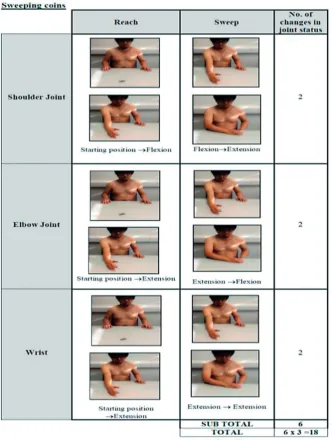
held in a static position, actively working to overcome any external forces. In order to illustrate how the task complexity calculation was arrived at, an example of a ‘sweeping coins’ task is provided in Figure 2. For a given task, the number of times a change in status occurred at each joint during each phase was recorded and the sum calculated. This number was then multi-plied by the number of joints involved in the whole functional task, as a weighting factor. This took into account that tasks that involved co-ordinated move-ment at multiple joints were likely to be more complex than the sum of the complexity of individual joint movements (i.e. a movement involving coordination of two joints is likely more than twice as complex as a movement involving a single joint). This figure (i.e. sum of changes in joint status, multiplied by number of joints involved in the task) provided the task complex-ity score for a specific task.
To allow development of the tool to predict setup time, a suitable library of tasks needed to be identified that would be representative of those that might be used in a therapy session. The library of tasks took into
account the importance of specificity of training,15
bilat-eral training due to the many tasks in everyday life that
involve bilateral activity16 and the real-world relevance
of objects in the tasks. Finally, we used results from a
previous study17which provided examples of functional
tasks that are important to People with Stroke (PwS)
and that they have difficulty in achieving.18
As the method for devising task complexity was study specific, it was important to ensure there was
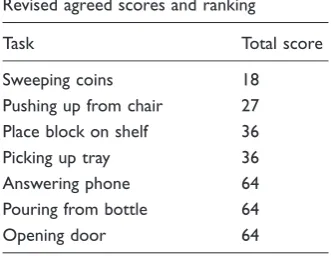
some robustness to this approach. A second senior research physiotherapist (RP) (RP2) was provided with the definition for calculating task complexity and asked to independently calculate the task complexity scores for the library of tasks. Based on each therapist’s individual scores, the set of tasks was ranked, placing the least complex task first and the most complex task last. Results were compared by plotting the results of RP1 against RP2 (Figure 3), including a line of best fit. There was a high level of agreement across the RPs. The task complexity totals were the same for five of the seven tasks, and the ranking of task complexity was the same for all tasks. Of the two tasks where the scores differed, in each case, a movement phase had been omitted. After further discussion, it was agreed to include the additional movement phases (Table 1).
Methodology for testing the model
Ethical approval was gained from the Greater
Manchester NHS Ethics committee (10/H1005/26) and the University of Salford Ethics Committees (REP10/146). Written informed consent for patient information and images to be published was provided by the patients. Seven chronic stroke participants who met the inclusion and exclusion criteria (Table 2) were purposively sampled from a database of volunteers. PwS who were deemed to represent the type of PwS most likely to benefit from an advanced FES system such as ours were selected. An information sheet was provided outlining the details of the study. Informed consent was gained on the first visit to the lab. Each participant was asked to visit the laboratory on up to six occasions.
During the first visit, once informed consent had been provided, clinical data were gathered to characterise the participant. Their level of impairment was measured using Fugl-Meyer Upper Extremity (UE) Assessment,
(FMA-UE).19Other measures were also taken to
char-acterise the participants as follows: Action Research
Arm Test20 and Mini-Mental State.21 To remove one
(external) source of variability in setup time, throughout testing, the same physiotherapist – who was trained to use the system and who specialised in stroke – carried out all the clinical measures and acted as the operator when setting up the FES device.
from simplest to most complex, in accordance with the task complexity ranking. This allowed participants to build confidence by successfully achieving some of the simpler tasks before being asked to attempt more com-plex tasks.
A usability data collection form was used to record time taken to set up each stage of the FES device and to record relevant usability observations during the setup process, for use in subsequent final refinement of the GUI. The timing of the setup process only began once all of the hardware was laid out and both the physiotherapist and the participant were ready to commence. Setting up the Hasomed FES Rehastim, the
Xsens and loading the GUI (at this stage in the devel-opment, the software was loaded through Matlab com-mands) was carried out by an independent researcher who had written the code. This ensured that the FES system was set up consistently across all of the lab-based testing.
[image:5.595.127.460.69.510.2]Times were captured using a stopwatch and were recorded from when the operator commenced stage 1 of the setup process. In order to test the lab-based protocol and the reliability of the software on stroke participants, the first participant (participant 0) was used as a pilot. The data from this participant were therefore not included in the results.
Figure 2. An example of the task, sweeping coins into contralateral hand. The columns that are entitled ‘Reach’ and ‘Sweep’ refer to the movement phase. Each picture shows the start and end point of the upper limb relative to each movement phase and anatomical joint.
Data analysis
We report the baseline characteristics of all the partici-pants. The individual relationships between setup time and both task complexity and level of impairment (FM-UE) were explored using Pearson’s correlation and scatterplots. Scatterplots were conducted to visu-ally establish the nature of any relationship between
participants’ upper limb impairment scores and
setup times for the FESRT. We used multiple linear regression to develop a model of the combined effect of impairment and task complexity on setup time, adding each variable in turn to establish whether adding both would improve the level of prediction. We report the overall fit of the model to predict setup time and the relative contribution of each of the independent variables. All analyses were done using SPSS V20.0. Statistical significance was set at
p<.05, two tailed.
Results
Participant characteristics
All participants were classified as being in the chronic stage post stroke. Participants were graded using the Fugl-Meyer UE Scale as mild (50–65), moderate (30– 49) or severe (below 30) according to the criteria used
by Michelson et al.22 Four participants were therefore
categorised as severely impaired, whilst two were mod-erate. Participants generally had a low level of functional ability. One participant had expressive language difficul-ties as a result of the stroke. All other participants had no communication or language deficits (Table 3).
Setup times
Setup times were recorded for each stage (stages 1–4) of the setup process together with the overall setup time for each of the seven functional tasks. Table 4 displays the overall initial setup times (min) for each participant, per completed task. A key for the functional task code is also provided.
There was a general trend for setup time to increase with task complexity and a general trend for the setup time to be longer with patients with greater levels of impairment.
Relationship between task complexity and
setup times and the level of patients’ upper
limb impairment and setup times
[image:6.595.79.277.66.228.2]There was a weak positive correlation (0.23) between task complexity and setup time which was not statistic-ally significant. However, there was a large negative Table 2. Lab-based testing: stroke participant inclusion and exclusion criteria.
Inclusion criteria
A single stroke
At least six months post stroke
Medically stable
Sufficient cognitive ability to understand the experimental protocols
Over 18 years of age
Adequate motor response to surface stimulation and able to tolerate sensation
Reduced arm function on their hemiplegic side Exclusion criteria
Premorbid orthopaedic, neurologic or other medical condi-tion including poorly controlled epilepsy, which would affect the response to electrical stimulation
Cardiac demand pacemaker or other active medical implant/ device that may be affected by FES
Fixed contractures of elbow, wrist or fingers
Pain due to shoulder subluxation
[image:6.595.312.551.94.300.2]FES: functional electrical stimulation.
Figure 3. Scatterplot of task complexity scores for Research Physiotherapist 1 (author) and Research Physiotherapist 2. Line of the best fit included.
Table 1. Revised agreed scores in rank order (lowest to highest).
Revised agreed scores and ranking
Task Total score
[image:6.595.97.263.341.469.2]relationship between the participants’ level of impair-ment and setup time, with a Pearson correlation coef-ficient of0.643 (p<.05).
Modelling setup time
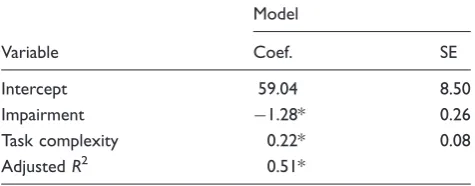
A linear regression model (Table 5) showed that each additional increase (improvement) in upper limb impairment score reduces setup time by an average of 1.28 min, after taking into account the effect of task complexity. Similarly, each increase in task complexity
score increases setup time by an average of 0.22 min after taking into account the effect of impairment score, and both were statistically significant (p<.05)
As derived from the regression analysis, the equation to predict setup time was
Predicted setup time¼59:042ð1:28impairmentÞ
þð0:22task complexityÞ:
How well did the proposed model fit?
When corrected for any positive bias, the adjustedR2of
Model 2 was 0.51 (51%), indicative of a medium to
large combined effect23 of impairment and task
com-plexity on setup time.
Discussion
Model development
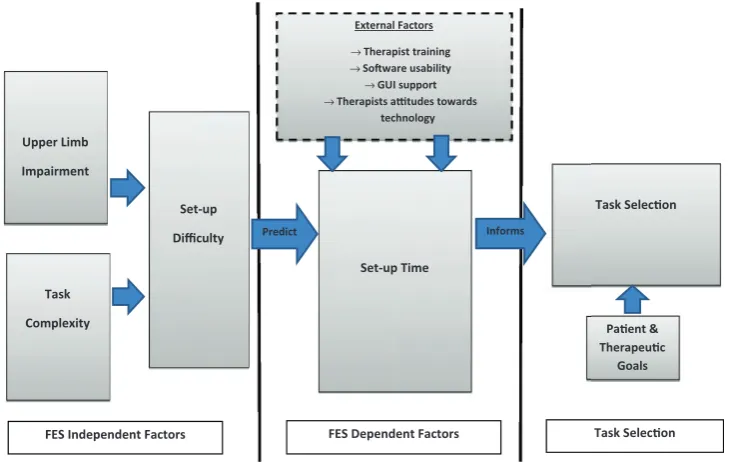
Factors likely to influence setup time. We proposed that setup time was likely to be influenced in the first instance
by two factors (Figure 4). First, the level of upper limb
[image:7.595.49.537.84.210.2]impairment. For individuals with no impairment and Table 4. Impairment level and setup times per participant and functional task.
Participant Number
Age
(years) FM-UE
Task SC (18)
Task PC (27)
Task BS (36)
Task PT (36)
Task OD (64)
Task PB (64)
Task AP (64)
1 59 18 28.51 38.93 50.71
2 80 29 29.33 37.51 39.36 23.88 49.85 41.73
3 41 29 20.98 49.80 33.96
4 79 28 23.31 23.90 27.30 37.56
5 42 37 14.50 16.08 17.15 22.38
6 59 38 19.71 16.32 18.11 24.15
Mean 60 (17) 29.8 (7.2) 22.7 (5.6) 31.4 (10.6) 43.6 (8.6) 26.6 (10.4) N/A 28.3 (18.6) 35.3 (11.9)
[image:7.595.50.536.263.388.2]Note: Task complexity scores are shown in brackets. Grey shaded regions represent task not attempted. SC: sweeping coins; PC: pushing up from chair; BS: place block on shelf; PT: picking up tray; OD: opening door; PB: pouring from bottle; AP: answering phone.
Table 3. Participant characteristics: impairment, function and Mini Mental scores for the lab-based testing.
Participant no.
Time since CVA (years)
Age (years)
Affected side
Hand
dominance Gender FM
UE/66 ARAT/57
Mini Mental/30
1 28 59 R R M 18 4 24
2 3 80 L R M 29 10 26
3 5 41 R R M 29 8 23
4 3 79 L R M 28 6 25
5 13 42 R R F 37 NK 30
6 7 59 L R M 38 24 29
Mean 9.8 (9.6) 60 (17) 31.1 (6) 10.4 (7.9) 26.1 (2.7)
NK: not known; FM UE: Fugl-Meyer Upper Extremity Scale; ARAT: Action Research Arm Test; CVA: Cerebrovascular Accident.
Table 5. Summary of multiple regression analysis and the effect of task complexity and upper limb impairment on setup time.
Model
Variable Coef. SE
Intercept 59.04 8.50
Impairment 1.28* 0.26
Task complexity 0.22* 0.08 AdjustedR2 0.51*
Coef.: unstandardised regression coefficient. *p<.05.
[image:7.595.49.287.468.561.2]hence requiring no FES support, setup time should be zero. Conversely, an individual with a high level of impair-ment, attempting the same task, would require a high degree of assistance from the system. It was reasonable therefore to propose that for a given task, the number of channels of stimulation, and hence the associated time needed to place electrodes and find appropriate stimula-tion levels, would be positively related to the patients’ level
of impairment. The second factor was thecomplexity of
the taskto be practised. We also proposed that a simple task, involving a small number of movement phases, should take less time to set up than a complex task invol-ving more movement phases, as setting up of each rule between movement phases has an associated time cost. It
was postulated that a model based onimpairmentandtask
complexitymay allow for prediction of setup time. From the regression analysis, the participants’ level of upper limb impairment, as measured by the Fugl-Meyer UE Scale, appeared to have the greatest influence within the proposed model on the prediction of setup time for the UL FESRT. Generally speaking, the more impaired the participant, the greater the overhead in terms of setup. Within the range of tasks selected, task complexity appeared to have less influence on setup time. This finding was consistent with the author’s observations.
Internal factors affecting setup time
.
a. Upper limb impairment
Although the proposed model and findings from the lab-based testing appear promising, it is important to
recognise that the model only predicted 51% of the variance in setup time and hence needs further refine-ment. Other patient characteristics such as presence of spasticity, cognitive involvement or communication
deficits can potentially impact the setup times.
Although one of the participants recruited for the lab testing had expressive language difficulties, this partici-pant was well known to the testing team, resulting in minimal increase in setup time. Introducing other vari-ables into the model at this stage of the development process was not possible, as this would have required additional testing to gather more data. In addition, although the Fugl-Meyer UE Scale was felt to be a reliable and valid measure of impairment, other meas-ures of impairment may offer a more sensitive measure of impairment level. The model only applies to people with some form of neurological impairment. Clearly, the model is invalid for people with no impairment.
b. Task complexity
Although task complexity also significantly contributed to the prediction of setup time, it contributed less than participants’ impairment scores. The method of calculat-ing task complexity provided a useful startcalculat-ing point that allowed exploration of the relationship between task complexity and upper limb impairment and subse-quently the effect of these variables on setup. In the cur-rent study, a pragmatic approach was adopted, that merely aimed to refine the scoring of the set of tasks, using two raters. However, as the method appears to have some merits, more formal reliability testing would
Task Selecon
Paent & Therapeuc
Goals Upper Limb
Impairment
Task
Complexity
Set-up
Difficulty
Set-up Time
External Factors
→Therapist training
→Soware usability
→GUI support
→Therapists atudes towards technology
Predict
FES Independent Factors FES Dependent Factors Task Selecon
[image:8.595.122.487.68.299.2]Informs
be warranted. It is worthy of note that the proposed method is only applicable for the range of tasks included in the lab-based testing. It remains to be seen how well the method generalises to other functional tasks.
External factors affecting setup time. There are other fac-tors that potentially influence setup time for FES devices outside of the lab (Figure 4). First, the effect-iveness of training that therapists receive is critical to effective use and indeed adoption of rehabilitation
devices. Hochstenbach-Waelen and Seelen8highlighted
the need for therapists to become familiar with technol-ogy by spending time at workshops and learn from peers whilst using the device. One way of mitigating against the impact of time away from patients in the clinical setting would be for rehabilitation technology to feature more prominently in therapists’ pre-registra-tion educapre-registra-tion. Presently, there is only a small amount of time dedicated to rehabilitation technologies in the majority of pre- and post-qualification curricula. Second, the usability of the software and indeed its level of robustness have the potential to influence
setup times.24,25 In the current study, usability factors
such as the amount of support the GUI provided to the therapist was unchanged throughout testing. Finally, the model has only been developed for a single system (the FESRT). Further work would be needed to explore to what extent the two factors (impairment and task complexity) might influence setup time of other upper limb rehabilitation devices.
Limitations and conclusions
Limitations
The number of participants in the study was bounded by the resources available. However, there was a suffi-cient number to identify potential key influencers on setup time. The impairment profile of these participants was limited to participants categorised as either mod-erate or severely affected. This meant that it was not possible to ascertain if the model would have general-ised to participants with only mild levels of impairment. In addition, these participants were all in the chronic stage of stroke and therefore at this point it was not possible to determine if the proposed model of calculat-ing setup time would generalise to participants in the acute or sub-acute phases post stroke. Testing in the lab, in only a partially controlled environment, at times proved to be challenging when attempting to standardise the method for timing the setup process. However, every attempt was made to ensure any dis-ruption to the timing of setup was excluded from the setup time calculations. Although the model to predict setup time for the FESRT is useful to therapists as part
of the decision process when selecting which task to choose for participants, it cannot be generalised to other rehabilitation technologies.
Conclusions
This is the first model that has attempted to predict setup time for a rehabilitation technology, namely, FES. The model, based on participants’ level of upper limb impairment combined with a task complexity score, predicted initial setup time for participants in the chronic stage post stroke. However, further testing needs to be carried out on participants in the acute and sub-acute stages post stroke and on participants with only a mild level of impairment. In addition, it remains to be seen if the model will apply when the FESRT is used in a real-world clinical environment. While these outstanding issues must await future studies, it is our hope that this seminal work will inform related research into rehabilitation technologies.
Declaration of conflicting interests
The author(s) declared no potential conflicts of interest with respect to the research, authorship, and/or publication of this article.
Funding
The author(s) disclosed receipt of the following financial sup-port for the research, authorship, and/or publication of this article: The research was supported by a grant from the National Institute for Health Research New and Emerging Applications of Technology (NIHR NEAT) Programme (Grant ref L030). The views expressed are those of the author(s) and not necessarily those of the NHS, the NIHR or the Department of Health.
Guarantor
CS
Contributorship
CS researched the literature and conceived the study. CS wrote the first draft of the manuscript. All authors reviewed and edited the manuscript and approved the final version of the manu-script. SC provided statistical advice and checked the analysis. CS, HL and KW recruited the patients and collected the data. MS wrote the software for the GUI. MS, CS, HL, KW, DH and LK designed the GUI. CS, HL, KW and NH conducted the usability testing for the GUI. CS gained ethical approval.
Acknowledgements
We would like to thank the therapists and patients who took part in the study. The NIHR had no involvement in the study design, collection, analysis, interpretation of data, writing of the report or the decision to submit the report for publication. The authors had full access to all the study data throughout the writing of the report. Access to data is ongoing.
ORCID iD
Christine Smith http://orcid.org/0000-0001-5354-953X Laurence Kenney http://orcid.org/0000-0003-2164-3892 Sarah Cotterill http://orcid.org/0000-0001-5136-390X
References
1. Howlett OA, Lannin NA, Ada L, et al. Functional elec-trical stimulation improves activity after stroke: a system-atic review with meta-analysis. Arch Phys Med Rehabil
2015; 96: 934–943.
2. Meadmore KL, Exell TA, Hallewell E, et al. The appli-cation of precisely controlled functional electrical stimu-lation to the shoulder, elbow and wrist for upper limb stroke rehabilitation: a feasibility study. J Neuroeng Rehabil2014; 30: 105.
3. Oujamaa L, Relave I, Froger J, et al. Rehabilitation of arm function after stroke. Literature review. Ann Phys Rehabil Med2009; 52: 269–293.
4. Nudo RJ and Milliken GW. Reorganization of move-ment representations in primary motor cortex following focal ischemic infarcts in adult squirrel monkeys.
J Neurophys1996; 75: 2144–2149.
5. Lew B, Alavi N, Randhawa BK, et al. An exploratory investigation on the use of closed-loop electrical stimula-tion to assist individuals with stroke to perform fine movements with their hemiparetic arm. Front Bioeng Biotechnol2016; 7: 20.
6. Vidaurre C, Klauer C, Schauer T, et al. EEG-based BCI for the linear control of an upper-limb neuroprosthesis.
Med Eng Phys2016; 19: 1–10.
7. Kutlu M, Freeman CT, Hallewell E, et al. Upper-limb stroke rehabilitation using electrode-array based func-tional electrical stimulation with sensing and control innovations.Med Eng Phys2016; 38: 366–379.
8. Hochstenbach-Waelen A and Seelen HA. Embracing change: practical and theoretical considerations for suc-cessful implementation of technology assisting upper limb training in stroke.J Neuroeng Rehabil2012; 9: 52. 9. Pedrocchi A, Ferrante S, Ambrosini E, et al. MUNDUS
project: Multimodal neuroprosthesis for daily upper limb support.J Neuroeng Rehabil2013; 10: 66.
10. Fitzgerald D, Kelly D, Ward T, et al. Usability evalu-ation of e-motion: a virtual rehabilitevalu-ation system designed to demonstrate, instruct and monitor a thera-peutic exercise programme. In: 2008 Virtual rehabilita-tion, Vancouveer, BC, 25–27 August 2008.
11. Dijkers MP, deBear PC, Erlandson RF, et al. Patient and staff acceptance of robotic technology in occupational therapy: a pilot study.J Rehabil Res Dev1991; 28: 33–44. 12. Heller BW, Clarke AJ, Good TR, et al. Automated setup of functional electrical stimulation for drop foot using a novel 64 channel prototype stimulator and electrode
array: results from a gait-lab based study. Med Eng Phys2013; 35: 74–81.
13. van Swigchem R, Vloothuis J and den Boer J. Is trans-cutaneous peroneal stimulation beneficial to patients with chronic stroke using an ankle-foot orthosis? A within-subjects study of patients’ satisfaction, walking speed and physical activity level. J Rehabil Med 2010; 42: 117–121.
14. Sun M, Kenney LK, Smith C, et al. A novel method of using accelerometry for upper limb FES control. Med Eng Phys2016; 38: 1244–1250.
15. Schmidt RA and Young DE. Transfer of movement con-trol in motor skill learning. In: SM Cormier, JD Hagman (eds) Transfer of learning. Orlando, FL: Academic Press Inc., 2005, pp.12–14.
16. Barreca S, Gowland CK, Stratford P, et al. Development of the Chedoke Arm and Hand Activity Inventory: the-oretical constructs, item generation, and selection. Top Stroke Rehabil2004; 11: 31–42.
17. Taylor P, Mann G, Esnouf J, et al. A randomised controlled trial of an accelerometer triggered functional electrical stimulation device for recovery of upper limb function in chronic stroke – the reach project.Int J Stroke
2014; 9: 15–17.
18. Barker RN and Brauer SG. Upper limb recovery after stroke: the stroke survivors’ perspective. Disabil Rehabil
2005; 27: 1213–1223.
19. Fugl-Meyer AR, Jaasko L, Leyman I, et al. The post-stroke hemiplegic patient: a method for evaluation of physical performance. Scand J Rehabil Med 1975; 7: 13–31.
20. Lyle RC. A performance test for assessment of upper limb function in physical rehabilitation treatment and research.Int J Rehabil Res1981; 4: 483–492.
21. Folstein MF, Folstein SE, McHugh, et al. Mini-mental state. A practical method for grading the cognitive state of patients for the clinician. J Psychiatr Res 1975; 12: 189–198.
22. Michelson ME, Selles RW, Stam HJ, et al. Quantifying nonuse in chronic stroke patients: a study into paretic, nonparetic, and bimanual upper-limb use in daily life.
Arch Phys Med Rehabil2012; 93: 1975–1981.
23. Cohen J. Statistical Power Analysis for the Behavioral Sciences. New York, NY: Routledge Academic, 1988. 24. Timmermans AA, Seelen HA, Willmann RD, et al.
Technology-assisted training of arm-hand skills in stroke: concepts on reacquisition of motor control and therapist guidelines for rehabilitation technology design.
J Neuroeng Rehabil2009; 6: 1.
25. Demain S, Burridge J, Ellis-Hill C, et al. Assistive tech-nologies after stroke: self-management or fending for yourself? A focus group study. BMC Health Serv Res