International Journal of Emerging Technology and Advanced Engineering
Website: www.ijetae.com (ISSN 2250-2459,ISO 9001:2008 Certified Journal, Volume 5, Issue 1, January 2015)
138
Passive Solar Tracking System
Asst. Prof. Narendrasinh .J. Parmar
1, Ankit .N. Parmar
2, Vinod .S. Gautam
31Asst. Prof./ Mechanical Department, Government Engineering College/GTU, Godhara, Gujarat, India.
2,3
UG students /Mechanical Department, Om Institute of Technology, Vantavachhoda/GTU, Shahera, Gujarat, India.
Abstract— A Solar Tracker is a device onto which solar
panels are fitted which tracks the motion of the sun across the sky ensuring that the maximum amount of sunlight strikes the panels throughout the day. The Solar Tracker helps to attempt to navigate to the best angle of exposure of light from the sun. Main focus of this device is to harvest the maximum solar energy. Gravity turns the tracker, using the heat from the sun to move liquid from one side to the other side in the container to reliably track the sun’s path from east to west. There is no motors, no gears and no controls to fail.
The work presented in this paper is concentrated around a solar tracker working in the Zomework principle, in which an increment in the electrical output of photovoltaic modules by 25% or more compared to modules on fixed mounts is expected. i.e. A 12-module tracking system delivers the same electric output as 15-modules mounted on fixed racks – a savings of three modules.
Keywords—solar tracker, solar panel, solar power, Passive,
solar energy.
I. INTRODUCTION
Among the non-conventional, renewable energy
sources, solar energy affords great potential for
conversion into electric power, able to ensure an important part of the electrical energy needs of the planet. The conversion of solar light into electrical energy represents one of the most Promising and challenging energetic technologies, in continuous development, being clean, silent and reliable, with very low maintenance costs and minimal ecological impact. Solar energy is free, practically inexhaustible, and involves no polluting residues or greenhouse gases emissions.
A field of young sunflowers will slowly rotate from east to west over the course of a sunny day, each leaf seeking out as much sunlight as possible as the sun moves across the sky through an adaptation called heliotropism. It’s a clever bit of natural engineering.
What are solar trackers?
Solar trackers are an automated solar panel that actually follows the Sun to increase the power output. The sun's position in the sky varies both with equipment over any fixed position.
Generally, one well-known type of solar tracker is the heliostat which is a movable mirror that reflects the moving sun to a fixed location, but many other approaches are used as well.
[image:1.612.329.584.332.503.2]Solar trackers are racks for photovoltaic modules that move to point at or near the sun throughout the day. The Trackers add to the efficiency of the system, reducing its size and the cost per kWH. Trackers need not point directly at the sun to be effective. If the aim is off by ten degrees the output is still 98.5% of the full-tracking maximum.
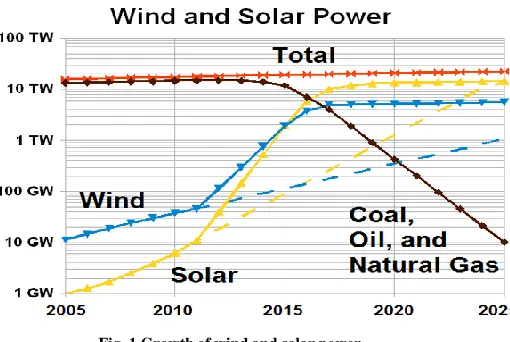
Fig. 1 Growth of wind and solar power
II. INTRODUCTION OF ZOMEWORK MODEL
International Journal of Emerging Technology and Advanced Engineering
Website: www.ijetae.com (ISSN 2250-2459,ISO 9001:2008 Certified Journal, Volume 5, Issue 1, January 2015)
[image:2.612.54.283.135.287.2]139 Fig. 2 Universal Zomework model
2.1 Solar Trackers- Facing the Sun:
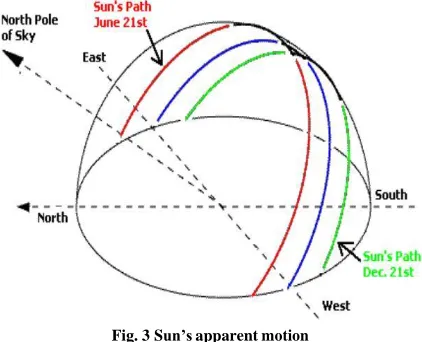
Tracking systems that adjust the position of PV modules to follow the sun can boost yields from solar installations by 40% or more. Solar panels are usually set up to be in full direct sunshine at the middle of the day facing South in the Northern Hemisphere, or North in the Southern Hemisphere. Thus, morning and evening sunlight hits the panels at an acute angle reducing the total amount of electricity which can be generated each day.
Fig. 3 Sun’s apparent motion
Usually there are two basic types of solar tracker system.
1. Single-axis trackers simply rotate about one axis, azimuthally moving from east to west over the course of a day.
2. Double-axis trackers rotate both east to west and zenithally (vertically).
2.2 Methods of Drive:
Active Trackers: Active Trackers use motors and gear trains to direct the tracker as commanded by a controller responding to the solar direction. The Light-sensing trackers typically have two photo sensors, such as photodiodes, configured differentially so that they output a null when receiving the same light flux. Mechanically, tracker should be Omni directional (i.e. flat) and are aimed 90 degrees apart which will cause the steepest part of their cosine transfer functions to balance at the steepest part and thus translates into maximum sensitivity.
Passive Trackers: Passive s o l a r Trackers use a low boiling point compressed gas fluid that is driven to one side or the other (by solar heat creating gas pressure) to cause the tracker to move in response to an imbalance.
Chronological Tracker: Chronological s o l a r Tracker counteracts the earth's rotation by turning at an equal rate as the earth, but in the opposite direction. Actually the rates aren't quite equal as the earth goes around the sun. so the position of the sun changes with respect to the earth by 360° every year or 365.24 days. A solar tracker is a device onto which solar panels are fitted which tracks the motion of the sun across the sky ensuring that the maximum amount of sunlight strikes the panels throughout the day. Most solar panels are around 11-15% efficient. The efficiency rating measures what percentage of sunlight hitting a panel gets turned into electricity that you can use[20].
2.2 Factors that affect solar array efficiency include
1. Panel Orientation: In the U.S., your roof ideally should face south, but a quality design can often compensate for other directions[17].
2. Roof and Panel Pitch: The “pitch” or tilt of roof can affect the number of hours of sunlight you receive in an average day throughout the year. Large commercial systems have solar tracking systems that automatically follow the sun’s tilt through the day[17].
3. Temperature: Some panels like it hot but most don’t. So, panels typically need to be installed a few inches above the roof with enough air flow to cool them down. Some photovoltaic panels are designed to be more efficient in hotter climates[17].
[image:2.612.63.274.419.590.2]International Journal of Emerging Technology and Advanced Engineering
Website: www.ijetae.com (ISSN 2250-2459,ISO 9001:2008 Certified Journal, Volume 5, Issue 1, January 2015)
140
Before design a system for home, conduct a detailed shading analysis of roof to reveal its patterns of shade and sunlight throughout the year. This is just one of many reasons to work with a highly experienced solar provider like One Block off the Grid.[17.
2.3 Solar Cell Efficiency Factors
1. Maximum power point: A solar cell may operate over a wide range of voltages (V) and currents (I). By increasing the resistive load (voltage) in the cell from zero (indicating a short circuit) to infinitely high values (indicating an open circuit) one can determine the maximum power point (the maximum output electrical power Pm = Vmax * Imax , in watts).
2. Energy conversion efficiency: A solar cell's energy conversion efficiency (η, "eta"), is the percentage of power converted (from absorbed light to electrical energy) and collected, when a solar cell is connected to an electrical circuit. This term is calculated using the ratio of Pm, divided by the input light irradiance under "standard" test conditions (E, in W/m2) and the surface area of the solar cell (Ac in m²)[18].
3. Peak Watt: Solar cell output power depends on multiple
factors, such as the sun's incidence angle, for comparison purposes between different cells and panels, the peak watt (Wp) is used. kW(p) is a measure of the maximum (or peak) power you PV installation can produce when the sun is brightest. It is called the “kilowatt peak rating”.
III. DESIGN AND WORKING OF PASSIVE SOLAR TRACKER
[image:3.612.326.581.491.668.2]3.1 Design of Passive Solar Tracker:
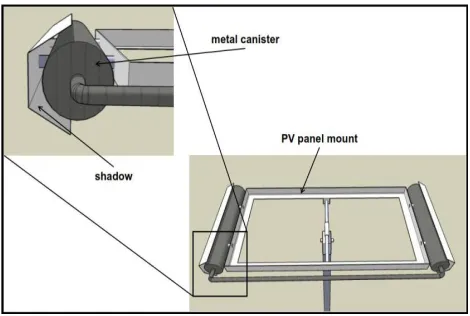
Fig. 4 Design of Solar Tracker
Here two metal canisters are being fixed on both sides of the PV panel mount. Both the canisters are kept connected to each other by a metal pipe. A shadow is being fixed on both the canisters in such a way that they cover the outer half portion of canisters. Such complete system is being fixed on a vertical pole in such a way that the panel can be easily rotated for tracking the sun’s direction. Finally volatile liquids are being filled in these canisters at high pressure.
Different Parts of Model:
1. Shadow bar:The shadow bars are adjustable, and in the
winter mode the shadow bars point inwardly so that the near canister is shaded more than the far canister when the rays of the sun are not normal to the frame.In the summer mode, the shadow bars are adjusted to point outwardly so that the near canister is exposed to the sun and the far canister is shaded from the sun when the sun is not directly overhead.
2. Cylinders or canister: Generally cylinders are made from stainless steel also cylinders are coated with black color for getting best heat transfer. These two cylinders connected with pipe. Cylinders are filled with volatile liquid, and due to temperature changes a pressure difference exist.
3. Bearing: Bearing is a type of rolling-element that uses balls to maintain separation between the bearing races. The purpose of bearing is to reduce rotational friction and support radial and axial loads.
3.2 Dimension of model:
[image:3.612.51.286.545.703.2]International Journal of Emerging Technology and Advanced Engineering
Website: www.ijetae.com (ISSN 2250-2459,ISO 9001:2008 Certified Journal, Volume 5, Issue 1, January 2015)
[image:4.612.55.366.129.720.2] [image:4.612.48.298.130.473.2]141 Fig 5. Frame
Fig 6. Shafting and Bearings
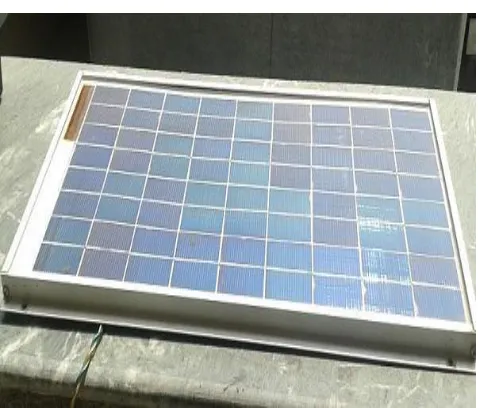
Fig 7. Solar Panel
3.3 Working of the Model:
a. This model begins with the day facing west. As the sun rises in the east, it heats the unshaded west-side canister, forcing liquid into the shaded east-side canister. As liquid moves through a copper tube to the east-side canister, the tracker rotates so that it faces east[19].
b.The heating of the liquid is controlled by the
aluminum shadow plates. When one canister is exposed to the sun more than the other, its vapor pressure increases, and forcing liquid to the cooler, shaded side. The shifting weight of the liquid causes the rack to rotate until the canisters are equally shaded[19].
c. As the sun moves, the rack follows (at approximately 15 degrees per hour), continually seeking equilibrium as liquid moves from one side of the tracker to the other[19].
d.The rack completes its daily cycle facing west. It remains in this position overnight until it is "awakened" by the rising sun the following morning[19].
[image:4.612.324.587.320.581.2] [image:4.612.49.288.486.690.2]International Journal of Emerging Technology and Advanced Engineering
Website: www.ijetae.com (ISSN 2250-2459,ISO 9001:2008 Certified Journal, Volume 5, Issue 1, January 2015)
142
[image:5.612.64.513.117.725.2]IV. VOLATILE LIQUID TESTS
Table 1
Properties Of Tested Liquids
Properties
Volatile liquid ThinnerMethano
l
Acetone
Chemical formulae CH2Cl2 CH3OH (CH3)2OH
Boiling point (°C) 4
0
64.6 56.2
Vapor pressure (mm Hg) 300 96 181.72
Density (g cm-3) 1.325 0.271 0.784
Molar weight (g mol-1) 84.94 32.04 58.08
[image:5.612.325.573.127.687.2]Specific gravity(At 25°C) 1.315 0.791 0.788
Table 2
Average Orientation of above Liquids
TIME
ORIENTATION
SUNTRACKER
THINNE R
METHANO L
ACETON E
9:30:00 AM -38 -16 -14 -15
9:45:00 AM -34 -14 -13 -13
10:00:00 AM -30 -12 -13 -12
10:15:00 AM -26 -11 -12 -10
10:30:00 AM -23 -9 -12 -8
10:45:00 AM -19 -7 -11 -7
11:00:00 AM -15 -5 -9 -6
11:15:00 AM -11 -4 -8 -4
11:30:00 AM -8 -3 -7 -3
11:45:00 AM -4 -2 -6 -2
12:00:00 PM 0 4 -4 -1
12:15:00 PM 4 5 -1 0
12:30:00 PM 8 7 0 1
12:45:00 PM 11 8 2 3
1:00:00 PM 15 11 4 6
1:15:00 PM 19 12 5 9
1:30:00 PM 23 14 7 12
1:45:00 PM 26 17 9 14
2:00:00 PM 30 20 10 16
2:15:00 PM 34 22 11 18
2:30:00 PM 38 25 12 20
2:45:00 PM 41 28 14 22
3:00:00 PM 45 30 15 24
3:15:00 PM 49 31 18 25
3:30:00 PM 53 32 19 26
3:45:00 PM 56 34 20 28
4:00:00 PM 60 35 23 30
4:15:00 PM 64 36 24 30
4:30:00 PM 68 36 25 32
4:45:00 PM 71 36 26 33
5:00:00 PM 75 36 26 34
5:15:00 PM 79
5:30:00 PM 83
5:45:00 PM 86
6:00:00 PM 90
6:15:00 PM 94
6:30:00 PM 98 19 22 23
6:45:00 PM 101
7:00:00 PM 105
7:15:00 PM 109
[image:5.612.52.286.137.741.2]7:30:00 PM 113 7 19 17
International Journal of Emerging Technology and Advanced Engineering
Website: www.ijetae.com (ISSN 2250-2459,ISO 9001:2008 Certified Journal, Volume 5, Issue 1, January 2015)
[image:6.612.47.299.156.646.2]143 Table 3
Power Output With and Without Tracker
TIME
FIXED PANEL TRACKER
VOLT AGE (V) CURRE NT (mA) POW ER 1(mW ) VOLTA GE (V) CURRE NT (mA) POWER 2 (mW)
8:00 AM 8.4 0.6 9.15 1.7 15.56
9:00 AM 8.5 1.17 9.95 9.45 1.78 16.82
10:00 AM 8.6 1.25 10.75 9.7 1.99 19.30
11:00 AM 9.7 1.82 17.65 9.85 2.38 23.44
12:00 PM 9.9 2.22 21.98 10.2 2.7 27.54
1:00 PM 1
0
.
3
2.56 26.37 10.8 3.2 34.56
2:00 PM 1
0
.
5
2.97 31.19 10.7 3.05 32.64
3:00 PM 9.7 2.71 26.29 1
0
.
2
5
2.93 30.03
4:00 PM 8.6 2.5 21.50 9.8 2.63 25.77
5:00 PM 8.3 2.14 17.76 9.25 2.43 22.48
6:00 PM 8.1 1.43 11.58 8.75 1.87 16.36
Average 19.50 Average 24.05
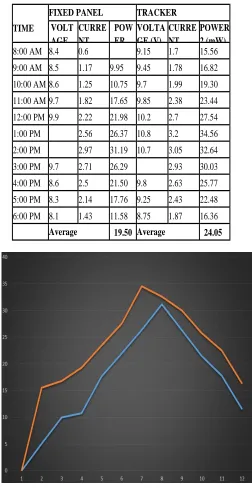
Fig 10. Comparison chart with and without tracker
The above reading is taken from the place Godhara, Gujarat, India.
Difference between output powers
= (Average power output with tracker– Average power output without tracker)
= 24.05 – 19.50
= 4.55 Mw
Hence by calculation we can get 23.33% more power by using ZOMEWORK PASSIVE SOLAR TRACKER.
V. COST CALCULATION
[image:6.612.319.568.324.606.2]5.1 Domestic Electrical Energy costing (According to current tariff of power Distribution Company in India, Gujarat):
Table 4
Domestic Electrical Energy Costing
Sr. No Equipt ments N os. Watt/ equip ment Using hours Total energy consum ption /hr. Total energy consu mptio n
1 fan 4 60 10 240 2400
2 Tube
light
4 40 7 160 1120
3 CFL
Tube light
5 20 7 100 700
4 bulb 5 15 6 75 450
5 TV 1 100 8 100 800
Total Watt 54700
Total energy consumption per day by equipment’s
= 5470 watt
= 5.47 kW
There for electrical energy used for 30 days = 30*5.47
= 164.1 kW
International Journal of Emerging Technology and Advanced Engineering
Website: www.ijetae.com (ISSN 2250-2459,ISO 9001:2008 Certified Journal, Volume 5, Issue 1, January 2015)
144
Therefore total energy cost = 164.1*6
= 985/- per month.
So, total energy cost of the year = 985*12
= 11,820/- per year.
If 500watt panel is installed with tracker: Battery consume the power 6 hours in day.
So, energy consumed in a day = 500*6
= 300 Watt
= 3 kW
So, energy consumed in a month = 3*30
= 90 kW
Therefore = 90*6
= 540/ month
So, Rs 540 saved per month by using tracker.
Yearly savings = 540*12
= 6480/ year
5.2 Costing of installing solar panel system with tracker
Table 5
Costing Of Installing Passive Solar Tracker
PARTS COST (in Rs)
Panel (500 Watt) 27,500
Battery 25000
Inverter 15000
Tracker cost 5000
Total 72,500
So, the payback period for the system = 72,500*6480
= 11.18 years
= 11 years
VI. ADVANTAGES OF ZOMEWORK PASSIVE SOLAR TRACKER
The suns heat moves liquid from side to side. This allows to gravity alone to turn the track rack to follow the sun heat therefore no motor, no gear, no controller required.
It is very easy to install.
It is very effective and significantly increase the module efficiency.
Easy to mounted on hill area and rural area.
Motors are not required so that no need of external power, hence easy to install any place.
Maintenance cost is very low compared to the active solar tracker.
VII. CONCLUSIONS
Gravity turns the tracker, using the heat from the sun to move liquid from one side to the other side, to reliably track the sun’s path from east to west. No motors, no gears and no controls to fail.
Zomework increase electrical output of photovoltaic modules by 23.33% or more compared to modules on fixed mounts. A 12-module tracking system delivers the same electric output as 15-modules mounted on fixed racks – a savings of three modules.
REFERENCES
[1] Asmara hid Ponniran1, Ammar Hashim1, Ariffuddin JoretA “Design of Low Power Single Axis Solar Tracking System regardless of Motor Speed”, International Journal of Integrated Engineering, Vol. 3 No. 3 2011.
[2] Adrian Catarius, Mario Christiner2010, “ Azimuth-Altitude Dual Axis Solar Tracker”, A Master Qualifying Project: submitted to the faculty of Worcester Polytechnic Institute.
[3] Bull, S. R., 2001, “Renewable Energy Today and Tomorrow,” IEEE Proc.89 (8), pp. 1216–1226.
[4] J. Rizk, and Y. Chaiko (2008)"Accurate analytical method for the extraction of Solar Cell Model Parameters”, University of Singapore Kent Ridge, Singapore 0511
[5] Jeff Muhs, Oak Ridge National Laboratory 2000, “Design and analysis of hybrid solar lighting and full- spectrum solar energy systems”, Oak Ridge National Laboratory, Oak Ridge, Tennessee 37831-8048, Lockheed Martin Energy Research Corp.
[6] Minor M. Arturo, García P. Alejandro 2010, “ High–Precision Solar Tracking System”, Proceedings of the World Congress on Engineering 2010 Vol II WCE 2010, June 30 July 2010, London, U.K.
International Journal of Emerging Technology and Advanced Engineering
Website: www.ijetae.com (ISSN 2250-2459,ISO 9001:2008 Certified Journal, Volume 5, Issue 1, January 2015)
145 [8] Nur Mohammad, TarequlKarim, “ Design and Implementation of
Hybrid Automatic Solar-Tracking System”, Journal of Solar Energy Engineering 2012 by ASME February 2013, Vol. 135.
[9] Okpeki U.K. otuagoma. S.O 2007, “Design and Construction of a Bi–Directional Solar Tracking System”, International Journal of Engineering and Science ISSN: 2278-4721, Vol. 2, (February2013), Pg 32-38.
[10] Rahman, S., 2003, “Green Power: What Is It and Where Can We Find It?” IEEE Power Energy Mag., 1(1), pp. 30–37.
[11] R K Rajput, Heat and Mass Transfer, S Chand & Co., 2013. [12] R S Khurmi, Refrigeration and Air Conditioning, S Chand & Co.,
2010.
[13] R K Bansal, Engineering Thermodynamics, Lakshmi Publication, 2010.
[14] www.alibaba.com [15] www.Zomework.com [16] www.solarelectric.com.
[17] http://pureenergies.com/us/how-solar-works/solar-panel-efficiency/ [18] http://wikieducator.org/Solar_cell
[19] http://svionline.org/what-we-do/projects/landscape.../solar-energy-installation/