How to cite this paper: Dibrov, N.V. (2014) Exact Formula for Shadow-Gravity, Strong Gravity. Open Access Library Journal, 1: e1076. http://dx.doi.org/10.4236/oalib.1101076
Exact Formula for Shadow-Gravity,
Strong Gravity
Nikolay V. Dibrov
Prospect Gagarina, No 175, ap. 43, Kharkov, Ukraine
Email: [email protected]
Received 21 October 2014; revised 27 November 2014; accepted 22 December 2014
Copyright © 2014 by author and OALib.
This work is licensed under the Creative Commons Attribution International License (CC BY).
http://creativecommons.org/licenses/by/4.0/
Abstract
A new more exact formula, than that recently published (Apeiron, Vol. 18, No 2 (2011)), for Sha-dow-Gravity force, for any distances between fundamental sub-particles, including very short ones when gravitation becomes strong, is developed. It is found also that, in fundamental contrast to Darwin’s conclusion, the gravitation effect is performed at the expense of elastic collisions of
fa-tions with fundamental sub-particles, and thus the well known basic objection against the shadow-
gravity (the thermal problem) becomes baseless.
Keywords
Shadow-Gravity, Strong Gravity, Exploding Electron, Hypothetical Sub-Particles
Subject Areas: Computational Physics, Modern Physics
1. Introduction
The hypothesis of the shadow-gravity was originally proposed by Nicolas Fatio Duillier in 1690. Later (1748) Georges-Louis Le Sage somewhat developed this idea. Fatio reported on his idea to the Royal Society in Lon-don, but did not publish it in his lifetime. Therefore this hypothesis is far-famed as Lesage’s theory [1] [2].
Fatio have assumed that the Space is filled with microscopic unseen particles, moving in all directions with large velocities, andweakly absorbed by bodies. Lesage had named them as ultra-mundane corpuscles. These corpuscles have been called lesagons in the work [3], in which an attempt to develop Fatio-Lesage’s idea was also made, but I named them as fations in honor of Fatio who first proposed this idea.
Fations, bombarding bodies from all sides, exert a pressure on bodies. As a consequence, both the density of the fations in areas between bodies and the pressure on bodies are reduced, resulting in attractive forces on the bodies. To be more exact, bodies are pushed towards each other.
OALibJ | DOI:10.4236/oalib.1101076 2 December 2014 | Volume 1 | e1076 gravitational effect can exist only if fations bombard bodies with non-elastic collisions. But in this case the body temperature, as a consequence of the energy absorption, must rapidly rise to a high level. In this paper I have found a radical solving this problem. A complete list of objections can be found, for example, in [5]. I have giv-en answers on most of them in my previous papers [6] [7].
I was aware, for the first time the formula for the shadow gravity force was obtained by Darwin in 1905 [8]. He considers the conjectural case when the fations impact the bodies partially elastical with some coefficient k, which is 1 for a complete inelasticity, and 2 for perfect elasticity. Darwin did not consider fations are reflected between the particlesof interacting bodies, whereas, as we will show in this paper, this feature plays the deci-sive role in the shadow-gravity. The final formula obtained by him (in result of cumbersome derivations) is ap-proximately valid only for k=1, perfect smoothness and macroscopic distances between the interacting par-ticles; it has the form
2 2 2 2 1 π 4
v a b R
ρ , (1)
where (in original denotation) ρ is a mass density of the fation gas, v is the fation velocity, a and b are radii of spherical particles of interacting bodies, R is the distance between them.
In [6] I have found a more exact formula by a method, which differs from Darwin’s one. I had used the notion about a gravitational shadow area. The formula has the form
4
1 2
π 4 c G G
r
F = ε δ
, (2)
where rc is the radius of the electron core1; δ is the factor, which has the meaning of the probability of ab-sorbing of fations by the core. The factor δ is the ratio of the part of fations absorbed by the core to the all fa-tions bombarding the core. For reasons, that we have considered in detail in [6] [7], δ has named as the asymmetry factor. I introduced also notion of energy density εG of the fation gas instead of Darwin’s
2 2
v
ρ ,
and considered impacts with perfect smoothness.
In [7] I have introduced the notion about fundamental sub-particles (FSP) from which all substance consists. I suggest considering as fundamental such sub-particles, which are absolutely impermeable for fations. Evidently FSP, to a certain extent, can be associated with known sub-leptons: preons, which are hypothetical constituents of the electron and quarks. In [7] I have found the more exact (although not enough exact) formula as
(
)
2 2( )
Gff 2
2 π
4
p r rp a G a
F k L
L
δ ε δ
−
= . (3)
where δa and δp are the asymmetry factors for active and passive FSPs, respectively, ra and rp are radii of respective FSPs, k L
( )
is the factor, which for macroscopic conditions, when Lr, is equal to 1 and for short distances it becomes very large, and gravitation becomes strong. I have taken into account also fations that reflected between the interacting FSPs.Unlike Darwin, in this paper, I consider that each fation is either absorbed or reflected randomly with some probability δ ; therefore we can consider action of elastic and inelastic blows separately and then sum obtained results.
2. The Updated Formula for the Shadow-Gravity Force
2.1. The Component of the Force from the Action of Inelastic Collisions
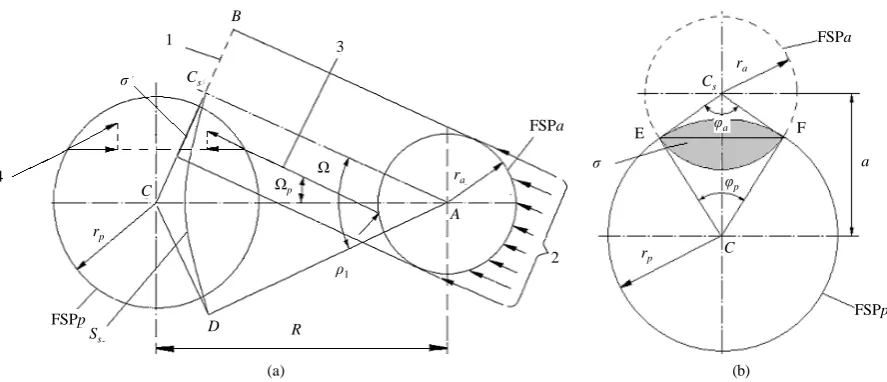
Let us consider (as I have done it in [7]) the gravitational interaction between two FSPs (Figure 1(a)) regardless of a possible electric forces acting between them. For convenience, the FSP which “creates a gravitational field” (creates the shadow from fations) will be here referred to as the active FSP (FSPa), and the FSP to which the gravitational force is attached (is shadowed from fations) will be referred to as the passive one (FSPp).
In the same manneras in [7] we consider that the gravitational force is proportional to the total area of the shadow falling on the cross-section of the passive FSP from the active one. Let us name it as Gravitational
OALibJ | DOI:10.4236/oalib.1101076 3 December 2014 | Volume 1 | e1076
[image:3.595.93.537.81.272.2](a) (b)
Figure 1.(a) Scheme for the calculation of the shadow force of gravity acting on the FSP.The passive FSPp is shadowed, from the right side, by the active FSPa from the flows of fations 2 directed within the limits of the solid angle element dΩ of the solid angle Ω (unidirectional flows having energy density εG∗). Only flows 3, reflected from FSPa, fall on the FSPp under a plane angle Ωp, from the right side. Analogous flows, 4, act on FSPp from the left side; (b) Cross-section
along BCD (on (a)). The force element is proportional, in modulo, to the area of the shadow element, σ, that falls on the cross-section BC of the passive FSPp from the active FSPa (a). C s is the shadow center; ra and rp are radii of active
and passive FSPs.
Cross-section (GCr-S). Gravitational effect is possible only if fations, at least partially, are absorbed by bodies (by FSPs in the final analysis). As Darwin noted [8], the attraction effect vanishes, when fations bombard bodies fully elastically, because fations that reflected between FSPa and FSPp, in the case of fully elastic collisions, exactly counterbalance the attraction. However, it is so only if all fations impact bodies elastically
(
δ =a 0)
. We will show in this paper that the gravitational effect is performed only at the expense of elastic collisions of fations with FSP.As we noted above, we will consider that part of fations impacts, with some probability δ in fully inelastic way and other part
(
1−δ)
impacts in fully elastic way. The effects of elastic and inelastic impacts will be con-sidered separately and then summed.In the same manneras in [7] let us consider two FSPs: passive p and active a (Figure 1(a)). The passive FSPp is shadowed, from the right, by the active FSPa from the flows of fations 2 directed within the limits of the solid angle element dΩ of the solid angle Ω (unidirectional flows having energy density εG∗). Therefore only flows 3, reflected from FSPa, come to the FSPp under the plane angle Ωp from the right side. These flows have energy density εG∗
(
1−δa)
, because FSPa absorbed a part of fations proportionally to the factor δa, therefore these flows act on the FSPp, from the right side, with the force horizontal projection of which is pro-portional to εG∗(
1−δ δa)
pcosΩp. We introduced here different subscripts p and a at δ in case where passive and active FSP have different value of asymmetry factors2. In the opposite direction (from the left side) flows 4 also act with the force proportional to ε δG∗ pcosΩp.It maybe noted that, for the inelastic collisions, a necessity to resolution of the momentum into radial and tangential components is fall away.
In addition, we must take into account the fact that not all fations, which arrive from the left side, come to FSPa and then, being reflected from FSPa, come to FSPp from the right side, inasmuch as the FSPp screens some part of them, therefore it is necessary to introduce a coefficient 1−k R
( )
∗ for the fations that come to FSPp from the right side. We denote R∗=R rp, where R is the distance between FSPs, and rp is the radius of FSPp. Thus, resultant element of the force, which acts on FSPp in direction to FSPa, is proportional toB
Cs
1 3
FSPa
FSPp Ss 4
2
σ
C
rp
ρ1
R D
Ω Ωp
ra
A
Cs
FSPa
FSPp σ
C ra
a
rp
φp
φa
E F
2In principle, it is possible a case when 0
p
OALibJ | DOI:10.4236/oalib.1101076 4 December 2014 | Volume 1 | e1076
(
)
( )
{
}
( )
11 1 cos d 1 1 cos d
G p p a p G a p p
a
k R k R
ε δ δ δ σ ε δ δ σ
δ
∗ − − − ∗ Ω Ω = ∗ + ∗ − Ω Ω
, (4)
where coefficient k R
( )
∗ has a sense of the probability of screening of the fation flow by FSPp. This geometric probability can be found as( )
sf s
k R∗ = Ω
Ω + Ω , (5)
where Ωf is the solid angle within limit of which fations freely come to FSPa and then, being reflected from FSPa, come to FSPp from the right side, and Ωs is the solid angle screened by FSPp. The vertexof all these angles is in the center A of active FSPa (Figure 1(a)). Figuratively speaking, Ωs is the solid angle under which FSPp is seen from the centre A. It is equal to [7]
2
2 1
2π 1 1
rp p
s
S r
R
ρ
Ω = = − −
, (6)
where Srp is the area of the spherical surface having radius ρ1. After substituting (6) in (5) we obtain
( )
1 1 rp 2k R
R
∗ = − −
. (7)
In doing so, we put Ω + Ω ≈f s 2π regardless of the difference in radii of FSPs. Although the value (7) is approximate, but according to our calculations it is very slightly differs from the exact one, therefore we do not give exact calculations here because they, in addition, are extremely cumbersome.
As was noted above, gravitational effect is proportional to the shadow, which comes to the passive FSPp from the active FSPa with taking into account above features connected with fations reflected from the FSPa. Actions of all other fations, that bombard the FSPp from right and left sides, counterbalance each other.
Thus, the cross-section element
σ
(in Figure 1(b) it is shaded), is shadowed from the fations directed with-in the limits of the element dΩ of the solid angle Ω. Total area of the shadow is equal to sum of the elementsσ
, when the center Cs of the shadow (Figure 1(a)) circumscribes the circle with radius cosa Ωp and theplane angle Ωp goes through the values from 0 (when a=0) to Ωpmax, when a= +ra rp. In doing so, the solid angle Ω goes through the values from 0 to Ωmax. Thus, the force acting on the total shadow area in the direction to FSPa can be obtain, considering (4), as
(
)
maxGff G a p , a 0 cos pd
F =ε δ δ∗ k R∗ δ
∫
Ω σ Ω Ω, (8) where we denoted(
)
( )
1, a 1 1
a
k R δ k R
δ
∗ = + ∗ −
, (9)
where k R
( )
∗ is given by (7). Next from Figure 1(b) we find(
)
(
)
sin 2 sin 2
p p a a
EF=r ϕ =r ϕ . (10) The cross-section element of the shadow
σ
can be found as the sum of areas of segments:( ) (
2)
( )
2(
)
1 2 sin and 1 2 sin
a ra a a p rp p p
σ = ϕ − ϕ σ = ϕ − ϕ (11)
Whence, taking into account (10), we obtain [7]
(
)
( )
2 2
2 2 2
1
sin 2 arcsin sin sin 1 sin
2 2 2 2 2
p a a a p
a p a a a a a a a
r r
f
ϕ ϕ ϕ
σ σ= +σ = γ ϕ − ϕ + γ −γ −γ = ϕ
OALibJ | DOI:10.4236/oalib.1101076 5 December 2014 | Volume 1 | e1076 where and further γa=r ra p, r p and ra are radii of the FSPp and FSPa respectively, ra≤rp. The expres-sion in curly brackets is denoted by f1
( )
ϕa . It will be used further.The solid angle Ω is equal to ratio of the spherical segment area, Ss, to 2 2 2
R a
ρ = − , where R is the distance between FSPs. The segment area, Ss, is equal to
1 2π s
S = ρh, (13) where h is the height of the segment, which is equal to
(
)
(
(
)
2)
1 1 cos p 1 1 1
h=
ρ
− Ω =ρ
− − a R , (14)where
2
cos p 1 a
R
Ω = − (15)
Then substituting (14) in (13) we obtain the expression for the solid angle as
1 2 2 2
1
2π 1 1 s S a R ρ
Ω = = − −
. (16)
Differentiating this relationship with respect to a, we obtain [7]
2 2π d d cos p a a R Ω =
Ω . (17)
From simple trigonometric relations (Figure 1(b)), taking into account also (10), we obtain [7]
(
)
(
)
{
(
)
1 2(
)
}
2 2
cos 2 cos 2 1 sin 2 cos 2
p p a a a p a a a a
a=r ϕ +r ϕ =r γ −γ ϕ + ϕ =r a′, (18)
where γp =rp ra=1γa, and the expression in curly brackets is denoted by a′. By differentiating (18) with respect to ϕa, we obtain [7]
(
)
(
)
2( )
2 2 sin
d sin 2 d d
2 2 1 sin 2 2
a a a a
a a a a
a a
r r
a γ ϕ ϕ ϕ f ϕ ϕ
γ ϕ = − + = − −
, (19)
where expression in curly brackets is denoted by f2
( )
ϕa .Now, substituting (12), (17) into (8), taking into account also (18), (19), we obtain the formula for the com-ponent of the force from inelastic collisions as
(
)
2 2 inelast
Gff 2 inelast
π
, 4
p a G a p
a
r r
F k R I
R
ε δ δ
δ ∗
= , (20)
where εG =4πεG∗ is the volume energy density of omnidirectional flows of fations, and
( )
(
( )
)
1 2 inelast 2 0 2 d d 2π p a r r a a a pa f f
I a a
r
ϕ
ϕ
ϕ
−
′ −
= +
∫
. (21)We have used expressions for two limits of integrating (21). First of them is equal to 2π , 0, for the variable a
ϕ that corresponds to positions of the shadow in the limits: rp − ≤ ≤ra a rp+ra. The second limits are 0≤ ≤a rp−ra, for the variable a, and π 2
a
r
σ = have used instead of (12). The first integral is for the situation when FSPp is partially shadowed (like the waning moon) as depicted in Figure 1(b), and second for cases when the shadow from FSPa is wholly situated within the cross-section of FSPp.
[image:5.595.91.539.94.523.2]OALibJ | DOI:10.4236/oalib.1101076 6 December 2014 | Volume 1 | e1076
2.2. The Component of the Force from the Action of Elastic Collisions
Flows of fations falling onto FSPp from the left side and taking part only in elastic collisions have energy den-sity
(
1 δ εp)
G∗
− , and those coming from the right side after their reflecting from FSPa have energy density
(
1−δp)
(
1−δa)
1−k R( )
∗ εG∗, where(
1−δa)
is the factor considering the absorption of fations by FSPa, and( )
k R∗ is the given by (7) factor considering the part of fations shadowed by FSPp.
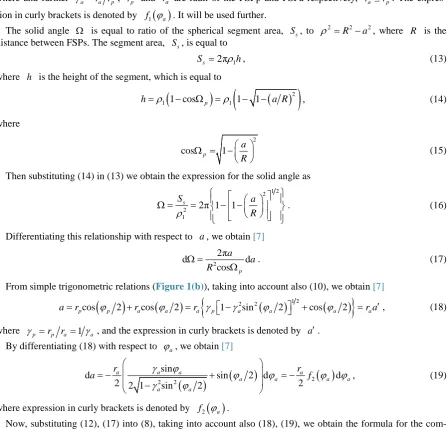
In this case we must resolve the momentum vector on radial and tangential components, but take into account only the radial component, because the tangential component is removed by the reflected fations (Figure 2(a)). We assume that the collisions are perfectly smooth.
Thus, the horizontal projection of the force element dFleft acting on the surface element of FSPp ds from the left side is equal to
(
)
2(
)
left
dF =2εG∗ 1−δp cos Ω +p α cos d dα Ω s. (22) The analogous element acts from the right side
(
)
(
)
( )
2(
)
right
dF =2εG∗ 1−δp 1−δa 1−k R∗ cos Ω +p α cos d dα Ω s, (23)
where, in (22) and (23), we have taken into account only elastic collisions. The resultant force element is
(
)
( )
(
)
left right
1
d d d 2 G 1 p a 1 1 pcos p cos d d
a
F F F ε δ δ k R ρϕ α α x
δ
∗ ∗
= − = − + − Ω + Ω
, (24)
where we have taken into account that ds=ρϕpdx cos
(
Ω +p α)
, where ρϕpdx is an arcwise shadow ele-ment (Figure 2(b)) and ρ =CF=abs x( )
, dΩ is given by (16).Thus, the total formula for the gravitation force from elastic collisions will be found as
max 1
1
elast
Gff d 1 0 d 2
p a
a a
r a r
a r a r
F =
∫ ∫
ΩΩ − F +∫ ∫
Ω −+ F , (25)where Ω1 corresponds to the coordinate a1=rp−ra, and Ωmax to the coordinate amax = +ra rp (Figure 2(b)); the first double integral and the element of force dF1 correspond to situation when FSPp is partially shadowed as depicted in Figure 2(b), and the second double integral and dF2 are for cases when the shadow from FSPa is wholly situated within the cross-section of FSPp.
Next, using relations (17) (24), and (25), let us take outside of integrals the constant parameters and go over to non-dimensional quantities, using relations: sin
(
p)
p x
x r
α ∗
Ω + = = ; a rp =a∗; ρ rp =ρ∗;
2 cosα xsin p cos p 1 x
∗ ∗
= Ω + Ω − , γa=r ra p. In result we obtain the total formula for the elastic part of colli-sions as
(
)
(
)
2 2 elast
Gff 2 elast
π 1
, 4
a p G p a
a
r r
F k R I
R
ε δ δ
δ ∗ −
= , (26)
where
2
1 2
1 1 1
1 2
elast 1 2 1 1 0 2 2 2
4 4
d d d d
π π
a a a
a a a
a
a a
a a
a a
I γ a γ a γ
γ γ γ σ γ γ σ
∗
∗ ∗
∗ ∗
+ ∗ ∗ − ∗ + ∗
− − −
=
∫
∫
+∫
∫
, (27)where
(
2 2)
1 1 1 1 1 1 1 1
dσ∗ =ϕ ρp ∗ x∗ 1−x∗ tgΩ + −p 1 x∗ dx∗; (28)
(
2 2)
2 2 2 2 2 2 2 2
OALibJ | DOI:10.4236/oalib.1101076 7 December 2014 | Volume 1 | e1076
[image:7.595.91.535.85.274.2](a) (b)
Figure 2.(a) Scheme for calculation of the shadow-gravity force acting on the FSPp from the action of elastic collision. The passive FSPp is shadowed, from the right side, by the active FSPa from the flows of fations 2 directed within the limits of the solid angle element dΩ of the solid angle Ω (unidirectional flows having energy density εG∗). Only the flows 3, re-flected from FSPa, fall on the FSPp under a plane angle Ωp from the right side. Analogous flows 4 act from the left side.
The difference of the force elements dFleft and dFright created by these flows pushes FSPp to FSPa. (b) Cross-section on BCD (a). The force element is proportional, in modulo, to the area of the shadow element, dl x, that falls on the cross-sec- tion BC of the passive FSPp from the active FSPa (a); C s is the shadow center; ra and rp are radii of active and passive
FSPs.
where k R
(
∗,δa)
is given by (9). Proceeding from trivial relations(
)
(
)
(
)
(
)
sin 2 sin 2 ; cos 2 cos 2
p p a a a a p
r ϕ =r ϕ a=r ϕ +ρ ϕ (30)
We obtain, for γa =r ra p ≤0.5,
2 2 2
1 arccos 2 a p a r a ρ ϕ ρ + −
= (31)
And, for γa =r ra p >0.5,
2 2 2
2 arccos 2 a p r a a ρ ϕ ρ − −
= . (32)
In so doing if x1∗<0, then ϕp=0, in order to avoid of a double summation, and also if ρ1∗< −γ a1∗, we put 2π
p
ϕ = , and arcs become rings.
The total force equal to the sum of elastic (26) and inelastic (20) components as
(
)
(
)
2 2 total elast inelast
Gff Gff Gff 2 elast elast inelast
π
, 4
G a p a
a p p
r r
F F F k R I I I
R
ε δ
δ δ δ
∗
= + = − + , (33)
where, since 41
~ 10 1
p
δ − [7], the expression in the brackets equals elast
I , and therefore the total force is performed only at the expense of elastic collisions of fations with FSP in contrast of given above Darwin’s con-clusion!
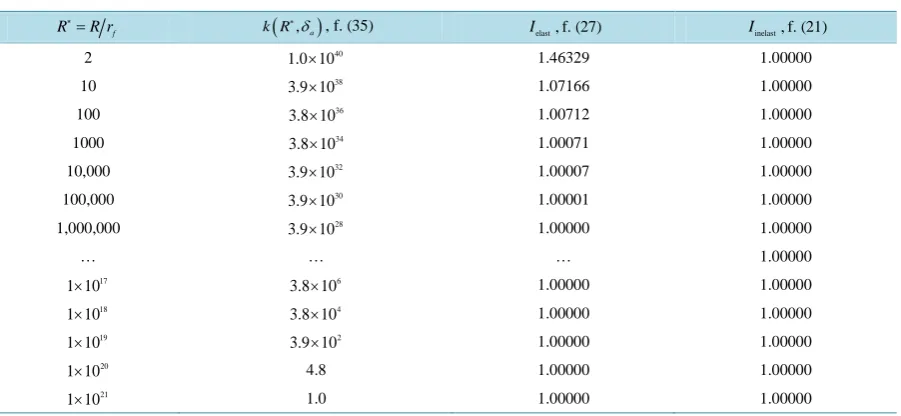
In Table 1
,
it is seen that for macroscopic conditions, R∗=R rf >100, 000, Ielast =Iinelast =1, therefore ex-pression in the brackets of (33) also equal to 1. Thus the final formula, for R∗=R rf >100, 000, takes the form(
)
2 2 total Gff 2 π , 4G a p a
a
r r
F k R
R
ε δ
δ ∗
= . (34)
OALibJ | DOI:10.4236/oalib.1101076 8 December 2014 | Volume 1 | e1076
Table 1. Results of calculations by (21), (27) and (35) for 41 1.3 10
a p
δ =δ = × − .
f
R∗=R r k R
(
,δa)
∗ , f. (35)
elast
I ,f. (27) Iinelast,f. (21)
2 1.0 10× 40 1.46329 1.00000
10 3.9 10× 38 1.07166 1.00000
100 3.8 10× 36 1.00712 1.00000
1000 34
3.8 10× 1.00071 1.00000
10,000 3.9 10× 32 1.00007 1.00000
100,000 3.9 10× 30 1.00001 1.00000
1,000,000 28
3.9 10× 1.00000 1.00000
… … … 1.00000
17
1 10× 3.8 10× 6 1.00000 1.00000
18
1 10× 4
3.8 10× 1.00000 1.00000
19
1 10× 2
3.9 10× 1.00000 1.00000
20
1 10× 4.8 1.00000 1.00000
21
1 10× 1.0 1.00000 1.00000
For distances R∗=R rf >100, 000 it is necessary to add multiplier Ielast calculated by (27) taking into ac-count (28…32).
Since, accordance with [7] δa 1.3 10 41 −
= × and, 1δa1, we may omit 1 in (9) and, taking into account also (7), finally to write
(
)
(
)
2, a 1 1 1 f a
k R∗ δ = + − − r R δ
. (35)
In Table 1, it is given results of calculations of the integrals Ielast, Iinelast and coefficient k R
(
∗,δa)
. The calculations were performed by the numerical method (by Simpson’s formula) with the relative precision( )
(
Iekast ekast i −Iekast 1i−)
I i <0.00001, where i is number of the calculation cycle.Of course, results of the above numerical calculations are strongly depend from the numerical value of δa, which evidently has a smaller value, because the value δa 1.3 1041
−
= × had been found very approximately in [7].
3. Strong Gravitation
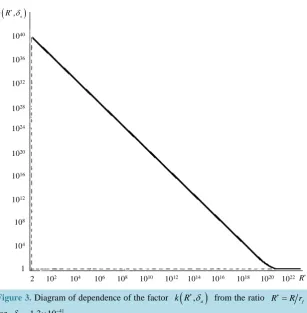
As is seen from the table and Figure 3, when R∗→ ∞ coefficient k R
(
∗,δa)
→1. Practically when R∗=1021 we can consider this coefficient is equal to 1, but at short distances it has a very large value, and thus gravitation becomes strong. On the shortest distance R∗=2 it is comparable to electromagnetic and nuclear forces. Un-fortunately, we do not have reliable data on the size of the fundamental sub-particle, rf Evidently, it is less of Planck’s length, ~10−35 m.The claimed in literature notion about a strong gravitation “constant”, evidently, is not valid, inasmuch as actually the factor k R
(
∗,δa)
is function of distance R. The production of the maximal value of(
,)
~ 1040a
k R∗ δ on Newton’s gravitation constant, G, i.e.
(
,)
6.67 1011 1040 ~ 1030a
Gk R∗ δ = × − × m3∙kg−1∙c−2, is comparable to nu-merical values of the “strong gravitational constants” given, for example, in [9] 3.9 × 1031 dyne∙c2∙g−2 - 1028 m3∙kg−1∙c−2 and in [10] 1038 G - 1028 m3∙kg−1∙c−2 which had been found by another methods.
Thus, Newton’s improved formula for the force of gravity can be represented as follows:
(
)
21 2
2 1 1 1 f a
m m G
F r R
R δ
= + − −
, (36)
where rf and δa are new constants, which must be found theoretically and experimentally.
OALibJ | DOI:10.4236/oalib.1101076 9 December 2014 | Volume 1 | e1076
Figure 3.Diagram of dependence of the factor k R
(
∗,δa)
from the ratio R R rf ∗=for 41
1.3 10
a
δ = × −
.
4. Conclusions
An improved self-consistent model of the shadow-gravity has been developed and the exact formula for the shadow gravity force, for any including short distances, was derived. The obtained new formula for shadow- gravity force can be important for the particle physics theory and for unification of the strong, electrical and gravitation forces.
An important consequence of the derived exact formula here is the fact that the well known basic objection against the shadow-gravity (thermal problem) loses grounds. Poincaré have deduced, on Darwin’s conclusion, that temperature of the Earth must be increase at 1026 degrees per second in result of absorption of fations. However this is so if the gravitation force is created only by inelastic collisions fations with body matter, as until now it was thought on Darwin’s conclusion. Point is that Darwin does not take into account the flows of fations 3 (Figure 1(a) and Figure 2(a)) which are reflected from the active FSP (FSPa) and then come to the passive FSP (FSPp) from the right side. Having in mind this fact, as well as having considered elastic and inelastic colli-sions separately, I have shown that the gravitational force is created only at the expense of the action of elastic collisions, inasmuch as the inelastic part is counterbalanced by the negative term of the elastic one. Inelastic part of the force is considerably smaller than that of elastic. Indeed, from (20) and (33) it follows that the inelastic component makes up only FGffinelast FGfftotal=δp~ 10−42 part of the whole force and, therefore, bombarding the body fations. Thus, Poincaré’s estimation must be corrected as 1026×10−42=10−16 degrees per second. During the existence of the Earth (~1017 seconds), its temperature must be increased, in result of the fation absorption, regardless of other well known factors, only to 10degrees, thereby the objection loses grounds.
The new improved factor k R
(
∗,δa)
for the strong gravity force is derived. Gravity force becomes strong beginning from the relative distance R∗ =R rf =1020 and reaches ~ 1040FGff∞ at the distance R∗=R rf =2 between FSPs, where FGff∞ is the gravitation force for macroscopic conditions: practically at R∗ =R rf ≥1020, when the factor k R(
∗,δa)
becomes equal to 1.0. Thus, at the distance R∗=R rf =2 gravitation forcebe-1040
1036
1032
1028
1024
1020
1016
1012
108
104
1
(
, a)
k R∗δ
OALibJ | DOI:10.4236/oalib.1101076 10 December 2014 | Volume 1 | e1076 comes comparable to the electric and nuclear forces.
In the paper, the new important notion about fundamental sub-particles (FSP), from which all substances consist, is used. I suggest considering such sub-particles as fundamental, which are absolutely impermeable for fations.
Inasmuch as FSPs are in the sub-electron and sub-quark levels, their experimental detection presents a big problem.
It is possible, that the idea of shadow-gravity is confirmed by Podkletnov’s experiments [11] subject to my interpretation of his results [12]. Unfortunately, it should be noted that no one can reproduce Podkletnov’s ex-periment until now.
Finally, I would like to notice that, although we have made some arbitrary assumptions throughout the paper, these assumptions are justified out by the self-consistent model of the shadow-gravity and by important corolla-ries of the model.
References
[1] Edwards, M.R., Ed. (2002) Pushing Gravity: New Perspectives on Le Sage’s Theory of Gravitation. C. Roy Keys, Montreal, 320.
[2] Le Sage’s Theory of Gravitation. http://en.wikipedia.org/wiki/Le_Sage's_theory_of_gravitation
[3] Demidenko, V. (1979) Ether—Zigzags of the Way. Tehnika Molodegy, No. 5, 25-29. (In Russian)
[4] Poincaré, H. (1908) La Dinamique de l’électron. Revue générale des sciences pures et appliquées, 19, 386-402.
[5] Markus Hanke (2012) Why Push Gravity Does Not Work. The Science Forum.
[6] Dibrov, N. (2003) On Working out a New Model of the Electron. Physics Essays, 16, 4-25.
[7] Dibrov, N. (2011) Unified Model of Shadow-Gravity and the Exploding Electron. Apeiron, 18, 43-83.
[8] Darwin, G.H. (1905) The Analogy between Lesage’s Theory of Gravitation and the Repulsion of Light. Proceedings of the Royal Society of LondonSeries A, 76, 387-410.
[9] Tennakone, K. (1974) Electron, Muon, Proton, and Strong Gravity. Physical Review D, 10, 1722-1725.
http://dx.doi.org/10.1103/PhysRevD.10.1722
[10] Sivaram, C. and Sinha, K.P. (1976) On the Field Equations of the Tensor-Scalar Theory of Finite-Range Strong Grav-ity. Progress of Theoretical Physics, 55, 1288-1297.
[11] Podkletnov, E. (1997) Weak Gravitation Shielding Properties of Composite Bulk YBa2Cu3O7-x Superconductor be-low 70 K under e. m. Field. arXiv: cond-mat/9701074 v3 16, 23.