© 2018, IRJET | Impact Factor value: 6.171 | ISO 9001:2008 Certified Journal | Page 3628
SEISMIC ANALYSIS OF MULTISTORYED RCC AND COMPOSITE BUILDING
SUBJECTED TO VERTICAL IRREGULARITY
Vishwanatha S N
1, D S Sandeep kumar
21
Vishwanatha S N, PG Student, Department of civil engineering, PESCE Mandya, Karnataka, india
2
D S Sandeep Kumar, Assistant professor Department of civil engineering PESCE Mandya, Karnatka, India
---***---Abstract
- Many buildings in the present scenario have irregular configurations both in plan and elevation. This in future may subjected to devasting earthquakes. In case, it is necessary to identify the performance of the structures to withstand against disaster for both new and existing one. Structures experience lateral deflections under earthquake loads. Magnitude of these lateral deflections is related to many variables such as structural system, mass of the structure and mechanical properties of the structural materials. Reinforced concrete and steel construction is extensively preferred over the whole world. But the use of composite construction is of particular interest, due to its significant potential in improving the seismic performance of structure. Steel concrete composite construction is built in place of RCC structures to get maximum benefit of steel and concrete and to produce efficient and economic structure. Composite construction combines the better properties of both steel and concrete along with speedy construction, fire resistance, high durability and superior seismic performance characteristics. In this study comparison of composite and conventional RCC structure is carried out for G+16 RCC and composite structure. The building is situated in seismic zone V. Seismic design is followed by IS 1893-2002. Modeling and analysis has been carried in ETABS software. The results are obtained of various parameters such as base shear, storey displacement, storey drift.Key Words
: RCC, composite columns, regular andvertical irregular buildings, ETABS, response spectrum analysis, base shear, storey displacement, storey drift
1. INTRODUCTION
As we know earthquakes are the unpredictable natural disasters, from which it is very difficult for saving life and engineering properties against it. We want to identify the act of the building for seismic loads to overcome these issues by the various developmental analytical procedures, from which the structures can withstand for small earthquakes and enough warning has to be produced when subjected to strong earthquakes, this may save the possible number of lives. The performance of building during an earthquake depends upon several factors, such as stiffness, mass, geometry and regular configuration.
But in modern days, with more advancement in the rapid growth of urbanization and for aesthetic purpose buildings are constructed with irregular structural configurations. These building configurations provides to irregular
distribution of strength, mass and stiffness from this it may lead to damage of the frame during earthquakes.
Irregular building configuration: The section-7 of IS-1893 (part-1) 2002 enlists the different irregularity in structural configuration system. The irregularities are categorized in to two types
(i) Plan/Horizontal irregularities (ii) Vertical irregularities
The Vertical Irregularities are as follows,
1. Soft story (stiffness discontinuity): This type of story exists when a lateral-stiffness becomes less than 70% of its above story or less than 80% of its average stiffness.
2. Weak storey (strength discontinuity): This type of story exists when the strength becomes less than 80% of its above story.
3. Vertical Geometric Irregularities: The lateral-force-resisting systems in a horizontal dimension of any storey should be greater than 150% of its adjacent storey.
4. Mass Irregularity: The mass of any floor/story is greater than 200% of the effective mass of its adjacent story. (A lighter roof mass excepted).
5. In-plane Discontinuity: A lateral-load-resisting elements which is greater than a length of their elements.
1.1 Composite Column
A column is designed to combine two different materials to form a structural member. A composite column is a member which is mainly subjected to compression. Composite construction that seeks to co-action the capabilities of two materials i.e. concrete and steel.
© 2018, IRJET | Impact Factor value: 6.171 | ISO 9001:2008 Certified Journal | Page 3629 1.1.1 Merits of composite columns
Protection against corrosion in case of concrete encased columns.
Increased stiffness which influences to reduce slenderness of column.
Higher stiffness results in less deflection, longer spans and less overall height.
Encased columns are good fire resistance.
There are some economic advantages compare to concrete and steel.
1.2 Objectives
To evaluate the comparison of RC Column and composite encased I section column.
To study the effect of vertical irregularities of building and performance of the structure.
To understand the behavior of regular and vertical irregular framed structure on the basis of shear force, storey drift and storey displacement.
To find the structural behavior of multi-storey building for different vertical irregularities of parameters like mass irregularity, stiffness irregularity and geometrical irregularity.
To understand the performance of RCC and composite structure under seismic zone V.
1.3 Scope of the study
A seismic analysis of multi-storied composite and RCC structure is carried-out for different parameters of vertical irregularities.
The installation of composite column in a construction increases strength, fire resistance and resistance towards lateral forces.
The scope of present project is explained in detail for all models to compare the analysis results including storey displacement, storey drift and base shear.
2. METHOD OF ANALYSIS
The seismic analysis of all the building frames are carried out according to IS 1893:2002 (Part 1) by response spectrum method.
2.1.1 Response Spectrum Analysis
In this method, peak response of a structure during an earthquake is obtained directly from the earthquake response spectrum. This method gives an approximate peak response, which is quite accurate for structural design. In RSM multiple modes of response of a building to an earthquake is taken into account.
3. MODELING AND ANALYSIS USING ETABS
3.1 Description of the model:
In our present study four different configurations have been chosen in which one is rectangular and remaining three are of vertical irregularities. The floor to floor height, column size, beam size, slab thickness, floor finish loads, live loads and Response-spectra data remains same for all the models.
The models consists of G+16 stories of Rectangular, mass irregularity, stiffness irregularity and geometrical irregularities are considered. For all models composite structure column of size 300x700mm (ISMB 250) and composite beam ISMB 250 without shear connector is provided and all other parameters are kept constant. The Response Spectrum analysis is made for all the buildings using a ETABS version 15.
3.2 Materials property and geometry of the model:
Layout of plan : 8 bays x 8 bays Plan dimension : 40 m x 40 m Spacing in x direction : 5 m
Spacing in Y direction : 5 m Height of each storey : 3.3 m Number of storey : G+16 Grade of concrete : M40 Grade of reinforced steel : Fe 500 Size of beam : 300 x 600 mm Size of column : 300x 700 mm Slab thickness : 150 mm Floor finish : 1 KN/m2
Live load : 3 KN/m2 (FLOOR) Live load : 1.5 KN/m2 (ROOF) Total height of building :52.8 m
Density of concrete :25 KN/m3 Composite column :300 x 700 mm
(With ISMB 250) Composite beam :ISMB 250
(Without shear connector)
Seismic parameters considered
Seismic zone : V Zone factor : (0.36) Soil type : III Importance factor : 1 Response reduction factor : 5 Damping ratio : 5%
© 2018, IRJET | Impact Factor value: 6.171 | ISO 9001:2008 Certified Journal | Page 3630 Earthquake load :X and Y direction
Diaphragm :Rigid
3.3 Modeling of structure:
[image:3.595.43.555.49.343.2]3.3.1 Regular structure:
Fig 1. Plan of a regular structure
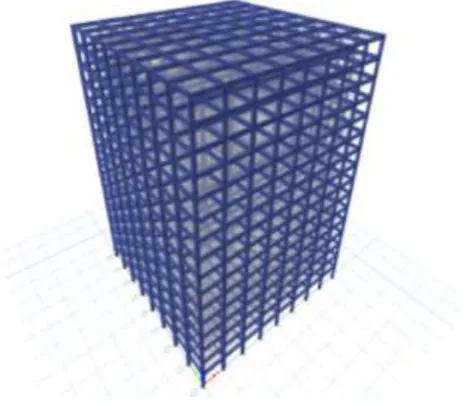
Fig 2. 3D View of regular structure
3.3.2 Mass irregular structure:
The structure is modeled as same as that of regular structure except the loading due to swimming pool is provided on the terrace floor.
Height of swimming pool considered – 1.8 m
[image:3.595.295.551.59.311.2]Loading due to swimming pool – 18 KN /m2
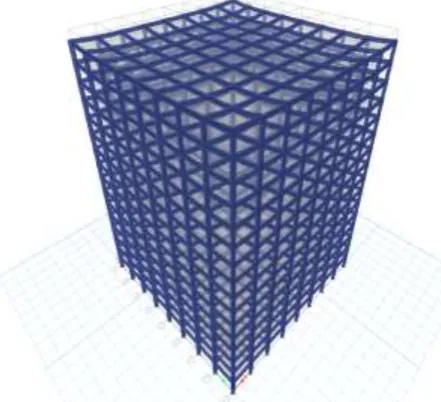
Fig 3. Mass irregular structure with swimming pool on terrace floor
3.3.3 Stiffness irregular structure:
In this irregularity, the changes made with respect to regular building are, the base story is made as soft story by increasing the height of it from the following equation,
Stiffness of each column – 12EI/L3
Therefore,
Stiffness of other floor/Stiffness of ground floor
(3.3/4.5)3 =0.39 < 0.7
[image:3.595.61.294.365.567.2]Hence as per IS 1893 Part-1 the structure is irregular
[image:3.595.334.535.533.714.2]© 2018, IRJET | Impact Factor value: 6.171 | ISO 9001:2008 Certified Journal | Page 3631 3.3.4 Vertically Geometric irregular:
The structure is 16 storyed with steps in 4th, 8’th, 12’th and
16thfloor. The setback is along Y direction.
Width of top storey :25 m
Width of bottom storey :40 m
As per IS 1893 (PART 1): 2002
Vertical geometric irregularity when L2 >1.5 L1
Where L1 – Width of top storey
L2 – Width of ground storey
[image:4.595.311.558.216.372.2]Vertically irregular 40 > 37.5
Fig 5. Vertical geometric irregular structure
Fig 6. Analysis of a structure
4
.
RESULTS AND DISCUSSION
This chapter represent the results and discussion of dynamic analysis of regular and vertical irregular building of both conventional RCC and composite structure. After analysis of the structure situated in seismic zone V using ETABS, the results are compared in terms of response parameter such as base shear, storey drift and storey displacement.
[image:4.595.108.201.318.471.2]4.1 Base shear:
Fig 6. Base shear along X – direction
[image:4.595.314.561.465.617.2]Base shear is more incase of mass irregular structure both in conventional RCC and composite structure and also conventional RCC structure have more base shear compared to composite structure.
Fig 7. Base shear along Y – direction
[image:4.595.38.259.523.724.2]© 2018, IRJET | Impact Factor value: 6.171 | ISO 9001:2008 Certified Journal | Page 3632 4.2 Displacement
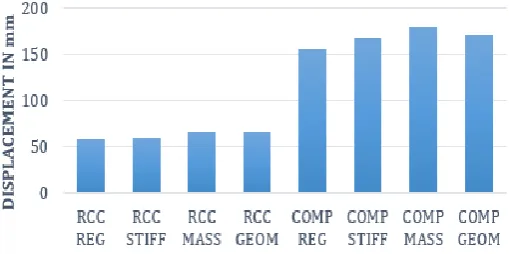
Fig 8. Storey displacement along X – direction
[image:5.595.43.292.113.246.2] [image:5.595.307.569.151.289.2]Storey displacement is maximum for composite building as compared to conventional RCC building. Mass irregular structure have more displacement compare to other irregular structure. As the vertical irregularities increases storey displacement also increases.
Fig 9. Storey displacement along Y– direction
Storey displacement is maximum for composite building as compared to conventional RCC building along Y-direction. After regular structure stiffness irregular structure undergone less displacement compare to mass and geometric irregular structure.
4.3 Drift
Fig 9. Storey drift along X– direction
[image:5.595.37.292.354.481.2]On the basis of storey drift conventional RCC building is performed well compared to composite building and also vertical irregular building have more inter storey drift compare to regular structure.
Fig 10. Storey drift along Y – direction
Storey drift is maximum along Y-direction compare to X-direction. Regular structure undergo less storey drift compare to other vertical irregular structure.
5. CONCLUSION
According to the result of RSM, the storey shear was found to be more in conventional RCC building compare to composite building because weight of RCC building is more than the composite building.
Storey shear was found to be more in mass irregular building than the regular building frames both in conventional RCC and composite building.
Storey shear in case of stiffness irregular building is less compare to regular building
Geometric irregular building has low base shear compared to regular building because setback is provided along Y direction and also dead weight of the building is low compare to regular structure both in conventional RCC and composite building.
Storey displacement is maximum for composite building as compared to RCC building both in X and Y direction. RCC building has the lowest storey displacement because of its high stiffness.
Vertical irregular building have more displacement than the regular building.
Storey drift in response spectrum analysis along X and Y direction is more for composite structure as compared to RCC structure.
© 2018, IRJET | Impact Factor value: 6.171 | ISO 9001:2008 Certified Journal | Page 3633 From overall result it can be concluded that
maximum storey drift and storey displacement will increases as the vertical irregularities increases in all the models respectively both in conventional RCC and composite structure.
6. REFERENCES
[1] D.R.Panchal and P.M Marathe “Comparative Study of
RCC ,Steel and Composite (G+30 Storey) Building”, Institute of technology , Nirma university , Ahmedabad -382481,08-10 December 2011
[2] Shashikala Koppad, Dr. S.V.Itti “Comparative Study of
RCC and Composite Multistoryed Buildings”, International Journal of Engineering and Innovative Technology (IJEIT) Volume 3, Issue 5, November 2013
[3] Nitin M. Warade and P.J. Salunke “Comparative Study of
Analysis and Design of Composite Structure”, International Journal Of Advance Research In Science And Engineering, IJARSE, Vol. No.2, Issue No.12, December, 2013
[4] Hajira Nausheen ,Dr. H. Eramma “Comparison of Seismic
Behavior of a Structure with Composite and Conventional Columns”, International Research Journal of Engineering Technology ,Volume :02 Issue :08 Nov -2015.
[5] Ravindra N. Shelke and U.S. Ansari “Seismic Analysis of
Vertically IrregularRC Building Frames”International Journal of Civil Engineering and Technology (IJCIET) Volume 8, Issue 1, January 2017
[6] Akram S Shaikh, Dr.S.H. Mahure “Analysis and Design of
Multi Storied Building Subjected to Seismic Loading Using Composite and RCC Structures”, International Journal of Innovative Research in Science, Engineering and Technology, Volume 6,Issue 2, February 2017
[7] Oman Sayyed, Suresh Singh Kushwah and Aruna Rawat,
“Seismic Analysis of Vertical Irregular RC Building with Stiffness and Setback Irregularities”, IOSR Journal of Mechanical and Civil Engineering Volume 14, Issue 1 Ver. VI (Jan. - Feb. 2017)
[8] M. Ramyakrishna and K. Sundarakumar “Analysis of
Seismic Response of A Multi-storey Building with Stiffness Irregularity”, International Journal For Technological Research In Engineering Volume 4, Issue 11, July-2017
[9] Rahul and Shivanand CG “Study Of Vertical Irregularity
of Tall RC Structure Under Lateral Load”International Research Journal of Engineering and Technology (IRJET) Volume:04, Issue:08, Aug:2017
[10] IS 1893:2002 (Part 1). “Indian Standard Criteria for
Earthquake Resistant Design of Structures”, Bureau of Indian Standards (BIS), New Delhi, India.
[11] IS: 456-2000 (Fourth Revision), “Indian standard code
for practice for plain reinforced concrete for general building construction”, Bureau of Indian Standards, New Delhi
[12] IS 11384:1985, “Code of Practice for Design of
Composite Structure”, Bureau of Indian Standards, New Delhi, India
[13] IS:800,Code of practice for design load (other than
earthquake) for buildings and structures” Bureau of Indian Standards, New Delhi,2002
[14] AISC 360-10, Specification of structural steel building,
An American national standard, American Institute of Steel Construction, Inc.,2005
BIOGRAPHIES
Vishwanatha S N
P.G Student, Department of Civil engineering, Pesce,
Mandya, Karnataka, India ,
D.S. Sandeepkumar
Assistant Professor Department of Civil Engineering Pesce Mandya.