© 2018, IRJET | Impact Factor value: 6.171 | ISO 9001:2008 Certified Journal | Page 3582
NUMERICAL STUDY OF THE CROSS-SECTIONAL SHAPE OF TUNNEL
UNDER BLAST EFFECT USING ANSYS
Josy Jose
1,Anju V
21
P G student, Department of Civil Engineering, Sree Narayana Institute of Technology, Adoor, Kerala, India,
2
Assistant Professor, Department of Civil Engineering, Sree Narayana Institute of Technology, Adoor, Kerala, India,
---***---Abstract
-This paper summarizes the dynamic responses of buried tunnel in depth of 3m for surface charge of 1500kg TNT in a surrounding sandy soil. The Kobe box shape subway tunnel was used as an example to evaluate and compare with semi ellipse, circular shape tunnels having the same area. In this paper Modeling and analysis are done by ANSYS AUTODYN softwareKey words: Dynamic response, subway tunnel
1. INTRODUCTION
Recently, the worldwide terrorism attacks are becoming intensive and more frequent. These attacks have resulted in enormous cost in loss of life, injuries, property damage and economic consequences. A blast generates ground vibration which may cause damage to surrounding structures. Subway is one of the public places that might be affected by such events. One the aspect in the protection that structures is the accurate prediction of the blast loadings on structural elements using advanced numerical tools are taking in to account. Therefore it is necessary to analyse the dynamic behaviours of underground structures subjected to surface explosion to ensure the safety of these structures.
This work is carried out with the software ANSYS AUTODYN for the dynamic response of Kobe box shaped subway tunnel in a sandy soil in depths of 3m affected by surface explosion of 1500kg TNT charge.
2. LITERATURE REVIEW
BehnamMubarak&MohammadVaghefi (2014) have
evaluated the dynamic responses of buried tunnel in depths of 3.5, 7, 10.5 and 14 m for surface detonation of 1000 kg TNT charge in a surrounding sandy soil. The Kobe box shape subway tunnel was used as an example to evaluate and compare with semi ellipse, circular and horseshoe shape tunnel. The finite element software LSDYNA has been used to model and to analyse the outcome of this project, specifically to be modelled in the area of the second interaction due to explosion. The results indicate that the circular and horseshoe tunnels are less resistant to demolition than the box shape tunnel however the semi ellipse tunnel is more resistant than the box shape tunnel.
Yubing Yang et al (2010) found the effects of possible
ground explosion on a shallow-buried metro tunnel, this paper attempts to analyse the dynamic responses of the operating metro tunnel in soft soil, using a widely applied
explicit dynamic nonlinear finite element software ANSYS/LS-DYNA. The blast induced wave propagation in the soil and the tunnel, and the von Mises effective stress and acceleration of the tunnel lining were presented, and the safety of the tunnel lining was evaluated based on the failure criterion. Besides, the parametric study of the soil was also carried out.
3. AIM& OBJECTIVE
The aim of this project is to analyse the blast effect on tunnel.
Objectives: The main objectives of the project are:
Investigation of blast phenomena and their negative effects on tunnels.
To develop FE models using software ANSYS AUTODYN
To find the best shape tunnel have the ability to resist blast.
4.
MODELING
DETAILS
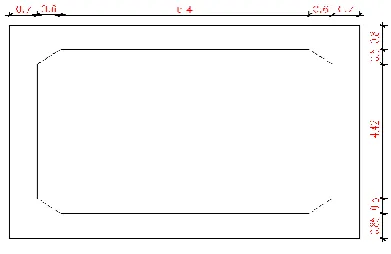
[image:1.595.339.535.615.742.2]The project of the Kobe metro is considered in this paper. The tunnel is box shape with size of 9mx7.17m.It is assumed that the entire soil layer has the same parameters as the sand for the simplicity. The tunnel is centered under the explosive charge and only a quarter of field with the size of 25 mx25 m x 30 m is modeled due to the symmetry about the YZ and YX planes. Furthermore, the transitional displacement of the nodes normal to the symmetry planes is constrained. The free boundary condition is used for upper surface(BehnamMobaraki et al., 2015).
© 2018, IRJET | Impact Factor value: 6.171 | ISO 9001:2008 Certified Journal | Page 3583 Fig 2 Circular shape
[image:2.595.332.563.121.453.2].
Fig 3 Semi ellipse shape
5. MATERIAL PROPERTIES
Table 1
Air Parameters
Reference density 0.001225g/cm³
EOS Ideal gas
Table 2TNT Parameters
Reference density 1.630000g / cm³
EOS JWL
Table 3 Sand Parameters
Reference density 2.641000g/ cm³
EOS Compaction
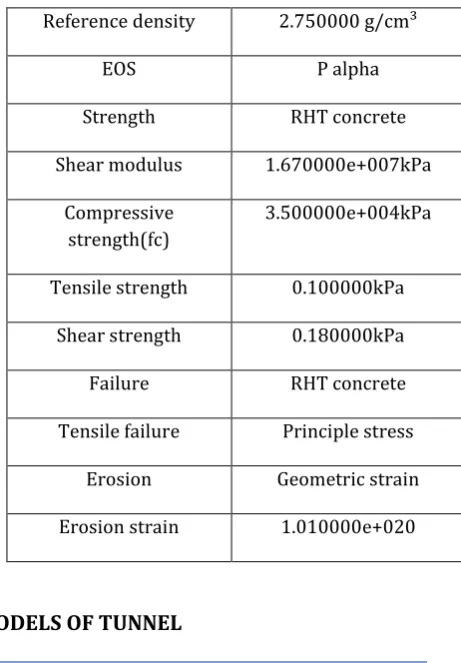
Table4 Concrete Parameters
Reference density 2.750000 g/cm³
EOS P alpha
Strength RHT concrete
Shear modulus 1.670000e+007kPa
Compressive strength(fc)
3.500000e+004kPa
Tensile strength 0.100000kPa
Shear strength 0.180000kPa
Failure RHT concrete
Tensile failure Principle stress
Erosion Geometric strain
Erosion strain 1.010000e+020
6. MODELS OF TUNNEL
Fig 4 Model of box shape tunnel
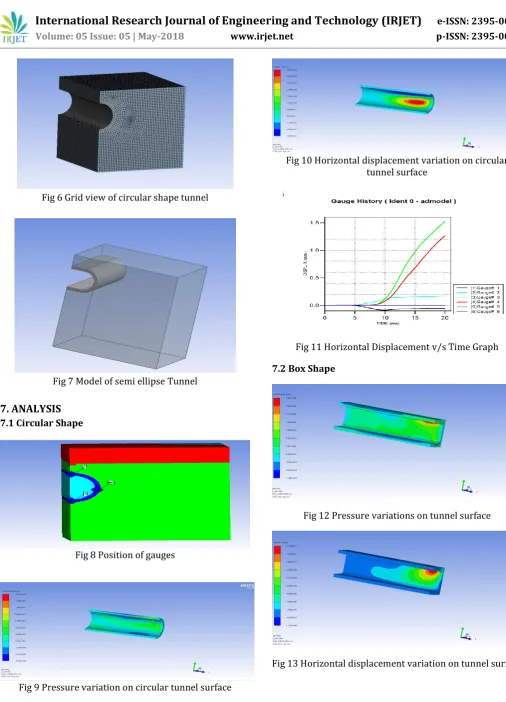
© 2018, IRJET | Impact Factor value: 6.171 | ISO 9001:2008 Certified Journal | Page 3584 Fig 6 Grid view of circular shape tunnel
Fig 7 Model of semi ellipse Tunnel
7. ANALYSIS
7.1 Circular ShapeFig 8 Position of gauges
Fig 9 Pressure variation on circular tunnel surface
Fig 10 Horizontal displacement variation on circular tunnel surface
Fig 11 Horizontal Displacement v/s Time Graph
[image:3.595.306.561.407.523.2]7.2 Box Shape
Fig 12 Pressure variations on tunnel surface
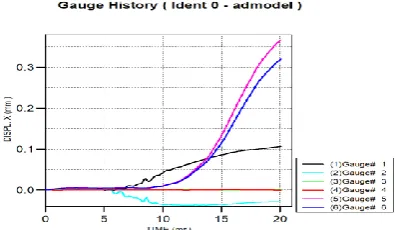
[image:3.595.308.560.551.671.2]© 2018, IRJET | Impact Factor value: 6.171 | ISO 9001:2008 Certified Journal | Page 3585 Fig 14 Horizontal Displacement v/s Time Graph
[image:4.595.80.278.89.204.2]7.3 Semi Ellipse Shape
Fig 15 Pressure Variation Tunnel Surface
Fig 16 Horizontal displacement variation on tunnel surface
Fig 17 Horizontal Displacement v/s Time Graph
[image:4.595.44.276.253.371.2]8. COMPARISON OF RESULTS
Fig 18: comparison of maximum displacement
9. CONCLUSIONS
Circular tunnels is less resistant to demolition than the box shape tunnel, however the semi ellipse tunnel is more resistant than the box shape tunnel.
Semi ellipse tunnel has the maximum length of contact with soil compared with the other three tunnels. Indeed extension the length of contact zone between soil and buried structure causes to increase the rigidity and stability of the structure. Thus, semi ellipse shape has the minimum lateral deflection as compared to box shape and circular shape tunnel.
ACKNOWLEDGEMENT
First of all I thank God Almighty for his grace without which it would not have been possible to complete my thesis work in time. My sincere thanks to all the teaching and non-teaching staff of our college and I feel proud in sharing this success with staff members, my family and friends who helped me with timely help and cooperation in successful completion of the work.
REFERENCES
[1]BehnamMobaraki& Mohammad Vaghefi “Numerical study of the depth and cross-sectional shape of tunnel undersurface explosion”, Tunnelling and Underground Space Technology 114–122 (2014)
[2]R. Prasanna“Response of tunnels due to blast loading”, Geotechnical Aspects of Underground Construction in Soft Ground (2014)
[3]Yuzhenhan “Soil-Tunnel Interaction under Medium Internal Blast Loading”, The 3rd International Conference on Transportation Geotechnics, Volume 143 Pages 403– 410(2014)
[4]Robert Bertuzzi “Back-analysing rock mass modulus from monitoring data of two tunnels in Sydney, Australia”,
0 0.2 0.4 0.6 0.8 1 1.2 1.4 1.6 1.8 CIRCULAR
[image:4.595.36.287.397.502.2] [image:4.595.49.274.542.667.2]© 2018, IRJET | Impact Factor value: 6.171 | ISO 9001:2008 Certified Journal | Page 3586 Journal of Rock Mechanics and Geotechnical Engineering,
877-891 (2017)
[5]Tabatabaei Z.S, Volz J S , Baird J, Gliha B P and Keener D. I. “Experimental and numerical analyses of long carbon fiber reinforced concrete panels exposed to blast loading”, International Journal of Impact Engineering, 57, 70-80 (2013)