© 2017, IRJET | Impact Factor value: 5.181 | ISO 9001:2008 Certified Journal | Page 3356
DIP BASED AUTOMATIC FABRIC FAULT DETECTION
Swapnil R. Kurkute
1, Pallavi S. Sonar
2, Shweta A. Shevgekar
3Dipali B. Gosavi
4123
Assistant Professor,Dept. Of E&TC, Sandip Foundation’s SIEM, Nashik, Maharashtra, India
4Student, Dept. Of Computer Science, Sillod, Maharashtra, India
---***---Abstract -
The purpose of this paper is to contribute in terms of automating the online detection of weaving defects by a computerized system based on image processing software. Obviously, fabric inspection has an importance to prevent the risk of delivering inferior quality product. Until recently the visual defect detection is still under taken offline and manually by humans with many drawbacks such as tiredness, boredom and, inattentiveness. Usually, after the produced fabric is doffed from the weaving machines, it is batched into large rolls and sent to the inspection department. A skilled stuff rolls the fabric at high speed on the inspection machine under sufficient light to identify all defects. Besides the mentioned drawbacks, the lag time exists between defect creation and detection causes more second choice fabric. The paper gives an alternative automated system to overcome the\e above drawbacks.Key Words: Fast Fourier Transform (FFT),
Cross-correlation techniques
1.INTRODUCTION
Now in today’s era to improve production rate it is necessary to have maximum automation to reduce cost of production and to improve production rate. To achieve above aims fortunately, the continuous development in computer technology introduces the online automated fabric inspection as an effective alternative. This paper represents an effective and accurate approach to automatic defect detection. It is capable of identifying all defects. Because the defect-free fabric has a periodic regular structure, the occurrence of a defect in the fabric breaks the regular structure. Therefore, the fabric defects can be detected by monitoring fabric structure. In this work, Fast Fourier Transform (FFT) and Cross-correlation techniques, i.e. linear operations, are first implemented to examine the structure regularity features of the fabric image in the frequency domain. To improve the efficiency of the technique and overcome the problem of detection errors, further thresholding operation is implemented using a level selection filter. Through this filter, the
technique is able to detect only the actual or real defects and highlight their exact dimensions. In general we can say there are two types of inspection methods. Traditional method called Visual fabric inspection and modern method called Automatic Fabric fault detection.
1.1 Visual Fabric Inspection
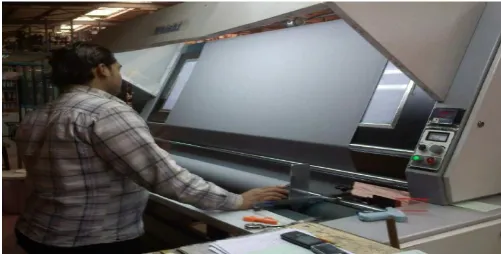
Visual Fabric inspection consists of grading the materials based on their overall texture characteristics such as material isotropy, homogeneity and coarseness or the severity of its defects. This procedure must performed by well-trained (expert) human inspectors The existing methods of fabric inspection vary from mill to mill. In few mills, trained labors pull the fabric over a table by hand. As shown in figure most mills have power driven inspection machines where the manufactured fabric rolls are removed from the weaving machines and unrolled on an inspection table (under adequate light) at a relatively higher speed of 8-20 meters per minute[8].
Fig -1: Visual fabric inspection.
1.2 Automated Fabric Inspection
[image:1.595.309.560.418.545.2]© 2017, IRJET | Impact Factor value: 5.181 | ISO 9001:2008 Certified Journal | Page 3357 designed for multiple inputs and output desperate general
purpose computers.[2]
2. LITERATURE SURVEY
Abdel Salam MALEK gives the detail idea about Online Fabric Inspection by Image Processing Technology in his thesis which was submitted in University of Haute for requirement of the degree of Doctor of Philosophy In Mechanical Engineering. In his thesis he conclude that t a doubt optimising fast Fourier transform and the principle of cross-correlation to be suitable for online automated fabric inspection, Development of a suitable procedure using a software package, Matlab and Scilab, to implement the proposed technique. Improving and describing an improved classification for the automated fabric inspection approaches. Through this improved classification, the texture analysis problem is categorised into six approaches according to the used algorithm. Development of a fabric defect map to determine the major defects which should be considered during the pre-processing step.[1]
Chi-ho Chan and Grantham Pang gives the detail idea about Fabric defect detection by Fourier analysis in his paper & conclude that The Fourier transform approach is described to detect the Structural defect. The simulated models are used to understand the behaviour of frequency spectrum. Since the three-dimensional frequency spectrum is very difficult to analyse and many defects occur along the horizontal and vertical axes, the central spatial frequency spectrum approach has been proposed to increase the efficiency of the analysis process. Seven significant characteristic parameters can be extracted from the central spatial frequency spectrums for describing the defect type. Experiments have shown that the extracted parameters can be used to classify fabric defects [12].
Xianghua Xie discuss a Review of Recent Advances in Surface Defect Detection using Texture analysis Techniques, This review of recent advances in visual inspection using image processing techniques gives us some insights into the current state-of-the-art and possible trend of this application area. Although the research on visual inspection is diverse and ever-changing, There are significant and increasing amount of work on color texture analysis, however, limited work has so far been reported in visual inspection using color texture analysis The majority of the existing methods decompose the colour image into separate channels and process them independently or with limited interactions In order to understand the formation and nature of the defects, it is important to be able to accurately localize the defective regions rather than classifying the surface as a whole. [3].
Dorrity J., Vachtsevanos G. and Jasper W gives Real-time fabric defect detection and Control in weaving
processes. They describes fabric inspection system aided by computer vision to detect and classify defects in circular knitted fabrics using different common texture-recognition methods, including co-occurrence matrices, the discrete Fourier transform, wavelets, Gabor, and clustering. The images of the fabrics were broadly classified into six classes: cracks, holes, vertical stripes, horizontal stripes, soil freckles, and defect-free. One hundred and twenty images (256 gray level and 100 dpi) containing 20 images of defect-free fabrics (rib 1x1) as well as 100 images corresponding to five different categories were used. In general, one-half of the images in each category were employed for training and the remaining images we reused for testing. Textured materials, such as woven and knitted fabrics, possess strong periodicity due to the repetition of basic weaving patterns. Therefore, spectral techniques using discrete Fourier transform (Chan and Pang, 2000; Tsai and Heish, 1999), optical Fourier transform (Hoffer et al., 1996), and windowed Fourier transform (Campbell and Murtagh, 1988) have been used to detect defects in woven fabric. Escofet et al. used the angular correlation of the Fourier spectra to evaluate the resistance of fabric web to abrasion [4].
3. SYSTEM DESIGN
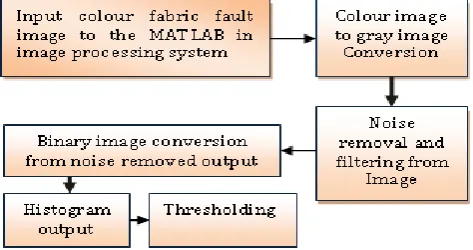
An image may be defined as a two –dimensional function, f(x, y), where x and y are spatial (plane) coordinates, and the amplitude of f at any pair coordinates (x, y) is called he intensity or gray level of the image at that point. [1][12].When x, y, and the amplitude values of f are all finite, discrete quantities; we call the image as a digital image. The Image Processing technique is a collection of functions that extend the capability of the MATLAB in numeric computing environment. The figure shows the basic flow block diagram of system working and intermediate methodology Noise removal filters are used. Filters are used to achieve desired spectral characteristics, to reject unwanted things like noise or interferers, to reduce the bit rate[4][9][14]
[image:2.595.310.547.588.713.2]© 2017, IRJET | Impact Factor value: 5.181 | ISO 9001:2008 Certified Journal | Page 3358 image, 2-D median filtering and adaptive filtering, Image
analysis and enhancement,[10] Color Image decomposition into RGB Channels, Image histogram, Image segmentation, image Multithresholding, image movie , signal plotting and etc... , Many of the toolbox functions are MATLAB M-files, Model files and a series of MATLAB statements that implement specialized image processing algorithms. Then Histogram is done for the image and finally thresholding is done for the same image using this image processing toolbox.
MATLAB is used for the implimentation of this system but SCILAB is also best alternative for MATLAb as it is open source. We can used SCILAB for the same development.[6]
3. EXPERIMENTAL SETUP
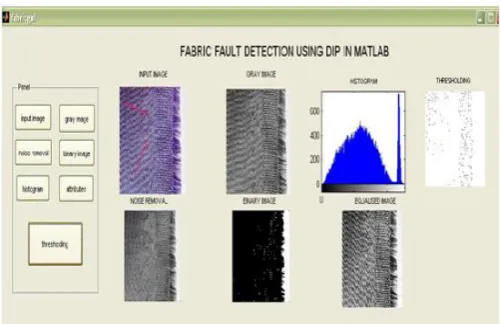
For experimental poin of view it was not possible to impliment real time model for demonstration purpose so we have implimented the system using MATLAB simulation. Using Matlab we have design the GUI which is an graphical usar interface act as human machin interface. Instade we can also develop GUI using Visual Basic. Visual Basic is a tool that allows you to develop Windows (Graphic User Interface - GUI) applications. The applications have a familiar appearance to the user.[11]
Along with VB Lab VIEW can also be used for automisation purpose. Lab VIEW is also called system design platform and development environment for a visual programming language. Lab VIEW is an interactive program development[13].
and execution system in which one creates program using graphical notation. The step by step operational working is explained bellow.
Fig -3: Graphics user interface
3.1 Fabric Fault Image As Input To The MATLAB
As discussed will provide an fault image as aninput to Matlab which will be considered to compare with actual fabric that is fault free fabric.Fig -4: Fault Image As Input To The Matlab
The defective fabric part is now processed using Matlab by the following steps. In the first step it is converted into gray image as shown in the above figure then noise removal is done. This data is used to obtain the Histogram output after thresholding is done.
Fig -5: Fault Image with it’s histogram.
This is the procedure followed for fault fabric processing using Matlab in this paper. The below program is executed in Matlab R2012a (7.14.0.739) 32 bit and the defective fabric image is obtained. Similarly the Histogram image is obtained from the image.
4. PERFORMANCE ANALYSIS
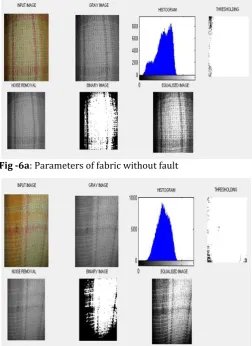
From experimental setup we have tacken different redings and result for so many faults in fabric. For the analysis purpose we have tacken two faults under consideration. first hole in fabric and second Slub in fabric. The figure shows the comparative threshold outputs of fault fabric and goodfabric sample.
4.1 Thresholding
[image:3.595.311.563.101.247.2] [image:3.595.310.561.341.503.2] [image:3.595.37.290.499.668.2]© 2017, IRJET | Impact Factor value: 5.181 | ISO 9001:2008 Certified Journal | Page 3359 using an optimal threshold [7]. The purpose of
[image:4.595.308.562.78.266.2]thresholding is to extract those pixels from some image which represent an object (either text or other line image data such as graphs, maps). Though the information is binary the pixels represent a range of intensities. Figure 6a and figure 6b shows the outputs for without fault fabric and with fault (hole) fabric.
Fig -6a: Parameters of fabric without fault
Fig -6b: Parameters of fabric with fault as hole in fabric Figure 7a and figure 7b shows the outputs for without fault fabric and with fault (slub) fabric.
Fig -7a: Parameters of fabric without slub fault
Fig -7b: Parameters of fabric with slub fault
5. CONCLUSIONS
The work presents fault identification of Faults on fabrics such as hole, scratch, fading and other it is easy by using MATLAB Implementation. The manual textile quality control usually goes over the human eye inspection. Human visual inspection is tedious, tiring and fatiguing task, involving observation, attention and experience to correct identification of fault. Here, it has been demonstrated that Textile Defect Recognition System is capable of detecting fabrics’ defects with more accuracy and efficiency Thereby applying Matlab R2012a (7.14.0.739) 32 bit version to the color faulty fabrics it is processed and finally the Histogram is obtained for the same image and thresholding is done to obtain the intensity of the image. In future this can be extended to any number of fault identifications on fabrics and can be processed.
REFERENCES
[1] Brad R.: Studies and researches for the
implementation of quality assurance systems in the textile industry, University of Lucian Blaga, Sibiu, Faculty of Agricultural, Food Industry and Environmental Protection, 2007.
[2] Prof. Swapnil R. Kurkute, Mr. Akshay S. Kulkarni, Mr.
[image:4.595.37.290.183.530.2]© 2017, IRJET | Impact Factor value: 5.181 | ISO 9001:2008 Certified Journal | Page 3360
[3] Xie X.: A Review of Recent Advances in Surface Defect
Detection using Texture analysis Techniques, Electronic Letters on Computer Vision and Image Analysis, Vol. 7, no. 3, 2008, pp. 1-22.
[4] Mr. S.R.Kurkute and Mr. D.G.Agrawal International
Journal of Mordern Embedded System(IJMES) Volume-2 Issue -4 ISSN 2320-9003,Page 42-45, “Averaging in Noise Cancellation using Adaptive Filter for Voice Recognition”
[5] Cuenca S.A. and Cámara A.: New Texture Descriptor
for High-Speed Web Inspection Applications, IEEE International Conference on Image Processing (ICIP), Barcelona, Spain, September 14-18, 2003, pp. 537-540.
[6] Mr. S.R.Kurkute and Mr. D.G.Agrawal International
Journal of Modern Computer Science and Applications (IJMCSA) ISSN: 2321-2632 (Online) Volume No.-2, Issue No.-6, page 22 To 26 “ Scilab An Open Source Alternative Over Matlab –A Review”
[7] Kang T.J. et al. “Automatic Recognition of Fabric
Weave Patterns by Digital Image Analysis”, Textile Res. J. 69(2), 77-83 (1999
[8] Dorrity J., Vachtsevanos G. and Jasper W.: Real-time
fabric defect detection and control in weaving processes, National Textile Center, Annual Report, August, 1995, pp. 143-152.
[9] Mr. S.R.Kurkute and Mr. D.G.Agrawal International
Journal of Modern Computer Science and Applications (IJMCSA) ISSN: 2321-2632 (Online) Volume No.-2, Issue No.-6, page 26 To 29 “ Parametric Comparative Study of Adaptive Filter for Noise Cancellation”
[10] Newsgroups.derkeiler.com > Archive > Comp >
comp.soft-sys.matlab > 2007-09.
[11] Prof. S.R.Kurkute, Gopal Girase, Prashant Patil, “
Automatic Energy Meter Reading System Using GSM Technology”International Journal of Innovative Resurch In Electrical,Electronics,Instumentation And Control Engineering ISSN: 2321-2004 (Online) Volume No.-4, Issue No.-3, IF- 4.855
[12] Meylani R., Ertuzun A., and Ercil A.: A comparative
study on the adaptive lattice filter structures in the context of texture defect detection, Proceedings of the 3rd IEEE International Conference on Electronics,
Circuits and Systems (ICECS), Rodos , Greece, Vol. 2, October 3-16, 1996, pp. 976-979.
[13] Prof. Swapnil R. Kurkute, Ms.Arbuj Komal Promod, Ms.
Dargude Chaitanya Rangnath, Ms.Dholi Komal Dattu, “Laboratory Virtual Instrument Engineering Workbench (LABVIEW)”, International Journal of Modern Embedded System (IJMES), ISSN: 2320-9003(Online), Volume No.-5, Issue No.-1, February, 2017, Page No-17-20
[14] Mr. S.R.Kurkute and Mr. D.G.Agrawal Science Park
International recognized Research Journal ISSN
2321-8045, Volume-1 Issue -7,DOI: