© 2017, IRJET | Impact Factor value: 5.181 | ISO 9001:2008 Certified Journal
| Page 392
OPTIMIZED TRAVEL RECOMMENDATION USING LOCATION BASED
COLLABORATIVE FILTERING
Fathima Rasidha Roushan.A
1, Piravina.N
2, Divyadharshini.R
3, Venkata Lakshmi.S
41
Fathima Rasidha Roushan.A , Dept. of Computer Science and Engineering ,Panimalar Institute Of
Technology,Tamilnadu, India
2
Piravina.N , Dept. of Computer Science and Engineering ,Panimalar Institute Of
Technology,Tamilnadu, India
3
Divyadharshini.R ,
Dept. of Computer Science and Engineering ,Panimalar Institute Of
Technology,Tamilnadu, India
3
Venkata Lakshmi.S,
Dept. of Computer Science and Engineering ,Panimalar Institute Of
Technology,Tamilnadu, India
---***---
Abstract -
Big data is essential in travelrecommendation.A customized travel arrangement suggestion is proposed when a client is going to visit another place. Web-based i.e. social networking - based proposal methodologies are powerful and effective, however experiences the notable "time multifaceted nature issue and cost fulfillment" in suggestion frameworks, because of travel information being exceptionally scanty. In this situation, it makes exact comparative client recognizable proof exceptionally troublesome if the client has just gone by a little number of POIs.The classification points are typically dictated by the guileless class data from suggested frameworks in Topic Model Method(TM). From the foreordained classifications, it is helpful to ascertain client inclinations. Shockingly, for rich photograph sharing systems like Flickr, there is no such characterized class data. Along these the topic based suggestion approach can't be used specifically in travel proposals, accordingly by utilizing location based collaborative filtering method, the group contributed photographs are utilized to give customized venture out succession arrangements to enthusiastic explorers.
Key Words
:
Big data , Location based collaborative filtering method, POIs(Point Of Interest), Topic Model Method(TM),Flickr.1.INTRODUCTION
Tourism has turned out to be one of the world's biggest
enterprises. Besides the World Travel and Tourism council, the commitment of tourism to worldwide gross domestic product is required to ascend from 9.1% in 2011 to 9.6% by 2021 1. To be sure, with the progression of time and the change of expectations for everyday comforts, even a standard family can do developed travel easily on a little spending plan. As a pattern increasingly travel organizations, for example, Expedia 2, give online administrations. Be that as it may, the quick development of online travel data forces an expanding challenge for vacationers who need to browsean extensive number of travel bundles to fulfill their customized necessities. On the opposite side, to get more business and benefit, the travel organizations need to comprehend these inclinations from various vacationers and serve more appealing bundles. In this way, the interest for keen travel administrations, from both sightseers and travel organizations, is relied upon to increment significantly. Since recommender systems have been effectively connected to improve the nature of administration for clients in a number of fields, it is characteristic bearing to create recommender systems for personalized travel package recommendation (1). In our day by day lives, travel arranging is dependably a dull and troublesome assignment. Increasing helpful data from the fastidious crude materials by means of manual examination of travel guide site like IgoUgo (www.igougo.com) could be exceptionally tedious, particularly when explorers confront another city. Customized travel proposal systems, which can successfully coordinate client inclinations (e.g., social, cityscape or scene), are increasing an ever increasing number of considerations because of different potential applications in photographs via web-based networking media record their travel history and much data about day by day life. Flickr client's photograph contains metadata like "Client Id", "labels", "Taken information" "Scope" and "Longitude" (2) Among every one of the applications, travel recommendation has been pulled in by numerous specialists in view of the importance and the inborn relationship between individuals' each day lives. As a rule, a regular travel recommendation system comprises of two angles: nonexclusive recommendation and customized recommendation (3).
© 2017, IRJET | Impact Factor value: 5.181 | ISO 9001:2008 Certified Journal
| Page 393
In spite of the fact that the data in a solitary travelogue isperhaps boisterous or one-sided, various travelogues overall could mirror individuals' general inclination and comprehension of travel assets, and therefore can fill in as a dependable learning source (4). A clear way to deal with creating labels that describe an area is to examine the labels related with Flickr pictures. As of late, mining area related data from Flickr labels has been effectively researched . In any case, as labeling on Flickr is open, the labels are semantically unconstrained and just a part of them are identified with travel. Consequently, it is a non-insignificant undertaking to recognize such travel-related labels from others just in view of Flickr information, as there are couple of relevant confirmations that can offer assistance. Other than Flickr information, we see that individuals are making and sharing a great deal of good travelogues on the Web on for all intents and purposes any area. In complexity to Flickr information, travelogues not just actually focus on travel-related topics additionally contain much wealthier relevant semantics. Along these lines, travelogues give a superior information source to produce outlines and virtual visits for areas (5) .
1.1
SYSTEM ANALYSIS
The existing system as examined suffers from the following drawbacks; static travel plans, not supporting personalized POI recommendations, category information is undefined, static datasets for POI. In proposed system a personalized travel sequence plans recommendation is given when a user is about to visit a new place. In contrast to existing location based collaborative filtering methods, we learn users’ travel preferences from the text descriptions associated with their shared photos on social media, instead of from GPS trajectories or check-in records. In addition, users’ similarities are measured with author topic model instead of location co-occurrence.
Places are classified based on the geotag information, Number of Persons on the photo and can be later used with POI recommendation. In personalized travel recommendation system, we utilize users’ topic preferences as the law for collaborative filtering instead of location co-occurrences. Dynamic travel plans are recommended to the user based on POI.
2.METHODOLOGIES
2.1 Creation of social site for the client
A social networking profile that is particularly focused on client’s pictures is made. Client will enlist their subtle elements and server stores client information in a database. Clients will transfer their photos into the social networking site. While transferring, client gives labels to the photo, Geotagging information and gets to benefit. Client share photographs in Social Networking Website.
First clients register their details to login to their personal site.Informations such as clients’ name,date of birth,,gender,location,mobile number, mail id and password for the site are requested by the admin.Once user completes the registration process with their login credentials they can open their personal site. The personal site is just like a social media; user can change their profile and background pictures as they wish. User can make friends and chat with their friends, they can even upload text and pictures .Privacy is provided for their sharing, they can share their photos and texts either to their friends or to public. Therefore a good social site is provided for the user to communicate and explore various environments. Figure 1 shows user uploading their photos and provides tags and preprocess it .Then access priveledge is given to them to aces the site.
FIG – 1 : USER OPERATONS
2.2 Data collection and processing
In this module, Admin gathers photographs by giving tags from Flickr Website. Administrator downloads open photographs from this site. Preprocessing will be finished. Geotagging will be connected to all downloaded open photographs. Geotagging connected utilizing Flickr API. Client can see their drive where all transferred pictures by the client recorded in this drive.The admin gathers photos from client’s website, and make use of geotags; place information’s and season details. The admin database contains all the details of users’ posting. Admin maps the users’ ip address and gathers all the information’s into the database.
© 2017, IRJET | Impact Factor value: 5.181 | ISO 9001:2008 Certified Journal
| Page 394
database. The longitude and latitude details are alsoloaded into admin data.
FIG – 2 : COLLECTING DATASETS
Figure 3 shows the places which the admin has
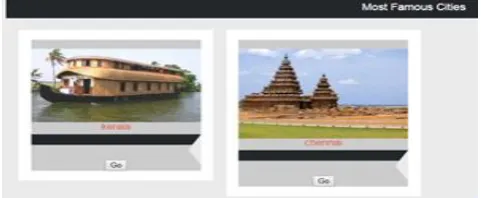
preprocessed before the user had given the place of interest. This preprocessing is known as location based as it uses the location based collaborative filtering method. The admin inputs the famous cities name and all geotagging and preprocessing of the time, date, tage, point of interest and address is done and the data’s are stored in a database for the admins’ accessing purpose.FIG – 3: PREPROCESSING THE DATAS OF MOST FAMOUS PLACES
2.3 Travel recommendation website
[image:3.595.36.295.104.224.2]
Travel Recommendation Website for recommending locations to the user is being created. Admin will get permission from Social Website to access public photos with tags. After permission granted by the Social Website, Admin will perform preprocessing to the public photos. During preprocessing stage: location, date and time and tags of photos will be retrieved.These photos information is stored into database.User must login to the site to give his Point of interest and get his required travel plan according to his interest. In figure 4 admin gets permission from social networking site and access only after permission is granted
FIG - 4 : ADMIN PROCESSING DATA
2.3.1 Topic’s Cost and Time Matrix Mining
In the wake of mining representative marks, around there, we mine cost and time qualities for each one of the focuses from travelogs. They are portrayed as cost grid and time system .We could see from the going with travelog, "the passageway cost is €17 for adults and €9.50 for youths. Opening hours are 9:00-17:30.", that sentences related to cost and time usually contain numbers. The position of the related catchphrases is basic. Picture like "$", "€", "yuan" are obliging to find the cost information and "AM", "PM", "clock" are helpful to find the time data.Be that as it might, not each one of the sentences contain numbers identified with cost or time. So we should thusly pick sentences related to cost or time. The methods of cost and time are near, so we take cost for example. In the first place, we select sentences containing numbers. What's more, a while later we utilize customary vernacular taking care of (NLP) to take in the highlight of each sentence. We use "faridani matlabNLP"1 to set up each sentence. The basic believed is according to the accompanying. For every sentence, in the first place, we go it through "commentSanitizer". By then we present overall hash plot. For each word in the coming to fruition string, in the first place, we pass the word to "porterStemmer". By then if the word is not in your hash outline, it. In case it is, essentially add one to its regard. Do a comparative thing for the overall hash portray. By then we take the qualities in your hash diagram have regard >¼ n, for example, n = 3, and store those keys as a header. For each hash guide of a sentence, we show it using headers. For example if header is 'book', 'note', 'I', a comment like "I love my book" should be [1,0,1].
The second step is to set up a substance classifier with positive tests and negative examples. We physically check 500 positive tests and 500 negative illustrations. We portray the sentences, which contain cost information (e.g., ticket cost) as positive cases. Sentences, which contain numbers not related to cost, are described as negative illustrations. In the wake of preparing the classifier, we put the sentences containing numbers into the classifier to test whether a sentence is identified with cost. We utilize the sentenceswhich are both identified with taken a toll and from the travelogs of the theme to mine the cost data about this theme. We ascertained the mean estimation of the numbers showed up in these sentences. It mostly comprises of the ticket cost of the POI and once in a while likewise including providing food cost and transportation cost.Notice that in spite of the fact that the tickets expense for grown-ups and kids are distinctive, the mean cost could in any case recognize modest and costly things.
[image:3.595.35.276.325.424.2]© 2017, IRJET | Impact Factor value: 5.181 | ISO 9001:2008 Certified Journal
| Page 395
the normal cost and time appropriation to introduce thepoint is the cost appropriation for a POI. It is a four-measurement vector. We separated the cost to four sorts: (1) under $6, (2) from $6 to $20, (3) from $20 to $50, (4) more than $50. For instance, the cost of "Stop and Garden" is $2. At that point the cost vector is [1,0,0,0]. Time conveyance for POI is computed by the same strategy as cost framework. Every time vector in time grid is additionally a four-measurement vector. We partition one day to [morning, evening, evening, midnight]. In the wake of getting the cost vector of every point, we apply a cost framework to exhibit the cost vector of all the N points. Fetched network is a framework. Every line of the framework is the taken a toll conveyance for one point. It is computed by the normal of cost circulation for every one of the POIs in this point. So also, we get the time lattice for every one of the themes.
2.3.2 Topic’s Season Matrix Mining
In the wake of getting POIs, to every POI, there are an arrangement of photographs with labels and "date taken" names. To season, we utilize the "month" in "date taken" to get the meeting conveyance amid the 12 month. The season vector of a POI is characterized as 2 [spring, summer, fall, winter]. Months from March to May have a place with spring etc. As per the structure of travelogs, for every theme, we normal over all the season appropriations of the POIs in this topic.Each column of the grid is the season dispersion for one subject.
2.3.3 Community-Contributed Photos Mining
We arbitrarily gathered 7 million pictures around the world transferred by 7,387 clients from Flickr open API. For every client, there is a photograph collection comprises of the photographs shared by the client, related with the heterogeneous metadata including client ID (e.g., 19181920@N03), literary labels (e.g., room, roma, colosseo), date taken (or timestamp) (e.g., 2004-09-25 00:00:01), scope and longitude (e.g., 41.890585, 12.493171) given by the client, or recorded by camera or advanced mobile phone. In this area, we present POIs mining, season trait digging for every point, and agent pictures mining for POIs from group contributed photographs.
2.3.4
POI Mining
So first we acquaint the route with mine POIs from swarmed geo-labeled photographs. POIs mining is a hot research range in late years. To begin with, we channel an arrangement of photographs for every city from every one of the clients. We coordinate city name, for instance, London, with the printed labels of every photograph. It can not ensure that all the photographs coordinating city name certainly have a place with this city, since group contributed photographs incorporate a considerable measure commotions. We additionally utilize the
[image:4.595.315.575.230.336.2]geo-area limitation as in figure 5. In the event that the GPS organize of the photograph is 500 km (between area level also, nation level) far from the focal point of the city, we expel it. In the wake of getting an arrangement of photographs of every city, second, we extricate POIs from these swarmed geo-labeled photographs toward every city by mean move grouping. At that point pick the POIs in both the groups and the travelog site. In this way, these POIs have both GPS organizes and travelogs portrayal, which could ensure the courses plan and courses bundle mining.
FIG – 5 : MINING LOCATION DETAILS
2.4 Personalized itenary travel plan
Travel goals is suggested for the client in presence of client informations. Client indicates their Point of Interest and requirements for getting Travel Recommendations. Client information will be present area, place to visit, length, sort and motivation behind visit and spending cost. Base on client personalized POI, server produce a personalized touring arrangement. Client choose his point of starting in the site.The site suggest four places for the user to start.User need to choose one of them to start their travel.User gives his budget for travelling,based on the budget number of places are recommended for the user.User also chooses his point of interest from recommendations according to all these users’ input a personalized travel plan is recommended for the user by the admin.Finally a route plan is given to the user indicating his starting point ,the intermediate point and the final points. Based on the kilometer the timing wil be suggested for the user. For example if the use travels for 1 kilometer then an estimation of 1hour is given in the plan. The places are recommended in the sequences of the timing availability of the places and the nearest destinations providing users a ease of travelling. [image:4.595.324.560.641.728.2]© 2017, IRJET | Impact Factor value: 5.181 | ISO 9001:2008 Certified Journal
| Page 396
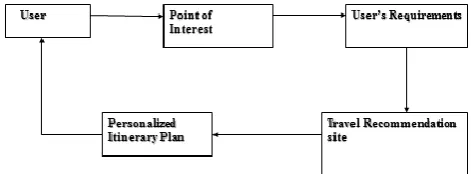
Figure 6 shows the outline of admin providing traveldestination to the users..The user gives their point of interest and user requirements to the travel recommendation website.The based on the user input details all informations are processed and an itenary travel plan is provided to the user with the destination and route maps.The time from when the places will be available is also given to the user for providing better convinence.The travel plan is for a maximu of 2 days .So a plan for day1and day2 will be given .We can enhance our days by using large servers.
3. IMPLEMENTATION
[image:5.595.51.561.368.768.2]
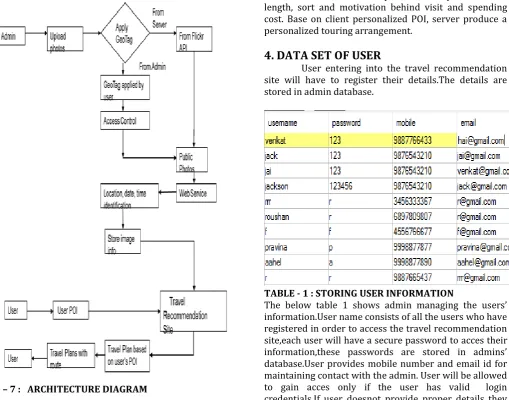
The figure 7, shows architecture of the proposed work , we are making a social networking profile that is particularly focused on clients pictures. Client will enlist their subtle elements and server stores client information in a database. Clients will transfer their photos into the social networking site.
FIG – 7 : ARCHITECTURE DIAGRAM
While transferring, client gives labels to the photo, GeoTagging information and get to benefit. Client share photographs in Social Networking Website. n first module, Admin gathers photographs by giving tags from Flickr Website. Administrator download open photographs from this site. Preprocessing will be finished. GeoTagging will be connected to all downloaded open photographs. GeoTagging connected utilizing Flickr API. Client can see their drive where all transferred pictures by the client recorded in this drive. A Travel Recommendation Website for recommending areas to the client is made. Administrator will get authorization from Social Website to get to open photographs with labels. After consent conceded by the Social Website. Admin will perform preprocessing in general photographs.
Admin preprocessing stage: area, date and time and labels of photographs will be retrieved.These photographs data is put away into database. Travel goals is suggested for the client in presence of client informations. Client indicates their Point of Interest and requirements for getting Travel Recommendations. Client information will be present area, place to visit, length, sort and motivation behind visit and spending cost. Base on client personalized POI, server produce a personalized touring arrangement.
4. DATA SET OF USER
User entering into the travel recommendation site will have to register their details.The details are stored in admin database.
TABLE - 1 : STORING USER INFORMATION
© 2017, IRJET | Impact Factor value: 5.181 | ISO 9001:2008 Certified Journal
| Page 397
cannot gain access,but the database will store the dataswhich the user entered wronlgly.
[image:6.595.316.576.103.249.2]5. INFORMATION PROCESSED FROM FLICKR
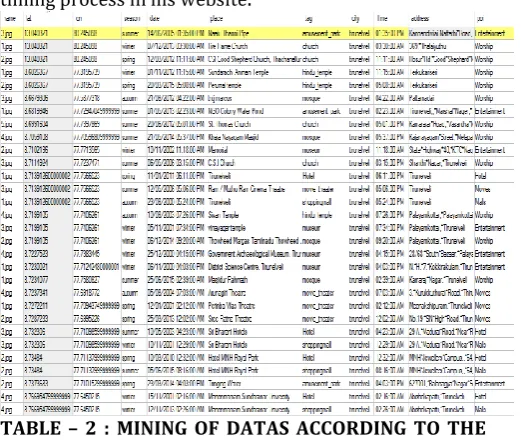
Information are processed from flickr for providing dynamic travel plan to the user.For each photo in flickr latitude and longitude information are given for finding the exact location of the photo.The accurate time the photo was taken are processed. Finally as shown in table 2, the address ,point of interest,season, date, time, tag, addresss and place are mined from Flickr.The season shows at which climate the photo was took and the date and time shows the exact timing of the photograph and date.Tags are the places which the user has choosen and given as input to the travel recommendation site.Cities of the places are given with full address. These data sets are stored in admin database for providing user a good travel plan.These are processed once after admin has entered the places and has done his mapping,season and timing process in his website.
TABLE – 2 : MINING OF DATAS ACCORDING TO THE PLACE OF INTEREST
6.TRAVEL SEQUENCE RECOMMENDATION
After mining user package we tend to introduce ,our travel routes recommendation module. It contains 2 main steps: (1) routes ranking consistent with the similarity between user package and routes packages, and (2) route optimizing consistent with similar social users’ records. Finally a map representing the travel plan is given to the user.Atlast a plan indicating the sequence that is from first place to next and soo on is given until the destination this entire plan is given based on the user point of interest and budget cost indicating how many places he can travel within the given amount. Figure 8 shows the travel recommendation page were user enters his point of interest.The starting place for travel is provided by travel site and user must choose one comfortable to them.
Fig – 8 : USER VISUALIZATION
[image:6.595.36.297.332.554.2]User provides input as the date of starting and the date of ending their travel based on that they choose their budget,Finally place of interest are choosen,finally the loacation based collaborative filtering is used to mine the places based on user interest and a travel plan is provided. Table 3 ,shows the travel plan given to the user by mining all the point of interest from the users .The map gives accurate planning based on timing availability of each places and the distances between each place is also calculated.
TABLE 3 : FIRST DAY PLAN FOR THE GIVEN PLACES
[image:6.595.316.574.403.561.2] [image:6.595.318.574.587.751.2]© 2017, IRJET | Impact Factor value: 5.181 | ISO 9001:2008 Certified Journal
| Page 398
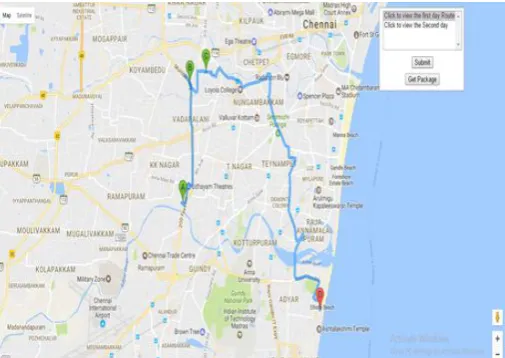
FIG - 9 : TRAVEL PLAN MAPPINGFigure 9 shows the plan for day1 and day2 by clicking route map we will get to know the route plans for both days.Figure 10 shows route map which contains the sequence of travelling for the users with starting point and destinations.
FIG – 10 : TRAVELLING SEQUENCE FOR THE PLAN
7. CONCLUSION
Enormous information progressively advantage both research and mechanical territory, for example, social insurance, fund administration and business recommendation. Customized travel sequence recommendation is utilized for both travelogs and group contributed photographs and the heterogeneous metadata (e.g., labels, geo-location, and date taken) related with these photographs. Online networking based recommendation is the most surely understood approach, and is broadly used in items, administrations and travel recommendations .Thus the customized travel arrangements are produced for the client, based on POI travel recommendations of the clients' utilizing customized travel sequence recommendation on Multi-Source Big Social Media. This is accomplished by utilizing three techniques i.e., location based
collaborative filtering, geotag extraction, query based technique.
8. FUTURE ENHANCEMENT
The proposed system can be enhanced by using larger server and can be implemented using larger data sets providing much dynamic plan without delay. More places can be provided as starting point for user and many places which are uncommon can also be added in recommendation.
9. REFERENCES
[1]Personalized Travel Package Recommendation by Qi Liu, Yong Ge, Zhongmou Li, Enhong Chen, Hui Xiong, IEEE 11th Int. Conf. Data Mining,2011, pp. 407–416. [2]Travel Recommendation via Author Topic Model Based Collaborative Filtering by Shuhui Jiang,Xi’an, MMM,Part II, LNCS 8936, pp. 392–402, 2015.
[3]Personalized Travel Recommendation by Mining People Attributes from Community-Contributed Photos by An-Jung Cheng, Yan-Ying Chen, Yen-Ta Huang, Winston H. Hsu,Hong-Yuan Mark Liao, 19th ACM Int. Conf. Multimedia,2011, pp. 83–92
[4]Equip Tourists with Knowledge Mined from Travelogues by Qiang Hao, Rui Cai, Changhu Wang, Rong Xiao, Jiang-Ming Yang,Yanwei Pang, Lei Zhang , 19th Int. Conf. World Wide Web, 2010, pp. 401–410.
[5]Generating Location Overviews with Images and Tags by Mining User-Generated Travelogues by Qiang Hao, Rui Cai, Xin-Jing Wang, Jiang-Ming Yang, Yanwei Pang, Lei Zhang, 17th ACM Int. Conf. Multimedia,2009, pp. 801–804.
[6]IM2GPS: Estimating Geographic Information from a Single Image by James Hays and Alexei A. Efros, Conf.Comput. Vis.Pattern Recog., 2008, pp. 1-8.
[7]Visual Summarization for Place-of-Interest by Social-Contextual Constrained Geo-clustering by Yayun Ren, Xueming Qian, Shuhui Jiang, IEEE 17th International Workshop on Multimedia Signal-Processing (MMSP), Oct 19-21, 2015.
[8]Personalised Travel Recommendation based on Location Co-occurrence by Maarten Clements, IEEE TRANSACTION ON KNOWLEDGE AND DATA ENGINEERING, JUNE 2011.
[9]Location-Aware Recommendation Systems: Where We Are And Where We Recommend to Go by María del Carmen,Rodríguez-Hernández, Local Rec’15, September 19, 2015.
[image:7.595.38.291.345.524.2]