Facial Expression Recognition System Using Neural Network based on
LBP Features
1
Shital L. Pachpole,
2Prof. D U Adokar
1Student, Dept. of Electronics and Telecommunication, SSBT’s COET, Jalgaon (Maharashtra), India. 2Professor, Dept. of Electronics and Telecommunication, SSBT’s COET, Jalgaon (Maharashtra), India. ---***---Abstract:Anovel expression recognition scheme is proposed
to identify seven dissimilar facial emotions by using JAFFE (Japanese Female Expressions) database. Three different approaches of feature selection and extraction have been used for generation of optimal feature vector. Here, 2D-DCT (Two-Dimensional Discrete Cosine Transforms), uniform rotation-invariant LBP (Local Binary Patterns) and HOG (Histogram of Oriented Gradients) coefficients are employed in addition to image statistics parameters with a view to design a hybrid feature vector. The single hidden layer feed forward neural network has been used as a classifier in order to classify and also to recognize different emotions from frontal facial images. Three learning algorithms such as resilient back propagation, scaled conjugate gradient and gradient descent algorithm with momentum and adaptive learning rate have been compared. Major contribution of this research is in the design of an optimal feature vector comprising of uniform LBP based hybrid feature vector for encoding subtle texture information of images and also in the development of a simple neural network classifier containing a single hidden layer with carefully chosen number of neurons based on the experiments. The proposed neural network classifier trained with gradient descent algorithm with momentum and adaptive learning rate delivers the maximum average facial expression recognition accuracy of 97.2% along with the least number of connection weights and biases.
Keywords: Facial Expressions, 2D DCT, LBP, HOG, Neural network, Classifier.
1. Introduction
Expression is the most important mode of non-verbal communication between people. Facial expression conveys crucial information about the mental, emotional and even physical states of the conversation. Facial Expression Recognition (FER) has very broad applications, such as lie detection, behaviour prediction, user-friendly interface between man and machine and emotional robot, etc. However, these facial expressions (emotions) may be difficult to recognize by the untrained persons. It is necessary to understand the status of mind using face expression, because the situation of mind can be read by the person’s mouth, eyes, eyebrows etc. With FER systems, it is possible to assess the human expressions depending on their effective state in the same way that human’s senses do. The FER system can be applied in different areas of life such security and surveillance, they can predict the criminal’s behaviour by analysing the images of their faces that are captured by the control-camcorder. Furthermore, the FER system has been used in communication to make the
“answer machine” more interactive with people. FER has attracted increasing attention in computer vision, pattern recognition, and human-computer interaction research communities. The rest of the paper is organized as follows. Section II describes there view of related reported and published research work in the literature. The proposed research methodology has been explained in Section III. Computer simulation results are demonstrated in Section IV and finally, Section V highlights the conclusion.
2. Review of Related Work
65.77%. C. Shan et al. [10] adopted Boosted-LBP. Their recognition rate is 81.0%for JAFFE database and 95.1% for CK database. Wang, Xun; Liu, Xingang; Lu, Lingyun; Shen, Zhixin et al. [11], have proposed a new FER system, which uses the active shape mode (ASM) algorithm to align the faces, then extracts local binary patterns (LBP) features and uses support vector machine (SVM) classifier to predict the facial emotion.
3. Proposed Research Methodology
The research problem undertaken is to develop a neural network based classifier system for identification of principal emotions (expressions) from human facial images with respect to standard benchmark database, namely, Japanese female expression database (JAFFE). All these images are frontal still gray images of the human faces, which will be used to develop an optimal neural network based classifier system with a view to correctly identify and recognize the expressed emotion by a person.
A unique hybrid image feature selection and generation scheme has been suggested with a view to achieve the best classification accuracy and the recognition. Features based on 2D DCT, LBP and HOG are augmented with features with regard to image statistics, entropy, texture, homogeneity, etc., so that every image is represented by a unique feature vector. Based on the annotations available and the visual inspection of the frontal still facial image of a person, the exact emotion is recognized, which is the target emotion. The facial image database is transformed to a knowledgebase to be used by a neural network, where a feature vector is followed by the expressed emotion. Primarily, three different feature extraction schemes based on 2D DCT, LBP and HOG are compared in order to determine the optimal feature vector of an image. Consequently, an optimal feature vector is designed. In a software environment available in MATLAB 2016a, codes are developed for accomplishing the tasks of feature extraction, development of a classifier based on neural network, etc.
For designing the optimal neural network based classifier, a network growing approach has been employed and in addition, a double loop design strategy has been followed. For ensuring simplicity of the neural network and also reduced time complexity and space complexity (hardware, number of connection weights including biases), a single hidden layer feed forward neural network is chosen, which is known as feed-forward neural network in MATLAB. The number of neurons (processing elements) in the hidden layer is increased gradually from 10 to 1000 in the increment of 10. For each value of the number of PEs (processing elements or neurons) in the hidden layer, ten different neural network candidates are configured and retrained with different random initialization of connection weights and biases as well as different random data partitioning into training, validation (cross validation) and testing subsets. This is necessary to ensure true learning without any prejudices and biases. Moreover, neural network learning has been made almost independent of any specific calculated choice of data partitioning into training,
cross validation and testing datasets. Because of random partitioning of data into the training, validation and testing sets, each sample participates, on an average, an equal number of times to all these three sets. Because of small size of the dataset, 90% of the total samples are used as Training Dataset, different 5 % of the total samples as cross-validation (validation) dataset and remaining 5% of the total samples as testing dataset. Because of the fact that JAFFE database has 213 different images or samples, above distribution implies that 191 samples (exemplars) are used for training the neural network, other 11 samples are used for validation of the trained neural network and remaining 11 samples are used for testing the performance of the trained neural network.
Obviously, the performance of the neural network is always the best on the training dataset, because it is this dataset only which has been presented iteratively to the neural network in order to achieve learning and estimate the optimal values of the connection weights and biases of the neural network. Therefore, examination of the performance of the neural network on validation as well as the testing dataset is more important as neural network never sees these datasets during the process of learning. Cross-validation dataset is used for termination of the neural network training and as training proceeds, at the end of every iteration, it is ensured that both the error on training dataset and that on validation dataset go on decreasing with respect to the number of iterations (epochs). Though, the magnitude of these errors might be significantly different. It is generally noticed that the error on the training dataset is always much lower than that on validation dataset.
The magnitude of the error gradient and the number of validation checks are used to terminate the training. The number of validation checks represents the number of successive iterations that the validation performance fails to decrease. If this number reaches 6 (the default value), the training will stop.
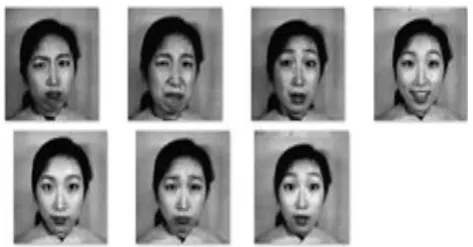
[image:2.595.321.558.623.746.2]All input features are normalized with zero mean and unit variance, so that the neural network based classifier models can run faster and better. Fig. 1 shows some sample facial images of JAFFE database. In the following figure the face expression is as following order Angry Disgust Fear Happy Neutral Sad Surprise.
For every setting of the number of neurons in the hidden layer, ten different trials of the neural network are run and during every trial, the results of the neural network are found to be drastically different most of the time. This is because of randomness in initialization of connection weights and biases and randomness in data partitioning into training, CV (cross-validation) and testing subsets at the beginning of every trial run. In addition, as this problem represents learning from data, the problem always has multiple non-optimal solutions (multiple local minima) and one optimal solution (global minimum). When training of the neural network proceeds, the learning algorithm often might get trapped to any one of the local minima and during every trial it can go on finding different local minima and thus further worsens the matter of finding a global optimal solution. Because of these complex situations, it is impossible to maintain exact reproducibility in the results produced by the same configuration of the neural network. For training of the neural network, three different learning algorithms, namely, Gradient descent with momentum and adaptive learning rate backpropagation (GDX) , Resilient backpropagation (RP) and Scaled Conjugate Gradient backpropagation (SCG) are used.
Because of the fact that input feature values are bipolar, ‘tansig’ activation function is used for the hidden as well as output layer neurons. Cross entropy error criterion is more appropriate for classification. The crux of the best design is the simplicity and the minimum time and space complexity of the neural network based classifier. The network with minimum number of free parameters (connection weights and biases) should be employed.
The performance of the neural network based classifier is recorded for all ten different trials (runs) with respect to cross-entropy error on training dataset, CV dataset and Testing dataset, Average Classification Accuracy on Training dataset, Average Classification Accuracy on CV dataset, Average Classification Accuracy on Testing dataset and Overall Average Classification Accuracy. Finally, the best performance measures are highlighted with an emphasis to the Average Classification Accuracy in comparison with cross-entropy error, because we are solving a classification problem. As overall average classification accuracy reflects the average classification accuracy on training, validation and testing datasets; the neural network configuration with the highest average overall classification accuracy is chosen.
4 Experimental Results
4.1 Scatter Plots for Visualization of Decision
Regions.
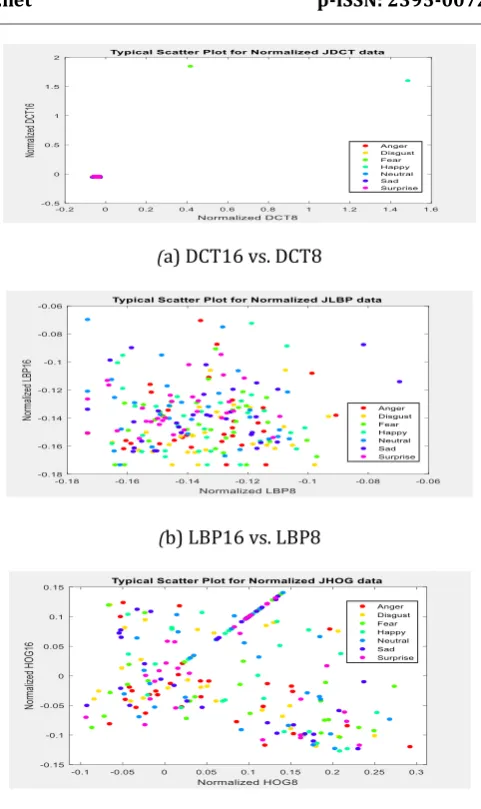
Scatter plots are plots of sample input feature vectors in input features space. They are excellent visualization tools for determining feature vector distribution in Rd, where d ≤ 3. They often facilitate natural or obvious clustering of class-specific feature data and the partitioning of Rd into suitable decision regions for classification.
(a) DCT16 vs. DCT8
(b) LBP16 vs. LBP8
[image:3.595.314.555.52.457.2](c) HOG16 vs. HOG8
Figure 2. Typical Scatter plots showing (a)Normalized
DCT16 versus Normalized DCT8 (b)Normalized LBP16 versus Normalized LBP8 (c)Normalized HOG16 versus
Normalized HOG8 for 7 different emotions.
estimated by an optimal neural network model for classification into seven different classes. As compared to input features based on 2D – DCT, the quality of input features based on LBP is much better. Similarly, Fig. 2 (c) depicts the scatter plot using features as Normalized HOG16 and Normalized HOG8 for 7 different emotions with respect to JAFFE database. It is noticed that there exists somewhat clustering of emotion-class specific feature data with very little overlapping between different emotion classes. As the decision regions are noticed as highly nonlinear; they can be estimated by a classifier based on a neural network for classification into seven different classes. This is possible, because the neural network has shown an ability to learn from input data (exemplars or instances) and with appropriate design, development and training of the neural network, facial expression recognition system can classify and recognize the human emotions with reasonable accuracy. As compared to input features based on LBP, the quality of input features based on HOG is slightly inferior. The proposed uniform LBP approach is very robust in terms of gray scale variations of images, immunity to contrast variations and rotation-invariant texture analysis of images. Hence, it is expected that the proposed LBP based hybrid feature vector would entail the best classification as well as recognition of the emotion.
4.2 Design of Neural Network based Classifier.
For the development of a classifier based on neural network, three different types of carefully designed feature vectors, such as, FVDCT and FVLBP and FVHOG have been employed. The feature vector, FVDCT based on 2D – DCT for JAFFE Database is comprised of 75 features, such that FVDCT = [DCT1, DCT2, DCT3, …,DCT64, Average, SD, Entropy, moment2, moment3, median, variance, contrast, correlation, energy, homogeneity].
The feature vector, FVLBP based on LBP features for JAFFE Database is comprised of 72 features, so that FVLBP = [LBP1, LBP2, LBP3, …,LBP59, Average, SD, Entropy, moment2, moment3, kurtosis, skewness, median, variance, contrast, correlation, energy, homogeneity].
The feature vector, FVHOG based on HOG for JAFFE Database is comprised of 75 features, so that FVHOG = [HOG1, HOG2, HOG3, …, HOG64, Average, SD, Entropy, moment2, moment3, median, variance, contrast, correlation, energy, homogeneity].
First, input features based on 2D – DCT have been applied to the single hidden layer feed-forward neural network. As construed from the Scatter plot shown in Fig. 2 (a), the quality of FVDCT is very poor. Therefore, reasonable classification accuracy is no longer possible. In case of FVDCT, the maximum average overall classification accuracy is obtained for a neural network with a single hidden layer containing 520 neurons and trained with scaled conjugate gradient backpropagation algorithm. The maximum average overall classification accuracy is observed as only 42.253521% at the cost of formidable total number of connection weights and biases amounting to 43,167. In case
of FVHOG, the maximum average overall classification accuracy is obtained for a neural network with a single hidden layer containing 610 neurons and trained with Gradient descent with momentum and adaptive learning rate backpropagation algorithm. The best average overall classification accuracy is observed as 92.9577% at the cost of formidable total number of connection weights and biases amounting to 50,637, which is certainly not pragmatic.
In view of this, neural network based classifier has been trained using FVLBP in order to achieve maximum average classification accuracy. The parameters of the neural network are designed a follows:
Input Layer: 72 Neurons
No. of PEs in Hidden Layer = 70 (optimal number decided after rigorous experimentation and re-training)
Output Layer: 7 Neurons as Seven emotion-classes are 1. Surprise, 2. Sad, 3. Neutral, 4. Happy, 5. Fear, 6. Disgust and 7. Anger
Architecture of patternnet: 72-70-7
Learning Algorithm: Gradient descent with momentum and adaptive learning rate backpropagation algorithm. For 70 neurons in the hidden layer, the neural network is re-trained ten times with different random initialization of connection weights including biases and random partitioning of the data into training, cross-validation and testing datasets (Training: 90%, Cross-validation: 5 % and Testing 5 %). Among ten different trials, during Trial 1, the maximum average overall classification accuracy is observed. Table I enlists the different performance measures of the optimal neural network delivering the maximum average overall classification accuracy for input features based on 2D – DCT, uniform LBP and HOG for three different learning algorithms, namely, GDX, RP and SCG.
Table 1. Performance Measures of Neural Network
FV P
E Cross-Entropy Error Maximum Average Classification Accuracy in % LA NCW
Train CV Test Train CV Test Overall
DC T (7 5) 68 0 0.261 2 0.260 0 0.282 6 28.272 251 18.181 818 18.181 818 27.230 047 GD X 564 47 80 0.233
6 0.2742 0.2747 35.602094 18.181818 9.090909 33.333333 RP 6647 52
0 0.2333 0.3347 0.2733 43.455497 45.454545 18.181818 42.253521 SCG 43167 HO G (7 5) 61 0 0.067 5 0.399 7 0.547 5
100 45.454
545 18.181 818 92.957 746 GD X 506 37 17
0 0.0738 0.3745 0.5522 639 96.858 54.545455 27.272727 91.079812 RP 14117 86
0 0.0748 0.4007 0.7963 100 636 36.363 27.272727 92.957746 SCG 71387 LB
P (7 2)
70 0.032 0.111 19
0.342 7
100 72.727
273 72.727 273 97.183 099 GD X 560 7 12
0 0.040972 0.393554 0.257441 100 54.54545 54.54545 95.30516 RP 9607 38 0 0.034 832 0.212 824 0.248 576
100 63.636
36 54.545 45 95.774 65 SC G 304 07
for feature vector, FVLBP, a neural network with 70 processing elements in the hidden layer, maximum average overall classification accuracy obtained is equal to 97.183099% for GDX training algorithm and the number of connection weights required are also very less i.e., only 5,607 as compared to other two algorithms. In case of the feature vector based on DCT data, i.e., FVDCT, the average classification accuracies are very poor ( 42.2535 %) for scaled conjugate gradient algorithm and the number of connection weights inclusive of biases required is enormous (43,167). Similarly, for feature vector, FVHOG, a neural network with 610 processing elements in the hidden layer, obtained maximum average overall classification accuracy is equal to 92.9577% for GDX training algorithm and the number of connection weights required is massive i.e., 50,637 as compared to other two algorithms.
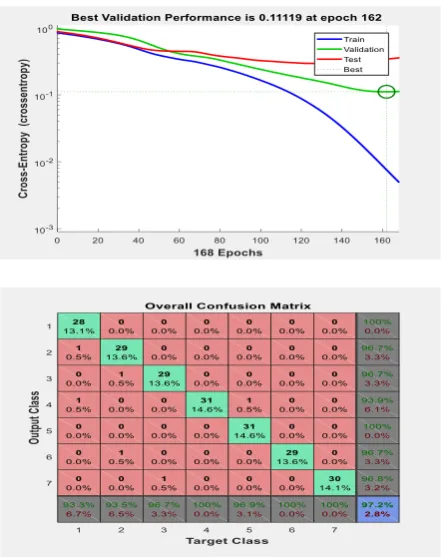
Figure 3.(a) Plot showing Cross-Entropy Error versus
number of Epochs for training, cross validation and testing data, 3 (b) Overall Confusion Matrix for 72-70-7 Neural
Network with GDX learning algorithm
In above graph shown in Fig. 3 (a), it is seen that the best validation cross-entropy error performance after six consecutive validation checks is 0.11119, which is obtained at epoch number 162. So at this instant, the training of the Neural Network is terminated. The Fig. 3 (b) shows the overall confusion matrix which combines classification accuracies of training, cross-validation and testing datasets for various emotions like surprise, sad, neutral, happy, fear, disgust and anger. So, it is noticed that the average overall correct classification accuracy is 97.2% for all the emotions.
It is seen from the Table 2 that 28 emotions are correctly recognized as surprise, one emotion is incorrectly recognized as sad and one emotion is incorrectly recognized
[image:5.595.51.272.270.549.2]as happy, resulting into the classification accuracy for surprise as 28/30, i.e., 93.3%. It is also observed that 29 emotions are correctly recognized as sad, one emotion is incorrectly recognized as neutral and one emotion is incorrectly recognized as disgust. Thus, out of total 31 emotions, only 29 emotions are correctly recognized as sad, resulting into the classification accuracy for sad of 29/31, i.e., 93.5%%. It is also noticed that 29 emotions are correctly recognized as neutral and one emotion is incorrectly recognized as anger, thus, leading to the classification accuracy for neutral as 29/30, i.e., 96.7%.
Table 2. No of correct classifications by the trained Neural Network (72-70-7, GDX)
No. of Recognize d Emotion (Output)
No. of Desired Emotions (Target) Surpris
e Sad Neutral Happy Fear Disgust Anger
Surprise 28 0 0 0 0 0 0
Sad 1 29 0 0 0 0 0
Neutral 0 1 29 0 0 0 0
Happy 1 0 0 31 1 0 0
Fear 0 0 0 0 31 0 0
Disgust 0 1 0 0 0 29 0
Anger 0 0 1 0 0 0 30
Correct
Recognition 28/30 29/31 29/30 31/31 31/32 29/29 30/30
Classificatio
n Accuracy 93.3% 93.5% 96.7% 100% 96.9% 100% 100%
Overall Average Classificatio
n Accuracy
97.2%
In addition, it is also observed that all 31 emotions are correctly recognized as happy, thus, resulting into the classification accuracy with respect to happy as 100 %. Furthermore, 31 emotions are correctly recognized as fear and one emotion is incorrectly recognized as happy, entailing the classification accuracy for fear as 31/32, i.e., 96.9%. It is also obvious that all 29 emotions are correctly recognized as disgust, resulting into the classification accuracy in relation to disgust as 100%. Moreover, it is also evident that all 30 emotions are correctly recognized as anger, resulting into the classification accuracy for anger as 100%. The average overall classification accuracy for all emotions is computed as 97.2%.
5. Summary
= 72) using a neural network with only 70neurons in the hidden layer and trained with Gradient descent with momentum and adaptive learning rate back propagation algorithm and the total number of connection weights inclusive of biases is only 5,607,which is very optimal as demonstrated in Table 1. This is the best ever reported maximum average overall classification accuracy on the JAFFE database, as no other researcher so far has reported such accuracy on the said database. In view of this, it is recommended to use the suggested optimal feature vector comprising of input features based on uniform LBP combined with image statistics and other features such as texture, entropy, etc. for training a neural network with a single hidden layer comprising of only 70 neurons. Though slightly slower in convergence, Gradient descent with momentum and adaptive learning rate back-propagation algorithm works superbly as compared to two other relatively faster algorithms.
6. Conclusion
In this paper, we have considered two datasets (Japan and cohn_kanade), and found the ROI for both. Then the various features like DCT, LBP and HOG along with image statistics are extracted as well as PCA’s are also calculated for both datasets and these features are given as input to neural network for classification of emotions. The various training algorithms used for training ANN are SCG, RP and GDX and the parameters considered for classification are Confusion matrix and Cross Entropy Error.
For JAPAN dataset with LBP approach and GDX training algorithm, we obtained maximum classification accuracy of 97.183% with minimum number of connection weights, i.e.,5607 and for COHN KANADE dataset with LBP approach and RP training algorithm, we obtained maximum classification accuracy of 99.1% with minimum number of connection weights,i.e.,5465.
So by observing all the results we can conclude that the raw input features based on LBP provided best accuracy compared to DCT and HOG approaches with minimum number of connection weights and the training algorithm PR and GDX are very fast compared to SCG.
References
[1] Ekman P., Huang T. S., Sejnowski T. J., Hager J. C., “Final Report to NSF of the Planning Workshop on Facial Expression Understanding, 1992.
[2] Alvino C., Kohler C., Barrett F., Gur R. E., Gur R. C.,Verma R., “Computerized measurement of facial expression of emotions in schizophrenia”, Journal of Neuroscience Methods , 2007, 163, pp. 350-361.
[3] Wang P., Barrett F., Martin E., Milonova M., Gur R. E., Gur R. C., Kohler C., Verma R., “Automated video-based facial expression analysis of neuropsychiatric disorders” Journal of Neuroscience Methods, 2008, 168, pp. 224-238.
[4] Dinges D. F., Venkataraman S., McGlinchey E. L., Metaxas D. N., “Monitoring of facial stress during space flight: Optical computer recognition combining discriminative and generative methods”, Acta Astronautica , 2007, 60, pp. 341 – 350.
[5] Padgett C., Cottrell G.W., “Representing Face Images for Emotion Classification,” Proceedings of Conference on Advances in Neural Information Processing Systems, 1996, pp. 894-900.
[5]Zhang, “Feature-based facial expression recognition: Sensitivity analysis and experiments with a multi-layer perceptron. International Journal of Pattern Recognition and Artificial Intelligence, 1999, 13, pp. 893-911.
[6] G. Guo and C.R. Dyer, “Learning from Examples in the Small Sample Case: Face Expression Recognition,” IEEE Trans. Systems, Man, and Cybernetics, Part B: Cybernetics, vol. 35, no. 3, June 2005, pp. 477-488.
[7] Z. Wenming, Z. Xiaoyan, Z. Cairong, and Z. Li, “Facial Expression Recognition Using Kernel Canonical Correlation Analysis (KCCA),” IEEE Trans. Neural Networks, vol. 17, no. 1, Jan. 2006, pp. 233-238.
[8] Zhengdong, S. Bin, F. Xiang, and Z. Yu-Jin, “Automatic Coefficient Selection in Weighted Maximum Margin Criterion, ”Proc. 19th Int’l Conf. Pattern Recognition, 2008, pp. 1-4.
[9] Shan, S. Gong and P.W. McOwan, “Facial Expression Recognition Based on Local Binary Patterns: A Comprehensive Study,” Image and Vision Computing, vol. 27, 2009, pp. 803-816.
[10] Xun Wang, Xingang Liu, Lingyun Lu, ZhixinShen, "A New Facial Expression Recognition Method Based on Geometric Alignment and LBP Features," 2014 IEEE 17th International Conference on Computational Science and Engineering (CSE), 19-21 Dec.2014, pp. 1734-1737.
AUTHOR'S PROFILE
Shital L Pachpole has received her Bachelor of Engineering degree in Electronics and Telecommunication engineering from Government College of Engineering Jalgon, Year 2011. At present she is pursuing Master of Engineering in Digital Electronics from SSBT's COET Jalgaon.
Master of Engineering degree in Electronics and Telecommunication engineering and working as an Associate Professor in SSBT's COET Jalgaon.
oto