© 2017, IRJET | Impact Factor value: 5.181 | ISO 9001:2008 Certified Journal
| Page 758
Control on Remote Sensing Network Using Cloud Computing Services
Chandrika C N
1Deeksha Hegde B
2Kamala L
3Meghashri E M
41,2,4
Assistant Professor, Department of CSE, SAI VIDYA INSTITUTE OF TECHNOLOGY, KARNATAKA, INDIA
3Assistant Professor, Department of ISE, SAI VIDYA INSTITUTE OF TECHNOLOGY, KARNATAKA, INDIA
---***---Abstract: The cloud computing technology can be
combined with many other technologies. One among the prominent technology is the Zig Bee technology. The cloud computing technology is combined with the Zig Bee technology, which is wireless for the monitoring and status control of the devices in the house. The real time information could be found in the cloud, hence the example could be taken as the implementation of the lamp, fan and motion detection sensor in the house and the technologies providing the greater convenience and opportunity for software developers With the advent of 4G era, making large-scale commercial cloud computing services is possible.
KEYWORDS: Home Automation, Monitoring, technology.
I.INTRODUCTION
The real time monitoring and status control of the remote sensing devices can be achieved by the combination of cloud computing services and ZigBee in which the cloud computing provides the platform for the software developers and the real time feedback can be stored in the cloud via internet and the remote sensing devices is more flexible and hence access to remote sensing devices is more easier and the cloud computing is the one of the most upgrading technology which provides the greater opportunity to the software developers along with its convenience of usage, and ZigBee creates the wireless personal area network (WPAN) for the communication of the devices in the network.
Cloud Computing
Cloud computing can be defined as the computing based on the internet in which group of remote servers which are large, form a network for the purpose of data sharing, task processing, storage of data, access to online services and resources etc.
Cloud Service Models
SaaS (Software as a Service): The cloud provides the user with the opportunity to make use of the applications which are running on the
infrastructure of the cloud and these applications are accessible from various remote clients devices through a interface e.g.: email(web based)
PaaS (Platform as a Service): The cloud provides the user with the opportunity to deploy the applications which are created or acquired by the user using the programming languages and tools present in cloud e.g.: configurations.
SaaS (Software as a Service): The cloud provides the user with the opportunity to run and deploy arbitrary software and this may include applications and OS e.g.; firewalls
Cloud Deployment Models
Private Cloud: The cloud works solely for the single organization which is managed by the third party and the cloud may be present either in premises or off premises. Hence the main advantage of this type of cloud is that it as a single client and as high security
Public Cloud: This type of cloud is owned by the organization selling the cloud and this cloud is made available to public and the main advantage of this type of cloud is that it had multiple clients and is of low cost.
Hybrid Cloud: This type of cloud is the combination of two or more clouds and those are unique but are bound together by the standardized technology that enables data and applications to be portable.
Community Cloud: The cloud which is same as the hybrid cloud but these clouds are used for sharing and supporting the single community e.g.: mission.
Key Features of Cloud Computing
Cost Efficient: As the clouds are “pay as use model” i.e., pay for what the customers use Almost Unlimited Storage: This depends purely
© 2017, IRJET | Impact Factor value: 5.181 | ISO 9001:2008 Certified Journal
| Page 759
Backup and Recovery: As the cloud provides the alternate storage facility for the accessibility of the data if lost
Rapid Provisioning: The data in cloud can be accessed from anywhere and one need is that the internet should be present.
Internet of Things (IOT)
IOT can be defined as the process of interconnecting the devices that are uniquely identifiable and mainly these devices should be embedded devices which can be embedded within the existing internet network.
Key Technologies in IOT
Identification Technology: The main aim of the identification technology is to build or give unique identity to the individual so that each entity could be identified with the unique identification without any confusion and this identity can be given based on the collection of attributes and through these technology global ID schemes can be given e.g.: biometrics. In IoT if the digital identity is given then the digital names and the relationships can be given in the digital domain and the deployment of these things require the identity management, security features to protect individual ID etc., and hence the IOT in these fields requires the various schemes in future.
Communication Technology: The
communication technology plays a important role in the IoT and there are many parameters that define these technology as follows,
Connection: The connection may be occasional or continuous
Network Size: The size of the network may be ranging from 1 to 1000 nodes.
Connection Type: The connection of the network may last for few hours, several months or many years.
Deployment: The deployment may be incremental, random or onetime.
Network Topology: The topology may be single multi hop, star or mesh topology.
QoS (Quality of Service) Requirements: Include the resistance to tamper, constraints to real time etc.
Cost, Size and energy: Varies according to the needs.
Power and energy Storage Technology: The applications and autonomous things that are running on the IoT that perform the monitoring or sensing activities require the continuous supply of power and energy from the power to perform desired job and the power can be obtained by different means like solar, vibration, heat etc,. And the power collection technology varies according to the environmental conditions and the power generation and storage technologies are the enablers for the deployment of IoT applications. Hence the power generation technologies should provide a high end power generation and harvesting techniques and one among which support today’s IoT is nano electronics.
Security and Privacy Technology: There are two major issues in the technology that is privacy of humans and confidentiality process of business. To overcome these types of issues, the large number of encryptions for confidentiality schemes is used. Along with it one of the major goals is to reduce the encryption time and power consumption. The major reason for the issues in privacy is the mobility.
Applications of IoT
Medicinal and Health Care Industry: The prevention and easy monitoring of the diseases can be done using these technology and records of the patient could be stored so that easy monitoring of the patient health could be taken care of and the diseases like cancer, diabetes, coronary heart diseases could be monitored. Edible biodegradable chips can be placed in human body for the guided actions and also, paraplegic patient can have the implanted smart chip for the functional movement.
Telecommunication Industry: The merging of the diverse telecommunication technologies to create new services like NFC (Near Field Communication), low power Bluetooth, GPS (Global Positioning System) and sensor network with SIM card technology. The mobile phone acts as NFC reader and transmits the data to the central server and the SIM card plays the major role for authentication and storage of NFC data. Agriculture and Breeding: The tracing of animal
© 2017, IRJET | Impact Factor value: 5.181 | ISO 9001:2008 Certified Journal
| Page 760
herd of animals hence IoT technology helps in the identification of the vaccinated animals. And hence the good technology is very much necessary for the identification, monitoring, surveying and preventing the diseases.
ZigBee (IEEE 802.15.4)
ZigBee is the new personal area network that is been designed for the communication between the devices and it is one of the major network standard designed for the applications of automation to replace existing non standard technology. Key Features of ZigBee
Less Cost: The 2.4 GHz operating frequency of ZigBee exempts the license, the without fee band and hence ZigBee is of less cost than any other devices.
Less Power Loss: The capacity of power of emission of ZigBee is less than 1mW, and hence the power consumed is less than any other devices.
Large Capacity of Network: The ZigBee component can adapt to various conditions and hence there may be up to 60,000 nodes of ZigBee placed in the network and one area of network which is flexible can have up to 16 nodes of ZigBee.
Trustworthy: The ZigBee technology works on the basis of the reliability the ZigBee sender
devices wait until it receives the
acknowledgement from the ZigBee receiver and any problem occurs in transmission of the data then the data can be resent hence ZigBee is also called as trans receiver.
Applications of ZigBee
Access Control: In Building Smart homes
Building Security System: In building secure entrance system.
status Monitor: Monitoring the activities of the employees in the company.
Industrial control applications: Applied from manufacturing to processing of work E.g.: CNC Machines.
GPRS (General Packet Radio Service)
The General Packet Radio Service (GPRS) allows the sending and receiving of information within a network and
also the GPRS is a new non voice service introduced. The GPRS is not similar to GPS (Global Positioning System), that is similar word and technology used in the mobile network and the GPRS supports the today’s short message services and circuit switched data.
Key Features of GPRS
Speed: The maximum speed of GPRS is about 171.2Kbps and this speed is about three times faster as the today’s telecommunication network that is fixed and ten times more faster than the circuit switched data. GPRS allows the data to be transmitted more quickly, securely at less cost and is one of the best technologies in modern mobile network.
Immediacy: The information can be sent and received immediately whenever the need arises. There is no need of dial up connections hence the GPRS uses the term “always connected” hence high immediacy is very much necessary for critical applications for e.g.: credit card authorization. New Applications, Better Applications: GPRS
enables almost all applications from your desktop needs to web browsing to over mobile chatting and also as the ability to control and access the in house devices in home automation. The GPRS is more reliable than GSM (Global System for Mobile) which has speed of about 9.6Kbps. Switching of Packet: The data transferred across
is split into multiple packets and rearranged at the receiver end.
Applications of GPRS
Communication: The GPRS can be used in the intranet/internet access.
Value added Services: The GPRS can be used in games and information services.
Location Based Applications: The GPRS can be used in navigation, traffic conditions etc.
Advertising: The GPRS is used in advertising, and it is sensitive to location, For example, a customer entering the mall may get messages.
Aim/Objective
Minimizing power consumption.
© 2017, IRJET | Impact Factor value: 5.181 | ISO 9001:2008 Certified Journal
| Page 761
SYSTEM DESIGN
The operations involved here consists of mainly two modules one is the transmitter and the other is the receiver and the transmitter has many sensors connected to it which include light intensity, temperature, motion detection sensors etc. the data acquired by the sensors are uploaded to the transmitter through which the data is remotely passed to the receiver and from there the data is uploaded to the cloud in serial form. The data in the cloud is displayed using the ASCII format and this data can be stored in the cloud drop box. The data in the cloud can be seen anywhere but the internet connection is mandatory and there is a graphical user interface that is been developed using the visual basic/dot net through which we can also see the output when the server is turned on.
Fig1: Overall System Design of Home Automation with Monitoring Station
Operation involved
The operations involved here consists of mainly two modules one is the transmitter and the other is the receiver and the transmitter has many sensors connected to it which include light intensity, temperature, motion detection sensors etc. the data acquired by the sensors are
uploaded to the transmitter through which the data is remotely passed to the receiver and from there the data is uploaded to the cloud in serial form. The data in the cloud is displayed using the ASCII format and this data can be stored in the cloud drop box. The data in the cloud can be seen anywhere but the internet connection is mandatory and there is a graphical user interface that is been developed using the visual basic/dot net through which we can also see the output when the server is turned on.
Functioning of the System
The control command from the server in the Cloud
are first sent to the home gateway through TCP/IP protocol and then transmitted to the appliance with ZigBee wireless communication.
The home gateway is a server which is used to
receive the user command from the far-end place on the Internet, and to transmit the status as well as the power consumption information of appliances back to the database server.
The gateway will then transmit the received
commands to a ZigBee transceiver through the universal asynchronous transmitter and receiver (UART) interface
With the proposed structure, authorized users or
the system manager can log into the web server which will be in connection with the database, and devices in the house can be remotely monitored and also the power can be utilized without any wastage.
Cloud Data Base Center
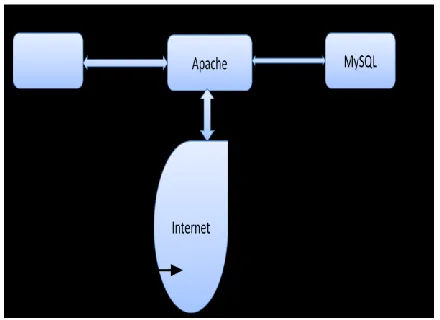
[image:4.612.341.561.523.683.2]The design of the cloud data base centre is as shown below
© 2017, IRJET | Impact Factor value: 5.181 | ISO 9001:2008 Certified Journal
| Page 762
The cloud stores the data that it received from the network and the received data can be retrieved back from anywhere and the status of the devices can be known and the required actions can be taken. In the above figure 2 shows the cloud database centre where the database centre, web server are connected together by the HTTP. The web server where the apache is connected to the internet and the web server is also connected to the client browser where the client can access the data, hence the procedure shows the design of database centre of cloud.
IMPLEMENTATION
[image:5.612.53.271.324.435.2]Modules of Proposed System The two modules used are: 1. Transmitter 2. Receiver In the below mentioned figure (3 & 4) is a system and method for design of Energy Conservation System for Smart Homes Based on Cloud Network.
[image:5.612.58.266.482.629.2]Fig 3: Block diagram of Transmitter with ZigBee and Sensors
Fig 4: Block Diagram of Receiver [MASTER NODE] with ZigBee and Monitoring and control done through cloud
(PC).
The Wireless (ZigBee) Based Home Automation System Using ARM 7,In this project there are mainly two modules
one is the transmitter and the other is the receiver, in transmitter section the MC is connected to different sensors, where the data from the sensors are transmitted to the receiver using the ZigBee and then the data received by the receiver is uploaded to the cloud using the GPRS. The data can also be viewed in the GUI (graphical user interface) developed with the help of Visual studio/dot net. Main advantage of the cloud in this project is, we can access the device status from anywhere and we can retrieve back the data whenever it is necessary and perform some particular action.
SYSTEM REQUIREMENTS
Software Requirements
Express PCB and express schematic
Keil micro-vision 3 real view IDE
Flash utility software for programming
Embedded C
JDK
Visual studio 2010
Windows XP
Hardware Requirements
Microcontrollers
ARM 7
ZigBee Modules
Temperature, humidity, motion sensors
LCD Display
Power supply 12V i.e. 1A
Relays
[image:5.612.344.556.498.684.2]© 2017, IRJET | Impact Factor value: 5.181 | ISO 9001:2008 Certified Journal
| Page 763
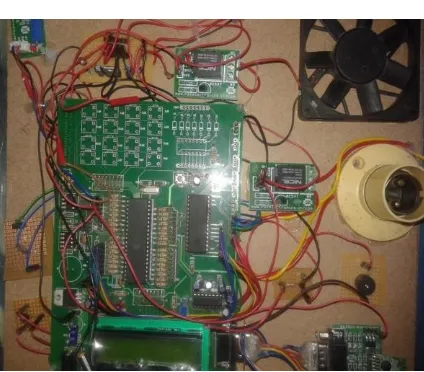
Fig 6: Snapshot of ARM 7
SNAPSHOTS
The below picture 7 represents the flash utility software, in which the port for the transmission of the data can be checked,
Fig 7: Snapshot of Flash Utility and Running the Program Dumped
COM 3 and then buffer to serial analysis cable can be introduced so that the new program can be dumped into the ARM 7 board and the terminal is used to run the software and the output is displayed in the screen as shown in the next snapshot 6.3 and hence the status of the devices can be known.
[image:6.612.54.270.363.522.2]The below picture 8 represents the snapshot of the drop box,
Fig 8: Snapshot of the Cloud Drop box
In which the data is displayed in terms of ASCII format, from the values mentioned in the drop box. We get know the status of the devices in the house along with the time and date, hence one can know the status of the devices inside the house using the cloud in which the data is uploaded to the cloud using the GPRS and also can control the devices in the house.
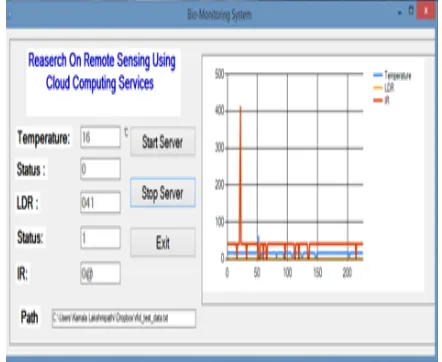
The below picture 9 represents the snapshot of the GUI (graphical user interface) the name of the project the elements required for the project like the status of temperature, light, motion detection etc. shown GUI the server is started hence data is visible, graph is also seen in the picture above, and also the path for linking the cloud. Once the start server button is clicked then the server starts before that the path to the drop box has to be copied and also one can see the status of temperature, light intensity values.
[image:6.612.339.560.497.678.2]© 2017, IRJET | Impact Factor value: 5.181 | ISO 9001:2008 Certified Journal
| Page 764
The graph for associated values in which blue line represents the temperature, yellow line represents the light intensity and red line represents the motion detection inside the house. The graph shows the values of the temperature, light intensity and motion detection values in different colors so that the user can identify the changes in the values easily and take necessary actions.
CONCLUSION
Cloud computing is the booming technology and all the companies today have this new technology adapted and there is no doubt that this companies are running successfully and even cloud computing can be adapted for small to mid-size companies and the experts believe that this technology as better future and become one of the prominent technology in future. Cloud computing technology provide one of the best service for controlling and accessing and Upgraded level of security and convenient usage of the devices can be achieved through the combination of the ZigBee and cloud computing services because of their Distinguishing features and Eliminates the manual control of the devices and Provides provision for future development E.g.: Building of smart cities and Aimed to facilitate the life of human beings. In this work we can control the fan, light and motion detection of the people in the house and monitor the devices in house from anywhere, also can save power consumption and help in improving the communication performance.
FUTURE ENHANCEMENT
The future enhancement depicts the research that can be further enhanced for the present project so that the project comes of the present disadvantages and have good scope in real time. In this project the further enhancement can be done as mentioned below:-
The status monitoring of the devices could be
done even in the presence of people in the house.
It could also be extended for the timely pet feeding
in the house or farms
The government can launch the public cloud and
see to it that there is no wastage of power and efficient utilization of the power can be done. Helps in building of smart cities and make it a
better place to live.
BIBLIOGRAPHY
[1] “IOTs Gateways: Bridging Wireless Sensors Networks into Internet of Things” by Qian Zhu, Ruicong Wang, Qi Chen, Yan Liuand Weijun Qin 2010 IEEE
[2] “A Security Aspect in Cloud Computing” by Gurudatt Kulkarni & Jayanth Gambir & Teiswini Patil &Amruta Dongare ©2012 IEEE
[3] “Technologies and Protocols for Data Centers and Cloud Networkings” by Nabil Bitar, Steven Gringeri, and Tiejun J. Xia, Verizon Laboratories© 2013 IEEE.
[4] “Dynamic merging of ZigBee’s Homes Networks into Home Gateways Using OSGi’s Services Registry’s” by Young-Guk Ha©2009 IEEE.
[5] “ZigBee source route technology in home application” by Yao-Ting Wu in 2008 IEEE.
[6] “Research of ZigBee’s data securities and protections” by Li Chunqing1, Zhang Jiancheng, © 2009 IEEE.
[7] “ZigBee and UPnP Expansion for Home Electrical Appliance Control on Internet” by Kuk-Se Kim, Chanmo Park ,Kyung-SikSeo, Il-Yong Chung, Joon Lee2007 ICACT2007.
[8] “ZigBee’s Wireless Sensors Applications for Health, Wellness and Fitness” by ZigBee’s Alliances© 2009 ZigBee Alliance.
[9] “Z-Phone: Implementation and Design of Embedded Voice over ZigBee Applications” by A. Meliones and E. Touloupis.