© 2017, IRJET | Impact Factor value: 5.181 | ISO 9001:2008 Certified Journal
| Page 471
Finite Element Solution On Effects Of Viscous Dissipation & Diffusion
Thermo On Unsteady Mhd Flow Past An Impulsively Started Inclined
Oscillating Plate With Mass Diffusion &Variable Temperature
B. Shankar Goud
1, M.N Rajashekar
21
Department of Mathematics, JNTUH College of Engineering Kukatpally, Hyderabad- 085 , TS, India.
2
Department of Mathematics, JNTUH College of Engineering Nachupally, Karimnagar -505501, TS, India.
---***---Abstract -
The aim of this is paper is to investigate on the effects of viscous dissipation and diffusion thermo on an unsteady MHD flow with an inclined oscillating plate started impulsively. The effects with a variable temperature and mass diffusion are observed. Considered fluid is gray, absorbing-emitting radiation, but a non-scattering medium. Solutions of the nonlinear differential equation are obtained by finite element method. The effects of different flow parameters on the flow variables are discussed. The results have been analyzed graphically.Key Words: Unsteady, variable temperature and mass diffusion, MHD, FEM, Viscous Dissipation
1. INTRODUCTION
The study of the hydromagnetic flow of an electrically conducting fluid has many applications in science and engineering problems such as magnetohydrodynamic (MHD) generator, plasma studies, nuclear reactors, aerodynamic heating, etc. Soundalgekar et al [1] investigated the problem of free convection effects on Stokes problem for a vertical plate with transverse applied magnetic field. Elbasheshy [2] studied MHD heat and mass transfer problem along a vertical plate under the combined buoyancy effects on of thermal and spices diffusion. Ibrahim [3] has investigated analytical solution of heat and mass transfer over a permeable stretching plate affected by chemical reaction, internal heating, Dufor-Soret effect and Hall effect.MHD flow Past an Impulsively started vertical plate with variable temperature and mass diffusion was studied by Rajput and Surender kumar [4]. Rao and Shivaiah [5] studied chemical reaction effects on unsteady MHD flow past semi- infinite vertical porous plate viscous dissipation. P.K Sing [6] showed heat and mass transfer in MHD boundry layer flow past an inclined plate with variable temperature and mass diffusion. T.Arun kumar and L Anand Babu [7] has analyzed the study of Radiation effect of MHD flow past an impulsive started vertical plate with variable
temperature and uniform mass diffusion – A finite element method.
P.Srikanth Rao and D.Mahendar [8] investigated Soret effect on unsteady MHD free convection flow past a semi-infinite vertical permeable moving plate. D.Chennakesavaiah and P V Satyanarayana[9] studied the radiation absorption and dufour effect to MHD flow in vertical surface. Dufour effects on unsteady MHD free convection and mass transfer flow fast through a porous medium in slip regime with heat source/ sink was studied by K.Sharmilaa and S.Kaleeswari[10]. K.Anitha [11] has analyzed chemical reaction and radiation effects on unsteady MHD natural convection flow of rotating fluid past a vertical porous flat plate in the presence of a viscous dissipation. The effect of Hall current on an unsteady MHD free convective flow along a vertical plate with the thermal radiation was studied by P.Srikanth Rao and D.Mahendar [12].
2.
MATHEMATICAL ANALYSIS
In this paper we have considered MHD flow between two parallel electrically non conducting plates inclined at an angle
from vertical. axis is taken along the plate andnormal to it. A transverse magnetic field of uniform strength is applied on the flow. The viscous dissipation and induced magnetic field has been neglect due to its small effect. Initially it has been considered that the plate as well as the fluid is at same temperature and the Concentration level everywhere in the fluid is same as in stationary condition. At time
t
0
, the plate starts oscillating in its own plane with frequency
and temperature of the plate is raised to and the concentration level near the plate is raised linearly with respect to time.© 2017, IRJET | Impact Factor value: 5.181 | ISO 9001:2008 Certified Journal
| Page 472
2 * 2 2 0 cos u ug T T g C C
t t B u - (1) 2 2 2 2 2 m T
p s p p
D k
T k T C u
t C y C C y C y
- (2)
2
2 r
C C
D K C C
t y
- (3)
With the corresponding initial and boundary conditions:
2 0 0
2 0
0 : 0, , ,
0 : cos , ( ) ,
( ) 0
0, ,
w
w
t u T T C C for all y
U t
t u U t T T T T
U t
C C C C at y
u T T C C as y
- (4)
In order to write the governing equations and the boundary conditions in dimensionless form, the following non dimensional quantities are introduced.
2 0 0 0 0 2 3 0 0 * 2 3 2 0 2 0 2 0 , , , ,, , Pr ,
, , , , , , , p w w w w
m T w r
S P w
P w
U y
t U u
t y u Sc
U D
c
C C
T T
C
T T C C k
g T T
Gr
U U
g C C B
Gm M
U U
D k C C K
Du Kr
c c T T U
U Ec
c T T
- (5)
With the non dimensional quantities equations (1),(2) and (3) reduces to the following dimensionless form:
2
2 cos r m
u u
G G C Mu
t y
- (6)
2 2 2 2 2 1 Pr C u Df Ec
t y y y
- (7)
2
2
1
C C
KrC
t Sc y
- (8)
With the initial and boundary conditions in dimensionless form are:
0, 0, 0, , 0
0 : cos , , , 0,
0, 0, 0
u C for all y t
t u t t C t at y
u C as y
- (9)
3. SOLUTION OF THE PROBLEM
Using finite element method with Crank-Nikolson discretization taking h0.1,k0.01.The element
equation for the typical element( )e yj y ykfor the
boundary value problem can be written as: 2 ( ) ( )
( ) ( )
2 0
k T
j
y e e
e e
y
u u
N Mu P dy
t y
- (10)Where PGrcosGmcosC
( ) ( ) ( )
( ) ( ) ( ) ( )
0
k k k
T T T
j j
j
y y y
e e e
e e e e
y y
y
u u u
N N dy N Mu P dy
y y t
Neglecting the first term in the above equation, we get
( ) ( )
( ) ( ) ( ) 0
k
T T
j
y e e
e e e
y
u u
N N Mu P dy
y t
Let ( )e ( )e ( )e
u N be the finite element approximation
solution (yj y yk) where
( ) ( )
, T
e e
j k j k
N N N u u , k , j
j k
k j k j
y y
y y
N N
y y y y
are the basis functions.
yk yk
j j j k j j j j k j
j k k j k k k
yj yj
k
yk yk
j j j k j j
j k k k k k
yj yj
N N N N u N N N N u
dy dy
N N N N u N N N N
u
N N N N u N
M dy P dy
N N N N u N
Where
denotes the differentiation with respect to' 'y and ' 'denotes the differentiation with respect to' 't . Here
' 1, ' 1
j k
N N
h h
,hykyj
( ) ( ) ( )
( )
1 1 2 1 2 1 1
1
1 1 6 1 2 6 1 2 2 1
e e e
j
j j
e
k k
k
u l u Ml u Pl
l u u u
© 2017, IRJET | Impact Factor value: 5.181 | ISO 9001:2008 Certified Journal
| Page 473
2
( )
1 1 2 1 2 1 1
1 1
1 1 6 1 2 6 1 2 2 1
j
j j
e
k k
k
u u M u P
u u l u
We write the element equation for the elements 1
i i
y y y and yi y yi1 assemble three elements equations, we obtain
2 1 1 ( ) 1 1 1 1
1 1 0 2 1 0
1 1
1 2 1 1 4 1
6
0 1 1 0 1 2
2 1 0 1
1 4 1 2
6 2
0 1 2 1
i i i i e i i i i i u u u u l u u u M P u u - (11)
Now put row corresponding to the node to zero, from the above equation the difference scheme is
2 1 1 1 1
( ) 1 1 1 1 2 4 6 4 6
i i i
i i i
e
i i i
u u u u u u
l M
u u u P
Put ( )e2 2
l h , r k2 h
.
2 1 1 1 1
1 1 1 1 2 4 6 4 6
i i i
i i i
i i i
u u u u u u
h M
u u u P
Applying the trapezoidal rule, the following equations in Crank-Nicholson method are obtained:
1 1 1 *
1 1 2 3 1 4 1 5 6 1
n n n n n n
i i i i i i
A u A u A u A u A u A u P - (12) Where
1 4
2 5
3 6
*
2 6 2 6
8 12 4 , 8 12 4
2 6 , 2 6
12 12 ( cos n cos n
r i m i
A Mk r A Mk r
A r Mk A r Mk
A Mk r A Mk r
P Pk k G G C
Similarly applying the applying Galerikin finite element method for equations (7) and (8) the following equations are obtained:
1 1 1 **
1 1 2 3 1 4 1 5 6 1
n n n n n n
i i i i i i
B
B
B
B
B
B
P - (13)1 1 1
1 1 2 3 1 4 1 5 6 1
n n n n n n
i i i i i i
C C C C C C C C C C C C - (14)
Where
1 4 1
2 5 2
3 6 3
5 4 6 2 2 ** 1 2
2 Pr 6 2 Pr 6 2 6
8 Pr 12 8 Pr 12 8 4 12
2 Pr 6 2 Pr 6 2 6
8 4 12
2 6
2 6
12 12 Pr i Pr
i
B r B r C Sc kScKr r
B r B r C Sc kScKr r
B r B r C Sc kScKr r
C Sc kScKr r
C Sc kScKr r
C Sc kScKr r
C u
P P k k Df Ec
y y
Here h k, are the mesh sizes along y direction and t direction respectively. Index refers to the space and refers to the time. In equation (12), (13) and (14), taking
( )
and using (9), the following systems of equations are obtained:( )
- (15) Where’s are the matrices of order and ’s column matrices having
componenets. The solutions of the above system of equations are obtained by using Thomas algorithm for the velocity
( )
, temperature( )
, concentration( )
. Also numerical solutions are obtained by C-program. Computations are carried out until the steady state is reached. In order to prove the convergence of the Galerkin finite element method, the computations are carried out for slight changed values of h k, byrunning same C program, no significant changes was observed in the values of velocity
( )
, temperature( )
, concentration( )
. Hence, the finite element method is stable and convergent.4.
RESULTS AND DISCUSSION
[image:3.595.37.222.364.499.2]In order to assess the effects of the dimensionless thermo physical parameters on the regme calculations have been carried out on velocity, temperature, concentration fields for various physical parameters like, mass Grashof number (Gm), thermal Grashof number (Gr), magnetc field parametrt (M), Dufour number (Df), Prandtl number problem (Pr), Schmidt number (Sc) and time (t).The results are represented through graphs in figures 1 to 16 for various parameters
© 2017, IRJET | Impact Factor value: 5.181 | ISO 9001:2008 Certified Journal
| Page 474
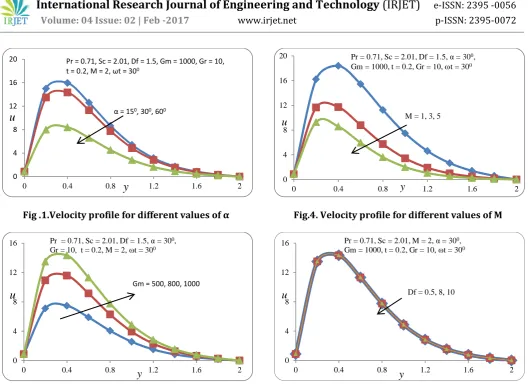
Fig .1.Velocity profile for different values of αFig.2.Velocity profile for different values of Gm
Fig. 3.Velocity profile for different values of Gr
Figure 2 describes that an increase in mass Grashof number cause an increase in velocity of the fluid under consideration. It is observed that from figure 3, the velocity is increased when the thermal Grashof number is increased.
Fig.4. Velocity profile for different values of M
Fig. 5.Velocity profile for different values of Df
Fig.6. Velocity profile for different values of ωt
Figure 4 details the effect of increasing the values of magnetic parameter M resulting a decrease in velocity. From Figure 5 show that the decrease in velocity is caused by increase in Dufour number
0 4 8 12 16 20
0 0.4 0.8 1.2 1.6 2
Pr = 0.71, Sc = 2.01, Df = 1.5, Gm = 1000, Gr = 10, t = 0.2, M = 2, ωt = 300
α = 150, 300, 600
u
y
0 4 8 12 16
0 0.4 0.8 1.2 1.6 2
Pr = 0.71, Sc = 2.01, Df = 1.5, α = 300, Gr = 10, t = 0.2, M = 2, ωt = 300
Gm = 500, 800, 1000
u
y
0 5 10 15 20 25 30 35
0 0.4 0.8 1.2 1.6 2
Pr = 0.71, Sc = 2.01, Df = 1.5, α = 300, Gm = 1000, t = 0.2, M = 2, t = 300
Gr = 10,100,500
0 4 8 12 16 20
0 0.4 0.8 1.2 1.6 2
Pr = 0.71, Sc = 2.01, Df = 1.5, α = 300, Gm = 1000, t = 0.2, Gr = 10, t = 300
M = 1, 3, 5
u
y
0 4 8 12 16
0 0.4 0.8 1.2 1.6 2
Pr = 0.71, Sc = 2.01, M = 2, α = 300, Gm = 1000, t = 0.2, Gr = 10, ωt = 300
Df = 0.5, 8, 10
u
y
0 4 8 12 16
0 0.4 0.8 1.2 1.6 2
Pr = 0.71, Sc = 2.01, M = 2, α = 30, Gm = 1000, t = 0.2, Gr = 10, Df = 1.5
ωt = 300, 900, 1800
© 2017, IRJET | Impact Factor value: 5.181 | ISO 9001:2008 Certified Journal
| Page 475
Fig.7.Velocity profile for different values of Pr
Fig.8.Velocity profile for different values Sc
Fig.9.Velocity profile for different values of t
From figure 9, when time is increased then the velocity increased. Figures 10 to 13 describes that the temperature profile for parameters Dufour number, Prandtl number, Schmidt number, time respectively.
Fig.10.Temperature profile for different values of Df
Fig.11.Temperature profile for different values of Pr
Fig.12.Temperature profile for different of Sc
An increase in the above mentioned parameters lead to increased temperature. Figure 14-16 displays the effects of the Dufour number, Prandtl number and time on concentration profiles. We observe that concentration profiles increases with increasing Df, Pr, t.
0 4 8 12 16
0 0.4 0.8 1.2 1.6 2
Pr = 0.71, 4.5, 7
Sc = 2.01, M = 2, α =3 00, Gm = 1000,
u
y
0 2 4 6 8 10 12 14 16
0 0.2 0.4 0.6 0.8 1 1.2 1.4 1.6 1.8 2
Pr = 0.71, M = 2, α = 300 , Gm = 1000, t = 0.2, Gr = 10, ωt = 300, Df = 1.5
Sc = 2.01, 2.10, 2.20
0 4 8 12 16
0 0.4 0.8 1.2 1.6 2
t = 0.15, 0.18, 0.2 Pr = 0.71, Sc = 2.01, M = 2, α = 300,
u
y
0 0.05 0.1 0.15 0.2 0.25
0 0.4 0.8 1.2 1.6 2
Df = 0.5, 1, 1.5
Pr = 7, Sc = 2.01, M = 2, α = 300, Gm = 1000, Gr = 10, ωt = 300, t = 0.2
y
0 0.05 0.1 0.15 0.2 0.25
0 0.4 0.8 1.2 1.6 2
y
Df = 0.2, Sc = 2.01, M = 2, α = 30, Gm = 1000, Gr = 10, t = 300, t = 0.2
Pr = 0.71, 4.5, 7
0 0.2 0.4 0.6 0.8
0 0.4 0.8 1.2 1.8
Pr = 7, Df = 0.2, M = 2, α = 30, Gm = 1000, Gr = 10, Wt = 30, t = 0.2
Sc = 2.01, 3, 4
© 2017, IRJET | Impact Factor value: 5.181 | ISO 9001:2008 Certified Journal
| Page 476
Fig.13.Temperature profile for different values of tFig. 14.Concentration profile for different values of Df
Fig.15. Concentration profile for different values of Pr
Observation of Figure 6 depicts that an increase in phase angle, decreases velocity. Figure 7 demonstrates that the increase in velocity with an increase in Prandtl number. Figure 8 depicts an increase in velocity due to an increase in Schmidt number.
Fig.16. Concentration profile for different values of t
5. CONCLUSIONS
In this article a mathematical model has been presented for the effects of the viscous dissipation and diffusion thermo on unsteady magnetohydrodynamics flow past an impulsively started inclined oscillating plate with mass diffusion and variable temperature. Solutions for the model have been derived by finite element method. The conclusions of the study are as follows:
1. Velocity increases with the increase in mass Grashof number, Prandtl number, Schmidt number and time.
2. Velocity decrease with increase in the angle of inclination of plate, thermal Grasof number , the magnetic field, Dufour number and phase angle. 3. Temperature profiles increases with the
increase in Dufour number , Prandtl number, Schmidt number and time.
REFERENCES
[1] Soundalgekar VM.,Gupta Sk.,Birajdar NS “Effect of mass transfer and free effects on MHD Stokes problem for a vertical plate ,Nucl Eng Res, 53 ,pp.309-46,1979.
[2] ElbasheshyEMS “Heat and mass transfer problems along a vertical plate and concentration in the presence of magnetic field”, International journal of Engineering Science, 34(5), pp. 15-22, 1997.
[3] Ibrahim a.abdallah. “Analytical solution of heat and mass transfer over a permeable stretching plate affected by chemical reaction, internal heating, Dufor-soret effect and Hall effect”, Thermal Science: 13(2), pp. 183-197, 2009.
0 0.05 0.1 0.15 0.2 0.25
0 0.4 0.8 1.2 1.6 2
Pr = 0.71, Df = 0.2, M = 2, α = 300, Gm = 1000, Gr = 10, ωt = 300, Sc = 2.01
t = 0.1, 0.15, 0.2
y
0 0.1 0.2 0.3 0.4 0.5 0.6 0.7
0 0.6 1 1.4 1.8
Pr = 0.71, Sc = 2.01, M = 2 , α = 300, Gm = 1000, Gr = 10, ωt = 30,0 t = 0.2
Df = 0.5, 1, 1.5
C
y
0 0.05 0.1 0.15 0.2 0.25
0 0.4 0.8 1.2 1.6 2
Pr = 0.71, 4.5, 7 Df = 0.2, Sc = 2.01, M = 2, α= 300, Gm = 1000, Gr = 10, ωt = 30, t = 0.2
C
y
0 0.05 0.1 0.15 0.2 0.25
0 0.4 0.8 1.2 1.6 2
C
y
Pr = 0.71, Df = 0.2 , M = 2, α = 300, Gm = 1000, Gr = 10, ωt = 300, Sc = 2.01
[image:6.595.37.291.454.601.2]© 2017, IRJET | Impact Factor value: 5.181 | ISO 9001:2008 Certified Journal
| Page 477
[4] U.S. Rajput and Surender kumar “MHD flow Past anImpulsively started vertical plate with variable Temperature and Mas Duffusion”, Applied Mathematical Science, 5(3),pp.149-157,2011.
[5] Rao and Shivaiah “Studied chemical reaction effects on unsteady MHD flow past semi- infinite vertical porous plate viscous dissipation”, Appl.Math.Mech-Engl.Ed., 34(8), pp. 1065-1078, 2011.
[6] P.K Sing “ Heat and mass transfer in MHD boundry layer flow past an inclined plate with variable temperature and mass diffusion”, International Journal of Scientific &Engineering Research ,3(6), pp.1-11, 2012.
[7] T.Arun kumar and L Anand Babu “Study of Radiation effect of MHD flow past an impulsive started vertical plate with variable temperature and uniform mass Diffusion – A finite element method”, Ind.J.Sci.and tech.
1(3), pp.3-9, 2013.
[8] P.Srikanth Rao and D.Mahendar “Soret effect on unsteady MHD free convection flow past a semi-infinite vertical permeable moving plate”,
International of Mathematical Archive, 5(8), pp.235-245, 2014.
[9] D. Chenna Kesavaiah and P V Satyanarayan “Radiation absorption and dufour effects to mhd flow in vertical surface”,Global journal of engineering ,design & technology, 3(2) , pp.51-57, 2014.
[10] K.Sharmilaa and S.Kaleeswari “Dufour effects on unsteady MHD free convection and mass transfer flow fast through a porous medium in slip regime with heat source/ sink”, International Journal of scientific Engineering and Applied Science(IJSEAS),1(6), pp.307-320,2015
[11] K.Anitha “Chemical reaction and radiation effects on unsteady MHD natural convection flow of rotating fluid past a vertical porous flat plate in the presence of a viscous dissipation”, International Journal of Science and research (IJSR), 4(3),2015.