University of East London Institutional Repository: http://roar.uel.ac.uk
This paper is made available online in accordance with publisher policies. Please scroll down to view the document itself. Please refer to the repository record for this item and our policy information available from the repository home page for further information.
To see the final version of this paper please visit the publisher’s website. Access to the published version may require a subscription.
Author(s):
Lee, Sin Wee; Palmer-Brown, Dominic.Article title:
Phonetic Feature Discovery in Speech using Snap-DriftYear of publication:
2006Citation:
Lee, S. W. and Palmer-Brown, D. (2006). "Phonetic Feature Discovery in Speech using Snap-Drift." International Conference on Artificial Neural Networks (ICANN'2006) (Athen, Greece, 10th - 14th September 2006), S. Kollias et al. (Eds.): ICANN 2006, Part II, LNCS 4132, pp. 952 -962.Link to published version:
http://dx.doi.org/10.1007/11840930_99Learning
Sin Wee Lee and Dominic PalmerBrown
Innovative Informatics Research Group http://www.uel.ac.uk/scot/ii/index.htm University of East London, Essex, Rm8 2AS, UK
{SinWee, D.PalmerBrown}@uel.ac.uk
Abstract. This paper presents a new application of the snapdrift algorithm [1]: feature discovery and clustering of speech waveforms from nonstammering and stammering speakers. The learning algorithm is an unsupervised version of snapdrift which employs the complementary concepts of fast, minimalist learning (snap) & slow drift (towards the input pattern) learning. The Snap Drift Neural Network (SDNN) is toggled between snap and drift modes on successive epochs. The speech waveforms are drawn from a phonetically annotated corpus, which facilitates phonetic interpretation of the classes of patterns discovered by the SDNN.
1
Introduction
Stuttering (stammering) is a highly variable condition which occurs across ages and cultures. There is a lack of consensus in establishing the criteria for a definition. Finding a way of identifying exactly what phonetic characteristics are associated with stammering, as opposed to nonstammering speech, has proved elusive. Perceptual analysis is known to be compromised by its subjectivity [2], [3]. In contrast, a correlative data analysis to characterise the acoustic properties of stammering is realisable. There are four classes of sound pressure wave that form the acoustic structure of utterances [4]: Periodic ‘voice’: regular repeating fluctuations produced by vocal fold vibration; Aperiodic ‘noise’: ongoing irregular fluctuations in voiceless fricatives; Transient ‘burst’: brief irregular fluctuations as in voiceless plosives; or Silent: no acoustic energy is emitted. The speech sounds used in human languages are made up of combinations of the four categories.
The snapdrift learning algorithm first emerged as an attempt to overcome the limitations of ART learning in nonstationary environments where selforganisation needs to take account of periodic or occasional performance feedback. Since then, the snapdrift algorithm has proved invaluable for continuous learning in several applications.
of reinforcement, has been used in the analysis and interpretation of data representing interactions between trainee network managers and a simulated network management system [7]. New patterns of the user behaviour were discovered.
The further exploration ofsnapdrift, in the form of a classifier [8] has been used in attempting to discover and recognize phrases extracted from Lancaster Parsed Corpus (LPC) [9]. Comparisons carried out between snapdrift and MLP with back propagation, show that the former is faster and just as effective.
This paper describes the further exploration of snapdrift, in unsupervised form, in attempting to discover the defining and unique millisecond features in the speech patterns, which will be used to help understand the language learning of non stammering and stammering speakers.
2
The SnapDrift Neural Network (SDNN) Architecture
[image:3.595.173.428.377.531.2]
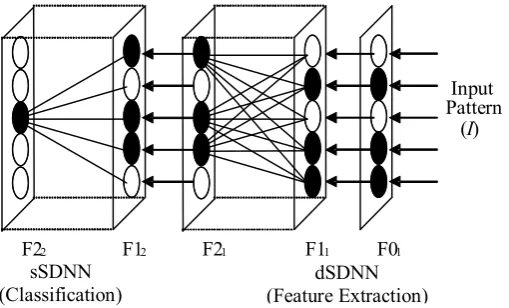
The modular neural network modified from the Performanceguided Adaptive Resonance Theory (PART) network, first introduced by Lee & PalmerBrown [1] is shown in Fig. 1.
Fig. 1. SDNN Architecture
On presentation of an input pattern at the input layer F01, dSDNN will learn to group the input patterns according to their general features. In this case, 10 F21 nodes, whose weight prototypes best match the current input pattern, are used as the input data to the sSDNN module for feature classification. In both of the modules, the standard matching and reset mechanism of ART [5], [6] is discarded. Instead, in the dSDNN module, the output nodes with the highest net input are always accepted as winners. In the sSDNN module, a quality assurance threshold is introduced. If the net input of a sSDNN node is above the threshold, the output node is accepted as the winner, otherwise a new uncommitted output node will be selected as the new winner and initialised with the current input pattern.
Input Pattern
(I)
F22 F12 F21 F11 F01 dSDNN (Feature Extraction) sSDNN
In this version of SDNN we introduce weight reinitialisation. The main purpose of weight reinitialisation is to enable unused output nodes to be reinstated into the competition for winning nodes. Weight reinitialization is invoked after many epochs since the SDNN must first allow input patterns to settle into their categories. After a duration defined by a certain number of input patterns, called a learning era (an era is a number of epochs), the weights of nodes unused during the preceding era will be reinitialised to enable them to participate again in the competition for the best winning nodes. In effect, reinitialisation is a neuron pruning algorithm. It removes weight vectors that are redundant.
The following is a summary of the steps that occur in SDNN:
Step 1: Initialise parameters: (a = 1, s = 0), era = 2000
Step 2: For each epoch (t)
Test: Weights reinitialization condition For each input pattern
Step 2.1: Find the D (D = 10) winning nodes at F21
with the largest net input
Step 2.2: Inhibit the F21 node for weights re
initialization
Step 2.3: Weights of dSDNN adapted according to the
alternative learning procedure: (a,s)
becomes Inverse(a,s) after every successive epoch
Step 3: Process the output pattern of F21 as input
pattern of F12
Step 3.1: Find the node at F12 with the largest net
input
Step 3.2: Test the threshold condition:
IF (the net input of the node is greater than the threshold)
THEN
Weights of the sSDNN output node adapted according to the alternative learning procedure: (a,s)
becomes inverse (a,s) after every successive epoch ELSE
An uncommitted sSDNN output node is selected and its weights are adapted according to the
alternative learning procedure: (a,s) becomes Inverse(a,s) after every successive epoch
Weights reinitialization condition:
After ‘era’ input patterns
IF (F21 node not used for the past era input
Reinitialize the F21 node with randomly selected input
pattern
Inhibit the F21 node for weights reinitialization for
the next era input pattern presentation ELSE
No action taken.
3
The SnapDrift Algorithm
The learning algorithm combines a modified form of Adaptive Resonance Theory (snap) [10] and Learning Vector Quantisation (drift) [11]. In general terms, the snap drift algorithm can be stated as:
Snapdrift=a(Fast_Learning_ART) +s(LVQ) (1) The topdown learning of both of the modules in the neural system is as follows:
wJi (new) = a(I ÇwJi (old) ) +s(wJi (old) +b (I wJi (old) )) (2) where wJi = topdown weights vectors; I = binary input vectors, and b = the drift speed constant = 0.5.
In successive learning epochs, the learning is toggled between the two modes of learning. When a = 1, fast, minimalist (snap) learning is invoked, causing the top down weights to reach their new asymptote on each input presentation. (2) is simplified as:
wJi (new) = I ÇwJi (old) (3) This learns subfeatures of patterns. In contrast, when s= 1, (2) simplifies to:
wJi (new) = wJi (old) +b (I wJi (old) ) (4) which causes a simple form of clustering at a speed determined byb.
The bottomup learning of the neural system is a normalised version of the top down learning.
wiJ (new) = wJi (new) / | wJi (new) | (5) where wiJ (new) = topdown weights of the network after learning.
In SDNN, as described in section 2, snapdrift is toggled between snap and drift on each successive epoch. The effect of this is to capture the strongest clusters (holistic features), subfeatures, and combinations of the two.
4
Simulations
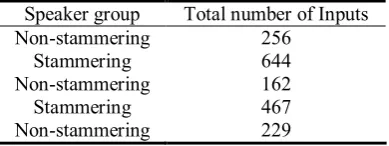
simulations, preprocessing of the utterances is completed. In this research, each point of a speech utterance waveform collected represents 1 ms of speech data. In this research, in order to analyze and recognise the acoustic properties of the speaker with sufficient precision, each utterance is sampled every 10 points for a total of 1000 points, which represents about 1 second of speech information. This is considered sufficient by a phonetics expert. Figure 2 shows the example of sampled utterance used in the simulations. Each of the sampled waveforms is used to generate a number of input patterns for SDNN. The input patterns are generated using a sliding window of size 100 samples points. The sliding window is shifted to the right by 25 sample points to create a new input. This provides some overlapping of features among the input patterns. Then, each input pattern is converted into a 1400 bit coarse coded binary pattern. 5 utterances are used from 2 speakers, 3 utterances from the non stammering speaker and 2 from the stammering speaker. Table 1 shows the range and properties of the input set, making the total number of input patterns, 1873 input vectors. These test input patterns are presented in sequence to SDNN. The number of input patterns for each speaker varies because:
1. Each speaker is asked to speak using different types of statements.
2. Nonstammering speaker will produce more fluent speech utterances with shorter or no delay between phrases.
3. Stammering speakers always produce longer utterances due to the delay in the voiceless fricative.
The input patterns, which are also quite noisy, provide a real world test for unsupervised SDNN as a feature discovery and classification system.
[image:6.595.201.396.533.606.2]For SDNN to act as a viable classifier, and to demonstrate the utility of the features it acquires, it should be able to estimate or predict whether a speaker in a realtime scenario is nonstammering or stammering when a speech utterance is fed into the system. An estimation will be made of how long it takes to be certain that a speaker is nonstammering or stammering.
Table 1. Range and properties of the input set
Speaker group Total number of Inputs Nonstammering 256
40000 30000 20000 10000 0 10000 20000 30000 40000
[image:7.595.195.422.158.262.2]1 516 1031 1546 2061 2576 3091 36064121 4636 5151 5666 6181
Fig. 2. Example utterance waveform used in simulation
4.1 Results
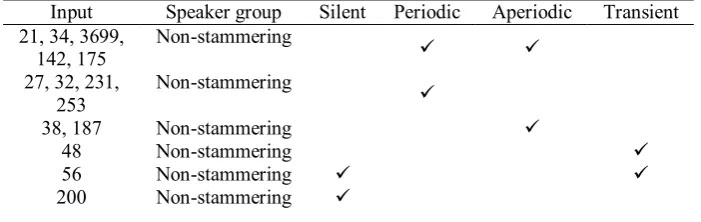
[image:7.595.124.478.432.552.2]The results are presented in Table 2 to Table 4; each of the tables shows the example category types formed by the SDNN network with their acoustic properties. The acoustic properties record is obtained from a phonetics expert’s annotation of the speech waveform corpus. Each of the sampled sequence of the speech utterance is identified with one or more acoustic properties: Silent, Periodic, Aperiodic and Transient.
Table 2. Accoustic properties of example category type 1 (Stammering)
Input Speaker group Silent Periodic Aperiodic Transient
195 Nonstammering ü ü ü
211 Nonstammering ü ü
377, 456 Stammering ü
432, 68 Stammering ü ü
473, 485, 575, 585
Stammering
ü
570 Stammering ü ü
595 Stammering ü ü
609 Stammering ü ü
Table 3. Accoustic properties of example category type 2 (NonStammering)
Input Speaker group Silent Periodic Aperiodic Transient 21, 34, 3699,
142, 175
Nonstammering ü ü
27, 32, 231, 253
Nonstammering
ü
38, 187 Nonstammering ü
48 Nonstammering ü
56 Nonstammering ü ü
[image:7.595.123.474.582.693.2]304 Stammering ü ü ü
[image:8.595.123.473.201.320.2]310 Stammering ü ü
Table 4. Accoustic properties of example category type 3 (Mixture of both type of speakers)
Input Speaker group Silent Periodic Aperiodic Transient 45, 108 Nonstammering ü ü
165 Nonstammering ü
131, 135 Nonstammering ü ü
204, 123 Nonstammering ü
283, 504 Stammering ü ü
304, 442 Stammering ü ü ü
615, 565, 370, 457
Stammering
ü
546, 547 Stammering ü
By looking at the tables, it is clear that the SDNN has categorised the input patterns into 3 distinctive types, stammering speech, nonstammering speech, and a category type with a mixture of the two speaker types. The three category types were identified since they corresponded to different nonoverlapping sets of sSDNN output nodes.
Fig. 3.Example input waveform for category type 1 (Input 377)
15000 10000 5000 0 5000 10000
[image:8.595.209.420.391.537.2]Fig. 4.Example input waveform for category type 1 (Input 595)
Fig. 3 5 show the example input waveforms being grouped into the same category, in this case example category type 1 (Stammering). By comparing these waveforms, the similarities can be easily identified. In order to understand the learned features of the speech utterances, a comparison of the input patterns of the system and the learned weight templates is performed.
[image:9.595.200.408.516.662.2]The input patterns received by the SDNN are binary coarse coded representations of the fragments of speech input utterances, such as those shown in Fig. 3 – 5. Each point in the speech input is represented by a 14 bit binary representation. So, the weights learned are the results of processing these binary input patterns. As a means of visualization, the weights learned are thresholded as a first order approximation to produce a binary representation of the weights learned. Then, the 14 bit coarse binary representation of the weights learned are decoded to show the actual waveform features that have been acquired from the original waveforms.
Fig. 5.Example input waveform for category type 1 (Input 456)
8000 6000 4000 2000 0 2000 4000 6000
1 9 17 25 33 41 49 57 65 73 81 89 97 3000
2000 1000 0 1000 2000 3000
Fig. 6. Example weights learned for category type 1 (Winning node 42)
4000 3000 2000 1000 0 1000 2000 3000 4000
1 8 15 22 29 36 43 50 57 64 71 78 85 92 99
Fig.7.Example weights learned for category type 1 (Winning node 13)
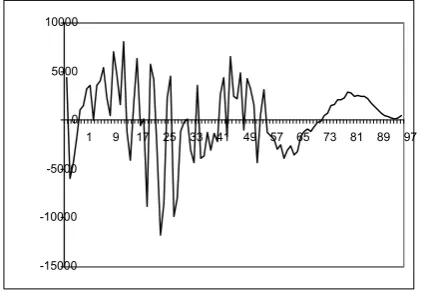
Fig. 6 and Fig. 7 show the weights learned. Although these weights graphs are drawn using approximation for visualization, the figures clearly show that system has learned the features in the input patterns of the categories. In fig. 6 and 7, the graphs show a noisy sinusoid of about 3 Hz. By comparing with the original waveforms, it has clearly shown that what these waveforms have in common is a sinusoid of approximately 3Hz. The phonetics expert has identified that these parts of the utterances are often associated with silence or pauses or gaps between words where there is some sound perhaps but no clear articulation. This is indeed known to be the case for stammerers.
4000 3000 2000 1000 0 1000 2000 3000 4000
[image:10.595.201.407.338.486.2]5
Unique Sequences and Classifications
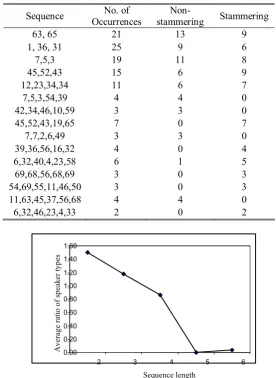
As mentioned, during each learning epoch, the speech utterances are fed into the system in sequence, one speaker utterance at a time. In order to do the analysis and thus determine the time it takes to identify the speaker type, one epoch after convergence is randomly selected. By randomly selecting one sequence of sSDNN winning nodes to start with, the whole epoch is examined to find any repeated occurrences of the sequence. These repeated occurrences of winning nodes sequences are called unique sequences if they are unique to only stammering or nonstammering speakers. Then, the speaker input utterances which caused the unique sequence, is examined. With this method of analysis, the length of unique sequence of winning nodes which only occurred in a particular group of speakers, either stammering or nonstammering, will determine the time the system takes to be certain of the speaker group for a particular speech utterance.
Table 4 shows the sequence occurrence of winning nodes for nonstammering or stammering group input patterns. The sequences for analysis are randomly selected. In the table, most of the sequences with the length less than 3 tend to have a mixture of occurrence of both types of speaker groups. By increasing the length of the sequence, some form of bias arises. With the sequence length of more than 5 winning nodes, these sequences only occur in one of the speaker types, either nonstammering or stammering. For example, the sequence {45, 52, 43, 19, 65} only exists in the speech input of the stammering speaker. Obviously, this sequence is unique to the stammering speaker. By plotting the average ratio of the speaker type over the sequence length, the length of the sequence which can be labelled as unique can be identified. This is illustrated in Fig. 3. In fig. 3, the average ratio of the speaker group for sequence length of 5 and 6 is the lowest. With this number of randomly selected sequences for consideration, it confidently shows that input patterns for particular speaker groups can be identified when a unique sequence, with the length of 5 winning nodes is used for analysis.
By identifying this unique sequence; we mean SDNN is capable of identifying the speaker group of input patterns after system convergence is achieved. As mentioned in section IV, each input pattern roughly represents about 1 second of speech information, thus, SDNN is capable of distinguishing the type of speaker by analysis of about 5 seconds of speech, which is analogous to the a person identifying a speaker as stammering or nonstammering after hearing several words. Since not all words are stammered by stammerers, this figure is also of the order of 5 seconds of speech for humans.
0.00 0.20 0.40 0.60 0.80 1.00 1.20 1.40 1.60
2 3 4 5 6
[image:12.595.158.435.198.577.2]Sequence length Av e ra g e ratio o f sp e a k e r t y p e s
[image:12.595.160.435.201.577.2]Table 5. Randomly selected sequence occurrence of winning nodes for nonstammering / stammering group input patterns
Fig. 7. The average ratio of the speaker type over the length of the winning node sequence
6
Conclusion
This paper presents the new application of feature discovery in phonetics speech data using the snapdrift algorithm. It also gives the opportunity to test the performance of SDNN without performance feedback in a purely unsupervised mode. SDNN categorizes the input patterns according to their general and distinct features. By
Sequence No. of Occurrences
Non
stammering Stammering
63, 65 21 13 9
1, 36, 31 25 9 6
7,5,3 19 11 8
45,52,43 15 6 9
12,23,34,34 11 6 7
7,5,3,54,39 4 4 0
42,34,46,10,59 3 3 0
45,52,43,19,65 7 0 7
7,7,2,6,49 3 3 0
39,36,56,16,32 4 0 4
6,32,40,4,23,58 6 1 5
69,68,56,68,69 3 0 3
54,69,55,11,46,50 3 0 3 11,63,45,37,56,68 4 4 0
examining the phonetic and waveform properties of the input patterns in each of the categories formed, it has been shown that without any performance feedback, the SDNN modules group the input patterns sensibly and extract properties which are general between nonstammering and stammering speech, as well as distinct features within each of the utterance groups, thus supporting classification.
References
[1] Lee, S. W., PalmerBrown, D., Roadknight, C. M.: Performanceguided Neural Network for Rapidly SelfOrganising Active Network Management. Neurocomputing, Vol. 61C (2004) 5 – 20.
[2] Aylett, M., Turk, A.: Vowel Quality in Spontaneous Speech: What makes a good vowel. Proc. of Int. Conf. of Spoken Language Processing. Sydney, Australia.
[3] Klatt, D. H.: Review of TexttoSpeech Conversion for English. Online collection (1987) [4] Ladefoged, P.: A Course in Phonetics. 4th ed., Boston, Heinle & Heinle (2001)
[5] Lee, S. W., PalmerBrown, D., Tepper, J., Roadknight, C. M.: SnapDrift: Realtime Performance guided Learning. Proc. of IJCNN, Portland, Oregon, Vo1. 2 (2003) 1412 – 1416.
[6] Lee, S. W., PalmerBrown, D., Roadknight, C. M.: Reinforced SnapDrift Learning for Proxylet Selection in Active Computer Networks. Proc. of IJCNN, Budapest, Hungary, Vo1. 2 (2004) 1545 – 1550.
[7] Donelan, H., Pattinson, C., PalmerBrown, D., Lee, S. W.: The Analysis of Network Manager’s Behaviour using a SelfOrganising Neural Networks. Proc. of ESM, Magdeburg, Germany, (2004) 111 – 116..
[8] Lee, S. W., PalmerBrown, D.: Phrase Recognition using Snap‑Drift Learning Algorithm. Proc. of IJCNN, Montreal, Canada (2005).
[9] Garside, R., Leech, G., Varadi, T.: Manual of Information to Accompany the Lancaster Parsed Corpus: Department of English, University of Oslo (1987).
[10] Carpenter, G. A., Grossberg, S.: A Massively Parallel Architecture for a SelfOrganising Neural Pattern Recognition Machine. Com. Vision, Graphics and Image Proc., Vol. 37 (1987) 54115. [11] Kohonen, T.: Improved Versions of Learning Vector Quantization. Proc. of IJCNN, Vol. 1 (1990)