University of East London Institutional Repository: http://roar.uel.ac.uk
This paper is made available online in accordance with publisher policies (CIS Research reports are published ‘in house’ by the Centre for Institutional Studies which is a research institute of the University of East London). Please scroll down to view the document itself. Please refer to the repository record for this item and our policy information available from the repository home page for further information.
Print copies of this work may be ordered via the Centre for Institutional Studies website: http://www.uel.ac.uk/cis/index.htm
Author(s): Madgin, Rebecca.
Article Title: Report of the Implementation of Fight for Peace in East London 2007- 08
Year of publication: 2008
Citation: Madgin, R. (2008) ‘Report of the Implementation of Fight for Peace in East London 2007- 08’ CIS Research Report 6, London: Centre for Institutional Studies, University of East London.
REPORT OF THE IMPLEMENTATION OF FIGHT FOR PEACE IN
EAST LONDON 2007- 08
REPORT OF THE IMPLEMENTATION OF FIGHT FOR PEACE IN EAST
LONDON, 2007- 08
Rebecca Madgin
Centre for Institutional Studies
School of Humanities and Social Sciences
University of East London
4 – 6 University Way
Docklands
London
E16 2RD
June 2008
Published as CIS Research Report 6
THE CENTRE FOR INSTITUTIONAL STUDIES
The Centre for Institutional Studies (CIS) established in 1970, is dedicated to undertaking research which contributes to the improvement of public policies. The distinctive approach of our research at the Centre is to identify the problems to which new policy is seen as a solution, and to assess the capacity of institutions to put new policies into practice. The Centre's name and its perspective are derived from the work of Sir Karl Popper, and in developing this approach the Centre is unique in this country.
CIS is dedicated to improving policy, management and practice through research. We treat institutions, policies and practices as trial solutions to social problems; analysing and testing their formulation and their effectiveness (Burgess 2002). Since 1970 the Centre has completed a range of studies in the fields of education, voluntary and community organisations, local government, and other public services. Evaluations of recent government initiatives include the Youth Inclusion Programme, the Home Office Crime Reduction Programme, Children’s Fund and Sure Start. Other initiatives which have been assessed include neighbourhood policing, the role of faith communities in community development, social enterprises, community development in Thames Gateway and the involvement of users in community and voluntary organisations. International comparative studies on higher education have taken place in Austria, Finland and China.
We would like to thank Luke Dowdney, Louise Brown, Darrin Reece, the sessional staff and the young people for participating in this research.
CONTENTS
_______________________________________________________________________
Executive Summary
i - iv
1. INTRODUCTION
1 - 3
2. RESEARCH
4 - 5
3. FIGHT FOR PEACE IN NEWHAM, EAST LONDON
6 - 7
4. IMPLEMENTATION AND DEVELOPMENT OF FFP
8 - 12
5. MONITORING DATA
13 - 26
6. RECOMMENDATIONS
27 -28
BIBLIOGRAPHY
29
_____________________________________________________________________ EXECUTIVE SUMMARY
_____________________________________________________________________ The Programme
This study reports on the findings from the implementation of Fight for Peace in East London between October 2007 and March 2008.
Fight for Peace (FFP) aims to offer ‘real alternatives for children and youth to crime, drug trafficking and violence via social inclusion through sports, education, access to the formal work market, the promotion of a culture of peace and building youth leaders’.1
FFP opened in East London in October 2007 in premises adjacent to a disused and abandoned school in North Woolwich, Newham. These premises were secured at no cost due to FFP’s relationship with a local community organisation: Community Links.
FFP in East London was the second FFP project to open. The first FFP project is located in the Maré favela in Rio de Janeiro, Brazil and started in 2000.
FFP employs two full time staff members: a project manager and a youth programme co-ordinator. In addition to this, sessional staff are employed to deliver the sporting activities and also to mentor the young people and assist with Personal Development (PD). Up until March 2008 FFP employed eight sessional staff. Additionally, FFP also employed a person on a part time basis to provide management training, assist with the accounts and also a part time fundraiser who was unable to commit sufficient time to raise funds.
FFP in East London is (up to March 2008) funded by four main bodies: Esmee Fairburn, Laureus Sport for Good Foundation, Ballymore, and the Sainsbury’s Family Charitable Trust.
FFP is a tool for social change which uses a working methodology based on a holistic 5 pillar approach: 1. Boxing and Martial arts; 2. Personal Development (PD); 3. Social Action; 4. Access to Labour Market; 5. Youth Leadership.
The boxing and martial arts pillar incorporates boxing sessions for under and over 16s and for under 16s girls; Thai kick boxing for under and over 16s; caporeira for under 16s; gym for under and over 16s and Ju Jitsu for under and over 16s although this was discontinued following timetable clashes.
PD is an educational programme designed to challenge the way young people think and make their decisions. The young people have to attend PD as a condition of participating in the rest of the programme. The young people design the themes that will be discussed during the 40 minute sessions. Previous themes included racism, drugs and knife/gun violence.
Social Action is designed to promote a culture of peace and also aims to provide referral services for young people for assistance with educational, legal, medical and/or psychological issues.
Access to the labour market aims to provide employment and training opportunities for young people whereas Youth Leadership aims to encourage young people to improve the society, in which they live, give them a voice and through the Youth Council represents the project beneficiaries.
This 5 pillar model is being delivered in phases and up to March 2008 two pillars had been implemented: boxing and martial arts, and PD.
The Research
CIS staff work within a theory of change research framework which seeks to understand how social interventions, in this case the 5 pillar model, brings about change in the decision-making process, behaviour and attitude of young people participating in the project.
Working within the confines of a £3k budget, a multi-method approach was adopted and included:
! Designing a monitoring database that would enable FFP staff to collect, collate and internally analyse the attendance levels and profile of registered members.
! Observations of young people at the different activities offered by FFP on seven different occasions and on seven different days.
! Two semi-structured interviews at three month intervals, with three members of FFP staff: the founder, project manager and the youth programme co-ordinator.
The data analysis identified the organisational development of FFP as well as the profile and attendance of young people and any changes to their behaviour, attitude and levels of interaction with their peers and FFP staff.
The monitoring data was developed during the research period and a significant amount of information is missing for some young people in the categories gender, ethnicity, postcode, date-of-birth, start date (when a young person registered for the project) and status (in education, training pupil referral unit etc). Out of these ethnicity and status were the two categories with the most missing data. The interpretation of the information presented in the report therefore needs to be viewed with caution. An analysis of the available monitoring data is presented in this report and found:
Numbers:
! Between October 2007 and March 2008, FFP registered 459 young people in the project.
! Of these 459, FFP has retained a core of 121 young people who have stayed in the project for two months or longer. Of these 121, 49 stayed in the project for three months or longer.
! Under 16s: 35% of those who remain in the project for 3 months or longer are female, 95% are between 12 -16 and 95% are from the local area defined as E16.
! Over 16s: 92% of those who remain in the project for 3 months or longer are male, 77% come from the local area and the most popular activities are gym and boxing.
! The numbers of young people attending have fluctuated in line with levels of outreach work, the school calendar, school holidays and exam periods.
Profile of Young People:
! The dominant demographic profile of participants is black, male, aged between 12 and 16 and from the local community (postcode E16).
! The original target group was the 12-16 age group and indeed this group accounts for 61% of those registered at FFP who gave their date-of-birth on the registration form.
! The majority of those who attend are in school.
! In terms of attracting at risk young people, 14% of those who registered revealed that they are known to the Youth Offending Team (YOT) or the Criminal Justice Service (CJS) or consider themselves to be in a gang. Targeting young offenders is in phase 2 of FFP’s delivery plan but even before this phase is implemented FFP is engaging with young people at risk of offending.
Activities:
! Gym has been the most popular activity, attracting on average 43 young people per month. Boxing has been the second with 27 young people who attend each month on average.2
! Just over a third of young people who attended FFP between December 2007 and March 2008 attended Personal Development but not the sporting activities showing an unexpected popularity of attending out-of-school educational activities.
! The predominant catchment area for all of the sporting activities is E16 where FFP is located.
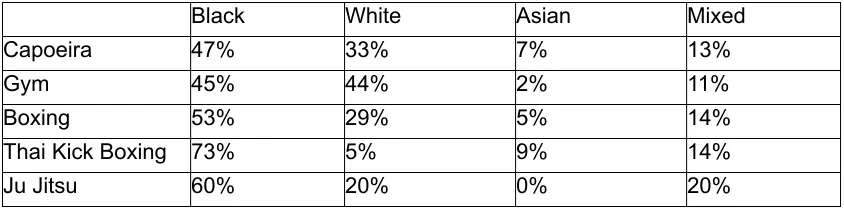
! Different sporting activities show varying ethnic compositions. For example, boxing and Thai kick boxing are mostly attended by black males whereas gym has a more even spread between black and white. This pattern is similar for both under and over 16 activities.
! In comparison with other ethnic groups there is a smaller percentage of Asians who attend the FFP activities.
Behaviour and Attitude of the Young People:
! Positive relationships have developed between staff and young people and also between young people, as new friendship groups appear to have formed. These relationships are predicated upon trust and mutual respect.
! FFP staff initially adopted a disciplinarian stance with young people which over time has softened as staff build up a rapport with the young people.
! The different activities engender different reactions from the young people. Boxing and Thai kick boxing are based around strict discipline whereas gym is a lot less structured.
! FFP has increasingly become a reference point for young people as a significant number wear the FFP branded t-shirts and drop in to be part of the project despite not always being able to take part in the sessions. The April 2008 launch of FFP at ExCel reinforced this sense of identity that young FFP members gain from belonging to this project.
Achievements
The founder of FFP undertook a number of tasks before the project could become fully operational. Staff were hired and trained in Rio de Janeiro to ensure they understood the ethos of the organisation and its aims and objectives. Following their training staff made links with Community Links who helped FFP find premises and also with local
2 Attendance data for Under 16s boxing in October was not on the database and as such boxing
young people through a consultation process. This process engaged with a cross-section of young people from Newham and asked them a series of questions concerning existing provision, pressing issues and gang culture. The training in Rio and the practical help offered by Community Links ensured that FFP staff were aware of local needs and had the knowledge and physical premises to start working with the young people.
FFP staff have a sound knowledge of FFP’s working methodology and clear ideas about how to adapt this framework to meet the needs of young people in Newham. Indeed staff adopted a phased approach to rolling out the 5 pillars and recognised the need to adapt the 5 pillars methodology to local conditions and pressures in East London. For example FFP staff adhered to the findings of their initial consultation report and targeted the age group most perceived to be at risk: 12-16 year olds.
FFP staff put in place health and safety requirements and devised a policy and procedures handbook in order to insure that a consistent and coherent approach ran throughout the organisation.
The ethos of FFP has been maintained as staff has focused on retaining its youth-centred approach by actively seeking to involve the young people in their decision-making process. For example: the consultation, support code, interim youth council, selection of topics to discuss in PD sessions and with the design and location of the new premises in Canning Town.
FFP have attracted significant numbers of young people specifically resulting from outreach. For example in January and February FFP registered 161 young people. Just under one third of the 459 who initially registered for FFP attended the project for two months or longer. The project has been well received by local young people as 66% of those registered are from E16 and of those who attended for three months or longer (up to March 2008) 95% were from E16. Furthermore, FFP has received positive feedback from local residents and parents and is becoming an established local organisation.
FFP staff have faced many challenges both in the day-to-day running of the project and in its strategic development in terms of rolling out the pillars. However, staff have responded to these difficulties both in a considered way and through working as a team and have implemented a series of measures to negate the problems.
Difficulties
The day-to-day running of FFP has been and will continue to be impeded by two main issues: space and capacity. Although FFP is located in a small part of an unused school, the London Borough of Newham who own the premises, have been slow to respond to the requests of the founder to make additional space available. Slow moving bureaucratic arrangements by the Borough are neither in the interests of the young people or the local community.
The large influx of young people in January and February allied to those already registered placed a demand on the amount of physical space currently available for FFP and highlighted the need for an extension of the premises. Additionally, this sudden upsurge in young people registering for FFP presented a problem in terms of discipline and of the young people not understanding or respecting both the ethos of FFP and the local community.
outreach was halted as a result of space and discipline issues with the large influx of young people, as staff needed to respond to immediate problems posed by the surge of these young people.
In order to alleviate the above two issues more funds are needed to ensure that the next stage of the delivery plan can be implemented. At the moment a fundraiser can only work 1-2 hours per week which is not sufficient to attract enough funds to find staff, increase capacity and to sustain the first two pillars and roll out the next three.
The Personal Development sessions initially provided a problem for FFP staff as the young people did not respond to the classroom setting and school like lessons. This was in marked difference to Brazil but FFP staff illustrated their capability to tweak the 5 pillars model by conveying the same educational messages through fun and practical based activities in the sports hall rather than in classrooms.
Internal monitoring of the project has proved an issue for FFP staff as they have encountered some initial problems in the ways in which data concerning the profile and attendance of the young people was collected, recorded and saved.
Although the project is in its initial stages of implementation the way staff have implemented the project and responded to the challenges they have faced, the core of young people who have registered, the changes in their behaviour and relationships with staff, the identification with the project, the numbers of young people registering and the percentage being retained and the success of the launch indicates that FFP are on track to increase the access to opportunity of young people in Newham
Recommendations
Being mindful of the fact that space is limited and staff are overstretched, the following requires attention:
Response to Difficulties:
! London Borough of Newham could release more space in the disused premises to ensure that there is an improved working environment for FFP staff that can also accommodate large influxes of young people
! FFP could increase staffing levels as staff have been unable to deliver one component of phase one, tracking young people to ensure they receive adequate services due to limited time and limited numbers of staff. Furthermore, phase two has been affected by the same issue as more staff are needed to help roll out the ‘access to the labour market’ pillar.
Future Practice:
! FFP staff could refine and set their target numbers in light of the constraints of space and capacity.
! FFP staff could target specific groups to ensure the project attracts a more representative sample of young people. Presently, the numbers of females, YOT’s, NEET’s and whites could be increased.
! FFP staff could differentiate their schedule to take account of dips in attendance. This tends to occur in the school holidays and the forthcoming May half-term provides an opportunity to test this before the longer summer vacation from July to September.
Future Research:
_____________________________________________________________________
1. INTRODUCTION
_____________________________________________________________________
1.1 Ethos of Fight For Peace (FFP)
FFP Mission Statement:
“Fight for Peace offers real alternatives for children and youth to crime, drug trafficking and violence via social inclusion through sports, education, access to the formal work market, the promotion of a culture of peace and building youth leaders.”1
Fight for Peace (FFP) is a tool for social change which uses a working methodology based on a holistic 5 pillar approach.
The 5 pillars methodology and the ethos of FFP offer a viable philosophy on which to explore how the project has been designed to make a difference and early indicators into the way which the project has been implemented to achieve this as well as any perceived barriers to realising this in East London. FFP’s working methodology is based on logical and methodical foundations2 and is clear in its desired outcomes to prevent youth crime, reduce the poverty of opportunity and foster social inclusion.
To achieve these outcomes FFP uses a working methodology that is designed to counter potential risk factors defined as: poverty/inequality of wealth, lack of economic options, social marginalisation, violence, family groups, and lack of leisure facilities/ boredom. FFP aims to offer real alternatives to these risk factors through its 5 pillar model. In East London the 5 pillars are Boxing and Martial Arts, Personal Development, Social Action, Access to Labour Market and Youth Leadership. The pillars are designed to challenge established patterns of behaviour and alter the decision-making process of a young person in order for them to have the knowledge, confidence and self-esteem to reject potential risk factors in East London. This holistic approach is based around fostering a culture of non-violence and each activity within the 5 pillars is chosen for its perceived ability to change the decision-making process and behaviour of young people.
Activities offered by FFP during October 2007 to March 2008: • Boxing
• Thai Kick Boxing
• Gym
• Capoeira (started in November) • Ju Jitsu (stopped in December) • Personal Development Classes • 1-2-1 Mentoring Sessions
In practice Fight for Peace bases its everyday philosophy around three notions: respect, rules and responsibility. Young people who attend the project are encouraged to respect the programme, their peers and the staff and to take this respectful attitude with them outside of the FFP academy. Whilst at the academy whether in the sports
1 L. Dowdney, Fight for Peace Replication Manual
hall, in Personal Development (PD) classes, in the reception area or in 1-2-1s with staff the young people are made aware of the need to also respect rules put in place to ensure that young people can carry out the activities. With respect and rules also comes responsibility and young people are actively encouraged both through the activities offered and the informal conversations and relationships with staff to take responsibility for their own actions. In these ways FFP aims to challenge embedded patterns of behaviour and to alter the decision-making process of disadvantaged young people.
1.2 Origins and Evolution in Brazil
Luta Pela Paz was founded in 2000 to prevent young people entering into the armed drug trade in a favela in Rio de Janeiro. The project was originally founded within Viva Rio, a Brazilian non-governmental organisation and it has recently established as an independent organisation. Based on the 5 pillars methodology devised by Luke Dowdney, Luta Pela Paz produced boxing champions, reintegrated children into the formal school system, helped young people into employment, given them practical skills in IT and school subjects and life skills in terms of increasing their self esteem, confidence, leadership skills and also given them an identity to rival that of being in a drug faction.
1.3 Replication in East London
Based on the above successful foundations and using the 5 pillars model as a template to be adapted to local conditions, Luta Pela Paz was replicated in Newham, East London under the English translation Fight for Peace in October 2007. The process of replication was methodically conceived, planned and implemented and was heavily grounded in a mixture of a conceptual framework and local knowledge of how to deliver the 5 pillars. The links between Luta Pela Paz and FFP were established as newly appointed staff were trained at the project in Rio de Janeiro in order to develop a comprehensive understanding of how the methodology worked in Rio and also to use the staff’s knowledge of the East London context to generate ideas concerning how the 5 pillars model could be adapted to meet the needs of Newham’s young people.
FFP undertook a series of tasks to identify the most viable way of replicating the project. This involved carrying out in depth local research, undertaking a bibliographical review, carrying out a series of consultations with local young people and establishing links with partner organisations. In light of the these steps FFP formed a working relationship with Community Links, the largest community organisation in Newham which both gave them a building at no cost and enabled them to access local knowledge about the community and the extent of problems faced by young people in Newham. This was further enhanced by the consultation process carried out by FFP staff in which 38 young people from the area, representing a mix of gender, age and ethnicity, and local organisations were asked a variety of issues that helped to affect both the practice and formation of FFP in East London. These issues focussed around locality of the premises, usage of the facilities, how far people would travel to attend FFP, availability of youth opportunities, the extent of the gang culture, the ability of young people to access the job market and how FFP could provide an effective service in the area.
_____________________________________________________________________
2. RESEARCH
_____________________________________________________________________
The research was commissioned by Fight for Peace and its founder/director Luke Dowdney. For the sum of £3k UEL researchers carried out eight days work into the implementation and development of Fight for Peace in East London. The research covered the initial six-month period, October 2007-March 2008 of the implementation of FFP in Newham.
2.1 Research Framework
Research carried out by UEL researchers was designed to evaluate the progress made by Fight for Peace during its first six-months. Particular emphasis was placed on the implementation and development of the programme during its first six months of operation. Contained within this was an exploration of the adaptation of the 5 pillars methodology to meet the needs of the young people of Newham. Furthermore, through using a ‘theory of change’ evaluation approach, the research examined the different ways in which the project was designed to, and perceived by staff to be, making a difference to the decision-making process, behaviour and attitude of young people. The research approach taken was to find out how the sporting and educational interventions make a difference by exploring the links between the activities offered by FFP and outcomes. The research question is: how do the activities contribute to the social, moral, and emotional development of young people?
2.2 Theories of Change
The ‘theory of change’ evaluation approach is adopted by CIS in order to understand how FFP is making a difference to the lives of young people. A theory of change evaluation is simply defined as ‘a theory of how and why an initiative works’. 3 This method of evaluation originated from research in the United States into complex community based initiatives and is designed to unravel the process by which certain activities and events result in certain outcomes. This approach endeavours to ascertain the mechanisms of change which in this instance contribute to the social, moral and emotional development of young people attending the FFP Academy. The holistic design of FFP is planned to alter the decision-making process and established behavioural patterns of young people. By combining sports with education and improved access to opportunity FFP aims to deliver an integrated service plan which targets every area of a young person’s life.
2.2.1 Intended Mechanisms of Change4 through the 5 Pillars:
3 Barnes, 2000 cited from DfES, Developing Collaboration in Preventative Services for Children and Young People: The National Evaluation of the Children’s Fund, First Annual Report 2003, Research Report RR528, 2004, appendix 2.
1. Boxing and Martial Arts
Channel aggression, increase confidence, learn self-discipline, forces young people think about the decisions they make through training and competitions
2. Education / Personal Development
Group work, 1-2-1 conversations, role plays, imagery, DVDs, games to enable them to improve their decision-making process and understand the importance of making considered decisions which will help them inside and outside of school.
3. Social Action: Promoting a Culture of Peace
Methods of non-violent conflict resolution delivered through the boxing and martial arts activities and workshops through PD to ensure young people do not turn to violence in order to solve their perceived problems. Increased opportunities for young people to access services as FFP staff evaluate the needs of young people and determine whether they need to be referred to an outside agency for educational, legal, medical and/or psychological assistance.
4. Access to Labour Market
Reduce the need for young people to turn to criminal activity to make a living, by having opportunities to access employment.
5. Youth Leadership
Give young people a sense of responsibility by making them the ‘voice’ of the project.
2.3 Data Collection
A multi-method approach was adopted and included:
• Seven observations of the young people during the various activities offered by FFP on seven different days during 2007 and 2008.
• Two semi-structured interviews with the Founder/Director, Project Manager and Project Coordinator, one at the end of Phase 1 and one early in Phase 2
• Collating monitoring data for those registered and who participated in the FFP programme
•
Analysis of existing FFP reports and other literature produced during the period October 2007 to March 20082.4 Data Analysis
_____________________________________________________________________
3. FIGHT FOR PEACE IN EAST LONDON
_____________________________________________________________________
3.1. Profile of Newham
Fight for Peace is located in North Woolwich in the London Borough of Newham where the latest mid-year estimates report that the total population is 246,200.5 There is no longer any relevant data for North Woolwich where FFP is located, as it has been subsumed into the Royal Docks ward. This ward contains a mix of social and private housing and the social and economic polarisation of the ward masks the severity of localised poverty within the area immediately surrounding the FFP Academy.
3.2 Deprivation
FFP is located in Newham in East London. This borough has traditionally been one of the most deprived in the country. Indeed the Index for Multiple Deprivation (IMD) in 2007, ranked Newham as sixth out of 354 local authorities in England in terms of average deprivation.
3.3 Age Structure
The age structure of Newham is heavily weighted towards young people; 39.7% of Newham’s population that are under the age of 25 compared to 32% for Greater London.6 Within this context both youth deprivation and youth crime in Newham is a serious problem, indeed the workload for the Newham Youth Offending Team is 52% above the London average.7
3.4 Status
The skills levels and status of the young people of Newham reflects its status as a disadvantaged area. Higher proportions of young people in the Newham borough are classified as NEET (not in education, employment or training) than in the rest of East London. Furthermore, in Newham there is a lower proportion entering employment or government supported training, than in the rest of East London.8
3.5 Ethnicity
Newham has greater equality in the relative sizes of each ethnic group population than in other London boroughs. Using data from the 2001 Census, Newham is the second
5 London Borough of Newham, Focus on Newham, Local People and Local Conditions, Newham Council, London Borough of Newham, 2007, p 17.
6 London Borough of Newham, Focus, 2007, p. 24.
7 http://www.newham.gov.uk/News/2006/August/Leadingworktostopyouthcrime.htm Accessed 8 April 2008
most diverse local authority in England and Wales. Greater London Authority figures (2006) show that Newham has a larger black and Asian community and a smaller white community, than in London as a whole.
Table 1 Ethnic Composition of Newham and London
Newham London
White 33% 68%
Black /Black British 25% 13%
Asian /Asian British 36% 14%
Chinese /Other 4% 5%
Source: London Borough of Newham, Focus on Newham, Local People and Local
Conditions, Newham Council, London Borough of Newham, 2007, p. 26.
3.6 Gender
The male population of Newham reached the level of the female population in 2001 and it has now overtaken the female population. Figure 2 illustrates the numbers of young people in the area are evenly split between male and female in the age category 10 to 24.
Figure 1 Gender and age structure of the population of Newham
Source: London Borough of Newham, Focus on Newham, Local People and Local
[image:18.595.102.511.412.660.2]_____________________________________________________________________
4. IMPLEMENTATION AND DEVELOPMENT OF FFP
_____________________________________________________________________
Fight for Peace is located in an annex of a closed down school in North Woolwich and opened in October 2007. In the first six months over 450 young people registered with the project. This chapter outlines the management structure, working practices of FFP, and the achievements and challenges during the period October 2007 to March 2008.
[image:19.595.91.508.260.530.2]4.1 Management Structure
Figure 2 Management Structure of FFP in East London
Project Manager
Founder / Director
Youth Programme
Sessional Staff
Coaches: Boxing, Thai Kick Boxing, Capoeira, Ju Jitsu, Gym Youth Workers
Finance Fundraiser (1-2 hours per week max)
4.2 Funding
Fight for Peace is in the process of receiving charitable status and is supported by four funding bodies: Esmee Fairbairn, Laureus Sport for Good Foundation, Ballymore and Sainsbury’s Family Charitable Trust.
4.3 Practice
FFP opted for a phased approach to implement the 5 pillars methodology in order to ensure that the project evolved at a pace that would allow it to gradually adjust to the needs of the young people in Newham. The delivery plan was split into three phases and was designed to roll out the 5 pillars over an eighteenth month period. Staff were keen to build up the project slowly to ensure that young people felt comfortable in the project. Trust relationships were built up over time between staff and young people and so that the foundations for rolling out the pillars were firmly in place.
Phase One was envisaged to last from October 2007 to April 2008. This phase involved conducting outreach to attract young people to the project, delivering the sports and PD pillars. Contained within this was: registering young people; recruiting sessional staff; carrying out their inductions; building up referral agency networks through identifying local providers of youth services, and mentoring and monitoring young people to ensure they were receiving adequate services. Boxing and gym sessions were offered to young people from the outset and taster sessions in capoeira, ju jitsu and Muay Thai kick boxing were also provided. Of these taster sessions only ju jitsu did not continue and this was due to timetable clashes rather than youth disinterest. Towards the end of phase one PD sessions were made a compulsory element of the project and indeed young people were not allowed to attend the sporting activities without attending PD once a week. These PD sessions explored various themes such as crime and violence, health, discrimination, emotional development, life skills and environmental concerns were also delivered to the young people by the project co-ordinator and the sessional staff. FFP staff delivered the majority of Phase One with the exception of tracking young people to ensure they were receiving adequate services. This was unable to happen due to staff capacity. However, 1-2-1 mentoring was brought in ahead of schedule.
4.4 Achievements
During the first six months FFP has made real progress; core and sessional staff were hired and trained; the ethos of FFP was elucidated during a training trip for core staff to FFP in Rio de Janeiro; premises in an old school building were rented from the local authority at no cost via FFP’s relationship with local organisation, Community Links; equipped for sporting activities; activities commenced; health and safety and policy and procedures put in place.
FFP has been positively received by the local community. The ethos of FFP to involve young people in its programme has been demonstrated in numerous ways since October. Young people were consulted about the content of PD and their ideas were used to form the themes of PD sessions. A support code which outlines the rules, respect and responsibility ethos was devised by young people. An interim Youth Council is in the process of being formed so that young people can become the voice of the project, just as they are in Brazil. Finally, FFP consulted young people for their long-term development about the design and location of the new building due to open in 2009. Staff have responded well to some challenging behaviour and difficult situations that were encountered with young people.
4.4.1 Challenges
FFP staff have faced a series of challenges during the initial stages of implementing FFP in Newham. Getting the building open, made safe, and filled with sporting equipment was a major hurdle and required staff to step outside of their original job descriptions in order to co-ordinate the delivery of a viable, safe and functioning physical premise. The large numbers of young people in a small physical space has implications for the day-to-day running of the project. Working with large numbers of young people led to the postponement of outreach and staff have responded to immediate issues rather than being able to continue with the implementation of all 5 pillars. January and February were particularly busy months when staff registered 161 young people, of whom 124 signed up in January. This significant influx of numbers highlighted a number of issues that staff had to respond to; the reception area was too small to accommodate the sheer number of people entering FFP and the numbers of young people inside the sports hall limited the amount of space in which young people could take part in their chosen activity.
A further challenge also originated from this influx of numbers. A significant number of young Portuguese males from outside the local community attended the project and failed to initially respect the ethos of FFP and also the local community. Whilst it was undoubtedly an achievement that word had spread to outside the immediate area, this caused an unexpected influx of young people and it challenged staff to respond to this increased demand. During this period several negative incidents were perpetrated by the new influx within the local community and to manage the situation staff held daily emergency meetings and implemented a series of measures to respond to the problems caused by the influx of young people, for example talking to the young people individually, in groups and eventually closing the project to the over 16s for one week in February.
Other challenges were also faced during the process of adapting the 5 pillars. One such obstacle was with the PD classes. Whilst the classroom setting was respected and enjoyed in Brazil, this method was not received in the same way in Newham. The profile of young people, some of whom have serious behavioural issues and short attention spans allied with a formal classroom setting that young people can reject because of its similarity to a school setting saw the initial PD classes run into a series of problems concerning the behaviour and attitude of the young people. The challenge posed by PD was transformed into a success as staff adapted the 5 pillars model to accommodate the needs of the local young people. PD sessions are now typically held in the gym rather than in a classroom setting and consist of practical, fun based activities in which the young people devise role plays, take part in games, and watch DVDs which are all designed to deliver the same messages as before but in a way that is more appropriate with the needs of the local young people.
FFP staff were overstretched during the first six months and as such, internal monitoring systems and systems to collect, collate, analyse and check data were not put in place.
4.5 Delivery Plan
Adapting the delivery of the 5 pillars was illustrated with the 1-2-1 PD sessions (in which each young person is given dedicated attention by a member of staff) these were carried out ahead of schedule in Phase One. Originally planned to be in Phase Two, staff felt that they had enough young people and enough interest as well as an adequate trust based relationship to be able to give them individual attention earlier than previously envisaged. These sessions highlighted any individual issues that a young person faced and allowed staff to respond to individual as well as collective needs. Phase Two is planned to cater for these individual needs by referring young people to the necessary services and providing them with educational and employment information in order to increase their access to opportunity.
4.6 Making a Difference?
Amongst academics it is generally agreed that ‘many years must elapse before such outcomes can be expected’9 and that we have to understand the complex variables at play that may have influence the behaviour, attitude and/or mindset of the young person such as other projects, change in family circumstances, change in educational status etc. In order to probe how the intended mechanisms of change are affected the decision-making process of the young people it would be productive to conduct a series of interviews, focus groups and hold informal conversations with regular attendees of the project. However, in the absence of this qualitative evidence it is necessary to look at the development of FFP thus far and any apparent constraints that may affect the project’s ability to make a difference.
The organisational development of FFP thus far indicates that the project has built an initial platform upon which there is a real possibility of making a difference to the lives of its members. Staff members have demonstrated their flexibility and capacity to respond to challenges. The target groups i.e. 12-16 have been attracted and the numbers of young people registering and staying in the project for two or more months illustrates how FFP has become a reference point for their members. The project has
become a reference point, as illustrated by: the attendance at both the sporting activities and the PD sessions, the numbers who bought FFP branded t-shirts, and the young people that drop in to the project despite being unable to access the activities for various reasons i.e. injuries. Furthermore the noticeable changes in young people in terms of their attitude, behaviour and respect for the project. Finally, the relationships between staff and the young people are now based on mutual respect and trust and a clear ethos has emerged (see section 5.5). These axioms have given FFP a platform upon which to roll out the further three pillars and to make a difference to its members over a longer-term period.
However, in order to continue delivering the services that are designed to improve the access of opportunity for young people and challenge established patterns of negative/ deviant behaviour there are two major barriers for FFP: physical space and capacity, that need to be overcome.
Space
In order to roll out each of the 5 pillars within the designated time periods, FFP will need to increase both their physical space and also their capacity. In terms of space the influx of young people in January halted the outreach work as the premises could not accommodate this number of people. Additionally, there is currently no space for the young people to relax as the reception area is again too small to allow this. Furthermore, office space is also limited which constrains staff and their ability to maintain confidentially.
Staff
Currently the development of the project is limited by staffing levels. More staff, or at least more staff time, will be required to carry out and follow up 1-2-1s, collecting and collating monitoring data, receiving and making referrals and delivering the education and work placement elements of the pillars. However, increasing staff to check data and receive/make referrals is dependent on funding. Without additional funding it will be difficult to roll out the 5 pillar model to provide a holistic preventive approach for young people.
Responsiveness
_____________________________________________________________________
5. MONITORING DATA
_____________________________________________________________________
This chapter analyses the data arising from the project monitoring database created by UEL researchers and FFP staff. These results must be viewed with caution due to the amount of missing data. It is to be expected that young people will be unwilling to reveal information to adults who they have just met, but it could be followed up at a later stage to improve the accuracy of the database. Of the categories examined in this chapter, there are 44 entries missing for date-of-birth, 160 for self defined ethnicity, 10 for gender, 60 for postcode, 58 for start date,10 and 187 for self defined status defined by whether a young person is in education, employment or training. Currently there are no NEETS (not in education, employment or training) recorded on the database. This may be due to missing data or lack of targeted outreach but this is one of the groups FFP aims to attract. There is also no information entered on the monitoring database concerning the number of 1-2-1’s carried out by staff or the young people that were mentored. With this amount of missing data, interpretation of the information presented in this chapter should be treated cautiously. The data below is based on the available information.
5.1 Profile of Participants
5.1.1 Gender
FFP has registered 459 participants, 291 are under 16 and 168 are over 16. Of those registered 73% (329) are male and 27% (120) are female. This does not match the demographic profile of Newham (see page 4) which shows a virtually even distribution of male and female young people.
[image:24.595.91.492.533.713.2]5.1.2 Ethnicity
Figure 3 Self-defined ethnicity of young people
Compared to the ethnic composition of the borough, blacks are over represented in this project and whites and Asians are under represented.11
[image:25.595.86.521.181.315.2]5.1.3 Physical and Mental Health
Table 2 Status of young people’s self-identified problems
Category Number Registered at FFP and Who Gave Information
Anger Management Issues 4 Special Educational Needs 1
Bereavement 2
Dyslexia 1
Health Issues 12
Physical Disability 2
The above figures are self-definitions from the registration forms of the young people and as such they are likely to disguise the real numbers who suffer from any physical disability or mental issue.
5.1.4 Postcode
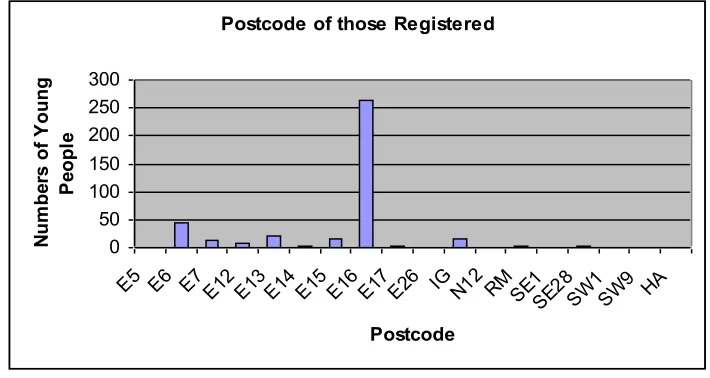
Most young people disclosed their postcode (87%) and this information revealed that two thirds come from the immediate area, followed by those who live in Beckton and East Ham. A significant percentage already travel from the Canning Town / Custom House area which bodes well for the proposed new premises to be provisionally opened in 2009. However, the project is also attracting people from much further a field as members come from south of the river and from neighbouring Essex.
Figure 4 Postcode of young people
[image:25.595.118.473.523.712.2]5.1.5 Age
Figure 5 The age of young people
FFP is meeting its targets in terms of their age range as the majority of young people fall between the 10 and 21 age category that FFP wanted to attract to the Academy. The main ages of those registered for FFP are 14, 15 and 16 which is in line with FFP’s desire to target the 12-16 age group who were perceived to be the most vulnerable age group identified during the consultations.
5.1.6 Start Date
Figure 6 Start dates of young people
[image:26.595.87.507.480.700.2]most frequent, that new members signed up: 93, 83, and 124 respectively. The lows of December and February can be attributed to firstly stopping outreach and secondly the impact of school holidays.12 One possible reason for this is that young people have incorporated FFP into their daily routine which, for the majority includes school, followed by attending the FFP Academy.
[image:27.595.85.524.218.354.2]5.1.7 Status
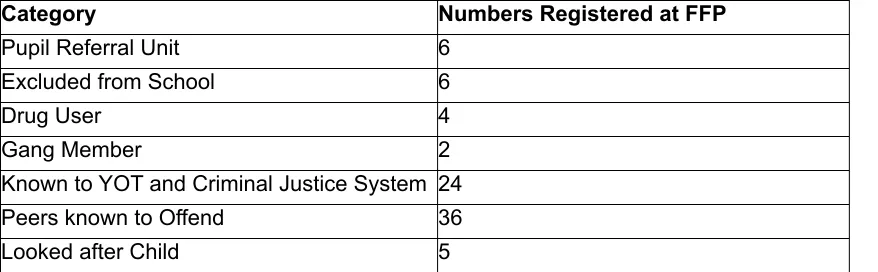
Table 3 Self-defined status of young people
Category Numbers Registered at FFP
Pupil Referral Unit 6
Excluded from School 6
Drug User 4
Gang Member 2
Known to YOT and Criminal Justice System 24
Peers known to Offend 36
Looked after Child 5
Of those young people (272) who gave their status under the category in Education, Employment or Training 97% are at school. Whilst the majority are at school, 5% of those who registered and gave information are known to the Youth Offending Team (YOT) and interestingly only two young people define themselves as being part of a gang13 and 8% admitted they had friends involved in a criminal activity.14 This figure increases to 14% (62)15 when this is added to the number known to YOT and the Criminal Justice System and gang members. These figures show that before targeted outreach on young offenders FFP are attracting a percentage that are in a vulnerable situation with regard to youth crime.
12 During the holidays not only is their routine broken but there are other competing factors such as vacation, other activities and family commitments (see 4.3 for more on this).
13 It has to be recognised that young people would be reluctant to disclose their background to staff during their first meeting. There is therefore an issue with the data as to whether young people are not revealing their status or whether there are few issues regarding youth crime and vulnerability.
14 36 divided by the 459 who registered. This number could be higher but without resolving the issue surrounding missing data we cannot prove this.
5.2 Monthly Breakdown
[image:28.595.118.482.174.362.2]5.2.1 Under 16s Attending FPP Activities
Figure 7 Number of under 16s attending FFP, October 2007 – March 2008
As would be expected the number of under 16s attending FFP activities showed a decline during the first month the project was open as their initial enthusiasm waned. The FFP project increased in popularity, as overall attendance rose between November 2007 and March 2008, which reflected increased knowledge about the project. The slight decline, in January and February which accounted for a loss of twelve young people during one month, was attributed to the large influx of over 16s which staff felt had put some of the under 16s off coming. In conversations with staff young people revealed that many had not attended during January and February because of pressures with school exams.
5.2.2 Over 16s Attending FFP Activities
[image:28.595.121.475.567.750.2]The over 16s saw a different pattern to that of the under 16s as numbers steadily rose until January and then declined as the impact of the project’s one-week closure to over 16s, the new rules and the more disciplined nature of gym affected the numbers of over 16s who attended.
5.3 Attendance Data
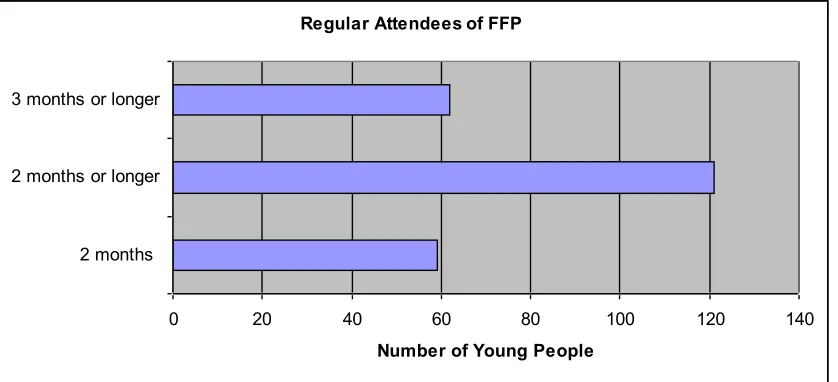
[image:29.595.91.510.292.483.2]This section is concerned with the regular attendees of FFP, both under and over 16s, defined as those who have stayed in the project for two months or longer. There is also a description of the profile of those who stayed for two months and those who stayed three months or longer to ascertain the type of young person FFP is retaining in the project.
Figure 9 Retention of young people in FFP
5.3.1 Two Months
There are a total of 59 young people who have attended FFP for two months. Of these 59, 3816 are under 16s and 21 are over 16s.
Of these 38 who stayed at FFP for two months the predominant profile is again black, male, aged 13 or 15 years and living in the E16 area. However, there are some interesting differences in the profile of those who stay for two months. The percentage for those attending from E16 is 67% which is less than the 83% for those who spend longer than two months in the project. This indicates that FFP attracts people from outside the area initially but these people are not retained to the same extent as those from the local area. This can be explained by time, distance, travel, convenience etc and local young people may feel that they own the project more than those who travel. This of course is speculative and would need to be corroborated by interviews with the young people.
There are 21 over 16s who have stayed in the project for two months. This accounts for 20% of the 107 whose dates of birth are recorded. Of these 21, 69% come from E16 which is similar to the 67% of the under 16s. The prevailing age is 18 and although there is only data for the ethnic background of 8 of the 21 regular attendees, this data illustrates that 50% are black. Males make up 90% of the 21 over 16s which is 10% more than the male figure for the under 16s. The dominant profile of the over 16s therefore matches the under 16s and black males from E16 are the most common.
5.3.2 Two Months or Longer
There are a total of 121 young people who have attended FFP for two months or longer. Of these 121, 87 are under 16s which represents almost 30% of the total under 16s that registered with the project.17 For the over 16s there are 34 who stayed at least two months which equates to 32% of those who signed up who gave their date of birth.
Of these 121 the predominant profile is black, male, aged 15, 17, 18, 21 and living in the E16 postcode area.
5.3.3 Three Months or Longer
The core of under 16s defined as those who have attended for three or more months accounts for 49 young people, which is 16% of the total number of under 16s that FFP registered.18 Again the profile is black, male, aged 15 and from E16. However, there are some differences in the profile as females account for 35% of those who have stayed in the project three or more months. This illustrates that whilst the overall numbers of those signed up to the project are overwhelmingly male, the females who do register are more likely to attend FFP over a longer period of time. The proportion of whites staying in the project is just under a third which reflects the overall composition of those registered for FFP. In terms of the age range, FFP stated in its consultation report that it should focus primarily on 12-16 year olds and 95% of this age group are core attendees. Furthermore, 95% of those who regularly attended were from the E16 postcode showing that local young people are both attracted to, and regularly use, the FFP Academy. This is a major success as it corroborates with staff findings that the project has been successfully accepted and embedded within the local community.
These 49 young people have collectively spent 506 hours at the various activities that FFP offers at an average of 10 hours per month per individual. This equates to over three hours per week and thus demonstrates that this core attend at least three activities during the week. The peak of attendance was 43 hours over the three months by one individual whereas the low was three hours over the three months indicating this young person attended once a month. These figures demonstrate that not only is FFP attracting its target age group from the local community but they are also engaging with the activities offered by FFP.
The core of over 16s was 13 which represented 12% of those who signed up and gave their date of birth. Of these 13, 92% are male, which is a third more than the number of
17 This number may be an under-estimate as not every young person gave their birth date on the registration form but out of the 298 young people born after 1991, 87 stayed for two months of longer.
under 16 males registered. The local area is again the key catchment area as 77% of the core comes from E16 although this again shows a difference from under 16s where this figure is 95% and thus illustrates that on average the core of over 16s travel further to attend FFP activities. This core is composed of predominantly older age group as over a third are aged 21 and the most popular activities are gym which accounted for 121 collective hours spent at the activity over the three month plus period and boxing which accounted for 120 hours.
5.4 Activities and Breakdown for All Attendees, October 2007 – March 2008
[image:31.595.82.519.277.382.2]5.4.1 Gender under 16s
Table 4 Gender for under 16s participating in the FFP sporting activities
Male Female
Capoeira 70% 30%
Gym 61% 39%
Boxing 74% 26%
Thai Kick Boxing 100% 0%
Ju Jitsu 91% 9%
Most of those registered aged under 16 years are male, with young women most likely to attend the gym (39%), or caporeira (30%). A weekly women-only boxing session increases the proportion participating in boxing.
5.4.2 Ethnicity
[image:31.595.90.506.499.695.2]Table 5 Ethnic Composition for under 16s participating in sport (percentage)
Black White Asian Mixed
Capoeira 47% 33% 7% 13%
Gym 45% 44% 2% 11%
Boxing 53% 29% 5% 14%
Thai Kick Boxing 73% 5% 9% 14%
Ju Jitsu 60% 20% 0% 20%
Black is the dominant ethnicity represented by the participants in the under 16s activities. However, gym has a virtually even split between black and white whereas Thai kick boxing is heavily consisted of black males.
5.4.3 Postcode
Table 6 Young people who attend sporting activities from inside and outside the local area (percentage)
E16 E6 Other Outside Local
Area
Capoeira 79% 7% 14% 21%
Gym 83% 8% 9% 17%
Boxing 78% 9% 13% 22%
Thai Kick Boxing 84% 3% 13% 16%
Ju Jitsu 100% 0% 0% 0%
[image:32.595.89.509.346.463.2]5.5 Numbers
[image:33.595.89.505.173.362.2]5.5.1 Under 16s
Figure 11 Patterns of attendance
The above graph illustrates the pattern of attendance of under 16s at the different sporting activities provided by FFP. Fluctuations were witnessed in gym where initial numbers dropped to provide a fairly steady number between November and January. However, from January the gym went through a change as sessions were split into defined time periods with no late comers allowed into the activity. This is reflected in the results as numbers fell but then rose again as rules were adhered to. Capoeira and Gym saw a 50% loss in numbers from 6 to 3 and 76 to 32 young people respectively between October and March whereas boxing and Thai kick boxing both saw their numbers double during the same period from 10 to 22 and 5 to 10 respectively. Ju Jitsu also saw its numbers double between October and November but due to timetabling issues the activity has now stopped but did initially prove popular. The fluctuations in the numbers reflect the settling in phase for the activities when the young people tried out different activities to see which they enjoyed. These fluctuations also reflect the numbers who initially attended the project and then decided not to attend anymore.
Table 7 Numbers of young people attending activities, October 2007 – March 2008
Capoeira Gym Boxing Thai Kick Boxing
Ju Jitsu
October Not started 67 0 recorded 0 recorded 7
November 6 20 10 5 16
December 6 23 15 2 finished
January 0 24 9 10 finished
February 3 13 24 8 finished
[image:33.595.84.514.598.733.2]5.5.2 Personal Development
[image:34.595.88.508.172.359.2]5.5.2.1 Attendance at PD
Figure 12 Number of under 16s recorded as attending PD
Attendance at Personal Development (PD) classes showed a significant rise between December and February when FFP staff implemented a new format based on fun and practical activities in the sports hall, rather than in a classroom setting. The increases in attendance also reflect staff enforcing compulsory attendance at PD as a requirement for attending the sporting activities. An interesting dimension to PD is that significant young people are just attending PD and not the sporting activities (see figure 13) which is unexpected especially after the initial reaction to PD by the young people.
5.4.2.2 Attend PD but not Sports
[image:34.595.90.509.531.727.2]The above graph shows that at a peak in January, 51% of young people attended PD but not sporting activities offered by FFP. This illustrates that FFP is reaching those who are not traditionally interested in sports. However, as FFP is based on a holistic approach, the benefits of attending the whole program are designed to outweigh the component parts, and as such, by only attending PD the under 16s are not receiving the full benefit of the FFP methodology.
5.5.3 Composition of Activities Over 16s
[image:35.595.84.517.253.323.2]5.5.3.1 Gender
Table 8 Percentage of males and females attending the sporting activities
Male Female
Gym 74% 26%
Boxing 97% 3%
Thai Kick Boxing 100% 0%
The over 16s activities show an even stronger male domination although, of those who attend gym, a quarter are female. This again highlights that FFP is attracting mainly male participants.
5.5.3.2 Ethnicity
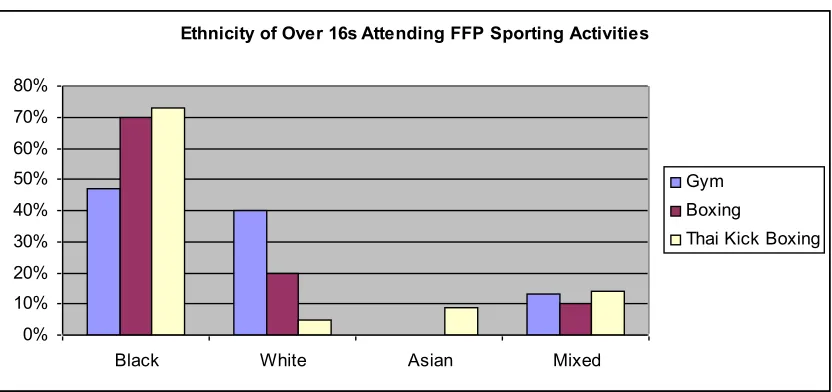
Figure 14 Ethnicity of over 16s attending sporting activities
[image:35.595.88.507.446.639.2]5.5.3.3 Postcode
Table 9 Postcodes of those attending over 16s sports
E16 E6 Other Outside Local Area
Gym 73% 4% 21% 27%
Boxing 69% 9% 22% 31%
Thai Kick Boxing 100% 0% 0% 0%
The trends showed similar patterns to the under 16s, with the overwhelming majority living in the local community where the Academy is located.
[image:36.595.90.506.301.493.2]5.5.4 Over 16s Numbers
Figure 15 Popularity of sports with the over 16s19
The over 16s pattern shows much sharper fluctuations in attendance than the under 16s. The regulations for using the gym were changed from February onwards: set time periods were introduced, no latecomers were allowed to join in and the activities were given greater structure, for example group warm ups and exercises were combined with individual work outs. The drop in attendance between February and March can also be attributed to the project’s closure to over 16s as a result of the problems caused by the huge influx of young people as outlined in Chapter 4. Thai kick boxing data were not collected properly and this needs to be addressed.
5.6 Observation Findings
Seven different observations at different times and different days of the week since October found positive changes in attendance and behaviour by individuals, between young people and staff. From the beginning it was clear that staff were keen to adopt a disciplinarian stance within the sports hall, no swearing or disruptive behaviour was allowed during the sporting activities. However, over time although this approach has
remained the same, the behaviour of young people has improved and staff in the sports hall have softened their approach and now engage young people in friendly banter when the moment allows. The young people in general respond positively and a positive spirit of mutual respect has emerged.
The different sports each engender different reactions from young people, Thai kick boxing and boxing are based around strict discipline and a clear structure that demands focus, attention, and 100% concentration. The over 16s tend to respond to these demands and are focussed on improving their individual performance. A genuine culture of promoting achievement and a mutually supportive environment in which young people encourage each other and suggest improvements for each other’s technique has developed. This has occurred to a lesser extent with the under 16s whom, for the majority treat the gym and boxing as fun activities and do not participate in the activities as seriously as the over 16s. On occasion the under 16s still push the boundaries in classes by not listening and by laughing and joking, although this has reduced over time. The gym sessions are a lot less structured than the other sports and there is the potential for the younger age groups in particular to treat the machines like toys and as a place to talk rather than work out. With the introduction of a more structured approach and informative posters that explain how to work the machines and the benefits of working out, young people are taking activities in the gym more seriously and are more focussed. This is a pleasing change as the structure of the gym now demands more focus from the young people than previously.
_____________________________________________________________________
6. RECOMMENDATIONS
_____________________________________________________________________
6.1 Limitations of the Data
• Developing a more robust system for collecting and entering information on the database is recommended. The data presented in this report reveals the quantitative dynamics of FFP and also the working practices of FFP staff. However, the large amount of missing data (see point 5.0) that is not recorded on the databases makes it difficult for staff to routinely assess their progress. • Monitoring data could be used by FFP staff to regularly review their progress
and performance: see point 4.4.1.
• One of FFP’s target groups is the NEET category. As yet the numbers of NEET young people are not entered on the database and FFP staff could address this. By accessing this information FFP will be able to inform their outreach programme: see point 5.0
6.2 Practice
• FFP staff need to ensure external partners deliver on their promises to increase their physical space. Space and capacity could impede the development of the project and rolling out the pillars: see point 4.6
• In order to reach a more diverse demography FFP staff could look at the activities they offer and the profile of the coaches they employ. The overall pattern is of black, male participants. Employing a white male coach as well as a female boxing coach and/or diversifying the activities to appeal to more females could cure this anomaly: see Chapter 5. Additionally, outreach could be targeted to attract different groups. Indeed staff have addressed this issue; the youth programme coordinator has recently visited local girl’s schools.
• FFP’s original target for phase one as 150 service users who accessed the project over a three-month period. Whilst this target has not been met it has to be recognised that this target was set when staff believed the premises were going to be double the size that they are currently. A target of 150 service users is an ambitious possibly unrealistic target considering the limited physical space and the capacity of staff. For the next phase FFP staff might consider revising their attendance targets in line with the findings from chapter 5: especially see point 5.2
6.3 Monitoring and Evaluation
• FFP staff could set up a system to ensure that staff collate the data and check the database on a regular basis to ensure that the required data is being collected and checked for accuracy: see point 5.0
• FFP staff could set up systems to ascertain why young people registered for the project but are not attending regularly: see point 5.1.2. This could enhance the performance of the project by understanding how the project is perceived by certain young people and whether this is affecting their attendance.