1
Title: Performance of the rapid Nucleic Acid Amplification by Abbott ID NOW COVID-19 in
nasopharyngeal swabs transported in viral media and dry nasal swabs, in a New York City
academic institution
Running Title: Performance of Abbott ID NOW rapid SARS-CoV-2 NAAT
Atreyee Basu1, Tatyana Zinger1, Kenneth Inglima2, Kar-mun Woo3, Onomie Atie3, Lauren Yurasits3, Benjamin See2, and Maria E. Aguero-Rosenfeld1
1NYU Grossman School of Medicine, Department of Pathology, New York, NY, USA, 2NYU Langone Health, Tisch Hospital New York, NY, USA
3NYU Grossman School of Medicine, Department of Emergency Medicine, New York, NY,
USA
Corresponding author:
Maria E. Aguero-Rosenfeld
Address:
NYU Langone Health, Tisch Hospital Clinical Laboratories
560 First Avenue,
New York, N.Y. 10016
Telephone: (212) 263-5905
Fax number: (212) 263-7922
2
Conflict of Interest statement: No conflicts of interest.
Acknowledgements:
We sincerely acknowledge the help and support of the medical technologists from the Tisch
Microbiology laboratory (Jiamin Chui, Claudia Funez and Alicia Lovell) and the Emergency
Medicine Nursing Team including Patricia Baptiste, Jennifer Tiarsmith, Jason Garcia, Roselle
David, Robin Keida, Jacquelyn Burns, Lauryn Clouden for caring for the patients and their
3
Abstract (word count=237)
The recent emergence of the SARS-CoV-2 pandemic has posed formidable challenges for clinical
laboratories seeking reliable laboratory diagnostic confirmation. The swift advance of the crisis in
the United States has led to Emergency Use Authorization (EUA) facilitating the availability of
molecular diagnostic assays without the more rigorous scrutiny to which tests are normally
subjected to prior to FDA approval. The need to identify the COVID-19 positive cases quickly and
accurately has propelled the release of a variety of assays intended to meet the urgent demand.
Several Nucleic Acid Amplification Tests (NAAT) platforms are currently available. Our
laboratory currently uses two real time RT-PCR platforms, the Roche Cobas SARS-CoV2 and the
Cepheid Xpert Xpress SARS-CoV-2. Both platforms demonstrate comparable performance;
however the run times for each assay are 3.5 hours and 45 minutes, respectively. In search for a
platform with shorter turnaround time, we sought to evaluate the recently released Abbott ID NOW
COVID-19 assay which is capable of producing positive results in as little as 5 minutes. We present
here the result comparisons between Abbot ID NOW COVID-19 and Cepheid Xpert Xpress
SARS-CoV-2 using nasopharyngeal swabs transported in VTM as well as dry nasal swabs for the
Abbott assay. Regardless of method of collection and sample type, Abbot ID NOW COVID-19
missed a third of the samples detected positive by Cepheid Xpert Xpress when using NP swabs in
VTM and over 48% when using dry nasal swabs.
Keywords: SARS-CoV-2, COVID-19, Abbott ID NOW, validation, nasopharyngeal and nasal
4
Introduction
The novel coronavirus, severe acute respiratory syndrome coronavirus 2 (SARS-CoV-2) causing
coronavirus disease-2019 (COVID-19) was first identified in Wuhan Jinyintan Hospital, China in
December 2019. Since then, it has spread vastly, reaching the status of global pandemic as declared
by the World Health Organization on March 11th, 2020 (1). As of May 2nd, 2020, there are 3,356,205 reported cases, and 238,730 confirmed deaths worldwide, in 215 countries (2). In NY
State and New York City, there were 316,415 and 168,845 reported cases and 19,189 and 13,319
deaths respectively as of May 2nd, 2020 (3, 4).
Common signs and symptoms with the associated respiratory illness are fairly non-specific and
include fever, dry cough, headache, myalgias, arthralgias, and sore throat, with indicators of more
severe disease such as shortness of breath and respiratory failure (1). Nearly 80% of the infected
individuals are either asymptomatic or have mild symptoms leading to difficulties to diagnose this
disease. COVID-19 has high human-to-human transmission rates (R0 = 2.0 – 2.5), and is stable in
aerosols and on surfaces, presenting a challenge to mitigation and emphasizing the urgent need for
a more rapid, accessible and accurate diagnostic assays (5).
SARS-CoV-2 virus is detected in various human sampling sources including respiratory and fecal,
but testing has been validated for PCR primarily of nasal, nasopharyngeal, and oropharyngeal
specimens. Positive samples for SARS-COV-2 were found in Chinese patients 1-2 days prior to
symptom onset and persisted up to 2 weeks in severe cases (1).
While long-term mitigation and prevention goals include prognostic markers, therapeutics, and
vaccines (1), the urgency of this rapidly developing crisis in the United States has prioritized the
5
(EUA) (5, 6). The initiative to expand and accelerate testing has eased the usual scrutiny that new
assays would normally undergo prior to release. This obligates clinical laboratories to more
carefully assess the overall performance of the various rapidly emerging testing platforms prior to
implementation. Several Nucleic Acid Amplification tests (NAAT) platforms are currently
available. Our laboratory uses two real time RT-PCR platforms, the Roche Cobas and the Cepheid
GeneXpert. Both platforms perform comparably with similar limits of detection (LOD) of
SARS-CoV-2 viral RNA, 100-150 and 250 copies/mL, respectively. However, the assay run times of 3.5
hours and 45 minutes, respectively, are still too long for timely decision support in a variety or
important clinical situations. (e.g. Emergency Department discharge). In search for a platform with
shorter turnaround time, we sought to evaluate the recently released Abbott ID NOW COVID-19
assay. Abbott ID NOW uses isothermal nucleic acid amplification of the RdRp viral target with a
claimed LOD of 125 copies/mL. The objective of our study was to evaluate the performance of
the rapid Abbott-ID-NOW platform test by using the Cepheid-Xpert-Xpress SARS-CoV-2 test on
the GeneXpert Dx as the comparator reference method.
Materials and Method
All samples were obtained from patients seen at the New York University Langone Tisch Hospital
with diagnosis of suspected COVID-19. Nasopharyngeal (NP) samples were obtained using
flocked NP swabs and transported in universal viral transport media (VTM) (Cepheid Xpert Viral
Transport Medium; SWAB/B-100) or BD Universal VTM / 2250527) within 1-2 hours of
collection.
For the assessment of performance of dry swabs, we obtained 101 dry nasal swabs of both nares
as well as 101 NP swabs in VTM from the same patient on the same ED encounter to be tested
6
respectively. The dry nasal swabs, which are supplied with the Abbott assay (Puritan Medical
Products 25-1506 IPF 100) were transported in a sterile tube to the laboratory along with the
corresponding NP swab in VTM.
Instruments and Methods
ID NOW COVID-19 is a rapid test that qualitatively detects SARS-CoV-2 viral nucleic acids
from nasal, nasopharyngeal and throat swabs. It is an automated assay that utilizes isothermal
nucleic acid amplification technology that eliminates the need for denaturation by thermocycling.
The test includes a sample receiver containing elution/lysis buffer, a test base comprising two
sealed reaction tubes containing the reagents required for amplification of SARS-CoV-2, an
internal control, a transfer Cartridge to transfer the eluted sample to the test base, and the ID NOW
Instrument. The templates which are similar to primers, are intended to target SARS-CoV-2 RNA
and amplify a unique region of the RdRp genome. The amplified RNA target is detected with the
use of fluorescent-labeled molecular beacons. Target amplification starts after adding the samples
to the sample receiver and transferred with the transfer cartridge to the test base. The instrument
provides heating, mixing and detection. Positive results are available within 5-13 minutes and
negative results within 13 minutes.
Xpert Xpress SARS-CoV-2 test is a rapid, real-time RT-PCR test detecting ribonucleic acid
(RNA) from the SARS-CoV-2 in nasopharyngeal swab and/or nasal wash/aspirate specimens
collected from individuals with suspected COVID-19 diagnosis. The specimens were collected,
placed in VTM and run on the GeneXpert Dx. This platform automates and integrates sample
preparation, nucleic acid extraction and amplification, and detection of the target sequences. The
assay detects 2 nucleic acid targets, namely N2 (nucleocapsid) and E (envelope) wherein N2 is
7
the manufacturer to be 250 copies/mL. SARS-CoV-2 genomic load is assessed using the number
of amplification cycles needed for a positive PCR test (i.e. the cycle threshold [Ct] value). Ct
values have an inverse relationship to viral loads and thereby provide a surrogate measurement of
the viral genomic load (7). Consequently, the higher the viral load, the lower the Ct value of a
particular specimen and vice versa.
Both assays are used only under Food and Drug Administration’s Emergency Use Authorization
(EUA).(8)
The performance evaluation of the Abbott ID NOW assay was conducted in several steps.
Initial verification of the Abbott ID NOW platform included two previously tested patients’
samples using the Xpert Xpress assay, one with high a Ct value 30.8 for N2 and another with low
Ct value of 19.3 (i.e. high viral load). Both samples were diluted 1:2, 1:5, 1:10, 1:20, 1:50 and
1:100 in VTM. All the dilutions were tested separately on both platforms.
Assessment of performance of Abbott ID NOW on NP samples transported in VTM. This
included 15 sequential NP specimens submitted in VTM by our Emergency Department from
patients with suspected COVID-19 disease. Each specimen was tested on both, the Cepheid
GeneXpert and Abbott ID NOW platforms.
Determining Abbott ID NOW performance according to N2 Ct values obtained by the
Cepheid Xpert Xpress assay. For this analysis, rather than using specimen dilution to simulate
a series of decreasing viral loads, a set of 8 previously tested specimens in the Xpert Xpress assay
were selected with increasing N2 Ct values ranging from 32.6 to 41.8. All samples were tested on
the ID NOW platform and the results compared to those previously obtained on the Cepheid
8
For all the comparisons mentioned above, all samples were nasopharyngeal swabs transported to
the lab in VTM. In response to our findings of lower sensitivity of the ID NOW compared to the
GeneXpert, Abbott communicated to us that despite the indications in the package insert, their
assay was not optimized for testing nasopharyngeal swabs in VTM; the best performance would
be from dry nasal swabs obtained at the point of care (POC). They indicated that they would be
modifying their package insert to reflect this change (ID NOW COVID-19 Product Insert,
IN190000 Rev.3 2020/04:6-8.). Since the Abbott ID NOW rapid results feature was regarded as a
worthwhile advantage over our other assays in use, we compared dry nasal swab (both nares) tested
on the Abbott platform versus NP in VTM tested on the Cepheid platform. Both samples were
obtained in parallel from patients with suspected COVID-19, seen at the NYU Langone Health
Tisch Hospital Emergency Department. Although Abbott indicated that the dry swab could be
transported in the same sleeve in which the swabs were packaged, we considered the safety of this
modality and chose a sterile tube instead. A total of 101 paired samples collected during 12 hour
shifts over 3 consecutive days were included. Ninety-three percent of the samples were transported
to the laboratory within 1 hour for testing, the remainder within 2 hours. Testing at the point of
care was not practical.
Statistical analysis
Qualitative Method Comparison was performed using EP Evaluator (Data Innovations, VT 05403)
and correlation coefficient using Excel 2010.
Results
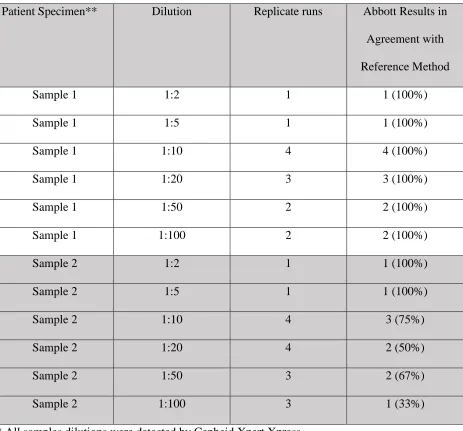
Results of the initial verification of the Abbott ID NOW revealed that it performed well with
respect to the reference method when a specimen (Sample 1) with low N2 CT value (9.3) was
9
N2 Ct value (30.8) (Table 1). Decreased sensitivity was noted at 1:10 dilution level (approximated
Ct=33.8) and beyond with only a 33% agreement at 1:100 (approximated Ct value of 36.8).
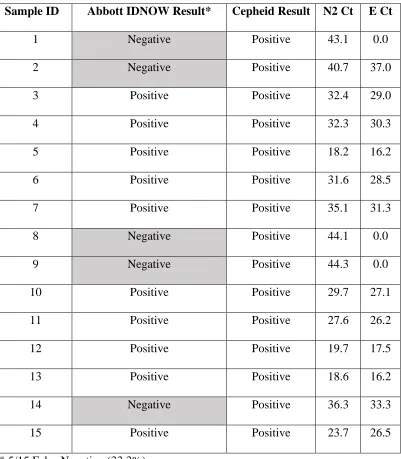
Comparison of results obtained on 15 sequential NP specimens submitted in VTM by our
Emergency Department produced 5 false-negative results by Abbott ID NOW (33.3%) (Table 2).
The Cepheid N2 Ct values of the discordant specimens ranged from 36.3 to 44.3.
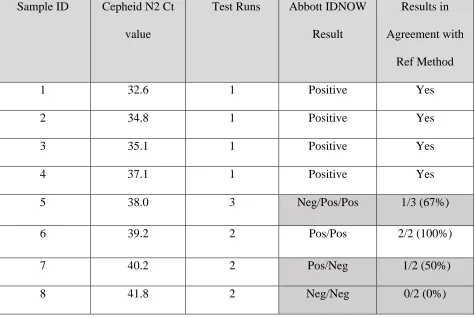
In order to confirm that the lower sensitivity of the Abbott ID NOW platform was related to the
Ct value obtained on the GeneXpert Dx, we used a series of previously tested NP specimens with
increasing N2 Ct values (Table 3). Similar to the dilution studies, the performance of the Abbott
ID NOW started to decline as the N2 Ct values increased throughout the series, although at a higher
Ct value (38.0) than that seen in our previous comparisons (~ 33.8, 36.3, respectively). That is,
beyond a Ct value of 38, ID NOW performance became increasingly less reliable.
The distribution of the Ct values of 1439 positive samples previously tested in the Xpert Xpress
over the previous 1 ½ months in our laboratory revealed that 15.1% of total positive samples had
Ct values above 38 (data not shown).
For the dry nasal swabs versus NP samples in VTM we included samples from 101 Emergency
Department patients (age 28-90) with suspected COVID (onset of symptoms 1 day to 1 month).
Patients were sampled twice during the same encounter using a nasal dry swab of both nares and
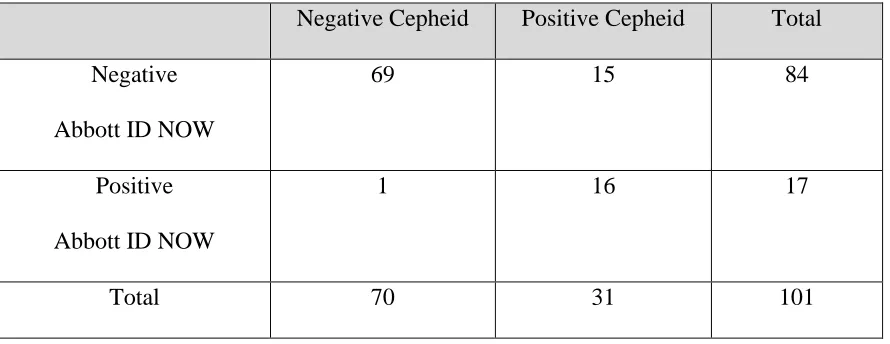
a NP specimen submitted in VTM. As seen in Table 4, the Abbott ID NOW using dry nasal swabs
detected 51.6% (16 of 31 positive samples detected by Cepheid Xpert Xpress). The remaining 15
samples were falsely negative. The sensitivity of the Abbott ID NOW platform according to the
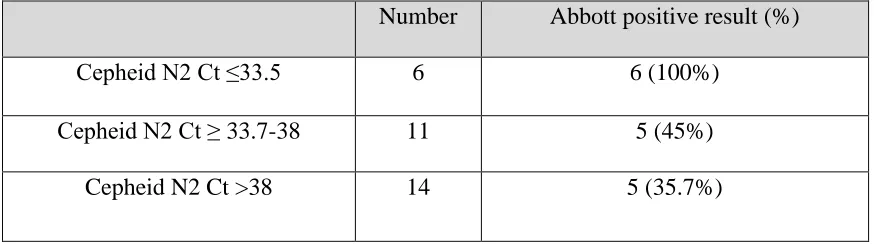
N2 Ct values obtained with the Cepheid Xpert Xpress is shown in Table 5. All 6 dry nasal swabs
10
Abbott ID NOW. But sensitivity of Abbott ID NOW was 45% (5 of 11) and 35.7% (5 of 14) when
N2 Ct values obtained by Xpert Xpress were between 33.7 and 38, and >38, respectively.
There was no correlation between N2 Ct and days of onset of symptoms (R2 = 0.097). Sixteen of
the 31 patients whose samples tested positive for SARS-CoV2 RNA by Xpert Xpress were
admitted; 6 of these patients had negative results when tested by Abbott ID NOW.
Discussion
The urgency of the COVID-19 pandemic and the United States government’s subsequent use of
the Federal Authorization Act has placed an unusual onus of responsibility on the clinical
laboratories to substantiate the clinical value and performance of the COVID-related tests they
introduce. Accurate diagnostic testing and subsequent isolation of sick individuals is crucial to
mitigating continued infectious transmission. Therefore, assay sensitivity must be evaluated on the
many newly available COVID-19 testing platforms to minimize the public health risks that come
with false negative results.
Our study used several approaches in an attempt to validate the rapid testing methodology by
Abbott ID NOW COVID-19 in comparison to Cepheid Xpert Xpress SARS-CoV-2. The appeal
of the Abbott technology stemmed from our intention to provide rapid and accurate results in our
institution, especially for our Emergency Department.
Our results showed progressively more false negative results with lower viral load (higher N2 Ct
values) as determined by Cepheid, but this was not consistent; there were samples testing positive
by Abbott platform even when N2 Ct values were above 38 when we did the parallel comparison
of dry nasal swabs versus NP samples in VTM. A study from Northwell Health has shown similar
11
negatives out of 107 nasopharyngeal samples, resulting in a sensitivity of 87.7% compared to
98.3% on Xpert Xpress SARS-CoV-2. Their study however, used NP swabs transported in VTM,
which the manufacturer claims decreases the sensitivity of their assay. These authors also
determined that the GeneXpert had the lowest limit of detection at 100 viral copies/mL, while the
ID NOW had a limit of detection of 20,000 copies/mL (9) which is well above the limit of
detection stated in the Abbott ID NOW COVID-19 package insert (125 viral copies/mL).
Using a larger sample size, preliminary studies at the Cleveland Clinic also revealed a lower
sensitivity for the Abbott ID NOW, with a false negative rate of 14.8%. However, the samples
were all stored in viral transport media (10). Although the initial Abbott package insert had stated
that 0.5 to 3.0 mL of viral transport media was acceptable for use in their assay, it also
recommended minimizing dilution of the sample is as it may result in decreased test sensitivity.
The use of dry swabs is now recommended by the manufacturer for optimal test performance. To
investigate potential improvement in test performance resulting from this change, we evaluated
the use of dry nasal swab and NP in VTM obtained in parallel on ED patients. Contrary to
manufacturer expectations, our parallel study showed that the sensitivity of Abbott ID NOW using
dry swabs (51.6%), was actually lower than when using viral transport media (66.7%) as seen from
our earlier study of ED samples.
The literature provides no strong consensus regarding the influence of transport medium and
storage conditions on viral load stability. One study looking at differing viral transport media and
storage conditions using the Quest and Roche EUA assays showed consistent detection of
SARS-CoV-2 RNA after 7 days at room temperature, and up to 14 days refrigerated or frozen. (11) The
SARS-COV-2 ID-NOW package insert also directs clinicians to test swabs as soon as possible
12
to testing. Outside of inpatient hospital laboratories, such as in outpatient point-of-care testing,
independent validation should be performed to assess performance in different settings, including
pre-analytic variables.
Extrapolating from our results from 101 patient samples, if the Abbott-ID-NOW COVID-19 assay
were to be used as a first step screening, confirmation of over 80% of the tested samples would be
required to be confident that the negative results are truly negative. While there was one apparent
false-positive result in our parallel study, the overall high PPV (94.1%) and specificity (98.6 %)
do support the added value that in 5 -13 minutes a positive result can be interpreted as a true
positive. We could not confirm that the apparent false positive result obtained with the Abbott ID
NOW was due to sampling variability.
Based on our findings we could argue that the Abbott ID NOW detects samples with high viral
load or possibly viable virus that could be of importance for transmission. But, the fact that it
misses positive samples on patients being admitted to the hospital with clinical picture of
COVID-19 makes this technology unacceptable in our clinical setting. Recent reports indicate that
mutations in the RdRp domain have been emerging (12). It is unknown at this point if the genomic
region targeted by the Abbott assay has changed significantly as the virus is spreading throughout
the world.
Limitations of our study include relatively small sample size, inability to control for sampling
variabilities, time of transport of dry swabs and testing being conducted in the clinical laboratory,
rather than point-of-care setting as Abbott ID NOW platform is intended.
13
Overall, our study revealed low sensitivity with high false negative results by Abbott ID NOW
platform irrespective of use of viral transport media, which raises concern regarding the
performance of the assay and its suitability as a diagnostic tool for symptomatic patients. The
resolution could be to reflex all negative results for confirmation by a method with higher
sensitivity. However, such requirement would, except for positives, severely diminish the value of
the rapid results of the assay.
References
1. World Health Organization. 2020. Report of the WHO-China Joint Mission on
Coronavirus Disease 2019 (COVID-19) WHO, Geneva.
2. World Health Organization. 2020. Coronavirus disease (COVID-19) Pandemic, on
WHO. https://www.who.int/emergencies/diseases/novel-coronavirus-2019. Accessed May 3.
3. New York State Department of Health. 2020. NYSDOH COVID-19 Tracker.
https://covid19tracker.health.ny.gov/. Accessed May 3.
4. Health NYCDo. 2020. COVID-19: Data. https://www1.nyc.gov/site/doh/covid/covid-19-data.page. Accessed May 3.
5. Zhen W, Manji R, Smith E, Berry GJ. 2020. Comparison of Four Molecular In Vitro
Diagnostic Assays for the Detection of SARS-CoV-2 in Nasopharyngeal Specimens. J
Clin Microbiol doi:10.1128/jcm.00743-20.
6. US Food and Drug Administration (FDA). 2020. FAQs on Diagnostic Testing for
14
7. Hasegawa K, Jartti T, Mansbach JM, Laham FR, Jewell AM, Espinola JA, Piedra PA,
Camargo CA, Jr. 2015. Respiratory syncytial virus genomic load and disease severity
among children hospitalized with bronchiolitis: multicenter cohort studies in the United
States and Finland. J Infect Dis 211:1550-9.
8. Cheng MP, Papenburg J, Desjardins M, Kanjilal S, Quach C, Libman M, Dittrich S,
Yansouni CP. 2020. Diagnostic Testing for Severe Acute Respiratory Syndrome-Related
Coronavirus-2: A Narrative Review. Ann Intern Med doi:10.7326/m20-1301.
9. Zhen W, Smith E, Manji R, Schron D, Berry GJ. 2020. Clinical Evaluation of Three
Sample-To-Answer Platforms for the Detection of SARS-CoV-2. J Clin Microbiol
doi:10.1128/jcm.00783-20.
10. Stein R. 2020. Study Raises Questions About False Negatives From Quick COVID-19
Test, p In National Public Radio (NPR).
https://www.npr.org/sections/health- shots/2020/04/21/838794281/study-raises-questions-about-false-negatives-from-quick-covid-19-test.
11. Rogers AA, Baumann RE, Borillo GA, Kagan RM, Batterman HJ, Galdzicka M,
Marlowe EM. 2020. Evaluation of Transport Media and Specimen Transport Conditions
for the Detection of SARS-CoV-2 Using Real Time Reverse Transcription PCR. J Clin
Microbiol doi:10.1128/jcm.00708-20.
12. Pachetti M, Marini B, Benedetti F, Giudici F, Mauro E, Storici P, Masciovecchio C,
Angeletti S, Ciccozzi M, Gallo R, Zella D, Ippodrino R. Emerging SARS-CoV-2
mutation hot spots include a novel RNA-dependent-RNA polymerase variant. Journal of
15
Tables
Table 1: Initial verification of Abbott ID Now. Positive Agreement* when testing two
progressively diluted patient specimens with low and higher N2 Ct values
Patient Specimen** Dilution Replicate runs Abbott Results in
Agreement with
Reference Method
Sample 1 1:2 1 1 (100%)
Sample 1 1:5 1 1 (100%)
Sample 1 1:10 4 4 (100%)
Sample 1 1:20 3 3 (100%)
Sample 1 1:50 2 2 (100%)
Sample 1 1:100 2 2 (100%)
Sample 2 1:2 1 1 (100%)
Sample 2 1:5 1 1 (100%)
Sample 2 1:10 4 3 (75%)
Sample 2 1:20 4 2 (50%)
Sample 2 1:50 3 2 (67%)
Sample 2 1:100 3 1 (33%)
* All samples dilutions were detected by Cepheid Xpert Xpress
[image:15.612.76.539.172.603.2]16
Table 2. Results of sequential nasopharyngeal specimens submitted in VTM from the Emergency
Department tested on both Abbot ID NOW and Cepheid GeneXpert for SARS CoV-2 RNA
Sample ID Abbott IDNOW Result* Cepheid Result N2 Ct E Ct
1 Negative Positive 43.1 0.0
2 Negative Positive 40.7 37.0
3 Positive Positive 32.4 29.0
4 Positive Positive 32.3 30.3
5 Positive Positive 18.2 16.2
6 Positive Positive 31.6 28.5
7 Positive Positive 35.1 31.3
8 Negative Positive 44.1 0.0
9 Negative Positive 44.3 0.0
10 Positive Positive 29.7 27.1
11 Positive Positive 27.6 26.2
12 Positive Positive 19.7 17.5
13 Positive Positive 18.6 16.2
14 Negative Positive 36.3 33.3
15 Positive Positive 23.7 26.5
17
Table 3. Abbott ID NOW Results according to Xpert Xpress N2 Ct values
Sample ID Cepheid N2 Ct
value
Test Runs Abbott IDNOW
Result
Results in
Agreement with
Ref Method
1 32.6 1 Positive Yes
2 34.8 1 Positive Yes
3 35.1 1 Positive Yes
4 37.1 1 Positive Yes
5 38.0 3 Neg/Pos/Pos 1/3 (67%)
6 39.2 2 Pos/Pos 2/2 (100%)
7 40.2 2 Pos/Neg 1/2 (50%)
18
Table 4. Comparison of results obtained using Abbott ID NOW and Xpert Xpress on 101
patients seen at the ED who had paired nasal dry swabs and NP samples in VTM
Negative Cepheid Positive Cepheid Total
Negative
Abbott ID NOW
69 15 84
Positive
Abbott ID NOW
1 16 17
Total 70 31 101
Agreement: 84.2% (75.8 – 90.0%)
Sensitivity: 51.6% % (34.8 - 68.0%)
Specificity: 98.6% (92.3 - 99.7%)
95% Confidence Interval calculated by the “Score” Method
PPV: 94.1%
19
Table 5. Comparison of Abbott ID NOW results using dry nasal swabs in a total of 31 testing
positive by Cepheid Xpert Xpress using NP in VTM according the N2 Ct values
Number Abbott positive result (%)
Cepheid N2 Ct ≤33.5 6 6 (100%)
Cepheid N2 Ct ≥ 33.7-38 11 5 (45%)