
http://dx.doi.org/10.4236/ojee.2015.44009
Analysis of DVFS Techniques for Improving
the GPU Energy Efficiency
Ashish Mishra, Nilay Khare
Department of Computer Science and Engineering, Maulana Azad National Institute of Technology, Bhopal, India
Received 2 October 2015; accepted 11 December 2015; published 14 December 2015
Copyright © 2015 by authors and Scientific Research Publishing Inc.
This work is licensed under the Creative Commons Attribution International License (CC BY). http://creativecommons.org/licenses/by/4.0/
Abstract
Dynamic Voltage Frequency Scaling (DVFS) techniques are used to improve energy efficiency of GPUs. Literature survey and thorough analysis of various schemes on DVFS techniques during the last decade are presented in this paper. Detailed analysis of the schemes is included with respect to comparison of various DVFS techniques over the years. To endow with knowledge of various power management techniques that utilize DVFS during the last decade is the main objective of this paper. During the study, we find that DVFS not only work solely but also in coordination with other power optimization techniques like load balancing and task mapping where performance and energy efficiency are affected by varying the platform and benchmark. Thorough analysis of various schemes on DVFS techniques is presented in this paper such that further research in the field of DVFS can be enhanced.
Keywords
GPGPUs, DVFS, Task Mapping, Energy Efficiency
1. Introduction
As we move from mega scale to petascale era, the requirements of data processing and computation are growing exponentially. In order to accomplish this high computation demand, researchers have moved from serial com-putation platforms to high performance comcom-putation (HPC) platforms such as multicore processor, FPGAs and heterogeneous system (GPU supported systems) etc. GPUs, in particular, have been widely used for HPC appli-cations due to their extremely high computational powers. A large number of supercomputer found in TOP500 list use GPU to achieve unprecedented computational power [1].
cores and much higher peak performance than CPUs. Hence, many HPC applications utilize the power of GPUs. For example, the recently built supercomputer Tianhe-1A has won the second spot on the TOP 500 list [1] and is equipped with Intel Xeon 5670 processors and NVidia’s CUDA-enabled Tesla M2050 general purpose GPUs. Having GPU in Tianhe-1A makes supercomputers able to achieve more than two fold energy efficiency than the third place CPU-based Jaguar TOP 500 list. However, the electricity bill of Tianhe-1A is estimated around an-nual electricity bill of $2.7 million [2]. This high power consumption is another reason that forces researchers to work in a direction to reduce the power consumption of GPUs.
On the other hand, manufacturers increase the number of processing core to gain the high performance which has resulted in raising the power consumption of GPUs. They consume much high power as compared to CPUs and the raised levels of power consumption of GPUs have significant impact on reliability, architecture design, economic feasibility and deployment into widespread range of application domains. In recent years, several re-search has been accomplished for the reduction of power consumption of homogenous as well as heterogeneous systems and various techniques to reduce the power consumption of both the systems have been proposed. In [3], Sparsh and Jeffery present superior categorization of various power reduction techniques which are categorized as follows:
1. DVFS based techniques;
2. CPU-GPU workload division techniques; 3. Saving energy in GPU components; 4. Dynamic resource allocation techniques;
5. Application specific and programming level techniques.
In this paper, literature survey and thorough analysis of various schemes on DVFS techniques to reduce the energy efficiency of GPUs only are presented. The rest of the paper is organized as follows.
2. Background
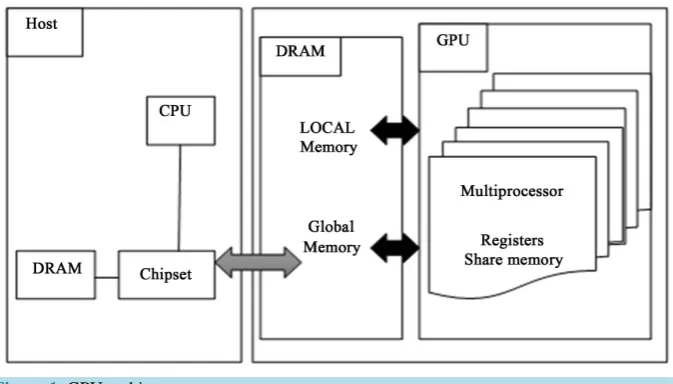
2.1. GPUAs shown in Figure 1,all GPUs have two important component one is number of parallel streaming processor and second one is memory used by GPUs core. Each streaming processor again has a number of processing elements. Performance of kernel application is vastly depending on the frequency on which these two compo-nents operated.
2.2. Need to Improving Energy Efficiency of GPU
[image:2.595.145.482.521.713.2]Due to application limitation, it is not always possible for an application to map all the available cores. In sever-al applications, memory bandwidth [4] [5] of GPU act as bottleneck to affect the performance of GPU. Due to this bottleneck, the core of GPU remains unutilized. Therefore, a good power management technique is required
to save the power consumed by these unutilized cores. As said by Anderson in [6], a 15 degree increase in tem-perature is responsible to increase the failure rates of component by a factor of two. This component failure may lead to system malfunction that in turn affect economic of the system as GPU becomes popular accelerator among the super computer and business services. Thus, an efficient energy model is needed to ensure the relia-bility. Although, GPU’s get admired for the performance improvement and have to be energy efficient to ensure the reliably and improve business gain.
3. Dynamic Voltage Scaling Techniques
Dynamic voltage and frequency scaling (DVFS) is a technique widely used for reducing energy consumption of processors by varying the voltage and frequency at run time [7]. The main idea is to reduce frequency or voltage during periods when the processor has a reduced workload. If DVFS is done wisely, energy can be saved with-out any noticeable effects on the speed at which the processor performs its tasks. Most systems are designed with fixed voltage and frequency settings in order to make the system stable. However, the activity levels of ap-plications are variable, and in many cases, apap-plications have idle periods when no useful task is performed. By reducing the processor voltage and frequency levels at run-time when the application has low-activity or idle pe-riods, energy can be saved.
DVFS can be used to eliminate power-wasting idle times by lowering the processor’s voltage and frequency during low workload periods so that the processor will have meaningful work at all times leading reduction in the overall power consumption. The energy consumed by GPU is given by the following equation [3] [8]:
2
E=CV ∗f (1)
where,
E = Energy consumed by GPU Measured in joules (J);
C = Capacitance;
V = Voltage supply to GPU;
f = Clock frequency of GPU.
Thus, the power consumed by a task may be decreased by reducing V or F, or both. However, for tasks that require a fixed 5 amount of work, reducing the frequency may simply take more time to complete the work. As a result, little or no energy will be saved. Therefore, intelligent DFVS techniques are required to improve the energy efficiency of GPUs. Many techniques are used to control power consumption by controlling the fre-quency, since processor frequency has a strong effect on power consumption and temperature. Dynamic voltage and frequency scaling (DVFS) are the most commonly used techniques in modern processors [9].
This section describes various DVFS techniques explored by the researchers exclusively for GPUs. We found that DVFS not only work solely but also work in coordination with other techniques like workload divisions/ task division techniques to give the best result. This section categorized the DVFS techniques in the following heads:
A. Schemes using core DVFS technique
B. Schemes using DVFS with other GPU optimization (Hybrid DVFS)
In Section 3.1, detailed description of energy saving methods with only DVFS technique is presented. In Sec-tion 3.2, those methods which not only used DVFS but also used some other optimizaSec-tion such as task mapping, workload division, load balancing etc. in coordinated manner are discussed.
3.1. Schemes Using Core DVFS Technique
Intelligent use of DVFS technique may reduce energy consumption of GPU’s energy demand. It is a challenging task for DVFS to save energy while preserving the performance [8]. The schemes presented in [10]-[14] apply only DVFS technique for conserving energy on various benchmarks. All of them managed to save energy while maintaining the performance aspects. A triple domain DVFS scheme is proposed in [11] for graphical processor where the frequency and voltage of RISC, geometry processor (GP) and rendering engine (RE) are indepen-dently managed. This multi-domain power management scheme used three power management unit that is fully integrated on chip to apply DVFS on graphical processing unit (GPU).With this triple domain power scheme in
applica-tion kernels under varying frequency settings are characterized. In order to conduct research, the authors choose three computationally diverse applications namely:
1. Compute Intensive Application 2. Memory Intensive Application 3. Hybrid Application
The authors identified these three classes of kernel on the basis of two metrics proposed in [15]: 1. Rate of instruction issues
2. Ratio of Global memory transaction to Computation Instruction
On the basis of above ration, following application kernel belonging to above three categories are identified. The kernel categories and application kernels are shown inTable 1.
In [8], the number of utilized GPU cores is not varied because of the restrictions of GPUs in “suspending” unused GPU cores so as to utilize lesser power causing inconsistent results. At the end of study [8], the authors concluded that performance and power consumption of GPU are largely determined by two characteristics: the rate of issuing instructions and the ration of global memory transactions to computation instructions. The vital goal of research work in [8] is to investigate the power and performance, and power consumption of typical GPU application kernel under different memory and core frequency.
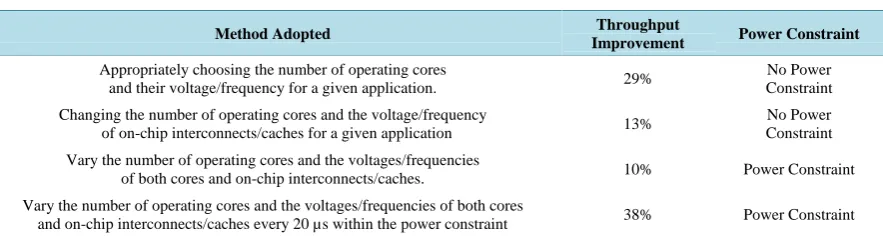
In [12], the authors improve throughput of GPUs by adjusting the number of operating cores and voltage/ frequency of cores and/or on chip interconnects/cached for different application under the power constraint en-vironment. Even they further improve throughput by dynamically scaling the number of core and voltage/fre- quency of both core and on-chip caches at runtime. The objective of [12] is to improve the throughput only by keeping power consumption constant and the results are shown in Table 2on the basis of experiments con-ducted on GPGPU-SIM [16] simulator.
On average, [12] achieved 20% improvement in power constraint environment. In addition to core/memory frequency, the method proposed in [12] also varies the number of active core. Instead of adding one more para-meter, the proposed method does not have robust runtime mechanism to deal with all scenarios. However, the benefits of implementing DVFS on GPU without describing the detailed process of the runtime system [17] are shown. The scheme do not focus on memory side DVFS at all as DVFS can be useful for embedded GPUs.
A power management approach is presented in [10] that takes a unified view of the CPU-GPU DVFS to re-duce the power consumption of latest 3D mobile games on android platform as compared to independent CPU- GPU DVFS based power management approach. The main objective of scheme is to provide expected frame per second for games while reducing the power consumption. Besides Asphalt 7, high end android games like Anomaly 2, Call of Duty, Need for Speed Most Wanted, Final Strike, Real Football 2013 and AVP are used. In
[image:4.595.96.538.602.720.2][10], the authors examined that increasing the GPU frequency has no impact on the frame per second. Instead, they employ the concept of CPU COST and GPU COST [18] which is given by:
Table 1.Kernel categories and application kernels.
S. No Kernel Category Kernel
1 Compute intensive Dense matrix multiplication
2 Memory intensive Dense matrix transpose
3 Hybrid Fast Fourier transform
Table 2.Throughput improvement under various uses case and power constraints.
Method Adopted Throughput
Improvement Power Constraint
Appropriately choosing the number of operating cores
and their voltage/frequency for a given application. 29%
No Power Constraint
Changing the number of operating cores and the voltage/frequency
of on-chip interconnects/caches for a given application 13%
No Power Constraint
Vary the number of operating cores and the voltages/frequencies
of both cores and on-chip interconnects/caches. 10% Power Constraint
Vary the number of operating cores and the voltages/frequencies of both cores
Cpu cost=Cpu utilization frequency∗ (2)
Gpu cost=Gpu utilization frequency∗ (3)
Proposed integrated approach is able to reduce power consumption of 3-D games by up to 26% for compara-ble frame per second range.
A broad study of GPU DVFS conducted on 37 benchmark kernel is presented in [13]. The scheme not only increase performance by 4% but also conserves energy by 19.28% and it is shown that frequency scaling is ef-fective approach to save the energy. By scaling down the core frequency, run time energy can also be saved. The scheme is compared with performance matrices obtained from default setting.
Matrices Rˆ and Rmax are used to evaluate energy conservation in [13].
min
ˆ 1 ˆ
R= −E E (4)
ˆ
E = Energy consumption at default GPU Configuration.
min
E and Emax are the minimum and maximum energy consumption under different voltage/frequency
set-ting for a given application.
max 1 min max
R = −E E (5)
Core scaling and memory scaling does not work well for every application kernel and some application kernel gives best result at default frequency settings.
Ge etal.[14] applied frequency scaling on both CPU and GPU with three typical parallel applications. They found that scaling GPU frequency higher would not consume more energy [14]. To investigate the impact of DVFS, they use following four classes of the performance metrics:
1. Performance 2. Power 3. Energy
4. Energy Efficiency
Experiments are performed on Tesla K20 series GPU form the family of Keplers architecture that support power management and power accounting features. The scheme presented in [14] not only concentrate on GPU energy but also focus on system lever energy and concluded that GPU DVFS affect system energy less as com-pared to CPU DVFS.
3.2. Schemes Using DVFS with Other GPU Optimization (Hybrid DVFS)
DVFS shown in the previous section suffers from major energy/performance trade-off issues. If not intelligently selected, it may affect performance/energy or both. Therefore, researchers combine DVFS with some other op-timization techniques to further improve the performance as well as energy efficiency of running kernel. Over the years, considerable work has been proposed in [9] [17] [19]-[22] to improve the energy efficiency by adding some more optimization approaches to DVFS.
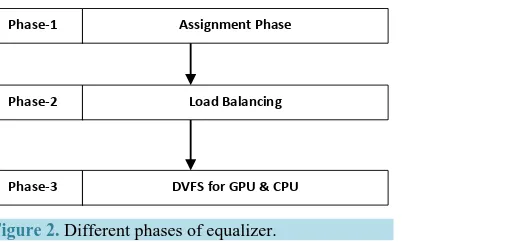
Liu etal.[19] proposed power aware time sensitive mapping technique for heterogeneous system that are able to meet application timing requirement while reducing power consumption of applying DVFS on both CPU and GPU. The scheme is executed in three phases as shown in Figure 2.
Assignment phase is responsible to assign application to processor like GPU/CPU. Thereafter, Load Balanc-ing phase will manage the Load among CPU and GPU. Finally, DVFS phase scale the frequency as per re-quirement while meeting all the deadlines. Assignment phase calculate the heterogeneous ratio for each of ap-plication to take the assignment decision. Heterogeneous ratio is given by Hi
max ,
c g
i i
i g c
i i
e e
H
e e
=
(6)
where eic is the worst case execution time of i th
workload on CPU under maximum voltage and eig is worst case execution time of ith workload on GPU under maximum voltage.
If 1
c i g i e
Figure 2.Different phases of equalizer.
With the proposed method in [19], Liu etal. managed to save energy more than 20%. Although they develop algorithm for time sensitive applications like data analysis, stock trading, real time scoring of bank transaction, live video processing etc., but does not experiment with them. Behavior of proposed method should be investi-gate with memory/core bounded applications.
There has been lot of work done on saving energy consumption of either CPU or GPU but, the work in iso-lated manner cannot achieve maximum performance. Ma etal.[20] proposed an energy-management framework known as GreenGPU for GPU-CPU heterogeneous architecture. The framework presented 2-Tier design framework for saving energy as shown in Figure 3. As an example, the workload share of CPU and GPU may be 15% and 85% respectively. Tier-1 ensure load balancing which avoid the energy-waste due to idling.
Tier-2 adjusted the frequency of GPU cores and memory is adjusted along with the frequency and voltage of the CPU to achieve largest possible energy savings with marginal performance degradation. However, [20] use DVFS and workload division individually, and so their method cannot set optimal parameters of DVFS and task mapping [22], otherwise existing marginal performance degradation can be improved. An efficient power cap-ping technique through coordinating task mapcap-ping and DVFS in a CPU-GPU heterogeneous system is proposed in [22]. The proposed empirical model predict execution time and power consumption of heterogeneous system in order to avoid power violation and load imbalance between the CPU and GPU. The scheme was using benchmark application form Rodinia and form BLAS library under the power constrained of 200 w, 220 w, 240 w, 260 w, 280 w. Their proposed Power model is represented by
(
,)
(
, ,)
(
, ,)
node idle cpu gpu cpu cpu gpu cpu gpu cpu gpu gpu
p = p f f +p f f r +p f f r (7)
where pidle is represent idle power consumption which is dependent on frequency of CPU ( fcpu) and GPU
( fgpu) but independent of task mapping function. On the other hand, power consumption of CPU (pcpu) and
GPU (pgpu) is dependent on the percentage of task mapping along with the frequencies. The proposed power
capping techniques can achieve more than 93% of performance as compared to the ideal one. In [17], Sethia et al. proposed a runtime system known as Equalizer that provides adaptive approach so that the hardware will best match the needs of running kernel. Equalizer was designed to work on two modes:
1. Energy efficiency mode 2. High performance mode
Working of Equalizer can easily understand with the help of Figure 4. In energy efficient mode, equalizer throttled the frequency of underutilized resources. No performance degradation reported, in fact it saves 15% energy by improving the performance by 5%. On the other hand, in high performance mode only bottleneck re-source is boosted by scaling up the frequency to provide higher performance.
On the cost of 6% extra energy consumption, this mode achieves 22% performance improvement. To achieve this improvement in both the modes, equalizer tunes three major architectural parameters: No of Concurrent Thread, Core Frequency, and Memory Frequency according to the mode selected. As per the requirement, Equa-lizer tunes these three parameters. Wang and Nagarajan [9] proposed a feedback controlling algorithm, known as Proportional integral derivative dynamic frequency scaling (PIDDFS) to scale the core and memory frequen-cies for GPU architecture. PIDDFS minimized the energy consumption for the memory intensive applications. This technique basically targeted to memory bound application and can be able to save more power if applica-tion is memory bounded. The reason is: when memory access intensity is higher, low frequency period main-tained by PIDDFS will be more and power saving during that time will be more. The technique was simulated
Phase-1 Assignment Phase
Phase-2 Load Balancing
Figure 3. Green GPU two tier design architecture [20].
Figure 4.Flow chart of equalizer [17].
with GPGPU-SIM [16] in coordination with power model GPUWattch [23]. Simulation results show that appli-cation gain 23% on average power saving with performance improvement of average 4% for all benchmarks. Although proposed method is less complicated and has cross platform adaptability but give best result only for the memory bound applications. The authors compared PID based approach with only CPU DVFS rather than GPU DVFS.
Since the authors in this field usually applied DVFS on single GPU, Ren etal.[21] proposed a method that apply DVFS on CPU and load balancing on multiple GPUs. In this scheme, they identify that the power con-sumption behavior of the application is highly dependent on the underlying design of the algorithm. The scheme used the algorithmic level power model to predict the execution time and power related parameters. The method converts instruction mixture information, pipelining structure and out of order processing in SIMD flow, so that it can be measured in optimum accuracy. This is the only document that used the CPU DVFS technique with load balancing in multiple GPU and successfully saved the 4.4% energy. The scheme used CPU DVFS only for improving the executing time and load balancing technique to improve the energy consumption of applications. Sufficient overhead was saved by avoiding the GPU DVFS. The authors created three scenarios depicted in Ta-ble 3 and test their proposed algorithm model.
The scheme demonstrated that intelligent use of GPU parallelization, CPU frequency scaling and power load scheduling methods will improve the performance of application while reducing the energy consumption of processing elements in multiple GPU platforms. Wu etal. [24] proposed a machine learning based power esti-mation model that learn itself to scale application according to different hardware configuration. The ultimate
Dynamically split and distribute workload among CPU & GPU based on the characteristics of workloads
Dynamically throttles the frequencies of GPU cores and memory in a coordinated manner
TIER-1
TIER-2
Increase/Decrease/Maintain The number of threads on SM
Take Vote among different SM’s to determine the overall Resource requirement of kernel
Mode selection
Energy efficient mode
objective of their research is to predict the power and performance of GPUs across a range of hardware confi-guration. The machine learning algorithm requires training data set which is formed by varying the number of computing core, frequency of core and memory. Although DVFS not directly used but varying the frequency of core and memory are used to get the performance metrics. Total 448 training sets are acquired by varying the range of eight computing unit (4, 8, …, 32) eight core frequencies (300, 400, …, 100 MHz) and eight memory frequencies(475, 625, …, 1375 MHz).
4. Comparative Study
[image:8.595.93.539.287.719.2]DVFS can be used either in isolated manner or in coordination with some other techniques. As shown inTable 4, energy/performance improvement depends on type of application kernel and platform chosen. DVFS can be
Table 3. Measurement result under three power aware CPU-GPU configuration [21].
Load Balancing DVFS (CPU ONLY)
Execution Time
Improvement Energy Improvement
CPU + GPU NO YES YES NO
CPU + MULTIPLE GPU NO YES YES NO
CPU + MULTIPLE GPU YES YES YES YES
Table 4. Comparative analysis.
Author Technique Used No of Benchmark Used Benchmark Or Application Kernel Energy Improvement Performance Improvement Platform for Parallel Implementation Core DVFS
Lee etal.[11] DVFS Not
specified Not specified 65% Not specified Not specified
Jiao etal.[8] DVFS 3
Dense matrix multiplication
Dense matrix transpose
Fast Fourier transform
4% Not specified NVidiaGTX-280
Lee etal.[12] DVFS 39
GPGPU-Sim
Rodinia
ERCBench
Power
constraint 20%
GPGPU-Sim (Simulate Quadro
FX 5800)
Mei etal.[13] DVFS 37 CUDA SDK 4.1
Rodinia 19.28% 4
NVIDIA GeForce GTX 560 Ti
Ge etal.[14]
K20c DVFS 1
Matrix multiplication
Traveling salesman problem
Finite state machine
Not
specified Not specified
NVIDIA Tesla K20c
Hybrid DVFS
Liu etal.[19] DVFS with
Load Balancing 4
AMD OPENCL Sdk
IBM 20%
Performance
constraint AMD Radeon HD 5770
Ma etal. [20]
DVFS with Task Mapping
9 Rodinia 21.04%
Marginal performance
degradation
NVIDIA GeForce 8800 GTX
GPU
Komoda etal.[22]
DVFS with Task
Mapping
25 Rodinia BLAS Library
Power
constraint 93%
NVIDIA Tesla K20c
Sethia and Mahlke [17]
DVFS with Vary No of
Thread
27 Rodinia Parboil 15% (Energy efficiency mode) 20% (Performance mode) GPGPU-Sim (Simulate GTX480) Wang & Nagarajan [9]
DVFS with PID
12 CUDA Sdk 23% 4% GPGPU-Sim
designed to improve either performance [19] or energy [12] or both [9] [12] [13] [17] [19]. A variation in im-plementation platform is observed although NVidia is the favorite for researchers [14]. Presented a deep study on advance GPU K20c by varying the frequency of CPU and GPU and observe the performance/energy effi-ciency improvement. It is observed that applying CPU DVFS and Load balancing in multiple GPU can also im-prove the energy and performance efficiency [21].
5. Conclusion
In this paper, survey and analysis of several DVFS techniques aimed at analyzing and improving the energy ef-ficiency of GPUs are presented. The key emphasis is on the need of power management in GPUs and identifica-tion of important trends in DVFS which are admirable for future study. In our study, we classify the research on DVFS into schemes using core DVFS technique and schemes using DVFS with other GPU optimization (Hybrid DVFS) and highlight the underlying similarities and differences between them. Energy efficiency and perfor-mance variation of applications running on GPU are presented in this paper such that breakthrough invention of designing Green GPUs for further research can be accomplished. In future, DVFS can be pooled with other techniques such that energy saving in an optimized way can be attained and electric bill as well as carbon foot-print of IT infrastructure can be reduced.
References
[1] TOP500 Supercomputing Sites. http://www.top500.org/
[2] The Green500 List. http://www.green500.org/lists/2010/11/top/list.php
[3] Mittal, S. and Vetter, J.S. (2014) A Survey of Methods for Analyzing and Improving GPU Energy Efficiency. ACM ComputingSurveys, 47, 1-23. http://dx.doi.org/10.1145/2636342
[4] Hong, S. and Kim, H. (2010) An Integrated GPU Power and Performance Model. ACMSIGARCHComputer Archi-tectureNews, 38, 280. http://dx.doi.org/10.1145/1816038.1815998
[5] Cebri’n, J.M., Guerrero, G.D. and Garcia, J.M. (2012) Energy Efficiency Analysis of GPUs. 2012IEEE 26th Interna-tionalParallelandDistributedProcessingSymposiumWorkshops&PhDForum,Shanghai, 21-25 May 2012, 1014- 1022. http://dx.doi.org/10.1109/ipdpsw.2012.124
[6] Dave, A., Dykes, J. and Riedle, E. (2003) More than an Interface-SCSI vs. ATA. FAST’03 Proceedings ofthe 2nd USENIXConferenceonFileandStorageTechnologies, 2003, 245-257.
[7] Hsu, C.-H. and Kremer, U. (2002) Compiler-Directed Dynamic Voltage Scaling for Memory-Bound Applications. In: Hsu, C.-H. and Kremer, U., Compiler-DirectedDynamicVoltageScalingforMemory-BoundApplications, Technical Report DCS-TR-498, Department of Computer Science, Rutgers University,New Brunswick/Piscataway, Camden and Newark.
[8] Jiao, Y., Lin, H., Balaji, P. and Feng, W. (2010) Power and Performance Characterization of Computational Kernels on the GPU. 2010IEEE/ACMInternationalConferenceon&InConferenceonCyber, PhysicalandSocialComputing (CPSCom) GreenComputingandCommunications (GreenCom), Hangzhou, 18-20 December 2010, 221-228.
http://dx.doi.org/10.1109/greencom-cpscom.2010.143
[9] Wang, Y. and Ranganathan, N. (2014) A Feedback, Runtime Technique for Scaling the Frequency in GPU Architec-tures. 2014 IEEEComputerSocietyAnnualSymposiumonVLSI, Tampapp, 9-11 July 2014, 430-435.
http://dx.doi.org/10.1109/isvlsi.2014.34
[10] Pathania, A., Jiao, Q., Prakash, A. and Mitra, T. (2014) Integrated CPU-GPU Power Management for 3D Mobile Games. Proceedingsofthethe 51stAnnualDesignAutomationConferenceonDesignAutomationConference, 2014, 1-6. http://dx.doi.org/10.1145/2593069.2593151
[11] Lee, J., Nam, B.-G. and Yoo, H.-J. (2007) Dynamic Voltage and Frequency Scaling (DVFS) Scheme for Multi-Do- mains Power Management. 2007 IEEEAsianSolid-StateCircuitsConference,12-14 November 2007, Jeju, 360-363.
[12] Lee, J., Sathisha, V., Schulte, M., Compton, K. and Kim, N.S. (2011) Improving Throughput of Power-Constrained GPUs Using Dynamic Voltage/Frequency and Core Scaling. 2011 InternationalConferenceonParallelArchitectures andCompilationTechniques, PACT, Galveston, 10-14 October 2011, 111-120. http://dx.doi.org/10.1109/pact.2011.17
[13] Mei, X., Yung, L.S., Zhao, K. and Chu, X. (2013) A Measurement Study of GPU DVFS on Energy Conservation. Proceedingsofthe WorkshoponPower-AwareComputingandSystems, HotPower ’13, Farmington,3-6 November 2013, Article No. 10. http://dx.doi.org/10.1145/2525526.2525852
826-833. http://dx.doi.org/10.1109/ICPP.2013.98
[15] Ryoo, S., Rodrigues, C.I., Baghsorkhi, S.S., Stone, S.S., Kirk, D.B. and Hwu, W.W. (2008) Optimization Principles and Application Performance Evaluation of a Multithreaded GPU Using CUDA. Proceedings of the 13th ACM SIGPLANSymposiumonPrinciplesandPracticeofParallelProgramming, PPoPP ’08, Salt Lake City, 20-23 Febru-ary 2008, 73-82. http://dx.doi.org/10.1145/1345206.1345220
[16] Bakhoda, A., Yuan, G.L., Fung, W.W.L., Wong, H. and Aamodt, T.M. (2009) Analyzing CUDA Workloads Using a Detailed GPU Simulator. 2009 IEEEInternational Symposium on PerformanceAnalysisofSystems and Software, Boston, 26-28 April 2009, 163-174. http://dx.doi.org/10.1109/ISPASS.2009.4919648
[17] Sethia, A. and Mahlke, S. (2014) Equalizer: Dynamic Tuning of GPU Resources for Efficient Execution. 2014 47th AnnualIEEE/ACMInternationalSymposiumonMicroarchitecture, Cambridge,13-17 December 2014, 647-658.
http://dx.doi.org/10.1109/MICRO.2014.16
[18] Bai, Y. and Vaidya, P. (2009) Memory Characterization to Analyze and Predict Multimedia Performance and Power in Embedded Systems. 2009 IEEEInternationalConferenceonAcoustics, SpeechandSignalProcessing, Taipei, 19-24 April 2009, 1321-1324. http://dx.doi.org/10.1109/ICASSP.2009.4959835
[19] Liu, C., Li, J., Huang, W., Rubio, J., Speight, E. and Lin, X. (2012) Power-Efficient Time-Sensitive Mapping in Het-erogeneous Systems. Proceedings ofthe 21stInternational Conference onParallel Architectures andCompilation Techniques, PACT ’12,Minneapolis, 19-23 September 2012, 23-32.
[20] Ma, K., Li, X., Chen, W., Zhang, C. and Wang, X. (2012) GreenGPU: A Holistic Approach to Energy Efficiency in GPU-CPU Heterogeneous Architectures. 2012 41st International Conference on Parallel Processing, Pittsburgh, 10-13 September 2012, 48-57. http://dx.doi.org/10.1109/icpp.2012.31
[21] Ren, D.Q., Bracken, E., Polstyanko, S., Lambert, N., Suda, R. and Giannacopulos, D.D. (2012) Power Aware Parallel 3-D Finite Element Mesh Refinement Performance Modeling and Analysis with CUDA/MPI on GPU and Multi-Core Architecture. IEEETransactionsonMagnetics, 48, 335-338.http://dx.doi.org/10.1109/TMAG.2011.2177814 [22] Komoda, T., Hayashi, S., Nakada, T., Miwa, S. and Nakamura, H. (2013) Power Capping of CPU-GPU Heterogeneous
Systems through Coordinating DVFS and Task Mapping. 2013 IEEE 31stInternationalConferenceonComputer De-sign (ICCD), Asheville, 6-9 October 2013, 349-356.http://dx.doi.org/10.1109/ICCD.2013.6657064
[23] Leng, J., Hetherington, T., Tantawy, A.E., Gilani, S., Kim, N.S., Aamodt, T.M. and Reddi, V.J. (2013) GPUWattch: Enabling Energy Optimizations in GPGPUs. Proceedingsofthe 40thAnnualInternationalSymposiumonComputer Architecture—ISCA’13, New York, 2013, 487.
![Figure 3. Green GPU two tier design architecture [20].](https://thumb-us.123doks.com/thumbv2/123dok_us/8035117.769983/7.595.180.465.75.482/figure-green-gpu-two-tier-design-architecture.webp)
![Table 3. Measurement result under three power aware CPU-GPU configuration [21].](https://thumb-us.123doks.com/thumbv2/123dok_us/8035117.769983/8.595.93.539.287.719/table-measurement-result-power-aware-cpu-gpu-configuration.webp)
