Automatic License Plate Recognition System using
SURF Features and RBF Neural Network
Abhay Chaturvedi
Dehradun Institute of Technology, Dehradun
Nidhi Sethi(Asst.prof)
Dehradun Institute of Technology, Dehradun
ABSTRACT
Automated License plate recognition is technology used in traffic management techniques allowing us to recognize identity of a vehicle through its registration plate information usually by videos or still images. It can be used for Parking assistance, automatic toll collection, vehicle theft management etc for improving manual traffic management error rate .In this paper we are proposing a method for implementing Automatic License Plate Recognition using Speed up robust feature matching SURF technique for plate detection and Advanced Radial basis function for matching characters. Simulation through popular tool Matlab ver 2011 shows 95% correctly detected plates and over 90% of character matching..
General Terms
Neural networks, Radial basis function, Speed up robust features, Automatic License plate recognition
Keywords
ANN, Neural, RBF,ALPR,LPR, recognition, Computer vision ,Radial basis, function, Matlab, Ransac, SURF, Newrb, automatic toll collection, Traffic management, Segmentation
1.
INTRODUCTION
Computer vision techniques have led to new innovation in the automation in license plate localization. Number plate localization has been a major and vital part of the license plate recognition system .This technique can solve various traffic management problems such as Highway toll collection, Parking management, vehicle Theft detection etc. Automatic License Plate Recognition algorithms generally consists of three processing steps: 1) Detection and extraction of the license plate (LP) region; 2) Segmentation of the plate characters; and 3) Optical Character Reader. The first two steps incorporate image processing techniques on still images or frame sequences (videos), whose evaluation relies on the true recognition rate and the error recognition rate. Techniques that require less computational resources shall be introduced in the following. Algorithms should be fast enough cope up with real world scenario. Image processing techniques such as filtering, edge detection, Thresholding , etc are normally used to perform the first two steps of the ALPR process. Constraints arise due to some environmental and illumination conditions which create or provide some dim pictures, or blurry images due to motion , images with noise which is very difficult to remove after a certain level .Also Shadows sometimes leads to gray spots in plate, leading to false identified areas. There are some country specific guidelines based on which printing of plates depends. For
example, Indian norms for printing plates are black text with white background for normal vehicles and with yellow background. for commercial vehicles .
Furthermore, the environmental constraints exist like lighting, shadow occlusion, air pollution, weather conditions (sunny, rainy, foggy, etc.) as well as additional image distortions, such as, motion blur, vehicle vibration, and abrupt contrast changes which can possibly occur frequently in an actual system . Papers following these three fold structure have been surveyed and based on that this new method has been proposed .As a first step vast database of number plate vehicles were acquired from various sources such as Google and some registered database like [8].Video database for testing was used from [9]. In our case the first step of licence plate detection and extraction has been done using feature extraction through SURF feature detection .Then this plate is extracted using the found features. After that third step comes in progress of segmenting the characters individually for the recognition process. Then these characters are matched with our character database using modified RBF network. This paper has been organized into 4 parts, First part gives the basic theory about ALPR and research literature .Second part is for the Detection or localization of the plate from proposed method with SURF and RANSAC techniques.Third part has segmentation and matching step of ALPR, and last is the conclusion with results .
2.
PREVIOUS WORKS
In almost every recognition system major problems to be solved are detection of object in stream of video or picture and after that recognizing it. Earlier this problem has been solved through different techniques like advanced Thresholding, correlation methods etc.
38 Zhiwen Wang et.all used a modified version of Back
Propagation Network learning algorithm extraction of edge of gray-scale image is used to locate the license plate accurately. In Where Sobel operator was used to extract the edge image g(x,y) of the original gray image Or (x,y).Gray image edge is mixed, as the intensity variation in the original image. For reducing the impact of light conditions, image is binarized using formula.
“t = mean + covariance”, mean is the edge mean of the edge image g(x,y) .Vertical edge is taken using sobel operator. Song Qing-kun et. All [6] Used mathematical operations like dilation, edge erosion, so that all the parts of background interference are removed for exact location of plate and then segmented characters are matched using modified RBF .
[image:2.595.57.289.259.409.2]2.1
Proposed method
Fig 1: Basic Steps
2.2
Detection/Localisation
2.2.1 SURF
In current method method used is SURF feature extraction for licence plate localization , SURF method is used for feature detection and extraction based on hessian matrix . This is basically dependent on the determinant of the Hessian matrix. For the use of the Hessian, we use a continuous function of two variables with the value of the function at (x; y) is given by f(x; y). Hessian matrix, H, is denoted as the matrix of partial derivates of the function f.
2 2
2
2 2
2
( ( , )) x x y [1]
H f x y Eq
x y y
Eq[1]
The determinant of this matrix, known as the discriminant, is calculated by:
2 2 2
2 2
det(
H
)
x
y
x v
Eq[2]
This discriminant value is used to classify the minima and maxima of the function using the second order derivative test. As we know that the determinant is the product of eigenvalues of the Hessian we can classify the points according to the sign of the result. If the determinant is negative then the eigenvalues have different signs and hence the point is not a
local extrema; if it is positive then either both eigenvalues are positive or both are negative and in either case the point is classified as an extremum.
We generally calculate derivatives by convolution with an appropriate kernel. In the case of SURF the second order scale normalised Gaussian is the chosen filter as it allows for analysis over scales as well as space.
For making this method work with images we replaced the f(x,y) with the image pixel intensities and for calculating Second order partial derivative we used convolution with appropriate kernel.Gaussian derivatives kernels can be built in x, y and combined xy direction such by calculating four entries of the Hessian matrix. Gaussian allows to vary the amount of smoothing during the convolution stage so that the determinant is calculated at different scales. Furthermore, as Gaussian is an isotropic (i.e. circularly symmetric) function, convolution with the kernel allows for rotation invariance. The hessian matrix H is calculated , as function of both space x = (x, y) and scale.
( , )
( , )
( , )
( , )
( , )
Lxx x
Lxy x
H x
Lxy x
Lyy x
Eq [3]Here Lxx (x,σ) refers to convolution of the second order
Gaussian derivative
2
2
( )
g
x
the image at point x = (x, y)and similarly for Lyy and Lxy. These derivatives are known as Laplacian of Gaussians Working from this we can calculate the determinant of the Hessian for each pixel in the image and use the value to find interest points .These LOG are used to calculate determinant of Hessian for each pixel and search for the interest points.
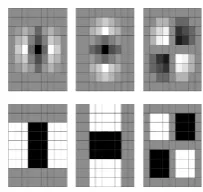
FIG :2 The discretised and cropped second order Gaussian derivatives in the x, y and xy-directions .Lower Row: Weighted Box filter approximations in the x, y and
xy-directions.
The exact method for extracting interest points includes mainly three steps Constructing scale space , Accurate Interest point localization . As in fig 3 features detected in the samples have been shown
[image:2.595.379.481.530.626.2]kernel and repeatedly sub-sampled (reduced in size). Then responses are thresholded such that all values below the predetermined threshold are removed. After thresholding, a non-maximal suppression is performed to find a set of candidate points. To do this each pixel in the scale-space is compared to its 26 neighbours, comprised of the 8 points in the native scale and the 9 in each of the scales above and below.The final step in localising the points involves interpolating the nearby data to find the location in both space and scale to sub-pixel accuracy..
[image:3.595.317.553.144.342.2]`
Fig 3 : Matched features
2.2.2 Ransac
After finding the interest points we need to find the outliers for accurate detection .For this we have used Random sample consensus algorithm for outlier detection.It basically is used for estimating the parameters of mathematical model from a observed set containing outliers in non deterministic manner. In our case for finding outliers we provided parameters of inliers and outliers based on which we removed the regions that were wrongly classified as plate region .
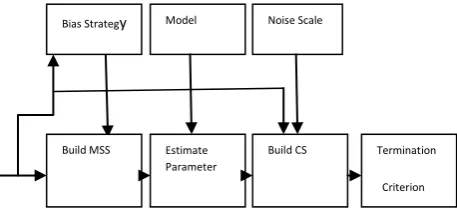
The RANSAC algorithm is essentially composed of two steps that are repeated in an iterative fashion (hypothesize and test framework
[image:3.595.53.282.204.304.2]1.Hypothesize. Firstly minimal sample sets (MSSs) are randomly selected from set of input datasets and the parameters are computed using only the elements of the MSS. The cardinality of the MSS is the smallest sufficient to determine the model parameters
Fig 4 :Block diagram for Ransac
2. Test Framework: In the second step RANSAC checks the elements in the dataset for consistency with the model
[image:3.595.316.537.544.682.2]instantiated with the estimated parameters in the first step. The set of these elements are called consensus set(CS).RANSAC terminates when the probability of finding a better ranked CS drops below a certain threshold.
Fig 5: Located number plate with inlier features
2.3 Segmentation
In this process we need to segment the letters in different parts and store them at some folder . For this we used morphological operations such as dilation ,open, close to find the connected components and removed all the components lower than a certain threshold value and extracted all the components as characters which are later fed into recognition module of ANN.
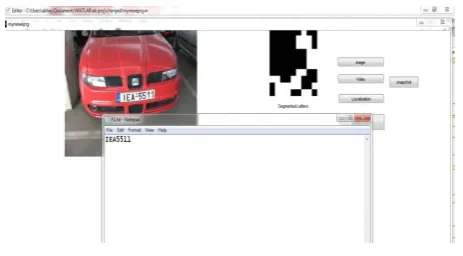
Some of the segmentation results are shown in fig :6.
Fig 6: Segmented letters in GUI
Bias Strategy
Build MSS Estimate Parameter
Build CS Model
Termination
[image:3.595.53.282.589.698.2]40
Fig 7: Other Licence plates detected areas with bounding box
2.4
Matching
After the segmentation is complete and each character has been individually extracted comes the matching step. For the matching step we created a database of 26 alphabets and numbers of size 24x42 pixels using Adobe Photoshop CS3.This database contains multiple samples of one character for neural network training purpose .This step is directly related to the speed and accuracy of the overall recognition process.As training time will be defining the speed of the recognition.
A stable network has been built to recognize licence plate character by training of database samples of characters. This training may take long time which is also its disadvantage but once trained the network can easily be applied to the identify segmented plate characters. This network was simulated using Matlab 2011 and can handle distorted training samples for recognizing printed character having more noise.
RBF network is a feed forward propagation neural network consisting of 3 layer neurons structure : input,hidden and output as in fig 8.
[image:4.595.55.291.70.197.2]Radial basis networks can require more neurons than standard feedforward backpropagation networks, but often they can be designed in a fraction of the time it takes to train standard feedforward networks. They work best when many training vectors are available.[7]
Fig 8: RBF basic structure
Here the input to the radbas transfer function is the vector distance between weight vector w and the input vector
p,multiplied by the bias b.(The || dist || box in this figure accepts the input vector p and the single row input weight matrix, and produces the dot product of the two.) In RBF network, the input layer only play the role of the signal transmission, and the value of weight connected to the hidden layer is 1. This uses partial response radial basis function instead of the traditional global response function as
activation function. In RBF network, each hidden layer node has a clustering head.Gaussian function is usually used as activation function in radial basis function,
Which can be expressed as in eq(4):
2
2
||
||
( )
exp(
)
2
j
x
cj
x
j
Eq[4]
j is the variance of Gaussian function. || x-cj || is Euclidean disatance, Cj is the center of the Gaussian function. With δ smaller, the width of the radial basis function is smaller and basis function is more selective.Then the k-th output of the RBF network can expressed as in eq (5).W kj is weight value between layer and output layer neurons, Yk is actual output. The learning process of RBF neural network includes two phases: Firstly, selecting the center Cj and radius of
1
( )
n
k kj j
j
y
w
x
Eq[5]all hidden layer nodes Cj and radius δ, then correct the connection Jweights matrix W between the hidden layer and output layer.
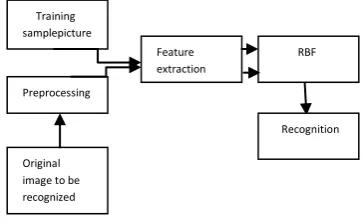
Fig 9: Block diagram of RBF matching
Character matching results are shown in fig:10 using RBF neural networks.
3.
CONCLUSION
The main aim of this paper is to simulate and investigate the results of automatic license plate recognition using Speed up robust feature method for detection of license plate region.This detection has better results as compared to previous used methods with overall 95% detection rate as per our mentioned database. Also we have used radial basis function for character recognition which is successful in recognizing characters segmented with blurry and noisy backgrounds with over 90% recognition rate. The system was trained by a training data set, and validated by a validating data set to find the suitable network architecture.All the experiments and simulations have been performed with Matlab 2011. In the near future recognition rates in real time video can be improved with the use fuzzy neural techniques and other classifiers for better results for detection .
Training samplepicture
Feature extraction Preprocessing
Original image to be recognized
RBF
neural network Recognition
[image:4.595.335.517.375.487.2]Fig 10: Matching results
4. REFERENCES
[1]. Hakan Caner, H. Selcuk Gecim, and Ali Ziya Alkar” Efficient Embedded Neural-Network-Based License Plate Recognition System “.IEEE Transactions 2008 [2].Muhammed tahir, Muhammad Asif “Automatic number
plate recognition system for vehicle Identification using optical character recognition” IEEE 2009
[3]. Bih-Yaw Shih, Chen-Yuan Chen and Jin-Wei Kuo Po-Wei Chen”A Preliminary Study on Design and Development of Template-Based for License Plate Recognition System Applying Artificial Coordinates Auxiliary Techniques” IEEE Proceedings 2010
[4]. Sz.Pletl and Cs.Gálfi Parking surveillance and number plate recognition application”IEEE 2010
[5]. Zhiwen WANG , Shaozi Li “ Research and Implement for Vehicle License Plate Recognition Based onimproved BP Network” International Conference on Computer and Communication Technologies in Agriculture EngineeringIEEE 2010
[
6]
Song Qing-kun et.all”.License Plate Recognition Based On Mathematical Morphology Method and RBF Neural Network”, 2012 1ntemational Conference on
Measurement, Information and Control (M1C)
[7]. Chen,S., C.F.N. Cowan, and P.M. Grant, “Orthogonal Least Squares Learning Algorithm for Radial Basis Function Networks,” IEEE Transactions on Neural Networks, Vol. 2, No. 2, March 1991, pp. 302–309. [8]. http://www.medialab.ntua.gr/research/LPRdatabase.html
[9].http://vision.ucsd.edu/belongiegrp/research/carRec/car_dat a.html
[10].“V.Koval,V.Turchenko,V.Kochan,A.Sachenko,G.Marko wsky” ,Smart License Plate Recognition System Based on Image Processing Using Neural Network. IEEE International Workshop on Intelligent Data acquisition and Advanced Computing Systems: Technology and Applications 8-10 September 2003.
[11] “Yo-Ping Huang, Chien-Hung Chen, Yueh-Tsun Chang, Frode Eika Sandnes” ,An intelligent strategy for checking the annual inspection status of motorcycles based on license plate recognition’,2008
[12] Ankush Roy, Debarshi Patanjali GhoshalNumber “Plate Recognition for Use in Different Countries Using an Improved Segmentation’ ,IEEE 2011
[13].“Hongliang, B,Changping,L”. A Hybrid License Plate Extraction Method Based on Edge Statistics and Morphology. In Proceedings of the 17th International Conference on Pattern Recognition, Cambridge, UK, 23–26 August 2004
[14] “Siddhartha Choubey “Pixel Distribution Density based character recognition For Vehicle License Plate. [15] Bal´azs Enyedi,LajosKonyha,K´alman Fazekas “Real
time number plate localization algorithms” Journal of ELECTRICAL ENGINEERING 2006
[16] Martin H. Luerssen “Character Recognition with Neural Networks”
[17] Mark Hudson Beale,MartinT.Hagan,Howard B.Demuth,” Neural Network Toolbox™ User’s Guide” MATLAB [18] “Gérard.Blanchet,Maurice.Charbit “Digital Signal and
Image Processing using MATLAB”
[19] Per Christian Henden “A Comparison of Thresholding Methods”2004
[20] RafaelC.Gonzalez,RichardE.Woods,StevenL.E”Image Processing using Matlab
[21]http://en.wikipedia.org/wiki/Artificial_neural_network [22]http://www.mathworks.com/access/helpdesk/help/pdf_do
c/nnet/nnet.pdf, MATLAB and Simulink Neural Network Toolbox Manual.
[23] H. Bay, T. Tuytelaars, and L. Van Gool.” Surf: Speeded up robust features”. European Conference on Computer Vision, 1:404{417, 2006).
[24] K. Mikolajczyk and C. Schmid. A performance evaluation of local descriptors. IEEE Trans. Pattern Anal. Mach. Intell., 27(10):1615{1630, 2005}.
[25] D.G. Lowe. Distinctive image features from scale-invariant keypoints. International Journal of Computer Vision, 60(2):91{110, 2004).vision.ece.ucsb.edu/zulani [27] Auranuch Lorsakul and Jackrit SuthakornTraffic Sign
Recognition Using Neural Network on OpenCV: Toward Intelligent Vehicle/Driver Assistance System