Technology (IJRASET)
©IJRASET 2015: All Rights are Reserved
448
A Survey of QoS for IEEE 802.22 WRAN
Technologies
Krishan Kant Singh Gautam1, Nitin Gupta2, Arundhati Walia3
1
Assistant Professor, Department of Computer Science, Shivaji College
2
Assistant Professor, MCA Department,3 Assistant Professor, CSE Department
HRIT, Ghaziabad
Abstract-We Survey theory and applications of Wireless Regional Area Networks, Today Quality of Service are the main key problem of wireless network in RAN. Due to explosion of wireless network, internet is becoming backbone and heterogeneous. We need to focus on Wireless RAN (WRAN) applications are increasing in fixed wireless broadband access in rural and remote areas. WRAN system will take advantage of unused TV channels that exist in these lightly populated areas. And utilize these channels for fixed wireless access without interfering with existing users, including TV receivers and wireless microphones. We review, definition, design principals and its applications
Keywords: IEEE 802.22, WRAN, Cognitive Radio (CR), Dynamic Spectrum Access (DSA), Orthogonal Frequency Division Multiplex (OFDM)
I. INTRODUCTION IEEE 802.22 WRAN STANDARD
The IEEE 802.22 standard defines a system for a Wireless Regional Area Network, WRAN [1, 5] that uses unused or white spaces within the television bands between 54 and 862 MHz, especially within rural areas where usage may be lower. To achieve its aims, the 802.22 standard utilizes cognitive radio technology to ensure that no undue interference is caused to television services using the television bands. In this way 802.22 is the first standard to fully incorporate the concept of cognitive radio. The IEEE 802.22 WRAN standard is aimed at supporting license-exempt devices on a non-interfering basis in spectrum that is allocated to the TV Broadcast Service. With operating data rates comparable to those offered by many DSL / ADSL services it can provide broadband connectivity using spectrum that is nominally allocated to other services without causing any undue interference. In this way IEEE 802.22 makes effective use of the available spectrum without the need for new allocations. The remainder of this paper is organized as following: Section 2 gives an Overview of WRAN, Section 3 System Architecture, while a section 4 describes those Layer protocols, Section 5 Describes IEEE 802.22 Spectrum Sensing Network, Section 6 describe QoS for IEEE 802.22 WRAN and concludes the survey and presents future research areas.
II. AN OVERVIEW OF IEEE 802.22 WRAN
©IJRASET 2015: All Rights are Reserved
449
While the major push towards the commercial deployment of CRs is coming mostly from the US, the goal of IEEE 802.22 is to define an international standard that may operate in any regulatory regime [6, 10, 11]. Therefore, the current 802.22 project identifies the North American frequency range of operation from 54-862 MHz, while there is an ongoing debate to extend the operational range to 41-910 MHz as to meet additional international regulatory requirements. Also, the standard shall accommodate the various international TV channel bandwidths of 6, 7, and 8 MHz.1) System Topology: The 802.22 system specifies a fixed point-to-multipoint (P-MP) wireless air interface whereby a base station
(BS) manages its own cell2 and all associated Consumer Premise Equipments (CPEs), as depicted in Figure 1. The BS (a professionally installed entity) controls the medium access in its cell and transmits in the downstream direction to the various CPEs, which respond back to the BS in the upstream direction. In addition to the traditional role of a BS, it also manages a unique feature
of distributed sensing. This is needed to ensure proper incumbent protection and is managed by the BS, which instructs the various
CPEs to perform distributed measurement of different TV channels. Based on the feedback received, the BS decides which steps, if any, are to be taken.
2) Service Capacity: The 802.22 system specifies spectral efficiencies in the range of 0.5 bit/(sec/Hz) up to 5 bit/(sec/Hz). If we
consider an average of 3 bits/sec/Hz, this would correspond to a total PHY data rate of 18 Mbps in a 6 MHz TV channel. In order to obtain the minimum data rate per CPE, a total of 12 simultaneous users have been considered which leads to a required minimum peak throughput rate at edge of coverage of 1.5 Mbps per CPE in the downstream direction. In the upstream direction, a peak throughput of 384 kbps is specified, which is comparable to DSL services.
3) Service Coverage: Another distinctive feature of 802.22 WRAN as compared to existing IEEE 802 standards is the BS coverage
range, which can go up to 100 Km if power is not an issue (current specified coverage range is 33 Km at 4 Watts CPE EIRP(effective radiated power relative to an isotropic source) ). As shown in Figure 2, WRANs have a much larger coverage range than today’s networks, which is primarily due to its higher power and the favorable propagation characteristics of TV frequency bands. This enhanced coverage range offers unique technical challenges as well as opportunities.
Figure 1 WRAN classification as compared to other popular wireless standards
III. SYSTEM ARCHITECTURE
Technology (IJRASET)
[image:4.612.71.540.328.533.2]©IJRASET 2015: All Rights are Reserved
450
Figure 2 System Architecture
Furthermore, cross-layer optimization can provide significant performance improvements over systems which treat each layer as a separate problem. The drawback to this method is producing a potentially large, complex solution space over which searching becomes an issue. To mitigate this problem, we propose a multi-step search process as a compromise between the accuracy and complexity of searching. In the first stage the cognition focuses on assigning an appropriate TV channel and initial power setting to new service requests; on the second stage the cognition focuses on assigning the resources to the node, such as: modulation scheme, sub-carriers, time-slots, coding, etc.
A. IEEE 802.22 Characteristics
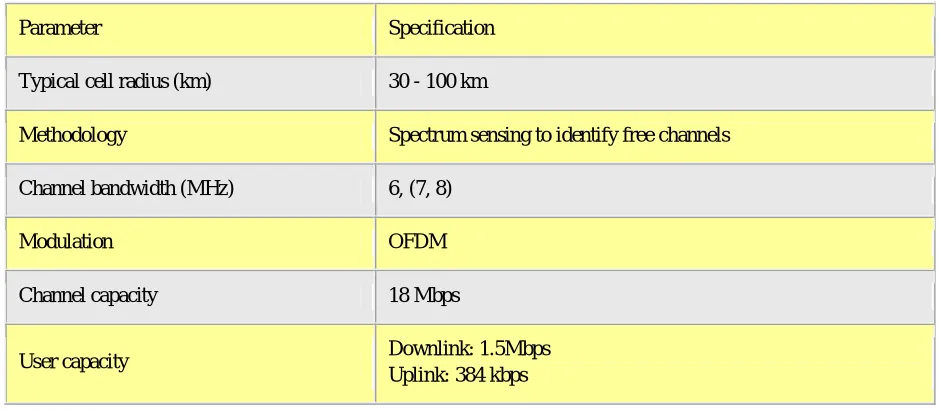
The basic specification parameters of the IEEE 802.22 standard can be seen in the table below:
Parameter Specification
Typical cell radius (km) 30 - 100 km
Methodology Spectrum sensing to identify free channels
Channel bandwidth (MHz) 6, (7, 8)
Modulation OFDM
Channel capacity 18 Mbps
User capacity Downlink: 1.5Mbps
Uplink: 384 kbps
WRAN standard specification parameters.
IV. IEEE 802.22 LAYERS
A. Physical Layer
In order to meet the requirements for the overall 802.22 system, the physical layer maintains a high degree of flexibility. This is built in to the basic specification of the system. One of the first characteristics is the modulation scheme. An OFDM scheme has been adopted because the 802.22 WRAN system to provide resilience against multipath propagation and selective fading as well as a high level of spectrum efficiency and sufficient data throughput. To provide access for multiple users, OFDMA is used for both
upstream and downstream data links on OFDM:
©IJRASET 2015: All Rights are Reserved
451
symbol period and their contribution will sum to zero - in other words there is no interference contribution. The data to be transmitted is split across all the carriers and this means that by using error correction techniques, if some of the carriers are lost due to multi-path effects, then the data can be reconstructed. Additionally having data carried at a low rate across all the carriers means that the effects of reflections and inter-symbol interference can be overcome. It also means that single frequency networks, where all transmitters can transmit on the same channel can be implemented.IEEE 802.22 allows a variety of modulation schemes to be used within the OFDMA signal: QPSK, 16-QAM and 64-QAM can all be selected with convolutional coding rates of 1/2, 3/4, and 2/3. The required modulation and error correction rates are chosen according to the prevailing conditions In order to meet the requirements for the individual users that may be experiencing very different signal conditions, it is necessary to dynamically adapt the modulation, bandwidth and coding on a per CPE basis.
In order to be able to obtain the required level of performance, it has been necessary to the IEEE 802.22 to adopt a system of what is termed "Channel Bonding." This is a scheme where the IEEE 802.22 system is able to utilise more than one channel at a time to provide the required throughput. Often it is possible to use adjacent channels because in many countries the regulatory authorities and frequency planners allow two or more empty channels between stations transmitting high power signals as this prevents interference on the TV signals. These multiple free channels allow the use of contiguous channel bonding. In practise the maximum number of channels that are bonded is likely to be limited to three as a result of the front-end bandwidth limitations. To provide access for both upstream and downstream data, the form of duplex scheme that has been adopted is TDD. This has several advantages. First it only requires one channel to be used - FDD would not be viable because it would be more difficult to control two channels with sufficient transmit / receive spacing. Secondly the use of TDD enables dynamic change of the upstream and downstream capacity.
B. Medium Access Control
The fact that the IEEE 802.22 standard [10, 11] is so flexible brings a number of new challenges to the practical implementation of the system. Accordingly the MAC has been designed to provide flexibility and to incorporate these new ideas. In the first instance the initialization and network entry needs to accommodate the elements of the spectrum usage flexibility. As there is not fixed channel for the system, and no pilot channel can be broadcast, any CPE when turning on and initializing needs to be able to find the signals. Accordingly, when initializing, any CPE first scans the available spectrum to look at channel occupancy. It will detect those channels free of television transmissions. In the remaining empty channels it will then scan for base station pilot signals and acquire any network information. Once it has acquired the correct network it can then proceed to connect to the network. It is also necessary to have a defined format for the data. To enable the data to be suitably structured, the transmission is formatted into frames and super frames.
1) Super frames: The super frame is built up from the smaller frames. The super-frame is used to provide overall synchronisation for
the system, and in particular provides the initial network access / entry initialization. At the beginning of each superframe, there is a preamble known as the Superframe Control Header, SCH. The SCH contains the information needed for any new CPEs that need to access the base station.
2) Frames: The superframe is built up from frames. These frames are split into two elements: the upstream subframe (US) and the
downstream subframe (DS). The boundary between these two subframes is variable and can be adapted to accommodate changes on the levels of upstream and downstream capacity required.
IEEE 802.22 equipment is designed to ensure that no undue interference is caused to existing television services. As a result the whole system has to be adaptive to ensure that the system avoids channels that are in use while still maintaining the required throughput. It even ahs to adapt to changes in radio time. As a result the cognitive radio and cognitive network technology has been incorporated to ensure this requirement is met.
V. IEEE 802.22 SPECTRUM SENSING NETWORK
A. IEEE 802.22 Spectrum Sensing Basics
Technology (IJRASET)
©IJRASET 2015: All Rights are Reserved
452
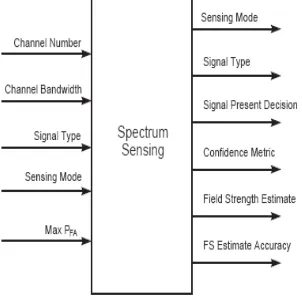
In order to effectively provide the level of interference avoidance that is required, 802.22 spectrum sensing is distributed across the network of users. Accordingly, the 802.22 spectrum sensing is undertaken within the Customer Premises Equipments, CPEs [3, 6]. The CPEs scan the various channels that are open for their use and send back information about signals and strengths on the channels to the base station equipment. It is BS which makes the decision about which channels are occupied and whether they can be used for the 802.22 transmissions. To make this decision the BS uses the spectrum sensing results as well as geo-location information and other information provided by an entity known as the network manager.
The 802.22 standard takes cogniscence of the fact that there will be three main types of users of the frequencies used by 802.22:
Analogue television - for North America this based on the NTSC standard, whereas for Europe it is generally PAL. The level of an analogue signal above which the 802.22 system will vacate the channel is -94 dBm measured at the peak of the sync pulse - different levels may be applied for other television systems.
Digital television - for North America DTV is used, although within Europe DVB-T is most widespread. The level of a DTV digital television signal above which the 802.22 system will vacate the channel is -116 dBm.
[image:6.612.233.384.308.458.2]Wireless microphones - these may have a variety of formats as they are not standardised, although typically they use FM and have a bandwidth of around 200 kHz. The level of a wireless microphone signal above which the 802.22 system will vacate the channel is -107 dBm measured in a 200 kHz bandwidth.
Figure 3 Spectrum Sensing Framework
In this way the IEEE 802.22 WRAN performs spectrum sensing across the whole network and adjusts itself accordingly. This means that the 802.22 WRAN system is a true cognitive radio network, rather than an individual cognitive radio operating in isolation.
B. IEEE 802.22 Spectrum Measurements
The channel management and spectrum sensing or signal measurements form an important part of the overall 802.22 scheme [6, 9]. The MAC layer within the CPEs carries out many important tasks that enable this to work efficiently and smoothly. The base station instructs the CPEs to perform periodic measurements in one of two formats;
1) In Band Spectrum Sensing: The in-band spectrum sensing applies to the channels that are being currently used by the BS to
communicate with the CPEs. In order for this type of sensing to be undertaken it is necessary for the BS to quieten the transmissions on the channel. With a short break of the transmissions, the CPEs can then listen for any other transmissions. When assessing the presence of other signals on the channel, the CPE is required to look for very low level, the levels required and the accuracy being controlled by the BS. Length of time for the measurement, which channels, length of measurement time, and probability of false alarm are all under the control of the BS. In order to gain the best overall measurement, the BS may instruct different CPEs to make different measurements. The choice of how this is done, is made by the BS and is calculated by the algorithms it contains. By instructing different CPEs to make different measurements and over different lengths of time, the BS can make up an occupancy map for the overall cell.
2) Out Of Band Spectrum Sensing: The out of band spectrum sensing refers to channels that are not currently being used by the BS
©IJRASET 2015: All Rights are Reserved
453
be using adjacent channels.C. In-Band Spectrum Sensing
The in-band spectrum sensing is carried out on a regular basis. The quiet periods for sensing are built into the transmission timings. There are two types of sensing that are defined:
1) Fast Sensing: This form of spectrum sensing is accomplished quickly, as the name implies. This form of sensing typically uses a
simple energy detection algorithm and is completed within 1 ms. The results of the fast sensing are returned to the BS which then analyses them and determines whether a fine sensing measurement is required.
2) Fine Sensing: The fine sensing procedure is undertaken if the BS believes there is need for a more accurate measurement.
During the fast sensing a more detailed examination is made of the particular channels. This form of spectrum sensing takes around 25 ms. during any fine sensing time, the CPE looks at the signatures of signals that may be the primary user, i.e. television.
It is also possible that adjacent 802.22 networks may cause interference to one another, and the adjacent networks may sense each other. To overcome the possibility of confusion caused by adjacent networks detecting each other algorithms are built into the system to synchronize overlapping cells. This also includes the synchronisation of the quiet periods when the spectrum sensing occurs.
D. Cognitive Radio Spectrum Sensing Components
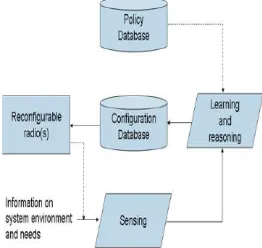
[image:7.612.247.378.366.490.2]The 802.22 standard is the fist standard to adopt cognitive radio spectrum sensing as a means of gaining greater use of the radio spectrum. By using cognitive radio networking techniques, it is able to sense the environment and adjust the network to accommodate any changes.
Figure 4 A views of the components that may exist in a cognitive radio system.
VI. QoS – WHAT AND WHY?
In general terms, QoS is the ability of a network element to provide some levels of assurance for consistent network data delivery. The collective effect of service performance that determine the degree of satisfaction of a user of the service. The quality of service is characterized by the combined aspects of service support performance, service operability performance, serviceability performance, service security performance and other factors specific to each service. The term "quality of service" is not used to express a degree of excellence in a comparative sense nor is it used in a quantitative sense for technical evaluations. In these cases a qualifying adjective (modifier) should be used. Good QoS services include guaranteed features of
Required Bandwidth Faster Response Time Minimal Error Rate Consistent connectivity Service Security
VII. CONCLUSION
Technology (IJRASET)
©IJRASET 2015: All Rights are Reserved
454
countries. As a result of the fact that 802.22 uses cognitive radio technology, it will be possible to ensure that no undue interference is caused to any existing services and users should not suffer any degradation in performance of their terrestrial television reception. Accordingly the use of IEEE 802.22 WRAN technology should enable more efficient use of the spectrum to be made as well as providing new services for users, especially in rural areas.
IEEE 802.22 WRAN is the first application of cognitive radio networks reframing the TV broadcast bands. The standardization and deployment of cognitive WRAN systems will have significant impact on the future advancement of cognitive radios. In this paper, we describe our research efforts in developing both a cognitive radio engine framework that integrates the spectrum management capabilities outlined in the IEEE 802.22 standard, as well as a few preliminary cognitive engine models. We have developed a solid and generic architecture and a general framework that will allow for future design, development and testing of various learning, decision-making and optimization techniques that will provide efficient performance and accurate solutions for the IEEE 802.22 problems.
VIII. FUTURE WORK
Using this general framework we have the tools to implement and optimize specific modules for cognitive engines and test their performance and functionalities further for future development. Based upon these initial results, we can formulate which algorithms are suited for specific scenarios. By tailoring our engine to the strengths of each algorithm, we can optimize the performance for an efficient cognitive engine for 802.22 wireless base stations. Cognitive radio technology is the key to efficient utilization of the spectrum. Standardization enables complicated technologies to be mass produced and mass accepted, hence driving the costs down. Finally, we discussed the future directions for standardization and military applicability for cognitive radio technology.
REFERENCES
[1] IEEE P802.22/D0.5, Draft Standard for Wireless Regional Area Networks Part 22: Cognitive Wireless RAN Medium Access Control (MAC) and Physical Layer(PHY) specifications: Policies and procedures for operation in the TV Bands, Mar. 2008.
[2] Carl R. Stevenson, Carlos Cordeiro, Eli Sofer, and Gerald Chouinard, Functional Requirements for the 802.22 WRAN Standard, IEEE 802.22-05/0007r46, Sept. 2005.
[3] Steve Shellhammer, Victor Tawil, Gerald Chouinard, Max Muterspaugh, and Monisha Ghosh, Spectrum Sensing Simulation Model, IEEE 802.22-06/0028r10, Sept. 2006.
[4] Steve Shellhammer, Sai Nandagopalan, Rahul Tandra, and James Tomcik, “Performance of power detector sensors of DTV signals in IEEE 802.22 WRANs,” TAPAS Workshop, Aug. 2006.
[5] Advanced Television Systems Committee, ATSC Digital Television Standard (A/53) Revision E, with Amendments No. 1 and 2, Sept. 2006.
[6] J. M. Mendel, “Tutorial on higher order statistics (spectra) in signal processing and systems theory: Theoretical results and some applications,” Proc. of IEEE, pp. 278–305, Mar. 1991.
[7] IEEE 802.22 Working Group on Wireless Regional Area Networks, http://www.ieee802.org/22/.
[8] K. Challapali, D. Birru, and S. Mangold, “Spectrum Agile Radio for Broadband Applications,” EE Times In-Focus, August 23, 2004.
[9] S. Mangold, Z. Zhong, K. Challapali, and C-T. Chou, “Spectrum Agile Radio: Radio Resource Measurements for Opportunistic Spectrum Usage,” in IEEE Globecom, 2004.
[10] D. Agrawal and Q-A. Zeng, Introduction to Wireless and Mobile Systems, Brooks/Cole Publishing, 432 pages, ISBN 0534-40851-6, August 2002.
[11] G. Chouinard, “WRAN Reference Model,” IEEE 802.22, http://www.ieee802.org/2