Technology (IJRASET)
A Three Way Visual Cryptography & its
Application in biometric Security : A Review
Mr.Praveen Chouksey1, Mr.Reetesh.Rai2
1
M.Tech Scholar, 2Professor Department of Computer Science & Engineering, LNCT JABALPUR
Abstract—Visual cryptography provides secured digital transmission which is used only for one time. The original images can be reuse by using this scheme. It is effortless and uncomplicated technique to execute the secret image for shadow images. The shadow images are the shrunken version of the original image, in which the secret image share is embedded. These are used to guard the data and secret images in the internet so that it is not accessed by any unauthorized persons. Visual cryptography divides the image into secret shadow images. After this these shadow images are distributed in the original image. Recovering of secret image is done by human visual system by piling all the shadow images.
Keywords—Visual Cryptography, Encryption, Decryption, Shares, Extended Visual Cryptography
I. INTRODUCTION
Technology (IJRASET)
II. DIFFERENTVISUALCRYPTOGRAPHYSCHEME
A. Extended Visual Cryptographic Scheme Using Back Propagation Network [2].
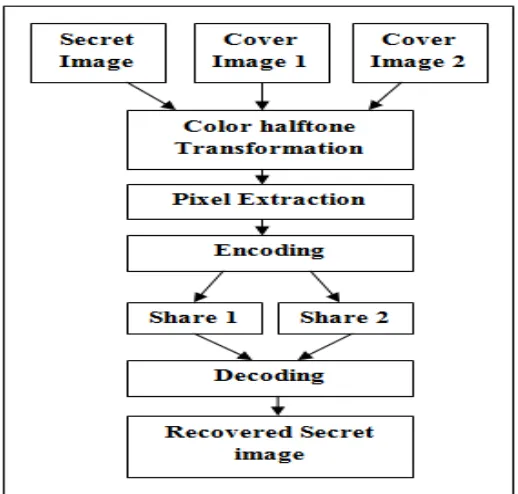
[image:3.612.178.437.231.478.2]In 2012, J. Ida Christy and Dr. V. Seenivasagam Praposed Extended Visual Cryptographic Scheme Using Back Propagation Network. In these Scheme inputs taken for the proposed method are two cover images and one secret image. All the three images are of the same size. The outputs produced out of the encoding process are two shares that look like the two cover images. The secret image is hidden in the two shares. The size of the output images is also the same. When the two shares are overlapped, we get the secret image. There are four main steps in the proposed method. In the first step, the three images are resized to half of their size. Then the three images are transformed to color halftone images. In the second step some useful pixels are extracted. The third step is encoding where the secret image is encoded in the two shares. The last step is the decoding procedure where the secret image can be obtained by overlapping the two shares. The block diagram is shown in the Fig.1
Fig 1. Block Diagram of Extended Visual Cryptography
[image:3.612.186.429.512.683.2]Technology (IJRASET)
B. Visual Cryptography system using Cover Image share embedded security algorithm (CISEA) [3].
In 2011,Himanshu Sharma, Neeraj Kumar proposed Visual Cryptography system using Cover Image share embedded security algorithm.
Following three phases of proposed algorithm:
PHASE 1: First phase of the algorithm is marked by the basic visual cryptography scheme. We will consider any visual cryptography model which may operate on binary images. So firstly consider the secret image I that is converted into the halftone image S by using any Halftoning technique such as ordered dithering, error diffusion [4],[5]. Later we will generate the shares S1 and S2 from the binary image. Each share is generated as a result of this phase is meaningless if we consider the share independently.
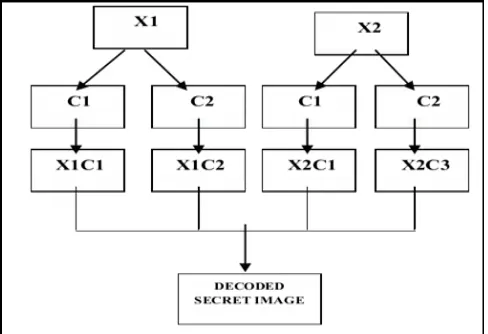
[image:4.612.179.431.264.408.2]PHASE 2: Second phase is marked by the generation of embedded images with the help of compliment images of the cover image. Let the cover image be C and its complimented images are C1 and C2. Then four embedded images X11, X12, X21, X22 are generated which are to be transmitted to the destination through transmission channel. These shares can be generated by simply embedding the shares S1 and S2 over the compliments of cover image i.e. C1 and C2.
Fig 3. Proposed scheme structure X11= EMBEDDED( S1,C1) X12= EMBEDDED( S1,C2)
X21= EMBEDDED( S2,C1) X22= EMBEDDED( S2,C2)
Watermarking scheme provide the additional security over basic visual cryptography scheme. Our proposed algorithm provides one more layer of security due to generation of compliments of cover image over which the shares can be embedded on it. The result of this phase is the new image having some information extract from cover image and some hidden information extract from secret image.
[image:4.612.185.429.524.691.2]Technology (IJRASET)
C. Constant Aspect Ratio based (2, 2) Visual Cryptography through Meaningful Shares (CARVCMS) [6].
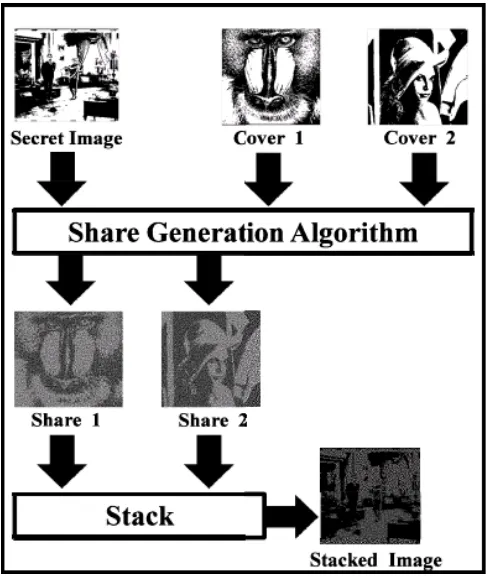
[image:5.612.184.429.157.446.2]In this technique is a (2, 2) visual cryptographic scheme where secret will be revealed directly by stacking two meaningful shares in an arbitrary order but with proper alignment. According to the proposed algorithm, the generated shares are meaningful and the aspect ratio and the dimensions of the shares are identical with that of the secret image which ensure optimal space requirement. The main advantage of the proposed scheme is that the decrypted secret is identical with respect to the aspect ratio and image dimension of the source image.
Figure 5: Schematic diagram of CARVCMS Algorithm
1) The Share Generation Algorithm: Input: The secret image of size m× n and two cover Images of size m× n.
Output: Two meaningful shares of size m
Step 1. Repeat for each block of size 2 × 2 of secret image denoted by BS and cover images denoted by CS1 and CS2 where all
blocks are position wise identical.
Step 2. If BS is a white block then CS1 and CS2 are replaced by any one of the combinations a along with their permutations.
Step 3. If BS is a black block then CS1 and CS2 are replaced by any one of the combinations a permutation.
Step 4. Stop.
D. Extended Visual Cryptography for Color Images Using Coding Tables [7].
There are three steps in this algorithm:
1) Color Halftone Transformation
2) Encoding and Generation of Shares
3) Decryption
Each of these steps is explained in detail below:
Technology (IJRASET)
respective halftone images IA, IB, IC, ID and IS. The size of the halftoned images is also NxN pixels. Each input image is decomposed into three constituent planes red, green and blue. Then the halftone technique is applied to each of these planes. By combining these three halftoned planes, a color halftone image is generated. Halftoning is performed using error diffusion. The error diffusion algorithm uses Jarvis filter.
2) Encoding and Generation of Shares: A Key Table and two types of Coding Tables—Cover Table (CT) and Secret Table (ST)
are used to encode the secret image into the cover images. These encoded cover images are meaningful shares and can be transmitted securely. The sender has the option to select two (or more) of the four shares generated for transmission. The secret image is obtained when the receiver stacks the shares. The steps used in encoding are:
a)Key Generation
b)Cover Images Encoding
c)Secret Image Encoding
d)Generation Of Shares
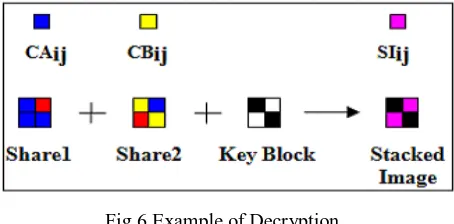
[image:6.612.195.422.335.447.2]3) Decryption : In the decryption process, we stack two or more shares along with the Key Image to reconstruct the secret image. Figure 6 shows an example of decryption with blocks from two shares, Share1 and Share2 and the corresponding block from the Key Image. The block of the stacked image produced contains two sub pixels of the same color as the pixel of the secret image and the other two sub pixels are black. Since two sub pixels out of four in each block will always be of the same color as the pixel of the secret image, 50% of the secret image is retained in the final reconstructed image.
Fig 6.Example of Decryption
E. A Verifiable Visual Cryptography Scheme Based on XOR Algorithm [8].
The scheme in this paper is based on XOR algorithm and shift operations. The result produces a kind of verifiable and modified (k, n, h, l, m)-VCS [8]. K is the minimal number of share images, from which secret images can recover; n is the total number of secret share images; m is the number of pixels in a share images; his the number of used white sub-pixels per pixel in the share images=m-h, m>h>l0.
They proposed a verifiable visual cryptography scheme which based on XOR algorithm. Through using XOR algorithm with the share images of participates and the validation image, they can judge the share images are true or false without any other information to ensure the correctness of the secret image recovery. The process of recovery and judgment are both simple and the recovery of secret image and verifiable image are clear and without any pixel expansion. This scheme is able to indicate the correctness and truth of one single share image and improve the function of anti-deception.
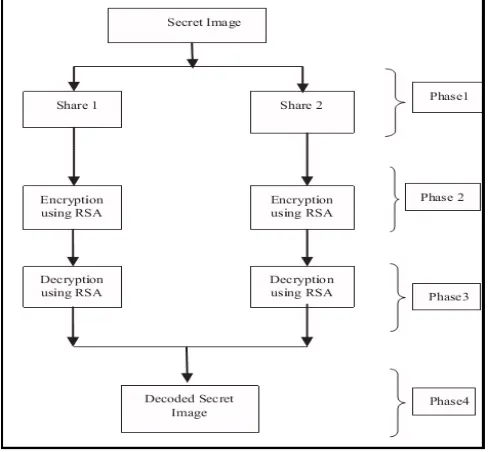
F. Securing Visual Cryptographic Shares using Public Key Encryption [10].
Technology (IJRASET)
Fig.7 Methodology of the Proposed Scheme
[image:7.612.184.426.414.569.2]1) PHASE-1 Generating shares of secret image: In this phase Visual Cryptography Encryption is implemented. It consists of generation of shares from secret image using VC (2, 2) scheme. The secret image is first converted into a binary image then each pixel in the secret image is broken into 8 sub pixels, 4 pixels in each share by selecting the random pixel encoding scheme out of three given in Fig. 8.
Fig. 8. Pixel encoding schemes
2) PHASE-2 Encrypting the generated Shares: This is the second phase of our approach which will encrypt shares generated from the first phase. We have used RSA for encryption in this step. First we have generated the key for RSA and then performed the encryption. Results of this phase are encrypted shares.
3) PHASE-3 Decrypting the Shares using RSA: This process takes place at the destination of the document/image/text. We again
convert the encrypted shares in their actual form using RSA decryption algorithm, which were encrypted at the sender end.
Technology (IJRASET)
the original secret image by applying the binary XOR operation on both decrypted shares.
III. LITERATURESURVEY
Tzung-Her Chen et al [11] offered the multiple image encryption schemes by rotating random grids, without any pixel expansion and codebook redesign.Until the year 1997 visual cryptography schemes were applied to only black and white images. First colored visual cryptography scheme was developed by Verheul and Van Tilborg [13]. Colored secret images can be shared with the concept of arcs to construct a colored visual cryptography scheme. In c-colorful visual cryptography scheme one pixel is transformed into m subpixels, and each subpixel is divided into c color regions. In each subpixel, there is exactly one color region colored, and all the other color regions are black. The color of one pixel depends on the interrelations between the stacked subpixels. For a colored visual cryptography scheme with c colors, the pixel expansion m is c× 3. Yang and Laih [14] improved the pixel expansion to c × 2 of Verheul and Van Tilborg [13]. But in both of these schemes share generated were meaningless. For sharing a secret color image and also to generate the meaningful share to transmit secret color image Chang and Tsai [15] anticipated color visual cryptography scheme. For a secret color image two significant color images are selected as cover images which are the same size as the secret color image. Then according to a predefined Color Index Table, the secret color image will be hidden into two camouflage images. One disadvantage of this scheme is that extra space is required to accumulate the Color Index Table. In this scheme also number of subpixels is in proportional to the number of colors in the secret image as in Verheul and Van Tilborg [13] Yang and Laih [14] schemes.
When more colors are there in the secret image the larger the size of shares will become. To overcome this limitation Chin-Chen Chang et al [16] developed a secret color image sharing scheme based on modified visual cryptography. This scheme provides a more efficient way to hide a gray image in different shares. In this scheme size of the shares is fixed; it does not vary when the number of colors appearing in the secret image differs. Scheme does not require any predefined Color Index Table.
To hide a color secret image into multiple colored images it is desired that the generated camouflage images contain less noise. For this purpose R.Youmaran et al [17] invented an improved visual cryptography scheme for hiding a colored image into multiple colored cover images. This scheme provides improvement in the signal to noise ratio of the camouflage images by producing images with similar quality to the originals.
For reducing pixel expansion in color visual cryptography scheme S. J. Shyu [18] advised a more efficient colored visual secret sharing scheme with pixel expansion of [ log2c*m] where m is the pixel expansion of the exploited binary scheme. Du-Shiau Tsai et al [19] devised a secret image sharing scheme for true-color secret images. In the proposed scheme through combination of neural networks and variant visual secret sharing, the quality of the reconstructed secret image and camouflage images are visually the same as the corresponding original images.
Tzung-Her Chen et al [12] anticipated a multi-secrets visual cryptography which is extended from traditional visual secret sharing. The codebook of traditional visual secret sharing implemented to generate share images macro block by macro block in such a way that multiple secret images are turned into only two share images and decode all the secrets one by one by stacking two of share images in a way of shifting. This scheme can be used for multiple binary, gray and color secret images with pixel expansion of 4. F. Liu et al [20] developed a colour visual cryptography scheme under the visual cryptography model of Naor and Shamir with no pixel expansion. In this scheme the increase in the number of colors of recovered secret image does not increase pixel expansion. Zhengxin Fu, Bin Yu [21] Proposed a scheme based on correlative matrices set and random permutation, a new construction of rotation visual cryptography scheme (RVCS) has been presented, which can be used to encode four secret images into two shares. For extending this scheme for color image, exploiting color decomposition with high contrast is needed.
Pallavi V. Chavan, R.S. Mangurlkar [22] presented a scheme of secret sharing in terms of visual cryptography for color images in which secret image is divided into color shares (images). Each share carries some information which is scrambled instead and unreadable by necked eyes. The shares are superimposed together by performing X-OR operation to reveal original image; while the size remains the same as that of the original image. This scheme can be extended to generate multiple shares instead of generating two shares only providing better division of secret.
Technology (IJRASET)
cryptography for natural images. This proposed scheme is based on YCbCr color model. The encryption and decryption works with the help of half-tone and inverse half-tone respectively and based on visual cryptographic scheme This new scheme provides efficient computation to generate key and cipher. The space taken to store the binary key image and cipher image is lesser than original secret image. The height and width of image retained constant throughout the process. The visual quality of recovered image is visually acceptable with the inverse half-tone method. Meera Kamath, Arpita Parab, Aarti Salyankar, Surekha Dholay [25] proposed a new VC scheme for color images using meaningful shares. Like the existing schemes, the size of the shares produced and final image after stacking are twice the size of original image. However, the visual quality achieved by algorithm is higher. The Key Table and Image Encoding procedure used considerably improves the security by increasing the randomness. Chun-Yuan Hsiao, Hao-Ji Wang [26] use the color model of Ateniese et al. to improve the image quality of the reconstructed image of Chiu’s image secret sharing scheme. The aim behind is that a color pixel can be used either as a white or black one, thus solving the problem that the share images do not produce (when stacked) enough black pixels for the reconstructed image. The technical difficulty of this work is how and where to inject the color pixels so that both the shares and the reconstructed images have high quality.
Yuanfeng Liu, Zhongmin Wang [27] proposed HVC (Halftone visual cryptography) construction method that can encode a secret halftone image into color halftone shares. The secret image is concurrently embedded into color halftone shares while these shares are halftoned by constrained vector error diffusion. The proposed method is able to generate halftone shares showing natural color images with high image quality.
Shyong Jian Shyu, Hung-Wei Jiang [28] give formal definitions to threshold multiple-secret visual cryptographic schemes, namely -MVCS and -MVCS, using only superimposition without any additional operation in decoding process. General constructions for both schemes are designed using the skills of linear programming in which the objective functions are to minimize the pixel expansions with the constraints satisfying the revealing, concealing and security conditions in the corresponding definitions. for a given setting of k ,n and s, “which revealing list may produce the smallest pixel expansion” and “how does a revealing list affect the resultant pixel expansion” are still challenges.
Young-Chang Hou, Shih-Chieh Wei, and Chia-Yin Lin [29] proposed user-friendly visual secret sharing scheme, not only maintains the security and pixel non-expanding benefits of the random-grid method, but also allows for the production of meaningful share-images, while satisfying the requirements of being easy to carry and easy to manage. Moreover, all pixels in the cover-image and the secret image are used to perform encryption, which ensures that the contrast on the share-images and the stack-image can reach the theoretical maximum. This method also removes some unnecessary encryption restrictions (e.g., having to use only one cover-image, having to take enough black pixels from the secret image) which makes the encryption process more flexible. The findings show that our user-friendly visual secret sharing is better than the method.
Shyong Jian Shyu [30] introduced two novel and effective VCRG-GAS algorithms to resolve the problem of visual secret sharing for binary and color images. In this paper the algorithms do not require any extra pixel expansion. The approach of VCRG relieves the concern of pixel expansion, yet its reconstruction ability is not flawless as VCS.
IV. CONCLUSION
Visual Cryptography is an exciting era of research where exists a lot of scope.There exists various scope of enhancement in visual cryptography system. Our future work is to develop quantitative analysis of this algorithm in the terms of quality, contrast, reliability and clarity of the final decoded secret image that is directly decrypted by human visual system without using any decryption algorithm .So that human save money and time .One more enhanced this algorithm is also possible with our visual cryptography system make compatible with color images.
REFERENCES
[1] M. Naor and A. Shamir, "Visual cryptography," Advances in Cry ptology - EUROCRYPT'94, pp. 1-12, 1995.
[2] J. Ida Christy and Dr. V. Seenivasagam, ”Construction of Color Extended Visual Cryptographic Scheme Using Back Propagation Network for Color Images”, 20 12 International Conference on Computing, Electronics and Electrical Technologies [IC CEET] 978- 1-4673 -02 1 0-41 1 2©20 12 IEEE. [3] Himanshu Sharma , Neeraj Kumar, Govind Kumar Jha,” Enhancement of security in Visual Cryptography system using Cover Image share embedded security
algorithm (CISEA)”, 978-1-4577-1386-611©2011 IEEE
Technology (IJRASET)
[5] Digital Image Processing Laboratory: Image Halftoning” April 30, 2006. Purdue University.[6] J. K. Mandal and Subhankar Ghatak, “Constant Aspect Ratio based (2, 2) Visual Cryptography through Meaningful Shares (CARVCMS)”.
[7] Meera Kamath, Arpita Parab, “Extended Visual Cryptography for Color Images Using Coding Tables”, 2012 International Conference on Communication, Information & Computing Technology (ICCICT), Oct. 19-20, Mumbai, India 978-1-4577-2078-9/12 ©2011 IEEE.
[8] Bin Yu, Xiaohui Xu, Liguo Fang, “Multi-secret sharing threshed visual cryptography,” CIS Workshops 2007, Harbin, 2007: 815-818.
[9] Yanyan Han and Haocong Dong, “A Verifiable Visual Cryptography Scheme Based on XOR Algorithm”, 978-1-4673-2101-3/12/$31.00 ©2012IEEE. [10] Kulvinder Kaur and Vineeta Khemchandani “Securing Visual Cryptographic Shares using Public Key Encryption”, 978-1-4673-4529-3/12/$31.00c 2012
IEEE.
[11] Tzung-Her Chen, Kai-Hsiang Tsao, and Kuo-Chen Wei, “Multiple-Image Encryption By Rotating Random Grids”, Eighth International Conference on Intelligent Systems Design and Applications, pp. 252-256 , 2008.
[12]Tzung-Her Chen, Kai-Hsiang Tsao, and Kuo-Chen Wei, “Multi-Secrets Visual Secret Sharing”, Proceedings of APCC2008, IEICE, 2008.
[13] E. Verheul and H. V. Tilborg, ”Constructions And Properties Of K Out Of N Visual Secret Sharing Schemes.” Designs, Codes and Cryptography, 11(2) , pp.179–196, 1997.
[14] C. Yang and C. Laih, “New Colored Visual Secret Sharing Schemes”, Designs, Codes and cryptography, 20, pp. 325–335, 2000.
[15] C. Chang, C. Tsai, and T. Chen. “A New Scheme For Sharing Secret Color Images In Computer Network”, Proceedings of International Conference on Parallel and Distributed Systems, pp. 21–27,July 2000.
[16] Chin-Chen Chang , Tai-Xing Yu , “Sharing A Secret Gray Image In Multiple Images”, Proceedings of the First International Symposium on Cyber Worlds (CW.02), 2002.
[17] R.Youmaran, A. Adler, A. Miri , “An Improved Visual Cryptography Scheme For Secret Hiding”, 23rd Biennial Symposium on Communications, pp. 340-343,2006.
[18] S.J. Shyu, “Efficient Visual Secret Sharing Scheme For Color Images”, Pattern Recognition 39 (5) ,pp. 866– 880, 2006.
[19] Du-Shiau Tsai, Gwoboa Horng, Tzung-Her Chen, Yao-TeHuang, “ANovel Secret Image Sharing Scheme For True-Color Images With Size Constraint”, Information Sciences 179 3247–3254 Elsevier, 2009.
[20] F. Liu, C.K. Wu, X.J. Lin , “Color Visual Cryptography Schemes” 2008.
[21] Zhengxin Fu, Bin Yu “Research on Rotation Visual Cryptography Scheme” International Symposium on Information Engineering and Electronic Commerce, 2009.
[22] Pallavi Vijay Chavan, R.S. Mangrulkar “Encrypting Informative Color Image using Color Visual Cryptography”, Third International Conference on Emerging Trends in Engineering and Technology, 978-0-7695-4246-1/10 $26.00 © 2010 IEEE DOI 10.1109/ICETET.2010.94
[23] Roberto De Prisco and Alfredo De Santis, “Using Colors to Improve Visual Cryptography for Black and White Images,” ICITS 2011, LNCS 6673, pp. 182-201, 2011.
[24] Gopi Krishnan S I, Loganathan D., “Color Image Cryptography Scheme Based on Visual Cryptography” Proceedings of 2011 International Conference on Signal Processing, Communication, Computing and Networking Technologies (ICSCCN 2011).
[25] Meera Kamath, Arpita Parab, Aarti Salyankar, Surekha Dholay, “Extended Visual Cryptography for Color Images Using Coding Tables” International Conference on Communication, Information & Computing Technology (ICCICT), Oct. 19-20, 2012.
[26] Chun-Yuan Hsiao, Hao-Ji Wang, “Enhancing Image Quality in Visual Cryptography with Colors”, 2012 IEEE, International Conference on Information Security and Intelligence Control (ISIC), Page(s): 103 – 106, 2012.
[27] Yuanfeng Liu, Zhongmin Wang; “Halftone Visual Cryptography With Color Shares”, International Conference on Granular Computing (GrC), pp. 746-749, IEEE, 2012.
[28] Shyong Jian Shyu, Hung-Wei Jiang; “General Constructions for Threshold Multiple-Secret Visual Cryptographic Schemes” IEEE Transactions on Information Forensics and Security, Volume: 8 , Issue: 5,pp: 733 – 743, 2013.
[29] Young-Chang Hou, Shih-Chieh Wei, and Chia-Yin Lin; “Random-grid-based Visual Cryptography Schemes” IEEE Transactions on Circuits and Systems for Video Technology, Issue: 99, 2013.