Palmprint Recognition Based on Fusion of Spatial
and Transform Domain Features
Chandrakala V1, Chetan Tippanna Madiwalar2, K Suresh Babu2, K B Raja2, Venugopal K R3
1Dr. Ambedkar Institute of Technology, Bangalore-560056, India.
2University of Visvesvaraya College of Engineering, Bangalore University, Bangalore-560 001, India.
Abstract: The authentication of person using palmprint biometric trait is more efficient as more number of features are available. In this paper we propose palmprint recognition based on fusion of spatial and transform domain features. The palmprint images are preprocessed and the spatial domain features are extracted using Linear Binary Pattern (LBP). The LBP features of test palmprint images are compared with LBP features of database images using Euclidean Distance(ED) to compute performance parameters. The Stationary Wavelet Transform (SWT) is applied on LL band of Discrete Wavelet Transform (DWT) matrix of palmprint images to extract transform domain features. The ED is used to compare transform domain features of database and test palmprint images to compute performance parameters. The Optimum Total Success Rates (OTSR) of spatial and transform domain technique are fused to obtain better OTSR compared to individual techniques. It is observed that, the performance parameters are better compared to existing methods.
Keywords— Biometrics, Palmprint images, LBP, DWT, SWT, Fusion.
I. INTRODUCTION
biometric systems are used to authenticate the identity of human beings by measuring the physiological and/or behavioral characteristics of biometric traits. the physiological biometric traits are parts of human body and almost static which includes fingerprint, palmprint, iris, dna etc., the behavioral biometric traits include signature, voice, keystroke, hand gesture etc., which vary based on moods of humans and environment around a person. the biometric traits are characteristics must satisfy. (i) universality: every person must have the characteristics. (ii)distinctiveness: the characteristic of biometric traits must be different for humans.(iii)permanence: the characteristic must be constant over a period. (iv)collectability: the characteristic must be measured quantitatively by collecting biometric trait samples. (v)performance: the recognition efficiency must be high with low error rates.(vi)acceptability: the human beings are willing to accept the use of biometric traits for their recognition. (vii)privacy: the privacy of the person must be protected.the palmprint is used in our research to recognize a person as it has lot of unique and stable information such as (i) geometrical features like dimensions and area of the palmprint. (ii) principle line and its locations. (iii) wrinkle features which are irregular and thin lines and are different from the principle lines. (iv)delta like regions, which are stable and unique (v) minutiae features Organization: This paper is organized as follows: Section 2 describes the overview of Related Work, Section 3 focuses on proposed model, Section 4 describes proposed algorithm, and Section 5 displays the Performance analysis and results using LBP, DWT and Fusion to indicate the effectiveness of proposed approach. Finally Section 6 presents the conclusion and outlines our future work.
II. RELATEDWORK
accuracy. Runbin Cai and Dewan Hu [5] introduced Image Fusion of Palmprint and Palm Vein. The use of dual-sensor fusion system combines image from a visible light CCD camera with near infrared images. In this fusion of palmprint and palm vein uses pre-processing algorithms for palm authentication systems. The methods used are opponent–processing and Dual-Tree Complex Wavelet algorithm (DTCWT). Opponent –processing based on biological model, while DTCWT is based on mathematical model. The results show that fused images using two methods are more effective for image fusion than Discrete Wavelet Transform (DWT) and Shift Invariant Discrete Wavelet Transform (SIDWT). Ragavendra et al., [6] proposed a three Stage Process for Palmprint Verification. The palmprint verification is based on to locate the Region Of Interest (ROI). The three process of palmprint verification are (i) Locating and segmenting the ROI and locating the corner points between middle finger and ring finger. (ii) Texture feature extraction of palmprint using Log Gabor Transform. (iii) Palmprint classification for using Gaussian Mixture Model (GMM) and Independent Component Analysis (ICA) both together as ICA Mixture Model (ICAMM). By combining the Log Gabor with ICA will perform better than Log Gabor and ICA and outperform individual performance of Log Gabor and ICA. Jane you et al., [7] Presented a technique on hierarchical coding scheme to integrate multiple palmprint features for guided palmprint matching. The combination of four features is Level-1 Global geometry, Level-2 Global texture energy, Level-3 fuzzy interest line, Level-4 local texture feature. The level 1, 2, 3 reduce the number of samples for further processing at the fine level and Level-4 does fast search for the best match. Qichuntian et al., [8] proposed palmprint classification algorithm based on wavelet multi-scale analysis with a new feature extraction and match algorithm. (i) Feature extraction- based on wavelet analysis used for multiscale analysis. (ii) Matching algorithm-layered match algorithm for different scale features. The result shows decrease affects from illumination, imaging distance, shape transform, aging and noise. Lishang et al., [9] introduced Palmprint extraction using weight coding based non-negative sparse coding. By extracting the feature vectors of the palm print locality, orientation and spatial selection with feature extraction. The image reconstruction task is implemented and compared with basic NNSC (Non-Negative Sparse Coding). Palanikumar et al., [10] proposed palmprint enhancement using GA-AIVHE method (Genetic algorithm-Adaptively Increasing the Value of Histogram).HE-AIVHE (Histogram Equalization-AIVHE) is a contrast enhancement method. Enhancement is controlled by two user parameters beta and gamma. It enhances the contrast but the brightness is not preserved. To overcome this genetic algorithm is used. It optimizes the value of beta and gamma based on the entropy value which is a fitness function. Lei Zhang et al., [11] proposed Palmprint verification using complex wavelet transform in which complex wavelet structural similarity index is used to compute matching, identify the input palmprint. The algorithm is robust to translation, rotation and scaling. This has a higher acceptance rate and lower false rate than competitive coding method and the drawback is that it requires of big memory management to store the wavelet coefficients.
III.PROPOSEDMODEL
In this section, the palmprint recognition based on spatial domain technique using Linear Binary Pattern (LBP), transform domain technique using Discrete Wavelet Transform (DWT) and Stationary Wavelet Transform (SWT) are discussed. The proposed technique using fusion of spatial and transform domain techniques is discussed.
A. Palmprint recognition using Spatial Domain Technique:
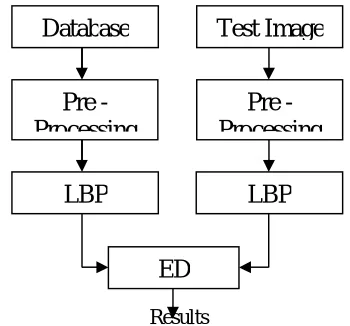
The palmprint images are resized in pre-processing unit and and features are extracted using LBP technique. The block diagram of spatial domain technique using LBP is shown in figure 1.
[image:3.612.121.296.551.714.2]Results
Fig 1: The palmprint recognition using LBP
Database
Test Image
Pre
-Processing
Pre
-Processing
LBP
LBP
1) The Palmprint Database: The polyUpalmprint database [28] is considered to test the proposed algorithm. The total number of persons in the database is 386 with twenty images per person. The total number of palmprint images available in the database is 7720. Each palmprint image is of size 384×284 with BMP format. The palmprint image samples of a person are shown in figure 2.
Fig 2 Samples of palmprint images
2) Preprocessing: The palmprint images are resized from 384×284 to 128×128 to reduce dimensions of each image. The original palmprint image and its resized images are shown in figure3.
(a) Original image (b) Resized image (384×284) (128×128) Fig 3 Preprocessed operation
3) Linear Binary Pattern (LBP): The technique is applaid on 128×128 preprocessed palmprint image to convert original palmprint image into LBP equivalent feature matrix. The LBP technique is applied on each 3×3 matrix of palmprint image. Each pixel Co-efficient of 128×128 image is converted into LBP equivalent. The zeroes are padded around the border of 128×128 image palmprint image to convert border pixel values into LBP co-efficient values.
Illustration of sign LBP:
Consider 3×3 matrix of an imageas shown in matrix 1
I= ………(1)
The centre pixel value is Pc=156 and is compared with neighbouring pixels Pn to convert grey values into binary values based on
equation 2.
Pn= 1, Pn≥Pc ………..(2) 0, Pn<Pc
Where n=1 to 8
The LBP matrix is obtained and is given in equation 3.
LBP = 0 1 1 ……….(3) Matrix 0 1 1
The centre pixel of original value is converted into LBP value based on neighboring binary values, which are converted into decimal value based on weighted by power of two as given in equation 4.
LBP(Pc)=0×27+1×26+1×25+1×24=0×23+0×22+1×21+1×20
= 26+25+24+21
=114 ………..(4)
Similarly every pixel value of palmprint image is converted into LBP values. The original palprint image and its LBP image is as shown in figure 4.
(a) Original image (b) LBP image Fig. 4 LBP Feature image
4) Euclidean Distance: The similarity measurement between two images i.e., two matrices is computed using ED. The threshold values are fixed and are compared with computed ED values to check similarities. The computed ED values are greater than the threshold values then the images are different else similar images. The ED is computed using equation (5)
E D = ……….. (5)
Where, M = No of coefficients in a vector.
Pi= Coefficients values of vectors in database. qi = Coefficient value of vectors in test image
B. Palmprint Recognition based on Transform Domain:
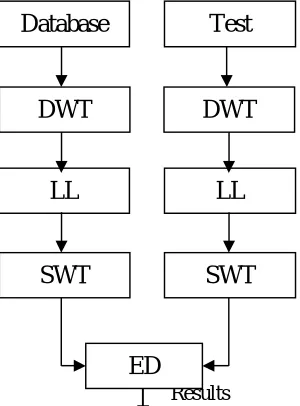
The human being is recognized using palmprints based on transform domain techniques. The polyu palmprint database is considered in the algorithm. The DWT is applied on palmprint images to generate high and low frequency bands. The SWT is applied on low frequency band of DWT to derive features of palmprint. The palmprint recognition based on transform domain technique is as shown in figure 5
[image:5.612.206.356.502.705.2]Results
Fig. 5 The palmprint recognition using DWT and SWT
Database
Test
Image
DWT
DWT
LL
LL
SWT
SWT
1) Discrete Wavelet transform (DWT): The 2D spatial domain signal is converted to transform domain signal using DWT. The 2D signal is decomposed simultaneously using low and high pass filters to obtain corresponding frequency components. The spatial domain signal is converted into detailed bands such as LH, HL, HL and HH using high pass filters. The horizontal, vertical and diagonal edge informations are available in detailed bands. The low pass filter converts spatial domain signal into approximation band (LL) of DWT, which has significant information of the signal. The one level decomposition of spatial domain palmprint image of DWT is as shown in figure 6.
a)Palmprint b) DWT decomposition c) Palmprint decomposition. /Fig. 6 DWT Decomposition of palmprint image
DWT provide information about both time location and frequency compared to Fourier Transform, which provide information about only frequency.
The palmprint image is converted into DWT matrix by considering 2×2 matrix from palmprint image matrix is given in equation 6.
………..(6)
Where a, b, c and d are pixel intensity values of palmprint image. The DWT bands such as LL, LH, HL and HH are obtained using equations 7, 8, 9 and 10 LL= ………(7)
LH= ………(8)
HL= ………(9)
HH= ………...(10)
Similarly, the procedure is repeated for all 2×2 matrix of palmprint image to convert whole image into DWT matrix.
2) Stationary Wavelet Transform (SWT): The DWT has a drawback of translation invariance, which is taken care in SWT. The undecimated version of DWT is SWT and is also known as Redundant Wavelet Transform (RWT).The SWT has shift invariance property, which is achieved by removing the down samples in DWT. The number of samples of SWT are same as number of samples of original spatial domain image. The number of samples in spatial domain and SWT are maintained equally by inserting Zeroes in the boundaries of spatial domain image.
IV.PROPOSEDFUSIONTECHNIQUEMODEL
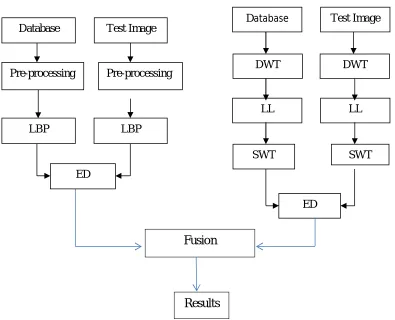
The Spatial domain technique based on LBP and transfer domain Technique based on DWT and SWT are fused using normalization technique to obtain better results. The proposed model is as shown in figure 7. Problem Definition: The palm print recognition based on LBP, DWT, SWT and Fusion technique is proposed to authenticate human beings effectively. The algorithm is given in Table 1.
A. Objectives
The algorithm must identify humans efficiently with the following
2) The error rates such as FRR, FAR and EER must be low.
3) The optimum total success rate must be high.
[image:7.612.55.450.366.686.2]Table 1: Proposed Algorithm
Fig. 7 Fusion of Spatial and Transform domain Input: Palm print Images
Output: Performance Parameters
1. The Palmprint images are considered from poly U database to test the proposed algorithm.
2. The Palmprint images are resized to 128×128 in pre-processing section to apply LBP technique.
3. The spatial domain features are extracted from plamprint images using LBP technique.
4. The LBP features of database images are compared with test images using ED to compute performance parameters.
6.The DWT is applied on Palmprint images and only LL sub-band is considered.
7. The transform domain features are extracted using SWT on LL band.
8.The ED is used to compare SWT features of database images and test images to compute performance parameters.
9.The performance parameters obtained from spatial domain and transform domain techniques are fused based on normalization technique to obtain better performance parameters.
Database Test Image
DWT DWT
LL LL
SWT SWT
ED
Fusion
Results
Database Test Image
Pre-processing Pre-processing
LBP LBP
V. PERFORMANCEANALYSIS
In this section, the definitions of performance parameters, the performance results using LBP and transform domain techniques, the performance results based on fusion techniques and comparison of proposed method with existing methods are discussed.
A. Definitions of performance parameters
The performance parameters such as FRR, FAR, EER, TSR and OTSR are used to test the performance of the proposed algorithm.
1) False Rejection Rate (FRR): The probability of genuine persons being rejected as an imposter. It is the ratio of number of genuine persons rejected to the total number of persons inside the database and is computed in equation 11
.
………... (11)
2) False Acceptance Rate (FAR):The probability of imposter being accepted as genuine persons. It is ratio of imposters accepted as genuine persons from outside the database to the total number of persons in the outside database and is computed in equation 12
……….. (12)
3) Equal Error Rate (EER): Is defined as error trade of between FRR and FAR i.e., FAR = FRR for a particular threshold value. A lower EER value indicates better performance of biometric systems.
4) Total Success Rate (TSR): Is the measure of accuracy of biometric systems. It is the ratio of the total number of
genuine persons identified correctly in the database to the total number of persons inside the database and is computed in equation 13.
………(13)
5) Optimum Total Success Rate (OTSR): The value of TSR corresponding to the EER for specified threshold. The optimum TSR values are computed using equation 14
....………(14)
6) Maximum Total Success Rate (MTSR): The value of maximum TSR for specified threshold value irrespective of error value.
B. Performance Results using LBP
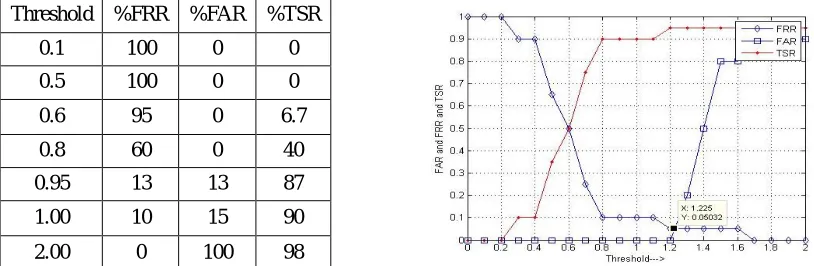
The LBP techniques are used to extract texture features of Palmprint images in the spatial domain to test the performance of the biometric system. The performance parameters such as combinations of Person inside Database (PID) and Person Outside the Database (POD) are tabulated and plotted. The variations of performance parameters with threshold value for PID and POD combinations of 10:10, 20:10, 20:30, 50:50 and 100:50 are tabulated in table 2 to 7 and plotted in figure 8 to 13. The value of FRR decreases with increase in threshold values. The values of FAR and TSR increases with increase in threshold value for all combinations of PID and POD’s. The EER values for PID and POD combinations of 10:10, 20:10, 20:30, 50:50 and 100:50 are 10, 9, 9, 13 and 6 respectively. The percentage OTSR values for PID and POD combinations of 10:10, 20:10, 20:30, 50:50 and 100:50 are 90, 91, 91, 87 and 94 respectively. The percentage maximum TSR values for PID and POD combinations of 10:10, 20:10, 20:30, 50:50 and 100:50 are 100, 95, 95, 98 and 99 respectively. The average EER, OTSR and maximum TSR values are 94, 90.6 and 97.4 respectively.
Table 2: Performance parameter variations for PID and POD of 10 and 10.
Threshold %FRR %FAR %TSR
0.1 100 0 0
0.7 100 0 0
[image:9.612.218.391.76.275.2]
[image:9.612.121.555.316.453.2] [image:9.612.106.508.499.674.2]
Fig. 8 Variations of performance parameters for PID and POD of 10 and 10. Table 3: Performance parameter variations for PID and POD of 20 and 10.
Fig. 9 Variations of performance parameters for PID and POD of 20 and 10. Table 4: Performance parameter variations for PID and PD of 20 and 30.
Fig. 10 Variations of performance parameters for PID and POD of 20 and 30. Table 5: Performance parameter variations for PIDand POD of 30 and 20.
0.9 30 0 70
1.0 10 0 90
1.02 10 10 90
1.20 0 100 100
2.20 0 100 100
Threshold %FRR %FAR %TSR
0.1 100 0 0
0.6 100 0 0
0.7 95 0 5
0.8 75 0 25
1.0 10 0 90
1.02 9 9 91
1.10 0 90 95
2.00 0 100 95
Threshold %FRR %FAR %TSR
0.1 100 0 0
0.6 100 0 0
0.7 95 0 5
0.8 75 0 25
1.0 10 0 90
1.01 9 9 91
1.10 0 97 95
Fig. 11 Variations of performance parameters for PID and POD of 30 and 2 Table 6: Performance parameter variations for PIDand POD of 50 and 50.
Threshold %FRR %FAR %TSR
0.1 100 0 0
0.5 100 0 0
0.6 95 0 6.7
0.8 60 0 40
0.95 13 13 87
1.00 10 15 90
2.00 0 100 98
[image:10.612.71.478.263.396.2]Fig. 12 Variations of performance parameters for PID and POD of 50 and 50. Table 7: Performance parameter variations for PIDand POD of 100 and 50.
Fig. 13 Variations of performance parameters for PID and POD of 100 and 50.
C. Performance Results using Transfer Domain
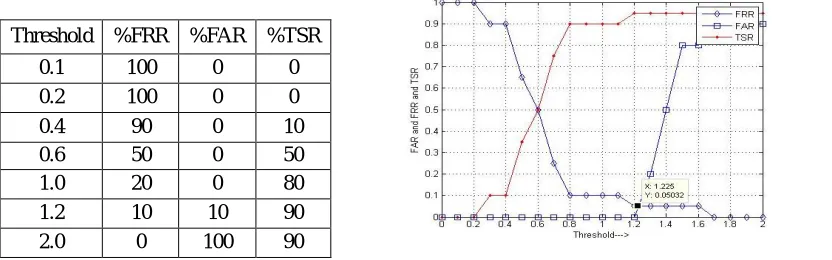
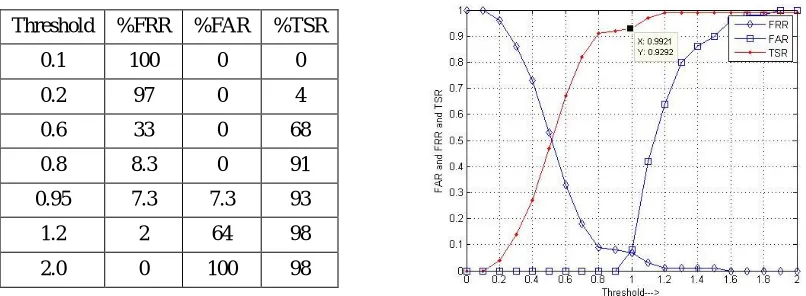
The palmprint images are converted into LL band matrix of DWT and SWT are applied on LL band matrix to derive transform domain features. The performance parameters such as percentage FRR, FAR, EER, OTSR and MTSR are computed to test the performance of the biometric system. The performance parameters are computed by considering the different combinations of PID and POD’s. The variations of percentage FRR, FAR and TSR with threshold for various PID and POD combinations of 10:10, 20:10, 20:30, 30:20, and 50:50 and 100:50 are tabulated in tables 8 to 12 respectively. It is observed that the values of FAR and TSR increases with threshold values. The variations of performance parameters with threshold values are plotted in figures 14 to 19. For PID and POD combinations of 10:10, 20:10, 20:30, 30:20, 50:50 and100:50 It is observed that the
percentage EER values are 90, 95, 95, 95, 98 and 98 and the percentage OTSR values are 90, 95, 92, 93.5, 95 and 93 for PID and POD combinations of 10:10, 20:10, 20:30, 30:20, 50:50 and100:50.
Threshold %FRR %FAR %TSR
0.1 100 0 0
0.5 100 0 0
0.6 93.3 0 7
0.8 70 0 30
1.0 14 6 87
1.01 11 11 89
1.1 0 100 97
2.0 0 100 97
Threshold %FRR %FAR %TSR
0.1 100 0 0
0.4 100 0 0
0.5 99 0 2
0.6 95 0 5
0.8 62 0 40
1.0 6 6 94
1.1 0 92 99
[image:10.612.83.493.432.577.2]Table 8: Performance parameter variations for PIDand POD of 10 of 10
Fig. 14 Variations of performance parameters for PID and POD of 10 and 10. Table 9: Performance parameter variations for PID and POD of 20 and 10.
Threshold %FRR %FAR %TSR
0.1 100 0 0
0.2 100 0 0
0.4 90 0 10
0.6 50 0 50
1.0 10 0 90
1.22 5 5 95
[image:11.612.107.489.264.387.2]2.0 0 90 95
Fig. 14Variations of performance parameters for PID and POD of 20 and 10 Table 10: Performance parameter variations for PID and POD of 20 and 30.
Threshold %FRR %FAR %TSR
0.2 100 0 0
0.4 90 0 10
0.6 560 0 50
0.8 10 0 90
1.15 8 8 92
2.00 0 97 95
[image:11.612.107.503.423.561.2]Fig. 15 Variations of performance parameters for PID and POD of 20 and 30.
Table 11: Performance parameter variations for PID and POD of 30 and 20.
Threshold %FRR %FAR %TSR
0.1 100 0 0
0.2 95 0 7
0.6 47 0 53
1.0 10 0 90
1.1 5 5 93.5
2.0 0 100 97
Threshold %FRR %FAR %TSR
0.1 100 0 0
0.2 100 0 0
0.4 90 0 10
0.6 50 0 50
1.0 20 0 80
1.2 10 10 90
[image:11.612.75.528.598.727.2]Fig. 16 Variations of performance parameters for PID and POD of 30 and 20 Table 11: Performance parameter variations for PID and POD of 50 and 50.
Threshold %FRR %FAR %TSR
0.1 100 0 0
0.2 98 0 4
0.4 74 0 27
0.8 8 0 92.5
1.02 2 53 98
[image:12.612.107.510.285.433.2]2.0 0 95 98
Fig. 17 Variations of performance parameters for PID and POD of 50 and 50. Table 12: Performance parameter variations for PIDand POD of 100 and 50.
Fig. 19 Variations of performance parameters for PIDand POD of 100 and 50.
[image:12.612.226.388.541.660.2]1) Performance of proposed Fusion Technique: The percentage of OTSR values of proposed fusion technique are obtained by fusing percentage OTSR values of spatial and transform domain techniques using normalization technique. The variations of OTSR for different combinations of PID and POD are given in Table 13. It is observed that, the OTSR values are better compared to individual techniques.
table13: variations of OTSR for various combinations of PID and POD’s.
D. Performance comparison of proposed method with existing methods
The percentage MTSR and EER of proposed method are compared with existing methods. The existing methods presented by Sang et al., [13], Sumangala Biradar et al. [14], Raouia Mokni and Monji Kherallah [15] and Shivakanth Koushik and Rajendra Singh[16] are compared with our proposed method in table14. It is observed that, the MTSR value is better in the case of proposed
Threshold %FRR %FAR %TSR
0.1 100 0 0
0.2 97 0 4
0.6 33 0 68
0.8 8.3 0 91
0.95 7.3 7.3 93
1.2 2 64 98
2.0 0 100 98
PID POD % OTSR
10 10 94.0
20 10 98.1
20 30 95.0
30 20 98.7
50 50 99.2
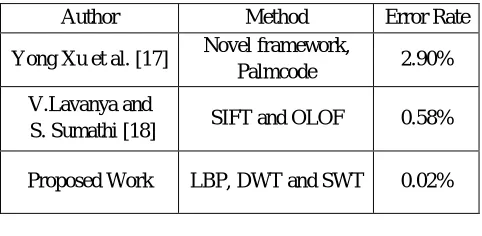
method compared to existing methods. The percentage EER values of proposed methods are compared with existing methods. The percentage EER values of proposed method are compared with existing methods presented by Yong Xu et al. [17] and Lavanya and Sumathi [18]. It is observed that the error rate is less in the case of proposed method compared to existing methods in table 15.
Table14. Comparison of MTSR values of proposed method of with existing methods.
Table15. Comparison of EER values of proposed method with existing methods.
VI. CONCLUSION
The physiological palmprint biometric trait is used to identify a person effectively. In this paper, palmprint recognition is based on fusion spatial and transform domain features is proposed. The spatial domain features are extracted from resized palmprint images using LBP. The DWT is applied on palmprint images and LL band is considered for further processing. The SWT is used to extract transform domain features from LL band of DWT. The performance parameters are computed using spatial and transform domain techniques. The OTSR of spatial and transform domain techniques. The OTSR of spatial and transform domain techniques are fused using normalization technique to obtain better results. It is observed that the performance of the proposed method is better than the existing methods.
In future the palmprint images are compressed using appropriate technique to reduce number of features to increase the speed of computation.
REFERENCES
[1] K.P Shashikala, and K.B Raja, “Palmprint Identification Based on DWT, DCT and QPCA,” Proceedings of International Journal of Engineering and Advanced
Technology,Vol-1,Issue-5,pp.325-331, 2012.
[2] Hafiz Imtiaz and Shaikh Anowarul Fattah, “A Wavelet based Feature Selection Scheme for Palmprint Recognition,” Proceedings in International Journal of
Modern Engineering Approach, Vol. 1, issue 2, pp. 2249-6645, 2011.
[3] Zhongxian Qu, Yan Hu, Huihui Sun and Jun Kong, “Novel User-Specific Palmprint Verification Approach,” Proceedings of Fifth International Conference on
Frontier of Computer Science and Technology, pp. 161-165, 2010.
[4] Wei Li, Lei Zhang, David Zhang, Guangming Lu and Jingqi Yan, “Efficient Joint 2D and 3D Palmprint Matching with Alignment Refinement,” Proceedings
of IEEE Computer Vision and Pattern Recognition, pp. 795-801, 2010.
[5] Runbin Cai and Dewan Hu, “Image Fusion of Palmprint and Palm Vein,” Proceedings of Third International Congress on Image and Signal Processing,
pp. 2778-2780, 2010.
[6] Ragavendra R, Ashok Rao and Hemantha Kumar G “A Novel Three Stage Process for Palmprint Verification,” Proceedings of International Conference on
Advances in Computing Control and Telecommunication Technologies, pp. 88-92, 2009.
[7] ]Jane You, Wai-kin kong, David Zhang and King Hong Cheling “An Hierarchical Palmprint Coding with Multiple Feature for Personal Identification in Large Databases,” Proceedings of IEEE Transactions on circuit and systems for Video Technology, vol. 14, No. 2, pp.234-243, 2004.
[8] Qichuntian, Ziliang Li, Xuhui Sun, Ruishan Zon and Min Wang, “Palmprint Classification Algorithm Based on Wavelet Multi-scale Analysis,” Proceedings
of International Conference on Computational Aspects of Social Networks, pp. 365-368, 2010.
[9] Li Shang, MingCui, Pin-gang Su, Zhi-qiang Zhao and Ji-xiang Du, “palmprint Feature Extraction Using Weight Coding Based Non-negative Sparse Coding,”
Author Method Accuracy
Sang et al. [13] 2DPCA,
Cosine Distance 99.14%
Sumangala Biradar et al. [14] Canny edge detection algorith 85%
Raouia Mokni and Monji Kherallah [15] BC Cumlnt, Mass Radius+ Random Forest 95.98%
Shivakanth Koushik and Rajendra Singh [16] LDA, PCA, 2DLDA and Wavelet 98%
Proposed Work LBP, DWT and SWT 100%
Author Method Error Rate
Yong Xu et al. [17] Novel framework,
Palmcode 2.90%
V.Lavanya and
S. Sumathi [18] SIFT and OLOF 0.58%
[image:13.612.186.427.273.391.2]Proceedings of IEEE International Congress on Image and Signal Processing, pp 1905-1908, 2010.
[10] S Palanikumar, M. Sasikumar, J and Rajeesh, “Palmprint Enhancement Using GA-AIVHE Method,” Proceedings of IEEE International Conference on
Communication Control and Computing Technologies, pp. 637-642, 2010
[11] Lei Zhang, Zhenhuaguo, Zhou wangand and David Zhang, “Palmprint Verification Using Complex Wavelet Transform,” Proceedings of IEEE International
Conferenceon Image Processing, pp. 417-420, 2007.
[12] The polyupalmprintdatabase:http://www.comp.polyu.edu.hk/-biometrics.
[13] H. Sang, W. Yuan, and Z. Zhang, “Research of lmprint recognition based on 2DPCA,” Proceedings in Advances in Neural Networks ISNN (Lecture Notes in
Computer Science). Berlin, Germany: Springer-Verlag, pp. 831–838, 2009.
[14] Sumangala Biradar, “personal identification using palmprint biometrics based on principal line approach,” Proceedings in International Journal of Advanced
Research in Computer Engineering & Technology (IJARCET), vol. 2, pp. 2262-2267, 2013.
[15] Raouia Mokni and Monji Kherallah, “ Novel palmprint Biometric System Combining Several Fractal Methods for Texture Information Extraction,”
Proceedings in IEEE International Conference on Systems, Man, Cybernatics(SMC), 2016.
[16] Shivakanth Koushik and Rajendra Singh, “A New Hybrid Approach for Palmprint Recognition in PCA Based Palmprint Recognition System,” Proceedings in
Fifth International Conference on Reliability, Infocom Technologies and Optimization(ICRITO), pp.239-244,2016.
[17] Y. Xu, D. Zhang and L.Fei, “Personal authentication using left and right palmprint images for more accurate personal identification,” IEEE Transactions on
Image Processing, Vol.24, no.2, pp. 549-559, 2015,
[18] V. Lavanya, S. Sumathi, “personal authentication using the combination of left and right palmprint images,” Proceedings in International journal of innovative