5
X
October 2017
Face Recognition Using Selective Block Local
Binary Pattern
Sharmila Kumari M1, Sunil Kumar B. L2
1
Department of Computer Science and Engineering, P A College of Engineering, Nadupadavu, Mangaluru
2
Department of Information Science and Engineering, Canara Engineering College, Benjanapadavu, Mangaluru
Abstract: This paper presents the selective block local binary pattern algorithm for human face recognition. The most important step in face recognition is the feature extraction. Tolerance to illumination variation and computational simplicity is made LBP a very popular method for pattern recognition system. Various LBP methods were used to improve the recognition rates. Traditional LBP method is compared with the selective blocks LBP methods by conducting the experiments using ORL and UMIST data base.
Keywords: Local Binary Pattern, Selective Block, Pattern Recognition, Feature Extraction, Histogram, Face Recognition.
I. INTRODUCTION
The different types of biometrics techniques are iris, signature, retina, voice, finger prints, hand, ear and face. Out of these techniques, facial recognition is considered as one of the most universal, collectable and accessible systems. It is a very big challenging task as it includes variety of parameters such as illumination, changes in pose, face background i.e. hair, expressions, head size etc. On human face recognition many research is going on and it is an active research area. Features of images used for recognition and matching of two images. Local Binary Pattern (LBP) is one of the feature extraction technique used for classification, clustering and segmentation [1]. The LBP technique was discussed for texture classification [2] using basic LBP as well as other extended methods. Beauty of the algorithm is calculation part. The variation of the algorithm was used for different applications [3]. So the aim is to design a face recognition system which can give a better result than the traditional LBP method.
II. LITERATURESURVEY
Survey shows that Local features focuses on the local parts of the face, which helps to recognize the face more accurately using the unique details, whereas global features focuses on whole face image. LBP works on the basis of local features. It is the ordered set of binary comparisons of pixel intensities between the centre pixel and its surrounding pixels. The face images are divided into several small blocks and descriptor of that block is calculated using Local Binary Pattern. T. Ahonen, A. Hadid, and M. Pietikainen, “Face Description with Local Binary Patterns: Application to Face Recognition”[16] proposed same method for the face recognition which concatenates all those block features to describe the face. Same approach was used by Md. Abdur Rahim, Md. Najmul Hossain, Tanzillah Wahid & Md. Shafiul Azam, “Face Recognition using Local Binary Patterns (LBP)”[4] which is used to consider shape and texture information of face images for person independent face recognition. Histograms of extracted LBP were concatenated to get the feature vector. Face recognition can be done with the help of this efficient feature vector. The component based framework for face identification and detection was proposed by Thomas Serre et al.[14] This framework consists of two layers of classifiers one layer with a set of component classifier and other layer with a single combination classifier. The component classifier independently identifies facial parts in the image. The output obtained from the component classifier is passed to the combination classifier to identify the face. The experiments compare the detection and identification systems to standard global approaches. Results show that the component-based approach is better than the global approaches.
III. LOCALBINARYPATTERN
LBP stands for Local Binary Pattern, which is proposed by Ojala in 1990. LBP method is easy and efficient to extract the local features from given input face. LBP has wide application in face recognition as well as it is used in real time environment because of its two important properties. They are (i) LBP features are computationally simple and (ii) LBP features are able to work for various illumination conditions. LBP feature vector can be calculated with the help of neighbourhood as-
B. Consider a centre pixel in cell, compare this central pixel with its eight surrounding neighbours pixels. Follow the pixels either a clockwise or anticlockwise along the circle.
C. If the value of the centre pixel is greater than the neighbour’s pixel value then consider it as “0” or if the value of the centre pixel is lesser than the neighbor’s pixel value consider it as “1”. It gives results of binary number which is of 8 digits, and then converts binary number into decimal number.
D. Histogram which is of 256-dimensional are computed based on the obtained feature vector over the cell.
E. LBP Features
[image:3.612.221.434.296.396.2]Labelling of pixels of an image with the decimal numbers is done by the LBP operator is known as LBP codes or Local Binary Pattern. It helps to encode the local structure around each pixel. Fig1 below shows an example of LBP operator, which gives complete details of the working of LBP on the input image. Here in 3x3 neighbourhoods, each pixel is compared with its 8 neighbour pixels by subtracting the central pixel value. If the value of the neighbour pixel is greater than the centre pixel then it is encoded as ‘1’ else it is encoded as ‘0’. By concatenating the entire neighbour binary codes either in a clockwise or anticlockwise to obtain a result of binary number and its corresponding decimal number, which is used as feature value for the particular pixel of an image.
Fig 1 : LBP Operator
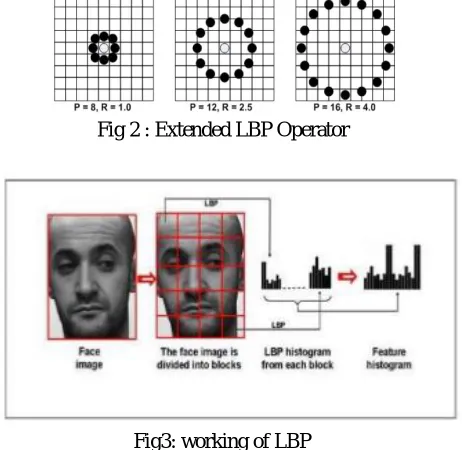
[image:3.612.195.426.454.679.2]Fig2 shows the extended LBP operator; here the notation (P, R) denotes a neighbourhood of P sampling points on a circle of radius of R. Circular (8,1.0) shows there are 8 neighbours around the central pixel with a radius of 1, similarly for circular (12,2.5) and (16,4.0) neighbourhoods are sown in the figure.
Fig 2 : Extended LBP Operator
Fig3: working of LBP
Fig 4 : Calculating LBP value
As shown in the Fig 4, LBP features of a pixel’s circularly neighborhoods are denoted by LBPp,r , where p is the number of neighborhood points present on the circle and r is the radius. BPp,r code is obtained as –
Where gc is the gray-level value of central pixel, gi is the grey-level values of surrounding pixels in the circle neighborhood. To reduce the number of possible bins, concept of uniform pattern is introduced. If the binary pattern has at most 2 bitwise transitions from 1 to 0 or vice versa then such type of LBP pattern is known as uniform pattern. For example if the bit pattern 11111111(no transition) or 00110000 (two transitions) are uniform whereas 10101011 (six transition) are not uniform. The uniform pattern constraint reduces the number of LBP pattern from 256 to 58 and it is very useful for face detection.
IV. FACEDATABASES
The experiments using traditional LBP and proposed methods are performed on standard ORL and UMIST face databases. In the experiment, Euclidian distance was used as the similarity measure for classification.
A. ORL database
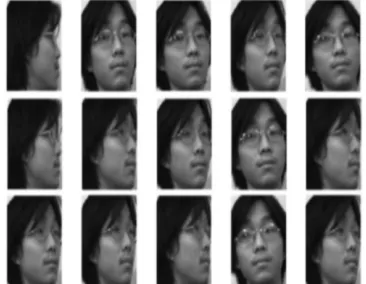
[image:4.612.213.396.577.719.2]The ORL face database consists of gray-scale images of 40 individuals each with 10 samples. They represent some variation in facial expressions, facial details, scale and also limited rotation. All images are cropped to size of 112 x 92 pixels. Fig 5 shows the subset of one such subject of the ORL database.
Fig 5 : Ten images of one person in ORL
B. UMIST database
V. PROPOSEDMETHOD
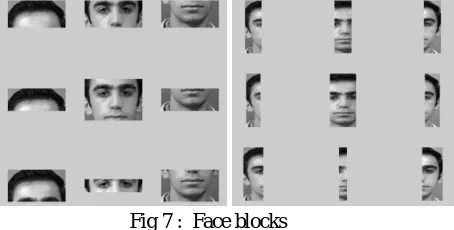
The selective blocks of the face are obtained by dividing the face image into different regions of different size. Here total of nine horizontal and vertical blocks are obtained as shown in the Fig 7. These blocks provides the inner and the outer information about the face image and also addresses the variations in chin, cheeks, forehead and nose.
Fig 7 : Face blocks
Features are extracted from the horizontal and vertical face image blocks using LBP. Then these features are used for recognizing the faces. Experiments are carried on these two standard data bases and the results were discussed.
A. Experiments on ORL database:
[image:5.612.202.429.132.247.2]The experiments are carried out by varying the number of training samples and testing samples under each subject. In all the cases, the recognition accuracy is measured. The results obtained using traditional LBP on ORL data base is shown in Table 1.
Table 1: Recognition Accuracy of LBP on ORL database. LBP Algorithm (ORL)
Training Set Testing Set Recognition
1,2,3,4 6,7,8,9 85.00%
6,7,8,9 1,2,3,4 81.50%
2,4,6,8 1,3,5,7 97.50%
[image:5.612.178.432.622.713.2]Results obtained using proposed horizontal face block on ORL database is given below.
Table 2: Recognition Accuracy of Horizontal LBP on ORL database. Horizontal LBP Algorithm (ORL)
Training Set Testing Set Recognition
1,2,3,4 6,7,8,9 95.00%
6,7,8,9 1,2,3,4 98.75%
2,4,6,8 1,3,5,7 98.75%
Results obtained using proposed vertical face block on ORL data base is given below.
Table 3: Recognition Accuracy of Vertical LBP on ORL database.
Vertical LBP Algorithm (ORL)
Training Set Testing Set Recognition
1,2,3,4 6,7,8,9 85.00%
6,7,8,9 1,2,3,4 95.00%
The combined horizontal and vertical block features are also tested and the obtained results are shown below.
Table 4: Recognition Accuracy Combined method on ORL database. Horizontal +Vertical LBP Algorithm (ORL)
Training Set Testing Set Recognition
1,2,3,4 6,7,8,9 95.00%
6,7,8,9 1,2,3,4 100.00%
2,4,6,8 1,3,5,7 98.75%
B. Experimentation on UMIST face database:
[image:6.612.178.439.258.350.2]Experiments were conducted using alternate samples as well as continuous samples for training and testing. The recorded recognition rate of LBP on UMIST data base is shown below.
Table 5: Recognition Accuracy of LBP on UMIST database. LBP Algorithm (UMIST)
Training Set Testing Set Recognition
1,2,3,4 6,7,8,9 70%
6,7,8,9 1,2,3,4 93%
2,4,6,8 1,3,5,7 80%
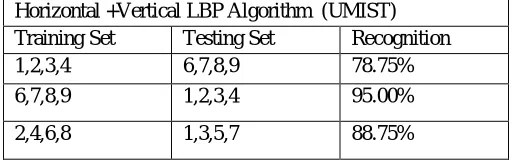
[image:6.612.175.439.410.494.2]Proposed horizontal, vertical and combined face block features are used for the recognition and the results are documented as shown in the following tables 6, 7 and 8.
Table 6: Recognition Accuracy of Horizontal LBP on UMIST database. Horizontal LBP Algorithm (UMIST)
Training Set Testing Set Recognition
1,2,3,4 6,7,8,9 78.75%
6,7,8,9 1,2,3,4 95.00%
2,4,6,8 1,3,5,7 91.25%
Table 7: Recognition Accuracy of Vertical LBP on UMIST database. Vertical LBP Algorithm (UMIST)
Training Set Testing Set Recognition
1,2,3,4 6,7,8,9 70.00%
6,7,8,9 1,2,3,4 93.75%
2,4,6,8 1,3,5,7 81.25%
Table 8: Recognition Accuracy of Combined method on UMIST database. Horizontal +Vertical LBP Algorithm (UMIST)
Training Set Testing Set Recognition
1,2,3,4 6,7,8,9 78.75%
6,7,8,9 1,2,3,4 95.00%
[image:6.612.178.437.525.605.2] [image:6.612.178.441.638.719.2]VI. CONCLUSION
In this paper methodology of Selective Block Local Binary Pattern algorithm was discussed. The two standard face database ORL and UMIST are used for conducting the experiments. The results are fairly good using the proposed method in comparison with the basic LBP method. Further results can be improved using the variants of Local Binary Pattern. The main focus was on discriminative capability improvement; enhance robustness and combining different approaches. Many a time combined approaches gives better result than the individual techniques.
REFERENCES
[1] Bhatt, Ms, et al. "A study of local binary pattern method for facial expression detection." arXiv preprint arXiv:1405.6130 (2014).
[2] Liu, Li, et al. "Extended local binary patterns for texture classification." Image and Vision Computing 30.2 (2012): 86-99.
[3] Huang, Di, et al. "Local binary patterns and its application to facial image analysis: a survey." IEEE Transactions on Systems, Man, and Cybernetics, Part C (Applications and Reviews) 41.6 (2011): 765-781.
[4] Rahim, Md Abdur, et al. "Face recognition using local binary patterns (LBP)." Global Journal of Computer Science and Technology (2013).
[5] Cai, Cheng, and Jianqiao Li. "Cattle face recognition using local binary pattern descriptor." Signal and Information Processing Association Annual Summit and Conference (APSIPA), 2013 Asia-Pacific. IEEE, 2013.
[6] Shyam, Radhey, and Yogendra Narain Singh. "Face recognition using augmented local binary pattern and Bray Curtis dissimilarity metric." Signal Processing and Integrated Networks (SPIN), 2015 2nd International Conference on. IEEE, 2015.
[7] Lv, Shiwen, Feipeng Da, and Xing Deng. "A 3D face recognition method using region-based extended local binary pattern." Image Processing (ICIP), 2015 IEEE International Conference on. IEEE, 2015.
[8] Panchal, Pradip, et al. "Pose, illumination and expression invariant face recognition using laplacian of Gaussian and Local Binary Pattern." Engineering (NUiCONE), 2015 5th Nirma University International Conference on. IEEE, 2015.
[9] Dahmouni, Abdellatif, et al. "Face recognition using local binary probabilistic pattern (lbpp) and 2d-dct frequency decomposition." Computer Graphics, Imaging and Visualization (CGiV), 2016 13th International Conference on. IEEE, 2016.
[10] Stekas, Nikolaos, and Dirk van den Heuvel. "Face Recognition Using Local Binary Patterns Histograms (LBPH) on an FPGA-Based System on Chip (SoC)." Parallel and Distributed Processing Symposium Workshops, 2016 IEEE International. IEEE, 2016.
[11] Saleh, Sheikh Ahmed, et al. "An improved face recognition method using Local Binary Pattern method." Intelligent Systems and Control (ISCO), 2017 11th International Conference on. IEEE, 2017.
[12] Olivares-Mercado, Jesus, et al. "Face recognition system for smartphone based on LBP." Biometrics and Forensics (IWBF), 2017 5th International Workshop on. IEEE, 2017.
[13] Yahia, Samah, Yassine Ben Salem, and Mohamed Naceur Abdelkrim. "3D face recognition using local binary pattern and grey level co-occurrence matrix." Sciences and Techniques of Automatic Control and Computer Engineering (STA), 2016 17th International Conference on. IEEE, 2016.
[14] Heisele, Bernd, Thomas Serre, and Tomaso Poggio. "A component-based framework for face detection and identification." International Journal of Computer Vision 74.2 (2007): 167-181.
[15] Siddharth, Kunwar Pankaj, and Dakshina Ranjan Kisku. "Heterogeneous Face Identification by Fusion of Local Descriptors." Advance Computing Conference (IACC), 2017 IEEE 7th International. IEEE, 2017.