Evaluation Process:
Double Blind Review
E-ISSN: 2318-9975
IRTUAL R&D TEAMS: A NEW MODEL FOR
PRODUCT DEVELOPMENT
1Nader Ale Ebrahim
orcid.org/0000-0001-7091-4439
ABSTRACT
Increased global competitions have urged small and medium enterprises (SMEs) to develop new products faster. Virtual research and development (R&D) teams in SMEs can offer a solution to speed up time-to-market of new product development (NPD). However, factors that affect the effectiveness of virtual teams for NPD are still not adequately verified. This paper presents the correlations between virtual R&D team constructs and virtual team effectiveness by developing a “Virtual Research and Development Team” (ViR&DT) model. The items, which may influence the effectiveness of virtual teams, are taken from the literature. Through an online survey and by application of structural equation modeling (SEM) technique, the proposed model (ViR&DT) has been tested. The results suggest that the process construct is strongly correlated to the effectiveness of virtual teams. Therefore, NPD managers in virtual R&D teams should concentrate on the process of new product development rather than simply equipping the teams with the latest technology or employing highly qualified experts. Further empirical research is recommended to fully explore and appreciate the breadth of application of the ViR&DT model. This paper is a part of my PhD journey.
Keywords: Virtual R&D teams, Collaborative teams, questionnaires, Team performance, cross-functional teams, product development
1
Visiting research fellow, Research Support Unit, Centre for Research Services, IPPP, University of Malaya, Jalan Lembah Pantai, Kuala Lumpur, 50603, Malaysia [[email protected]]
INTRODUCTION
Small and medium enterprises (SMEs) play vital roles in terms of employment, rapid new product development, and economic growth in an economy (Nader Ale Ebrahim, Ahmed, & Taha, 2010b). SMEs are considered to be engines for economic growth, especially for developing countries (Radas & Bozic, 2009; Singh, Garg, & Deshmukh, 2008). SMEs’ survival depends on their capability to improve their performance and produce goods which could fulfill international standards (Gomez & Simpson, 2007) in the prevailing open market environment. During the past few decades, new product development (NPD) has increasingly been recognized as a critical factor in fiercely competitive market situations for ensuring the continuing survival and growth of SMEs (Nader Ale Ebrahim, Ahmed, & Taha, 2009c).
To compete on a global scale and overcome the rapid technological changes in explosive manufacturing product varieties, SMEs are required to be able to sustain with product innovation (Laforet, 2008). A very important need is to enable SMEs creating new knowledge and transfer that into their development via collaborative environments and networks in order to increase their innovation capabilities (Flores, 2006). Since an important aspect of networking is to optimize the advantages that could be obtained by sharing the risk and benefits with participants, it is important for corporations to collaborate in networks in order to develop their mutual capacity, capability and competence to perform NPD and become suppliers of complete systems (H. H. Chen, Kang, Xing, Lee, & Tong, 2008).
On the other hand, rapid changes in the business environment cause a tendency to design highly flexible and agile organizations in order to bring successful new products to the marketplace (González & Palacios, 2002). Virtual teams can augment to answer these issues (Nader Ale Ebrahim, Ahmed, & Taha, 2009a). In recent years, R&D teams have become increasingly virtual (Kratzer, Leenders, & Engelen, 2006) and now is dependent on teams to carry out their R&D tasks (Nader Ale Ebrahim, Ahmed, & Taha, 2010a; Huang, 2009). Virtual R&D teams can be a means to increase the efficiency and competitiveness of SMEs in their local and global markets (Nader Ale Ebrahim et al., 2010b). Such teams have become critical for companies to survive (Lurey & Raisinghani, 2001). The main advantage of implementing a geographically dispersed R&D network structure
is the ability to tap selectively into the center of excellence (Criscuolo, 2005). To shrink the cost and protracted length of the total system and product development life cycles, many organizations have moved away from serial to concurrent collaboration through the use of cross-functional, integrated project/product teams (Bochenek & Ragusa, 2004). Virtual R&D teams could be a viable option to sustain and ease the operations of SMEs (Ebrahim, Ahmed, & Taha, 2010a).
Nevertheless, every company cannot cope up progressively or immediately with market requirements due to knowledge dynamics being experienced in the competitive milieu. Increased competition and reduced product life cycles put pressure on companies to develop new products faster. In response to these pressing needs, there should be some new approaches compatible with flexible circumstances (Schmidt, Montoya-Weiss, & Massey, 2001). With the rapid development of electronic information and communication media in the past decades, distributed work has become much easier, faster and more efficient (Hertel, Geister, & Konradt, 2005). Information technology is providing the infrastructure necessary to support the development of new organizational forms (Nader Ale Ebrahim, Abdul Rashid, Ahmed, & Taha, 2011).
Virtual teams represent one such organizational form, one which could revolutionize the workplace and provide organizations with unprecedented level of flexibility and responsiveness (Powell, Piccoli, & Ives, 2004). A virtual network structure is used to improve communication and coordination, and encourage the mutual sharing of inter-organizational resources and competencies (H. H. Chen et al., 2008).
Hence, virtuality seems to be well suited for cultivating and managing creativity in NPD teams (Leenders, Engelen, & Kratzer, 2003). Although Wagner and Hoegl (2006) showed that collaborative product development provides benefits to both managers from buying as well as the customer firm. Little research has been carried out on factors affecting and effects of virtual R&D teams in SMEs. Virtual teams and related concerns
distributed teams becomes essential for the success of engineering projects (Y. Zhang, Gregory, & Shi, 2008). Therefore, the experts suggest that more research is needed to explore ways to enhance the performance of virtual teams (El-Tayeh, Gil, & Freeman, 2008). Virtual teams deal effectively with issues sensitive to diverse cultural contexts, such as designing and introducing new products for specific markets, by communicating and collaborating with locally-based participants (Zemliansky & Amant, 2008).
Teams and virtual teams
The word “teams” was used in the U.S. as early as the 1960s. In the late 1980s and early 1990s, many companies implemented self-managing or empowered work teams. To cut bureaucracy, reduce cycle time and improve service, line-level employees involved themselves with decision-making and problem solving responsibilities which were traditionally reserved for management. By the mid-1990s, increasing numbers of companies such as Goodyear, Motorola, Texas Instruments, and General Electric had begun exporting the team concept to their foreign affiliates in Asia, Europe, and Latin America to integrate global human resource practices (Kirkman, Gibson, & Shapiro, 2001). Presently, due to communication technology improvements and continued globalization, virtual teams have increased rapidly worldwide (Kirkman, Rosen, Gibson, Tesluk, & McPherson, 2002). This era has seen a growing popularity for virtual team structures in organizations (Wayne F. Cascio, 2000; Walvoord, Redden, Elliott, & Coovert, 2008). Martins et al. (2004) in a major review of literature on virtual teams, concluded that ‘with rare exceptions all organizational teams are virtual to some extent.’ The current practice has moved away from working with people within visual proximity to working with people around the globe (Johnson, Heimann, & O’Neill, 2001).
Various forms of “virtual” work
Generally, the various forms of “virtual” work can be distinguished depending on the number of persons involved and the degree of interactions between them. The first is “telework” (telecommuting), which is performed partially or completely outside the main company workplace with the aid of information and telecommunication services. “Virtual groups” exist when several teleworkers are combined and each member reports to the same manager. In contrast, a “virtual team” exists when the members of a virtual group interact with each other in order to accomplish common goals. Finally, “virtual communities” are larger
entities of distributed work in which members participate via the Internet, guided by common purposes, roles and norms. In contrast to virtual teams, virtual communities are not implemented within an organizational structure but are usually initiated by some of their members. Examples of virtual communities are open source software projects (Hertel et al., 2005). Computer-mediated collaborations (CMC) are also used to encompass asynchronous and synchronous interactions.
Asynchronous interactions using a collaborative workspace, such as e-mail, instant messaging, and synchronous interactions using a system which incorporates desktop video conferencing, shared workspace, chat and other features (Rice, Davidson1, Dannenhoffer, & Gay, 2007). Extended enterprise concept in parallel with the concurrent enterprising looks for ways to add value to the product by incorporating knowledge and expertise from all participants on the product value chain (Sorli, Stokic, Gorostiza, & Campos, 2006). The basic element of the concurrent product development is team work (Starbek & Grum, 2002).
Teleworking is viewed as an alternative way to organize work which involves the complete or partial use of ICT to enable workers to obtain access to their labor activities from different and remote locations (Martinez-Sanchez, Pérez-Pérez, de-Luis-Carnicer, & Vela-Jiménez, 2006). Telework provides cost-saving to employees by eliminating time-consuming commutes to central offices and offers employees more flexibility to coordinate their work and family responsibilities (Johnson et al., 2001). Eppinger and Chitkara (2006) defined global product development (GPD) as combining certain centralized functions with some engineering and related product development functions distributed to other sites or regions of the world. The practice may involve outsourced engineering work along with captive offshore engineering facilities. The benefits of GPD include greater engineering efficiency through utilization of lower cost resources, access to technical expertise which is distributed internationally, design of products for more global markets and more flexible product development resource allocation through use of outsourced staff. Collaborative networked organizations (CNOs) are complex entities whose proper understanding, design, implementation and management require the integration of different modeling perspectives (Camarinha-Matos & Afsarmanesh, 2007).
for developing new products where major development activities, such as product and process design, occur “concurrently in an integrated fashion, using a cross-functional team, rather than sequentially by separate functions” (A. T. Boyle, Kumar, & Kumar, 2006). CE teams should be supported in organizations, specifically in complex NPD activities and an innovative organizational climate (T. A. Boyle, 2005). IPD has been, for the past two decades, the default product development technique (Mulebeke & Zheng, 2006). Costs of integrated product and process development are lower than sequential engineering costs (Kusar, Duhovnik, Grum, & Starbek, 2004) . One of the basic ideas of CE needed for product design and development is to assemble a team which is focused on developing or re-designing a product (Bochenek & Ragusa, 2004). Concurrent engineering is a conceptual methodology, which enables everyone impacted by the product design to have early access to design information and also the ability to influence the final design to identify and prevent future problems. It is different from virtual team working.
The term ‘‘concurrent engineering’’ denotes an inter-discipline cooperation and parallel work towards a common set of consistent goals on development, manufacturing and sales of products (Kusar et al., 2004). Sometimes IPD is defined as a different form of CE, whereby IPD is a managerial approach for improving NPD performance through the overlap, parallel execution, and concurrent workflow of activities. IPD signifies the chain of command and decision-making process in NPD projects and also defines who is supposed to communicate with whom, and the configuration of the reporting relationships (Naveh, 2005).
McDonough et al. (2001) distinguished the differences between virtual and global NPD teams. They defined virtual NPD teams as comprising of individuals possessing a moderate level of physical proximity and cultural similarity, whereas global NPD teams consist of individuals who work and live in different countries and are culturally diverse.
VIRTUAL R&D TEAMS
A number of companies are increasing, especially those with knowledge-intensive R&D programs which have turned to virtual teams in recent years in order to create the greatest competitive advantage from limited labor and resources (T. Y. Chen, Chen, & Ch, 2008). The understanding of teams is based upon traditional teams in which all members are collocated and communicate face-to-face. However, geographically distributed teams, whose members
are not collocated and must often communicate via information technology, are growing dramatically (Hinds & Bailey, 2003). In order to fulfill the technological needs of industry and boost entity international competitiveness, companies should operate based on virtual R&D teams. These needs are fundamentally linked to the flow of information, assignment of competency, and transfer of authority in international R&D organizations, and are central for international technology and knowledge transfer between dispersed R&D sites (Von Zedtwitz, Gassmann, & Boutellier, 2004). The trends in globalization and high demand variation force companies and supply chains to innovate new business models to gain and maintain in a competitive position. Networking, outsourcing, as well as ICTs are considered as general tools to respond to these challenges (Salmela & Lukka, 2004). Consequently, multinational corporations (MNCs) have increased their R&D investment in foreign countries (Reger, 2004). While the outsourcing activities of the MNCs are highly concentrated in a handful of economies by the advent of the global R&D wave, the offshore outsourced R&D activities are now more geographically dispersed, and this indeed reveals the increasing value of collaboration.
These multiple sites encourage the development of more ideas, due to the varied international backgrounds in global networks (Richtne´r & Rognes, 2008).
Virtual teams are important mechanisms for SMEs seeking to leverage scarce resources across geographic and other boundaries (Raval, Ale Ebrahim, Ahmed, & Taha, 2010). Additionally, virtual collaboration has become vital for most organizations. This is particularly true for R&D activities (Nader Ale Ebrahim, Ahmed, & Taha, 2011).
determine which factors make effective virtual teams in R&D and how those factors influence the competitive advantage of enterprises (Nader Ale Ebrahim, Ahmed, Abdul Rashid, & Taha, 2012).
One of the highest-cited studies (a total of 256 citations at present) on the effectiveness of virtual teams was conducted by Lurey and Raisinghani (2001). They determined the factors, which influence the effectiveness of virtual teams (Nader Ale Ebrahim, Ahmed, Abdul Rashid, & Taha, 2012; Nader Ale Ebrahim, Ahmed, Abdul Rashid, Taha, & Wazed, 2012). They identified the social aspects of virtual teams such as: team members’ relations, team members’ satisfaction, selection procedures, executive leadership styles, design process, internal group dynamics, and additional external support mechanisms (Lurey & Raisinghani, 2001). In addition, they found an interesting issue in the effectiveness of virtual teams, which is an insignificant relationship between the teams’ tools, technologies and communication patterns and the teams’ effectiveness measures. This is one of the concerns of this study, as
the author investigates the effects of communication technology on virtual teams’ effectiveness (Nader Ale Ebrahim, Ahmed, & Taha, 2008). Virtual team effectiveness models are clearly in the early stages of development and no single virtual team effectiveness model appears to have been favored in the literature. Most models have also not been empirically tested (Foster, 2010). Most of the existing virtual team effectiveness models consider the social aspect of teams, rather than the practical aspects. In this study, the author considers the practical aspects of virtual team effectiveness.
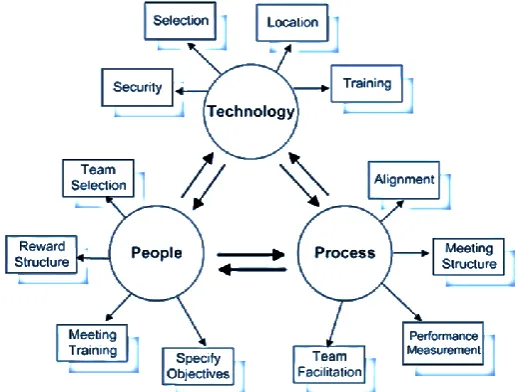
[image:5.595.172.431.372.568.2]The Bal and Gundry (1999; 2001b) model is used as the basic framework for discussions on the topic. The main constructs of the model are used directly, but the constructs’ items are modified according to the practical aspects of virtual team effectiveness. Similar to their study in (Bal & Gundry, 1999) Bal and Teo (2001b) identified 12 items for effective virtual team working by observation and interview. This is illustrated in Figure 1.
Figure 1 Model for effective virtual team working (Source: (Bal & Gundry, 1999)
Virtual R&D team working: technology point of view
Virtual teams use digital communications such as video and audio links, electronic whiteboards, e-mails, instant messaging, websites, chat rooms, et cetra, as substitutes for physical collocation of the team members (Baskerville & Nandhakumar, 2007; Pauleen & Yoong, 2001). The simple transmission of information from point A to point B is insufficient as virtual environment presents significant challenges for effective communication (Walvoord et al., 2008).
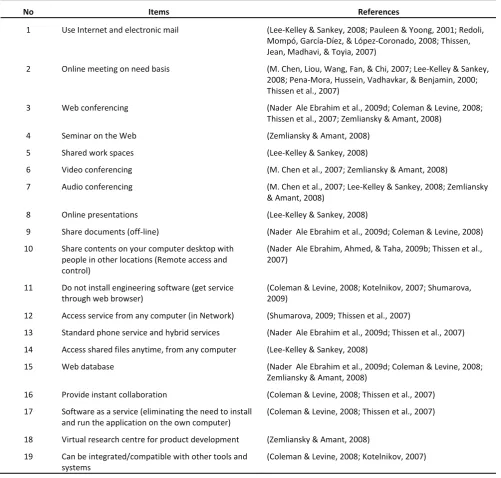
more or less likely (A. H. Anderson, McEwan, Bal, & Carletta, 2007). Virtual R&D team facilitators should choose the appropriate technology-based upon the purpose of the team (Nader Ale Ebrahim, Ahmed, & Taha, 2009d). Based on a comprehensive review on technology in virtual R&D team working, 19 important factors are extracted.
Items, which constitute technology construct in a virtual R&D team, are still ambiguous. The author extracted 19-important items related to technology
[image:6.595.49.551.249.727.2]constructs, based on a comprehensive review on technology in virtual R&D team working. Table 1 summarizes the items and their supporting references. E-mails and conference calls are generally known as first-generation technologies whereas online discussion boards, power point presentations, video tools and online meeting tools are second-generation technologies. Third second-generation technology refers typically to web-enabled shared workspaces via Intranet or Internet (Lee-Kelley & Sankey, 2008).
Table 1 Summary of items related to technology constructs in virtual teams
No Items References
1 Use Internet and electronic mail (Lee-Kelley & Sankey, 2008; Pauleen & Yoong, 2001; Redoli, Mompó, García-Díez, & López-Coronado, 2008; Thissen, Jean, Madhavi, & Toyia, 2007)
2 Online meeting on need basis (M. Chen, Liou, Wang, Fan, & Chi, 2007; Lee-Kelley & Sankey, 2008; Pena-Mora, Hussein, Vadhavkar, & Benjamin, 2000; Thissen et al., 2007)
3 Web conferencing (Nader Ale Ebrahim et al., 2009d; Coleman & Levine, 2008;
Thissen et al., 2007; Zemliansky & Amant, 2008)
4 Seminar on the Web (Zemliansky & Amant, 2008)
5 Shared work spaces (Lee-Kelley & Sankey, 2008)
6 Video conferencing (M. Chen et al., 2007; Zemliansky & Amant, 2008)
7 Audio conferencing (M. Chen et al., 2007; Lee-Kelley & Sankey, 2008; Zemliansky
& Amant, 2008)
8 Online presentations (Lee-Kelley & Sankey, 2008)
9 Share documents (off-line) (Nader Ale Ebrahim et al., 2009d; Coleman & Levine, 2008) 10 Share contents on your computer desktop with
people in other locations (Remote access and control)
(Nader Ale Ebrahim, Ahmed, & Taha, 2009b; Thissen et al., 2007)
11 Do not install engineering software (get service through web browser)
(Coleman & Levine, 2008; Kotelnikov, 2007; Shumarova, 2009)
12 Access service from any computer (in Network) (Shumarova, 2009; Thissen et al., 2007)
13 Standard phone service and hybrid services (Nader Ale Ebrahim et al., 2009d; Thissen et al., 2007) 14 Access shared files anytime, from any computer (Lee-Kelley & Sankey, 2008)
15 Web database (Nader Ale Ebrahim et al., 2009d; Coleman & Levine, 2008;
Zemliansky & Amant, 2008)
16 Provide instant collaboration (Coleman & Levine, 2008; Thissen et al., 2007) 17 Software as a service (eliminating the need to install
and run the application on the own computer)
(Coleman & Levine, 2008; Thissen et al., 2007)
18 Virtual research centre for product development (Zemliansky & Amant, 2008) 19 Can be integrated/compatible with other tools and
systems
Virtual team working: People’s point of view
From the knowledge worker’s point of view, the items, which are required for effective virtual teams, are unclear (Nader Ale Ebrahim, 2012; Nader Ale
Ebrahim, Ahmed, Abdul Rashid, & Taha, 2011). The researcher extracted 11-important factors related to a KW construct based on a comprehensive review of KW’s point of view in virtual R&D team working.
[image:7.595.71.523.200.438.2]Table 2 summarizes these items.
Table 2 Items related to knowledge worker construct in virtual teams
No. Item References
1 Working together (Redoli et al., 2008)
2 Interaction from inside (Bal & Teo, 2001a; Redoli et al., 2008) 3 Interaction from outside (Bal & Teo, 2001a; Redoli et al., 2008)
4 Interaction with colleagues (Chudoba, Wynn, Lu, Watson-Manheim, & Beth, 2005) 5 Online training and e-learning (Zemliansky & Amant, 2008)
6 Consulting service (Consulting with others) (Shin, 2005; Williams, Bellamy, Gameson, Sherratt, & Sher, 2005)
7 Collaborating and making decisions with co-workers or supplier
(Andersen & Drejer, 2009; Daoudi, 2010)
8 Facilitates cooperation between employees (Duhovnik, Starbek, Dwivedi, & Prasad, 2001) 9 Facilitates introduction of new employees (Wayne F. Cascio, 2000; Zemliansky & Amant, 2008) 10 Facilitates the management of NPD project (Leenders et al., 2003)
11 Used by the competitor (Ebrahim, Ahmed, & Taha, 2010b; Zemliansky & Amant, 2008)
Virtual team working: Process point of view
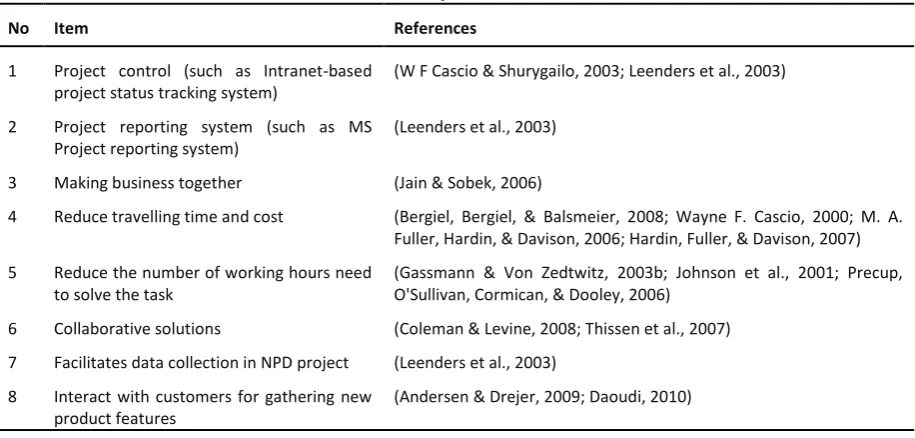
[image:7.595.67.525.531.750.2]From the process point of view, the items which are required for effective virtual teams are ambiguous. The researcher extracted 13 items related to the process construct based on reviewed papers (Table 3).
Table 3 Items related to the process construct in virtual teams
No Item References
1 Project control (such as Intranet-based project status tracking system)
(W F Cascio & Shurygailo, 2003; Leenders et al., 2003)
2 Project reporting system (such as MS Project reporting system)
(Leenders et al., 2003)
3 Making business together (Jain & Sobek, 2006)
4 Reduce travelling time and cost (Bergiel, Bergiel, & Balsmeier, 2008; Wayne F. Cascio, 2000; M. A. Fuller, Hardin, & Davison, 2006; Hardin, Fuller, & Davison, 2007) 5 Reduce the number of working hours need
to solve the task
(Gassmann & Von Zedtwitz, 2003b; Johnson et al., 2001; Precup, O'Sullivan, Cormican, & Dooley, 2006)
6 Collaborative solutions (Coleman & Levine, 2008; Thissen et al., 2007) 7 Facilitates data collection in NPD project (Leenders et al., 2003)
8 Interact with customers for gathering new product features
9 Provide quantity answer (Zemliansky & Amant, 2008)
10 Generate an easy interpretable answer (Corso, Martini, Pellegrini, Massa, & Testa, 2006; Zemliansky & Amant, 2008)
11 Ease of generating reports (Kirkman et al., 2002)
12 Ease of data entry (Corso et al., 2006; Thissen et al., 2007; Zemliansky & Amant, 2008) 13 Ability to accommodate multiple users (Wayne F. Cascio, 2000; Gaudes, Hamilton-Bogart, Marsh, &
Robinson, 2007; Kratzer, Leenders, & Engelen, 2005),
Benefits of virtual teams
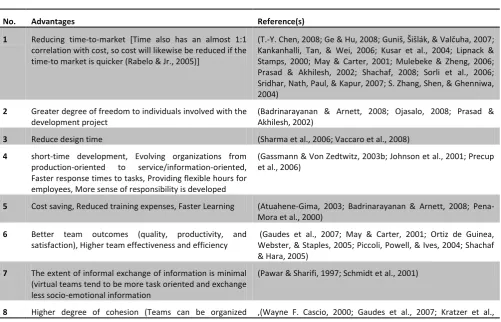
Working in today’s business world is like working in a world where the sun never sets. During the last decade, words such as “virtual”, “virtualization”, “virtualized” have been very often advocated by scholars and practitioners (Vaccaro, Veloso, & Brusoni, 2008). However, the advantages and pitfalls of virtual teams are concealed. The availability of a flexible and configurable based infrastructure is one of the main advantages of virtual teams. Virtual R&D teams often face tight schedules and the need to start quickly and perform instantly (Munkvold & Zigurs,
[image:8.595.38.540.428.750.2]2007). Virtual teams may allow people to collaborate with more productivity at a distance (Gassmann & Von Zedtwitz, 2003a). Virtual teams reduce time-to-market (May & Carter, 2001). Lead time or time-to-market has been generally admitted to being one of the most important keys for success in manufacturing companies (Sorli et al., 2006). Table 4 summarizes a number of the main advantages of virtual teaming. Clearly, the rise of network technologies has made the use of virtual teams feasible (Beranek & Martz, 2005). Many managers are uncomfortable with the concept of virtual teams because successful management of virtual teams may require new methods of supervision (Jarvenpaa & Leidner, 1999).
Table 4: Main advantages associated with virtual teaming
No. Advantages Reference(s)
1 Reducing time-to-market [Time also has an almost 1:1 correlation with cost, so cost will likewise be reduced if the time-to market is quicker (Rabelo & Jr., 2005)]
(T.-Y. Chen, 2008; Ge & Hu, 2008; Guniš, Šišlák, & Valčuha, 2007; Kankanhalli, Tan, & Wei, 2006; Kusar et al., 2004; Lipnack & Stamps, 2000; May & Carter, 2001; Mulebeke & Zheng, 2006; Prasad & Akhilesh, 2002; Shachaf, 2008; Sorli et al., 2006; Sridhar, Nath, Paul, & Kapur, 2007; S. Zhang, Shen, & Ghenniwa, 2004)
2 Greater degree of freedom to individuals involved with the development project
(Badrinarayanan & Arnett, 2008; Ojasalo, 2008; Prasad & Akhilesh, 2002)
3 Reduce design time (Sharma et al., 2006; Vaccaro et al., 2008)
4 short-time development, Evolving organizations from production-oriented to service/information-oriented, Faster response times to tasks, Providing flexible hours for employees, More sense of responsibility is developed
(Gassmann & Von Zedtwitz, 2003b; Johnson et al., 2001; Precup et al., 2006)
5 Cost saving, Reduced training expenses, Faster Learning (Atuahene-Gima, 2003; Badrinarayanan & Arnett, 2008; Pena-Mora et al., 2000)
6 Better team outcomes (quality, productivity, and satisfaction), Higher team effectiveness and efficiency
(Gaudes et al., 2007; May & Carter, 2001; Ortiz de Guinea, Webster, & Staples, 2005; Piccoli, Powell, & Ives, 2004; Shachaf & Hara, 2005)
7 The extent of informal exchange of information is minimal (virtual teams tend to be more task oriented and exchange less socio-emotional information
(Pawar & Sharifi, 1997; Schmidt et al., 2001)
whereas whether the members are in proximity to one another), Improve communication and coordination, and encourage mutual sharing of inter-organizational resources and competencies
2005), (H. H. Chen et al., 2008)
9 Creates and disperses improved business processes across organizations, Greater client satisfaction
(Jain & Sobek, 2006)
10 Reduced relocation time and costs (Biuk-Aghai, 2003; Boudreau, Loch, Robey, & Straub, 1998; Kankanhalli et al., 2006; Lipnack & Stamps, 2000; Liu & Liu, 2007; McDonough et al., 2001; Olson-Buchanan, Rechner, Sanchez, & Schmidtke, 2007; Prasad & Akhilesh, 2002; Rice et al., 2007)
11 Reduced travel costs (Bergiel et al., 2008; Wayne F. Cascio, 2000; M. A. Fuller et al., 2006; Hardin et al., 2007)
12 More effective R&D continuation decisions (Cummings & Teng, 2003; Schmidt et al., 2001)
13 Able to tap selectively into centres of excellence, using the best talent regardless of location
(Badrinarayanan & Arnett, 2008; Boudreau et al., 1998; Boutellier, Gassmann, Macho, & Roux, 1998; Wayne F. Cascio, 2000; Criscuolo, 2005; M. A. Fuller et al., 2006; Furst, Reeves, Rosen, & Blackburn, 2004; Prasad & Akhilesh, 2002; Samarah, Paul, & Tadisina, 2007)
14 Greater productivity, shorter development times (McDonough et al., 2001; Mulebeke & Zheng, 2006)
15 Producing better outcomes and attract better employees, Generate the greatest competitive advantage from limited resources
(T. Y. Chen et al., 2008; Martins et al., 2004; Rice et al., 2007)
16 Provide organizations with unprecedented level of flexibility and responsiveness
(T.-Y. Chen, 2008; Guniš et al., 2007; Hunsaker & Hunsaker, 2008; Liu & Liu, 2007; Piccoli et al., 2004; Pihkala, Varamaki, & Vesalainen, 1999; Powell et al., 2004; Prasad & Akhilesh, 2002)
17 Respond quickly to changing business environments (Bergiel et al., 2008; Mulebeke & Zheng, 2006)
18 Sharing knowledge and experiences (Furst et al., 2004; Lipnack & Stamps, 2000; Merali & Davies, 2001; Rosen, Furst, & Blackburn, 2007; Zakaria, Amelinckx, & Wilemon, 2004)
19 Cultivating and managing creativity (Atuahene-Gima, 2003; Badrinarayanan & Arnett, 2008; Leenders et al., 2003; Prasad & Akhilesh, 2002)
20 Provide a vehicle for global collaboration and coordination of R&D related activities
(Paul, Seetharaman, Samarah, & Peter Mykytyn, 2005)
21 Facilitate knowledge capture (Lipnack & Stamps, 2000; Merali & Davies, 2001; Rosen et al., 2007; Sridhar et al., 2007; Zakaria et al., 2004)
In summary, none of the existing approaches appears to give a complete picture of what is actually needed to create effective virtual R&D teams in SMEs. This suggests the need to develop a model for SMEs, which supports the following goals: clear relationship between the constructs and items, provides direction for NPD managers to develop products with lower costs and shorter time, provide a guideline for software developers to implement KW perceptions in the collaborative tools.
Problem statement
The main problem in today’s product design is to harness a pool of knowledge and experience in
source of innovation. At present, with the exception of open source software, little is known about how to utilize this know-how for NPD (J. Fuller, Bartl, Ernst, & Mühlbacher, 2006). The motivation to use virtual teams is often economically driven as well (Zemliansky & Amant, 2008, p. 121). The problem statements specific to this research are as below. Problems in handling NPD in SMEs
SMEs have scarce work force and other resources, and therefore, many SMEs do not have the possessions and employees to develop new products as per market needs. But SMEs' success and profitability are also strongly linked to the flow of updated and technically successful projects emanating from R&D activities. In order to ensure the success and viability of R&D activities, expertise and know-how has to be captured, created and inserted into the R&D units. Considering the geographical decentralization of the experts and the high cost of employing these experts, in addition to the time required for the presence of these individuals in the enterprises, the application of virtual R&D teams in NPD has become a necessity for SMEs. However, there is no simple method/model for developing a new product through virtual R&D teams in SMEs. “The new product process is multifunctional: it requires the inputs and active participation of players from many different functions in the organization. The multifunctional nature of innovation coupled with the desire for parallel processing means that a true cross-functional team approach is mandatory in order to win at new products (Cooper, 2001, p. 118)”. This problem is being faced by SMEs for rapid NPD.
Problems in using virtual R&D teams within SMEs
Nowadays, in organizations other than SMEs, virtual teams are allowed to use computer networks and thus reduce the need for teams to be collocated (Aripin, Mustafa, & Hussein, 2011). Few companies, regardless of their size, can afford to maintain R&D facilities with world-class competencies in many different sectors (Narula, 2004). SMEs typically suffer from lack of resources, their central role in the development of technology and science-driven industries is paradoxical (Partanen, Möller, Westerlund, Rajala, & Rajala, 2008).
Most products in manufacturing involve multiple technologies, and multiple skills. Faced with the challenges of increased globalization of markets and technological changes, SMEs need reinforced support through some viable team like virtual R&D teams.
Most of the research activities held relevant to SMEs did not use virtual R&D teams for NPD. Benefiting from the cross-functional virtual R&D teams beyond the organizations or countries are therefore vital to fill this gap, unlock growth opportunities for SMEs through research, and help them to carry out or outsource research in order to develop new products, processes and services. Lack of knowledge about the factors which impact the effectiveness of virtual teams
Literature shows the importance of the role of information and communication technology (ICT), product design and development process, and knowledge worker (KW) in increasing the effectiveness of virtual R&D teams for new product development. However, the items which make technology, process and KW constructs in a virtual R&D team are still to be evidently identified. The literature on team effectiveness usually discusses collocated teams, and few studies have been performed on the effectiveness and performance of distributed teams (Bosch-Sijtsema, Ruohomäki, & Vartiainen, 2009). The current literature on the role of KW in virtual teams has mainly focused on individual knowledge worker. However, the items which make KW construct and influence the effectiveness of knowledge workers in distributed teams is unclear.
In summary, none of the previous approaches appears to give a complete picture of what is actually needed to create effective virtual R&D teams in SMEs. This suggests the need to develop a model for SMEs, which supports the following goals: clear relationship between the constructs and items, direction for design engineers and NPD managers to develop products with lower costs and shorter time, and a guideline for software developers to implement KW perceptions in collaborative environment.
METHODOLOGY FOR MODEL BUILDING
R&D team effectiveness constructs are defined by 13 items. The research investigates the relationship between these constructs, their dimensions and items in the ViR&DT model in order to introduce a
reliable model to the managers of virtual R&D teams in order to increase the effectiveness of the new product development process and decrease the time-to-market of the product.
Hypotheses
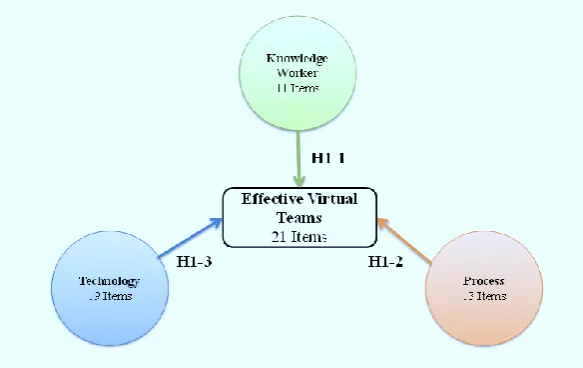
Based on the literature review a conceptual model was developed (Nader Ale Ebrahim, 2012). The author proposed a conceptual. A preliminary ViR&DT model based on the model by Bal and Gundry (1999) and Bal and Teo (2001b) is proposed (Figure 2).
[image:11.595.154.446.219.403.2].
Figure 2 Preliminary ViR&DT model for evaluating the effectiveness of virtual teams
In achieving the research objectives, the following hypotheses are addressed in this research:
H1-1: There is a (positive) significant relationship between knowledge worker and virtual team effectiveness.
H1-2: There is a (positive) significant relationship between process and virtual team effectiveness.
H1-3: There is a (positive) significant relationship between technology and virtual team effectiveness.
Data collection
The author used online questionnaires. The online data collection was matched to the topic of research. A questionnaire was aimed to obtain , factual information on the companies' practices of virtual R&D teams in new product development, as well as the NPD and R&D managers' perceptions of their implementation of virtual R&D teams (if any) or their expectations of virtual R&D teams. The questionnaires consisted of three sections:
1. Section A: demographic data (company
background, number of employees, country, etc.),
2. Section B: general understanding and
application of virtual R&D teams in new
product development within companies which used virtual teams,
3. Section C: requirements of the company to determine the appropriate design tools and methods for effective new product development through virtual R&D teams.
Overall, filling up the online questionnaire took approximately 25 to 30 minutes for each participant. The author excluded questionnaires which were completed very quickly, from the reliable responses. Structural equation modeling (SEM)
relationships specified by the researcher (Kyriazis, 2005). SEM is a technique to specify, estimate, and evaluate models of linear relationships among a set of observed variables in terms of a generally smaller number of unobserved variables (Shah & Goldstein, 2006). SEM has become one of the preferred data analysis methods among empirical Operations Management (OM) researchers, and articles which employ SEM as the primary data analysis tool now routinely appear in major OM journals (Shah & Goldstein, 2006). SEM permits complex phenomena to be statistically modeled and tested. SEM techniques are therefore becoming the preferred method for confirming (or disconfirming) theoretical models in a quantitative fashion (Schumacker & Lomax, 2004). Anderson and Gerbing (1988) proposed two main components of models in SEM:
1. The measurement model, or factor model
showing the relations between latent variables (construct) and their indicators (observed variables);
2. The structural model, showing potential
causal dependencies between endogenous and exogenous variables (Schumacker & Lomax, 2004).
The measurement model provides an assessment of convergent and discriminant validity, and the structural model provides an assessment of nomological validity (Schumacker & Lomax, 2004). In this study, the two steps of SEM were performed, namely building and fitting the measurement model followed by constructing the structural model. The task involved in developing the measurement model is two-fold:
1. To determine the number of factors to use in measuring each construct, and
2. To identify which items to use in formulating each factor (Byrne, 2010).
Criteria for model fit
Structural equation modeling (SEM) using AMOS
18 was employed for validation of the measurement model. This statistical analysis estimates both measurement and structural models simultaneously (Dibrell, Davis, & Craig, 2008). To ensure that the factors make up the right constructs, the measurement model was examined for model fit. The model was assessed for convergent and discriminant validity.
Convergent validity is established using a calculation of factor loadings, the average variance extracted (AVE) and composite reliability (CR). The factors that have standardized loadings exceeding 0.50, were maintained (Dibrell et al., 2008). AVE larger than 0.5 is the threshold (McNamara, Dennis, & Carte, 2008). CR is calculated by squaring the sum of loadings, then dividing it by the sum of squared loadings, plus the sum of the measurement error (Lin, Standing, & Liu, 2008). CR should be greater than 0.6 (Huang, 2009).
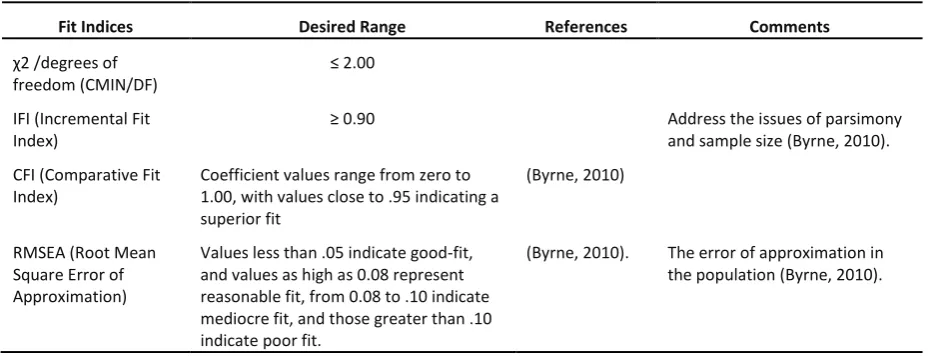
[image:12.595.77.543.576.754.2]Discriminant validity was performed with AMOS software using maximum likelihood method (ML). Considering the sample size of this study follows the Byrne’s suggestions (Byrne, 2010) for model fitting indices (Table 5). The model has an acceptable fit if at least three fitting indices are within the range.
Table 5 Fitting indices
Fit Indices Desired Range References Comments
χ2 /degrees of freedom (CMIN/DF)
≤ 2.00
IFI (Incremental Fit Index)
≥ 0.90 Address the issues of parsimony
and sample size (Byrne, 2010). CFI (Comparative Fit
Index)
Coefficient values range from zero to 1.00, with values close to .95 indicating a superior fit
(Byrne, 2010)
RMSEA (Root Mean Square Error of Approximation)
Values less than .05 indicate good-fit, and values as high as 0.08 represent reasonable fit, from 0.08 to .10 indicate mediocre fit, and those greater than .10 indicate poor fit.
Root mean square residual (RMR)
≤ 0.08
Goodness-of-Fit Index (GFI)
≥ 0.90 Absolute indices absolute indices
of fit because they basically compare the hypothesized model with no model at all (Byrne, 2010)
Adjusted Goodness-of-Fit Index (AGFI)
≥ 0.80 Absolute indices absolute indices
of fit because they basically compare the hypothesized model with no model at all (Byrne, 2010)
Normed Fit Index (NFI)
Coefficient values range from zero to 1.00, with values close to .95 indicating a superior fit
(Byrne, 2010) Shown a tendency to underestimate fit in small samples (Byrne, 2010) Relative Fit Index (RFI) Coefficient values range from zero to
1.00, with values close to .95 indicating a superior fit
(Byrne, 2010)
Tucker-Lewis Index (TLI)
Values ranging from zero to 1.00, with values close to .95 (for large samples) being indicative of good-fit
(Byrne, 2010)
The overall model fit is indicated by the model chi-squared value and other fit indices that are functionally related to the chi-squared value (Lei, 2009). Therefore, Chi-square is the most common index to evaluate the model fit in SEM. In applying the Chi-square test, the researcher does not wish to reject the null hypothesis (there is a significant difference between the “observed” and the “expected”) and, accordingly, the smaller the Chi-square value, the better fit of the model (Ho, 2006).
If the p-value of Chi-square is significant, this presents a good model fit between the observed data and the test model. However, the chi-square statistic is very sensitive to sample size. In case of large samples, almost every reasonable model will be rejected if only the chi-square value is considered (Ho, 2006). Therefore, using the value of Chi-square/degree of freedom to test the model fit is more common and an appropriate value is less than two if the p-value of chi-square is insignificant (Byrne, 2010). Byrne (2010) suggested that values less than 0.05 indicate good-fit, and values as high as 0.08 represent reasonable fit, from 0.08 to 0.10 indicate mediocre fit, and those greater than 0.10 indicate poor fit. Goodness-of-fit index (GFI) greater than 0.9 indicate a good model fit (Byrne, 2010).
Incremental fit measures compare the proposed model to the baseline model, most often referred to as the independence model. In the independence
model, the observed variables are assumed to be uncorrelated with each other. A number of incremental fit measures have been proposed, such as Tucker-Lewis Index (TLI), Normed Fit Index (NFI), Relative Fit Index (RFI), Incremental Fit Index (IFI), and Comparative Fit Index (CFI) (Ho, 2006). Incremental fit measures range from 0 (a fit which is no better than the null model) to 1 (a perfect fit) (Byrne, 2010; Ho, 2006). Joseph Hair (2009) argued if three indices fulfill the criteria, this provides adequate evidence of model fit.
Akaike Information Criterion (AIC) is a comparative measure between models with differing numbers of constructs. AIC values closer to zero indicate better fit and greater parsimony (Ho, 2006). In applying this measure to the comparison decision problem, one estimates all models, ranks them according to the AIC criterion, and chooses the model with the smallest value (Ho, 2006).
MODEL FITNESS ANALYSIS
to the analysis of the structural model (Ho, 2006). The structural model is of greater interest to the researcher, because it offers a direct test of the theory of interest (Ho, 2006). The measurement model was examined to determine the number of factors to use in measuring each construct, and identify which items to use in formulating each factor (Byrne, 2010).
Measurement model for knowledge workers, process, technology and Benefits (Overall CFA model)
Prior to hypothesis testing via the ViR&DT structural model, the author performed CFA to assess the fit between the four (knowledge workers, process, technology and Benefits) measurement models and data. The CFA model focuses solely on the link between factors and their measured variables, within the framework of SEM, and represents what has been termed a measurement model (Byrne, 2010). This overall CFA model was using the confirmed measurement models. The
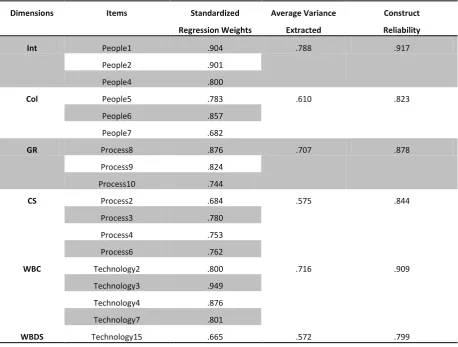
overall CFA model had sufficient convergent validity since the calculated construct reliability and average variance extracted, were above the cutoff points. The AVE values were ranging from 0.552 to 0.788, which is above a threshold value of 0.5. Respectively, the construct reliability ranging from 0.799 to 0.917 ranked as good and very good levels (
Table
6
). The convergent validity indicates that the measurement model was measured using valid and reliable dimensions and items. [image:14.595.66.525.397.744.2]Discriminant validity, to test for discriminant validity, the AVE for two dimensions should be greater than the square of the correlation between the relevant dimensions. The results of this step showed that the AVE is greater than the squared correlation between all two dimensions (Table 6 and Table 7). Hence, the overall CFA model fulfills the requirement of discriminate validity.
Table 6 The overall CFA model result
Dimensions Items Standardized
Regression Weights
Average Variance
Extracted
Construct
Reliability
Int People1 .904 .788 .917
People2 .901
People4 .800
Col People5 .783 .610 .823
People6 .857
People7 .682
GR Process8 .876 .707 .878
Process9 .824
Process10 .744
CS Process2 .684 .575 .844
Process3 .780
Process4 .753
Process6 .762
WBC Technology2 .800 .716 .909
Technology3 .949
Technology4 .876
Technology7 .801
Technology17 .845
Technology19 .709
ERD Benefit12 .676 .607 .903
Benefit13 .752
Benefit16 .769
Benefit17 .760
Benefit18 .774
Benefit19 .772
TCR Benefit2 .703 .552 .860
Benefit4 .663
Benefit5 .766
Benefit6 .759
Benefit10 .724
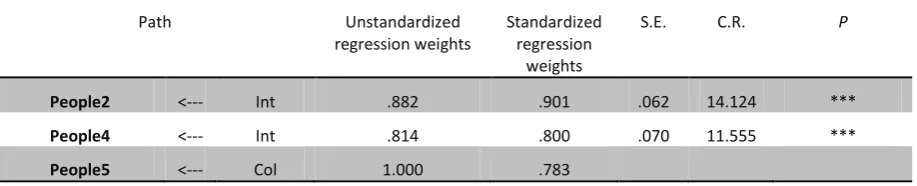
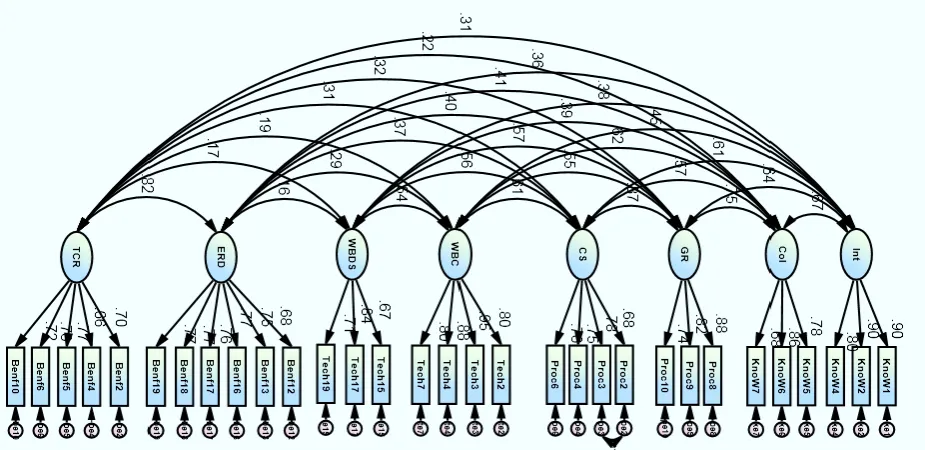
Model fitting, four constructs, namely, knowledge workers, process, technology and benefits, with eight different dimensions, gives an overall 39 items and constitute CFA model version 1. The CFA model failed to produce adequate fit indices. The standardized regression weights of the items were examined and it was found that all were exceed the required value of 0.5 (
[image:15.595.66.526.85.309.2]Table
8
). Referring to MI, Proc11, Proc7 and Tech18 were dropped. The final model (Figure 3) produced an acceptable fit, with CMIN/DF = 1.496, CFI = 0.916, IFI = 0.918 and RMSEA = 0.063.Table 7 Squared correlations estimation among the dimensions
Dimensions r2
Int Col GR CS WBC WBDS ERD TCR
Int 1
Col 0.444 1
GR 0.412 0.557 1
CS 0.375 0.327 0.210 1
WBC 0.446 0.384 0.308 0.372 1
WBDS 0.382 0.148 0.320 0.310 0.293 1
ERD 0.364 0.165 0.157 0.135 0.084 0.027 1
TCR 0.311 0.048 0.103 0.097 0.037 0.031 0.672 1
Table 8 Standardized and unstandardized regression weights of overall CFA model
Path Unstandardized
regression weights
Standardized regression
weights
S.E. C.R. P
People2 <--- Int .882 .901 .062 14.124 ***
People4 <--- Int .814 .800 .070 11.555 ***
[image:15.595.62.528.437.611.2] [image:15.595.68.527.664.757.2]People6 <--- Col .976 .857 .101 9.644 ***
People7 <--- Col .793 .682 .104 7.598 ***
Process2 <--- CS 1.000 .684
Process3 <--- CS 1.089 .780 .119 9.139 ***
Process8 <--- CR 1.000 .876
Process9 <--- CR .927 .824 .081 11.479 ***
Process10 <--- CR .880 .744 .090 9.778 ***
Process4 <--- CS 1.127 .753 .154 7.304 ***
Process6 <--- CS 1.047 .762 .142 7.375 ***
Technology2 <--- WBC 1.000 .800
Technology3 <--- WBC 1.239 .949 .097 12.752 ***
Technology4 <--- WBC 1.173 .876 .102 11.512 ***
Technology7 <--- WBC 1.030 .801 .101 10.151 ***
Technology15 <--- WBDS 1.000 .665
Technology17 <--- WBDS 1.381 .845 .199 6.934 ***
Technology19 <--- WBDS 1.265 .709 .196 6.466 ***
Benefit2 <--- TCR 1.000 .703
Benefit17 <--- ERD .910 .760 .120 7.557 ***
Benefit18 <--- ERD .944 .774 .123 7.675 ***
Benefit19 <--- ERD 1.024 .772 .134 7.661 ***
Benefit4 <--- TCR 1.018 .663 .151 6.755 ***
Benefit5 <--- TCR 1.148 .766 .149 7.721 ***
Benefit12 <--- ERD 1.000 .676
Benefit13 <--- ERD 1.080 .752 .144 7.487 ***
Benefit16 <--- ERD .939 .769 .123 7.635 ***
Benefit6 <--- TCR 1.197 .759 .156 7.651 ***
Benefit10 <--- TCR 1.068 .724 .146 7.337 ***
People1 <--- Int 1.000 .904
*** significant at the 0.001 level (two-tailed)
C.R.: Critical ratio
Figure 3 Final CFA Model for knowledge workers, process, technology and benefits with standardized factor load
ViR&DT structural model
Joseph Hair (2009) stated that after developing a theoretical model, the next stage is to represent the relationships in a path diagram. A path diagram depicting an SEM model is the graphical equivalent of its mathematical representation, whereby a set of equations relates dependent variables to their explanatory variables (Byrne, 2010). Assessing the overall goodness-of-fit for SEM is not as straightforward as other multi-variate techniques. SEM has no single statistical test that best describes the “strength” of the model’s predictions (Hair et al., 2009). In the final model, the author checked the model’s fit and analyzed the paths.
Both criteria were used because fit indices alone did not assess all aspects of a model’s appropriateness of the data. Path analysis is a statistical technique used to examine causal relationships between two or more variables. In path analysis, multiple regressions are often used in conjunction with a causal theory, with the aim of describing the entire structure of linkages between exogenous and endogenous variables posited from that theory (Ho, 2006).
To examine causal relationships amongst the key construct in ViR&DT, the author used AMOS18 software for path analysis.
The numbers on the paths in the Figure 4 represent the path coefficients, as well as the relationships between the exogenous and endogenous variables.
Figure 4 ViR&DT structural model with standardized regression weights
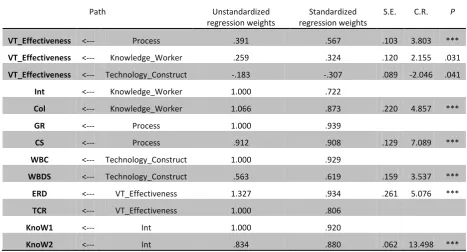
Table 9 Summary of path analysis
Path Unstandardized
regression weights
Standardized regression weights
S.E. C.R. P
VT_Effectiveness <--- Process .391 .567 .103 3.803 ***
VT_Effectiveness <--- Knowledge_Worker .259 .324 .120 2.155 .031
VT_Effectiveness <--- Technology_Construct -.183 -.307 .089 -2.046 .041
Int <--- Knowledge_Worker 1.000 .722
Col <--- Knowledge_Worker 1.066 .873 .220 4.857 ***
GR <--- Process 1.000 .939
CS <--- Process .912 .908 .129 7.089 ***
WBC <--- Technology_Construct 1.000 .929
WBDS <--- Technology_Construct .563 .619 .159 3.537 ***
ERD <--- VT_Effectiveness 1.327 .934 .261 5.076 ***
TCR <--- VT_Effectiveness 1.000 .806
KnoW1 <--- Int 1.000 .920
[image:18.595.63.531.503.755.2]KnoW4 <--- Int .787 .791 .069 11.360 ***
KnoW5 <--- Col 1.000 .763
KnoW6 <--- Col .976 .855 .116 8.437 ***
KnoW7 <--- Col .774 .654 .112 6.888 ***
Proc2 <--- CS 1.000 .760
Proc3 <--- CS 1.073 .849 .112 9.574 ***
Proc8 <--- GR 1.000 .875
Proc9 <--- GR .932 .827 .083 11.195 ***
Proc10 <--- GR .892 .755 .091 9.787 ***
Proc4 <--- CS 1.013 .748 .121 8.357 ***
Proc6 <--- CS .928 .758 .109 8.487 ***
Tech2 <--- WBC 1.000 .835
Tech3 <--- WBC 1.157 .964 .079 14.607 ***
Tech4 <--- WBC 1.058 .875 .084 12.531 ***
Tech7 <--- WBC .960 .819 .085 11.236 ***
Tech15 <--- WBDS 1.000 .778
Tech17 <--- WBDS 1.165 .863 .127 9.187 ***
Tech19 <--- WBDS 1.148 .784 .133 8.646 ***
Benf2 <--- TCR 1.000 .707
Benf17 <--- ERD .925 .782 .115 8.034 ***
Benf18 <--- ERD .957 .789 .118 8.106 ***
Benf19 <--- ERD 1.026 .788 .127 8.097 ***
Benf4 <--- TCR 1.020 .666 .150 6.796 ***
Benf5 <--- TCR 1.149 .773 .147 7.794 ***
Benf12 <--- ERD 1.000 .695
Benf13 <--- ERD 1.086 .773 .137 7.950 ***
Benf16 <--- ERD .949 .790 .117 8.113 ***
Benf6 <--- TCR 1.218 .776 .156 7.821 ***
Benf10 <--- TCR 1.062 .723 .145 7.339 ***
*** significant at the 0.001 level (two-tailed) ,C.R.: Critical ratio, S.E.: Standard error
The value above the virtual team effectiveness construct in Figure 4 indicates that knowledge workers, process, and technology account for 48% of the variance of VT effectiveness. This study defines 64 items to capture the four constructs of ViR&DT model. After careful inspection of the item content for construct representation, 33 items with low correlation or similarity effect were dropped: A) 5 items representing knowledge workers, B) 6 items representing process, C) 12 items representing technology, and D) 10 items representing the virtual
variables) can be seen in the standardized factor loadings (Figure 4). Figure 4 presents the estimated model in the form of a structural diagram, showing the direction and magnitude of the direct impact through the standardized path coefficients, in addition to error variance for measurement items. By
investigating p values in Table 6 the statistical significance of all paths are highlighted in Figure 4.
Significant regression weights in ViR&DT model suggested that the knowledge workers, process and technology items, dimensions and constructs were good predictors of virtual teams’ effectiveness.
CONTRIBUTIONS OF THE RESEARCH
The outcome of this research is a ViR&DT model for effective new product development in manufacturing SMEs. In the beginning of the model development, 64 items (factors) were set. After performing the relevant analyses that were reduced to 46 items in the final model with items having their respective factor loading, indicating the rank of each item. The results of this study suggest that the process is strongly correlated to the virtual R&D teams’ effectiveness. Therefore, the managers of virtual R&D teams may concentrate on the process of NPD in the teams rather than equipping the teams with the latest technology or employing over-qualified experts for NPD. This main finding is theoretically and empirically reliable since it is supported by the literatures, survey analyses, and the case study.
Theoretically, a new definition of virtual teams is extracted, which can be used as a reference by future researchers (wikipedia, 2011). The new definition has been cited over 30 times. A summary of the advantages and disadvantages of virtual teams based on comprehensive literature study is one of the additional contributions of this research. Empirical exploration of the main factors in defining NPD from the perception of R&D managers is another additional contribution of this research, which is theoretically and empirically applicable. These factors can lead managers to develop new product base on their priorities.
It is hoped that the findings of this research contribute to the building of new knowledge in terms of theory and practice in virtual R&D teams for NPD in SMEs. Specifically, this study is crucial in six key aspects:
1. This study identifies a set of items (factors) which constitute initial ViR&DT model by combining the existing model and literature review findings.
2. The study develops the ViR&DT model by survey findings and structural equation modelling analyses. The model proposed in this study has a minimum cost of implementation.
3. The study locates the importance of each
construct and the correlation between the
construct and factors in the ViR&DT model. 4. The study provides a comprehensive literature
review, detail procedures and validated ViR&DT model for other researchers to replicate the study with different scope.
5. The study provides a practical guideline for design engineers and NPD managers in SMEs to enhance the effectiveness of virtual teams by improving the process of NPD.
6. The study provides a guideline for software
developers to implement the virtual R&D team experts’ perceptions in the collaborative tools.
CONCLUSION
ACKNOWLEDGMENT
I would like to add a short biography of my supervisors to express my warmest respect and gratitude to them, Dr. Shamsuddin Ahmed, Prof. Zahari Taha and Dr. Salwa Hanim Abdul Rashid, who had not only served as my supervisors, but also encouraged and challenged me throughout my PhD journey.
Dr. Shamsuddin Ahmed is currently an Associate Professor in Manufacturing at the University of Malaya (UM), Malaysia. He obtained his first, second, and tertiary degrees from different reputed institutions of higher learning in different countries. He has been in graduate level teaching since 1986. He offered a good number subjects for both undergraduate and postgraduate studies and supervised a large number of students. At present, six PhD, several masters and undergraduate students are working under his supervision. He published more than 60 papers/articles in different international, regional and national journals, conference proceedings and bulletins. He assessed a good number of papers for a few journals including some Emerald journals.
Dr. Salwa Hanim Binti Abdul Rashid is currently a Lecturer in Department of Engineering Design and Manufacture at the University of Malaya (UM), Malaysia. She got Master of Science from Loughborough University, UK. She obtained her PhD in sustainable manufacturing from Cranfield University, United Kingdom. She has experience in the Sustainable Manufacturing, agility, virtual team, manufacturing strategy, supply chain and concurrent engineering. She is introducing and teaching Global Manufacturing Strategy for MEng and teaching Concurrent Engineering for the undergraduate. Since 2001 her papers have presented in the several referees journal and conferences.
Dr. Zahari Taha is currently a Professor of Faculty of Manufacturing Engineering at the University Malaysia Pahang. He graduated with a BSc in Aeronautical Engineering with Honors from the University of Bath, UK. He obtained his PhD in Dynamics and Control of Robots from the University of Wales Institute of Science and Technology in 1987. From 1995 to 1998, he completed his postdoctoral at the University of Wales Institute College Cardiff in the area of engineering design and ergonomics. He was awarded the Hitachi Fellowship in 1992 and also the Young Malaysian Scientist award by Ministry of Science, Technology and Environment in 1997. Dr. Zahari has published more than 100 papers in academic books, journals and proceedings. His major research interest includes mobile robots, underwater robots, surgical robots, ergonomics design, ergonomics at work, software development for traffic applications and motion analysis.
REFERENCES
Ale Ebrahim, N. (2012). Development of an effectual collaborative model for new product development in SMEs through virtual R&D teams. UNIVERSITY OF MALAYA.
Ale Ebrahim, N., Abdul Rashid, S. H., Ahmed, S., & Taha, Z. (2011). The Effectiveness of Virtual R&D Teams in SMEs: Experiences of Malaysian SMEs. Industrial Engineering and Management Systems, 10(2), 109-114.
Ale Ebrahim, N., Ahmed, S., Abdul Rashid, S. H., & Taha, Z. (2011, 22- 24 December). Knowledge Worker Role in the Virtual R&D Teams for New Product Development: A Measurement Model. Paper presented at the International
Conference on Mechanical Engineering and Renewable Energy 2011 (ICMERE2011), Chittagong, Bangladesh.
Ale Ebrahim, N., Ahmed, S., Abdul Rashid, S. H., & Taha, Z. (2012). Technology Use in the Virtual R&D Teams.
American Journal of Engineering and Applied Sciences, 5(1), 9-14.
Ale Ebrahim, N., Ahmed, S., Abdul Rashid, S. H., Taha, Z., & Wazed, M. A. (2012). Virtual Collaborative R&D Teams in Malaysia Manufacturing SMEs. Advanced Materials Research, 433-440, 1653-1659.
2nd Engineering Conference (EnCon 2008), Crowne Plaza Riverside Hotel, Kuching, Sarawak, Malaysia.
Ale Ebrahim, N., Ahmed, S., & Taha, Z. (2009a). Virtual R & D teams in small and medium enterprises: A literature review. [Review]. Scientific Research and Essay, 4(13), 1575–1590.
Ale Ebrahim, N., Ahmed, S., & Taha, Z. (2009b, 11-12 May). Virtual R&D Teams: Innovation and Technology Facilitator. Paper presented at the Engineering Education in 2025, School of Engineering and Technology, University of Tehran, Tehran, Iran.
Ale Ebrahim, N., Ahmed, S., & Taha, Z. (2009c). Virtual Teams for New Product Development – An Innovative Experience for R&D Engineers. European Journal of Educational Studies, 1(3), 109-123.
Ale Ebrahim, N., Ahmed, S., & Taha, Z. (2009d). Virtual Teams: a Literature Review. [Review paper].
Australian Journal of Basic and Applied Sciences, 3(3), 2653-2669.
Ale Ebrahim, N., Ahmed, S., & Taha, Z. (2010a). SMEs; Virtual research and development (R&D) teams and new product development: A literature review. [Review].
International Journal of the Physical Sciences, 5(7), 916– 930.
Ale Ebrahim, N., Ahmed, S., & Taha, Z. (2010b). Virtual R&D teams and SMEs growth: A comparative study between Iranian and Malaysian SMEs. [Full Length Research Paper]. African Journal of Business Management, 4(11), 2368-2379.
Ale Ebrahim, N., Ahmed, S., & Taha, Z. (2011). Virtual R&D Teams: A potential growth of education-industry collaboration. Academic Leadership Journal, 9(4), 1-5.
Andersen, P. H., & Drejer, I. (2009). Together we share? Competitive and collaborative supplier interests in product development. Technovation, 29(10), 690-703.
Anderson, A. H., McEwan, R., Bal, J., & Carletta, J. (2007). Virtual team meetings: An analysis of communication and context. Computers in Human Behavior, 23, 2558–2580.
Anderson, J. C., & Gerbing, D. W. (1988). Structural equation modeling in practice: A review and recommended two-step approach. Psychological Bulletin, 103(3), 411-423.
Aripin, N., Mustafa, H., & Hussein, A. (2011). Virtual Teams In Malaysia: A Qualitative Investigation In Multimedia Super Corridor Status Companies. Journal of Techno-Social, 2(1), 37-58.
Atuahene-Gima, K. (2003). The effects of centrifugal and centripetal forces on product development speed and
quality: how does problem solving matter? Academy of Management Journal, 46(3), 359-373.
Badrinarayanan, V., & Arnett, D. B. (2008). Effective virtual new product development teams: an integrated framework. [Conceptual paper]. Journal of Business & Industrial Marketing, 23(4), 242-248.
Bal, J., & Gundry, J. (1999). Virtual teaming in the automotive supply chain. Team Performance Management, 5(6), 174 - 193.
Bal, J., & Teo, P. K. (2001a). Implementing virtual teamworking: Part 2 - a literature review. [Research paper].
Logistics Information Management, 14(3), 208 - 222.
Bal, J., & Teo, P. K. (2001b). Implementing virtual teamworking: Part 3 – a methodology for introducing virtual teamworking. [Research paper]. Logistics Information Management, 14(4), 276 - 292.
Baskerville, R., & Nandhakumar, J. (2007). Activating and Perpetuating Virtual Teams: Now That We’re Mobile, Where Do We Go? IEEE Transactions on Professional Communication, 50(1), 17 - 34.
Beranek, P. M., & Martz, B. (2005). Making virtual teams more effective: improving relational links. [Research article]. Team Performance Management, 11(5-6), 200-213.
Bergiel, J. B., Bergiel, E. B., & Balsmeier, P. W. (2008). Nature of virtual teams: a summary of their advantages and disadvantages. [Conceptual paper].
Management Research News, 31(2), 99-110.
Biuk-Aghai, R. P. (2003). Patterns of Virtual Collaboration. University of Technology, Sydney.
Bochenek, G., & Ragusa, J. (2004). Improving Integrated Project Team Interaction Through Virtual (3D) Collaboration. Engineering Management Journal, 16(2), 3-12.
Bosch-Sijtsema, P. M., Ruohomäki, V., & Vartiainen, M. (2009). Knowledge work productivity in distributed teams. [Conceptual paper]. Journal of Knowledge Management, 13(6), 533-546.
Boudreau, M.-C., Loch, K. D., Robey, D., & Straub, D. (1998). Going Global: Using Information Technology to Advance the Competitiveness Of the Virtual Transnational Organization. Academy of Management Executive, 12(4), 120-128.
Boutellier, R., Gassmann, O., Macho, H., & Roux, M. (1998). Management of dispersed product development teams: The role of information technologies. R&D Management, 28(1), 13 - 25.