Journal of Chemical and Pharmaceutical Research, 2014, 6(7):1019-1026
Research Article
CODEN(USA) : JCPRC5
ISSN : 0975-7384
Study on knowledge network in collaboration between industry and university
Bingfeng Liu
School of Business Administration, Jing De Zhen Ceramic Institute, Jingdezhen, Jiangxi, China
_____________________________________________________________________________________________
ABSTRACT
Knowledge sharing between the enterprises and universities, across the field of economy and science education, may exist many differences that may lead to conflicts of all kinds in the process of cooperation. How to improve performance of knowledge sharing in industry-university cooperation has become an urgent problem to be solved. Based on the analysis of the knowledge network in industry-university cooperation and the gaming process of self-evolution, the dissertation constructs a bilateral coordinating multiple dimension network between enterprises and universities, at the same time, it also elaborates the building of the relationship and information platforms of the network.
Key words: Collaboration between Industry and University, Knowledge shared network, Knowledge network,
Self-evolution game
_____________________________________________________________________________________________
INTRODUCTION
Borys & Jemison[1] thinks that the inter-organizational relation of Industry-University cooperation often has a wide range of nature in target setting, so such a unique ,hybrid inter-organizational relation can avoid the shortcomings of traditional organization structure, and improve the effectiveness of technological innovation. According to a study of Tornataky&Baurman[2], university researchers with supportive and collaborative knowledge make a greater contribution to the performance of industry-university cooperation. Some enterprises are often trying to establish a long-term partnership in the industry-university cooperation, and continuing to carry out joint research projects. Usually the longer the cooperative relations maintains, and the more corresponding obligations the two sides undertake in a variety of resources, the easier it is for the two sides to reach an agreement or compromise in the study, and the lower both the frequency and intensity of conflict will be[3-5](Bonaccorsi, Piccalugadu; Geisler; Santoro, Chakrabarti). This continued partnership will help industry cooperation participants greatly reduce their transaction costs.
Modern university has not only the function of higher education and scientific research, but also the function of social service. In knowledge economy, modern university should assume more responsibility in national innovation system construction. From the development of western countries, university is not only the birthplace of knowledge and intellectual resources, but also the R & D institutions of science and technology. Powerful combination of business and universities, not only improves the company's technological innovation capability, but also brings the innovation of university research and capacity of social services, improving the quality of personnel training.
_____________________________________________________________________________
many differences exist in the purpose, knowledge, expectations and means of their cooperation. These differences introduce many contradictions and conflicts during the cooperation and thus making the performance of industry-university cooperation often less than ideal.
Ren ZhiAn[6] thinks, see from the knowledge network forming types basically has three kinds: first, network self-evolution (informal technology innovation networks); the second is the creation of the network(network of networks) (the Toyota production knowledge network), third is completely new innovation(knowledge alliance, formal technology innovation networks). Co-operative knowledge network is a special kind of network, its formation as the formation of network in two ways: self-evolution and initiative to create. This paper mainly studies the development process of self-evolution.
CONCEPT AND CHARACTERISTICS KNOWLEDGE NETWORK OF INDUSTRY-UNIVERSITY COOPERATION
The Concept of Industry-university Cooperation Knowledge network
In the era of knowledge economy, knowledge become a vital resource. Knowledge is the main driving force of organization changes and wealth create. Wu Sheng and Cathy S Lin[7] pointed out that in order to realize the knowledge increment, co-operative enterprise must through knowledge sharing to obtain competitive advantage, knowledge only on the Shared basis to maximum exert its utility. The research of industry-university co-operation knowledge network has become an important subject.
In this paper, several inter-organization knowledge network analysis, we find that the so-called industry-university knowledge network is a long-term cooperation organization mode or institutional arrangements, which constituted by two or more independent enterprises and universities through the formal contract and implicit contract, in order to share the knowledge between university and enterprise[8].
industry-university co-operation knowledge network characteristics
In the above definition, "long-term cooperation" means the university and enterprise in co-operative knowledge network is carried out in repeated transactions(namely knowledge sharing) and interactive. In this sense, the co-operative knowledge network is a kind of dynamic across organizational process rather than a static entity. "Independent" means the university and the enterprise in co-operative knowledge network shall have the legal person status. "Formal contract and implied contract" shows up the mechanism that industry-university knowledge network members are used for coordination and protect the relationship of cooperation passed to the formal contract, which protect by law, also includes informal social control and coordination mechanism. Formal contract and implied contract are complementary, the existence of formal contract guarantees the implicit contracts can play a role, and the implicit contract is added the insufficient of formal contract[9-10].
However, we believe, the core of co-operative knowledge network is the inter-organization knowledge sharing. Therefore, the co-operative knowledge network should have the following aspects’ nature.
First, the co-operative knowledge network should be a inter-organization cooperation shape, this is the co-operative knowledge network hallmarks. Specifically speaking, from system level to see, it is a kind of innovation network, is an intermediary organization between traditional enterprise and colleges; From the ability level to see, it is a kind of knowledge network, is a knowledge-based network organization to emphasize the knowledge sharing between enterprise and university . This characteristic means this research object for the new organization forms, namely the co-operative knowledge network organization, rather than individual knowledge sharing phenomenon of organization members of the university or enterprise as research object.
Second, the co-operative knowledge network's main role is protruding the role of knowledge complementary and knowledge sharing between university and enterprises. Or, the main objective of co-operative knowledge network is knowledge complementary and sharing, namely through industry-university knowledge network to realize the knowledge sharing between industry and university, thus achieved the purpose of acquiring knowledge and innovative knowledge, and to effectively improve the university and the enterprise operation performance, achieve "win-win or win-win".
SELF-EVOLUTIONARY GAME ANALYSIS
Self-evolution is a mode of co-operative knowledge network forming its meaning is knowledge network under certain conditions, after a certain period continuously evolved and evolved for co-operative knowledge network.
The necessity of introducing evolutionary game
limited rationality, knowledge sharing have the attribute of knowledge transaction , On the other hand, secondly, under the condition of limited rationality, knowledge sharing formation is a process of dynamic learning and adjustment. While traditional game often assumed participant is totally rational, it not only requires the behavior corpus always has the judgment and decision-making abilities of pursues his own benefit maximization in determining and uncertain environment, also requires they have perfect judgment and forecasting abilities in the game environment which existed interaction; not only requires people own have perfect rational, also requires people trust each other's rational, have common knowledge of rational. Thus, when using traditional game theory totally rational to study bounded rationality of knowledge sharing, and the rules of the game to simplify and abstraction, view every game as an isolated behavior, totally ignore the reciprocal influence among similar game, contradictions appear[11].
While in evolutionary game theory, each player are randomly drawn from groups and repetition, anonymous game, they have no particular game opponents. In this case, the participants either by his own experience directly obtained by decision information, also can be observed the decision of other players in similar environment and imitate indirectly obtain decision information, but also through observe game history from group distribution obtained decision-making information. For participants to look at the history of group behavior, estimate population distribution is very important, first, group distribution contains the information of a rival how to select the strategy. Secondly, through the observation group distribution can also help participants know what is good strategy and what is bad strategies. Participants will often imitate good strategy and bad strategy will be eliminated in the evolutionary process, imitation is an important part of learning process, success behavior not only in the form of behavior preaching passed down, but also easy to imitate. Participants due to rational constraint and his behavior is naive, its decision is not calculated by the swift optimization, but need to experience a adaptability adjustment process, in this process participants will be affected by various uncertainty or random factors in its environment. Evolutionary game, the emphasis is in bounded rationality conditions, strategy equilibrium of gambling sides is often learning adjustment results and instead of disposable choice results[12].
From traditional game and evolutionary game theory hypothesis and process perspective, we can see, since the special co-operation ways of the university and the enterprise knowledge sharing, adopt the evolutionary game theory to analyze its knowledge network’s self-forming more appropriate. This article will use large groups repeated game of study at slower speeds- replicated dynamic evolutionary game, which is similar with the forming process of knowledge sharing, to study knowledge network self-forming game process.
Symmetric Cases Industry-university Knowledge network Formation
The so-called "symmetrical case" here refers to the status of knowledge sharing on both sides are completely same, namely knowledge level and knowledge sharing returns of respective organizations without the fundamental importance degree and how much difference, in sharing in no secondary cent, is a kind of completely mutually beneficial knowledge sharing.
Assumptions and the model was established
We know, in co-operative knowledge sharing, universities and enterprises in knowledge sharing faced two strategies, namely the sharing or not sharing (hidden). In a symmetrical case, if the two organizations are not Shared, the knowledge value of parties not appreciation, remember to 0, If the two organizations are shared, the knowledge value of parties can reach increment, respectively for a record, If a party sharing, the other party not sharing, at this moment the knowledge sharing strictly speaking, belong to knowledge transfer (generally from university to enterprise's knowledge transfer), so, sharing the party's intellectual appreciation for - b (can only bring negative effect), and do not share the party's intellectual appreciation for b. Hence, we get a knowledge sharing game of random pairing, the matrix of benefits below figure 1.
Fig.1 Benefit matrix under the circumstance of symmetric
_____________________________________________________________________________
for strategic adjustment and change. To calculate the university or enterprise take Shared knowledge strategy expected revenue for:
1
(1
) (
)
U
= × + − × −
x a
x
b
(1)
The university or enterprise of take conceals knowledge ,which expected revenue for:
2
(1
) 0
U
= × + − ×
x b
x
(2)
All participate in the co-operative’s university or enterprise average expected revenue for:
1
(1
)
2U
= × + − ×
x U
x
U
(3)
According to the biological evolution replicated dynamic thoughts, if the expected return of taken two strategies to differ, expected yields low gambling sides will change the existing strategies and began to imitate another gambling sides, causing the university or enterprise of using different strategies ratio change in co-operative knowledge sharing .By imitator replicated dynamic equation, the dynamic changes of adopt the Shared knowledge strategy organization expressed as:
1
( )
/
(
)
F x
=
dx dt
= ×
x
U
−
U
(4) Send (1) (2) (3) into (4) type whole get:
/
(1
)(
)
dx dt
=
x
−
x ax b
−
(5)In (5) type, making
dx dt
/
=
0
,can get equilibrium of replicated dynamic equations, it isrespectively
x
1=
0,
x
2=
1,
x
3=
b a
/
.The equilibrium of equation only means in co-operative university or enterprise of taken in sharing strategy, which proportion reached this level will not again change, but did not indicate replicated dynamic process will eventually tend to the equilibrium. According to the nature of evolutionary stable strategy, whether it is built for stability, depends on the initial condition of proportion of university or enterprise adopted knowledge sharing and dynamic differential equation in the corresponding interval’s positive and negative situation, at the same time the stable equilibrium (notes for x) must have the stability with tiny disturbance. Therefore, by gambling sides mistake strategies, make the proportion x of university or enterprise take knowledge sharing strategy deviated from stable
points
x
*
, because the role of replicated dynamic will make its restore to stable pointsx
*
level. So, in the stablepoint,
F x
( )
=
dx dt
/
should be less than 0, that is, whenF x
′
( *)
<
0
, thex
*
of meet the requirements is evolutionary stable strategy, i.e., the strategy scale relationship in dynamic strategy adjustment process of limited rational gambling sides with the stability.Gambling process
Based on the above analysis, replicated dynamic eventually converge in
x
1 ,x
2 or,x
3 , depend on '1
( )
F x
,
' 2
(
)
F x
under what conditions less than zero.
Obtained from
F x
( )
=
x
(1
−
x ax b
)(
−
)
:' 2
( )
3
(
)
F x
= −
ax
+ +
a b x b
−
(6)Put
1
0,
21,
3b
x
x
x
a
=
=
=
'
(0)
F
= −
b
(7)'
(1)
2
F
= −
a
(8)' 2
( / )
/
F b a
= −
b
a
(9)In view of the above three specific discussion is as follows:
first, university or enterprise all adopt conceals knowledge strategy, when b > 0,
F
′
(0)
= − <
b
0
,the replicated dynamic equilibrium, x1=0 is evolutionarily stable strategy. Namely system after the initial state evolutionconvergence in place x1=0, this elucidation conceals knowledge achieved expected revenue
U
2is greater than theshared knowledge achieved expected revenue
U
1,university or enterprise will eventually take conceals knowledgestrategy, as shown in figure 2 shows.
Fig.2 Replicated dynamic phase diagram of university or enterprise all take hidden knowledge strategy
Second, university or enterprise all adopt the Shared knowledge strategy ,when a > 0,
F
′ = − <
(1)
2
a
0
,the replicated dynamic equilibrium, when X1=1 is evolutionarily stable strategy. In this case, to share knowledgeachieved expected revenue
U
1 is greater than conceals knowledge achieved expected revenueU
2, eventuallyuniversity or enterprise will all take the shared knowledge strategy, as figure 3 shows.
Fig.3 Replicated dynamic phase diagram of university or enterprise all take shared knowledge strategy
Third, part of university or enterprise adopts the shared knowledge strategy, another part of university or enterprise
take conceals knowledge strategy ,when a > 0, F b a'( / )= −b2/a<0, when replicated dynamic is not a stable state, namely organizational members of have b a/ proportion take shared knowledge strategy, people of (1−b a/ )
proportion take conceals knowledge strategy, as shown in figure 4 shows.
Fig.4 Replicated dynamic phase diagram of hidden or shared knowledge strategy in the part organization
Asymmetric Cases Industry-University Knowledge network Formation
We analyzed the symmetrical circumstance above, the general rules of co-operative knowledge network self-forming. But this did not suffice it, because in most cases, the university and the enterprise knowledge endowment or intellectual quality and their target, revenue isn't the same in knowledge sharing, thus asymmetries practice in the co-operative knowledge network should be more widespread. Therefore, we are completely necessary to further analysis the formation of industry-university knowledge network in asymmetric cases.
1)Assumptions and the Model was Established
_____________________________________________________________________________
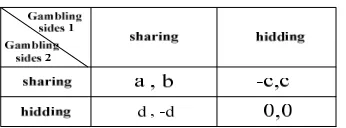
if both choose sharing strategy, then respectively obtained their knowledge value added with Vg=a and Vd=b , Vg and Vd separately show organization of high intellectual endowments and organization of low intellectual endowments obtained value-added, If both in only one party select a Shared strategy (then knowledge sharing performance for knowledge transfer), have two kinds of strategy combinations g (high, low) = (sharing, hidden), g(low, high) = (hidden, sharing), its corresponding benefit respectively V (g (high, low) = (- c, c), V (g (low, high)) = (d, - d), easily apparently know, c > d, If both choose not sharing strategy, both knowledge increment is 0. So, we have knowledge sharing game of among two kinds of group random pairing, the matrix of benefits as shown in figure 5.
Fig.5 Benefit matrix under the circumstance of asymmetric
Above in figure 5, gambling sides 1 said with high intellectual endowments organization, gambling sides 2 said with low intellectual endowments organization. We have a>d, b>d, c > d.
2)Gambling Process
The hypothesis in the population of gambling sides 1, the proportion of sharing strategy adopted for x, the ratio of adopt hidden strategy for 1 - x, meanwhile the hypothesis in gambling sides 2 groups, take sharing strategy ratio for y, take hidden strategy ratio for 1 - y.
According to the above assumptions, gambling sides 1 expected revenue of take sharing and hidden strategy
respectively for
U
11,U
12and gambling sides1,the participant’s expected revenue of mix strategy forU
1:)
(
)
1
(
11
y
a
y
c
U
=
×
+
−
×
−
(10)
U
12=
y
×
d
(11)12 11
1
x
U
(
1
x
)
U
U
=
×
+
−
×
(12)Game Party 1 replicator dynamics equation is:
] ) )[(
1 ( ) ( )
( x U11 U1 x x a c d y c dt
dx x
F = = × − = − + − −
(13)
Similarly available, the expected return of Game Party 2 take two strategies and Game party 2 take the mixed strategy is:
) ( ) 1 (
21 x b x d
U = × + − × − (14)
c
x
U
22=
×
(15)22 1
2
2
y
U
(
1
y
)
U
U
=
×
+
−
×
(16)
Game Party 2 the replicator dynamics equation is:
21 2
( ) / ( ) (1 )[( ) ]
F y =dy dt= ×y U −U =y −y b d+ −c x d− (17)
If
dx dt
/
=
0
,then x=0;y=c/(a+c-d); If dy dt/ =0,then y=0,1;x=d/(b+d-c);From the above solution can be obtained five partial equilibrium points of system in the
plane,S=(| ( , ) | 0x y ≤x y, ≤1), respectively for (0,0), (0,1), (1,0), (1,1) , ( / (d b+ −d c c), / (a+ −c d)).
[image:6.595.228.401.177.241.2]can get with the local stability method of Jacobin matrix of the system. The Jacobin matrix of game system
for:
( ) ( )
(1 2 )[( ) ] (1 )( ) ( ) ( ) (1 )( ) (1 2 )[( ) ] F x F x
x a c d y c x x a c d
x y
J
F y F y y y b d c y b d c x d
x y
∂ ∂
∂ ∂ − + − − − + −
=∂ ∂ = − + − − + − −
∂ ∂
According to the local stability analysis of differential
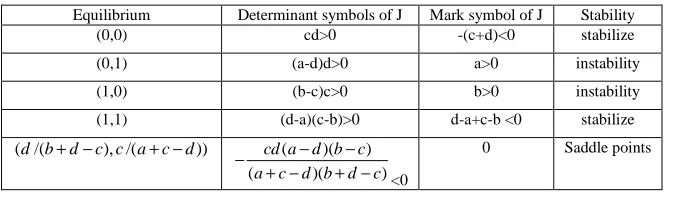
equation for five partial equilibrium stability is analyzed, and get the result in the list below table 1 shows:
There on the results of table the (0, 0) and (1, 1) is stable, is the evolutionary stable strategy of game system, while
the system have two unstable equilibrium point (0, 1), (1, 0), and a saddle point
( / (
d
b d
+ −
c c
), / (
a
+ −
c
d
))
.Small changes in the initial state of the game system will affect the final result of system evolution. The saddle point
is denoted as
x
∗,y
∗
;when x<
x
∗,y>y
∗
, the system will fully converge on the knowledge hidden strategy; when
x>
x
∗,y>y
∗
, system will be complete convergence and knowledge sharing strategy; When x<
x
∗,y>y
∗
or
x>
x
∗,y<y
∗
, the evolution of system with uncertainty, may converge to completely knowledge sharing, may also converges to completely hidden knowledge, in the evolutionary process, it may be for a long time to maintain a knowledge sharing and hidden situation.
[image:7.595.140.477.404.506.2]To sum up, in co-operative knowledge sharing of asymmetric cases ,with initial condition is different, the network has possible evolution for knowledge network, likely also cannot evolve for knowledge network, have uncertainties of evolved result. A university or enterprise of high intellectual endowments with university or enterprise of low knowledge endowment knowledge sharing, for who can from sharing obtain higher value is not too big effect on knowledge sharing behavior occurrence, this also from two aspects show the cause that in the knowledge sharing activities why existing "altruistic to righteousness" .
Table I Stability Analysis Under The Rcumstance Of Asymmetric
Equilibrium Determinant symbols of J Mark symbol of J Stability
(0,0) cd>0 -(c+d)<0 stabilize
(0,1) (a-d)d>0 a>0 instability
(1,0) (b-c)c>0 b>0 instability
(1,1) (d-a)(c-b)>0 d-a+c-b <0 stabilize
( /(d b+ −d c c a), /( + −c d)) ( )( )
( )( )
cd a d b c a c d b d c
− −
−
+ − + − <0
0 Saddle points
CONCLUSION
Generally, industry and university in the national innovation system exist complementarities of during the positioning, so their effective cooperation can give full play to their comparative advantages, greatly improve the efficiency of research and development. Moreover, in many conditions, cooperation with the universities, relative to other ways for the trading relatively low cost, especially in some key technology aspects’ learning, and cooperation with university in knowledge supply had set up barriers relatively weak.
However, due to the enterprises and universities are different in society responsibility, the knowledge structure, the purpose of technological innovation, active way there is a difference. See from the subject of co-operative knowledge sharing, including enterprise's own knowledge acquisition and innovation ability, and also including shared relationship of enterprise and the universities; view from object of cooperation technological innovation, the characteristics of knowledge similarly has certain influence on cooperative. These differences caused the complexity of industry-university knowledge sharing. Meanwhile, although network has ego evolved into knowledge network’s tendency and realizing sex, but, because the uncertainty and long-lasting and passivity of its self-forming, therefore, pay more attention to the knowledge network initiative to create analysis and the selection problem of knowledge sharing partners.
Acknowledgements
_____________________________________________________________________________
REFERENCES
[1]Liu Xiao-lan. China Sport Science and Technology. 1984, 29(13), 46-49.
[2]Luo Yang-chun. Journal of Shanghai Physical Education Institute. 1994, 23(12), 46-47. [3]Wan Hua-zhe. journal Of Nanchang Junior College. 2010, 3, 154-156.
[4]Li Ke. Journal of Shenyang Sport University. 2012, 31(2), 111-113.
[5]Zhang Shu-xue. Journal of Nanjing Institute of Physical Education. 1995, 31(2), 25-27. [6]Pan Li. Journal of nanjing institute of physical education(natural science). 2004, 19(1), 54-55. [7]Li Yu-he; Ling Wen-tao. Journal of Guangzhou Physical Education Institute. 1997, 17(3), 27-31. [8] Xu Guo-qin. Journal Of Hebei Institute Of Physical Education. 2008, 22(2), 70-72.
[9] Chen Qing-hong. China Sport Science and Technology. 1990, 21(10), 63-65
[10] Tian Jun-ning. Journal of Nanjing Institute of Physical Education. 2000, 14(4), 149-150.