Abstract— Effective Microorganism (EM) in cement based material has shown huge potential as new additive. However, the effect of EM to the internal of the microstructure of the cement matrix due to the inclusion of EM still needs to be extensively evaluated. In this present study, six (6) different dilutions percentages of EM Mixed Solution (EMMS) were added in the cement paste namely were 5%, 10%, 15%, 20%, 25% and 30% of the total mixing water including no addition of EMMS as a control specimen. The result showed that the addition of EMMS in cement paste contribute to high increment up to hundred twenty (120) percent of compressive strength respect to control at the age of 28 days. The microstructure examination had been performed using Field Emission Scanning Electron Microscopy (FESEM) equipped with Energy Dispersive X-ray (EDX) and chemical compound composition using X-Ray Diffraction (XRD) on cement paste containing 25% of EM dilution in the total mixing water. SEM micrograph examined that the microbed cement paste was less voids and denser compared to control paste without EM. While, XRD analysis showed the amount of Ca(OH)2, CaCO3 and SiO2 was
affected by the EMMS contents in microbed cement.
Keywords— Bio Booster, Effective Microorganism (EM), Energy Dispersive X-ray (EDX), Field Emission Scanning Electron Microscopy (FESEM), X-ray Diffraction (XRD).
I. INTRODUCTION
IGNIFICANT findings on using bacteria towards improving compressive strength (1-5), reducing the carbonation rate and chloride mitigation (6), water absorption and permeability (4,6,7-9) have been reported. Several types of bacteria had been introduced in cement based materials namely Bacillus species (3,5,6,10-14,16) while the other types of bacteria are Shawanella and E.Coli (2,16). These types of bacterias are known as Effective Microorganism (EM) under category EM non-product which is consists of single colony of selected bacteria. While, another type of EM is EM product which is a beneficial bacteria developed by Dr. Teruo Higa at University of Ryukus in Okinawa, Japan. This beneficial bacteria is the combination bacteria consists of Lactic Acid Bacteria, Yeast, Actinomyces
Noorli Ismail1 is with Faculty of Civil and Environmental Engineering, Universiti Tun Hussein Onn Malaysia, Johor. (corresponding author’s phone: +607-4537426); (e-mail: [email protected]).
Hamidah Mohd Saman2, is currently with Faculty of Civil Engineering,
Universiti Teknologi MARA, Shah Alam, Selangor. (e-mail:[email protected]).
and Photosynthetic Bacteria (17). EM product is in liquid form and had been proven able to improve the quality of crops (18-22) by improving the soil quality. However, the use of EM product in cement based material is still considered new area. Only a few researches (23-25) has been conducted to study the potential of EM product in enhancing the concrete properties. Previous studies have made pre-conclusion that the addition of EM product increase the strength of hardened cement paste, mortar and concrete with respect to control.
However, the effect of the EM product to the cement microstructure has not been well explained in the literature. Therefore, there is a need to examine the effect of EM to the internal microstructural of cement due to the inclusion of EM in cement by using the Field Emission Scanning Electron Microscopy (FESEM) techniques and substantiated with Electron Disperse X-Ray (EDX) and the effect of EM to the chemical compound using X-Ray Diffraction (XRD). Previous study found the inclusion of bacteria (Bacillus sphaericus) in mortar specimen indicated the presence of calcite rhombohedral crystals with the small quantities of vaterite (6). This approach can provide the understanding of the microstructure examination of microbed cement paste.
II.MATERIALSANDTESTINGS
The mixtures made of 5% EM.No-1 blended with 2% of molasses from the total mixing distilled water was prepared. This mixture was named as EM Mixed Solution (EMMS). Six (6) different percentages of EMMS was diluted to 5%, 10%, 15%, 20%, 25% and 30% from the main proportion of EMMS. It also included the control cement paste sample mixing with plain distilled water and one hundred percent (100%) of EMMS added in the cement paste. The purpose of introducing different dilutions of EMMS is to investigate the effect of the using different EMMS dilution level to the compressive strength of cement paste. Thus, the optimum concentration of EMMS can be determined. Meanwhile, the paste incorporated dilutions of 25% EMMS and control specimens were used for examining its microstructure under FESEM and compound chemical composition using XRD.
A.Materials
Effective Microorganism (EM)
Type of EM used was EM.No-1 with the brand name Bio-Booster which was obtained from Pertubuhan Peladang Johor, Malaysia. While, molasses used was from the sugar cane based product.
Microstructure Examination and Strength
Characteristics of Effective Microbed Cement
Noorli Ismail1 and Hamidah Mohd.Saman2
Preparation of Effective Microorganism Mixed Solution (EMMS)
EMMS were the mixtures of EM:No-1, molasses and distilled water. The fermentation process was carried out in sterilized plastic bottle and stored in room temperature for ten (10) days. The purpose of fermentation process is to promote the microorganism growth in EMMS. The pH of the mixtures was measured using the pH meter as shown in Table 1. The main proportion of one (1) liter volume of EMMS for fermentation was prepared and its consists of 5% EM.No-1, 2% of molasses and 93% of distilled water. For optimisation of EMMS, six (6) different designed series of EMMS content was diluted from the main proportion with the increment of 5% started from 5% to 30% in percentage of total distilled water content. The designations for the six (6) series are provided in Table 2.
TABLE 1
RESULT OF PH FOR MAIN PROPORTION OF EMMS
Day pH
1 5.21
2 5.01
3 4.85
4 4.49
5 4.07
6 3.99
7 3.95
8 3.90
9 3.82
10 3.80
TABLE 2
DILUTION CONTENTS OF EMMS
DESIGNATION
NAME EMMS (%)
DISTILLED WATER (%)
Control 0 100 D0 100 - D5 5 95 D10 10 90 D15 15 85 D20 20 80 D25 25 75 D30 30 70
Cement
Cement of Portland was used in the study. Preparation of cement paste specimens
The quantity of EMMS contents to be added in the cement paste was based on the result of consistency test. The consistency of main mix proportion was 0.3.
If the quantity of cement used was 1kg, the distilled water (DW) used in cement paste was 300ml. Table 3 shows the mix proportion used for one (1) kg cement. For the dilution of 5% EMMS, the total EMMS used was 15ml which was multiplied 5% from 300ml.
TABLE 3
MIX PROPORTION USED IN MICROBED CEMENT Designation
Name
Cement (kg)
EMMS (ml) DW (ml)
Control
1
- 300 D5 15 285 D10 30 270 D15 45 255 D20 60 240 D25 75 225 D30 90 210 D0 300 -
B.Testings
Consistency and Setting time
The test was carried out on the cement containing one hundred (100) percent of EMMS content and control paste without EMMS. The cement paste with and without EMMS were mixed in a 5-liter Hobart Mixer with two (2) velocities namely were 60 rpm (low) and 120 rpm(high). The cement of 500g was mixed with 100ml of EMMS for 1 minute at low and high speed, consecutively. The determination of consistency was measured with the penetration between plunger and base-plate (6 ± 2)mm. With paste of standard consistence mixed in, the elapsed time was measured from zero to the time at which the distance between the needle and the base-plate is (6 ± 3) mm. This initial setting time of the cement was recorded. In determining the final setting time, the elapsed time was measured from zero to that at which the needle first penetrates only 0.5 mm into the paste.
Density and Compressive Strength
This test was carried out on 96 cement paste specimens with the total of 12 specimens for each series. The different dilution of EMMS added in the cement paste with 5%, 10%, 15%, 20%, 25%, 30% and 100% of the total mixing distilled water was mixed with the cement mix. Cube specimens of size 50 mm were prepared for compressive strength test. After demoulded, the specimens were cured in room temperature till testing (26). The compressive strength test was carried out at 3,7,14 and 28 days of curing. Before the compressive strength was carried out, the weight of specimens were weighed to determine the density of specimens.
Field Emission Scanning Electron Microscopy (FESEM) with EDX
The scanning electron micrographs of freshly crushed cement specimens after 3 days and 28 days curing were taken with SUPRAIM 40VP (Oxford Instrument) equipped with an Energy Dispersive X-ray (EDX) which is located in FESEM Laboratory, Faculty of Applied Science, Universiti Teknologi MARA.
High vacuum was pumped with gun vacuum of 1.22 E-9 Mbar. The system used is Carl Zeiss SMT which is grouped in Nano Technology System Division. Two (2) magnifications of 3000x and 10,000x were selected for the imaging.
X-Ray Diffraction (XRD)
The fine powder of crushed cement specimens after 3 days and 28 days curing were taken and pressed into sample holder and tested with X’Pert PRO diffractometer. The XRD scans were recorded from 10º to 100° with the position of 2θ. The peaks of the spectrum for microbed paste specimen were marked and compared to the control paste specimen. This test had been carried out in XRD Laboratory, Faculty of Applied Science, Universiti Teknologi MARA.
III. RESULTS AND DISCUSSIONS
The compressive strength of cement paste with respect to different dilutions of EMMS incorporated with SEM micrograph and XRD results were elaborated in the following sections.
Effect of EMMS content to the consistency and setting time The standard consistency and setting time for control and microbed cement paste specimen is shown in Table 4. The setting time was prolonged due to the retardant effect of EMMS contents. The sugar contents in molasses acted as the retarder which make the hardening rate of cement paste slower than control paste (15,27).
TABLE 4
CONSISTENCY AND SETTING TIME WITH AND WITHOUT OF EMMS
Effect of various concentrations of EMMS to the density and compressive strength of cement paste
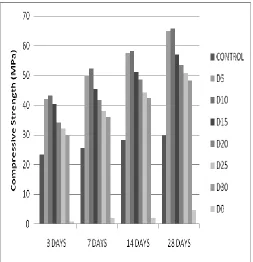
Figure 1 shows the compressive strength of all EMMS cement paste. Microbed cement paste attains higher compressive strength than specimens without microbes. In microbed cement specimen containing of 10% (D10) diluted of EMMS shows the highest increment in compressive strength (65.72MPa) with respect to compressive strength of control specimens (29.83MPa) without microbes at the age of 28 days. The increase in the compressive strength recorded about 120% or doubled corresponding to the control specimen. At 28 days, the density of control specimens is 2005.33 kg/m3 compared to the samples containing 10% diluted of EMMS with the value of 2168 kg/m3 as shown in Table 5.
The microbed cement specimen was denser compared to cement specimen without microbes. The same pattern also observes in specimen of D25 with compressive strength of 56.79 MPa for microbed cement specimens.
[image:3.612.324.577.107.369.2]The increment of 90% compressive strength was recorded corresponding to the control specimen. It is deduced that all inclusion of EMMS could enhance the compressive strength of cement paste.
Fig. 1 The compressive strength of cement specimens made of EMMS
TABLE 5
THE COMPRESSIVE STRENGTH AND DENSITY OF CEMENT SPECIMENS
Designation Name
Average Compressive Strength At 28 Days,
(MPa)
Average Density at 28 Days, (kg/m3)
Control 29.83 2005.33 D5 65.05 2184.8 D10 65.72 2168.00
D15 56.95 2112.48 D20 53.45 2118.08 D25 50.79 2050.56 D30 48.2 2114.08 D0 4.87 1603
Field Emission Scanning Electron Microscopy (FESEM) with EDX/XRD
The specimen containing dilution of 25% of EM Mixed Solution (EMMS) was analysed for the microstructure examination. When EMMS was added to the cement paste, the distribution and structure of cement containing EMMS was slightly different from that on control cement as illustrated in Figure 2 and Figure 3.
From the observation, the SEM micrograph of microbed cement paste was less voids and denser compared to control cement paste. The SEM micrograph was captured on the age of three (3) days curing with the magnification of 3000. SPECIMEN CONSISTENCY
(%)
INITIAL SETTING TIME (min)
FINAL SETTING TIME (min)
Control 28 45 145
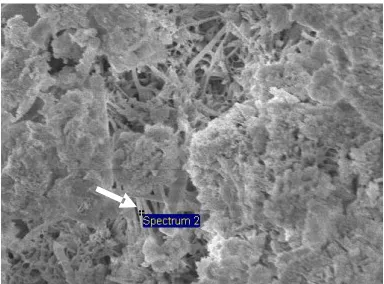
Using the same SEM equipment, the Energy Disperse X-Ray (EDX) was used to verify the chemical compositions of crystals of crushed cement paste on the point of spectrum. It can be referred in Figure 4 and Figure 5.
Fig. 2 SEM micrograph of control cement specimen
[image:4.612.85.274.99.236.2]Fig. 3 SEM micrograph of microbed cement specimen
Fig. 4 Representative EDX spectrum spotted on control cement specimen at the age of 3 days
Referred to Figure 5, the chemical composition of the microbed cement paste specimen is featuring high concentration in calcium (Ca) ions and low concentration ions in aluminium (Al), sulfur (S), magnesium (Mg) and silica (Si). Meanwhile, Ca concentration ions of the control cement paste were doubled than microbed cement paste. Generally, the amount of Ca in control cement paste was higher than microbed cement. Furthermore, the amount of silica (Si) was detected in microbed cement.
Fig. 5 Representative EDX spectrum spotted on microbed cement specimen at the age of 3 days
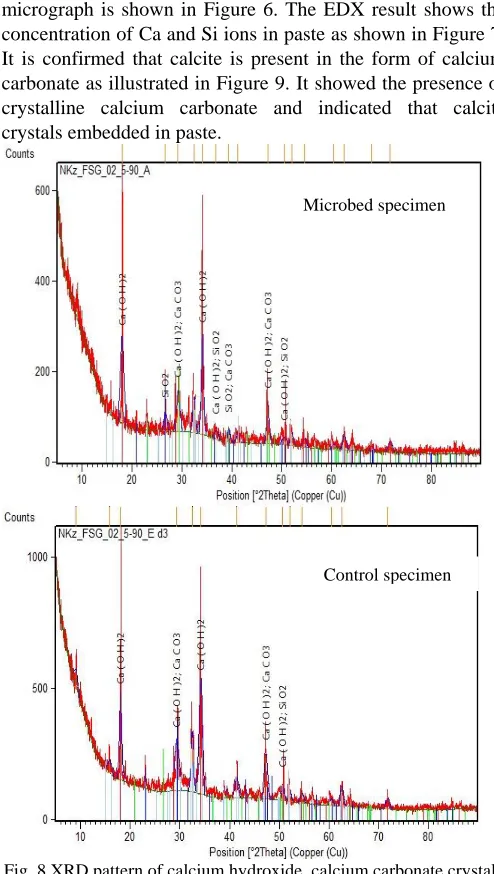
Seven (7) percent of silica content in microbed cement was slightly higher. XRD results indicated the presence of mineral formed layer on the surface of cement specimens consisting of calcite rhombohedral crystals and quartz at the age of three (3) days as shown in Figure 8. The XRD result confirmed that calcite was present in the form of calcium carbonate.The chemical formula for calcite and quartz is calcium carbonate (CaCO3) and silica oxide (SiO2), respectively. While,
chemical formula for portlandite is Ca(OH)2 which is
[image:4.612.344.536.364.506.2]important to describe the cement hydration.
[image:4.612.58.307.418.569.2]Fig. 6 SEM micrograph of microbed cement specimen at the age of 28 days
Fig. 7 Representative EDX spectrum spotted on microbed cement specimen at the age of 28 days
The microbed cement paste was also examined under Ca 42.73
O 57.27
C 4.45 O 58.32 Mg 2.14
Al 3.68 Si 7.2
S 4.06 Ca 20.16
[image:4.612.314.577.543.685.2]micrograph is shown in Figure 6. The EDX result shows the concentration of Ca and Si ions in paste as shown in Figure 7. It is confirmed that calcite is present in the form of calcium carbonate as illustrated in Figure 9. It showed the presence of crystalline calcium carbonate and indicated that calcite crystals embedded in paste.
Fig. 8 XRD pattern of calcium hydroxide, calcium carbonate crystals and quartz formed in control and microbed cement specimen at the
[image:5.612.45.292.465.690.2]age of 3 days
Fig. 9 XRD pattern of calcium hydroxide, calcium carbonate crystals and quartz formed in microbed cement specimen at the age of 28
days
IV. CONCLUSIONS
The following conclusions can be drawn in this present study;
The increasing in setting time with respect to control cement confirmed the low rate of hardening and hydration of microbed cement paste.
The incorporation of EMMS into cement paste produced higher compressive strength. The maximum increase in compressive strength occurred at dilution of 10% with the increment of 120% respect to the control specimens. The increase in compressive strength was associated with the increment of density in cement paste and denser pore structure. However, the addition of 100 % EMMS is not suggested in cement paste due to the adverse contribution of the former.
The capability of FESEM substantiated with EDX system was proven to describe the SEM micrograph with the chemical composition on the point interest. However, it is still need to support the result by providing the XRD test. SEM micrograph showed that the microstructure of microbed cement paste was less voids and denser at the early strength. While, the formation of Ca(OH)2, CaCO3
and SiO2 was affected by the EMMS contents causing lower
amount of Ca(OH)2 and CaCO3 and high amount of SiO2
with respect to control specimen. It was detected by using XRD analysis.
V.ACKNOWLEDGMENT
Financial support from Fundamental Research Grant Scheme (FRGS) under the project of Microbe-Silica Interaction Derivative Biomineralisation Model and file No: 600-RMI/ST/FRGS 5/3/Fst (28/2011) for this work is gratefully acknowledged.
REFERENCES
[1] Whiffin VS, Microbial CaCO3 precipitation for the production of
biocement. PhD Thesis. Western Australia: Murdoch University; 2004. [2] Ghosh P, Mandal S, Mandal BD, Chattopadhyay SP. Use of
microorganism to improve the strength of cement mortar. Journal of Cement Concrete Research, Volume 35, Pages 1980-1983, 2005. [3] Afifudin H., Hamidah M.S., Noor Hana H., Kartini K., Microbial
Participation in the Formation of Calcium Silicate Hydrated (CSH) from Bacillus subtilis, Procedia Engineering, Volume 20, Pages 159-165, 2011.
[4] Abo-El-Enein S.A, Application of microbial biocementation to improve the physico-mechanical properties of cement mortar, Housing and Building National Research Center (2013), http://dx.doi.org/10.1016/j.hbrcj.2012.10.004
[5] Jonkers, HM & Schlangen, E., Bacteria-based self-healing concrete,
International Journal of Restoration of Buildings and Monuments, Volume 15, Issue 4, Pages 255-265, 2009.
[6] De Muynck,W., Cox, K., De Belie, N., Verstraete,W., 2008b. Bacterial carbonate precipitation as an alternative surface treatment for concrete, Journal Construction and Building Materials, Volume 22, Issue 5, Pages 875-885, 2008b.
[7] De Muynck, W., Debrouwer, D., De Belie, N., Verstraete, W., Bacterial carbonate precipitation improves the durability of cementitious materials. Journal of Cement Concrete Research, Volume 38, Pages 1005–1014, 2008a.
[8] Navneet C.,Rafat S.,Anita R., Influence of bacteria on the compressive strength, water absorption and rapid chloride permeability of fly ash concrete, Journal Construction and Building Materials, Volume 28, Issue 1, Pages 351–356, 2012a.
[9] Navneet C.,Rafat S.,Anita R., Influence of bacteria on the compressive strength, water absorption and rapid chloride permeability incorporating silica fume, Journal Construction and Building Materials, Volume 37, Issue 1, Pages 645-651, 2012b.
[10] Ramachandran SK, Ramakrishnan V, Bang SS., Remediation of Concrete Using Micro-organisms, ACI Materials, Volume 98, Pages 3-9, 2001.
[11] Dick, J., De Windt, W., De Graef, B., Saveyn, H., Van der Meeren, P., De Belie, N., Verstraete, W., Bio-deposition of a calcium carbonate layer on degraded limestone by Bacillus species, Journal of Biodegradation, Volume 17, Pages 357–367, 2006.
[12] Van Tittelboom, K., De Belie, N., De Muynck, W., & Verstraete, W., Use of bacteria to repair cracks in concrete. Journal of Cement and Concrete Research, Volume 40, Issue 1, Pages 157-166, 2010.
[13] Arunachalam K.D., Sathyanarayanan K.S., Darshan B.S., Balaji R., Studies on the characterisation of Biosealant properties of Bacillus
sphaericus, International Journal of Engineering Science and
Technology, Volume 2, Issue 3, Pages 270-277, 2010.
[14] Rafat Siddique, Navneet Kaur Chahal, Review:Effect of ureolytic bacteria on concrete properties, Journal Construction and Building Materials, Volume 25, Pages 3791–3801, 2011.
[15] Hasan Yildirim and Baris Altun, Usage of molasses in concrete as water reducing and retarding admixtures, Indian Journal of Engineering and Materials Science, Volume 19, Pages 421-426, December 2012. [16] Ghosh S., Biswas M., Chattopadhyay B.D., Mandal S., Microbial
activity on the microstructure of bacteria modified mortar, Journal Cement & Concrete Composites, Volume 31, Issue 2, Pages 93–98, 2009.
[17] Higa T., Effective microorganisms: A biotechnology for mankind, In: J.F. Parr, S.B. Hornick, and C.E. Whitman (ed.) Proceedings of the First International Conference on Kyusei Nature Farming. U.S. Department of Agriculture, Washington, D.C., USA, Pages 8-14, 1991.
[18] Priyadi, K., H. Abdul, T.H. Siagian, C. Nisa, A. Azizah, N. Raihani, and K. Inubushi, Effect of soil type, applications of chicken manure and effective microorganisms on corn yield and microbial properties of acidic wetland soils in Indonesia. Soil Science and Plant Nutrition, Volume 51, Pages 689-691, 2005.
[19] Khaliq A., Kaleem Abbasi M.,Tahir H., Effects of integrated use of organic and inorganic nutrient sources with effective microorganisms (EM) on seed cotton yield in Pakistan, Bioresource Technology, Volume 97, Issue 8, Pages 967–972, 2006.
[20] Jochen Mayer, Susanne Scheid and Hans-Rudolf Oberholzer, How effective are ‘Effective Microorganisms’? Results from an organic farming field experiment, 16th IFOAM Organic World
Congress,Modena,Italy,June16-20,2008.
[21] Lee C.T., Ismail M.N, Razali F., Muhamad I.I., Sarmidi M.R., Khamis A.K., Application of effective microorganisms on soil and maze, Journal of Chemical and Natural Resources Engineering, Special Edition: 1-13, Universiti Teknologi Malaysia,2008.
[22] Muthaura C., David M.M., Joseph A.O and Samuel V.O., Effective microorganisms and their influence on growth and yield of pigweed (Amaranthus dubians), ARPN Journal of Agricultural and Biological Science, Volume 5, No. 1, 2010.
[23] Nobuyuki S., Masami S., Syuichi S., Investigation on Concrete Rust Preventive Agents Using Microorganisms (Mechanisms), 29th Conference on Our World in Concrete & Structures, Singapore, 25 - 26 August 2004.
[24] Jamaludin M. Yatim, Mohamad Ismail, Wan A. W. A. Rahman & Chiew V. Yaw, Performance of concrete containing effective microorganisms (EM) under various environments, In: Joint Conference of 7th Asia Pacific Structural Engineering and Construction Conference 2009 (APSEC2009) and 2nd European Asian Civil Engineering Forum (EACEF 2009), Awana Porto Malai, Langkawi, Malaysia, 2009. [25] Tan Cheng Siong Andrew, Ibrahim Izni Syahrizal, Mohd. Yatim
Jamaluddin, Effective Microorganisms for Concrete (EMC) Admixture – Its Effects to the Mechanical Properties of Concrete, Awam International Conference on Civil Engineering (AICCE’12) Geohazard Information Zonation (GIZ’12) Park Royal Penang Resort, Malaysia, 28th – 30th August 2012.
[26] Noorli, I , Hamidah, M.S and Kartini, K, Compressive strength of effective microbed concrete, Malaysian Science and Technology Congress, Sime Darby Convention Centre (MSTC 2012), 19 – 21 Nov
[27] Maria C. Garci Juenger, Hamlin M. Jennings, New insights into the effects of sugar on the hydration and microstructure of cement pastes,Cement and Concrete Research, Volume 32, Issue 3, Pages 393– 399, March 2002.
Noorli Ismail is a PhD student at Universiti Teknologi MARA, Malaysia. She has been active in doing the study related to the application of Effective Microorganism (EM) in enhancing the concrete properties. She obtained the postgraduate study from Universiti Malaya, Kuala Lumpur, Malaysia in Master of Engineering Science.