The Effects of Quick Strength Training on Agility
Performance in Soccer
Mahmut Alp1,*, Barış Baydemir2
1Faculty of Sport Sciences, Süleyman Demirel University, Turkey 2School of Physical Education and Sports, Çanakkale 18 Mart University, Turkey
Copyright©2019 by authors, all rights reserved. Authors agree that this article remains permanently open access under the terms of the Creative Commons Attribution License 4.0 International License
Abstract
The aim of this study is to investigate the effects of quick strength training on agility performance in soccer players. A total of 36 male soccer players from the U19 and U17 teams, which is the infrastructure of the Çanakkale Sports Team, participated in the study. The players were randomly divided into two groups: Control (CG) and Research Group (RG). The mean age was in CG 17.88±1.02, RG 18 ± 1.02 years; mean height in CG 175,94±5,88, RG 175,61±4,53 cm; body weight CG 67,72±6,52, RG 67,55±4,97 kg; BMI in CG 21,81±1,04, RG 21,87±, 89 kg / m2. During the 8 weeks, as the CG was given routine strength training with soccer training; additionally, the RG had quick strength training 3 days a week. “Illinois Test” was used to determine the agility performance. In the statistical analysis of data, Paired t Test was used for the pre- and post-test of the CG and RG, and Independent t Test was used for the comparison between the groups. The results were evaluated according to “p<0.05” significance level. At the result of the research, it was observed that the quick strength training of 8 weeks was more effective in RG than CG.Keyw
ords
Soccer, Quick Strength, Agility1. Introduction
Soccer is a challenging game that requires power, speed, agility, balance, stability, flexibility and sufficient endurance of players today [1-4. In the soccer game, some features based on motoric characteristics are the subject of curiosity by the researchers, while the performances of the players are analyzed in laboratory or field environments together with the developing technology. This reduces the unknown variables to the smallest possible number. Recently, acceleration, speed and agility have been found to be independent, unrelated qualities that create a limited transfer between each other [5].
During a soccer match, players run total of about 10 km
in which every 10 seconds (11% of the average activity), a sprint that lasts 2 to 4 seconds and covers a distance of 15 meters [6].
Although quickness represents a very important component for a soccer player, speediness (speed of acceleration in the first steps) is probably more important. This is because, although the longest distances of sprints tend to be approximately 40 m, they are usually performed at short distances at maximum intensity and often require several changes in directions [7,8]. The quickness can be expressed as the direction or speed changes that the whole body makes very quickly in reacting to a stimulus. Findings suggesting that the peak of muscle strength is a significant need in soccer, especially the lower extremity (leg muscles) shows that muscle strength is an important fitness component for a successful game in soccer [9-11].
Soccer is divided into categories such as high-speed movements, acceleration, maximum speed or agility skills. The velocity in soccer is defined as the velocity, the rate of reaction and the rate of acceleration in the first stage [12]. Both of these categories (speed, agility and quickness) imply that the method of education should be a useful component of training in soccer [13].
One of the most popular training methods in soccer is the study of the relationship between speed, agility and quickness. These concepts are well known and there are problems related to the planning of training methods. The primary problem is to decide what kind of conditioning will be applied to improve the performance of the players due to their motoric characteristics [7].
In the light of these information, the aim of the study is to investigate the effect of quick strength training on agility performance.
2. Methods
2.1. Participants
teams, which is the infrastructure of the Çanakkale Sports Team, participated in the study. The players were randomly divided into two groups: Control (CG) and Research Group (RG). The mean age was in CG 17.88±1.02, RG 18±1.02 years; mean height in CG 175,94±5,88, RG 175,61±4,53 cm; body weight CG 67,72±6,52, RG 67,55±4,97 kg; BMI in CG 21,81±1,04, RG 21,87±, 89 kg/m2. They joined to the study by having their parents confirm the “Informed Consent Form”. We followed the principles outlined in the Declaration of Helsinki.
2.2. Measures
2.2.1. Measurement of Height
The heights of the soccerers were measured by using a measuring tape on bare feet standing flat on the ground, heels joint, knees tense, and body straight position with 1 mm sensitivity. The values were recorded as centimeter (cm).
2.2.2. Measurement of Weight
The body weights of the soccerers were measured by using a digital scale with as thin clothing as possible, and by using a digital scale with a sensitivity of 0,001 kg. The
values were recorded as kilogram (kg). 2.2.3. Measurement of BMI
The BMI values of all players were obtained by dividing the weight in kilograms by the height in meters squared.
BMI (kg/m2): Weight (kg)/ (Height)2 (m2) 2.2.4. Illinois Agility Test
2.3. Procedures
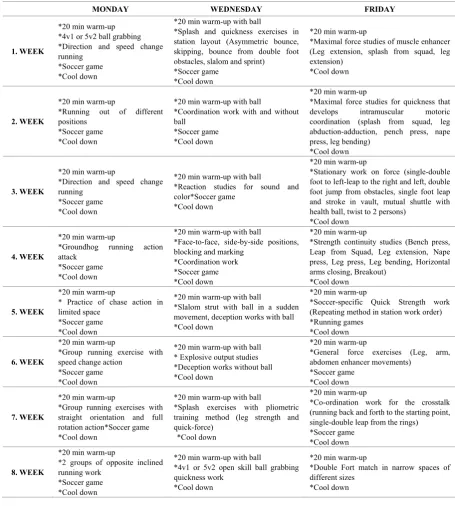
Table 1. Content of Football and Quick Strength Trainings
MONDAY WEDNESDAY FRIDAY
1. WEEK
*20 min warm-up *4v1 or 5v2 ball grabbing *Direction and speed change running
*Soccer game *Cool down
*20 min warm-up with ball
*Splash and quickness exercises in station layout (Asymmetric bounce, skipping, bounce from double foot obstacles, slalom and sprint)
*Soccer game *Cool down
*20 min warm-up
*Maximal force studies of muscle enhancer (Leg extension, splash from squad, leg extension)
*Cool down
2. WEEK
*20 min warm-up
*Running out of different positions
*Soccer game *Cool down
*20 min warm-up with ball
*Coordination work with and without ball
*Soccer game *Cool down
*20 min warm-up
*Maximal force studies for quickness that develops intramuscular motoric coordination (splash from squad, leg abduction-adduction, pench press, nape press, leg bending)
*Cool down
3. WEEK
*20 min warm-up
*Direction and speed change running
*Soccer game *Cool down
*20 min warm-up with ball
*Reaction studies for sound and color*Soccer game
*Cool down
*20 min warm-up
*Stationary work on force (single-double foot to left-leap to the right and left, double foot jump from obstacles, single foot leap and stroke in vault, mutual shuttle with health ball, twist to 2 persons)
*Cool down
4. WEEK
*20 min warm-up
*Groundhog running action attack
*Soccer game *Cool down
*20 min warm-up with ball
*Face-to-face, side-by-side positions, blocking and marking
*Coordination work *Soccer game *Cool down
*20 min warm-up
*Strength continuity studies (Bench press, Leap from Squad, Leg extension, Nape press, Leg press, Leg bending, Horizontal arms closing, Breakout)
*Cool down
5. WEEK
*20 min warm-up
* Practice of chase action in limited space
*Soccer game *Cool down
*20 min warm-up with ball
*Slalom strut with ball in a sudden movement, deception works with ball *Cool down
*20 min warm-up
*Soccer-specific Quick Strength work (Repeating method in station work order) *Running games
*Cool down
6. WEEK
*20 min warm-up
*Group running exercise with speed change action
*Soccer game *Cool down
*20 min warm-up with ball * Explosive output studies *Deception works without ball *Cool down
*20 min warm-up
*General force exercises (Leg, arm, abdomen enhancer movements)
*Soccer game *Cool down
7. WEEK
*20 min warm-up
*Group running exercises with straight orientation and full rotation action*Soccer game *Cool down
*20 min warm-up with ball
*Splash exercises with pliometric training method (leg strength and quick-force)
*Cool down
*20 min warm-up
*Co-ordination work for the crosstalk (running back and forth to the starting point, single-double leap from the rings) *Soccer game
*Cool down
8. WEEK
*20 min warm-up
*2 groups of opposite inclined running work
*Soccer game *Cool down
*20 min warm-up with ball
*4v1 or 5v2 open skill ball grabbing quickness work
*Cool down
*20 min warm-up
*Double Fort match in narrow spaces of different sizes
*Cool down
Table 2. Loading Parameters of Quick Strength Training
LOADING METHOD REPETITIONS
Loading intensity and time 100% / 20-30 sec
Relaxing time Full
[image:3.595.68.524.113.620.2]2.4. Statistical Analysis
The analysis of the data was done in the Statistical Package Program by using the “Paired t Test” for the pre- and post-test of the CG and RG, and “Independent t Test” was used for the comparison between the groups. The results were evaluated according to “p<0.05” significance level.
3. Results
[image:4.595.60.288.313.391.2]Table 3 shows that the differences in comparison of Illinois test avearges of CG (13.14±.88 sec) and RG (13.21±.75 sec). The differences were found to be statistically significant (p<0.05). When we pay attention to the post-tests of each group, RG showed more positive effect of quick strength training than CG.
Table 3. Comparison of Illinois Pre and Post-Test Averages
Groups Illinois Test Sequence Mean±SD t p
CG (sec) Pre-Test 13.14±.88 6.5 .000
Post-Test 12.13±.90
RG (sec) Pre-Test 13.21±.75 17.2 .000
Post-Test 11.32±.76
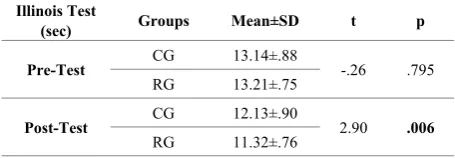
[image:4.595.60.288.480.559.2]As shown in Table 4, there was no difference in pre-test averages between CG (13.14±.88 sec) and RG (13.21±.75 sec) (p>0.05); however the difference in post-test averages of CG (12.13±.90 sec) and RG (11.32±.76 sec) were found to be statistically significant (p<0.05).
Table 4. Comparison of Illinois Test Averages between Groups
Illinois Test
(sec) Groups Mean±SD t p
Pre-Test CG 13.14±.88 -.26 .795 RG 13.21±.75
Post-Test CG 12.13±.90 2.90 .006
RG 11.32±.76
4. Discussion
As a result of the study, it was observed that the development of RG players were more effective than those of the CG. As a result of the comparison of soccer performances between groups, significant difference was found in the post-test values of Illinois.
Besler [15] compared the agility performances of the two soccer teams in his study. At the end of the study in which the average of the speed of the soccer players of
Tavşanlı Linyit Sports was 14.63±0.22 sec and the mean of the athletes of Dumlupınar University was 14.93±0.45 sec and the difference was observed to be statistically significant.
In the literature, it is reported that resistance training
improves speed, quickness and agility. The most studied ones of these are the effect of resistant sled training on sprint [16-20]. Carlos-Vivas et al. [16] emphasized in his study that 25 semi-professional soccer players, strength and resistance exercises with weight vests, and the vertical and vertical jump effects of the exercise as a result of the weight and the weight of the vestments will be a new tool to improve the strength and speed of exercises.
In a study, 33 male soccer players’ agility values according to their positions were found to be different [21]. Suna et al. [22] stated in their study that coordination trainings affect balance, velocity and agility performances positively.
Kevin et al. [23] reported in their study that quick strength trainings affect vertical jump and agility performance of soccer players positively. Miller et al. [24] stated that 6-week strength training was effective in increasing the agility of players, and a positive relationship between Illinois agility test and pliometric training. Sporis et al. [25] emphasized that in their study that after 12 weeks of strength training, women soccer players increased aerobic power by 4,3% and anaerobic power by 2,8%. Falk et al. [26] emphasized that 12-week strength training affects the agility performance of adolescent boys.
Christou et al. [27] found that resistance training increased agility in soccer players. They emphasized that soccer and resistance training combination could be used for the general development of physical capacity of young men.
Jullien et al. [28] examined the effect of certain leg strength training (as part of a larger exercise program) on running speed and agility in young professional soccer players. As a result of their study short sprint, direction changes, strengthening of the lower limbs did not improve performance. Kotzamanidis et al. [29] stated that strength training revealed that a significant improvement in sprint performance of soccer players.
Shalfawi et al. [30] investigate the effect of combined resisted agility and repeated sprint training vs. strength training on female elite soccer players. The main findings in their study were that resisted agility in combination with repeated sprint training had a tendency to improve agility performance.
To summarize the studies on the force aspect of soccer in the literature; Soccer is a sport that includes repetitive strong moves such as kicking, sprinting, fighting and jumping. Abilities of the players were to sprint [28-32], the height and distance of the jump [33], such as the force of performance, etc. It has been shown that there is a positive correlation with the development of performances.
5. Conclusions
than in CG. The results from our study demonstrate the benefits quickness training can have on agility. Not only can players use the monotony of training, but they can also improve their strength, explosiveness while working to become more agile. The results can also be considered important in terms of agility in competitive soccer performance. Soccer coaches could apply these terms in the process of planning the in-season training.
REFERENCES
[1] J Helgerud, L. C. Engen, U. Wisloff, J. Hoff. Aerobic endurance training improves soccer performance. Medicine and Science in Sports and Exercise, 33, 1925-1931, 2001. [2] E. M. Gorostiaga, M. Izquierdo, M. Ruesta, J. Iribarren, J. J.
González-Badillo, J. Ibáñez. Strength training effects on physical performance and serum hormones in young soccer players. European Journal of Applied Physiology 91, 698-707, 2004.
[3] P. Krustrup, M. Mohr, H. Ellingsgaard, J. Bangsbo. Physical demands during an elite female soccer game: Importance of training status. Med Sci Sports Exerc 37, 1242–1248, 2005. [4] J. Bloomfield, R. Polman, P. O’Donoghue, L. McNaughton. Effective speed and agility conditioning methodology for random intermittent dynamic type sports. The Journal of Strength and Conditioning Research, 21(4), 1093-1100, 2007.
[5] T. Little, A. G. Williams. Specificity of acceleration, maximum speed, and agility in professional soccer players. The Journal of Strength and Conditioning Research, 19, 76– 78, 2005.
[6] T. Stolen, K. Chamari, C. Castagna, U. Wisløff. Physiology of soccer: an update. Sports Medicine 35(6), 501-36, 2005. [7] M. Jovanovic, G. Sporis, D. Omrcen, F. Effects of speed,
agility, quickness training method on power performance in elite soccer players. The Journal of Strength and Conditioning Research, 25(5), 1285-1292, 2011.
[8] E. Rienzi, B. Drust, T. Reilly, J. E. Carter, A. Martin. Investigation of anthropometric and work-rate profiles of elite South American international soccer players. Journal of Sports Medicine and Physical Fitness, 40(2), 162-169, 2000. [9] G. Cometti, Maffiuletti, N. A., Pousson, M., Chatard, J. C., Maffulli, N. (2001). Isokinetic strength and anaerobic power of elite, subelite and amateur French soccer players. International journal of sports medicine, 22(01), 45-51. [10]J. L. Croisier, B. Forthomme, M. H. Namurois, M.
Vanderthommen, J. M. Crielaard. Hamstring muscle strain recurrence and strength performance disorders. The American journal of sports medicine, 30(2), 199-203, 2002. [11]R. Mjolsnes, A. Arnason, T. Raastad, R. Bahr. A 10‐week
randomized trial comparing eccentric vs. concentric hamstring strength training in well‐trained soccer players. Scandinavian journal of medicine & science in sports, 14(5), 311-317, 2004.
[12]V. Gambetta. In a blur: How to develop sport-specific speed. Sports Coach 19(3), 22-24, 1996.
[13]A. Pearson. Speed, Agility and Quickness for Soccer. London: A & C Black Press, 2001.
[14]T. Hazır, Ö. F. Mahir, C. Açıkada. Relationship between agility and body composition, anaerobic power in young soccer players. Hacettepe Journal of Sport Sciences, 21(4), 146-153, 2010.
[15]M. Besler, M. Acet, H. Koç, Y. Profesyonel ve Amatör Liglerde Dereceye Giren Takımlardaki Futbolcuların Bazı Fiziksel ve Motorik Özelliklerinin Karşılaştırılması, Selçuk Üniversitesi Beden Eğitimi ve Spor Bilim Dergisi, 12(2):
150–156, 2010.
[16]J. Carlos-Vivas, T. T. Freitas, M. Cuesta, J. Perez-Gomez, M. De Hoyo, P. E. Alcaraz. New Tool to Control and Monitor Weighted Vest Training Load for Sprinting and Jumping in Soccer. The Journal of Strength and Conditioning Research, 2018.
[17]A. Monte, F. Nardello, P. Zamparo. Sled towing: The optimal overload for peak power production. Int J Sports Physiol Perform 12: 1052–1058, 2017.
[18]M. R. Cross, M. Brughelli, P. Samozino, S. R. Brown, J. B. Morin. Optimal loading for maximising power during sled-resisted sprinting. Int J Sports Physiol Perform 12: 1069–1077, 2017.
[19]M. Hoyo, O. Gonzalo-Skok, B. San˜udo, C. Carrascal, J. R. Plaza-Armas, F. Camacho-Candil, C. Otero-Esquina. Comparative effects of in-season full-back squat, resisted sprint training, and plyometric training on explosive performance in U-19 elite soccer players. The Journal of Strength and Conditioning Research, 30: 368–377, 2016. [20]K. P. Clark, D. J. Stearne, C. T. Walts, A. D. Miller. The
longitudinal effects of resisted sprint training using weighted sleds vs. weighted vests. The Journal of Strength and Conditioning Research, 24: 3287–3295, 2010.
[21]E. Çetinkaya, H. Tanır, B. Çelebi. Comparison of Agility,
Sprint, Anaerobic Power and Aerobic Capacities of Soccer Players by Playing Positions. Journal of Education and Training Studies, 6(9), 184-190, 2018.
[22]G. Suna, M. Beyleroğlu, M. Alp, S. Yalçın. Investigating the
effects of coordination trainings on velocity, balance and
agility features of tennis kıds. SSTB International Refereed
Academic Journal of Sports, Health & Medical Sciences, (20), 2016.
[23]T. Kevin, F. Duncan, R. H. Philip. The effect of two plyometric training techniques on muscular power and agility in youth soccer players, The Journal of Strength and Conditioning Research, 23 (1), 332, 2009.
[24]M. G. Miller, J. J. Herniman, M. D. Ricard, C. C. Cheatham, T. J. Michael. The effects of a 6-week plyometric training program on agility, JSSM, 459-460, 2006.
[25]G. Sporis, M. Jovanovic, I. Krakan, F. Fiorentini. Effects of strength training on aerobic and anaerobic power in female soccer players. Journal of Sport science, 4(2), 32, 2011. [26]B. Falk, G. Mor. The effects of resistance and martial arts
[27]M. Christou, I. Smilios, K. Sotiropoulos, K. Volaklis, T. Pilianidis, S. P. Tokmakidis. Effects of resistance training on the physical capacities of adolescent soccer players. The Journal of Strength and Conditioning Research, 20(4), 783-791, 2006.
[28]H. Jullien, C. Bisch, N. Largouët, C. Manouvrier, C. J. Carling, V. Amiard. Does a short period of lower limb strength training improve performance in field-based tests of running and agility in young professional soccer players?. The Journal of Strength and Conditioning Research, 22(2), 404-411, 2008.
[29]C. Kotzamanidis, D. Chatzopoulos, C. Michailidis, G. Papaiakovou, D. Patikas. The effect of a combined high-intensity strength and speed training program on the running and jumping ability of soccer players. The Journal of Strength and Conditioning Research, 19(2), 369-375, 2005.
[30]S. A. Shalfawi, T. Haugen, T. A. Jakobsen, E. Enoksen, E. Tønnessen. The effect of combined resisted agility and repeated sprint training vs. strength training on female elite soccer players. The Journal of Strength & Conditioning Research, 27(11), 2966-2972, 2013.
[31]B. R. Ronnestad, N. H. Kvamme, A. Sunde, T. Raastad. Short-term effects of strength and plyometric training on sprint and jump performance in professional soccer players. The Journal of Strength and Conditioning Research, 22(3), 773-780, 2008.
[32]J. Siegler, S. Gaskill, B. Ruby. Changes evaluated in soccer-specific power endurance either with or without a 10-week, in-season, intermittent, high-intensity training protocol. The Journal of Strength and Conditioning Research, 17(2), 379-387, 2003.