Using plenary focus groups in information
systems research: More than a collection
of interviews
Sobreperez, P
Title
Using plenary focus groups in information systems research: More than a
collection of interviews
Authors
Sobreperez, P
Type
Article
URL
This version is available at: http://usir.salford.ac.uk/2268/
Published Date
2008
USIR is a digital collection of the research output of the University of Salford. Where copyright
permits, full text material held in the repository is made freely available online and can be read,
downloaded and copied for noncommercial private study or research purposes. Please check the
manuscript for any further copyright restrictions.
USING PLENARY FOCUS GROUPS IN INFORMATION SYSTEMS
RESEARCH: MORE THAN A COLLECTION OF INTERVIEWS
Polly Sobreperez
University of Salford UK
Abstract: Qualitative techniques for the collection of empirical materials are classically identified as including interviews and observations. However a further technique has more recently emerged known as the group interview or focus group, which may be applicable only to certain types of research situation but is widely overlooked and can add a level of knowledge and richness not available through other techniques. This paper follows the growth of focus group research, looks for situations in Information Systems research where this technique gives unique insights, and describes the conduct and application of the technique in a case study setting. An example of a useful structuring technique is described and conclusions are drawn concerning a particular type of focus group in information systems qualitative research which may well be useful in other research scenarios.
Keywords: Research instrument, focus groups, data collection, empirical technique
1. Introduction
Standard data collection techniques in qualitative research have included surveys, interviews and observations. More recently, focus group research has been used in several areas, particularly marketing (Leonhard, 1967/ Smith G H 1954 in Stewart & Shemdasani 1990) health care (Kidd and Parshall 2000) media (Lunt and Livingstone 1996) and politics (Delli Carpini and Williams 1994), but have been limited in the area of Information Systems. This paper introduces a focus group
approach to the study of information systems using a case study scenario and employing a structuring technique borrowed from Soft Systems Methodology designed to shape the discussion and organize group attention towards specific aspects of the descriptive process. The paper situates the case study and describes the conduct of a particular focus group with respect to
individual incidents. Therefore attention is drawn to a particular type of Focus Group and the unique properties and advantages of these focus group in respect to IS research and this underpins the usefulness of the technique in given situations. As the technique has broader use across research disciplines, an attempt is made to identify the attributes and properties of these ‘Plenary Focus Groups’ in information systems research scenario that might lend themselves to focus group research as a useful and successful technique.
2. Background
Standard data collection techniques of interviews, non participant and ethnographically embedded observation, (Denzin and Lincoln 1994; Miles and Huberman 1994; Silverman 1999) have often omitted the useful focus group technique. From a background in Market Research, the focus group approach originated by Merton (1947), was often referred to as group depth interviewing (Goldman and Schwartz McDonald 1987) with the emphasis on depth as referring to the emergence of psychoanalytical theory in the further understanding of the dynamics of group activity, and in particular the hidden and unconscious motives behind group interactions. From the 1980’s onwards, focus groups were used to explore knowledge, attitudes and practice in health related areas, by communications researchers, political parties, and social scientists (Folch-Lyon, Macorra et al. 1981; Joseph, Emmons et al. 1984; Basch 1987; Stewart and Shemdasani 1990; Knodel 1995; Johnson 1996; Lunt and Livingstone 1996; Wilkinson 1998; Bloor, Frankland et al. 2001).
3. Definition
A definition of focus groups has gradually emerged as having the following attributes (Vaughan, Schumm et al. 1996). Firstly, there will be a leader or moderator who plans and guides the session, secondly there will be a goal of eliciting feelings, attitudes and perceptions about a particular
4 The legacy of social psychological focus group activity
The background of focus group work in the work of social scientists such as Stewart and Shemdasani (1990) has brought with it a legacy of features which are now being discredited. Traditional social psychology assumes that the nature of ‘self’ and characteristics such as ‘attitude’ are fixed and stable properties of individuals. More recent work in discursive psychology (Billig 1996) suggests that this view is limited and that in many situations, people adapt and alter their attitudes. Individuals evaluate attitudes in the light of new information and interaction with other opinions. In addition, they have been recorded as altering and re-stating opinions after re-evaluation and also in accordance with the situation in which they find themselves (Potter 1998). In this way then the focus group itself may be the forum for interaction which synthesizes and consolidates differing accounts and underpins group consensus.
5 Methodological issues
Edward Fern (2001) has found it non-productive to offer methodological prescriptions for different types of focus groups, rather he suggests that the research task and associated objectives should provide scope and definition for the focus group activity. Although this viewpoint highlights the uniqueness of each focus group and stresses the importance of allowing theory to emerge rather than imposing a possibly constricting framework; it is countered by the definition of three different types of research tasks which for which focus groups can be adapted. These are exploratory, experiential and clinical: exploratory focus groups are used to uncover the attitudes opinions and beliefs participants have in common in different circumstances. Calder (1977) suggests this
knowledge does not have scientific status until it is subjected to the abstraction of scientific concepts or used to generate theory through an inductive process. Fern agrees that focus groups projects are indeed subject to problems in these areas, but points out that this also applies to survey and experimental research. Fern argues that through cross-validation or triangulation, and in some instances repeated confirmation or disconfirmation from a series of focus groups, they can be used to determine the consistency between scientific explanations and anecdotal or tacit knowledge. Experiential Focus Group Tasks allow the observation of ‘natural attitudes’ (Goldman and McDonald 1987) These attitudes arise from shared life experiences, preferences, intentions and behaviours. These behaviours become more common in groups of people who are socially close – family groups will have more in common than work colleagues. Thus the experiential focus group draws out shared experiences rather than those which are unique or individual. The researcher is commonly uninterested in generalizability and the focus of enquiry is the attitudes, beliefs and opinions, not necessarily their underlying dimensions. Knowledge will not be aggregated into higher-order theoretical constructs but is generated for its own value.
Clinical Focus Groups, also known as group depth interview (Wells 1979) is based on two factors. (1) The reasons for much behaviour is unknown to its perpetrator, although they may be clear to others. (2) These unknown reasons can only be understood only through clinical judgement. Clinical groups are used to uncover motives, predispositions, bias and prejudices.
In both exploratory and clinical purposes, interest is in differences between individual viewpoints, or intra-subjectivity, whereas experiential purposes are interested in inter-subjectivity – the sameness of individual’s viewpoints.
representativeness does not arise; the people attending the focus group were largely those attending the incident. In most cases, the entire group, or ‘watch’, attended both the individual incident, and the focus group discussion, absence being due to sickness, other duties, or change of shift patterns since the incident. This means there is no other information available, other than the official record of the event, which was produced by those same firefighters.
5 Conduct of Focus Groups
Guidelines on the conduct of focus groups (Heritage 1984; Antaki 2000; Puchta and Potter 2004) contend that there should be a moderator who has several major functions. Firstly, they must create informality, in order to loosen the situation and make contributions more open, spontaneous and revealing. Secondly they must manage the interaction ensuring that all participants can effectively contribute and thirdly as a result of the first two functions, they must elicit useful and varied opinions. The idea of attitude in particular, as mentioned previously, is changing in the light of current
research and has recently been defined by Mark Zanna and John Remple (1988 p319) thus: ‘The categorization of a stimulus object along an evaluative dimension based upon, or generated from three general classes of information: (1) cognitive information, (2) affective/emotional information, and/or (3) information concerning past behaviours’.
The wording of this emphasizes socio psychological ‘behaviourist’ roots by referring to the stimulus object, and then goes on to say that an attitude is produce by evaluation of this object in three different ways. Cognitive information concerns knowledge, affective/emotional information concerns feelings, and the third element clearly refers to any previous interaction we have had with the stimulus object and how we behaved in that situation. Although this is a complex definition, it still does not clearly address the issue of changing attitudes, but rather suggests that an attitude is a static internal position. This view is limited in that it treats attitudes as cognitive objects rather than looking at how evaluations are arrived at, and treats the stimulus object as an existing thing to be evaluated rather than considering the way objects are constructed via evaluations (Puchta and Potter 2004). In an attempt to redefine and classify attitudes and evaluations, Wiggins and Potter (2004) offer divisions between subjective and objective evaluations and between epistemic and descriptive accounts – the speaker justifies their account through reinforcing description. It is often useful to classify focus group evaluations and accounts according to these groupings and it can be seen that attitudes emerge and are constructed from all four of these types of interaction. It is important that the group moderator manages this interaction to reduce account clutter, arguments and irrelevant stories, and manages the group to stay on topic and speak about selected objects and ideas.
6 Eliciting Evaluations
In group situations there seems to be a common pattern to the way people make evaluations (Pomerantz 1984); when one speaker offers an evaluation, others in the group will usually offer an evaluation of their own, either disagreeing with or reinforcing the words of the original speaker. Thus a technique for eliciting many evaluations is to ask an individual for theirs, as this will often lead to other participants offering their own evaluations. This technique both generates talk and generates accounts for evaluation; people will justify their position with all types of evaluations and accounts. There appear to be dichotomies in the techniques currently proposed for story elicitation, as successful knowledge disseminating stories emerge from the organisational milieu having been constructed, morphed and embraced by multiple organisational participants. Current techniques such as questioning for eliciting stories are prescriptive, liable to inhibit rather than stimulate the offering of stories to the researcher and do not provide techniques for facilitating the generation of new stories or the nurturing of emerging stories. The focus group aims to provide an informal environment where experiences can be retold and discussed and such a forum would appear to be the ideal environment to generate, nurture and harvest stories. Unfortunately the researcher has few non prescriptive techniques to work with in order to stimulate such a forum, using structured direct open or closed questions or those which may be easier to analyse(Morgan 1998).
6.1 The Case Study – A Regional UK Fire and Rescue Service
After the incident a detailed electronic report, the FDR1 is completed categorizing and reporting on the incident, the report is semi-structured and any level of Officer can be assigned the responsibility of completing the report. Structured attributes of the form include cause of fire, location within the address, degree and speed fire spread, number of casualties, other emergency services involved, specific equipment used and arrival and departure times. Free format responses include incident handling strategies and lessons learnt. These reports are collated and summarized by a centralised office and abstracted results are presented to management who allocate human and physical resources from this data. In addition the summarized data is reported to central government who allocate funding and make policy decisions based on the data.
Due to the nature of the work of the fire service, a full picture of an incident is often only clear when the entire watch meets and discusses the incident. Thus the analysis of all fire and rescue related incidents takes place through focus groups which brings in the element of linguistic interface. This means that incidents were described and analysed through the language available to those present. This does not necessarily present a problem, or detract from the accuracy of reporting, especially as focus groups had the entire watch present and thus several accounts of incidents were heard adding richness and depth to the story. During a large and dangerous incident, any individual would only have their own physical view of angles and elevations of buildings and approaches of police and ambulance, other firefighters or members of the public. They may not have a physical view or cognitive awareness of the other sides of the building or location, the actions of other agents, other immediate incidents, dangers or occurrences. They also may not have a full picture of sequences of events, causes and effects of decisions made and actions and reactions of their colleagues. Thus the debriefing session in a focus group situation, is often the first time a full collective picture of any incident can be gleaned. This does mean that sometimes, the actuality of an incident was not observed by a single individual and that a layer, or several layers, of interpretation were added to the stories of particular incidents. At the culmination of each focus group session, a more complete consensus of opinion emerged which was agreed by those participating to be the full and final report of the incident, synthesizing and consolidating a myriad of partial views and experiences into a single cohesive account. In view of these factors, focus group discussion was determined as the most appropriate research instrument for examining data capture within this environment. A total of 24 focus groups were conducted within the Fire Service in an 18 month period. Each focus group consisted of between 7 and 15 male fire officers from a specific watch. The sessions lasted between 2.5 and 5 hours, 21 out of the 24 sessions have been electronically recorded and the collected data amounts to over 120 hours of transcribed discussion. The focus groups were facilitated by the author using facilitator guidelines on creating informality, managing interactions, stimulating and acknowledging contributions (Puchta and Potter 2004).
In most cases, the researcher was also the Focus Group moderator and in this role performed several major functions. As previously stated, informality was created, interaction was managed to ensure fair participant contribution, and as a result of the first two functions, useful and varied opinions were elicited (Heritage 1984). To do this the moderator appeared neutral and did not betray agreement or disagreement with any comments made. Receipt of knowledge was be marked with nods and of neutral words such as ‘oh’(Antaki 2000) and the suggestion that further information is given. At the same time attempts were made not to appear too aloof and distant in order to encourage openness and revelation. This was a dilemma which the moderator effectively balanced by use of careful wording and body language in order to elicit useful opinion without leading, guiding or acting disinterested.
Focus groups were situated in an informal atmosphere in order to reduce suspicion of accountability and identification, and foster a relaxed open environment. In this way it was hoped that participants would reveal more in-depth attitudes, feelings, hopes and fears than if they were in a formal
2000). The moderator also made clear that the purpose of the session was to elicit genuine
opinion and that individuals would not be followed-up or made accountable for any comments made, and that although events may be recorded, confidentiality was ensured. Although the focus groups took place in fire stations, and it was not feasible to find a neutral area, steps were taken to utilise common rooms and informal areas, to use similar level seating, and be seated aside rather than in front of the group.
7 Managing Interaction
One of the main reasons to run focus groups rather than distribute questionnaires is to promote engagement with the topic rather mere perfunctory completion of pre-arranged questions. The existence of interaction allows exchange refinement and re-evaluation of views. Conversational analysts (Jefferson; Heritage 1984; Sacks 1992; Schlegoff 1995) have noted that conversation structure is very robust, that people know instinctively that they must wait for the person before them to finish speaking, that the point they raise must relate the point in question and that they must allow response to any points made. The moderator managed the role of asking questions while ensuring that group participants did not feel they were being tested, and that they were able to make
controversial or unpopular opinion without censure or accountability. This was facilitated by using indirect questions which promote discussion, eliciting further response, asking for elucidation from those showing appropriate facial expressions or gesture, and using follow-up questions to clarify thoughts. The moderator ensured that no one person or topic aspect dominated the conversation, and that all group members got an opportunity to give views. Another task was to minimise account clutter – the extraneous information given by people to justify their accounts, to detract from their own importance, to be seen to be modest and self–effacing and to underpin their own limited depth or breadth of experience of the topic in question. .
8 Gaining useful and varied opinion
Although there was less time for each participant to contribute than in interviews, the synergy of the group provided a rich account of each incident; conflicts of opinion as to what occurred in what order and what actions were taken for what reasons were ironed out within the session as a fuller picture became known to each participant. Focus groups provide large amounts of concentrated, well targeted and pre-filtered data in a short period of time and avoid the overlap and repetition of individual interviews (Morgan 1997). In addition, whilst focus groups are more efficient than observational analysis, they do not provide the opportunity for examination of non-verbal communication or the detail of operation in a natural environment (Morgan 1997 (2nd Ed)). A structure was applied to the focus groups in order to lead and direct the discussion and this was supplemented and reinforced by the use of specific questions aimed at examining how information systems recorded the incident in question, and how non-standard interactions between fire fighters and other agencies were dealt with in terms of accuracy, truthfulness and completeness. These types of questions have been designated key questions (Krueger 1994) and were intended to elicit answers to probing and searching questions concerning the appropriateness or otherwise of the recording information systems. The structured focus groups allowed the research to contextualise the influences on the decisions made when recording and to bring the actuality of each incident into the forefront of the firefighter's minds.
9 Structuring the Discussion
A useful but non-prescriptive tool for eliciting discussion in described in the following section. To bring some structure to the enquiry process a subjectivist and pluralist perspective was employed. Stories are inherently subjective with multiple stakeholders from differing backgrounds being present. Therefore soft systems approaches would appear appropriate as they are both subjective and pluralist (Checkland 1981). The aim was to find an appropriate technique to support the social elicitation of best practice and lessons learnt type knowledge from participants, the ultimate aim being to draw lessons that enhance practice. The chosen approach was therefore storytelling within focus groups. The use of the focus group technique was thought to be particularly suitable because fire fighters work together as a ‘watch’. Each watch includes a team of fire fighters with an
a strong notion of ‘family’ exists. The group storytelling approach was chosen as it allowed different perspectives, viewpoints and angles to be conveyed. Furthermore, the incident driven nature of the Fire Service meant that storytelling was an organisational norm.
Focus groups can be highly structured with pre-arranged set of questions and fixed time spent on each. The moderator will manage the discussion tightly so there is no deviation from the pre-ordained issues, and will ensure that no one issue is allowed to dominate the allotted time. In less structured groups, moderators will ask open ended questions and allow important points to emerge. Although the discussion will be managed to ensure that all points are relevant, the moderator will give the group freedom to pursue what they see to be important points. The moderator encourages sharing of experiences, thoughts and feelings.
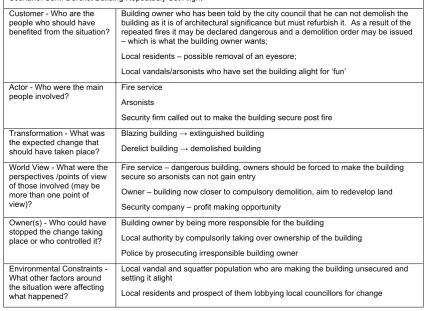
The aim of the focus groups was to facilitate knowledge elicitation and dissemination by use a storytelling approach. In order to stimulate the vocalisation of stories the sessions were conducted using a form of CATWOE analysis which is part of Soft Systems Methodology (Checkland 1991). CATWOE (Customers, Actors, Transformation Process, World Views (or Weltanschauung), Owners, Environmental Constraints) is a technique to aid in the building of a systems model founded on studying the various Transformations that the system supports and the differing rationales (or Worldviews) behind those transformations. The Transformations and associated World Views are then examined from the perspectives of those who could benefit from the Transformation (the Customer), those who enact the Transformation (the Actor) and those who could stop the
Transformation (the Owner). The differing perspectives were then considered within the bounds of the wider Environmental constraints within which they operate.
To begin, a typical scenario was presented to the group – a local semi-derelict building that the Fire Service is repeatedly called out to because of fire. The whole group were then asked to analyse the scenario based on CATWOE, the explanation of CATWOE as presented to the focus groups and an extract of the results from a single focus group are presented in Table 1.
Scenario: Semi-Derelict Building Repeatedly Set Alight
Customer - Who are the people who should have benefited from the situation?
Building owner who has been told by the city council that he can not demolish the building as it is of architectural significance but must refurbish it. As a result of the repeated fires it may be declared dangerous and a demolition order may be issued – which is what the building owner wants;
Local residents – possible removal of an eyesore;
Local vandals/arsonists who have set the building alight for ‘fun’
Actor - Who were the main people involved?
Fire service
Arsonists
Security firm called out to make the building secure post fire
Transformation - What was the expected change that should have taken place?
Blazing building → extinguished building
Derelict building → demolished building
World View - What were the perspectives /points of view of those involved (may be more than one point of view)?
Fire service – dangerous building, owners should be forced to make the building secure so arsonists can not gain entry
Owner – building now closer to compulsory demolition, aim to redevelop land
Security company – profit making opportunity
Owner(s) - Who could have stopped the change taking place or who controlled it?
Building owner by being more responsible for the building
Local authority by compulsorily taking over ownership of the building
Police by prosecuting irresponsible building owner
Environmental Constraints - What other factors around the situation were affecting what happened?
Local vandal and squatter population who are making the building unsecured and setting it alight
[image:7.595.76.504.416.727.2]Local residents and prospect of them lobbying local councillors for change
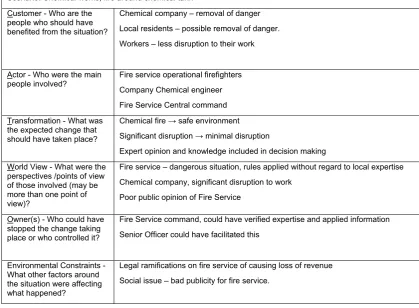
The second example is described in table 2
Scenario: Chemical works, fire around chemical tank
Customer - Who are the people who should have benefited from the situation?
Chemical company – removal of danger
Local residents – possible removal of danger.
Workers – less disruption to their work
Actor - Who were the main
people involved? Fire service operational firefighters Company Chemical engineer
Fire Service Central command
Transformation - What was the expected change that should have taken place?
Chemical fire → safe environment
Significant disruption → minimal disruption
Expert opinion and knowledge included in decision making
World View - What were the perspectives /points of view of those involved (may be more than one point of view)?
Fire service – dangerous situation, rules applied without regard to local expertise
Chemical company, significant disruption to work
Poor public opinion of Fire Service
Owner(s) - Who could have stopped the change taking place or who controlled it?
Fire Service command, could have verified expertise and applied information
Senior Officer could have facilitated this
Environmental Constraints - What other factors around the situation were affecting what happened?
Legal ramifications on fire service of causing loss of revenue
[image:8.595.78.498.95.403.2]Social issue – bad publicity for fire service.
Table 2 CatWoe Example 2
Guided by assertions that good interpretive research should present multiple viewpoints of those involved and their different problems(Glaser and Strauss 1967), the approach allowed a number of people to contribute to the stories. During the process of populating the initial CATWOE table multiple stories and anecdotes emerged, discussion and debate would ensue and an uncooperative and suspicious group would rapidly transform into a relaxed group of individuals reminiscing about past scenarios. Following the initial whole group CATWOE analysis the focus group was then split into sub-groups each of was required to identify a scenario where they felt additional knowledge may have been beneficial or where personal or tacit knowledge had an impact on the scenario. They were asked to analyse the scenario using CATWOE, their analysis was then presented back to the focus group for cross validation and corroboration purposes. Again this process stimulated the generation of stories as the whole group validated or morphed the emerging stories. Recording of incidents presents genuine problems for information systems and the elicitation technique helped the group members to think in different ways about the impact of their incident recording systems.
10 Summary and Conclusion
they progressed, frequently over the course of a single focus group session, from fragmented and fractional elements, to a complete story where reasons for actions and decisions, not clear at the time of the incident, fell into place. Participants were able to complete their partial view of the incident and the background to particular behaviours, evaluations and judgements became clear forming a more complete view in the minds of participants. The second factor important to the notion of ‘Plenary Focus Groups’ and to the fire incident focus groups is that the entire cohort of persons attendant at the incident may also comprise the focus group; there are none of the issues of selecting an appropriate sample or concerns about representativeness. This may lead to questions concerning generalizability but each fire incident is unique, as are many other dynamic incidents, e.g a surgical operation, any type of sporting or artistic performance. The original larger/outer studywas looking at the recording methods and techniques of fire service incidents within the case study and although each incident is unique there may well be common stages, opportunities for error/
misunderstandings. There may be similar situations which are difficult or impossible to record; or where recording is de-prioritised in favour of emergency action. The implications for future research might allow this technique to be used in other scenarios where group collaboration is vital for
completion of a dynamic, real life incident or project. Examples might include an operating theatre, a marketing presentation, sales convention, any type of performance event including artistic or sporting events. The contribution of this paper is to define a particular type of focus group that is not a sample but includes the entire group of the people present at an incident or event, designated a ‘plenary’ focus group. In addition, this study covers the implementation of a novel structuring
instrument for use with such a group and outlines in detail the application of the CATWOE technique for thinking about and describing particular incidents.
References
Antaki, C. (2000). "Two Rhetorical uses of the description 'Chat'." A Journal of Media and Culture3. Basch, C. E. (1987). "Focus Group Interview: an underutilized research techniquefor improving theory
and practice in health education." Health Education Quarterly14: 411-448.
Billig, M. (1996). Arguing and Thinking: A rhetorical approach to social psychology. Cambridge,
Cambridge University Press.
Bloor, M., J. Frankland, M. Thomas and K. Robson (2001). Focus Groups in Social Research. London,
Sage.
Calder, B. J. (1977). "Focus Groups and the nature of qualitative market Research." Journal of Marketing Research14(14): 353-364.
Checkland, P. (1981). Systems Thinking, Systems Practice, John Wiley & Sons.
Checkland, P. (1991). From Framework through experience to learning: the essential nature of action research. Information Systems Research: comtemporary approaches and emergent traditions. H.
E. Nissen, H. K. Klein and R. Hirshhiem. Amsterdam, Elsevier.
Conover, P. J., I. M. Crewe and D. D. Searing (1991). "The nature of citizenship in the United States and Great Britain: Empirical comments on theoretical themes." Journal of Politics53: 800-832.
Delli Carpini, M. X. and B. Williams (1994). "The method is the message:focus groups as a method of social, psychological and political inquiry." Res Micropolit4: 57-85.
Denzin, N. and Y. Lincoln, Eds. (1994). Handbook of Qualitative Research. London, Sage.
Fern, E. E. (2001). Advanced Focus Group research. Thousand Oaks, California, Sage.
Folch-Lyon, E., L. D. L. Macorra and S. B. Schearer (1981). "Focus Group and Survey Research on Family Planning in Mexico." Studies in Family Planning12: 409-32.
Glaser, B. G. and A. Strauss (1967). The Discovery of Grounded Theory: Strategies for Qualitative Research. New York, Aldine Publishing,.
Glick, D., A. Gordon, W. Ward, K. Kouame and M. Guessan (1988). "Focus group methods for formative research in child survival." International Quarterly in Community Health Education8(297-316). Goldman, A. and S. Schwartz McDonald (1987). The group depth interview: Principles and Practice.
Englewood Cliffs, NJ, Prentice Hall.
Heritage, J. (1984). A change-of state token and aspetcs of it's sequential placement. Structures of Social Action: studies in conversation analysis. J. Heritage and J. M. Atkinson. Cambridge, Cambridge University Press: 299-346.
Hoppe, M. J., E. A. Wells, A. Wilsdon, M. R. Gillmore and D. M. Morrison (1994). "Qualitative data from focus group interviews." Health Education quarterly21: 117-126.
Jefferson, G. "The Business of Talk."
Johnson, A. (1996). "It's good to talk: The focus group and the sociological imagination." The Sociological Review44(3): 517-38.
Psychologist39(11): 1297-302.
Kidd and Parshall (2000). "The use of focus groups in pediatric and adolescent research ." Journal of Paediatric Health Care19(2): 104-110.
Kitzinger, J. (1994). "The methodology of focus groups." Sociology of Health and Illness16: 103-21. Knodel, J. (1995). "Focus Groups as a method for cross-cultural research in social gerontology." Journal
of cross cultural gerontology10: 7-20.
Krueger (1994). Focus Groups: A practical guide to applied research. London, Sage.
Lunt, P. and S. Livingstone (1996). "Rethinking the focus group in media and communications." Journal of Communication46(2): 79-98.
Merton, R. K. (1947). "Selected Problems of field work in the Planned Community." American Sociological ReviewVol XII: 304-312.
Miles, M. and A. Huberman (1994). Qualitative data analysis: An expanded sourcebook. Thousand Oaks, CA, Sage.
Morgan, D. L. (1997 (2nd Ed)). Focus Group as Qualitative Research. Thousand Oaks, Sage.
Morgan, D. L. (1998). The Focus Group Guidebook. Thousand Oaks CA, Sage.
Morgan, D. L. (1998). Planning Focus Groups. London, Sage.
Pomerantz, A. (1984). Agreeing and disagreeing with Assessments:Some features of
preferred/dispreferred turn shapes. Structures of Social Action: studies in conversation analysis.
J. M. Atkinson and J. Heritage. Cambridge, Cambridge University Press: p57-101.
Potter, J. (1998). "Discursive Social Psychology:From attitudes to evaluations." European Review of Social Psychology9: 233-66.
Puchta, C. and J. Potter (2004). Focus Group Practice. London, Sage.
Sacks, H. (1992). Lectures on Conversation. G. Jefferson. Oxford, Blackwell.
Schlegoff, E. A. (1995). "Discourse as an interactional achievement III: the omnirelevance of action."
Research on Language and Social Interaction28: 185-211.
Silverman, D. (1999). Doing qualitative research: a practical handbook, Sage Publications.
Stewart, D. W. and P. N. Shemdasani (1990). Focus Groups: Theory and Practice. Newbuty Park CA, Sage.
Vaughan, S., J. S. Schumm and J. Sinagub (1996). Focus Group Interviews in Education and Psychology. Thousand Oaks CA, Sage.
Wiggins, S. and J. Potter (2004). "Attitudes and Evaluative practices: Category vs item and Subjective vs Objective constructions in everyday food assessments." British Journal of Social Psychology.
Wilkinson, S. (1998). "Focus Groups In Health Research: Exploring the meanings of Health and Illness."
Journal of Health Psychology3(3): 323-42.