This content has been downloaded from IOPscience. Please scroll down to see the full text.
Download details:
IP Address: 103.31.34.2
This content was downloaded on 01/08/2017 at 04:29 Please note that terms and conditions apply.
Improving Educator Development by Innovation in Teaching Activity via web 2.0
View the table of contents for this issue, or go to the journal homepage for more 2017 IOP Conf. Ser.: Mater. Sci. Eng. 203 012020
(http://iopscience.iop.org/1757-899X/203/1/012020)
Home Search Collections Journals About Contact us My IOPscience
You may also be interested in:
Commitment to innovation in publishing
China establishes five innovation centres Jiao Li
Creativity and innovation by empowering the customer: The case of Mulino Bianco. Part I: Organisational innovation context
A Bujor and S Avasilci
A case study on open innovation on Procter \amp Gamble. Part I: Innovation strategy over years I G Agafitei and S Avasilcai
1
Content from this work may be used under the terms of theCreative Commons Attribution 3.0 licence. Any further distribution of this work must maintain attribution to the author(s) and the title of the work, journal citation and DOI.
Published under licence by IOP Publishing Ltd
1234567890
Mechanical Engineering, Science and Technology International Conference IOP Publishing IOP Conf. Series: Materials Science and Engineering 203 (2017) 012020 doi:10.1088/1757-899X/203/1/012020
Improving Educator Development by Innovation in Teaching
Activity via web 2.0
Nurhanim Saadah Abdullah, Mohd Ismail Abd Aziz, *Affero Ismail, and Suhaizal Hashim
Universiti Tun Hussein Onn Malaysia
Faculty of Technical and Vocational Education 86400 Parit Raja, Batu Pahat, Johor, Malaysia. *[email protected]
Abstract. Preparing insightful teaching and learning materials for a lesson does need the effort from the educators. Educators should make some research of suitable ways to improve their teaching and learning sessions. In this 21st century, technologies are widely used as tools for education. Even so, there are educators that willing to support and some who do not agree to change. The aim of this study is to develop an innovation teaching materials by applying web 2.0 tools. The intention is to broaden knowledge and in the same time getting response and feedback from people regarding the teaching and learning session materials produced with proper instruction. Action research was used to give a structured flow of this study. The outcome of this study was encouraging and the reflection of this study can help educators in improvising their teaching and learning sessions and materials using action research.
1. Introduction
Being educators is a big job and responsibilities are on the educators shoulder especially to educate multiple generations such as Baby boomers, generation X and generation Y with their own differences in characteristics. The educations now are moving towards 21st
century and educators need to move faster
and prepare their lessons based on 21st century education. A student need electronic tool to support
students’ learning and professional growth [1]. Therefore, conducting learning session is more feasible to student’s current needs. Web 2.0 is used in this study as it emphasize user-generated content, usability
and interoperability for end users. Meanwhile Web 1.0 refers to the first stage in the World Wide Web,
2
1234567890
Mechanical Engineering, Science and Technology International Conference IOP Publishing IOP Conf. Series: Materials Science and Engineering 203 (2017) 012020 doi:10.1088/1757-899X/203/1/012020
1.0 is a source of debate, it is generally believed to refer to the Web when it was a set of static websites that
were not yet providing interactive content. In Web 1.0, applications were also generally proprietary.
2. Objective and Methodology
This study is focusing on the development of teaching material and applying web 2.0. Action research was implemented in which participants examine their own educational practice systematically and carefully, using the techniques of research. It is based on the following assumptions [2]:
Teachers and principals work best on problems they have identified for themselves
Teachers and principals become more effective when encouraged to examine and assess their own work and then consider ways of working differently
Teachers and principals help each other by working collaboratively
Working with colleagues helps teachers and principals in their professional development According to Ferrance [3], action research specifically refers to a disciplined inquiry done by a teacher with the intent that the research will inform and change his or her practices in the future.
3. Past Paradigms and Anomalies that occurred in Instructional Technology
Paradigm in education keeps shifting until recent years and Instructional Technology in education is one of the important matters that have experienced various paradigm shifts [4]. Technologies are being used in order to support instruction. The popular technology used in instruction is of course the computers. Before computers, there were numbers of other forms of technology used in instruction such as radio, television and film been introduced into classroom [5].
Anomaly that occurs at that particular era was as described by Cuban [5] which he argued that the failure of various technology-driven initiatives to achieve an appreciable impact has been due largely to a failure on the part of the designers to fully appreciate the expectations and requirements of classroom practitioners. Lack of appreciation of classroom practitioners has caused a failure to a technology in instruction. Therefore, in the next segment, the researcher would like to describe more on anomalies in the use of instructional technology focuses on higher education.
3
1234567890
[image:4.595.61.509.186.396.2]Mechanical Engineering, Science and Technology International Conference IOP Publishing IOP Conf. Series: Materials Science and Engineering 203 (2017) 012020 doi:10.1088/1757-899X/203/1/012020
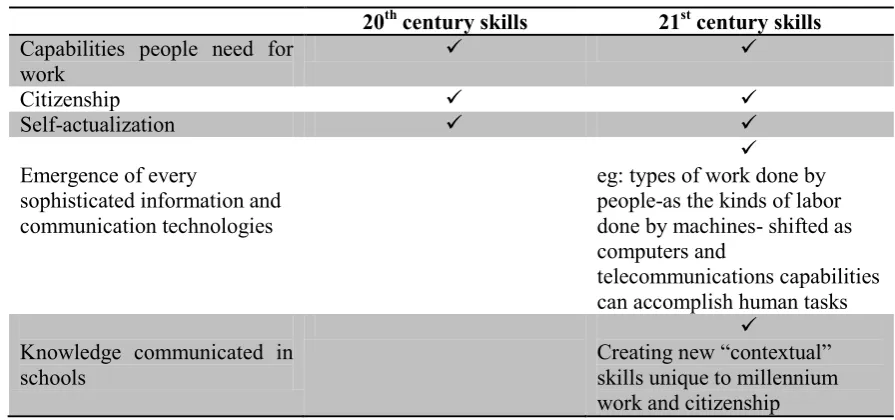
Table 1. Summary of the difference of 20th century and 21st century
20th century skills 21st century skills
Capabilities people need for work
Citizenship
Self-actualization
Emergence of every
sophisticated information and communication technologies
eg: types of work done by people-as the kinds of labor done by machines- shifted as computers and
telecommunications capabilities can accomplish human tasks
Knowledge communicated in schools
Creating new “contextual” skills unique to millennium work and citizenship
4. Results and Discussion
4
1234567890
[image:5.595.163.433.113.369.2]Mechanical Engineering, Science and Technology International Conference IOP Publishing IOP Conf. Series: Materials Science and Engineering 203 (2017) 012020 doi:10.1088/1757-899X/203/1/012020
Figure 1. Action Research Cycle [3]
To make the class lively, the instructor must prepare activities that can attract students and entice them to actively continue to learn. According to Swanson, Cano, Samy, and Hynes [7], the use of the term “active learning” by educators relied more on intuitive understanding than a common definition. Thus, many educators claim that all learning is essentially active and students are actively involved listening to formal presentations in the classroom [7]. Students must do more than just listen [8]. They must read, write, discuss, or be engaged in solving problems. Therefore, strategies that promoting active learning be defined as instructional activities involving students doing things and thinking about what they are doing [8]. Therefore, educators must be creative and advance in creating a better teaching and learning session to make learners more engaged and gain meaningful lessons.
After identifying all the problems stated in previous section, the researcher has done an action research to improve teaching and learning session in vocational education. The researcher has the idea of upgrading the traditional lesson to using web 2.0 tools to expose the lesson to other learners not specifically to vocational learners and instructors only but to other audience.
4.1 Preparation of Learning Material
5
1234567890
Mechanical Engineering, Science and Technology International Conference IOP Publishing IOP Conf. Series: Materials Science and Engineering 203 (2017) 012020 doi:10.1088/1757-899X/203/1/012020
The benefit of using web 2.0 is to get feedback from the viewer where they can post their comments and we can reply the comments. These threads of constructive comments are used as reflection of the lesson itself and how the lesson can be improved next time. As this activity will involve instructor and learners, a suitable theory has been chosen. Activity Theory is chosen because the intention of the researcher is to create a social constructivist learning environment. Therefore, activity theory is suitable to be applied in this study.
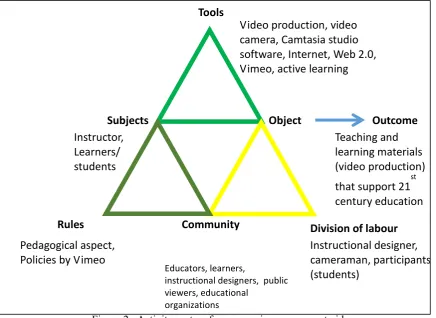
[image:6.595.74.511.302.620.2]In the work of Lorna Uden and Valderas [9], they explain that activity theory focuses on the interaction of human activity and consciousness within its relevant environmental context. The basic structure of an activity for this study can be illustrated as in Figure 2.
Figure 2. Activity system for peer review assessment video
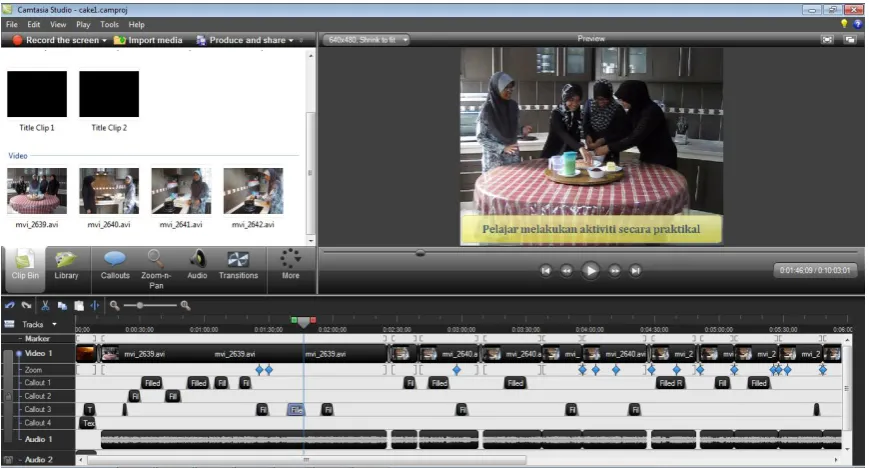
The researcher used almost all tools in the while editing the videos such as cutting the video length, adjusting the audio (high or low), put captions for easy and clear tracking by using callout tools, use title clips for every intersections of the videos, use transitions and basic video editing functions such as blurring and fading the video.
4.2 Publishing into web 2.0
Tools
Subjects
Object
Outcome
Rules
Community
Division of labour
Video production, video
camera, Camtasia studio
software, Internet, Web 2.0,
Vimeo, active learning
Instructor,
Learners/
students
Teaching and
learning materials
(video production)
that support 21
stcentury education
Pedagogical aspect,
Policies by Vimeo
Educators, learners,
instructional designers, public viewers, educational
organizations
6
1234567890
Mechanical Engineering, Science and Technology International Conference IOP Publishing IOP Conf. Series: Materials Science and Engineering 203 (2017) 012020 doi:10.1088/1757-899X/203/1/012020
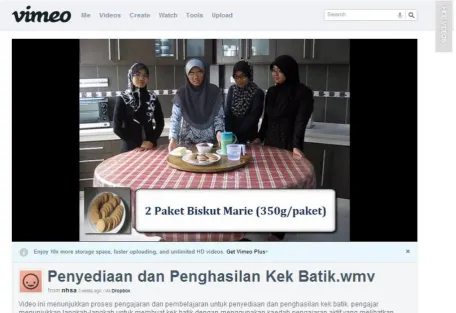
[image:7.595.81.516.333.567.2]After the video production processes were done, it is time to publish the videos to any online video streaming such as You Tube and Vimeo video sharing. The researcher preferred Vimeo since the layout is more interesting and colorful. Besides, the user friendly environment offered by Vimeo has attracted the researcher‟s interest to upload the videos into Vimeo. In order to upload the videos, the researcher need to sign up an account and it is free, and Vimeo has given 500 megabyte of space for users to upload their videos. The important reminder from Vimeo is that the videos uploaded must be original from the users. The process of uploading the videos depends on the length of the videos itself. When the uploading process between user‟s computer and Vimeo are done, the user need to wait for another approximately 33 minutes for the videos to be posted on Vimeo and can be viewed online (Figure 3 & 4).
7
1234567890
[image:8.595.71.528.113.426.2]Mechanical Engineering, Science and Technology International Conference IOP Publishing IOP Conf. Series: Materials Science and Engineering 203 (2017) 012020 doi:10.1088/1757-899X/203/1/012020
Figure 4. Video on Vimeo online video sharing
4.3 Review of the video on Vimeo
User can send invitation to other colleagues and students and also other audience to view the videos by entering email addresses of the person. Vimeo will automatically send invitation emails to the specified person. If the user set the videos as private, then password are required for other person to view the videos. As for the researcher, the videos are set to Public so that not only specified person can view, but other viewers can also view the videos without needing to enter password. The intention is to share the knowledge with the world as a big community.
The real intention of producing the videos was to get feedbacks and comments from colleagues and students who viewed the videos. Viewers can interact with the user by posting their comments in the comment box. Users can reply each of the comments by easily clicking the „reply‟ button on the left of the comment box post by the reviewers.
8
1234567890
Mechanical Engineering, Science and Technology International Conference IOP Publishing IOP Conf. Series: Materials Science and Engineering 203 (2017) 012020 doi:10.1088/1757-899X/203/1/012020
lesson. As for the researcher‟s videos, positive comments and ideas were posted by the viewers and those comments surely reflect the teaching and learning process occurred in the videos. The researcher was excited to get more and more comments and feedback from the other viewers so that amendments can be done in the next lessons.
From the thread of comments in Vimeo, it shows that viewers are actively concentrating on the videos. There were positive comments and also some viewers posted ideas regarding the improvement that can be done for the next video production. Researcher has had a great experience in doing the whole process starting from planning until the reflection and improvement to be done. Some comments that can improve the video productions for educational purposes. Some of the comments are as follows:
“The instructor used authentic learning by having the training of preparing a cake in a kitchen. The introduction is clear and it was confidently and naturally presented. The whole video presentation looks professional. You could also use some camera angle techniques to improve the presentation. I looks like instructor is not only teaching the people she has invited but also the audience who is watching the video. Good work.”
“Student gave innovative suggestion to replace the cake batik with other ingredient, instructor didn't encourage new innovative and creativity; even though instructor explain why other ingredient was not suitable.”
The educator will definitely list the weaknesses with the purpose of making improvements in self teaching and learning session. Important aspect as pedagogy in teaching cannot be left as second priority. All these processes are actually a good approach of learning and embedding technologies in daily lessons as experienced by the researcher. The combinations of ideas to improve teaching and learning session using technology in order to promote 21st century education can be seen positive by the application of action research done by the researcher. What educators should do is find ways to always improve the current practice in teaching and learning so that the meaningful learning can occur. Students in the 21st century are active and full of commitments. Therefore, it is the role of educators to be ahead of the students to give motivation and engagement to the learners towards knowledge taught. Educators also need to look in broader view. Educator needs to put more effort in sharing their knowledge to produce quality graduates [10].
5. Conclusion
9
1234567890
Mechanical Engineering, Science and Technology International Conference IOP Publishing IOP Conf. Series: Materials Science and Engineering 203 (2017) 012020 doi:10.1088/1757-899X/203/1/012020
knowledge could be shared to the entire technology world [11]. The development of online material does support the 21st century education and also enhance the educator‟s skill in using web 2.0 tools in making learning session meaningful with proper instructional technologies [12].
References
[1] Salonen, P. (2000). Development project of clinical training 2004-2006, Final report, Centria University of Applied Sciences.
[2] Watts, H. (1985). When Teachers Are Researchers, Teaching Improves, J. Staff Dev., vol. 6, no. 2, pp. 118–127.
[3] Ferrance, E. (2000). Action research. LAB, Northeast and Island Regional Education Laboratory at Brown University.
[4] Koschmann, T. (1996). Paradigm shifts and instructional technology: An introduction, CSCL Theory Pract. an Emerg.
[5] Cuban, L. (1986). Teachers and machines: The classroom use of technology since 1920. [6] Dede, C. (2010). Comparing frameworks for 21st century skills, 21St Century Ski., pp. 51–76. [7] Swanson, B. Cano, J., Samy, M. and Hynes, J. (2007). Introducing active teaching–learning
methods and materials into Egyptian agricultural technical secondary schools, Proc. 23rd. [8] Chickering, A. W. and Gamson, Z. F. (1987). Seven principles for good practice in
undergraduate education, AAHE Bull., vol. Mar, pp. 3–7.
[9] Lorna Uden, O. P. and Valderas, P. (2008). An activity-theory-based model to analyse Web app, Professor T.D. Wilson, 2008.
[10] Abiddin, N.Z. and Ismail, A. (2014). Exploring Service and Support Needs in Postgraduate Education towards the Higher Education Quality, Asian Social Science, 10 (17), 52
[11] StrategicPlan For Online Education (2016). The Cost Of Online Education . The Innovation And
Online Committee Florida Board of Governors, Affordability Workgroup 2025.
[12] Lawrence S. Bacow, William G. Bowen, Kevin M. Guthrie, Kelly A. Lack and Matthew P. Lon
(2012). Online Learning Systems
![Figure 1. Action Research Cycle [3]](https://thumb-us.123doks.com/thumbv2/123dok_us/8752925.892300/5.595.163.433.113.369/figure-action-research-cycle.webp)