Construction Materials and Technology Series 1 2018 ISBN 978-967-2183-19-8
139
CHAPTER 10
A STUDY ON SCHEDULE MANAGEMENT FOR BIM PROJECTS IN
THE CONSTRUCTION INDUSTRY
Peniel Ang Soon Ern1, Roslinda Binti Ali1, Ooi Chee Yang1
Faculty of Engineering Technology
,
Universiti Tun Hussein Onn Malaysia
,
Parit Raja,
Batu Pahat,
86400 Johor
,
Malaysia.
10
.
1 INTRODUCTIONThere is an advance modelling tool that currently been pushed by the industry is BIM. BIM as known as Building Modelling Information is a computerized process that is used to design, understand and establish the key physical and functional characteristic of a building on a ‘virtual’ computerized model basis at its most basic level [4]. Basically the resulting model is a digital representation of the building which the data can be extracted and analyzed to generate information that can be used for decision making and enhance the process of delivering the building and the entire life cycle use of the building [4]. BIM implementation can help to improve the quality of project especially the schedule management. By implementing BIM into construction project, it can provides schedule visualization which can make the construction planning more efficient. Besides that, through the BIM model clash detection can be detected in the preconstruction phase which save a lot of time on rework during construction phase.
The objectives of this study are to investigate the issues on schedule management in construction industry and to analyze the schedule management on BIM project in construction industry. This study was focused on G6 and G7 contractors. Furthermore, the project location was set in big city of Malaysia such as Johor, Kuala Lumpur and Penang. This is due to most of the construction projects in these locations have applied BIM compare to other states.
10.2 LITERATURE REVIEW
SCHEDULE ISSUES IN CONSTRUCTION PROJECT
Construction Materials and Technology Series 1 2018 ISBN 978-967-2183-19-8
140
contractor. Non-compensable excusable delay is the delay that out of control and does not cause by contractor parties. While for the compensable excusable delay, it is a reasonable delay, suspension or interruption occurs in the work which come from the client project itself. And lastly concurrent delay is the delay that happen at the same time where both client and contractor responsible for the delay [6]. Those delay can cause the project cost overrun in terms of materials, labours and machinery. Furthermore, delay in project also can reduce the quality of the project. This can be said so as the contractors are rushing to complete the project within the duration given and might ignore the quality of the project. Hence, BIM can be a solution provider to the construction industry which improve the schedule performance of a project. The 3D BIM model can provide a project visualization which can detect the clash detection and had a more systematic planning phase. A systematic planning phase means a better planning in schedule management before the construction start and hence shorten the project completion time.
BUILDING INFORMATION MODELLING (BIM)
BIM is the latest trend of contributor to the challenges faced in the construction industry. BIM stands for ‘Building Information Modelling’ or ‘Building Information Management’ [4]. From the view of Takim, Nawawi, & Mohd (2013), BIM is a new emerging technology to be deployed in the design, construction and facility management in which a digital representation of the building process is being created to facilitate the exchange and interoperability of information in digital format [7]. BIM can be categorized for two levels which are basic and advanced. Barnes & Davies (2014) stated that at basic level BIM is a computerized process that is used to design, understand and demonstrate the key physical and functional characteristics of a building on a ‘virtual’ computerized model basis [4]. For the advanced level, BIM is the use of a computer software model to replicate the construction and operation of a building [4]. So overall BIM is an advanced technology which is applying computerized software to obtain the information of the building by modelling.
a) Elements of BIM
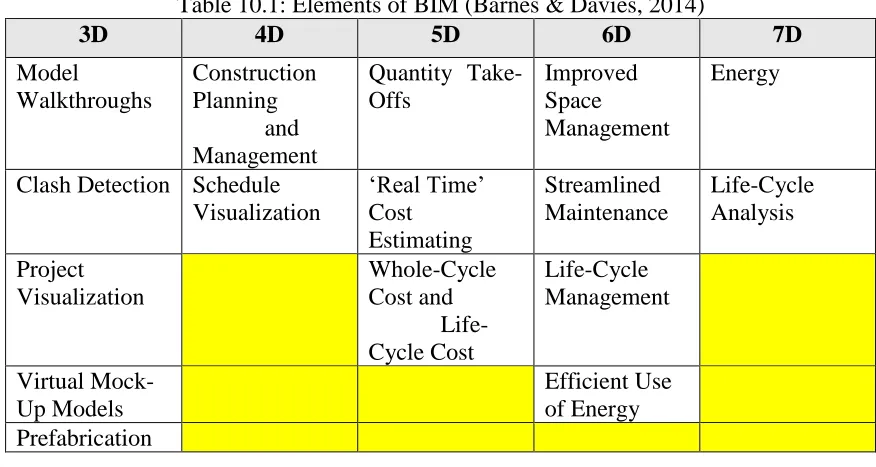
As for now BIM had 5 elements which are 3D, 4D, 5D, 6D, and 7D. Every elements have their own functionalities (see Table 10.1).
[image:2.597.78.516.541.775.2]
Table 10.1: Elements of BIM (Barnes & Davies, 2014)
3D 4D 5D 6D 7D
Model Walkthroughs Construction Planning and Management
Quantity Take- Offs
Improved Space
Management
Energy
Construction Materials and Technology Series 1 2018 ISBN 978-967-2183-19-8
141
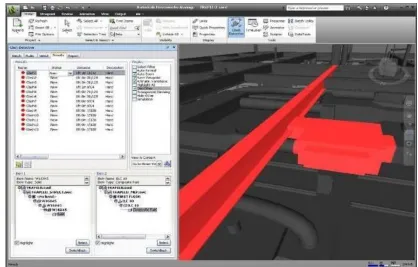
3D BIM not only has the ability to provide the view of building in three dimension but also can automatically update the changes from earliest conception to demolition. Overall BIM in 3D can identify conflicts between and amongst the building system which cannot be done by 2D drawings [8]. The 3D model consists of model walkthroughs, clash detection and project visualization which is useful for the schedule management (see Figure 10.1). The 3D model provides for:
1. Model walkthroughs: Before the construction phase, the designers and contractors will work
together to resolve any issue that had been identified from the collaborative model [4].
2. Clash detection: Basically any of the design drawings will be checked to avoid any clash
within the building. Unfortunately most of the clash were detected in the middle of construction work and causes delay due to modification. For now BIM can resolve this kind of issues as it can identify all the possible clash before the construction phase [4]. For example, in US there is a project where BIM model had been used and found out total 257 constructability issues and 7213 conflicts while with the traditional way on the same project only able to find out six constructability issues and one conflict [9].
3. Project Visualization: It is a simple tool to show how the building looks like during the
construction progress. Basically it is used to show the owner to have a look and contractor will use it to foreseen the building look [4].
[image:3.597.105.523.354.621.2]
Figure 10.1:3D model in BIM (clash detection)
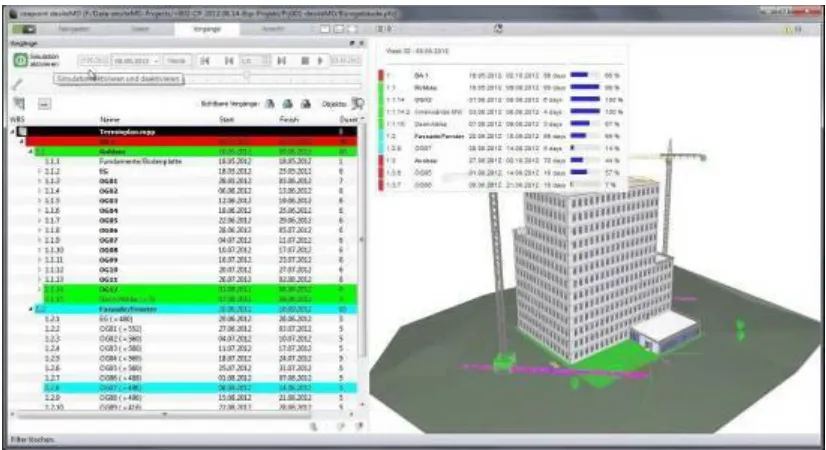
The 4D BIM is a model which have a clear visualization about the sequence for each activity to be taken out during the construction progress (see Figure 10.2). It can provide a ‘real time’ image for construction team about the progress for each activity [10]. The 4D (time) model provides for:
1. Construction planning and management: BIM models for this dimension can provides the
Construction Materials and Technology Series 1 2018 ISBN 978-967-2183-19-8
142
Temporary components include cranes, lorries and fencing while traffic routes include the access for lorries, cranes, lifts and other large items [9].
2. Schedule visualization: Scheduling and critical path of a project can be seen from the BIM
model, an impact will affect the critical path of project if the design keep on changing and all of these changes can be automatically detected by advanced BIM models [4]. Project members able to make decisions based on the schedule visualization [9].
[image:4.597.115.528.189.414.2]
Figure 10.2:BIM model with 4D (scheduling)
b) Pros and Cons
As mentioned before, BIM provides a lot of pros in the construction industry especially improve the schedule performance of a project. Throughout the BIM model, clash detection can be found and amendment can be made in the preconstruction or design stage. This can reduce the rework issue and hence reduce the project delivery time [11] [12]. Besides that, BIM also provides project visualization which can enhance the quality of schedule management. From the project visualization, planning phase can be more systematic and effective from preconstruction phase till the post construction stage. So, it can be seen that BIM implementation in construction industry does improve the schedule performance which lead to shorten project delivery time.
Apart from the benefits of BIM contributing to the construction industry, there are existing
constraints which restraint the implementation of BIM across the industry. Some barriers included lack of knowledge about BIM, no demands from clients and reluctance of BIM implementation by construction team [13]. Lack of knowledge about BIM was one of the main factor as BIM involved various parties. Without a clear or understanding knowledge on BIM, each party do not want to implement it as they believe such technology is difficult to learn. This caused that none of the parties would like to implement BIM as long as no demands from clients despite the pros of BIM. So, there is a need arises to study the impact of BIM in the schedule management of construction projects in Malaysia.
Construction Materials and Technology Series 1 2018 ISBN 978-967-2183-19-8
143
10.3 METHODOLOGY
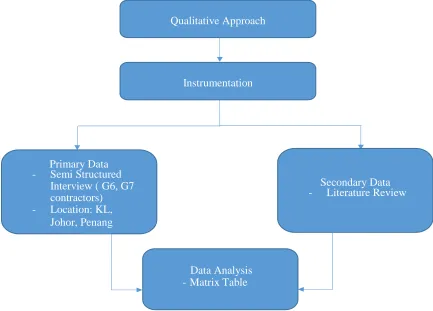
Qualitative research had been selected as methodology for this study. Specifically qualitative research is a method of collecting, analyzing and interpreting data is not easily reduced to numbers and cannot be judged by quantitative standards [14]. Semi-structured interview was been selected as a method to collect data. Semi-structured interview is where the interviewer does not constrained about the formal questions and the interviewer can prepare some questions but not necessary ask them all [15]. G6 and G7 contractors had been selected as the population of study while BIM projects had been selected as research sample. The location for the research was fixed at big cities such as Kuala Lumpur, Johor Bahru and Penang. Flow chart had been made to show the progress of the methodology (refer Figure 10.3).
[image:5.597.79.512.261.572.2]
Figure 10.3:Methodology Flow Chart of Study
10.4 RESULTS AND DISCUSSION
From the data analysis, the causes of schedule issues that the respondents faced in the construction industry are poor contractor management, design issues and improper planning phase. As it can be seen that these causes are still the main issues for the respondents which the respondents usually faced in the projects. Respondent 1 had said that poor contractor management is the main issue that he faced in his projects. Respondents 2 and 3 had faced the same issues in their projects which are the design issues and improper planning phase. While for the respondents 4 and 5 the issues that they faced in their projects are poor contractor management and improper planning phase. The respondents had implement BIM to improve the quality of projects. The percentage of implementation is different among the respondents.
Qualitative Approach
Instrumentation
Primary Data - Semi Structured
Interview ( G6, G7 contractors) - Location: KL,
Johor, Penang
Secondary Data - Literatu re Re view
Construction Materials and Technology Series 1 2018 ISBN 978-967-2183-19-8
[image:6.597.79.515.96.320.2]144
Table 10.2: Schedule Issues and BIM implementation
Respondents 1 2 3 4 5
Causes of Schedule Issues in Construction Project Poor contractor management Design issues Improper planning phase Design issues Improper planning phase Poor contractor management Improper planning phase Poor contractor management Improper planning phase Percentage of BIM Implementation
31-40% 10-20% 61-70% 41-50% 51-60%
Improvement of Schedule
Performance
11-15% 11-15% 11-15% 11-15% 6-10%
From the Table 10.2, the BIM implementation for the respondents is within the range of 1070%. Respondent 1 had implemented 31-40% while respondent 2 had implemented 10-20% only in his project. Respondent 3 had implemented the most among the respondents which is 61-70%. For respondents 4 and 5, the percentage of BIM implementation in their projects are 41-50% and 51-60%. After the implementation of BIM, it had improve the schedule performance which shorten the project duration around 6-15%. Respondents 1, 2, 3 and 4 had found out that BIM shorten their project duration in 11-15% while for respondent 5 said that BIM only shorten his project duration in 6-10%. This shows that the schedule performance can be improved without the effect of percentage of BIM implementation in construction project.
From the experienced of BIM implementation, respondents had commended that BIM can help to improve schedule performance by reducing conflicts and changes during construction, ease the planning work, had a better view in collaboration and coordination, and also optimization of cost and schedule. This shows that the quality of schedule management had been enhanced by implementing BIM into the projects. Furthermore, respondents are more likely to implement BIM as can improve the quality of projects, reduce rework issue, avoid clash detection between subcontractors, work well with design team, reduce cost and project completion time and optimize the owner’s experience and satisfaction [12] [11] [16]. According to (Allison, 2010), BIM implementation can help to work well with design team and optimize the owner’s experience and satisfaction throughout the construction phase [16]. Besides that, (Rodriguez, 2016) mentioned that BIM can help to reduce rework issue and avoid clash detection in a construction project [11].
Hindrances of BIM Implementation
Construction Materials and Technology Series 1 2018 ISBN 978-967-2183-19-8
[image:7.597.77.523.102.305.2]145
Table 10.3: Hindrances of BIM Implementation
Respondents 6 7 8 9
Hindrances of BIM
implementation
• Not always
relevant to project worked on
• Standard
guideline and software
incompatibility
• Higher of
training and software costs
• Lack of
expertise
No demand from clients
• Higher of
training and software costs
• Not always
relevant to project worked on
• Standard
guideline and software
incompatibility
However, there are still some hindrances which restraints the implementation of BIM. 4
respondents had been asked about the constraints of BIM implementation. From the Table 10.3, the hindrances of BIM implementation are higher of training and software costs, no demand from clients, not always relevant to project worked on, lack of expertise, and lastly standard guideline and software incompatibility. Respondents 6 and 9 had said that the hindrances of BIM implementation are not always relevant to project worked on, standard guideline and software incompatibility. In addition, respondent 9 also said that the training and software costs are higher for BIM which respondent 7 agreed with it. Besides that, respondent 7 also mentioned that there is lack of expertise for BIM which restraints the use of it. While for respondent 8 had said that no demand from clients about BIM implementation is the barrier for it.
Out of all the hindrances, the training cost is the main concern for the respondents. First of all, company does not willing to send their own staff for the training as they afraid the staff will leave the company once they done the training. Besides that, BIM does not worth to implement in every project [17]. For now it only suitable to implement in mega projects as the initial cost is higher. Meanwhile, the standard guideline and software incompatibility also one of the reason that respondents unwilling to implement BIM.
So in order to promote the BIM in the construction industry, government should take some
actions on it. First of all, government should include BIM course into the civil engineering subject so that company does not need to send people for training. Besides that, government should make a policy where every construction project should include BIM implementation. This can help to make the BIM more utilized in construction industry. Furthermore, government should make a talk for every construction company about BIM. As for now BIM is still consider as new technology and many people are still lack of awareness about it.
10.5 CONCLUSION
Construction Materials and Technology Series 1 2018 ISBN 978-967-2183-19-8
146
industry in Kuala Lumpur and Johor area. In general, the objectives of the research have been achieved.
Based on the first objective to investigate the issues on schedule management in construction
industry, the issues that respondents commonly faced are poor contractor management, design issues and improper planning phase. Those issues had caused project delay which effect the schedule performance of a project. The respondents had use different solutions to overcome the issues such as constantly measure and track the progress of project, increase machinery or requests time extension for the project. For the second objective which is to analyze the schedule management on BIM project in construction industry. From the data analysis, there is an improvement on schedule management after implementing BIM in the construction project. Overall BIM can shorten the project duration within the range of 6-15%. This shows that BIM implementation can enhance the quality of schedule management which also can increase the reputation of the contractors.
Apart from the benefits of BIM, there are constraints which restraint the BIM implementation in construction industry. One of the main constraint is the higher training and software costs. People that want to learn BIM will need to undergo training course which the cost is expensive. Besides that, the cost to purchase the software also higher where not all the company afford to buy it. In addition, due to purchasing cost BIM is not suitable to all kinds of projects. For now BIM only been implemented in mega projects. Although there is some barriers which restraint the BIM implementation in construction industry, overall BIM is an advance tool which can improve the quality of construction industry. Hence, there is a need to increase the BIM implementation in Malaysia.
Construction Materials and Technology Series 1 2018 ISBN 978-967-2183-19-8
147 REFERENCES
[1] X. Li, Q. Zhang and J. Xu, "Research on Construction Schedule Management Based on BIM,"
Procedia Engineering, vol. 174, pp. 657-667, 2017.
[2] T. Pourrostam and A. Ismail, "Causes and Effects of Delay in Iranian Construction Projects,"
IACSIT International Journal of Engineering and Technology, pp. 598601, 2012.
[3] H. A. Rahman, C. Wang, R. Takim and S. Wong, "Project schedule influenced by financial
issues: Evidence in construction industry," Scientific Research and Essays, pp. 205-212, 2011.
[4] P. Barnes and N. Davies, BIM in Principle and Practice, London: ICE, 2014.
[5] S. M. Ahmed, S. Azhar, M. Castillo & P. Kappagantula, "Construction Delays in Florida: An
Empirical Study, State of Florida". Final report. Department of Community Affairs, Florida, US, 2020.
[6] Y. Khairulzan and A. H. Syahira Nabila , "Causes and Effects of Delays in Construction
Industry," 2016.
[7] R. Takim, A. H. Nawawi and H. Mohd, "Building Information Modeling (BIM): A new
paradigm for quality of life within AEC industry," Procedia - Social and Behavioral Sciences,
pp. 23-32, 2013.
[8] B. Corke, "Building Information Modeling (BIM) – Expert Article on Construction Disputes,"
24 February 2016. [Online]. Available: http://www.robsonforensic.com/articles/building-information-modeling-BIMexpert-witness.
[9] BIMTalk, "BIM Dimensions," 30 April 2013. [Online]. Available:
http://bimtalk.co.uk/bim_glossary:bim_dimensions.
[10] N. Taylor, "BIM 4D Planning – A New Dimension In Construction Planning," 2016. [Online].
Available:
http://rcp.net.au/articles/bim-4d-planninga-new-dimension-in-construction-planning/.
[11] J. Rodriguez, "Building Information Modeling (BIM) Benefits Per Profession," 21 November
2016. [Online]. Available: https://www.thebalance.com/buildinginformation-modeling-bim-benefits-845045.
[12] M. Muzvimwe, "5D BIM Explained," 20 September 2011. [Online]. Available:
https://www.fgould.com/uk-europe/articles/5d-bim-explained/.
[13] Z. Zahrizan, N. Mohamed Ali, A. Tarmizi Haron, P. M. Amanda and Z. Abdul Hamid,
"Exploring the Barriers and Driving Factors in Implementing Building Information Modelling
(BIM) in Malaysian Construction Industry; A Preliminary Study," IEM Journal, p. 56, 2013.
[14] Questia, "Qualitative Research," 2017. [Online]. Available:
Construction Materials and Technology Series 1 2018 ISBN 978-967-2183-19-8
148
[15] A. Doyle, "What is a Semi-Structured Interview," 2 May 2017. [Online]. Available:
https://www.thebalance.com/what-is-a-semi-structured-interview-2061632.
[16] H. Allison, "10 Reasons Why Project Managers Should Champion 5D BIM Software," 23
November 2010. [Online]. Available: http://www.vicosoftware.com/vico-blogs/guest- blogger/tabid/88454/bid/27701/10Reasons-Why-Project-Managers-Should-Champion-5D-BIM-Software.aspx.
[17] A. Lymath, "The top five barriers to BIM implementation," 1 December 2014. [Online].
Available: https://www.thenbs.com/knowledge/the-top-five-barriers-tobim-implementation.