Journal of Chemical and Pharmaceutical Research, 2014, 6(3):602-611
Research Article
CODEN(USA) : JCPRC5
ISSN : 0975-7384
Optimization design for the over-travel rod spring of the vacuum circuit
breaker through the improved genetic algorithm
Xie Jiuming
1,2, Sun Dengyue
1, Xue Weiguo
2, Wang Dezhi
2and Ding Shanzhong
21
National Engineering Research Center for Equipment and Technology of Cold Strip Rolling,
Yanshan University, Qinhuangdao
2
Research Institute of Tianjin Benefo Machinery & Electric Holding Group LTD, Tianjin
_____________________________________________________________________________________________
ABSTRACT
The mechanical properties of the vacuum circuit breaker can directly influence the realization of its electrical properties. In view of the vacuum circuit breaker operating mechanism, this paper will elaborate on the function of Disc Spring on over-travel rod and make a multi-objective optimization design of it. In the process of optimization, the simple genetic algorithm was improved through adjusting the crossover probability and mutation probability, the second crossover, the specified gene mutation and the immigration strategy, and shortcomings when the simple genetic algorithm came into immature convergence were also easily overcome. Through comparing the optimization result and calculation efficiency of the traditional Matlab algorithm, the simple genetic algorithm and the improved genetic algorithm, the superiority of the improved genetic algorithm was verified. Meanwhile, the optimization result was experimented in the laboratory. Results showed that using the improved genetic algorithm for disc spring optimization design was feasible and effective, and the theoretical basis of optimization design for disc spring was provided as well.
Key words: Disc spring; Optimization design; Genetic algorithm; Immature convergence
_____________________________________________________________________________________________
INTRODUCTION
With the constant development of the national economy and improvement of people’s living standard, people have a growing demand for electricity, which stimulates the ceaseless expansion of electric grid and its capacity and wide application of highly safe and reliable power equipment into the grid [1].Thanks to its characteristics of no fire, no pollution and excellent breaking performance, the vacuum circuit breaker enjoys extensive applications in the power system, especially in the medium-voltage grid[2].Nevertheless, on the high-voltage level, especially the ultra-high voltage, there is rare application of the vacuum circuit breaker, which is mainly due to the difficulty in researching and developing the vacuum interrupter [3-4]. At the same time, the vacuum circuit breaker being a piece of machinery equipment with electrical properties, its electrical performance depends on its mechanical properties[5-7]. As the direct operating mechanism in the vacuum interrupter of the vacuum circuit breaker, the over-travel rod uses the compression spring to provide pressure for the vacuum interrupter contact, thus having a great impact on the vacuum interrupter and breaker breaking capacity. Therefore, it is of great necessity to make an optimization design of the compression spring on the over-travel rod.
Using the simple genetic algorithm (SGA) to conduct the optimization of multi design variables enjoys many advantages. Based on the principle of evolution and the idea of “survival of the fittest”, genetic algorithm is a method for random search and optimization. Possessed with strong problem solving skills, high computing efficiency and a wide range of adaptability, it provides a common framework for the solution of optimization problem in complex systems. Robustness and the nature of parallelism make the genetic algorithm highly effective in the global probabilistic search, rare limitations of these problems and the diversity of the mixed field structure also make it flexible to handle various special problems. These merits of the genetic algorithm make it more and more widely applied into practice[9-12].
In view of the 126kV double-module series vacuum circuit breaker, this paper will introduce the mechanism of the over-travel rod of the vacuum circuit breaker, on the basis of which functions of the compression spring will be explained, and the optimization model will also be determined. In addition, the improved genetic algorithm will be used for the multi-objective optimization design, and satisfying results are achieved. Meanwhile, expected results are also achieved through the experiment in the laboratory.
MECHANISM INTRODUCTION AND FUNCTION ANALYSIS OF THE OVER-TRAVEL ROD
The opening and closing process of the vacuum circuit breaker is determined by the vacuum interrupter, which, however, is directly controlled by the over-travel rod.
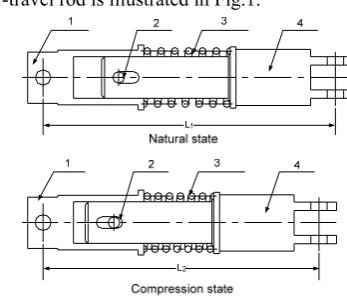
The typical mechanism of the over-travel rod is illustrated in Fig.1.
[image:2.595.210.384.301.451.2]1—guide sleeve; 2—connecting pin; 3—compression spring, 4—guiding axle
Fig. 1 Over-travel rod
The over-travel rod is composed of guide sleeve, connecting pin, compression spring and guiding axle. The compression spring is installed between the guide sleeve and guiding axle, which are connected by the connecting pin. On the connection point, a long hole exists in the over-travel rod, which renders it possible to change the length of the rod. The rod length is L1 in the natural state and L2 in the compression state. The difference between L1 and L2
stands for the contact route of the vacuum breaker.
The operation mechanism of the 126kV double-module series vacuum circuit breaker is demonstrated in Fig.2 (a). The over-travel rod movement is driven by the insulated pull rod, whose guiding axle is connected with the vacuum interrupter and the former controls the movement of the latter.Fig.2 (b)is the enlargement of some parts of the over-travel rod in Fig.2 (a).
(a) (b)
1—insulated pull rod cover; 2—insulated pull rod;3—cover; 4—over-travel rod; 5—outlet port; 6—vacuum interrupter; 7—interrupter insulation;8—support frame; others-connection components which are not marked.
Fig.2 The over-travel rod and its installation
Besides, in the closing process of the vacuum circuit breaker, the compression spring can reduce the attacks on the interrupter as well as the contact bouncing danger at the same time. When the vacuum interrupter contact wears, the compression spring can compensate for the wear distance so as to ensure the final contact pressure. In the opening process of the vacuum circuit breaker, the spring force on the over-travel rod contact can increase the opening speed of the vacuum interrupter so as to meet its motion parameters. Nevertheless, at the closing moment of the vacuum interrupter contact, the motion system is still influenced by the suddenly increased spring force, which will demand greater requirements for the operation mechanism.
Therefore, the optimization design of the compression spring must be based on the realization of its functions and the improvement of other motion systems and operation mechanisms. On the basis of design requirements of the over-travel rod, the compression spring should have a high rigidity and occupy small axial space, so the combination and involution of disc springs with non-bearing surfaces are adopted.
BASIC PRINCIPLES OF THE IMPROVED GENETIC ALGORITHM
The simple genetic algorithm directly uses the objective function to search for information and seeks for optimization in a point group through random searching. Due to a lack of the certainty principle, in the evolution of SGA, the crossover operator’s ability to generate new chromosome and the population diversity continue to decrease, so the individual concentration is too high, a good diversity of individuals is hard to be achieved, and it will easily fall into immature convergence. In comparison, through adjusting the crossover probability and mutation probability, the second crossover, the specified gene mutation and the immigration strategy, the improved genetic algorithm can facilitate the optimization search out of local reach and the achievement of the global optimal solution [13-15].
The crossover probability and mutation probability
The genetic algorithm parameters’ choice of the crossover probability Pc and mutation probability Pm can directly influence the solution quality. In the SGA, the crossover probability and mutation probability remain the same, which fundamentally contributes to the degradation of algorithm performance.
In light of the algebraic relation between the crossover probability and genetic evolution, when the population is in the early period of evolution, it is held that:
(1)
in which, —refers to the adaptability of the biggest individual in the population; —refers to the average individual adaptability in the population;k—constant.
Here, the adaptability in the population varies greatly, therefore, a great crossover probability and a small mutation probability can increase the convergence speed and avoid the passive state of the genetic algorithm.
(2)
Here, the adaptability in the population varies little, and the precocity will easily occur among individuals in the population, therefore, a small crossover probability and great mutation probability are adopted to expand the search scope, avoid partial optimal solution and realize global optimization of smooth convergence [16].
In the early period of evolution,
(3)
(4)
In the later period of evolution,
(5)
(6)
in which, —basic value of ; and 0.25 is adopted in this paper; —basic valueof , and 0.15 is adopted in this paper.
Second crossover
In the SGA, two individuals in the fatherly generation x1 and x2 are chosen for count crossover, as a result of which,
two filial individuals x and x are produced:
1
1 (7)
in which, λ—refers to the random number between 0 and 1.
When the evolution falls into local optimum, filial individuals produced after the crossover will be like the fatherly individuals before the crossover. This crossover is invalid. To avoid it, this paper adopts the form of second crossover, in which fatherly individuals are crossed with randomly produced new individuals to produce filial individuals. This approach can escape from local optimum in subsequent cycles, find the global optimal solution after several cycles when a generation is precocious.
Mutate specified gene
Select from parent individuals and mutate it, after which the offspring individual is produced. This paper employs the dynamic mutation method to calculate :
, (8)
in which, — is the upper bound of the value.
In the process of mutation, the value that returns to [0,y] from the function , makes the function tend to 0
with the increase of t. Thus, the function could search for the entire space evenly at the initial iteration and local areas in later periods.
In this paper, , is selected as follows:
, 1 (9)
in which, r—random number between 0 and 1; T—the maximum algebra; b—the parameter used to determine the
Immigration policy
As evolution increasingly converges on the most adapted individuals, the diversity of the population decreases and population structures tend to be similar in the later stages of the basic genetic algorithm evolution. As a result, the search efficiency is reduced and the genetic algorithm is easy to get caught in local optimal solution, namely the appearance of premature convergence.
To avert the genetic algorithm to converge on the local optimal solution, this paper employs the immigration policy. In the process of genetic manipulation, the immigration operation method is used at each interval of 10 generations for replenishing new individuals to replace the 10% individuals with minimum fitness so that individual genetic diversity of the population can be increased. This method is conducive to optimizing search and obtaining the global optimal solution[17].
Work flow chart
[image:5.595.173.447.246.741.2]T
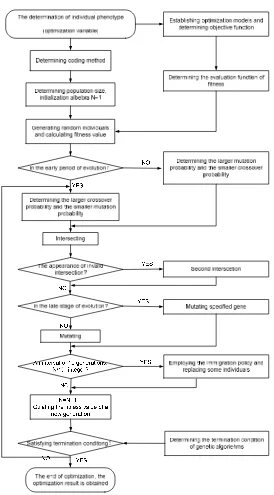
he flow chart of using the improved genetic algorithm for optimization is shown in figure 3:MULTI-OBJECTIVE OPTIMIZATION DESIGN OF DISC SPRING The structure of disc spring and the determination of optimization variables Chart 4 is the design chart of disc spring.
[image:6.595.166.441.131.188.2]H0 t h0
Fig. 4 Disc spring
The parameters of disc spring have the following relationship:
1 (10)
(11)
Ⅰ (12)
Ⅱ (13)
Ⅲ 2 (14)
Ⅳ 2 (15)
1 (16)
(17)
(18)
(19)
With regard to the spring without bearing surface, there is =1.
in which, F—spring load (N); D—the external parameter of spring (mm); d—the internal parameter of spring(mm); D0—the neutral parameter of spring (mm); H0—free height (mm); t—thickness (mm); h0—the usual deformation
amount of spring pressure (mm), h0= H0-t ; f—deformation amount (mm); E—elastic modulus (MPa); —Poisson's
ratio; C—the proportion of the external parameter to the internal parameter, C= ⁄ ; 、 、 、 —calculation
(20)
(21)
(22)
In which, —the total spring load (N); i—the number of convolution pieces; —the total deformation
amount(mm); —the free height of combination spring (mm).
As can be seen from the above, the design of disc spring is determined by parameters D、d、t、h0、i. Therefore, the
optimization of disc spring is equivalent to the optimization of parameter variable, namely the individual phenotype
X=[D,d,t,h0,i]T.
The determination of variable solution space and coding
Solution space is the possible value of optimization variables. In the process of optimization, this paper adopts the real number coding method on optimization variables, which not only shortens the length of chromosome but also makes it unnecessary to conduct transformation between design variables and binary encoding. Based on the design of over-travel rod, optimization variables all adopt real number discrete variables. Therefore, all it needs is to randomly generate the real number within the allowable range of design variables and conduct corresponding real number coding.
The determination of optimization objective function
Based on the design of over-travel rod, the optimization of disc spring firstly has to take into consideration the function demand of operation mechanism. Secondly, it has to take up less space and use less material to meet the requirements of miniaturization. The free height of the convolution combination’s disc spring is H iH 40mm, the deformation amount after compression or the maximum stroke of over-travel rod is f if 6~10mm. The material of disc spring selected in this paper is spring steel with E=2.06 10 MPa. According to the design requirement of that vacuum interrupter, the contact’s initial pressure is F 3400 N and the final pressure is F 4500 N. In order to neutralize the upper and lower deviation and guarantee the contact’s initial and final pressure, this paper selects the intermediate values F1=3600N and F2=4750N.
Based on the function requirement of compression spring, the following optimization objective function can be determined.
In the natural state, the disc spring elasticity is the initial pressure F1 provided by the vacuum interrupter contact. Namely, with respect to the disc spring elasticity, there is F0=F1. But in the strict sense, these two forces cannot be absolutely equal. Thus, it is required that these two values should be as close as possible. The objective function can be determined:
min | | (23)
In the compression state, the compression spring elasticity is the final pressure F2 provided by the vacuum interrupter contact. Namely, with respect to the disc spring elasticity, there is F3=F2. By the same token, the objective function can be determined:
min | | (24)
According to the structure requirements of compression spring, the following objective function is determined: The free height of the combination of disc springs is required to be about 40mm, whereby the objective function can be determined:
min | 40| (25)
As the disc spring uses the least material, which means that the disc spring has the minimum weight, the following objective function can be obtained:
Thus, the above formula can be simplified to:
min (27)
As the disc spring takes up the least space, which means that it has the least volume under the free state, the following objective function can be obtained:
min (28)
Likewise, the above formula can be simplified to:
min (29)
Thus, the objective function of disc spring optimization is formed.
The determination of constraint conditions
With respect to the design of the disc spring on over-travel rod, the constraints mainly come from two aspects: firstly the constraint of structure size, namely structure constraint; secondly, the performance requirement of the mechanical structure that the disc spring must satisfy, namely the performance constraint.
In terms of structure size, the disc spring is mounted on the guide shaft. The following constraint conditions can be determined:
The internal parameter d of the disc spring should be greater than the diameter of the guide shaft d1 and the external
parameter D of the spring should be less than the internal parameter d2 of the over-travel rod, namely:
12 (30)
36 (31)
The maximum compression amount of the disc spring set has to be greater than the maximum stroke of the over-travel:
(32)
In terms of mechanical performance, the stress that each key point of the disc spring is subject to should be less than the maximum allowable stress of that material, namely:
σⅠ,Ⅱ,Ⅲ,Ⅳ (33)
As deviation emerges when the initial and final pressure are selected, it is necessary to define the following constraint conditions:
150 (34)
200 (35)
Owing to the constraint conditions of spring, the evaluation function of fitness cannot evaluate the genetic optimization of individuals with the objective function being the evaluation variables. This paper employs the following penalty function to deal with and optimize constraint conditions. The optimization of constraint conditions can be depicted as:
0; 1,2, … … m (36)
The penalty function that deals with constraint conditions is:
0 works
∑ | | does not work (38)
in which, —The coefficient of the variable penalty function that refrains.
The selection of this penalty function will influence the quality of the solution to a great extent. When the penalty function is too small, speed of the algorithm will decrease and even converge to the unworkable solution; when the penalty function is too large, it is equivalent to the refusal strategy and may probably lead to the premature convergence of solution.
In this paper, the variable penalty coefficient increases with the increase of the number of iterations, namely:
(39)
in which, —corresponding constants of different constraint conditions; t—the number of iterations.
In the early period of evolution, is small to amplify the individual fitness and avert the premature convergence of solution. As evolution increases, gradually increases to avert the possibility that population converges to unworkable solution.
THE OPTIMIZATION RESULT OF SPRING AND THE ANALYSIS
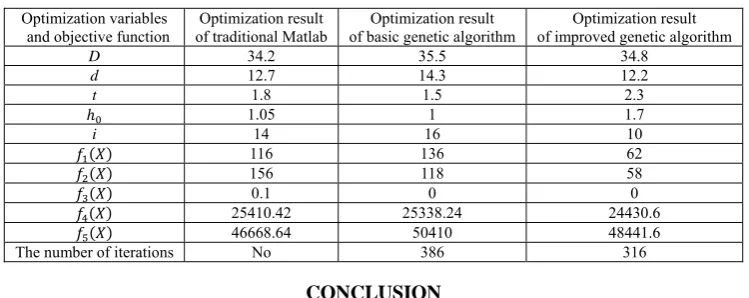
[image:9.595.119.494.462.611.2]This paper employs the improved genetic algorithm to optimize the design of the disc spring of the convolution combination and obtain the final optimization result which is compared with the optimization result of traditional Matlab and basic genetic algorithms shown in table 1. It can be seen that using the improved genetic algorithm to optimize the multi-variable and multi-target disc spring set achieved significant results. Then the laboratory test of performance parameters is conducted on the disc spring set obtained from optimization design. The deviation between the optimization result and the laboratory test result does not exceed 8%. In addition, the laboratory test whose mechanical life reaches 8000 times is conducted and there are no anomalies. Then the structure size and performance parameter tests are conducted on the disc spring set after test. The deviation between the obtained result and the optimization result does not exceed 12%, which further verifies the feasibility and effectiveness of the optimization algorithm.
Table 1 Comparison table of optimization results
Optimization variables and objective function
Optimization result of traditional Matlab
Optimization result of basic genetic algorithm
Optimization result of improved genetic algorithm
D 34.2 35.5 34.8
d 12.7 14.3 12.2
t 1.8 1.5 2.3
1.05 1 1.7
i 14 16 10
116 136 62
156 118 58
0.1 0 0
25410.42 25338.24 24430.6
46668.64 50410 48441.6
The number of iterations No 386 316
CONCLUSION
As the operation mechanism of vacuum interrupter, the over-travel rod functions with its core element being the disc spring. On the basis of introducing the structure of the over-travel rod, this paper analyzes the functions of disc spring and employs the genetic algorithm to optimize the design of disc spring.
In the process of the optimization design, through adjusting the intersection and mutation probability, the second intersection, designated gene mutation and immigration policy to improve the basic genetic algorithm, this paper solves the drawback that the basic genetic algorithm is easy to fall into premature convergence.
By comparing the optimization result obtained from improved genetic algorithm with the traditional Matlab optimization result and the optimization result of the basic genetic algorithm, this paper further verifies the advantage of using improved genetic algorithm to optimize the design of disc spring.
feasibility and effectiveness of the optimization design method.
REFERENCES
[1]WANG jimei, LIUzhiyuan, et al. Electrical Engineering,n 12, p5-92006
[2]WANG jimei. High Voltage Apparatus, v 39, n 1, p 65-67, 2003.
[3]SHU shengwen, RUAN jiangjun, HUANG daochun. High Voltage Engineering,v 40, n 1 ,p309-316,2014
[4]Wenzel T, Leibfried T. IEEE Transactions on Power Delivery, v 27. n 1, p236-244, 2012.
[5]SHI fei, LIN xin, XU jianyuan. Discharges and Electrical Insulation in Vacuum, n 2, p 438-441,2004. [6]YANG Wu, RONG mingzhe, WANG xiaohua. Proceedings of the CSEE, v 23, n 6, pp 128, 2003. [7]SHI fei, LIN xin, XUjianyuan, et al. High Voltage Apparatus, v 41, n 1, p 32, 2005
[8]LI jianji. Electrotechnics Electric, n 6, p58-59, 2012.
[9]YU xinjie, WANG zanji. Proceedings of the CSEE, v 20, n 11, p 21-24,2000.
[10]GUO hui. Proceeding of the CSEE, v, 25, n 4, p 119, 2005.
[11]Holland J H. University of Michigan Press, Ann Arbor,1975.
[12]JIANG daihong.Science Technology and Engineering,.v 13, n 3, p 763-765, 2013. [13]GAO shan, SHAN yuanda. Proceedings of the CSEE, v 21, n 5,p 45-48, 2001.
[14]Nims J W, Smith R E. Electric Machines and Power Systems. v 24, n 10, p 669-680, 1995. [15]YU jianming, DU gang, YAO lixiao. Power System Technology, v 26, n 7, p 46-49, 2002. [16]YUAN mianqi, ZOU zhenyu, SUN kaiqi, et al. Electric Power, v 46, n 1 ,p 16-20, 2013.