Journal of Chemical and Pharmaceutical Research, 2018, 10(3):190-198
Mini-Review Article
CODEN(USA) : JCPRC5
ISSN : 0975-7384
190
Properties, Applications and Synthesis (Microwave Assisted) of Binary
Carbides: A Mini-Review
Shilpa Vats, Ragini Sharma and Nupur Prasad
*Lovely Professional University, Phagwara, Punjab, India
_____________________________________________________________________________
ABSTRACT
In binary carbides, one of the constituent elements is carbon whereas other one is a much less electronegative element. These compounds show several unique properties. They are extensively used for numerous industrial applications. Hence, several routes of synthesis have been developed to synthesise a range of carbides. Normally, heat treatment is required to synthesise carbides. In recent years, microwaves as a heating aid, have extensively been used in laboratories for chemical synthesis. Microwave assisted synthesis of materials is much less time consuming than the conventional heating method. A range of carbides have been synthesised using microwave heating as carbon couples with microwaves. The generation of heat in carbon, when exposed to microwaves, is explained through conduction mechanism. Microwave assisted synthesis of carbides is fast, simple, cost-effective and environmentally friendly.
Keywords: Microwaves; Carbides; Carbide synthesis; Rapid synthesis; Binary carbide
_____________________________________________________________________________
INTRODUCTION
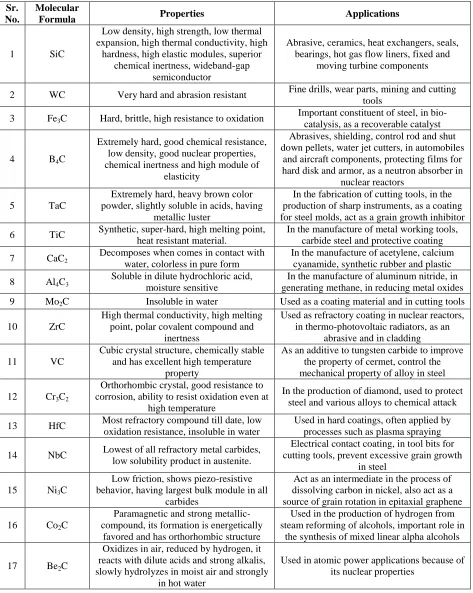
Carbides are important compounds because of their unique properties and numerous applications [1-17]. Hence, several routes of synthesis have been developed for their synthesis [18-81]. These are the compounds of carbon with less electronegative elements. Compounds of carbon with nitrogen, phosphorus, oxygen, sulfur and halogens are not recognized as carbides [82]. They are classified as follows:
1. Salt like or ionic carbides: Carbides of highly electropositive elements such as alkali metals, alkaline earth metals and aluminum are termed as ionic or salt like carbides. Few of these carbides for example aluminum carbide and calcium carbide, behave as if the carbon atom is present in in anionic form as when they are treated with water hydroxides of the metals is obtained [82].
2. Covalent carbides: Metalloids such as silicon and boron form carbides. Covalent bonds exist between the metalloid atom (i.e. atoms of silicon and boron) and carbon atom. These are extremely hard, infusible and chemically inert [82].
3. Interstitial carbides: Carbon atoms occupy the interstitial space in the closed packed array of metal atoms. These are very hard with high melting points. They are good conductors of electricity. These can be hydrolyzed by water or dilute acids [82].
191
Table 1: List of properties and applications of binary carbides
Sr. No.
Molecular
Formula Properties Applications
1 SiC
Low density, high strength, low thermal expansion, high thermal conductivity, high
hardness, high elastic modules, superior chemical inertness, wideband-gap
semiconductor
Abrasive, ceramics, heat exchangers, seals, bearings, hot gas flow liners, fixed and
moving turbine components
2 WC Very hard and abrasion resistant Fine drills, wear parts, mining and cutting
tools
3 Fe3C Hard, brittle, high resistance to oxidation
Important constituent of steel, in bio-catalysis, as a recoverable catalyst
4 B4C
Extremely hard, good chemical resistance, low density, good nuclear properties, chemical inertness and high module of
elasticity
Abrasives, shielding, control rod and shut down pellets, water jet cutters, in automobiles
and aircraft components, protecting films for hard disk and armor, as a neutron absorber in
nuclear reactors
5 TaC
Extremely hard, heavy brown color powder, slightly soluble in acids, having
metallic luster
In the fabrication of cutting tools, in the production of sharp instruments, as a coating for steel molds, act as a grain growth inhibitor
6 TiC Synthetic, super-hard, high melting point, heat resistant material.
In the manufacture of metal working tools, carbide steel and protective coating
7 CaC2
Decomposes when comes in contact with water, colorless in pure form
In the manufacture of acetylene, calcium cyanamide, synthetic rubber and plastic
8 Al4C3
Soluble in dilute hydrochloric acid, moisture sensitive
In the manufacture of aluminum nitride, in generating methane, in reducing metal oxides
9 Mo2C Insoluble in water Used as a coating material and in cutting tools
10 ZrC
High thermal conductivity, high melting point, polar covalent compound and
inertness
Used as refractory coating in nuclear reactors, in thermo-photovoltaic radiators, as an
abrasive and in cladding
11 VC
Cubic crystal structure, chemically stable and has excellent high temperature
property
As an additive to tungsten carbide to improve the property of cermet, control the mechanical property of alloy in steel
12 Cr3C2
Orthorhombic crystal, good resistance to corrosion, ability to resist oxidation even at
high temperature
In the production of diamond, used to protect steel and various alloys to chemical attack
13 HfC Most refractory compound till date, low
oxidation resistance, insoluble in water
Used in hard coatings, often applied by processes such as plasma spraying
14 NbC Lowest of all refractory metal carbides, low solubility product in austenite.
Electrical contact coating, in tool bits for cutting tools, prevent excessive grain growth
in steel
15 Ni3C
Low friction, shows piezo-resistive behavior, having largest bulk module in all
carbides
Act as an intermediate in the process of dissolving carbon in nickel, also act as a source of grain rotation in epitaxial graphene
16 Co2C
Paramagnetic and strong metallic- compound, its formation is energetically
favored and has orthorhombic structure
Used in the production of hydrogen from steam reforming of alcohols, important role in
the synthesis of mixed linear alpha alcohols
17 Be2C
Oxidizes in air, reduced by hydrogen, it reacts with dilute acids and strong alkalis, slowly hydrolyzes in moist air and strongly
in hot water
192
SYNTHESIS OF BINARY CARBIDES
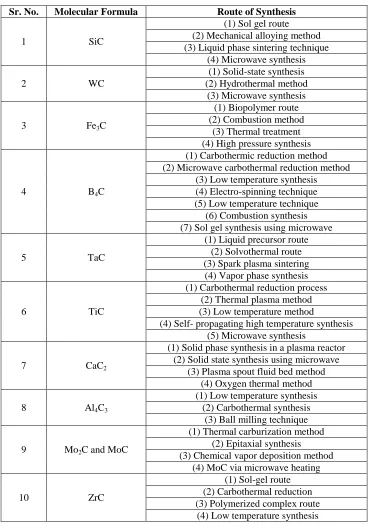
[image:3.612.122.493.192.717.2]Binary carbides are synthesised through several methods. The various routes of synthesis of binary carbides are listed in Table 2. Different methods are employed to synthesise carbides in an attempt to find out the best practice. A list of different synthetic routes employed for the preparation of different binary carbides are listed in Table 2 [18-81]. It was observed that heating is an important aid to bring about the chemical reaction. Normally, the reaction mixtures were heated using an electric furnace. It is a long and cumbersome process. To improve these processes the electric heating was substituted with microwave heating. It was believed that because of the difference in heating mechanism the rate of reaction will increase. The heating mechanisms are discussed in the following sections.
Table 2: Routes employed for the preparation of binary carbides
Sr. No. Molecular Formula Route of Synthesis
1 SiC
(1) Sol gel route (2) Mechanical alloying method (3) Liquid phase sintering technique
(4) Microwave synthesis
2 WC
(1) Solid-state synthesis (2) Hydrothermal method (3) Microwave synthesis
3 Fe3C
(1) Biopolymer route (2) Combustion method
(3) Thermal treatment (4) High pressure synthesis
4 B4C
(1) Carbothermic reduction method (2) Microwave carbothermal reduction method
(3) Low temperature synthesis (4) Electro-spinning technique (5) Low temperature technique
(6) Combustion synthesis (7) Sol gel synthesis using microwave
5 TaC
(1) Liquid precursor route (2) Solvothermal route (3) Spark plasma sintering
(4) Vapor phase synthesis
6 TiC
(1) Carbothermal reduction process (2) Thermal plasma method (3) Low temperature method
(4) Self- propagating high temperature synthesis (5) Microwave synthesis
7 CaC2
(1) Solid phase synthesis in a plasma reactor (2) Solid state synthesis using microwave
(3) Plasma spout fluid bed method (4) Oxygen thermal method
8 Al4C3
(1) Low temperature synthesis (2) Carbothermal synthesis
(3) Ball milling technique
9 Mo2C and MoC
(1) Thermal carburization method (2) Epitaxial synthesis (3) Chemical vapor deposition method
(4) MoC via microwave heating
10 ZrC
(1) Sol-gel route (2) Carbothermal reduction (3) Polymerized complex route
193
11 VC
(1) Thermal method (2) Low temperature synthesis (3) Mechanical alloying method
(4) Thermal refluxing method (5) Hydrothermal method
12 Cr3C2
(1) Conventional method (2) Chemical reduction (3) Mechanical- thermal method (4) Spark plasma sintering method
(5) Combustion synthesis
13 HfC
(1) Sol-gel route
(2) Carbothermal reduction method (3) Plasma sintering process
(4) Liquid phase synthesis (5) Low temperature synthesis
14 NbC
(1) Low temperature treatment (2) Carbothermal route (3) Mechanochemical method
(4) Self- propagating high temperature method (5) Microwave synthesis
15 Ni3C
(1) Thermal decomposition (2) Mechanochemical method
(3) Physical vapor deposition
16 Co2C
(1) Low temperature synthesis (2) Polyol reaction (3) Laser synthesis
17 Be2C (1) High temperature synthesis
Microwave Assisted Synthesis of Binary Carbides
Generally, carbides are synthesised at high temperatures. It is also a time-consuming process. To improve this process and to reduce the time microwaves was used. The difference is attributed to the difference in heating mechanisms. The heating mechanisms are as follows:
The conventional heating mechanism:
The exterior of the reactants is heated via radiation, convection or conduction. Normally, mixture of all three and hence the rate of heating is slow. The rate of flow of heat inside the body is determined by the physical properties of the work piece. They are i) specific heat; ii) thermal conductivity and iii) density. The combination of these is termed as “thermal diffusivity”. Thermal diffusivity determines the rate of rise of temperature inside the work-piece. Time and the thickness of the work-piece play an important role. As thicker the work piece, the greater will be the time it will take to transfer heat. Rate of transfer of heat cannot be changed neither the temperature achieved by the surface of the work-piece can be increased. Hence, temperature of the inner part of the work-piece depends upon the thermal diffusivity as well as the maximum temperature the surface of the work-piece can achieve [84]. In contrast to that in microwave heating, the electromagnetic radiation penetrates inside the work piece. It does not depend on the temperature of the surface. Hence, rise in temperature inside the work-piece is greater rate in microwave heating than the rate of rise of temperature via conventional heating.
The microwave heating mechanism:
Electromagnetic waves with wavelengths in the range of 1 mm to 1 m and frequency between 0.3 GHz to 300 GHz is termed as microwaves. The microwave heating mechanism is explained via the following ways:
i) Microwave heating due to molecular polarization ii) Microwave heating due to conduction
194
Microwave heating due to molecular polarisation: The molecules of a work-piece interact with the microwaves. Molecules contain both positive and negative charges. When these charges come in contact with the microwaves they tend to align with the electromagnetic field. The dipoles get energy from the electromagnetic field for rotation but the dipoles lag behind the alternating electric field of the electromagnetic radiation. This lag in rotation causes molecular friction which generates heat inside the work-piece. This gives rise to a phase difference. This phase difference causes energy to be lost from the dipole, by molecular friction and random collisions, giving rise to heat into the body. Thus, the tendency of displacement of charges within the material due to application of microwaves is one of the main causes of generation of heat [85-89]. This mechanism is further understood in the categories of electronic polarisation, polarisation due to inter-nuclear displacement and dipolar polarisation. Normally, when we heat our food in a domestic microwave oven, heat is produced via dipolar polarisation. As our food contain water. The molecules of water contain permanent dipole. A domestic microwave oven is tuned for water.
The above discussed mechanisms can be explained simply as that the oscillating electric and magnetic field of the electromagnetic field applies a force on the charged particles thus compelling the molecules to migrate and rotate. This molecular movement creates intermolecular friction which in turn produces heat.
Heating effects due to conduction: The microwave heating mechanism when a conducting material is exposed to microwaves is explained by the conduction mechanism. The conduction mechanism is discussed in the next section. When a material having loosely bound charged particles which are free to travel in the material, for example electrons in a sample of carbon such as graphite where labile electrons present in the system, or a solution containing ionic salts such as sodium chloride solution in water, are exposed to microwaves the oscillating electromagnetic field generates an oscillation of electrons or ions in the material, resulting in an electric current. These current faces internal resistance, which heats the material [85].
Microwave heating in metals: Heat is generated when a metal is exposed to microwaves. The mechanism of heat generation in metals can be explained by ‘skin effect’. Metals contain labile electrons on their outer surface. The electronic structure of metal can be visualised as positively charged ions submerged in a “sea” of electrons. When the metal is exposed to microwaves, there is tendency of the microwaves to disperse on the surface of the metal. Electric current tends to flow at the surface of the material which is known as the ‘skin effect’ and the measure of the distance over which the current falls to 1/e of its original value is known as the ‘skin depth’ [85-92]. The mechanism of heat production can be explained using Joule’s law or Ohmic heating. The microwave heating of metals often is accompanied by the formation of plasma.
Interfacial polarisation: This mechanism is important for systems comprised of conducting inclusions in a second non-conductive material. An example would be a dispersion of metal particles in a microwave transparent material such as sulphur. Sulphur is microwave transparent and the metals reflect microwaves yet the combination of the two makes the heterogeneous phase mixture microwave absorbent. It can be viewed as a combination of the conduction and dipolar polarisation. The formation of a few of the chalcogenides via microwave heating such as synthesis of arsenic sulfide [90-92] may be explained by this mechanism. Although arsenic is generally viewed as being a metalloid rather than being a true metal, being located in the middle of the ‘p’ block of the Periodic Table.
Microwave Assisted Synthesis of Carbides
195
different from that of the conventional heating method. Heat is generated because of molecular agitation when the reactants were exposed to microwaves [19,93].
Carbide of boron was synthesised using microwave assisted carbothermal reduction. High purity disordered carbon black and boric acids were used as source of carbon and boron. Different ratios boric acid and carbon black were added to ethanol in different sets of experiments with an aim to synthesise carbide of boron with different percentage of boron. The mixture was then heated at 50°C to partially evaporate the solvent form a paste like mixture. The mixture was then extruded and heated at 50°C in a kiln. Samples were exposed to microwaves for 20 minutes in a domestic oven (2.45 GHz, Cober, USA). The DMO cavity was flushed with argon (rate of flow of argon was reported to be 1liter/min) before the experiment. Crystals of boron carbide in nano-meter scale were formed. The reaction did not require any catalyst e.g. cobalt. Microwave carbothermal reduction process is fast, cost-effective and environmentally friendly [27]. Application of microwaves proved promising when boron carbide was synthesised using sol-gel method [32].
Titanium carbide and calcium carbide were synthesised via microwave carbothermal reduction. Oxides of titanium and calcium were taken as sources of calcium and titanium in these experiments. Carbon black was used as source of carbon. Theses starting materials were mixed with organic solvents (absolute ethanol was used for the preparation of TiC whereas acetone was used for the preparation of CaC2) and ball milled for several hours (12 hours for the preparation of TiC and 24 hours for the preparation CaC2) for intimate mixing. This mixture was dried (6 hours in electrical furnace at 80°C for synthesising TiC whereas 24 hours under vacuum for synthesising CaC2). These were then exposed to microwaves using a microwave oven. Reactions were carried out in microwave oven working at 2.45 GHz. Microwave oven from Institute of Metal research (Shengyang, China, CAS. MFM-863III) was used for the synthesis of TiC whereas industrial microwave reactor (Hadron Technologies Inc.) was used for the preparation of CaC2. TiC and CaC2 were formed in much less time via microwave heating than the conventional heating. CaC2 was synthesised in 180 minutes in DMO whereas it could be synthesised in 1200 minutes via conventional heating method. The success in these can be attributed to the difference in heating mechanisms [40,42].
WC is exceptionally resistant towards CO poisoning. This makes them promising materials that can be used with electrocatalyst in fuel cells. To increase the surface area of the WC, catalyst-supporting approaches are used. Ma. et. al. synthesised mesoporous carbon supported WC using microwave heating. WCl6 was used as source of W whereas sucrose was used as source of carbon. WCl6 and sucrose were dissolved in ethanol-water mixture. This mixture was then added to a solution of Pluronic F127 (a polymer) in ethanol. In a different set of experiment, WCl6, sucrose and the solvent mixture (i.e. ethanol-water mixture) was added to solution mesoporous silica (SBA-15, SBA15 was also dissolved in ethanol). The mixtures were then exposed to microwaves (Biotage, Initiator EXP) at 100 C for 60 min. The product was then calcinated at 900°C for 3 hours in a controlled environment (i.e. under the flow of argon and hydrogen gas). Results suggested that WC was formed in both the cases [94].
MoC was also synthesised via microwave heating. Ammonium-heptamolybdate (AMD) was used as source of Mo whereas carbon was used as source of carbon. AMD was dissolved in water. Carbon powder was dispersed in this solution. The reaction container was flushed with nitrogen in an attempt to remove oxygen. This reaction mixture was then exposed to microwaves for 2 minutes at 800 Watts when MoC was synthesised.
NbC was synthesised through solid-state synthetic route. Powders of Nb and C were mixed and pressed to pellets. It was then exposed to microwaves when carbides were formed. A single mode cavity was used. NbC can be formed in 20 seconds. The occurrence of fast reaction was attributed to the generation of heat at molecular level when the reactants were exposed to microwaves.
Titanium carbide and tantalum carbide were synthesised. Oxides of titanium (TiO2) and tantalum (Ta2O5) were used. Powdered carbon black was used as source of carbon. These oxides were mixed thoroughly and exposed to microwaves. A multimode microwave oven working at 2.45 GHz was used. The cavity was flushed with argon gas to create inert atmosphere. Microwave power was controlled between 500 Watt to 5 kWatt. Rise in temperature of the samples were measured using optical device. Rate of increase of temperature was very high which a challenge as described by the authors became. Commercial grade TiC cannot be synthesised. This result was attributed to either the use of argon atmosphere instead of vacuum or excessive growth of the grain which hindered the reaction. On the other hand, TaC was formed in pure phase. Conventionally, it takes about 6 hours to synthesise TaC at ~ 1750°C whereas the application of microwaves reduces the time to 60 minutes at 1500°C.
196
Oxides of vanadium (V2O5) were mixed with magnesium and amorphous graphite. The mixture was milled for 24 hours. The milling was done in a controlled environment (in high purity argon atmosphere). It was washed with acetic acid to remove oxides of magnesium. The mixture was then irradiated with microwaves at 900 Watts. The microwave oven was working at 2.45 GHz frequency. V8C7 nano powder was successfully synthesised. Al4C3 is synthesised via microwave heating in 30 minutes at 800 Watts. A microwave oven working at 2.45 GHz was used for this purpose. Aluminium metal powder and graphite were used as source of aluminium and carbon. These two powders were mixed thoroughly and pressed into pellet for close contact of the two materials. The microwave synthesis was much faster as compared to conventional method. Conventionally, it takes about 12 hours.
CONCLUSION
A range of carbides are synthesised via microwave heating. Microwave assisted synthesis has been proved to be fast, simple, cost-effective and environmentally friendly. This observation can be attributed to the microwave heating mechanism. Carbon absorbs microwaves and heat is generated. The mechanism of heat generation in carbon is explained by conduction mechanism. Carbon has very important role in microwave assisted synthesis of carbides. It reduces the oxides if in case oxides are taken as starting materials on the other hand it also acts as microwave absorbers.
REFERENCES
[1] http://accuratus.com/silicar.html
[2] https://www.azom.com/article.aspx?ArticleID=1203
[3] W Yang; S Rehman; X Chu; Y Hou; S Gao. Chem Nano Mat. 2015, 1(6), 376-398. [4] http://www.chemistrylearner.com/boron-carbide.html
[5] https://www.azom.com/article.aspx?ArticleID=2308
[1] http://iopscience.iop.org/article/10.1088/1757-899X/91/1/012017/pdf
[2] http://www.ascconline.com/img/services/project_report/Calcium_Carbide_Project_Report_Sample.pdf [1] http://www.chemicalbook.com/ChemicalProductProperty_EN_CB2101499.html
[2] https://www.americanelements.com/molybdenum-carbide-moc-12627-57-5
[3] Y Katoh; G Vasudevamurthy; T Nozawa; LL Snead. J Nucl Mater. 2013, 441(1), 718-742. [4] http://tudr.thapar.edu:8080/jspui/bitstream/10266/1916/3/1916.pdf
[5] M Detroye; F Reniers; C Buess-Herman; J Vereecken. Appl Surf Sci. 1997, 120(1), 85-93. [6] www.reade.com/products/hafnium-carbide-powder-hfc
[7] http://www.reade.com/products/niobium-carbide-powder-nbc-nb2c
[8] J Kelling; P Zahn; J Schuster; S Gemming. Phys Rev B. 2017, 95(2), 024113. [9] YH Zhao; HY Su; K Sun; J Liu; WX Li. Surf Sci. 2012, 606(5), 598-604. [10] http://www.allreactions.com/index.php/group-2a/beryllium/beryllium-carbide
[11] H Abderrazak, ES Hmida. Silicon carbide: synthesis and properties. In: Properties and applications of silicon carbide, InTech, 2011.
[12] T Ebadzadeh; E Marzban-Rad. Mater Charact. 2009, 60(1), 69-72. [13] J Ma; SG Zhu. Int J Refract Met H. 2010, 28(5), 623-627.
[14] S Sagadevan; I Das; P Singh; J Podder. J Mater Sci-Mater El. 2017, 28(1), 1136-1141. [15] Z Schnepp; SC Wimbush; M Antonietti; C Giordano. Chem Mater. 2010, 22(18), 5340-5344. [16] Y Gu; M Qin; Z Cao; B Jia; X Wang; X Qu. J Am Ceram Soc. 2016, 99(4), 1443-1148.
[17] O Schneeweiss, R Zbořil, B David, M Heřmánek, M Mashlan. Solid-state synthesis of α-Fe and iron carbide nanoparticles by thermal treatment of amorphous Fe2O3, InISIAME 2008, Springer, Berlin, Heidelberg, 2009, 167-173.
[18] RH Bagramov; VD Blank; NR Serebryanaya; GA Dubitsky; EV Tatyanin; VV Aksenenkov. Fullerenes, Nanotubes and Carbon Nanostructures. 2012, 20(1), 41-48.
[19] A Alizadeh; E Taheri-Nassaj; N Ehsani. J Eur Ceram Soc. 2004, 24(10), 3227-3234. [20] RF Gunnewiek; PM Souto; RH Kiminami. J Nanomaterials. 2017, 2017.
[21] P Murray. Low temperature synthesis of boron carbide using a polymer precursor powder route, Doctoral dissertation, University of Birmingham, 2011.
197
[23] K Zakharova, A Mednikova, V Rumyantsev, T Genusova. Synthesis of Boron Carbide from Boric Acid and Carbon-Containing Precursors, Proceedings of the International Conference Nanomaterials: Applications and Properties, 2013, 2, 3.
[24] RS Harini; E Manikandan; S Anthonysamy; V Chandramouli; D Eswaramoorthy. Combustion synthesis of novel boron carbide. AIP Conference proceedings, 2013, 1512(1), 1244-1245.
[25] M Rodríguez, U Ortiz, J Aguilar, Z Valdez. Microwaves for sol-gel synthesis of boron carbide (B4C). In World congress on microwave and radio frequency applications, 2004, 199-210.
[26] H Xiang; Y Xu; L Zhang; L Cheng. Scripta Materialia. 2006, 55(4), 339-342.
[27] C Zhang; A Gupta; S Seal; B Boesl; A Agarwal. J Am Ceram Soc. 2017, 100(5), 1853-1862. [28] PH Crayton; MC Gridly. Powder Metall. 1971, 14(27), 78-85.
[29] Y Gotoh; K Fujimura; M Koike; Y Ohkoshi; M Nagura; K Akamatsu; S Deki. Mater Res Bull. 2001, 36(13-14), 2263-2275.
[30] L Tong; RG Reddy. Scripta Materialia. 2005, 52(12), 1253-1258.
[31] DW Flaherty; RA May; SP Berglund; KJ Stevenson; CB Mullins. Chem Mater. 2009, 22(2), 319-329. [32] S Niyomwas. Sonklanakarin J Sci Technol. 2010, 32(2), 175.
[33] PA Liu, QS Yang, AZ Shui, H Wang, XS Cheng, LK Zeng, Y Liu. Microwave synthesis of nano-titanium carbide, In Advanced Materials Research, Trans Tech Publications, Switzerland, 2012, 399, 561-564. [34] MH El-Naas; RJ Munz; F Ajersch. Plasma Chem Plasma P. 1998, 18(3), 409-427.
[35] RC Pillai; EM Sabolsky; SL Rowan; IB Celik; S Morrow. Ind Eng Chem Res. 2015, 54(44), 11001-11010. [36] El-Naas MH. Synthesis of calcium carbide in a plasma spout fluid bed.
[37] Y Mi; D Zheng; J Guo; X Chen; P Jin. Assessment of energy use and carbon footprint for low-rank coal-based oxygen-thermal and electro-thermal calcium carbide manufacturing processes. Fuel Process Technol. 2014, 119, 305-315.
[38] J Li; G Zhang; D Liu; O Ostrovski. ISIJ International. 2011, 51(6), 870-877. [39] M Halmann; A Frei; A Steinfeld. Energy. 2007, 32(12), 2420-2427.
[40] M Bastwros; GY Kim; C Zhu; K Zhang; S Wang; X Tang; X Wang. Compos Part B-Eng. 2014, 60, 111-118.
[41] HM Wang; XH Wang; MH Zhang; XY Du; W Li; KY Tao. Chem Mater. 2007, 19(7), 1801-1807. [42] J Jeon; Y Park; S Choi; J Lee; SS Lim; BH Lee; YJ Song; JH Cho; YH Jang; S Lee. ACS Nano. 2018. [43] JJ Lugge. Molybdenum carbide synthesis using plasmas for fuel cells, Thesis submitted to Naval
Postgraduate School, 2013.
[44] M Nagai; I Shishikura; S Omi. Molybdenum Carbide Prepared by Chemical Vapor Deposition. Jpn J Appl Phys. 2000, 39(7S), 4528.
[45] M Dolle; D Gosset; C Bogicevic; F Karolak; D Simeone; G Baldinozzi. J Eur Ceram Soc. 2007, 27(4), 2061-2067.
[46] A Jain. Synthesis and Processing of Nanocrystalline Zirconium Carbide Formed by Carbothermal Reduction, Doctoral dissertation, Georgia Institute of Technology, 2004.
[47] R Liu; C Yan; C Zhang; Y Cao; X Long. Adv Appl Ceram. 2016, 115(1), 6-12.
[48] SW Zhang, Y Wen, HA Yeprem. Low Temperature Synthesis of High Quality Zirconium Carbide Powder. In Applied Mechanics and Materials, Trans Tech Publications, Switzerland, 2013, 319, 219-223.
[49] M Mahajan, K Singh, OP Pandey. Synthesis of vanadium carbide nanoparticles by thermal decomposition of the precursor. AIP Conference Proceedings 2013, 1536(1), 271-272.
[50] J Ma; M Wu; Y Du; S Chen; J Ye; L Jin. Mater Lett. 2009, 63(11), 905-907.
[51] M Hossein-Zadeh; M Razavi; M Safa; A Abdollahi; O Mirzaee. J King Saud Univ Engine Sci. 2016, 28(2), 207-212.
[52] F Liu; Y Yao; H Zhang; Y Kang; G Yin; Z Huang; X Liao; X Liang. J Mater Sci. 2011, 46(11), 3693-3697. [53] Y Zhang; J Zhang; M Fan; YA Long; Y Zhong; X Liu; CH Huang. B Mater Sci. 2013, 36(3), 345-351. [54] B Khoshandam; RV Kumar; E Jamshidi. AIChE Journal. 2006, 52(3), 1094-1102.
[55] S Rajpoot; OP Pandey. Synthesis and characterization of chromium carbide (Cr3C2) nanoparticles, Doctoral dissertation, 2013.
[56] OM Cintho; EA Favilla; JD Capocchi. J Alloy Compd. 2007, 439(1-2), 189-195.
[57] H Motono; M Yoshinaka; K Hirota; O Yamaguchi. J Jpn Soc Powder and Powder Metall. 2003, 50(5), 372-376.
198
[59] B Matović; B Babić; D Bučevac; M Čebela; V Maksimović; J Pantić; M Miljković. Ceram Int. 2013, 39(1), 719-723.
[60] L Feng; SH Lee; H Wang; HS Lee. J Eur Ceram Soc. 2015, 35(15), 4073-4081.
[61] C Zhang; A Gupta; S Seal; B Boesl; A Agarwal. J Am Ceram Soc. 2017, 100(5), 1853-1862.
[62] ZX Mei, XJ Su, GL Hou, F Guo, Y Cheng. Solution-Based Synthesis of Hafnium Carbide (HfC) Powders. In Advanced Materials Research, Trans Tech Publications, 2012, 457, 283-286.
[63] L Wang; W Xi; T Mei; Y Cai; J Lu; D Zhao; H Huang; W Liu; Q Zhou. J Ceram Soc Jpn. 2017, 125(10), 789-791.
[64] FF Medeiros; AG Da Silva; CP De Souza. Powder Technol. 2002, 126(2), 155-160.
[65] A Gupta, OP Pandey. Synthesis and characterization of Niobium Carbide (NbC) Nano-powder, Doctoral dissertation, 2015.
[66] J Kano; N Sato; S Suzuki; F Saito; H Suginobe; T Shiokawa. ISIJ Int. 2009, 49(3), 458-462. [67] T Tsuchida; Y Azuma. J Mater Chem. 1997, 7(11), 2265-2268.
[68] Y Goto; K Taniguchi; T Omata; S Otsuka-Yao-Matsuo; N Ohashi; S Ueda; H Yoshikawa; Y Yamashita; H Oohashi; K Kobayashi. Chem Mater. 2008, 20(12), 4156-4160.
[69] Portnoi VK, Leonov AV, Mudretsova SN, Fedotov SA. The Physics of Metals and Metallography. 2010, 109(2), 153-161.
[70] JY Hwang, AR Singh, M Chaudhari, JS Tiley, Y Zhu, J Du, R Banerjee. J Phys Chem C. 2010, 114(23), 10424-10429.
[71] P Hasin. J Phys Chem C. 2014, 118(9), 4726-4732.
[72] VG Harris; Y Chen; A Yang; S Yoon; Z Chen; AL Geiler; J Gao; CN Chinnasamy; LH Lewis; C Vittoria; EE Carpenter. J Phys D Appl Phys. 2010, 43(16), 165003.
[73] SH Huh; A Nakajima. J Appl Phys. 2006, 99(6), 064302.
[74] R Mateus; PA Carvalho; N Franco; LC Alves; M Fonseca; E Alves. In Materials Science Forum, Trans Tech Publications, Switzerland, 2013, 730, 179-184.
[75] FA Cotton; G Wilkinson. Basic Inorganic Chemistry, 1987. [76] https://en.wikipedia.org/wiki/Carbide
[77] RJ Meredith. Engineers' handbook of industrial microwave heating. Iet, London, 1998. [78] http://www.tan-delta.com/
[79] SA Galema. Chem Soc Rev. 1997, 26, 233-238.
[80] AG Whittaker; DMP Mingos. J Chem Soc Dalton Trans. 1995, 2073-2079. [81] AG Whittaker; DMP Mingos. J Chem Soc. Dalton Trans. 2002, 3967-3970.
[82] RP Feynman. Feynman lectures on physics: Mainly electromagnetism and matter, Addison-Wesley, US, 1964.
[83] N Prasad; D Furniss; HL Rowe; CA Miller; DH Gregory; AB Seddon. J Non-Cryst Solids, 2010, 356(41-42), 2134-2145.
[84] N Prasad, AB Seddon. First-time microwave-synthesis of As 40 Se 60 chalcogenide glass: With potential for mid-infrared photonics. In: Transparent Optical Networks (ICTON). 12th International Conference on IEEE. 2010, 1-4.
[85] N. Prasad, D Furniss, DH Gregory, S Kingman. Microwave assisted synthesis of chalcogenide glasses. International Symposium on Non-Oxide and New Optical Glasses (ISNOG), Indian Institute of Science, Bangalore, India, 2006.
[86] SM Kahar, CH Voon, U Hashim, MM Arshad, AR Ruslinda, PP Adelyn, AR Huda, HC Lee, CC Lee, W Rahman, BY Lim. Microwave Irradiation Assisted Synthesis of Silicon Carbide Nanowhiskers. In: Micro and Nanoelectronics (RSM), IEEE Regional Symposium. 2015, 1-4.
[87] M Shi; L Kang; Y Jiang; C Ma. Catal Lett. 2014, 144, 278-284.
[88] AR Yacob; MK Mustajab; NH Suhaimi. Int J Metall Mater Eng. 2012, 6(11), 1036-1039.
[89] SR Vallance; DM Round; C Ritter; E Cussen; S Kingman; DH Gregory. Adv Mater. 2009, 21, 4502-4504. [90] NA Hassine; JG Binner; TE Cross. Int J Refract Metals Hard Mater.1995, 13(6), 353-358.
[91] Z Zhao; F Chen; M Wang; H Zheng. Int J Refract Metals Hard Mater. 2015, 51, 212-215.
[92] M Hossein-Zadeh; M Razavi; M Safa; A Abdollahi; O Mirzaee. J King Saud Univ Sci. 2016, 28(2), 2017-212.
[93] G Furnari. Rapid Microwave-assisted Synthesis and Characterization of Transition Metal Carbides and Nitrides.Doctoral dissertation to University of Glasgow, 2017.