International Journal of Emerging Technology and Advanced Engineering
Website: www.ijetae.com (ISSN 2250-2459, Volume 1, Issue 2, December 2011)102
Evaluation of BER in CDMA with Parallel
Interference Cancellation
Rashmi Mishra
1, Prof. Rajesh Nema
2 1Department of Electronics & Communication Engineering, NIIST, Bhopal, M.P., INDIA 2Head,Department of Electronics & Communication Engineering, NIIST, Bhopal, M.P., INDIA
Abstract- In this paper, we present the performance of a parallel interference cancellation (PIC) scheme in Code division multiple access with cyclic prefix (CP-CDMA) systems and proposed a new model for cyclic prefix code division multiple access with less complexity and good resistance to near-far effect. This method is mostly used for broadband wireless communication in the uplink. Parallel interference cancellation (PIC) can achieve better performance of bit error rate (BER). According to PIC, it provides better performance as compare to interference cancellation (IC). The simulation results are provided in both additive white Gaussian noise channel and inter-symbol interference (multipath fading channel).
Keywords: Code-division multiple access with cyclic
prefix (CP-CDMA), Parallel interference cancellation (PIC), AWGN Channel, Fading Channel
I. INTRODUCTION
The design of future broadband wireless systems presents a big challenge, since these systems should be able to cope with severely time-dispersive channels and are expected to have high spectral and power efficiencies. The wireless communication industry has been very successful in recent years in providing high-speed data links that allow a multitude of multimedia applications. Among others, these successes include the terrestrial digital television standard DVB-T. The next generation mobile communication systems are required to support much higher variable data rate services with high quality. In direct sequence code division multiple access (DS-CDMA) mobile communication systems with time-varying multipath channels and additive white Gaussian noise (AWGN), both inter-symbol interference (ISI) and multiple access interference (MAI) must be considered [1].
However, recently much attention has been focused on another broadband technique, namely single-carrier (SC) transmission with frequency domain equalization (FDE). Interblock- Interference (IBI) in SC-FDE
systems [2] can be eliminated completely using
redundant cyclic prefix. SC modulation uses a single carrier, instead of the many. The equalization is carried out in the frequency domain instead of in the time domain, which has less implementation complexity in the rich multipath environments. Furthermore, code division multiple access (CDMA), with higher capacity than other multiple access techniques, can be combined with SC-FDE not only to solve the difficult multipath environment problem but also to achieve good frequency efficiency [3]. This system, called as cyclic prefix (CP)-CDMA. Moreover, CP-CDMA has reduced peak-to-average ratio (PAPR) requirements. This ratio compared with OFDM thereby allowing the use of less costly power amplifiers, which is very attractive for the implementation of user terminal. Therefore, CP-CDMA with frequency domain equalization is a good choice for the uplink transmission in the broadband wireless communication systems.
International Journal of Emerging Technology and Advanced Engineering
Website: www.ijetae.com (ISSN 2250-2459, Volume 1, Issue 2, November 2011)103
The cyclic-prefix (CP) of CP-CDMA system is known to be useful for removing IBI (Inter-Block Interference) and then CP-CDMA has been applied to uplink. The CP-CDMA system for uplink is useful for reducing complexity or processing delay of multiuser detection algorithm [4]. In this paper, we propose a novel selective parallel interference cancellation in CP-CDMA systems in the uplink.
The cancellation is performed in the frequency domain while the user signals are dispread and detected by hard-decision in the time domain. In order to alleviate the effects of the incorrect data estimates and reduce the computation complexity, the cancellation operation is selective and only the signals of the users with higher relative reliability will contribute to the
necessary interference regeneration. Multiuser
interference cancellation techniques exploit the structured nature of MAI and offer significant gains in system capacity resistance over the conventional DS-CDMA receiver [5]. A significant amount of work has been done in the simulation and analysis of Parallel Interference Cancellation (PIC) techniques in reducing MAI for CP-CDMA system, however, concentrated on the improvement in bit-error-rate (BER) performance of the system after PIC [6]. The simulation results show that the performances of the proposed receiver are better than the PIC receiver in DS-CDMA and lower BER.
II. SYSTEM MODEL
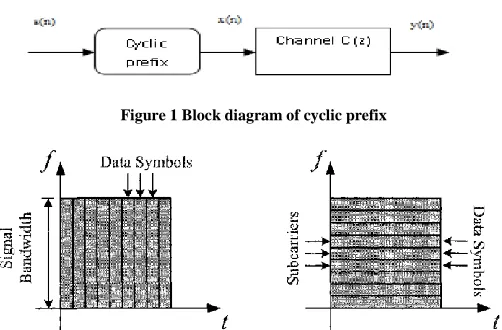
In this paper we consider the uplink transmission in DS-CDMA systems employing CP-assisted block transmission techniques. A single-cell system on the uplink is considered in this paper. One of the advantages of multiplexing and transmitting data over a number of narrow sub bands is that it lengthens the symbol duration. Instead of transmit- ting a set of data symbols in succession over the entire bandwidth, as is done in single-carrier communication, each data symbol is transmitted in parallel over the subcarriers, using a portion of the bandwidth. This is illustrated in Fig. 1-2 with denoting un-normalized frequency. This lengthening of the symbol duration reduces the effect of interference among the consecutive data symbols, or inter-symbol interference (ISI), caused by a time-dispersive channel. It consists of N user terminals transmitting quasi-synchronously (by restricting the degree of synchronization to be less than the length of the cyclic prefix) CP-CDMA symbols to a base station.
It describes the simple system model of single carrier CP-CDMA system with N user (Fig 1).
Figure 1 Block diagram of cyclic prefix
Figure 2 the relationship between the time duration and bandwidth usage in data Symbol transmission. A comparison between (a) single-carrier transmission and (b) OFDM.
We assume that the signals of the users arrive at the receiver. After binary phase shift keying (BPSK) modulation, each user’s data symbols are multiplied by m-sequence code and summed up, then divided into non-overlapping blocks. In each block there are m symbols per user. For simplicity notation, only one data block is considered in the context. The chip-level sequence in one data block can be expressed as
Where pk (i) is the Kth user’s chip-level sequence, Ak is
the average amplitude of the Kth user, and dk(m) denotes
the mth symbol of the kth user. The kth user’s spreading sequence ck (i), 0≤ i ≤N-1 is selected from a
set of m-sequence code of size N, where N is the spreading factor. Thus, the length of one data block is MN chip. Before transmission, a cyclic prefix (CP), which is a repetition of the last Ncp chips in the block, is
inserted at the beginning of the data block, as shown in Fig. 4. Note that the length of CP should be no less than the maximum delay spread of the channel to absorb the inter-block interference (IBI). The transmitted chip sequence in one CP-extended data block is defined as
[7]
.
r (i) = p (i+MN-Ncp), 0 ≤ i ≤ Ncp -1 (2)
[image:2.612.331.582.165.330.2]International Journal of Emerging Technology and Advanced Engineering
Website: www.ijetae.com (ISSN 2250-2459, Volume 1, Issue 2, November 2011)104
Fig.3. Structure of continuous transmission with CP.
Then, the transmitted data block passes through a fading channel, where the discrete channel impulse response can be expressed as:
( 3 )
The path attenuation aik is complex Gaussian random
process with zero mean, where aik can be written by
aiN = 0.5 1+ cos (2 /G (m-2)) , m= 1,2,3,…..
0 , Otherwise (4)
Where the factor G is introduced to allow scaling to customize the simulated ISI.
III. EQUALIZATION
A channel with a delay spread introduces
frequency-selectivity across the signal bandwidth and distorts the transmitted signal. This signal distortion is countered with a channel equalizer. However, the training of the equalizer and the equalizer structure itself can be quite complex for SCM. On the other hand, with OFDM, as long as the cyclic prefix is longer than the channel length, then it appears to the OFDM receiver as if each OFDM symbol blocks of length N has been circularly convolved with the channel. This circular convolution property implies that each subcarrier in an OFDM system can be equalized with a single complex-valued gain. It should be noted that similar advantages exist for single-carrier systems when a cyclic prefix is added and the equalization is
done in the frequency domain. However, this approach of single-carrier communication is rarely adopted in practice.
IV. PROPOSED PARALLEL INTERFERENCE
CANCELLATION (PIC)RECEIVER MODEL
International Journal of Emerging Technology and Advanced Engineering
Website: www.ijetae.com (ISSN 2250-2459, Volume 1, Issue 2, November 2011)105
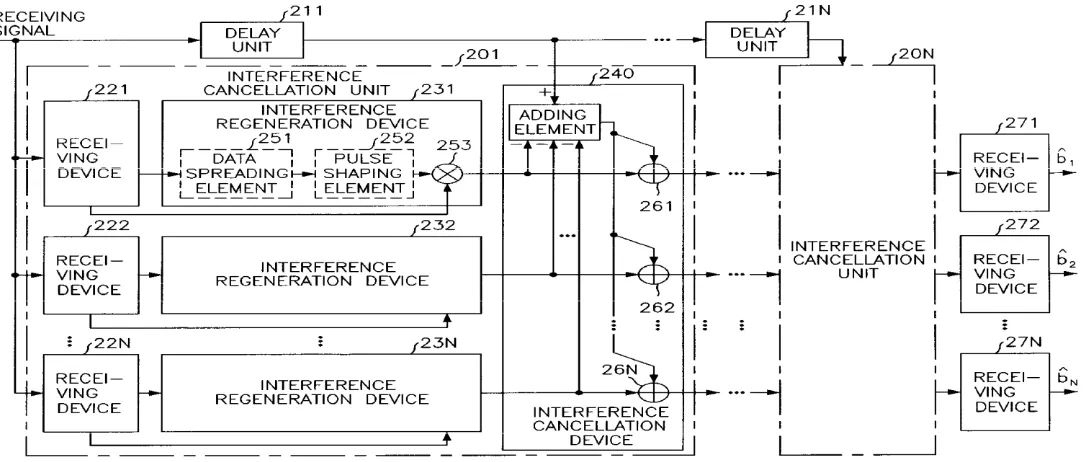
During this development we have assumed equal phase between users for notational simplicity. There are clearly phase differences between users. This must also be estimated and used in the cancellation process. In such a case, we can consider Ai to be complex containing both amplitude and phase. Further, the final decision statistic would have to be phase rotated prior to making a decision. According to Eq. (2) assumes the implementation of cancellation directly on the matched filter outputs. Since cancellation and dispreading are linear operations, we can perform cancellation prior to dispreading with no change in performance. If cancellation is performed on the signal prior to dispreading, we have fig 6.
(
6
)
V. SIMULATION RESULT
In order to evaluate the performance of proposed parallel interference cancellation detector in term of Bit error rate, the simulations are performed. The performance of the proposed PIC receiver scheme is evaluated by computer simulation.
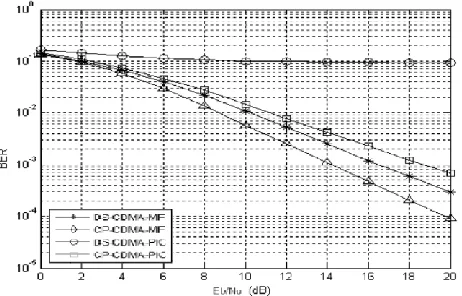
[image:4.612.41.586.150.381.2]We assume each block size is 14 chips excluding the cyclic prefix 2 chips for multipath fading 2 paths and block size 14 chips excluding the cyclic prefix 4 chips for multipath fading 4 paths when compared to DS-CDMA and CP-DS-CDMA in matched filter receiver and PIC receiver. Fig. 7 and Fig. 8 show the PIC and MF receiver performance comparison between DS-CDMA system and CP-CDMA system with 2 and 4 multipath fading. From the simulation results can be observed in this case, the PIC and MF receiver in CP-CDMA system has lowest BER when compared to the PIC and MF receiver in DS-CDMA.
International Journal of Emerging Technology and Advanced Engineering
Website: www.ijetae.com (ISSN 2250-2459, Volume 1, Issue 2, November 2011)106
[image:5.612.59.290.142.290.2])
Fig. 8: The PIC and MF performance comparison between DS-CDMA system and CP-CDMA system with adding 4 multipath fading
VI. CONCLUSION
In this paper, we propose the performance of PIC in CP-CDMA system. This cyclic prefix can effectively decrease in Inter Symbol Interference (ISI). Moreover it can be decrease MAI better than DS-CDMA, as shown in the lower of bit-error rate. However CP-CDMA has to use bandwidth for transmitting the data more than DS-CDMA.
References
[1] T. S. Rapp port, Wireless comm.: Principles and practice, 2nd
edition, Prentice- Hall, 2002.
[2] D. Falconer, "Frequency domain equalization for single-carrier broadband wireless systems," IEEE Comm. magazine, vol.40, no. 4, pp.58 - 66, April 2002.
[3] K.L.Baum, and TA.Thomas, "Cyclic-prefix CDMA: an improved transmission method for broadband DS-CDMA cellular systems," IEEE Wireless Commnunications and Networking Conference 2002, vol.1, pp. 183 - 188, March2002.
[4] D. Divsalar, M. K. Simon, D. Raphaeli, “Improved parallel interference cancellation for CDMA,” IEEE Trans. On Communications, 2005.
[5] S. Vewdu, “Optimal multiuser signal detection”, IEEE Trans. Information Theory, Vol. 31, issue 4, July 1985.
[6] M. K. Varanasi and B. Aazhang, “Multistage detection in asynchronous code division multiple access communications,” IEEE Trans. on Communications, pp. 509-519, April 1990. [7] K. Zheng, W. Wang, G. Decarreau, “Selective parallel
interference cancellation for uplink cyclic-prefix CDMA”, IEEE 16th International Symposium on Personal, Indoor and Mobile Radio Communications, 2005.
[8] M. D. Nisar, W. Utscick, H. Nottensteiner, and T. Hindelang, “Channel Estimation and Equalization of OFDM Systems with
Insufficient Cyclic Prefix,” in 65th IEEE Vehicular Technology Conference, Apr 2007
[9] R. Chandrasekaran and J. J. Shynk, “Analysis of parallel Interference canceller for DS-CDMA signals,” in Proc. 37th Allerton Conf. Communication, Control and Computing, Urbana, IL, Sep. 1999, pp. 967–976.
[10] D. Divsalar, M. K. Simon, and D. Raphaeli, “Improved parallel interference cancellation for CDMA,” IEEE Trans. Commun., vol. 46, no.2, pp. 258–268, Feb. 1998.