Journal of Chemical and Pharmaceutical Research, 2015, 7(1):897-901
Research Article
CODEN(USA) : JCPRC5
ISSN : 0975-7384
Design and simulation of a plant producing dimethyl ether (DME) from
methanol by using simulation software ASPEN PLUS
B. Sumalatha
1*, A. Venkata Narayana
1, K. Kiran Kumar
2, D. John Babu
1and
T. C. Venkateswarulu
11
School of Biotechnology, Vignan University, Vadlamudi, Guntur, A.P, India
2
Department of Chemical Engineering, Dr. SGIET, Markapur, A.P, India
_____________________________________________________________________________________________
ABSTRACT
DME is used primarily as a propellant and a motor fuel alternative, DME is miscible with most organic solvents and has a high solubility in water. Recently, the use of DME as a fuel additive for diesel engines has been investigated due to its high volatility (desired for cold starting) and high cetane number. A feasibility study and design of a plant producing 99.9 wt% Dimethyl ether (DME) is to be performed by using simulation software Aspen Plus. The plant is designed which is capable of producing 80,000 metric tons of DME per year via the catalytic dehydration of methanol over an acid zeolite catalyst. The goal is to check the feasibility of plant by used equipment that produces DME.
Keywords: Dimethyl ether, Production, Simulation, ASPENPLUS
_____________________________________________________________________________________________
INTRODUCTION
DME is a ‘Second Generation Biofuel it has a slight ethereal odor. It liquefies under slight pressure, much like propane [1]. It is relatively inert, noncorrosive, non-carcinogenic, almost non-toxic, and does not form peroxides by prolonged exposure to air. Its physical properties make it a suitable substitute (or blending agent) for liquefied petroleum gas (LPG, a mixture of propane and butane). The largest use of DME is currently as substitute for propane in LPG used as fuel in household and industry [3]. DME has two other primary applications: as a propellant in aerosol canisters, and as a precursor to Dimethyl sulfate as an aerosol propellant, DME is useful as a somewhat polar solvent. It can also be used as a refrigerant [1].
EXPERIMENTAL SECTION
The reaction of DME synthesis is mainly dehydration of methanol that is exothermic and reversible. In the current work, the rate expression has been selected from [2].
Methanol dehydration reaction: 2 CH3OH ↔ DME + H2O ∆H= - 21.255 kJ/mol.
the reaction. Three reactions take place simultaneously when DME is manufactured from the dehydration of methanol. A brief flow diagram is shown in Fig. 1.
Fig.1 A brief outlay of plant producing DME from methanol
Process Simulators
Process simulator is defined as an engineering tool which performs automated calculations, mass & energy balances, physical property estimations, design / rating calculations, costing, process optimization, accurate description of physical properties of pure components and complex mixture, models for a large variety of reactors and unit operations, numerical techniques for solving large systems of algebraic and differential equations.
There are about 52 process simulators presently available today. Some of the popular simulators available today are Aspen plus, CHEMCAD, Prosimulator, Winsim, Gproms, Hysys, Pro II and Design II.
Introduction to Aspen Plus
Aspen Plus was developed by Aspen Technology, Inc. A provider of software and services for the process industries Founded in 1981, Aspentech was born out a joint research project between the Massachusetts Institute of Technology (MIT). ASPEN stands for Advanced System for Process Engineering. Aspen Plus is based on techniques for solving flow sheets that were employed by chemical engineers many years ago. Aspen plus allows solving a process in three methods. The problem specification is the one of the important step in the simulation process as it involves in defining user requirement to the computer in a specific format depending on the user need they are divided into three types they are Rating Problem, Analysis problem and Design problem.
Design of plant & Simulation
The design of the plant that can capable of producing 80,000 tons of DME in annum i.e. 278.2 Kmol/hr of methanol is required assuming that the plant is operated 330 days in a year. The methanol is dehydrated over a catalytic reactor to form DME the conversion of the methanol in the reactor is 80% when 99.9 methanol is feed into the reactor. The conversion assumption has been drawn from the Industrial pilot plant results. The technology for large-scale production of DME includes the process of methanol dehydration.
DME Process Flow Sheet
Fig.2 DME process flowsheet in ASPEN PLUS simulator
RESULTS AND DISCUSSION
Actual Reaction is
2CH3OH C2H6O+H2O
1. Rstioc The Basic reactor
2. RadFrac-1 To separate DME from methanol and water mixture 3. RadFrac-2 To separate methanol and water mixture
Rstoic Stream conditions are Methanol flow rate are 282.1 kmol/hr, temperature 70oF and pressure 2 psi. Reactor temperature is 400 F and Pressure is 15 psi. Assuming 80% of methanol is converted into DME in reactor. Actual conversion takes place on catalytic bed reactor.
Simulation of Overall process
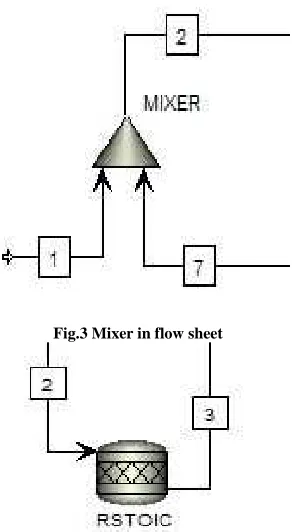
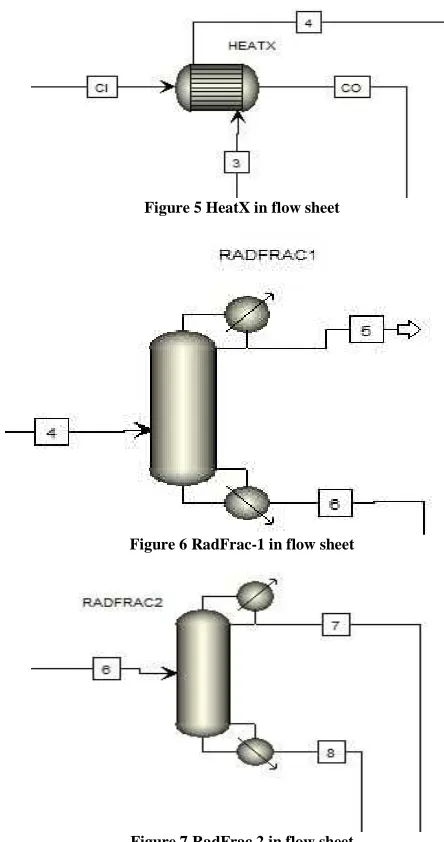
The following blocks were sequentially simulated by using aspen plus. The sequence follows as below Mixer, RStoic, HeatX, RadFrac-1, RadFrac-2.
[image:3.595.237.383.482.748.2]
Fig.3 Mixer in flow sheet
Figure 5 HeatX in flow sheet
Figure 6 RadFrac-1 in flow sheet
Figure 7 RadFrac 2 in flow sheet
[image:4.595.178.437.555.694.2]
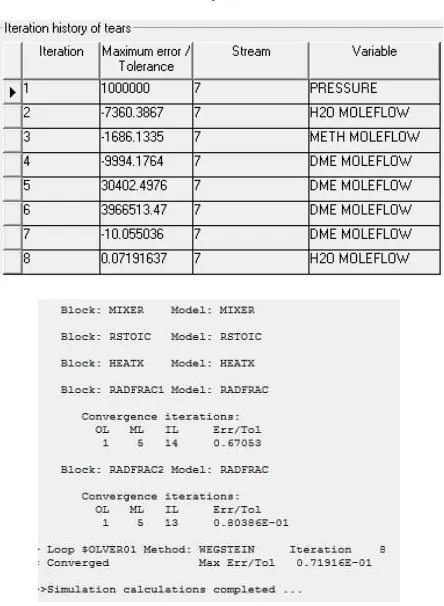
Convergence Summary
Table 2 Iteration History of tears after simulation
Fig 8 Convergence report from Control panel in Aspen Plus
CONCLUSION
Simulation of a plant which is capable of producing 99.99% purity DME (80000 tonnes per annum) from methanol is done using Aspen Plus process simulator. NRTL is chosen as the property method in the simulation and assuming that 80% of the methanol is converted into DME in the reactor, the product stream from the reactor consists of 39.9% DME, 40% water and 19.96% unconverted methanol. After passing through HeatX module (to bring down the temperature to the desired range for separation), the output stream is feed into RadFrac module. Here, the separation into DME and water-methanol takes place.About 99.9% purity DME is separated from the RadFrac-1 as top product and 33% methanol as bottom product. 66.6% of water in the bottom product is fed into second RadFrac column where the water and methanol are separated to maximum purity (99%). The converted methanol is recycled in the reactor by mixing with fresh methanol stream.Design specifications are used to meet the required results. The reflux ratio and the distillate rates are manipulated as variable parameters and the high purity of DME is obtained by using two RadFrac columns with one HeatX module.
Acknowledgement
We are very grateful to Vignan University for providing laboratory facilities to carry out this work.
REFERENCES
[1]Biofuel production technologies: status, prospects and implications for trade and development”, UNO New York and Geneva, 2008.
[2]Bercic G, Levec J. Ind. Eng. Chem. Res.1992, 31, 1035-1040.
[3]Mohammad Farsi; Abdolhossein Jahanmiriy. International Journal of Chemical Reactor Engineering, 2011,9, Article A74.
[4]Daesung Song; Wonjun Cho; Gibaek Lee; Dal Keun Park. Ind. Eng. Chem. Res., 2008, 47(13), 4553-4559. [5]Soren Dahl; Aage Fredensl und; Peter Rasmussen. Ind. Eng. Chem. Res., 1991, 30, 1936-1945.
[6]Takashi Katayama; Kazunri Ohgaki; Goro Maekawa; Motojiro Goto. Journal of Chemical Engineering of
Japan.,1975, 8(2).
[7]Torben Laursen; Simon Ivar Anderson. J. Chem . Eng. Data., 2002, 47, 1173-1174 .