Original article
DOI: 10.1111/j.1473-6861.2009.00227.xLearning theories and interprofessional
education: a user’s guide
Sarah Hean
PhD,
1* Deborah Craddock
MA BSc (Hons) DPodM2&
Cath O’Halloran
PhD31 Senior Lecturer (Research Methods), School of Health & Social Care (HSC), Bournemouth University, R114, Royal London House, Christchurch Road, Bournemouth, Dorset BH1 3LT, UK
2 MSc Programme Leader, School of Health Sciences, University of Southampton
3 Head of Department of Clinical and Health Sciences, School of Human and Health Sciences, University of Huddersfield
2
Keywords curriculum development, evaluation, interprofessional education, learning theory
*Corresponding author. Tel: +44 0 1202 9 62201; fax: +44 0 1202 9 62194; e-mail: [email protected]
Abstract
There is increasing interest in the theoretical underpinning of interprofessional
education (IPE) and writers in this field are drawing on a wide range of disciplines for
theories that have utility in IPE. While this has undoubtedly enriched the research
literature, for the educational practitioner, whose aim is to develop and deliver an IPE
curriculum that has sound theoretical underpinnings, this plethora of theories has
become a confusing, and un-navigable quagmire. This article aims to provide a
compass for those educational practitioners by presenting a framework that
summa-rizes key learning theories used in IPE and the relationship between them. The study
reviews key contemporary learning theories from the wider field of education used in
IPE and the explicit applications of these theories in the IPE literature to either
curriculum design or programme evaluation. Through presenting a broad overview
and summary framework, the study clarifies the way in which learning theories can aid
IPE curriculum development and evaluation. It also highlights areas where future
theoretical development in the IPE field is required.
Introduction
Historically, curriculum design and evaluation of initiatives in interprofessional education (IPE) have been accused of being theory less (Freethet al.2002; Barret al. 2005; Clarke 2006).
3 However, the scene
has changed over the past 5 years with an increasing number of published works in the field that do con-sider theoretical underpinnings. Within these arti-cles, writers turn to more established disciplines, mainly sociology, psychology and education, for theories with utility for IPE, e.g. contact theory,
social identity theory, activity theory and adult edu-cational theories (Colyer, Helme & Jones 2006). This however has resulted in an abundance of theories of potential use in IPE research, each author using a favoured approach to articulate his⁄her own
under-standing. For the educational practitioner, whose aim is to develop and deliver an IPE curriculum that has sound theoretical underpinnings, this plethora of theories has become a confusing, and un-naviga-ble quagmire. This article aims to provide a compass for those educational practitioners by presenting a framework that summarizes key learning theories
utilized in IPE and the relationship between them. The framework also represents a step towards mov-ing IPE theory from a list of theories and their indi-vidual application towards a heuristic, critical comparison and prioritization of key theoretical tools (O’Toole 2004).
A learning theory focus
To achieve such a comparison, it is tempting to try to review all theories applied to IPE; however, such an exercise is overambitious and unwieldy, so this study focuses specifically on learning theories by which we mean those theories that describe how IPE interventions are run or organized (e.g. complexity theory – Cooper 2004). Sociological theories dealing with issues of professionalism and socialization or psycho-sociological theories dealing with issues of group identity or group dynamics (e.g. social iden-tity theory, the contact hypothesis (Hean & Dickin-son 2005; Carpenter et al. 2006) have been put aside. Discussion here is confined to theories that seek to explore learning as defined as:
a relatively permanent change in behaviour with behaviour incorporating both observable activities along with internal processes such as thinking, attitudes and emotions. (Burns 1995)
Hence, the specific objectives of the study are to:
1 present an overview of learning theories applied in IPE and their relationships with one another.
2 note the relative contribution of these theories to the development of the field, identifying areas for future theoretical development in IPE.
In so doing, we briefly review:
1 key contemporary learning theories from the wider field of education and used in IPE.
2 explicit applications of these in IPE literature in either curriculum design or programme evaluation. Readers are directed to Craddocket al.(2006) for a more comprehensive review.
Method
To achieve the above aims, the authors reviewed key educational texts to identify key learning theories in the wider educational field.
Search strategy in IPE
Relevant literature was collected through a system-atic search of relevant databases: In order to capture literature pertaining to IPE and related terms (e.g. inter-professional; multi professional education), the first part of a published literature search strategy described in a critical review of the IPE literature described by Freeth et al. (2002) was undertaken. Hereby, literature was identified in which the con-cept of ‘interprofessional’ and related terms was identified. To identify IPE literature in which expli-cit reference to learning theories was made, the latter search was run in conjunction with searches for key words covering:
1 broader terms related to learning theory in gen-eral and broader families of learning theories (e.g. Learning theor*; behaviour*; constructivis*).
2 specific theories that fall within these families (e.g. interprofessional competen*, activity theory; adult learning theory; communities of practice).
The bibliographic databases searched were:
1 Medline 1966–2008;
2 Cumulative Index to Nursing and Allied Health Literature (CINAHL) 1982 to June 2001;
3 British Education Index (BEI), 1964 to June 2001. Key journals in IPE (Journal of Interprofessional Care, Learning in Health and Social Care) were searched by hand for any explicit use of a learning theory in discussion.
Review strategy
Abstracts were reviewed and selected on the follow-ing criteria:
• the article related particularly to IPE, using the
definition:
Members (or students) of two or more professions associ-ated with health or social care, to be engaged in learning with, from and about each other. (Freethet al.2002)
• The article’s content made explicit use of a key
learning theory to articulate formalized learning that might take place in an interprofessional context.
This meant that articles where the learning of the patient was central to the article were discarded. This narrowed the focus down to those studies in which
the learning of a group of two or more health and social care professionals was central.
• Articles involved learning in higher education
institution (HEI) and practice contexts and at an individual and organizational level were included.
For each study, the reviewer extracted and synthe-sized information from each article based on the following outcomes:
1 the learning theory that was applied;
2 the family of learning theory under which the individual learning theory could be subsumed (i.e. if the theory had behaviourist or constructivist ori-gins);
3 whether the application of the theory had been made to underpin an IPE curriculum design or eval-uation;
4 whether the unit of analysis was at the micro or macro level of learning. The micro level refers to learning at the level of the individual student; macro level learning has a wider remit and encompasses learning that may occur within communities, systems or organizations as a whole.
The dearth in application of learning theory in some areas (e.g. use of activity theory) made assess-ment of the quality of articles reviewed a difficult exercise. Because of this, the only criterion for the assessment of article quality was that the theory, and its application, was discussed in some detail in the article. Articles that only mentioned theory tangen-tially and without further discussion were excluded. In future, as and when theory becomes more widely applied in the IPE literature, strategies to assess and distinguish between articles based upon the quality with which theory has been applied, and the context in which it has been applied, would be recom-mended. Establishing the criteria for such an assess-ment will not prove an easy task, however, not least because of the familiarity required by the assessor of each individual theory under scrutiny.
The framework that resulted from the above syn-thesis which summarizes key learning theories that have found application in IPE can be viewed in Fig. 1. To test the validity of the framework, it was presented to an audience of IPE educators, practitio-ners and researchers attending an Economics and Research Council-funded Seminar Series (Hean et al.2008) in January 2008. The objective of this series was to develop IPE theory for the future. Par-ticipants were asked to discuss and feedback on the framework through group work as well as in evalua-tion sheets completed at the end of the seminar. Members of the convening group completed written reflections on the progress of the seminar. These data were synthesized to provide some preliminary pointers as to how this framework might move lean-ing theories forward in their application to IPE in future. Some of the conclusions that pertain to learning theories in particular will be reported here.
Learning theories and their utility in
IPE
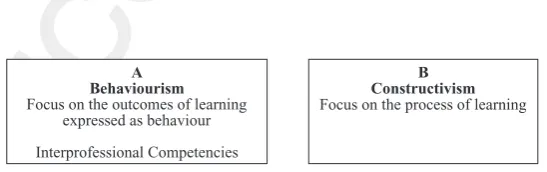
When attempting to use learning theories to under-pin the design or evaluation of an IPE initiative it is useful to recognize two wide families of learning theory, namely behaviourist and constructivist approaches (Bigge & Shermis 1999; Armitageet al. 2003) (Fig. 1A,B) and to first consider the initiative in relation to them.
Behaviourism
Behaviourists believe that:
1 Learning occurs through experiencing the conse-quences of one’s own behaviour.
2 Trial and error may be part of such learning.
3 All behaviour is learned and all learning involves an observable change in behaviour.
A Behaviourism
Focus on the outcomes of learning expressed as behaviour
Interprofessional Competencies
B Constructivism
Focus on the process of learning
Fig. 1Two key families of learning theory with application to interprofessional learning. 1
[image:3.595.106.380.592.678.2]4 Extreme behaviourists take a positivist approach through the belief that only what can be measured can be regarded as learning.
5 Students’ own activity in obtaining these out-comes is often central to learning (Bigge & Shermis 1999; Armitageet al.2003).
Behaviourists are less interested in thought pro-cesses and how learning has occurred, but focus on learning outcomes (Bigge & Shermis 1999; Armitage et al.2003).
A key question for the IPE practitioner is to con-sider the part behaviourist approaches have taken in the understanding the nature of interprofessional learning, IPE curriculum development and evalua-tion. Taking the above description of behaviourism, this approach is one in which an IPE curriculum developer creates an outcome-based curricula. This is in line with current trends in most curriculum development in Higher Education in the UK where establishing key learning outcomes is central (Biggs & Tang 2007). Curriculum developers should ques-tion whether their designs of IPE curricula should follow this same trend, i.e. borrow from the same
behaviourist tradition as that of the uniprofessional curriculum. The key question remains: is this a nat-ural and appropriate progression or one that is taken pragmatically when IPE curriculum develop-ment is often conducted in circumstances in which time and human resources are limited?
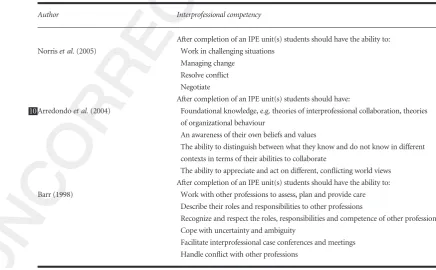
Although the search of the literature showed no reference to behaviourist models of learning explic-itly, some evidence was found of reference to the learning outcomes of IPE although these were rephrased asinterprofessional competencies. Using the latter as a keyword in the search strategy, identified only three key references (Barr 1998; Arredondo et al. 2004; Norris et al. 2005) that specifically mentioned interprofessional competencies. Some of these competencies identified in these articles are summarized in Table 1.
[image:4.595.114.551.424.694.2]A search of the published literature however showed no explicit reference to the use of these IPE competencies in curriculum design. Although it is hard to believe that at least some of these learning outcomes are not included in the learning objectives of current IPE curriculum, it is likely that the
Table 1 Interprofessional competencies identified by interprofessional education (IPE) authors taking a behaviourist approach to learning
Author Interprofessional competency
After completion of an IPE unit(s) students should have the ability to: Norriset al.(2005) Work in challenging situations
Managing change Resolve conflict Negotiate
After completion of an IPE unit(s) students should have: Arredondoet al.(2004)
10 Foundational knowledge, e.g. theories of interprofessional collaboration, theories of organizational behaviour
An awareness of their own beliefs and values
The ability to distinguish between what they know and do not know in different contexts in terms of their abilities to collaborate
The ability to appreciate and act on different, conflicting world views After completion of an IPE unit(s) students should have the ability to: Barr (1998) Work with other professions to assess, plan and provide care
Describe their roles and responsibilities to other professions
Recognize and respect the roles, responsibilities and competence of other professions Cope with uncertainty and ambiguity
Facilitate interprofessional case conferences and meetings Handle conflict with other professions
theoretical underpinnings of these designs are not being articulated and⁄or published more widely
other than in the HEI’s own course approval docu-mentation.
Behaviourist approaches were apparent in publi-cations linked to IPE evaluations, particularly those that focused on measurement of learning outcomes alone and in which any process measures were excluded. One clear example is the adaptation of the Kirkpatrick model of evaluation by Freeth et al. (2002). This framework has been utilized in IPE evaluations by authors such as McNairet al.(2001) and Carpenter, Barnes & Dickinson (2003). In this model, levels of educational learning outcomes are proposed, the measurement of which should be included in an effective evaluation of an educational programme. These levels include the reaction of the student to the learning experience, the modification of students’ attitudes⁄perceptions, the acquisition
of knowledge⁄skills, student behavioural change,
changes in organizational practice and benefits to clients.
The measurement of changes in student behaviour in interprofessional working would be an example of a behaviourist approach to evaluation. However, there is little evidence of IPE evaluations explicitly measuring student behavioural change, a fact previ-ously noted in the IPE literature (Barret al.2005). Some few exceptions include the work of McNair et al.(2001) where students are asked to make self-reports of their own developing interprofessional competencies and interprofessional confidence and involvement. These authors suggest facilitator obser-vation of student working be included in future mea-surement of behavioural change. Similarly, Pollard et al.(2006) collected students’ self-reports of their own communication skills. Generally however, there is a dearth of behavioural measures beyond the level of self-report. This is largely because measurements of behavioural change in IPE programmes (e.g. teamwork behaviours) are hard to identify and mea-sure effectively. If a broader definition of competen-cies is taken that includes student attitudes and knowledge, then several other instances in which competences have been incorporated into evalua-tions were found. For example, changes in students’ attitudes or stereotypes were measured as an IPE
learning outcome in several IPE evaluations (Hind et al. 2003; Mandy, Milton & Mandy 2004; Hean et al.2006).
A behaviourist approach to understanding IPE learning, designing IPE curriculum and evaluating its outcomes is likely to appeal to those more com-fortable with a positivist approach to research and curriculum development in which clear outcomes are expected, assessed and evaluated. Such a clear-cut, structured approach has its appeal. However, if chosen to underpin an IPE evaluation or curriculum design, it must be acknowledged that, in focusing exclusively on the outcomes or products of IPE, the developer ignores the processes that have under-pinned this learning. Furthermore, if a behaviourist curriculum approach emphasizes learning by doing, learning by trial and error, and the consequences of one’s own behaviour, then there is the danger that students become involved in practicalities of experi-ence, and fail to reflect on their actions during this process. Students may also become overly focused on the assessment and achieving the stated behavio-ural objectives (Bigge & Shermis 1999; Armitage et al.2003). These problems however are not limited to interprofessional learning.
Constructivism
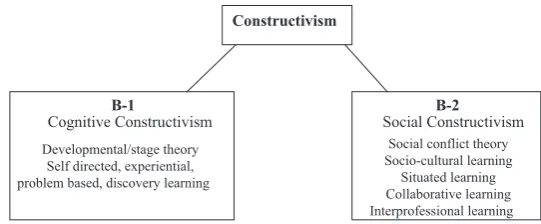
In contrast to behaviourist theory constructivism takes account of the process of learning. The structivist family encompasses both cognitive con-structivist and socio-concon-structivist approaches to learning (Fig. 2).
Cognitive constructivism
Cognitive constructivism is concerned with the pro-cesses experienced by learners. The creation of cog-nitive structures and higher order skills such as problem solving and the development of insights are key (Dewey 1966; Piaget 1973; Burns 1995; Atherton 2005) as too are student activity in learning and self-direction in his⁄her own development. A typical
cognitive constructivist approach applied to the IPE field would be to use the stage or developmental the-ories created by Piaget to explore learning and the acquisition of knowledge in children. Piaget (1973)
proposed that children’s cognitive development pro-gressed with age (maturation) beginning with basic sensory-motor functioning and progressing to for-mal operational stages of development (Bigge & Shermis 1999; Jarvis, Holford & Griffin 2003); how-ever, his basic premise of developmental learning has now been widely adapted from its original form to not only account for the development of knowl-edge and skills in the individual but also for the development or learning of more affective traits (Jar-viset al.2003). Dahlgren (2006) and Clarke (2006) appear to be the only authors who have considered these theories in their application to IPE. Dahlgren (2006)
4 considered the possible stages of interprofes-sional development and the processes of decentring in students, whilst Clark (2006) has explored the application of Perry’s (1970) four stages of student development in terms of students’ development of interprofessional knowledge and values. A commit-ment to relativism represents the ultimate goal on an interprofessional scale of development and when reached, students are comfortable and prepared to take a stand on their own particular professional perspective but show an awareness that their per-spective is governed by a system of values and beliefs and recognize that others may have committed to a different, but equally valid, perspective based on their own value and belief systems (Clark 2006). Despite these discussions of stage theory by Daghlen and Clark, no explicit reference was found to these concepts in published literature in either IPE curric-ulum design or indeed the evaluation of IPE initia-tives. Greater application of the ideas of ‘stages of IPE development’ beyond the theoretical and into the underpinnings of curriculum development and evaluation would progress the field.
Based in the tradition of stage development, Pia-get (1973) also proposed two processes involved in knowledge acquisition, namely assimilation and accommodation. The former is the process whereby a student will take in and filter information from their environment. This information interacts or comes into conflict with existing knowledge held by the individual. This interaction between existing and new knowledge is important in learning and has led to the recognition that teaching must take account of students’ existing knowledge (Bigge & Shermis 1999). These processes appear largely to be excluded from writing within the IPE literature, Hughes, Ven-tura & Dando (2004) being one exception. These authors described a third-year undergraduate online IPE module. In the IPE curriculum described here, students are given the opportunity to revisit and rework initial submissions of group work in an iter-ative process. Hereby successive layers of knowledge are added to existing knowledge through each cycle of the process in keeping with a constructivist approach to learning. The search strategy was also less successful in uncovering the application of a cognitive constructivist approach to the evaluation of IPE. The use of a Realistic method of evaluation (Pawson & Tilley 1997) in which mechanisms and processes are addressed in the evaluations of some IPE modules (Clarke, Lapthorn & Miers 2005) was one of the few examples of such an approach.
Although the above cognitive constructivist theo-ries are not commonly utilized in the IPE literature, the search strategy showed adult learning theories, in contrast, to be widely utilized in the field (Fig. 2B-1) (Craddock et al. 2006). Adult learning theory in this context appears as a collection of ped-agogical approaches and is described variously as
B-2
Social Constructivism
Social conflict theory Socio-cultural learning
Situated learning Collaborative learning Interprofessional learning
B-1
Cognitive Constructivism
Developmental/stage theory Self directed, experiential, problem based, discovery learning
Constructivism
Fig. 2Branches of constructivism that have been utilized with interprofessional education. 1
[image:6.595.215.486.87.199.2]e.g. self-directed (Kaufman 2003), experiential (Puliyel, Piliyel & Puliyel 1999; Moon 2004), prob-lem-based learning (Newble 2002; Wood 2003) and discovery-based learning (Spencer & Jordan 1999). Some of these theories have a particular emphasis on the process of reflection in learning, e.g. transfor-mative learning (Mezirow 1997, 2004), the reflective practitioner (Schon 2004), experiential learning (Kolb 1983; Moon 2004; Fig. 2B-1). In order to make meaning of the wide number of adult learning theory applied to IPE, it is important to recognize that many adult learning theories – experiential learning (Kolb 1983), inquiry-based learning (Clev-erly 2003) – are constructivist in their origins. This is reflected in some of the key assumptions of adult learning theory that holds that adults:
1 are independent and self directing;
2 have accumulated vast experiences, which are rich resources for learning;
3 value learning that integrates with the demands of their daily lives;
4 are more interested in immediate problem-cen-tred approaches than in subject-cenproblem-cen-tred ones;
5 are more motivated to learn by internal as opposed to external drivers
5 (Knowles et al. 1984;
Knowles 1990; Kaufman 2003).
However, a failure in the IPE literature to recog-nize the constructivist origins of adult learning the-ory, means these ‘theories’ are often used simply to describehowthe IPE curriculum was delivered (e.g. as a form of group work) and fail to recognize or articulate the constructivist theories that underpin whythe curriculum is being delivered in this way. This study takes the stance (as illustrated in Fig. 1) that adult learning applied to IPE should not be seen as a theory on is own but is instead a context in which constructivist learning theories are applied.
Social constructivism
Learning is not a purely individually constructed process and social constructivists view individual learning as being mediated by the environment. Curriculum developers and evaluators in IPE who discuss collaborative, interprofessional and situated learning take this perspective (Fig. 2B-2).
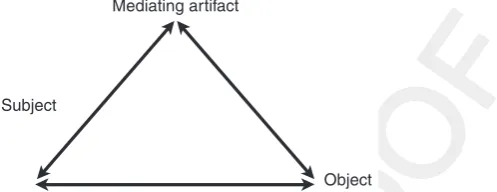
Social constructivism, in contrast to cognitive constructivism, emphasizes how social encounters influence learners’ meanings and understanding (Atherton 2005). The learner is more actively involved in constructing new meaning in a collab-orative enterprise, particularly with the facilitator (Atherton 2005). This approach is best character-ized by the theory of socio-cultural learning the-ory developed mainly through the work of Vygotsky (1978). Here student learning is per-ceived to be mediated through socio-cultural tools such as language (see Fig. 3). In the discussion of this mediated learning, Vygotsky talks of a zone of proximal development (ZPD). This is the level of development that students can achieve via facil-itated problem solving or in collaboration with more able peers. In other words, the ZPD is the difference between what a student can learn alone and what they can learn with the assistance of an external other. This external other may be their IPE facilitator or fellow student, albeit of another profession.
Vygotsky’s belief was that individuals have vary-ing potentials for ZPD in specific contexts which can be developed via teaching (Jarvis et al. 2003). To undertake tasks within the ZPD, and allow learners to transcend this zone, scaffolding systems can be employed. Scaffolds may take the form of more knowledgeable people or cultural resources external to the student and which support their leaning. This enables them to build on their own existing knowledge and internalize new informa-tion. Scaffolds, by their nature, are temporary support structures and will be slowly removed as
Mediating artifact
Subject
Object
Fig. 3Triangle depicting a subject’s (or learner’s) mastery or learning about an object as through an external and mediating artefact such a peer or tool such as language (Engestro¨m 2001).
[image:7.595.254.503.91.187.2]students master the concepts in question and become independent learners (Vygotsky 1978; Jarvis et al.2003).
If one remembers the ‘with, from and about’ defi-nition of IPE (Freeth et al. 2002), socio-cultural learning is key to an understanding of interprofes-sional learning. For those in the field who wish to pinpoint how interprofessional learning is in fact different from learning that could occur uniprofes-sionally, an emphasis on the socio-cultural approach, in preference to more cognitive constructivist approaches, will have an appeal.
As with cognitive constructivist and behaviourist approaches, the search strategy sought out articles in the IPE literature in which a reference to socio-cultural learning, scaffolding, Vygotsky and⁄or the
ZPD had been made. It found that explicit use of the theory was limited but with some notable exceptions: Although not situated within the con-fines of IPE delivery in a HEI, Zorga (2002) pub-lished a developmental–educational model of professional supervision in practice. In this model, the supervisor mediates the learner’s reflection on a relevant work issue from which they wish to learn⁄develop. The process of supervision is seen as
a mediating artefact that can accelerate learning across the ZPD, a form of scaffolding for the learner under supervision. Interdependence was actively discouraged and the supervision sessions are finite in order that scaffolding can be removed once the subject has developed sufficiently. Hughes et al. (2004) also referred briefly to the concept of the ZPD in a description of the interactions between peers and a peer review activity within a virtual IPE programme, using these interactions as a means by which Vygotsky’s ZPD can be tran-scended.
However, D’eon (2005) provided, by far, the most comprehensive utilization of socio-cultural learning and specifically the concept of scaffolding. This arti-cle provided arti-clear and practical guidance on how the concepts of scaffolding could be applied to IPE via a range of student tasks of ever increasing com-plexity. These become progressively more complex in two ways:
1 From working on paper-based scenarios to those set in real life practice settings.
2 From simple interaction between two profession-als, to a case in which a range of professionals are involved.
They maintain that when the scaffolding of these guided tasks is removed (i.e. the tasks are com-pleted), students should be able to apply or transfer their interprofessional learning independently ‘to novel cases and situations’.
There was no evidence in the search of concepts of scaffolding and ZPD being used as a means of evaluation. Future work in IPE development would therefore benefit from an increase in the applica-tion of ideas of ZPD and scaffolding and explora-tion of this can be applied to peer-led or tutor-led discussions.
Macro level thinking
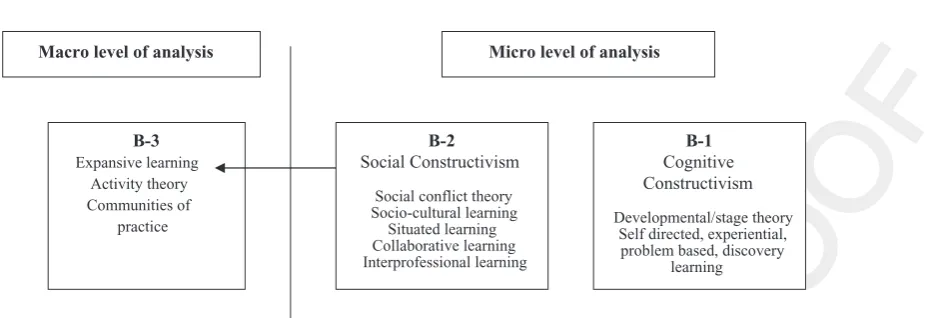
Constructivist and behaviourist approaches may be criticized as focusing overly on learning within an individual, or a micro level analysis. Some IPE edu-cationalists, especially those developing curricula in practice, may find a macro level understanding of IPE better suited to framing their understanding and curricula. They may wish to see learning as a collective exercise that takes place within or by a practice organization (Fig. 4B3). At this level, social constructivism grows into theories such as activity theory, communities of practice and expansive learning.
At the simplest level, the social environment in which the IPE student learns can be described in terms of communities of practice. These are groups of individuals engaged in a joint, mutually recognized activity that binds them together where common cultural resources are shared (Wenger 1998). A search of the IPE literature for the key word of communities of practice led to the con-clusion that although communities of practice is becoming a popular concept to describe working in practice in health and social care, it is less fre-quently used to explore how learning takes place (and it is student learning that we focus on in this study) or how learning occurs inter-professionally. The concept has greater utility if subsumed in the greater complexity described by activity systems.
To consider learning at the macro level, the con-cepts of socio-cultural learning have been expanded to explain learning beyond that which occurs at the level of the individual and whereby learning is viewed as being mediated by a single cultural arte-fact. This evolution is seen in Fig. 3 (Engestro¨m 2001)
6 where Vygotsky’s triangle of individual activ-ity develops into a macro level description of collec-tive human activity and the learning that takes place within these. Community is a key factor within the activity system. In the arena of interprofessional working, Engestro¨m (2001) uses the concept of activity systems to frame the learning that takes place when parents and practitioners from different professions and organizations work collaboratively to plan and monitor the care of sick children admit-ted to their care. In this system, knowledge is often generated in these interactions in parallel and simul-taneously to people and organizations learning within the system. Knowledge is therefore not stable or even understood ahead of time. Engestro¨m describes learning of this knowledge, in this context, as expansive learning. Expansive learning takes place within these collective activity frameworks, most often when contradictions in the system occur and are resolved (Engestro¨m 2001).
A search of the literature for the use of activity theory in curriculum development was not suc-cessful. However, this was not unexpected as cur-rent HEI curriculum development, especially if based outside practice, focuses on the micro, indi-vidual level learning with predictable and defin-able outcomes. The systems activity theory, in
which expansive learning takes place, is less pre-dictable and hence does not lend itself to use in curriculum development as readily. It was there-fore not unexpected that activity theory has not been used to underpin any known IPE curricu-lum models.
The search for use of activity theory in the evalua-tion of IPE was more successful: Two examples of the use of activity theory to underpin evaluations of interprofessional learning (rather than IPE) were identified. Robinson & Cottrell (2005) in an evalua-tion of decision-making and knowledge sharing in multi-agency teams, explored the ways in which professional knowledge was generated in these teams, how learning took place, as well as the ways of working created as a result of being part of this activity system. Similarly, Payler, Meyer & Humph-ris (2007) applied the second generation of activity theory to inform the development of a conceptual framework to guide an evaluation of the impact of pedagogy employed in continuing professional development for professionals in education, health and social care.
Despite the lack of macro level theories in the lit-erature, there is an increasing interest in their appli-cation. In the seminar used to validate this framework, it was clear from evaluations (Hean et al.2008) that the theories in which the social con-text of learning and working were included were seen as key. In fact, theories such as activity theory and socio-cultural learning took precedence over the other learning theories presented in the framework. It is the social component of these theories that
Micro level of analysis
B-3 Expansive learning
Activity theory Communities of
practice Macro level of analysis
B-1 Cognitive Constructivism
Developmental/stage theory Self directed, experiential, problem based, discovery
learning B-2
Social Constructivism
Social conflict theory Socio-cultural learning
Situated learning Collaborative learning Interprofessional learning
Fig. 4Learning theories used in interprofessional education at a macro and micro level of analysis. 1
[image:9.595.40.506.74.233.2]differentiates interprofessional from uniprofessional learning. This echoes Bleakley (2006) who also criti-cizes the abundance of adult learning theory, stating that
androgogy provides limited understanding of how learning occurs in complex, dynamic systems such as teams, where socio-cultural learning provide a more powerful alternative. Bias towards individualistic learning theory may be ideolog-ical rather than evidence based. (p. 151)
However, as with all theory, activity theory is not without it critics. Jarvis et al. (2003) for example, points out that although Engestro¨m’s (1990) theory emphasizes social reality within which learning and expansion occurs, there is a risk that insufficient emphasis is placed on the psychological processes and the individual. Furthermore, Tennant (1997) is concerned that communities of practice are roman-ticized and that
in their eagerness to debunk testing, formal education and formal accreditation, they do not analyse how…(this)… af-fects power relations, access, public knowledge and public accountability. (Tennant 1997, p. 79)
The push to move IPE into practice and the increased interest in activity theory and communi-ties of practice need to bear this in mind.
Potential use of the framework
The overview of learning theories used in IPE and presented as Fig. 5 attempts to explain the relation-ship between the range of available theories and how ideas have evolved one from another. An under-standing of these relationships can help researchers and practitioners form a mind map of the learning theories and their uses and compile a theoretical toolbox for use in IPE curriculum design and evalu-ation. For example, the relationship between micro level thinking of socio cultural learning and its appli-cation leads into the more complex macro level thinking of activity theory and expansive learning in which ideas of community practice may be linked is one example of how the range of theories can pro-vide clarity where a single theory cannot.
An understanding of the evolution and connect-edness of theories also helps us position ourselves as both educational practitioners and researchers. For example, evaluators who may have focused on IPE evaluation on measurement of stereotype change through quantitative surveys (Carpenteret al.2003; Heanet al.2006) would recognize from Fig. 5 that their theoretical underpinnings are from more posi-tivist, behaviourist traditions in which comfort is
BEHAVIOURISM interprofessional competencies
CONSTRUCTIVISM B
A
Cognitive Developmental/stage theory
Self directed, experiential, problem based,
discovery B-1 Social
Social conflict theory Socio-cultural learning
Situated learning Collaborative learning Interprofessional learning
B2 Expansive learning
Activity theory Communities of practice
B3
ADULT LEARNING Self directed, experiential,
problem based, discovery
interprofessional, collaborative collaborative
B-1-1
MICRO
MACRO
Focus on uncertainty/absence of a teacher/non linearity Expansive learning
Complexity theory
Focus on reflection: Transformative learning
Reflective practitioner Experiential learning
B-1-2
Fig. 5Overview of key learning theories in the interprofessional education literature and the relationships between one another.
COLOUR
[image:10.595.109.555.437.675.2]taken in assessment of measurable outcomes in an evaluation. The approach is also in line with a socio-psychological research approach in which the indi-vidual is the common unit of analysis. In contrast, those who have applied activity theory to underpin evaluations (Payler et al. 2007) would recognize more constructivist and sociological slants to their evaluations. Both are equally valid and potentially complementary.
The overview (Fig. 5) also shows that the learning theories used to underpin the understanding of IPE are not mutually exclusive. They only have a differ-ent emphasis. For example, taking a behaviourist approach to curriculum design in which interprofes-sional competencies are key does not preclude con-structivist ideas in which the processes behind learning these competencies are considered in paral-lel. Furthermore, both behaviourist and constructiv-ist theorconstructiv-ists would agree that interprofessional learning ‘by doing’ and student centredness are key.
Conclusions
Theory for theory sake is futile but practice that is not underpinned by a sound theoretical underpin-ning is tantamount to incompetence (Eraut 2003). It is essential that educationalists and researchers underpin their practice with sound theoretical frameworks, first to improve the quality of their cur-riculum development and evaluative practice but also as a means of explaining the curriculum and evaluation to sceptics.
We hope that this study, through presenting a broad overview and summary framework, has helped clarify the way in which learning theories can aid IPE curriculum development and evaluation. In some instances we raise unanswered questions and make recommendations that may appear tentative. How-ever, this is with intent as in many instances there is no right or wrong answer, no definitive recommen-dation that an educator or evaluator should follow. What they decide to do will largely be determined by the educational context in which they find them-selves. We ask at most, and at the very least, that edu-cators and evaluators consider these questions, evaluate their actions and then make an informed decision that is suitable for their own context.
The framework has also highlighted areas where future theoretical development is required: For the behaviourists among us, interprofessional compe-tencies are infrequently translated into published curriculum designs and evaluation strategies and moves need to be made to redress this alongside efforts to increase and improve the measurement of interprofessional behaviours. For proponents of adult learning theory in IPE, the constructivist ori-gins of adult learning theories need to be recog-nized and the application of these theories should progress from a ‘how we did it’ to a ‘why we did it’ approach. Those in the IPE field publishing their curricula and evaluation strategies also need to go beyond the current absence or tokenistic few sen-tences describing their theoretical standpoint to a careful consideration of how the theory has informed their practice.
Ideas around interprofessional stage development have potential but now need to move from the purely theoretical to an application in curriculum and evaluation design. Questions such as ‘how do we measure students’ stages of interprofessional development’ and ‘how do we enable them to pro-gress to the final stages of commitment to relativism’ need to be asked.
Finally, after some neglect, the IPE field is moving towards inclusion of socio-cultural and more macro level theories to underpin practice. Ideas of scaffold-ing and ZPD have potential and should be employed further to understand and improve our educational practice utilizing scaffolds such as e-learning and mediated learning through peer and tutor facilitated e-learning. There is also much scope for the applica-tion of issues of expansive learning and activity sys-tems, especially to the more complicated levels described in so-called third generational develop-ments.
Despite the potential for future development, the theoretical underpinnings of IPE practice has pro-gressed well over the past 5 years and is no longer the atheoretical discipline it has been in the past. The evidence of contemporary learning theories in education being reflected in IPE is particularly heart-ening and bodes well for the future development of IPE educational theory, IPE practice and research in general.
Acknowledgements
This work originated from a seminar series ‘Evolving theory in Interprofessional Education 2007-2009’ funded by the Economics and Social Research Council in the United Kingdom.
References
Armitage A., Bryant R., Dunhill R., Hayes D., Hudson A., Kent J. & Et Al. (2003)Teaching and Training in Post-Compulsory Education. Open University Press, Buckingham.
7
Arredondo P., Shealy C., Neale M. & Lapearle L.W. (2004) Consultation and interprofessional collaboration: modelling for the future.Journal of Clinical Psychology
60, 787–800.
Atherton J.S. (2005) Learning and teaching: constructivism in learning.????????, ????.
8
Barr H. (1998) Competent to collaborate: towards a com-petency-based model for interprofessional education.
Journal of Interprofessional Care12, 181–187. Barr H., Koppel I., Reeves S., Hammick M. & Freeth D.
(2005)Promoting Partnership for Health. Blackwell Publishing and CAIPE, London.
Bigge M.L. & Shermis S.S. (1999)Learning Theories for Teachers, 6th edn. Longman, New York.
Biggs J. & Tang C. (2007)Teaching for Quality Learning at University, 3rd edn. Open University Press, Maidenhead.
Bleakley A. (2006) Broadening conceptions of learning in medical education: the message from team working.
Medical Education40, 150–157.
Burns R. (1995)The Adult Learner at Work. Sydney Busi-ness and Professional Publishing, Sydney.
Carpenter J., Barnes D. & Dickinson C. (2003)Making a Modern Mental Health Care Force: Evaluation of the Birmingham University Interprofessional Training Programme in Community Mental Health 1998–2002. Centre for Applied Social Studies, University of Durham, Durham.
Carpenter J., Barnes D., Dickinson C. & Wooff D. (2006) Outcomes of interprofessional education for commu-nity mental health services in England: the longitudinal
evaluation of a postgraduate programme.Journal of
Interprofessional Care20, 145–161.
Clark P. (2006) What would a theory of interprofessional education look like? Some suggestions for developing a theoretical framework for teamwork training 1.Journal of Interprofessional Care20, 577–589.
Clarke B., Lapthorn C. & Miers M. (2005)Study 2: Student Learning in Interprofessional Modules: Evidence from Student Interviews and Assignments. University of West of England, Bristol.
Cleverly D. (2003)Implementing Inquiry-Based Learning in
Nursing. Routledge, London.
Colyer H., Helme M. & Jones I. (2006)The Theory–Prac-tice Relationship in Interprofessional Education. Higher Education Academy Health Sciences and Practice, London.
Cooper H. (2004) Complexity and interprofessional edu-cation.Learning in Health and Social Care3, 179–189. Craddock D., O’Halloran C., Borthwick A. & McPherson
K. (2006) Interprofessional education in health and social care: fashion or informed practice.Learning in Health and Social Care5, 220–242.
D’eon M. (2005) A blueprint for interprofessional learning.Journal of Interprofessional Care19(S1), 49–59. Dahlgren L.O. (2006)Developing Flexibility Through Expe-riencing Variety: A Potential Function of Interprofessional Learning for Improving Competence. Paper Presented at The Altogether Better Health III, London.
Dewey J. (1966)Democracy and Education. Collier Macmillan, London.
Engestro¨m Y. (1990)Learning Working and Imaging.
Orienta_Konsultit Oy, Helsinki.
Engestro¨m Y. (2001) Expansive learning at work; towards an activity theoretical reconceptualisation.Journal of Education and Work14, 133–156.
Eraut M. (2003) The many meanings of theory and practice.Learning in Health and Social Care2, 61–65. Freeth D., Hammick M., Koppel I., Reeves S. & Barr H. (2002)A Critical Review of Evaluations of Interprofes-sional Education. LTSN-Centre for Health Sciences and Practices, London.
Hean S. & Dickinson C. (2005) The contact hypothesis: an exploration of its further potential in interprofessional education.Journal of Interprofessional Care19, 480–491. Hean S., Macleod Clark J., Adams K., Humphris D. &
Lathlean J. (2006) Being seen by others as we see our-selves: the congruence between the ingroup and out-group perceptions of health and social care students.
Learning in Health and Social Care5, 10–22. Hean S., Barr H., Borthwick A., Craddock D., Hammick
M., Miers M.et al.(2008) Evolving IPE theory for practice: the outcomes of discussion from a seminar series.????????, ????–????.
9
Hind M., Norman I., Cooper S., Gill E., Hilton R. & Judd P. (2003) Interprofessional perceptions of health care students.Journal of Interprofessional Care17, 21–34. 1
Hughes M., Ventura S. & Dando M. (2004) On-line interprofessional learning: introducing constructivism through enquiry-based learning and peer review.
Journal of Interprofessional Care18, 263–268. Jarvis P., Holford J. & Griffin C. (2003)The Theory and
Practice of learning. Kogan Page, London. Kaufman D.M. (2003) Applying educational theory in
practice.British Medical Journal326, 213–216.
Knowles M.S. (1990)The Adult Learner: A Neglected
Species. Gulf Publishing, Houston, TX.
Knowles M.S.et al.(1984)Androgogy in Action: Applying Modern Principles of Adult Learning. Jossey-Bass, San Francisco, CA.
Kolb D.A. (1983)Experiential Learning: Experience as the Source of Learning and Development. Prentice-Hall, Hillside, New Jersey.
Mandy A., Milton C. & Mandy P. (2004) Professional stereotyping and interprofessional education.Learning in Health and Social Care3, 154–170.
McNair R., Brown R., Stone N. & Sims J. (2001) Rural interprofessional education: promoting teamwork in primary health care education and practice.The Austra-lian Journal of Rural Health9(Suppl. 1), S19–S26. Mezirow J. (1997) Transformative learning: theory to
practice.New Directory for Adults and Continuing Education74, 5–12.
Mezirow J. (2004) Forum comment on Sharan Merriam’s ‘‘The role of cognitive development in Mezirow’s trans-formational learning theory’’.Adult Education Quarterly
55, 69–70.
Moon J. (2004)A Handbook of Reflection and Experiential
Learning: Theory and Practice. Routledge Falmer, London.
Newble D.I. (2002) Don’t presume about experienced adult learners in medicine.British Medical Journal325, 779. Norris E., Alexander H., Livingston M., Woods K.,
Fischb-acher M. & MacDonald E. (2005) Multidisciplinary perspectives on core networking skills. A study of skills and associated training needs, for professionals working in managed clinical networks.Journal of Interprofes-sional Care,19, 156–163.
O’Toole L.J. (2004) The theory-practice issue in policy implementation research.Public Administration,82, 309–329.
Pawson R. & Tilley N. (1997)Realistic Evaluation. Sage, London.
Payler J., Meyer E. & Humphris D. (2007) Theorizing interprofessional pedagogic evaluation; framework for evaluating the impact of interprofessional continuing
professional development on practice change.Learning
in Health and Social Care6, 156–169.
Perry W.G. (1970)Forms of Intellectual and Ethical Development in the College Years: A Scheme. Holt, Rinehart and Winston, New York.
Piaget J. (1973)To Understand Is To Invent. Grossman, New York.
Pollard K., Miers M., Dando M., Evans D., Hughes M., Johnson R.et al.(2006)Evaluation of the Pre-Qualifying Interprofessional Curriculum. University of West of England, Bristol.
Puliyel M.M., Piliyel J.M. & Puliyel U. (1999) Drawing on adult learning theory to teach personal and professional values.Medical Teacher21, 513–515.
Robinson M. & Cottrell D. (2005) Health professionals in multi-disciplinary and multi-agency teams: changing professional practice.Journal of Interprofessional Care,
19, 547–560.
Schon D.A. (2004)The Reflective Practitioner: How Professionals Think in Action. Basic Books, New York. Spencer J.A. & Jordan R.K. (1999) Learner centred
approaches in medical education.British Medical
Journal318, 1280–1283.
Tennant M. (1997)Psychology and Adult Learning. Routledge, London.
Vygotsky L.M.I.S.C. (1978)Mind in Society. Harvard University Press, Cambridge.
Wenger E. (1998)Communities of Practice: Learning,
Meaning and Identity. Cambridge University Press, Cambridge.
Wood D.F. (2003) Problem based learning.British Medical
Journal326, 328–330.
Zorga S. (2002) Supervision: the process of life-long learning in social and educational professions.Journal of Interprofessional Care16, 265–276.
Journal:
LHS
Article:
227
Dear Author,
During the copy-editing of your paper, the following queries arose. Please respond to these by marking up your proofs with the neces-sary changes/additions. Please write your answers on the query sheet if there is insufficient space on the page proofs. Please write clearly and follow the conventions shown on the attached corrections sheet. If returning the proof by fax do not write too close to the paper’s edge. Please remember that illegible mark-ups may delay publication.
Many thanks for your assistance.
Query reference Query Remarks
Q1 AUTHOR: A running head short title was not supplied; please check if this
one is suitable and, if not, please supply a short title of up to 40 characters that can be used instead.
Q2 AUTHOR: Please provide full address for the second and third affiliations.
Q3 AUTHOR: Clarke (2006) has not been included in the Reference List, please
supply full publication details.
Q4 AUTHOR: Daghlen (2006) has been changed to Dahlgren (2006) so that this
citation matches the Reference List. Please confirm that this is correct.
Q5 AUTHOR: Knowles (1984) has been changed to Knowleset al.(1984) so that
this citation matches the Reference List. Please confirm that this is correct.
Q6 AUTHOR: Engestro¨met al.(2001) has been changed to Engestro¨m (2001) so
that this citation matches the Reference List. Please confirm that this is cor-rect.
Q7 AUTHOR: Please provide all author names in Armitageet al. (2003).
Q8 AUTHOR: Please provide journal name, volume and page span in Atherton
(2005).
Q9 AUTHOR: If there are fewer than 3 author names for Reference X, XXXX,
please supply all of their names. If there are 11 or more author names, please supply the first 3 author names thenet al.Also, provide journal name,
vol-ume and page span.
Q10 AUTHOR: Arrendo et al. (2004) has been changed to Arredondo et al.
Please correct and return this set
Instruction to printer
Leave unchanged
under matter to remain
through single character, rule or underline
New matter followed by
or
or
or
or
or
or
or
or
or
and/or
and/or
e.g.
e.g.
under character
over character
new character
new characters
through all characters to be deleted
through letter or
through characters
under matter to be changed
under matter to be changed
under matter to be changed
under matter to be changed
under matter to be changed
Encircle matter to be changed
(As above)
(As above)
(As above)
(As above)
(As above)
(As above)
(As above)
(As above)
linking
characters
through character or
where required
through character or
where required
or
indicated in the margin
Delete
Substitute character or
substitute part of one or
more word(s)
Change to italics
Change to capitals
Change to small capitals
Change to bold type
Change to bold italic
Change to lower case
Change italic to upright type
Change bold to non-bold type
Insert ‘superior’ character
Insert ‘inferior’ character
Insert full stop
Insert comma
Insert single quotation marks
Insert double quotation marks
Insert hyphen
Start new paragraph
No new paragraph
Transpose
Close up
Insert or substitute space
between characters or words
Insert in text the matter
Textual mark
Marginal mark
Please use the proof correction marks shown below for all alterations and corrections. If you
in dark ink and are made well within the page margins.