2017 2nd International Conference on Computational Modeling, Simulation and Applied Mathematics (CMSAM 2017) ISBN: 978-1-60595-499-8
A Multiple-Choice Test Recognition System
Based on Android and RBFNN
Dion KRISNADI
1,*, Aditya Rama MITRA
1, Ririn Ikana DESANTI
2,
Wiratama Dharma CIPUTRA
1and Hery Hery
21Informatics Department, Universitas Pelita Harapan, Karawaci, Indonesia
2Information System Department, Universitas Pelita Harapan, Karawaci, Indonesia
*Corresponding author
Keywords: Optical mark reader, Radial basis function neural network, Gradient features.
Abstract. Optical Mark Recognition (OMR) is often used by teachers to help mark students’ test in
the form of multiple-choice test. This article describes how to build an offline OMR system which run in Android based smartphone. The input is the digital image of student’s answer sheet which was taken from smartphone’s camera. The system implements image processing techniques to detect and determine not only student’s handwritten for his/her ID, name, and form’s ID, but also for the answer of each test number. Gradient feature is used as features for the handwritten parts, while pixel density and area are used for the marked parts. Radial Basis Function Neural Network (RBFNN) is implemented to recognize of the students’ handwriting. The experiment result shows that the system has successfully identified the answers with 99.69% success rates, but only has 82.28% and 72.25% success rates for digits and uppercase letters recognition respectively.
Introduction
OMR is the process of discrete data acquisition by scanning predefined OMR forms, eventually detecting the presence or absence of marks in the given spaces. This technology has been widely used in assessing students’ multiple-choice tests [1]. Dedicated OMR scanners or image scanners are often used. In the latter case, the image is processed by OMR software with similar efficacy, but slower performance, presenting advantages such as lower cost and the possibility to employ user customizable OMR forms [1, 2]. However, providing all hardware and software including the OMR form is not a trivial task. Setting up the technology may take longer then marking the test.
This paper proposes a system similar to OMR system which run in Android based smartphone. Moreover, the proposed system also includes offline handwritten character recognition to automatically determine the student’s name, id, and form’s id. The system works in three steps, first to recognize the form’s template, then to recognize the answer sheet key, and finally to recognize each answer sheet. For the second and third step, typical phases in document recognition system is employed, mainly preprocessing, features extraction, and classification [3].
The remainder of this paper is organized as follows. Section II describes briefly some related works in both OMR and handwritten character recognition, followed by feature extraction and classifier used in this paper. Section III describes the proposed system, while Section IV describes experiment result. Section V provides concluding remarks.
Feature Extraction and Recognition System
Related Work
five possible answer boxes using the number of black pixels and the number of holes. The experiment result for barcode and answer recognition were 98% and 99.1% respectively. A similar approach was used by Deng et al. [1] in designing an OMR system. Both used fixed size black boxes as references to process the answer sheet, and then the number of black pixels was used to determine the answer for the respective question number.
Several works have been done in offline handwritten character recognition. Some focused on the preprocessing step, such as one by Liu et al. [3] which compared various normalization functions to determine their effect on recognition performance. Other researches focused on selecting the best feature extraction or classifier. For feature extraction, one which has been widely used with good result is directional features [3, 5]. Reference [3] gave comparison of several directional features, and showed that gradient feature gave comparable result. For classifier, Pradeep et al. [6] showed that neural networks gave high recognition level. Although a lot of research have been done, fewer attentions have been given to recognize handwritten character using smartphone [7]. Reference [7] gave great comparisons in applying several algorithms for preprocessing, feature extraction, and classifier algorithms. Nonetheless, the smartphone is used only to capture the handwritten character image, not to recognize the character.
System Design
Designing Answer Sheet Form
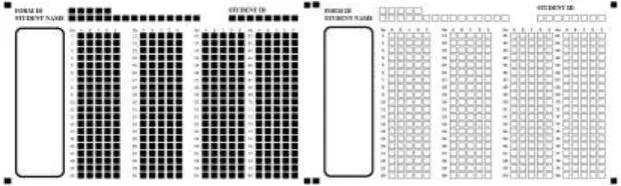
[image:2.595.142.453.419.512.2]Answer sheet form must be designed identically with the associate template of that form as shown in Fig. 1. Four black boxes on each corner of the paper indicate the area of the answer sheet. The other black boxes indicate the places where the student gives their input. The white box on the left side is set to be empty which can be used for additional information, label, icon, or logo.
Figure 1. Example of the template and the answer sheet.
All black boxes in the template are grouped into regions, such as FormID and StudentID which consist of only numbers, StudentName which consists of only uppercase letters, and the rest are answer regions which will be marked. Every two adjacent black boxes in the same region must have equal horizontal distance. Detailed information about these regions are provided in a text file named “Template_Format.txt”. An example is in Fig. 2 with the following explanation for each row:
• First is the total number of black boxes in this row.
• The next several numbers indicate the total number of black boxes in each region in this row. • The next several numbers indicate the answer’s type of each region in this row (1 for
uppercase, 0 for number, or 3 for mark).
• The next several string indicate the name of each region in this row.
Figure 2. Example of template’s format.
Proposed System
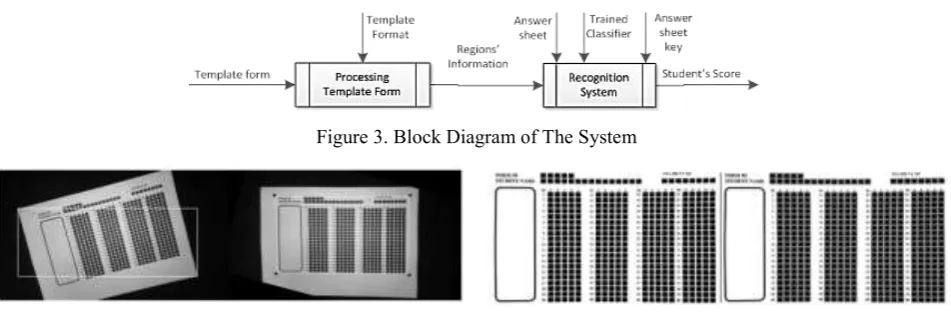
steps can be seen in Fig. 4. Otsu thresholding is applied whenever contours are to be detected. The output of “Processing Template Form” block is the information about each region in the template. It consists of a set of black boxes’ center coordinates along with the region’s answer’s type and name. It was saved in a text file named “Template.txt” whose rows contain the information of each region.
Figure 3. Block Diagram of The System
Figure 4. Steps in processing template.
After processing the template, system must first be provided with answer sheet key, the one containing the correct answers. It is coded by filling the StudentID with 00000000. The steps to get the answer sheet’s area are identical with the ones in processing template form. Afterwards, an area around each set of center coordinates is cropped and converted to binary using Otsu thresholding. The answer image is then detected by finding contours with similar area as the references boxes. An example of this process is shown in Fig. 5. After processing the answer sheet key, system will save the result in a text file named “FormID_Key.txt” with the following format:
• The first row consists of five digits of FormID. • The Second row is either the teacher’s name or blank. • The third row is 00000000 which is the StudentID.
[image:3.595.158.438.472.514.2]• The rest is just a single character in each row indicating the answer for question 1 to 80.
Figure 5. Getting the answer from the answer sheet.
[image:3.595.142.453.621.678.2]An answer sheet is processed in the same way as the answer sheet key. The answer for each question is then compared with the one from the answer sheet key to determine the student’s score. After processing all the answer sheets, the results are then saved in a text file named “FormID_Result.txt” with format as shown in Fig. 6. Columns labelled 1 to 80 store the student’s answers for each respective question, which is one out of five possible answers {A, B, C, D, E}.
Figure 6. The result after processing all answer sheets.
Handwritten Recognition Algorithm
decomposed into 8 standard directions with 45o interval each. The image is then divided into fixed size regions, and finally HOGs from all regions are concatenated and used as features. The classification is done using RBFNN with 26 hidden and output nodes. This configuration is done due to its simplicity for faster recognition process. Each hidden node implements a Gaussian function to determine the influence of an input vector to this node.
Experiment Result and Discussion
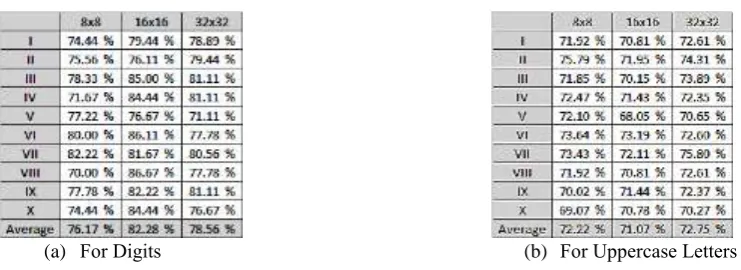
Two experiments are done, to find the success rates of the applied handwritten recognition algorithm, and then the success rates of the proposed system in recognizing the answer sheet. For handwritten recognition, data are collected from our students for both digits and uppercase letters, with each class having 180 samples from 18 writers. Some of these data can be seen in Fig. 7. Two separate RBFNNs are used to recognize digit and uppercase letter. For both RBFNN, testing by rotation method [8] of mode 10 is done with varying region’s size (8x8, 16x16, and 32x32). The result for digits is shown in Table 1(a), while the one for uppercase letters is shown in Table 1(b).
Figure 7. Examples of data collected for digits and uppercase letters.
[image:4.595.114.485.441.576.2]From Table 1(a), the best recognition result for digits with 82.28% success rates is obtained when the region’s size is 16x16. On the other hand, the best recognition result for uppercase letters with 72.75% success rates is obtained when using region’s size of 32x32. Based on these results, RBFNN for digit recognition (form’s and student’s ID) in answer sheet is trained with 16x16 region’s size, while the one for uppercase letter recognition (student’s name) is trained using 32x32 region’s size.
Table 1. Result of Testing by Rotation Method.
(a) For Digits (b) For Uppercase Letters
The second experiment for the proposed system’s performance is done using 12 answer sheets. For each answer sheet, there are three results which correspond with three different answer’s types (digit, letter, and marks). While RBFNN is used for digit and letter recognition, marked answers are detected using the total number of black pixel inside the answer boxes. The result can be seen in Table 2.
Table 2. Success Rates for 12 Answer Sheets.
Based on the results, the success rates in getting the marked answers is pretty high at 99.69%. Further analysis finds out that the system fails to recognize marked answers when the student fills more then one boxes (either intentionally or to change their answers). This shows that some standard rules must be set to handle scenario when the student marks more then one answers.
No 1 2 3 4 5 6 7 8 9 10 11 12 Average
DIGIT 100.00 % 100.00 % 92.31 % 92.31 % 92.31 % 92.31 % 92.31 % 92.31 % 84.62 % 84.62 % 84.62 % 84.62 % 91.03 %
LETTER 100.00 % 92.31 % 86.67 % 86.67 % 85.71 % 80.00 % 80.00 % 75.00 % 73.33 % 72.73 % 72.73 % 71.43 % 81.38 %
As for the digit and uppercase letter recognition, the results are higher then the first experiment. This might be because not all characters appear the same number of times. However, the result from the first experiment (82.28% for digits and 72.25% for uppercase letters) shows that more research should be done to deal with this problem. This might be caused by the choice of feature extraction or classification technique. Particularly, RBFNN configuration with 26 hidden nodes might be too simple to handle the variation in handwritten character. Another thing to consider is the addition of more features to increase the discrimating ability of the RBFNN.
Summary
A multiple-choice test recognition system which works on Android based smartphone has been made. The system consists of OMR to identify the answers and offline handwritten recognition to recognize the form’s ID, student’s ID, and student’s name. There are three steps to use the system, process the template, process the answer sheet key, and finally process each answer sheet.
The system has successfully identified 99.69% marked answers, with failures only when the student marked two or more boxes. On the other hand, the handwritten character recognition can only recognize 82.28% for digits and 72.25% for uppercase letters. Improvement can be made in both the features and classifier. Improvement on features can be made in the gradient features itself or by adding additional features without significant load on the system. Meanwhile, classifier can be improved by adjusting the RBNN configuration or by employing/combining other classifiers.
Acknowledgement
This research is funded by Indonesian Ministry of Research, Technology and Higher Education, Directorate General of Higher Education, Kopertis Wilayah III, No. 0419/K3/KM/2017 dated on 24 Mei 2017 and 189/LPPM-UPH/VI/2017.
References
[1] H. Deng, F. Wang and B. Liang, "A Low-Cost Omr Solution For Educational Applications," In International Symposium On Parallel And Distributed Processing With Applications, Sydney, 2008. [2] H. Kubo, H. Ohashi, M. Tamamura and T. Kowata, "Shared Questionnaire System For School Community Management," In International Symposium On Applications And The Internet Workshops. 2004 Workshops, Tokyo, 2004.
[3] C.-L. Liu, K. Nakashima, H. Sako and H. Fujisawa, "Handwritten Digit Recognition: Investigation of Normalization and Feature Extraction Techniques," Pattern Recognition, Pp. 265-279, 2004.
[4] A. Spadaccini and V. G. Rizzo, "A Multiple-Choice Test Recognition System Based on the Gamera Framework," Corr, Abs/1105.3834, Pp. 5-15, 2011.
[5] H. Fujisawa and C.-L. Liu, "Directional Pattern Matching For Character Recognition Revisited," In Seventh International Conference On Document Analysis And Recognition, 2003. Proceedings. Edinburgh, 2003.
[6] J. Pradeep, E. Srinivasan and S. Himavathi, "Performance Analysis Of Hybrid Feature Extraction Technique For Recognizing English Handwritten Characters," In 2012 World Congress On Information and Communication Technologies, Trivandrum, 2012.
[7] H. E. Bahi, Z. Mahani and A. Zatni, "An Offline Handwritten Character Recognition System For Image Obtained By Camera Phone," Mathematical Applications In Modern Science, Pp. 180-189, 2014.