2017 2nd International Conference on Artificial Intelligence and Engineering Applications (AIEA 2017)
ISBN: 978-1-60595-485-1
The Design of the Lamp Wireless Energy-saving
Control System
BIQING LI, ZHAO LI and SONGLIN CHEN
ABSTRACT
This design is a system which makes use of wireless technology to control circuit. The main engine of the system is composed by STC89C52SCM, key, DS1302 (clock chip), 315Mtransmitter module and Light detection circuit. The slave is composed by 315M wireless module and piezoelectric infrared human body induction module. The system constitutes a complete signal processing circuit through the remote wireless communication network, the single-chip microcomputer control center and LED lamp control terminal. It can not only save energy and money, but also can improve target localization accuracy and reduce management costs, so that offer facilities for people’s work and life. After debugging, this design has reached all the expected requirements.
KEYWORDS
315MHZ; STC89C52; DS1302; Piezoelectric infrared human body induction.
OVERALL DESIGN
Urban lighting system is one of the most promising green lighting systems, which can not only save energy, but also meet the requirements of low-carbon life. The development and manufacturing of LED remote control lamps has attracted numerous enterprise investments, and some of the top of the research and development of wireless network companies have also moved into the new industries, which makes the wireless network develops with a rapid speed, and its function also gets gradually improved, driving the economic development. The emergence and use of short-range wireless communication technology makes electronic products more intelligent, and makes our life more convenient so that our life standards are also improved. In addition, wireless communication is also used in many fields such as home appliances intelligence and medical treatment.
HARDWARE DESIGN
Design ideas
The system is divided into six parts according to the wireless energy saving control. The wireless control of this design consists of single-chip microcomputer and _________________________________________
Biqing Li, Songlin Chen, College of Mechanical and Electronic Engineering, Hezhou University, Hezhou Guangxi 542899, China; [email protected]
transceiver module. Through the network generated, the control order is sent to the street lamp, and the light and dark condition of LED street lamp is obtained. The module realizes energy saving by sensing the external environment and controlling the brightness of the LED.
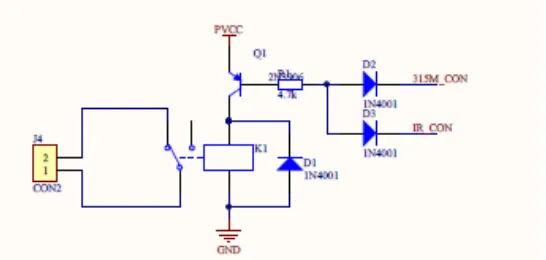
Figure 1. Relay circuit diagram.
315M wireless transceiver module
The 315M wireless transceiver module consists of two modules, which are receiving and firing modules. The 315M wireless transmitter module has PT2262 coding, and the corresponding receiver module has PT2272 decoding, among which, the emission chip PT2262 emission circuit is very compact, and the external components are small, but it contains the carrier oscillator, encoder and launcher unit, to realize many functions. The data loss of the receiving chip PT2272 has "temporary storage" and "lock storage", which is convenient for users to use. Working process is launch module, and after the data signals were collected by encoding chip PT226 signal encoding and after its transformation, by the carrier to transmit the information, by PT2272 received signal decoding, and then output the corresponding high level.
Control module
The control module is controlled by the microcontroller minimum system and relay control circuit. The central processor of the system uses the STC89C52 as the microprocessor, which uses the closing of the relay to control the switch of LED street lamps. Single chip microcomputer minimum system containing reset circuit. In the reset circuit, the reset pin RST connects a 10K resistor to GND, and a 10uF capacitor is connected to the VCC to form a RC charging and discharge circuit. The main function of this is to be able to reset and re-enter the normal state of work. The chip's system clock is a 12-point frequency of the crystal oscillator, but a new generation of 1T chips is no longer on the 12-point scale, which is much slower than the other series of single-chip processors.
Light detection circuit
NPN triode is controlled by R2 and R4 partial pressure. The resistance of the photoresist or R is affected by the intensity of the light, and the voltage of the rheostat is greater than 0.7 V, and the triode conductors, when it has the light. When there no light, the photosensitive resistance tolerance became many times larger than rheostat value, through resistor voltage almost can be ignored, triode B pole and E electrode voltage which cut-off when it is less than 0.7 V. Acquisition of light detection circuit is mainly to light through the processor's processing and will be gained by the information back to the system control center, through which it can judge the strength of the light intelligent control system, and according to the current environment, to destroy the light of the led to make a decision, thus saving electricity.
Thermally released human infrared sensing module
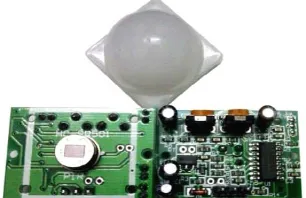
We all know that when the night comes, if there are no objects through a whole bright LED street lamp and it is a waste of electricity. This design through the piezoelectric infrared sensor surrounding objects pass, and when it senses the infrared ray emitted by objects, LED light will light up automatically, otherwise it is not bright, so as to achieve the purpose of saving energy. This design uses the LHI778 probe through infrared technology to sense the infrared signal emitted by the human body, and the sensitivity is very high, the reliability is very strong, the power consumption is small, and the work is in the ultra-low voltage mode.
LCD1602 liquid crystal display section
LCD display power consumption is low, and the programming is convenient, the configuration is flexible, with the single-chip computer interface is simple, in the single chip microcomputer application system is widely used. The components of the lattice building type general classification has 5 x7, and 5 x11 models, that is to say, component part of the components of a number of lattice character modules, and each module contains 35 or 55 display points, between the lattice modules remain a certain space. In this design, this display is used to display time, date, and voltage values to be able to simply implement the display functionality.
SOFTWARE DESIGN
System general procedure design
Perform the initializer first, then start the program, execute the automatic detection program, and perform corresponding functions according to the collected data.(2) 315M wireless functional procedures: it firstly scans each IO port, determines the radio signal transmitting and receives data according to each IO port, and then performs the corresponding functions.
Clock circuit subprogram design
interrupted, and if the interrupt causes a delay in the sequence of the serial communication, the clock pulse stop, which causes the error message to be sent.
The driving method of LCD1602
[image:4.612.223.376.251.350.2]LCD1602 modules usually have two connection methods, which are direct control and indirect control. Direct control refers to the actual LCD1602 module bus interface directly with microcontroller port connection, and single chip microcomputer simulation control port by the program, thereby to control the LCD1602 bus sequential control to complete the system operation. Indirect control means that LCD602 bus is connected to the interface of a single chip microcomputer, and control LCD1602 is directly operated in the program. Many single chip machines are now sealed in the bus, and no external bus has been introduced.
Figure 2. HC-SR501 module object diagram.
Figure 3. LCD1602 pin diagram.
SYSTEM TEST
[image:4.612.165.430.382.549.2]SUMMARY
This paper adopts single chip microcomputer technology, human sensing technology and wireless communication technology, and designs a kind of short distance wireless intelligent control LED lamp to save energy. The system is of high cost performance, low cost of hardware and maintenance, small power consumption and environmental protection, all of which meet the requirements of the society for green economy and energy-saving energy. This work is supported the following fund:2016 The project of improving the basic ability of young teachers in Colleges and universities in Guangxi: “Design and development of electronic commerce platform of agricultural products based on Semantic Technology” ( No, KY2016YB455 ) .2015 college students' innovative training program: “Research on the application of value added travel experience in the mobile terminal of the ‘ethnic custom travel’ in Guangxi” ( No 201511838070 );&& “The design and development He Yuan Tong Campus Mobile Phone APP based on Android” ( No 201511838034 ).Project of scientific research and technology development project of Hezhou: “Design and implementation of agricultural products e-commerce platform based on Semantic Technology” ( No, Hekeneng 1506006 ).
ACKNOWLEDGEMENTS
Corresponding Author: Zhao Li, Management Engineering Department, Guangxi vocational and technical college of, Nanning Guangxi 545000, China; [email protected].
REFERENCES
1. B.Q. Li, Y.F. Ling, H.Y. Zhang, and S.Y. Zheng: The Design and Realization of Cherry Tomato
Harvesting Robot Based on IOT. International Journal of Online Engineering, 12(12), 23, (2016).
2. B.Q. Li, W.L. Guan, S.Y. Zheng, X.G. Yue: Optimization Design of Corn Precision Seeder Based
on Multi-Route and Multi-channel Control. Journal of the Balkan Tribological Association, 21(4A), 1215, (2015).
3. S.Y. Zheng, et al, Social Work in Teen Addiction Correction Services Research under the New Situation, in: Proceedings of the 2015 4th National Conference on Electrical, Electronics and Computer Engineering (NCEECE 2015), Xian, China, 2015, PP. 252-255.
4. B.Q. Li, et al, Intelligent Control Management System and Its Application, in: Proceedings of the 2016 International Conference on Economics and Management Innovations, Wuhan, China, 2016, PP. 68-71.
5. B.Q. Li, et al, Design and Implementation of Tanks War Game Based on the Android Platform, in:
Proceedings of the 2016 2nd Workshop on Advanced Research and Technology in Industry Applications, Dalian, China, 2016, PP. 963-966.
6. B.Q. Li, et al, Design of a Tea Garden Ant freezing Control System, in: Proceedings of the 2016 6th International Conference on Machinery, Materials, Environment, Biotechnology and Computer (MMEBC), Tianjin, China, 2016, PP. 736-738.
7. B.Q. Li, et al, Design of Electronic Compass, in: Proceedings of the 2016 6th International Conference on Machinery, Materials, Environment, Biotechnology and Computer (MMEBC), Tianjin, China, 2016, PP. 1240-1243.
9. B.Q. Li, et al, The Design and Realization of Fruit Harvesting Robot Based on IOT, in: Proceedings of the 2016 INTERNATIONAL CONFERENCE ON COMPUTER ENGINEERING, INFORMATION SCIENCE & APPLICATION TECHNOLOGY (ICCIA 2016), Guilin, China, 2016, PP. 261-264.
10. B.Q. Li, et al, A New Type of Automatic Opening and Closing Light-Operated Curtain, in: Proceedings of the 2016 International Conference on Mechatronics Engineering and Information Technology (ICMEIT), Xian, China, 2016, PP. 66-69.
11. B.Q. Li, et al, Design of the Intelligent Air Humidifier, in: Proceedings of the 2016 International Conference on Mechatronics Engineering and Information Technology (ICMEIT), Xian, China, 2016, PP. 201-203.
12. B.Q. Li, et al, The Design Implementation of the APP of Experiencing Guangxi Folk Custom, in:
Proceedings of the 2016 International Conference on Economics and Management Innovations, Wuhan, China, 2016, PP. 47-50.
13. S.Y. Zheng, et al, Digital Display Design of Ethnic Clothing of Nanling, in: Proceedings of the 4th International Conference on Mechatronics, Materials. Chemistry and Computer Engineering 2015 (ICMMCCE 2015), Xian, China, 2015, PP. 2805-2808.
14. S.Y. Zheng, et al, Design and Implementation of Supermarket Personnel Management System Based
On Java, in: Proceedings of the 2015 International Conference on Education, Management and Computing Technology, Tianjin, China, 2015, PP. 1724-1727.
15. [15] S.Y. Zheng, et al, Analysis of Internet of Things Talent Training and Curriculum System Innovation, in: Proceedings of the 2016 International Conference on Education, Management and Computing Technology (ICEMCT-16), Hangzhou, China, 2016, PP. 957-960.
16. [16] S.Y. Zheng, et al, Brief analysis on “HeYuanTong” Campus Mobile Phone APP Design, in: