2017 2nd International Conference on Computer Engineering, Information Science and Internet Technology (CII 2017) ISBN: 978-1-60595-504-9
Parameter Optimization in GA for Large-scale
Traveling Salesman Problem
XINGKE TIAN and SHUO YANG
ABSTRACT
Traveling Salesman Problems (TSP) is a typical problem in computer science and it is also the most concerned problem for researchers in combinatorial optimization. Therefore, how to solve the optimal loop of TSP problem is a hot topic in researchers. At present, the genetic algorithm has been mature in solving the TSP problem, but the research on the optimization of genetic algorithm parameters is still relatively less. Therefore, in this paper, we analyzed the relevant parameters of the genetic algorithm, optimized the parameters in the application of TSP problem, strengthened its optimization ability, and gave a calculation framework: Firstly, we sampled and analyzed the parameters by using the experimental design method and found the most influential parameters. Secondly, we established and optimized the proxy model and obtained the optimal parameters. Finally, we verified the results with examples. The experiment proved that this method improved the efficiency of solving TSP problem greatly.
KEYWORDS
Genetic algorithm, experimental design method, agent model, and optimization.
INTRODUCTION
Traveling Salesman Problems (TSP) is a typical problem in computer science and it is also the most concerned problem for researchers in combinatorial optimization. Therefore, how to solve the optimal loop of TSP problem is a hot topic in researchers. At present, the genetic algorithm has been mature in solving the TSP problem, but the research on the optimization of genetic algorithm parameters is still relatively less. Therefore, in this paper, we analyzed the relevant parameters of the genetic algorithm, optimized the parameters in the application of TSP problem, strengthened its optimization ability, and gave a calculation framework: Firstly, we sampled and analyzed the parameters by using the experimental design method and found the most influential parameters. Secondly, we established and optimized the proxy model and obtained the optimal parameters. Finally, we verified the results with examples. The experiment proved that this method improved the efficiency of solving TSP problem greatly.
Genetic algorithm is a random parallel search algorithm based on natural selection and genetic genetics. It is an efficient method to find the global optimal solution without any initialization information. It regards the solution set of the problem as a _________________________________________
Population, through the continuous selection, crossover, mutation and other genetic operations, so that the quality of the solution is getting better and better. The algorithm has the advantages of global optimization ability, strong adaptability, robustness to solve nonlinear problems, no specific restrictions on the problem, simple calculation process, no special requirements for search space, easy integration with other algorithms. This paper is widely used in the fields of function optimization, image processing, system identification, automatic control, economic forecasting and engineering optimization. It is a more effective global method to solve NP-complete problem.
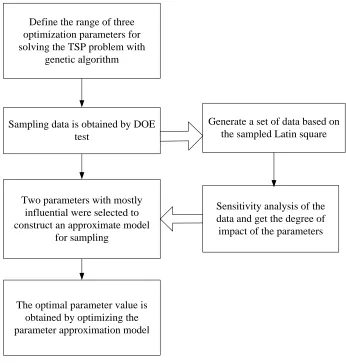
In the traditional genetic algorithm, the parameter crossover probability pc, the mutation probability pm and the population size are fixed in the evolutionary process, but the actual research shows that the three are the key factors that affect the performance of the genetic algorithm. The crossover operator is constantly updating the population, Size determines the rate of individual population update, its value is too large, will destroy the excellent genetic model, the value is too small will lead to slow search algorithm. The population is difficult to get evolution. pm affect the variation of the population, the individual appropriate variation can keep the population diversity, to prevent the local optimal. However, if the value of pm is too large, the algorithm is similar to random search, loss of genetic evolution characteristics. Population size is too small, easily lead to genetic algorithm premature convergence in the suboptimal solution, that appears premature phenomenon; population size is too large, genetic algorithm more resources, the calculation cost is higher. In the genetic algorithm of fixed population size, the population size is estimated by experience, which will bring great blindness. Therefore, it is a hot topic to study how to optimize the parameters of genetic algorithm and avoid the above problems. Many scholars have studied the adaptive control of parameters [3,4,5-7]. On this basis, the parameters of crossover probability, mutation probability and population size are optimized respectively. Fig.1 shows a parameter optimization which three parameters of the genetic algorithm are optimized.
PROBLEM DESCRIPTION
The earliest description of the TSP problem was the 1759 Euler Study Knight travel problem, that is, for 64 squares in the chess board, visit 64 squares once and only once, and eventually return to the starting point. Its general description for a traveler wants to visit n cities; each city must visit and can only visit once, need to seek to include a total of n cities with the shortest access route[8]. The article solves the shortest loop of pr1002 Traveling Salesman Problem.
OPTIMIZATION METHOD
Design of Experiment Method
There are many kinds of experimental design, such as: full factor design, part factor design, orthogonal array, center combination design, Box-Behnken design, Latin hypercube design. This paper used Latin hypercube design (LHD).
Latin hypercube design (LHD) was first proposed by M.D. McKay, R.J. Beckman, and W.J. Conover. The principle is that in the n-dimensional space, each dimension
coordinate interval is xkmin,xkmax ,k
1,n divided equally into m intervals, each cellis recorded as xki1,xki ,i
1,m . Randomly selected m points to ensure that eachlevel of a factor is only studied once, that is, constitute the n-dimensional space, the number of samples of m Latin hypercube design, recorded as m n LHD.
Define the range of three optimization parameters for solving the TSP problem with
genetic algorithm
The optimal parameter value is obtained by optimizing the parameter approximation model
Two parameters with mostly influential were selected to construct an approximate model
for sampling
Sampling data is obtained by DOE test
Generate a set of data based on the sampled Latin square
[image:3.612.130.476.221.584.2]Sensitivity analysis of the data and get the degree of impact of the parameters
……
……
……
Output layer
Middle layer (hidden layer)
[image:4.612.172.419.61.201.2]Input layer
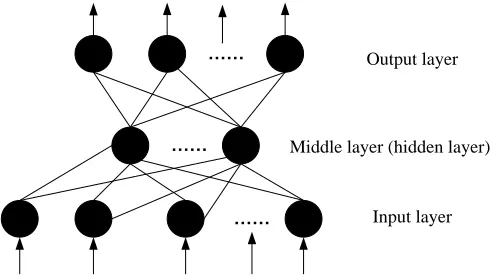
Figure 2. Composition of three-layer forward neural network.
Units Neural Network Model
In 1943, McCulloch and Pitts established the first artificial neural network model, which was extended to the "Perception" model. In the 1980s, Hopfield successfully applied neural networks to combinatorial optimization problems. Nowadays, neural network has been widely used in function approximation, pattern recognition, image processing and computer vision, signal processing, time series, medical control, expert system, power system, military system, financial system, artificial intelligence and optimization.
The structure of the neural network is a three-layer forward network in Fig. 2. The unit layer of the input signal is called the input layer. The cell layer of the output signal is called the output layer. The cell layer that does not directly contact the input and output is called the middle layer or the hidden layer. From the input layer to the hidden layer is a fixed non-linear transformation, the input vector directly mapped to a new space. The mapping of the hidden layer to the output layer is linear, and the output layer implements a linear weighted combination in the new linear space, where the weight is the network tunable.
The neural network model is divided into two types: radial basis RBF (Radial Basis Functions) network and elliptical basis (Elliptical Basis Functions) network.
In this paper, we use the radial basis network (RBF) model to determine the Euclidean distance between the point to be measured and the sample point as the independent variable, that is, the false 1,...,
N N
x x is a set of input vectors,
,
( c) , 1...
i j
g g xx j N is the basis function where xxj, is Euclidean
Distance: (xxj) (T xxj), and 0.2 c 3.
NLPQL Algorithm
1 2
( , ,... ) Design variable
( ) Objective function
( ) 0; 1,..., Equality constraints
( ) 0; 1,..., Inequality constraints
Boundary constraint N
j e
j e
l u
x x x x
F x
g x j m
g x j m m
x x x
. (1)
The key question of SQP is how to approximate the second order information to obtain a fast final convergence rate. Thus we define a second order approximation of a Lagrangian function and a Hessian form matrix approximation through a so-called Newton matrix. Then we can get the subprogram of the second plan: Thus we define the approximation of a Lagrangian function and the approximation of a Hessian form matrix through a so-called Newton matrix. Then we can get the subprogram of the second plan:
1
( )
2
( ) ( ) 0 1,...,
( ) ( ) 0 1,...,
T T n
k k
T
j k j k e
T
j k j k e
l k u k
d B d f x d d R
g x d g x j m
g x d g x j m
x x d x x
. (2)
In order to make the algorithm more stable, especially from a bad start guess point, to ensure that it can achieve global convergence, NLPQL applied in the additional linear search. Only when satisfies a drop on a solution to the quadratic programming problem, a step-by-step calculation of is performed to perform a new iteration. According to Schittkowski's algorithm, a simultaneous line search requires factor approximation and an extended Lagrangian value function to determine the parameters of the line search. In addition, there are some reliable security measures that need to be taken into account to ensure that linearized constraints are not contradictory.
The updating of matrix can be performed in SQP using standard techniques in unconstrained optimization. In the NLPQL, the BFGS algorithm is applied. The algorithm is a simple second order correction from the unit matrix, and only requires differential vectors xk1xk and L x( k1,uk) L x u( k, k). In the assurance of some security
measures, all the matrix can be guaranteed to be positive.
One of the most attractive features of the SQP algorithm is the superlinear convergence rate in the vicinity of the solution obtained from xk1x* k xkx* . Here, k is a positive sequence that converges to zero, and x* is an optimization
solution.
PARAMETER OPTIMIZATION ANALYSIS
Parameter optimization is a method to achieve the design goal. By parameterizing the design target, the optimization method is used to adjust the design variables constantly, so that the design results are close to the parameterized target values. In this paper, for the large-scale TSP problem, the crossover probability, the mutation probability and the population size are optimized in the genetic algorithm, so that the genetic algorithm can solve the large-scale TSP problem. When calculating the computational performance of the algorithm, the computation time is an important indicator, and the efficiency of an algorithm can be seen. Therefore, this paper takes time (T) as the optimization index.
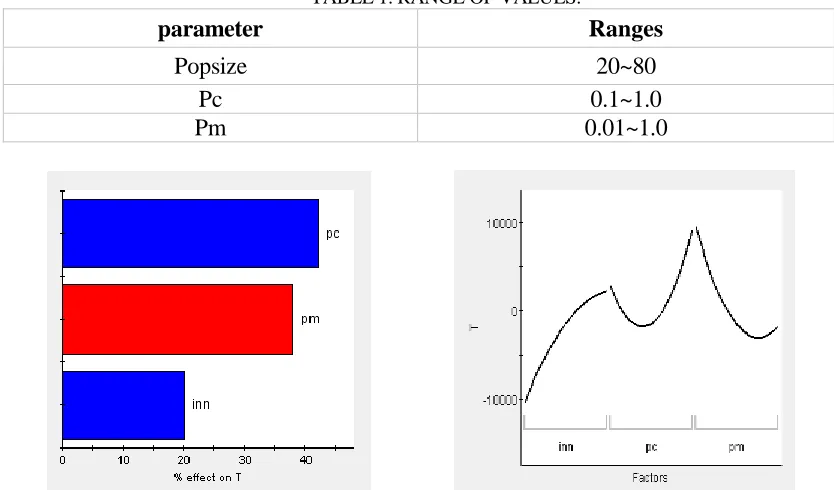
In this paper, the shortest path of large-scale TSP problem is optimized to solve the shortest loop of pr1002.tsp problem. The range of the three parameters of the genetic algorithm is shown in Table 1:
The parameter optimization process is as follows:
1) In the range of three parameters, the three parameters of Latin hypercube sampling, get 50 sample points.
2) Sensitivity analysis of 50 sets of data, the three parameters on the calculation of time (T) the degree of impact and trends, as shown.
3) The crossover probability pc and the mutation probability pm are re-sampled, and the radial basis network (RBF) model is used to predict and get the corresponding error analysis, as shown in Fig.4.
[image:6.612.88.505.404.649.2]4) The NLPQL algorithm is used to optimize the approximate model to obtain the most parameters.
TABLE 1. RANGE OF VALUES.
parameter Ranges
Popsize 20~80
Pc 0.1~1.0
Pm 0.01~1.0
(a) the degree of influence of the parameters (b) the impact of parameters on the trend of time
Figure 4. Actual - Predictive comparison chart. Figure 5. The optimize the process diagram.
TABLE 2. THE OPTIMAL SOLUTION OF THE AGENT MODEL.
pc pm popsize T(s)
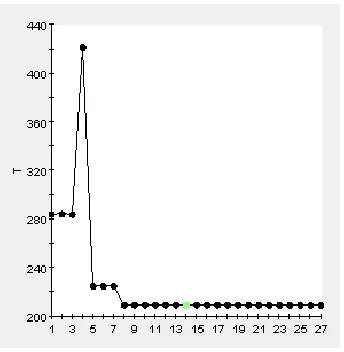
0.1 0.462 40 209
It can be seen from Fig. 3 (a) that the crossover probability pc and the mutation probability pm have a great influence on the calculation time, pc is in positive response with the output time, and pm is negatively related to the output time, and the population size is less affected. Therefore, in order to ensure the accuracy of the agent model prediction, this paper establishes the proxy model for the crossover probability pc, the mutation probability pm and the computation time T.
As can be seen from the Fig. 5, the curve does not change after the algorithm goes up to 13 generations. Get the optimal solution as shown in Table 2:
CONCLUSION
In this paper, the genetic algorithm is used to solve the problem of large-scale traveling salesman. In order to improve the quality of the genetic algorithm, we proposed a tuning framework of the parameters of the genetic algorithm. Then we established the proxy model about the main parameters and the number of evaluation in the genetic algorithm with the help of the Latin hypercharge method and RBF. Finally, we used the NLPQL algorithm to optimize the proxy model to get the optimal genetic parameters. Through the experimental calculation, we proposed that the optimization framework which is proposed in this paper improved the convergence and efficiency of the algorithm greatly.
ACKNOWLEDGEMENTS
Corresponding author: Shuo Yang.
REFERENCES
1. Yu Y Y, Chen Y, Li T Y. An Improved Genetic Algorithm for Traveling Salesman Problem[J]. Control and decision making, 2014(8):1483-1488.
[image:7.612.87.506.265.307.2]3. Ren Z W, San Y. Improved adaptive genetic algorithm and its application research in parameter identification[J]. J of System Simulation, 2006, 18(1): 41-43.
4. Mu A H, Zhou S L, Yu X L. Research on fast self-adaptive genetic algorithm and its simulation[J]. J of System Simulation, 2004, 10(1): 122-125.
5. Srinivas M, Patnail K L M. Adaptive probabilities of crossover and mutation in genetic algorithms[J]. IEEE Trans on System, Man and Cybernetics, 1994, 24(4): 656-667.
6. Ren H Y, Chen F X. Improvement of adaptive genetic algorithms and application in line simplification[J].Computer Engineering and Application, 2012, 48(11): 152-155.
7. Xiang Z Y, Liu Z C, Shen P A. An improved adaptive genetic algorithm based on evolutionary stages[J]. J of Wuhan University: Engineering, 2008, 41(1): 133-136.