2016 International Conference on Computer, Mechatronics and Electronic Engineering (CMEE 2016) ISBN: 978-1-60595-406-6
Research on FHA Based UAV Fault Locating and Repairing
Qian YE
1,*, Min-yan LU
2, Shao-shan SUN
3and Hong ZHANG
41,2,4
School of Reliability and Systems Engineering, Beihang University, Beijing, China
3
Aircraft Design & Research Institute, Chengdu, China *Corresponding author
Keywords: Function hazard analysis, Knowledge base, Abductive reasoning, Fault locating.
Abstract. In response to the failure of safety critical functions that unmanned aerial vehicle (UAV) may happen during the flight phases, fault location scheme was proposed based on function hazard analysis results. And methods about automatically generating repairing strategies were put forward according to the pre-configuration items. Firstly, failure knowledge base, which includes the information about function failure, failure effect, and others, was constructed based on the FHA results combing FMEA analyzing results. And then repair strategies for each failure in the knowledge base combing FTA analyzing results was pre-designed. Finally, abductive reasoning method was applied to search for the cause of failure. And repairing strategies were generated accordingly. An assistant tool was developed to simplify the process of building the knowledge base. Interface for the fault locating and repairing strategies generating was also implemented in the tool. An example was proposed to demonstrate the scheme.
Introduction
In recent years, due to the development of UAV technology and its unique advantages, UAV has been widely applied in military, commercial area and other aspects. However, besides the more complicated and diversified environment UVA may face, the time to execute a particular task and flight distance required is also increased gradually. During when, the health status, availability and other quality properties of UVA may degenerate, which might result in the failure of the specific task or even cause the crash of the UVA. One solution to the problem is adding various sensors and other monitoring equipment to different subsystems to monitor the overall operation of the UAV [1]. When the UAV health deterioration, corresponding measures could be taken fleetly to ensure the normal functions of UVA to continue executing tasks or guarantee the minimal ability for the aircraft to return to base.
UAV fault reasoning is a problem worthy to be studied. Meanwhile, how to locate the root of the fault and take appropriate measures to ensure the normal operation of UAV is equally worthy to be studied. Among them, FHA is one of the most important methods used for safety analysis, for which a lot of information about functions and structure of each system have been accumulated in analysis results. This paper presents a method to construct failure knowledge base on the basis of the safety analysis results of FHA combing with the analysis results of FMEA. Besides that, a method to locate the root fault with abductive reasoning [9] is also proposed. The FHA results in this paper is extended in which FMEA analysis results are embodied to contain more detailed information. After that, repair strategies for each extended FTA analysis results is established to form repair strategy knowledge base which is mapping with the failure knowledge base. Based on these, the UAV fault detection and repair process works as follows. The first thing to be done is detecting the potential root of fault according to the failure knowledge base with abductive reasoning method. Then, one or more repair strategies are generated basing on the repair knowledge base corresponding to each potential root of fault. Finally, UAV heath management module execute the optimal repair strategy after simulating and evaluating every proposed repair strategy. In this paper, TDPFM (i.e., target detection and processing function module) is demonstrated as an example to illustrate the methods above. What’s more, CKB-Tool (i.e., constructing knowledge base assistant tool) is developed to demonstrate and assist the process to build the failure knowledge base and repair knowledge base. Each item in the knowledge base can be exported as standard XML format file so that it can be transmitted and manipulated among different aircraft platforms. CKB-Tool also provides query interface to react that when event of failure is queried, reasons of failure and its corresponding failure repair strategy are automatic generated basing on the proposed methods in this paper.
The rest of this paper is organized as follows. Part 2 proposes the method. Part 3 gives an example to demonstrate the methods. Part 4 concludes the research.
Methods
Analysis about FHA
FHA (i.e., functional hazard analysis) is a systematic, comprehensive examination of functions to identify and classify failure conditions of those functions according to their severity [5]. And FHA is being increasingly recommended as a means of performing hazard identification.
FHA is usually performed at two levels, i.e. aircraft level and system level. The results of the FHA analysis can be used not only to assess the safety of the aircraft, but also to guide the following design work. FHA analysis results usually consist of the following parts: function, phase, failure condition, failure effect, security consequence classification, etc. A typical example of FHA analysis results is shown as Table 1.
Table 1. Example of FHA.
Ref Function Phase Failure Condition Failure Effect Classification 1 obtaining the
coordinate information
cruise phase
Interruption of receiving signal
Departure flight trajectory major
[image:2.595.70.525.612.665.2]Among them, the failure effect in FHA analysis results can be obtained by combining FMEA analysis results which could provide more detailed information. A typical example of FMEA analysis result is shown as Table 2.
Table 2. Example of FMEA.
Ref Function Failure mode Local effect Upper effect Final effect 1 obtaining
coordinate information
Failure of the model of receiving signal
Interruption of receiving signal
Exception of obtaining coordinate information
In this paper, knowledge base including failure knowledge base and repair strategy knowledge base is built on the basis of the results of FHA combing FMEA results rather than only the FHA or FMEA because of the reason that the FHA could provide a comparable high level information while FMEA results could provide more details relatively.
Constructing the Failure Knowledge Base
Failure knowledge base is a set consist of Horn clauses which are constructed according to actual situation of the UAV system. The Horn clause could be a certain clause, such as "if the attitude sensor is abnormal, then attitude angle calculation module is abnormal". It also could be an integrity constraint clause, such as "the command for UAV to put down and pack up the landing gear could not been sent at the same time". The hypothesis is represented as a set which includes all possible explanations for the root of the failure. Hypotheses in the UAV failure knowledge base are the root reasons that could lead to the failure of aircraft or its subsystems.
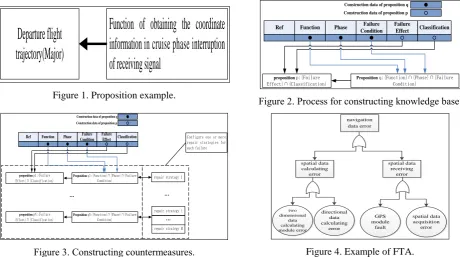
The FHA results could reflect the logical relationship between the failure condition and the failure effect. Take Table I as an example. It describes function of navigation system to automatically obtain flight coordinate information in cruise stage. Failure condition is signal receiving interrupted caused by the fault of navigation signal. And corresponding failure effect is losing the ability to locate the position of aircraft which could result in deviating from the normal flight trajectory. By establishing the relationship between the failure condition and the failure effect, a compound proposition could be constructed as Figure 1.
Departure flight
trajectory(Major)
[image:3.595.60.521.352.609.2]Function of obtaining the coordinate
information in cruise phase interruption
of receiving signal
Figure 1. Proposition example.
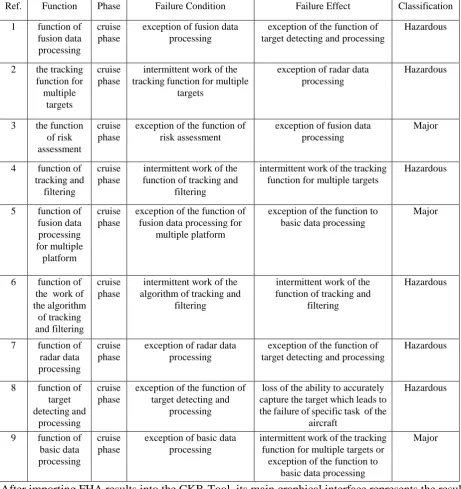
Ref Phase Failure Condition
Failure Effect Function
Construction data of proposition q
Classification
Construction data of proposition p
proposition p:{Failure Effect}∩{Classification}
Proposition q:{Function}∩{Phase}∩{Failure Condition}
Figure 2. Process for constructing knowledge base.
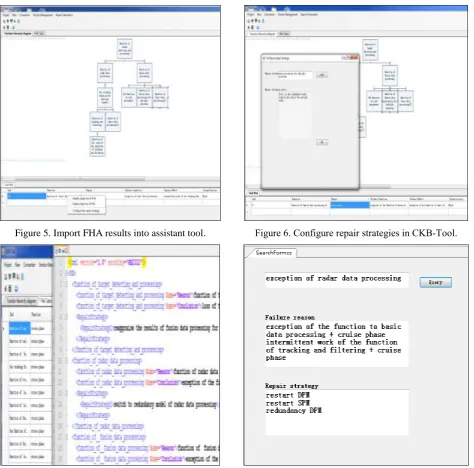
Ref Phase Failure Condition
Failure Effect Function
Construction data of proposition q
Classification
Construction data of proposition p
proposition p1:{Failure Effect}∩{Classification}
Proposition q1:{Function}∩{Phase}∩{Failure
Condition} repair strategy 1
…
proposition pN:{Failure Effect}∩{Classification}
Proposition qN:{Function}∩{Phase}∩{Failure Condition}
repair strategy i
…
repair strategy M
…
Configure one or more repair strategies for each failure
Figure 3. Constructing countermeasures.
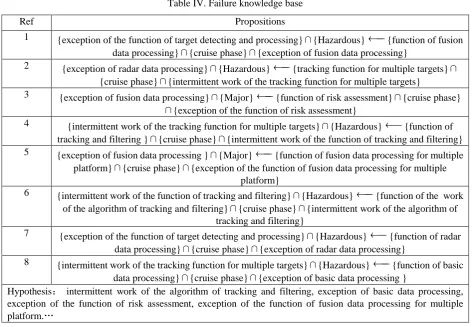
navigation data error spatial data calculating error spatial data receiving error two dimensional data calculating module error directional data calculating error GPS module fault spatial data acquisition error
Figure 4. Example of FTA.
Procedure to construct the compound proposition as the form pq by extracting the logical
relation from FHA results could be summarized as follows. Firstly, construct proposition p basing
on combing data in the failure effect column and classification column. Then, build proposition q by
merging the data in the function column, phase, and failure condition. Finally, construct the
compound proposition pq to establish logical relation. Header information in FHA results tables
and relation about the compound proposition is shown as Figure 2. All the root failure conditions after recursive analysis compose the common hypotheses.
Constructing the Repair Knowledge Base
generated by querying the repair knowledge base to obtain corresponding strategies for each specific failure. And the aircraft health managing system [10-13] automatically select the optimal one to execution. The relationship between the repair strategy knowledge base and the failure knowledge base is shown in Figure 3. The way to configure failure respecting strategies can refer to other analysis methods such as FTA, etc. During FHA analysis, FTA method could assist to find more detailed reasons of failure by further analysis. "Navigation data error", for instance, may be finally located to “two dimensional data calculating module error” after further FTA analysis. A typical example of FTA is as Figure 4.
Process to Locate the Fault
On the basis of the failure knowledge base, abductive reasoning method is applied to diagnose the source of failure. The occurrence and propagation of failure is recognized according to the alarm information generated by different sensors of UAV. During the abductive reasoning process, hypothesis is made by the observed phenomena to predict what may be the most likely cause of failure. Abduction is the inverse process of deduction. Peirce [14] described the abductive reasoning
as follows. We could conduct A is established when appearance of C is observed with the
pre-defined reasoning rule if A is established, then C is established. An unexpected fact is now
observed, and there is a reason for that. In [15], the interpretation of facts and the minimum
explanation in abductive reasoning methods is described as follows, in which KB represents the
knowledge base, and A is the hypothesis.
The scene of KB A, is the subset of A that makes KB H hold which means a model exists that
each element in KB and H is true. The interpretation of the proposition g in KB A, represents a
scenario which implements g in conjunction withKB. The implementation of g is a set of H that
make H Asatisfy KB H|g and KB H| false . If H is the implementation of g in KB A,
and no more strict subsets exist, then H is the minimal implementation.
During the process of reasoning, when an abnormal failure is observed, the reasoning of knowledge
base construction, a query could be made in KBr to check whether any item pfailure could match the
observed phenomena. Then the corresponding failure proposition qfailure could be confirmed
according to the rule pq. Let qfailurebe new proposition p and continue the process recursively
until it cannot carry on. Take the proposition qfailure in the ultimate reasoning process as the
interpretation for pfailure. If there are more than one interpretation, further identification should do to
narrow the scope of the interpretation to obtain minimum ones.
Generating the Repair Strategies
After applying the failure reasoning methods, possible reasons including one or more interpretation could be obtained by inferring. Query to acquire the repair strategies according to the repair strategies knowledge base. Sort these repair strategies in accordance with the risk level when functional failure occurs. And the one with higher risk receive the higher priority. The resulting repair strategies are submitted to the UAV heath managing module to the implement the repairmen.
Case Study
demonstration example by making FHA analysis, and establishing corresponding knowledge base. The FHA analysis results are extended with merging the FMEA analysis results. And the repair strategies are combined with the FTA analysis results.
Results of FHA
[image:5.595.68.530.249.739.2]Target detection and processing function of UAV could be divided as radar data processing sub-function, data fusion processing sub-function, etc. in [16]. The sub-functions could continue to be divided into more detailed sub-functions, for instance, radar data processing sub-function could be further divided until the hardware modules, such as data processing module (DPM), etc. In this paper, partial target detection processing system is selected as the FHA analysis object. And the failure effect in FHA is referring the FMEA analysis results. A FHA result of the object is shown as Table 3.
Table 3. FHA Results for integrated detection system.
Ref. Function Phase Failure Condition Failure Effect Classification
1 function of fusion data processing
cruise phase
exception of fusion data processing
exception of the function of target detecting and processing
Hazardous
2 the tracking function for multiple
targets
cruise phase
intermittent work of the tracking function for multiple
targets
exception of radar data processing
Hazardous
3 the function of risk assessment
cruise phase
exception of the function of risk assessment
exception of fusion data processing
Major
4 function of tracking and
filtering
cruise phase
intermittent work of the function of tracking and
filtering
intermittent work of the tracking function for multiple targets
Hazardous
5 function of fusion data processing for multiple platform cruise phase
exception of the function of fusion data processing for
multiple platform
exception of the function to basic data processing
Major
6 function of the work of the algorithm
of tracking and filtering
cruise phase
intermittent work of the algorithm of tracking and
filtering
intermittent work of the function of tracking and
filtering
Hazardous
7 function of radar data processing
cruise phase
exception of radar data processing
exception of the function of target detecting and processing
Hazardous
8 function of target detecting and
processing
cruise phase
exception of the function of target detecting and
processing
loss of the ability to accurately capture the target which leads to the failure of specific task of the
aircraft
Hazardous
9 function of basic data processing
cruise phase
exception of basic data processing
intermittent work of the tracking function for multiple targets or
exception of the function to basic data processing
Major
Figure 5. Import FHA results into assistant tool. Figure 6. Configure repair strategies in CKB-Tool.
Figure 7. XML file exported by CKB-Tool. Figure 8. Reason and repairing strategies generated by
CKB-Tool.
Constructing Failure Knowledge Base
[image:6.595.308.535.74.302.2]Table IV. Failure knowledge base
Ref Propositions
1 {exception of the function of target detecting and processing}∩{Hazardous} ¬¾¾ {function of fusion data processing}∩{cruise phase}∩{exception of fusion data processing}
2 {exception of radar data processing}∩{Hazardous} ¬¾¾ {tracking function for multiple targets}∩ {cruise phase}∩{intermittent work of the tracking function for multiple targets}
3 {exception of fusion data processing}∩{Major} ¬¾¾ {function of risk assessment}∩{cruise phase} ∩{exception of the function of risk assessment}
4 {intermittent work of the tracking function for multiple targets}∩{Hazardous} ¬¾¾ {function of tracking and filtering }∩{cruise phase}∩{intermittent work of the function of tracking and filtering} 5 {exception of fusion data processing }∩{Major} ¬¾¾ {function of fusion data processing for multiple
platform}∩{cruise phase}∩{exception of the function of fusion data processing for multiple platform}
6 {intermittent work of the function of tracking and filtering}∩{Hazardous} ¬¾¾ {function of the work of the algorithm of tracking and filtering}∩{cruise phase}∩{intermittent work of the algorithm of
tracking and filtering}
7 {exception of the function of target detecting and processing}∩{Hazardous} ¬¾¾ {function of radar data processing}∩{cruise phase}∩{exception of radar data processing}
8 {intermittent work of the tracking function for multiple targets}∩{Hazardous} ¬¾¾ {function of basic data processing}∩{cruise phase}∩{exception of basic data processing }
Hypothesis: intermittent work of the algorithm of tracking and filtering, exception of basic data processing, exception of the function of risk assessment, exception of the function of fusion data processing for multiple platform.…
Constructing Repair Knowledge Base
On the basis of failure knowledge base, repair strategies are configured for each failure descripted as the Horn clause in the failure knowledge base. Among them, the repair strategies are combining with FTA analysis results. In order to facilitate the representation, the number of items in Table 5 are in
accordance with the number of failure knowledge base KBr.
Table V. Repair knowledge base.
Ref Repair strategies
1 restart the model of tracking and filtering
2 switch to redundancy model of tracking function for multiple targets 3 reappraise risk assessment
switch to redundancy model of risk assessment 4 switch to redundancy model of filtering
5 reappraise the results of fusion data processing for multiple platform vote on the redundancy model results and select the optimal value 6 restart SPM
7 switch to redundancy model of radar data processing 8 reappraise the results of target detecting and processing 9 restart DPM
switch to redundancy DPM 10 restart DPM
switch to redundancy DPM
[image:7.595.142.455.501.696.2]Reasoning and Generating Repair Strategies
If the abnormal symptom of the radar data processing function is observed during the flight phase, then there are two minimum corresponding explanations to interpret the root cause of the upcoming
failure which are {intermittent work of the algorithm of tracking and filtering} and {exception of the
function to process basic data}. Meanwhile, if additional symptom {exception of radar data processing}∩{exception of fusion data processing}, then a minimal explanation {exception of basic data processing} could be obtained.
Because of the reason that when the phenomenon of “exception of radar data processing” is
observed, we can conduct that it must be caused by the reason “intermittent work of the function of
multiple targets tracking”, for which “exception of the function to process basic data” and
“intermittent work of the algorithm of tracking and filtering” are the root cause. What’s more, if
“exception of fusion data processing” is observed at the same time, it can be concluded that
“exception of basic data processing” is likely to be the root cause of the final failure. On the basis of
the repair strategy knowledge base, corresponding repair strategies {restart DPM} or {switch to
redundancy DPM} are generated. And failure could be removed by executing the repair strategies. CKB-Tool simulates provides the query function to demonstrate the process of fault locating and repair strategies generating which is shown in Figure 8.
Conclusion
In this paper, a method used for fault locating and repair strategies generating in UAV is proposed. The method is based on the FHA analysis results during the UAV development phase and analyzed data of similar models of aircraft. Among them, the failure effect in FHA results is obtained by analyzing the relevant FMEA results. By utilizing the abductive reasoning methods accompanying with the knowledge base, root cause of failure of UAV could be inferred. Meanwhile, corresponding repair strategies are generated automatically. The configuration of repair strategies are referring the FTA analysis results. By combining with CKB-Tool, the target detection and processing function module of UAV is taken as an example to demonstrate the feasibility of the method.
Because of essential nature of natural language which used in describing the FHA analysis results, vagueness and ambiguity is a huge challenge. How to construct the knowledge base accurately and intelligently from the FHA analysis results would be the further research to be studied. What’s more, how to utilize other safety analysis results to construct more accurate the knowledge base is also problem that needs to be studied.
References
[1] Zeng Sheng-kui, Michael G. Pecht, Wu Ji. Status and Perspectives of Prognostics and Health Management Technologies[J], Acta Aeronautica et Astronautica Sinica, 2005,26(5):626-632.
[2] E. L. Duke, J. D. Disbrow, and G. F. Butler, A Knowledge-Based Flight Status Monitor for Real-Time Application in Digital Avionics Systems, 1989.
[3] Zhang Xiang-wei, Ding Yun-liang, Liu Yi, Xia Qing-fan, The Realization of Aircraft Fault Diagnosis Expert System[J], Application Research of Computers, 2002,19(6):88-90.
[4] SHI Rong-de, Zhao Ting-di, Tu Qing-ci, Chang Wen-bin, Fault diagnosis expert system, Journal of Beijing University of Aeronautics and Astronautics[J], 1995,21(4):7-12.
[5] S. A. E. Arp, "Guidelines and methods for conducting the safety assessment process on civil airborne systems and equipment," SAE International, December, 1996.
[7] Tang Hua, Application of FHA in the design of air system of civil aircraft[J], Technology Innovation and application, 2014,26:34-35.
[8] Liu Jun, Gong Shu-li, Cui Chan-li, Wang Guo-jun, FTA based reliability analysis of air intake and exhaust device[J], Jiangsu Aviation, 2014, 139(4), 29-32.
[9] D. Walton, Abductive reasoning, 2014.
[10] Ma Xiao-jun, Zuo Hong-fu, Liu Xin, System design of operation monitoring and health management for large passenger aircraft[J], Journal of Traffic and Transportation Engineering, 2011,11(6):119-126.
[11] Zhao Ning-she, Zhai Zheng-jun, Wang Guo-qing, Technologies of New Generation Avionics Integration and Prognostics and Health Management[J], Measurement & Control Technology, 2011,30(1):1-5.
[12] Zhang Qi, Yuan Shen-fang, Overview of integrated vehicle health management (IVHM) technology and development[J], Systems Engineering and Electronics, 2009,31(11):2652-2657.
[13] Pang Quan-Wen, Zhang Guan-Hai, Liu Qi, Study on Prognostics and Health Management Architecture of Unmanned Air Vehicle[J], Aircraft Design, 2012,32(5):50-55.
[14] C. S. Peirce, "Abduction and induction," Philosophical writings of Peirce, vol. 11, 1955.
[15] D. L. Poole and A. K. Mackworth, Artificial Intelligence: foundations of computational agents, 2010.