London School of Economics and Political Science
IT-Enabled Rationalization of Public Administration in Developing
Countries: Essays on Ghana’s Customs Modernization
Atta Addo
A thesis submitted to the Department of Management
London School of Economics
for the degree of Doctor of Philosophy
Declaration
I certify that the thesis I have presented for examination for the MPhil/PhD degree
of the London School of Economics and Political Science is solely my own work other
than where I have clearly indicated that it is the work of others (in which case the extent of
any work carried out jointly by me and any other person is clearly identified in it).
The copyright of this thesis rests with the author. Quotation from it is permitted,
provided that full acknowledgement is made. In accordance with the Regulations, I have
deposited an electronic copy of it in LSE Theses Online held by the British Library of
Political and Economic Science and have granted permission for my thesis to be made
available for public reference. Otherwise, this thesis may not be reproduced without my
prior written consent.
I warrant that this authorisation does not, to the best of my belief, infringe the
rights of any third party. I declare that my thesis consists of 62, 994 words (excluding
references and appendices).
Statement of Conjoint Work
I confirm that paper 3 (chapter 8) was co-authored with Prof. Chrisanthi Avgerou. I did
majority of the work as first author. My contributions included literature review, data
collection, analysis, important parts of the theoretical development, as well as writing.
Prof. Avgerou provided critical guidance in the paper’s overall direction, and needed
support in focusing, refining and effectively communicating the paper for a top-journal
Acknowledgement
During my freshman orientation years ago, the university president gave a piece of advice that has been a beacon along my journey through higher education. “Respect the authority of ideas and not the idea of authority,” he had said. My abstract understanding of his admonition at the time has since given way to an experiential one after pursuing a PhD degree. Exploring ideas on their merit—independent of inherited wisdom and the authority of conventional thinking and its thinkers—has been not just a motor of discovery for me, but frequently, its own reward.
Authoring a doctoral thesis has often required me to trade-in apparent certainty for doubt, doubt for bewilderment, and on occasion, bewilderment for illumination. It is for such occasions of illumination that the last four years have been—even if bumpy in parts—delightfully worthwhile. The PhD journey, of course, neither starts nor ends in four years of institutionally regulated time. It is a culmination of many prior years of intellectual development and the beginning of many more. I have therefore approached my work not as some final word, but as a small contribution that might usefully add to an ongoing conversation that I have been fortunate to listen in on, and momentarily partake in.
There have been many brilliant minds, helping hands, kind spirits, and loving hearts who have contributed to my personal and intellectual development and who have made my journey possible. Thanking by name necessarily risks omissions, by no means out of slight, and for which I plead pardon.
supervision, but also through her thoughtful scholarship on IT in developing countries that has seeded much of my own work and that of countless others.
Special thanks to Dr. Shirin Madon and Dr. Antonio Cordella who assessed my Mphil/PhD upgrade and offered constructive criticism that vastly improved my approach. To all faculty and staff of the information systems and innovation group, and to fellow PhD students, present and past – Emilio, Kanchana, Kari, Antti, Kyung, Priyanka, Silvia, Florian, Cristina, Hono, Aleksi, Maha—thank you for the camaraderie, illuminating discussions and kind support.
To Prof. Brenda Chalfin of the University of Florida whose pioneering Anthropological work on customs and trade administration in neoliberal Ghana, and kind personal correspondence, gave me many insights when I desperately needed entry points into the otherwise opaque world of customs and trade administration. To Prof. Gamel Wiredu of the Ghana Institute of Management and Public Administration (GIMPA), who like a good ‘big brother’ has been a selfless mentor, unreserved critic, and a most friendly guide. To Dr. Richard Boateng, Prof. Bonsu and all the participants who gave me useful feedback at the 2015 doctoral consortium of the African Conference on Information Systems and Technology (ACIST 2015) in Accra, Ghana. To participants who offered valuable feedback at the Quadrangular Conference on Technology, Organization & Society, held at the LSE in September 2014. To the reviewers and insightful participants of the Development Track at the 24th European Conference on Information Systems (ECIS), held at Boğaziçi University, Istanbul Turkey in June 2016.To the incisive reviewers of Track 12, IFIP 9.4 2017 Conference in Yogyakarta, Indonesia. To journal reviewers of paper 3 (chapter 8) for their valuable feedback.
To Henry, Margaret, Nana, Maame, Ivan, Saka, Kakra, Akosua. To Koby for his encouragement, help recruiting informants in Ghana, and for getting me medication when I fell ill with Malaria during fieldwork (despite my best efforts at prevention). To Courtney for everything. To Kaykay for being there, no matter the hour. To my generous contacts and informants in Ghana who took precious time to share their wealth of knowledge and to point me in the right direction when I wandered helplessly—thank you!
Atta Addo
Papers included in thesis
The thesis is presented as a series of papers. It comprises versions of the following original works that have been published or are in review. The papers were all researched, developed and written during my enrolment in the PhD in Information Systems and Innovation at the Department of Management, London School of Economics, 2013-2017.
1. Addo, A. (2017). Subalternity in Information Systems in Developing Countries: A Critical Analysis of Ghana’s TRADENET. Accepted at 14th International
Conference on Social Implications of Computers in Developing Countries (IFIP WG 9.4 2017 in Yogyakarta, Indonesia) and pending publication in Springer Computer Proceedings of IFIP 2017. Papers from track also invited to be published in the Electronic Journal of Information Systems in Developing Countries
(EJISDC)
[An earlier version was presented in the doctoral consortium of the African Conference on Information Systems and Technology (ACIST) 7-8th July 2015, Accra, Ghana]
2. Addo, A. (2016). Explaining ‘Irrationalities of IT-enabled Change in a Developing Country Bureaucracy: Case of Ghana’s TRADENET. Electronic Journal of
Information Systems in Developing Countries (EJISDC), 77 (1)
[Earlier presented and published in Proceedings of the 24th European Conference on Information Systems (ECIS 2016) held in Istanbul, Turkey. Available at AIS Electronic library: http://aisel.aisnet.org/ecis2016_rp/index.2.html ]
IT-Enabled Rationalization of Public Administration in Developing
Countries: Essays on Ghana’s Customs Modernization
Abstract
Through a series of three standalone yet related essays, this thesis theorizes effects of the
government administration context in developing countries on situated IT-enabled
practices. It develops arguments on the capacity of the institutional logics perspective for
explaining complex interactions between the broader social context and IT-enabled
practices carried out by situated actors in the public administration of developing
countries. We theorize IT-enabled rationalization—a process through which inefficiencies,
and dysfunctional institutionalized practices are transformed through IT—as the
hybridizing outcomes from the resolutions in practice of often incompatible institutional
logics of administration with those introduced by IT. Through a case study of IT
modernization initiatives at Ghana’s customs organization, these arguments are developed
by identifying historically formed administration logics and the consequences of their
interplay with idealtypic public administration logics introduced through IT. We find that
rather than forcing out dysfunctional practices and replacing them with IT-driven ones i.e.,
replacing old logics with new, as is often an implicit goal of IT adoption in such settings,
the two sets of incompatible logics are instead comingled in practice through a process
identified as blending. This suggests that IT adoption in the public administration of
developing countries might enable rationalization, although not independently of
Contents
Declaration ... ii
Statement of Conjoint Work ... ii
Acknowledgement ... iii
Papers included in thesis ... v
Abstract... vi
Contents ... vii
Figures ... ix
Tables ... x
Abbreviations ... xi
Chapter 1: Introduction ... 1
Background ... 2
IT rationalization in developing country public administrations ... 4
Purpose and motivation of research ... 5
Overview of papers ... 7
Central arguments ... 11
Contributions ... 12
Conclusion ... 13
Chapter 2: Max Weber on Rationalization ... 14
Rationality ... 16
Rationalization ... 20
Bureaucracy ... 21
Critiques of Weberian rationalization ... 24
Conclusion ... 27
Chapter 3: Beyond Weberian Rationalization ... 29
Rationalization in new institutional studies ... 29
Rationalization in the public administration of developing countries ... 31
Bureaucracy, NPM and alternatives in developing countries ... 34
Conclusion ... 39
Chapter 4: Institutional Logics Perspective on Rationalization ... 41
Institutions and institutional theories ... 41
Institutionalized practice ... 47
Institutional logics perspective ... 48
Rationalization through an institutional logics perspective ... 51
Conclusion ... 53
Chapter 5: Information Systems in Developing Countries ... 54
IT effects in organizational and social settings ... 54
Context of IT-enabled change in development ... 56
Explaining IT phenomena ... 60
IT-enabled change in the public administration of developing countries ... 67
Alternative Rationalities ... 70
IT-enabled rationalization through institutional logics ... 80
Conclusion ... 86
Chapter 6: Subalternity in Information Systems in Developing Countries: A Critical Analysis of Ghana’s TRADENET ... 87
Abstract ... 87
Introduction ... 88
Theoretical background ... 89
Research Approach ... 92
Case narrative ... 95
Conclusion ... 107
Chapter 7: Explaining ‘Irrationalities’ of IT-Enabled Change in a Developing Country Bureaucracy: Case of Ghana’s TRADENET ... 109
Abstract ... 109
Introduction ... 110
Theoretical framework... 112
Methodology ... 121
Case study ... 123
Discussion and conclusion ... 129
Chapter 8: IT-Enabled Public Administration Rationalization in Developing Countries: Evidence from Ghana’s Customs Modernization ... 135
Abstract ... 135
Introduction ... 136
Theoretical foundations ... 139
Method ... 151
Sociotechnical configurations of Ghana’s customs practices ... 155
IT-enabled institutionalized practice change at Ghana’s customs ... 163
Cumulative rationalization effects of IT adoption ... 179
Conclusion ... 182
Chapter 9: Discussion ... 186
Research findings ... 189
IT-enabled rationalization in developing country administrations ... 193
Towards a model of IT-enabled rationalization ... 196
Implications ... 201
Conclusion ... 206
Chapter 10: Conclusion ... 207
Recapitulation ... 207
Contributions ... 208
Significance and reflections ... 209
Limitations ... 215
Further research ... 217
References ... 220
Appendices ... 258
Appendix 1: Permission letter for access to customs ... 258
Appendix 2: Permission letter for access to GPHA ... 259
Appendix 3: Details of interviews ... 260
Appendix 4: Secondary, archival and web data sources consulted ... 262
Appendix 5: Timeline of key events in Ghana's customs modernization ... 265
Appendix 6: A brief history of Ghana customs administration ... 266
Appendix 7: Convoluted data flows during ASYCUDA (De Wulf 2005) ... 268
Appendix 8: Steps in ASYCUDA import clearance (De Wulf, 2004, p.21) ... 269
Appendix 9: TRADENET’s Single Window vision (De Wulf 2005) ... 270
Appendix 10: Paper copy of IDF indicating official signatures and stamps ... 271
Appendix 11: Annual revenues at Tema Harbour (GRA 2015) ... 272
Figures
Figure 1: Analysing IT-related practice change iteratively within and across periods ... 154
Figure 2: The long room in the GCD office at Tema Harbour ... 157
Figure 3: Illustration of TRADENET-enabled clearance process ... 160
Tables
Table 1: Main public administration models in developing countries (McCourt 2001a,
p.243) ... 38
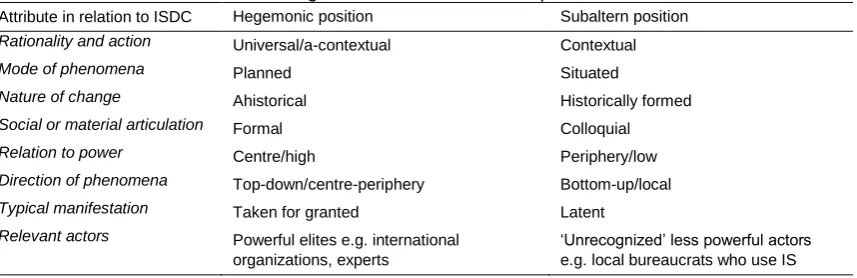
Table 2. Hegemonic versus subaltern positions of ISDC ... 92
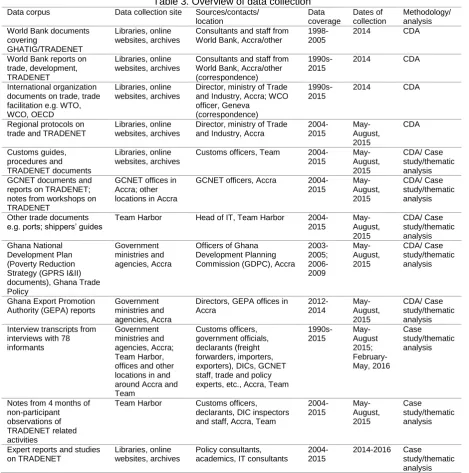
Table 3. Overview of data collection ... 94
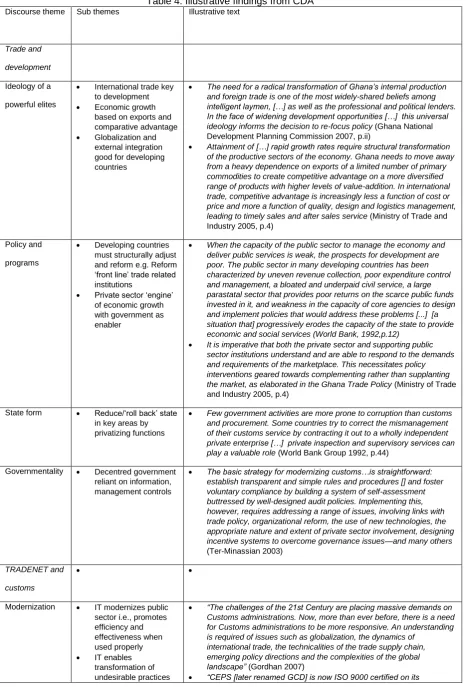
Table 4: Illustrative findings from CDA ... 99
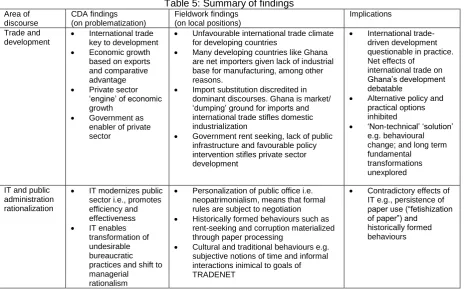
Table 5: Summary of findings ... 103
Table 6: Overview of theoretical constructs ... 120
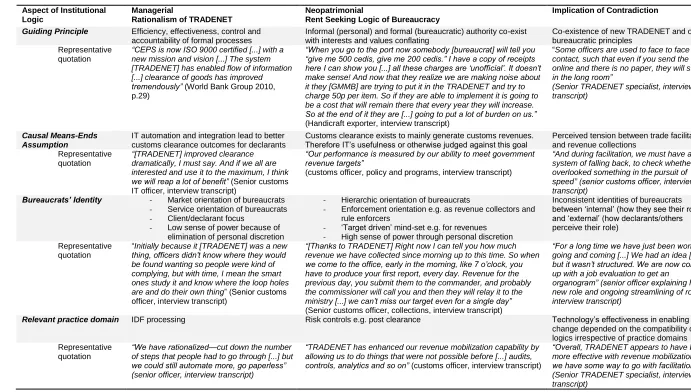
Table 7: Contradicting institutional logics and their implications in Ghana’s TRADENET-enabled customs rationalization ... 134
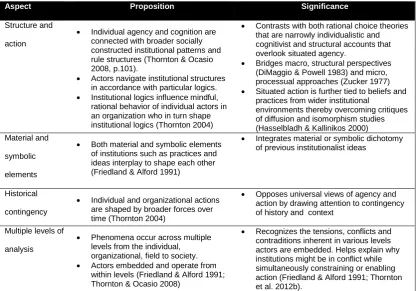
Table 8: Core attributes of institutional logics perspective ... 142
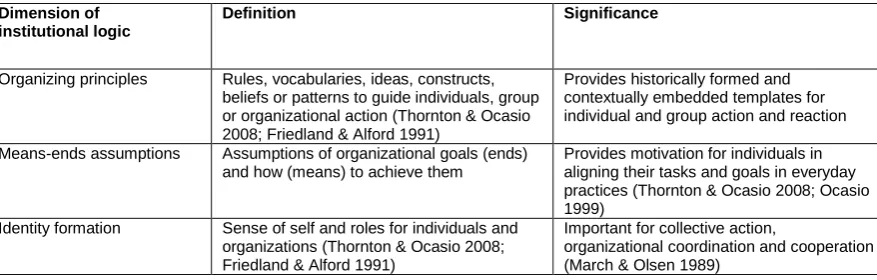
Table 9: Summary of institutional logics dimensions... 143
Table 10: Main public administration types in developing countries ... 150
Table 11: Distinctions between idealtypic logics and logics in practice ... 151
Table 12: Tracing of IT-related sociotechnical configurations and practices over time .. 155
Table 13: Artefacts and sociotechnical configurations of practices over time ... 163
Table 14: Blending of patrimonial logics in practice with bureaucratic ideal logics of ASYCUDA to form neopatrimonial logics in practice ... 167
Table 15: Blending of neopatrimonial logics in practice with managerial logics of TRADENET to form neopatrimonial managerial administration ... 173
Table 16: Key sociotechnical transformations of institutionalized practice over time ... 177
Abbreviations
ASYCUDA Automated System for Customs Data
B2G Business to Government
CEPS Customs Excise and Preventive Services (later renamed GCD)
DIC Destination Inspection Company
ECOWAS Economic Community of West African States
EDI Electronic Data Interchange
FCVR Final Classification and Valuation Report
FDI Foreign Direct Investment
GCD Ghana Customs Division
GCNET Ghana Community Network
GEPA Ghana Export Promotion Authority
GHATIG Ghana Trade and Investment Gateway
GoG Government of Ghana
GPHA Ghana Ports and Harbours Authority
GPRS Ghana Poverty Reduction Strategy
GRA Ghana Revenue Authority
IDF Import Declaration Form
IMF International Monetary Fund
IRS Internal Revenue Service
IS Information Systems
ISO International Standards Organization
IT Information Technology
MOFEP Ministry of Finance and Economic Planning
MOTI Ministry of Trade and Industry
NPM New Public Management
PNDC Provisional National Defense Council
PPP Public-private partnership
SAD Single Administrative Document
TRADENET Trade Network System
UNCTAD United Nations Conference on Trade and Development
WCO World Customs Organization
Chapter 1: Introduction
LILONGWE, the capital of Malawi, is [...] harder to escape scrutiny than in most places. So people took notice […] when lots of civil servants were suddenly buying houses in the city’s new suburbs […] A government clerk was found with $300,000 in his car [...] This was the genesis of the Cashgate scandal […] a systematic looting of public money [...] the state was defrauded of […] almost 1% of Malawi’s annual GDP, in just six months. A central element to the fraud was the manipulation of a government software system that was supposed to help control spending [...] No one checked whether any goods had been delivered […] Cheques were left in printers overnight and made out in corridors rather than secure offices. Payment orders […] were honoured by the central bank even if they had only two of the three required signatures. In one instance, high-value cheques with consecutive serial numbers for exact sums were cashed on the same day. The theft went unchecked in part because a reconciliation of bank payments by the accountant-general’s office had not been made for over a year.
(Economist 2014)
The anecdote is a rather dramatic cautionary tale of the potential pitfalls of IT-enabled
rationalization in the public administration of a developing country. A public financial
management system had been implemented to enable technical transformation of
dysfunctions and maladministration practices; but somehow, the system produced
contradictory and unexpected outcomes that made the administration worse of. The story
illustrates a complex nexus of technology, organizational arrangements, behaviours and
institutionalized practices that exist in many developing country public administrations.
While arguably on the extreme end of IT-enabled rationalization experiences across
developing countries, the anecdote raises important and enduring themes of Information
Systems (IS) in developing country public administrations. Among these being: a
questionable problematization of IT as a technical panacea for rather complex and intractable ills of organization and society; peculiarities of historically-formed behaviours and
commonplace disconnect between IT adoption and the organizational and social changes
needed for enduring change.
These three thematic strands are interwoven to form the basis of the thesis’ enquiry.
They are explored in-depth in the series of three papers comprising the thesis. The next
section provides a brief background to the research, and then describes the purpose and
motivation of the research. An overview of the papers is then presented, followed by an
outline of the central arguments of the thesis. Contributions of the thesis are briefly
highlighted followed by a chapter conclusion and overview of the rest of the thesis.
Background
Throughout the 1980s and 90s, attention was drawn to the link between institutions
and socioeconomic development. North (1990), for example, argued that institutions
determine socioeconomic outcomes. Perceived weak public administrations in developing
countries were specifically identified as a major drawback to development. The implications
of a weak public sector from a socioeconomic perspective are summarized in a report by the
World Bank Group (1992):
When capacity of the public sector to manage the economy, and deliver services is weak, prospects for development are poor. The public sector in many developing countries has been characterized by […] poor returns on the scarce public funds invested in it, and weakness in the capacity of core agencies to design and implement policies that would address problems [...] [a situation that] progressively erodes the capacity of the state to provide economic and social services (p.12)
Development stakeholders and international development agencies such as the World
Bank shifted emphasis to institutional improvements, governance and public administration
reforms as responses to problems of socioeconomic underdevelopment (The World Bank
clarion call by development organizations and stakeholders at the global and national levels.
Several ‘governance conditionalities’ intended to ameliorate problems of poor institutions
and governance, and to accelerate reform, were included as part of aid and other assistance to
developing countries (Kapur & Webb 2000).
IT has frequently been the underpinning for attempts at reforming the public
administration in developing countries due to a belief in its potential for enabling
organizational change (Wahid 2011; Schuppan 2009; Basu 2004). The case of Ghana
customs’ IT modernization studied in this thesis is typical of such globalised, IT-based
reform efforts by development organizations like the World Bank and stakeholders such as
governments, IT vendors and private actors.
In the past few decades, the domain of foreign trade clearance in developing countries
has experienced extensive IT-enabled reform initiatives (Grainger & Mclinden 2013;
Portugal-Perez & Wilson 2009; Glenday 1997; Kituyi 2013). Ghana customs’ IT
modernization was purposively selected as a case study because it had several defining
attributes that made it ideal to explore our phenomena of interest.
As a public administration of the government of Ghana that has existed for over a
hundred years, Ghana customs has a rich and long history of multiple institutionalized
practices, many of which have become severely dysfunctional over time. While the
organization has made strides over it’s more than three-decade experience with IT
modernization, it was obvious from initial literature review and case exploration that in
general, various technical objectives of IT remained unmet, with persistent contradictory
effects. The case was therefore ideal for investigating complexities of stability and change
related to IT-enabled practices, their persistence or transformations over time. Ghana customs
broader social context with situated IT-related practices, in order to understand the
sociotechnical changes that have resulted (or not) over time.
IT-enabled rationalization in developing country public administrations
Significant IT investments have been made in developing countries over the last four
decades based on a belief that IT can transform dysfunctional public administrations or those
underperforming relative to developmental objectives. The World Bank, a leading global
development agency that reports data on its investments, alone supported over 6,700 large IT
projects for public administration reforms between 1995-2015, mostly in developing
countries (World Bank Group 2015). And since 2003, 98% of public governance projects the
World Bank supported have had IT components to them (World Bank Group 2011, p.36,38).
Despite such investments by international organizations and governments, it remains
unclear whether and how IT has contributed to improvements. IT in developing country
public administrations appears to face a ‘double whammy’, in the sense that the picture of IT
projects—relatively speaking— is reported to be bleaker in developing countries (Avgerou
2008; Heeks 2002b; Walsham & Sahay 2006; Danish 2006), and in the public sector as a
particular organizational domain (Shea & Garson 2010, chap.17; Robertson & Seneviratne
1995).
Accurate empirical picture of IT in the public sector of developing countries remains
a challenge because of unclear standards and lack of baseline information to determine
success; difficulties in measuring effects consistently from varied evidence; and lack of
shared data on IT-related activities and outcomes over time (Scott, 2011, p. 8; Andrews,
2013). But contradictory outcomes of IT are reported frequently and the typical narrative is of
unmet expectations. From mostly anecdotal studies, some successes have been identified
disappointments (Scott 2011, p.i; Andrews 2012; Andrews 2013; Schacter 2000; Heeks
2003; Berman & Tettey 2001).
Of the World Bank’s public governance reform projects involving IT, about 70
percent were not implemented as planned but had to be modified, delayed or cancelled
(World Bank Group 2011, p.85). Also, of 145 developing countries that undertook
donor-supported reforms between 1998 and 2008, half declined rather than improved in indicators
of government effectiveness (Andrews 2013, p.15).
Contradictory effects of IT and unmet expectations in developing country public
administrations are worrisome given significance of the public administration: it remains the
exclusive organizational vehicle for providing public goods and advancing socioeconomic
development despite its crippling institutionalized practices. Pressures continue to mount for
successful information systems (IS) innovation to reform dysfunctions given an abiding
optimism in the potential of IT , the high opportunity costs of IT investments in
resource-scarce developing countries, and a perceived need for ‘catching up’ with ‘developed’
countries in light of increasing global integration (Avgerou 2008; Korac-Kakabadse et al.
2000).
Research interest is therefore justified in view of such pressures and existing
theoretical deficits. Hence, this thesis grapples with the varied but connected problems of
IT-enabled change identified through the Ghana case, with a view to contributing a
context-relevant, theoretical understanding of IT rationalization in the public administration of
developing countries.
Purpose and motivation of research
The thesis is motivated by the problem of whether and how IT enables
rationalization—that is, transformation of perceived dysfunctional institutionalized
contradictory effects. Institutionalized practices are understood as ‘stable, repetitive and
enduring activities’ that are ‘infused with value beyond the technical requirements of the task
at hand’ (Oliver 1992, p.563; Selznick 1957, p.17).
To understand such mix of practical, cognitive, and institutional factors influencing
practices, similar distinction has been made between everyday organizational routines and the
‘formative context’ within which they form and receive meaning and scope (Ciborra &
Lanzara 1994, p.64). Such distinction is important for reframing technical and managerial
challenges involving technology in organizations (Blackler 1990), and is in keeping with IS
findings that the process by which actors come to adopt and make meaningful use of
technology is not solely technical (Silverstone & Haddon 1996; Haddon 2011; Ciborra 1998;
Ciborra & Hanseth 1998).
To that end, the thesis investigates and theorizes implications of the broader context
of developing countries, believed to be pertinent to IT-enabled rationalization and related
phenomena (Avgerou 2001; Hayes & Westrup 2012). The purpose of our theorization is to
explain how IT might enable rationalization of public administration in a development
context; and why the effects of IT might be contradictory.
Three interrelated questions guide development of such explanation (1) how is IT
problematized in a developing country public administration context? (2) Why are there
contradictory effects and peculiar outcomes of IT-enabled rationalization in the context of
developing country administration? (3) How does IT-enabled rationalization of public
administration in a developing country context unfold?
The thesis develops arguments for the capacity of the institutional logics perspective
to help in explaining complex interactions between the broader social context and IT-related
Overview of papers
The set of papers comprising the thesis are standalone but intended to contribute to a
set of central arguments. Each paper advances the purpose of the thesis as described. While
the thesis is situated in the information systems in developing countries (ISDC), ICT for
development (ICT4D) and E-government in developing countries domains, the substantive
claims are multidisciplinary in nature and have been explicitly or implicitly sensitized by
diverse research traditions and ideas from varied fields of enquiry such as IS and STS
(sociotechnical systems), Sociology (Weberian sociology, structuration, new institutional
theory), Anthropology of the state (customs administration practices), Post-colonial studies
(critical theories, hegemony, subalternity and discourse), Political Economy (trade,
institutions and socioeconomic underdevelopment), Public Administration (substantive
theories of administration and public administration traditions), and Organizational Studies
(practice theories, organizational institutionalism).
The papers in this thesis further employ different research methods to answer related
questions as follows.
Paper 1 (Chapter 6): Subalternity in Information Systems in Developing Countries: A Critical Analysis of Ghana’s TRADENET
This paper sets the stage for the subsequent papers in the thesis that undertake
substantive theorizing of IT-enabled rationalization through the institutional logics construct.
The purpose of this paper is to provide an introduction to the empirical setting of the research
and to introduce a critique of ISDC; one related to problematization—how ‘problems’ such
as development and administrative dysfunctions are constructed and linked to
technical-rational ‘solutions’.
Inspired by critical and postcolonial literature, as well as findings on ISDC related to
Avgerou 2002), we trace problematization of Ghana’s TRADENET through critical discourse
analysis (CDA). We compare the dominant technical-rational problematizations to findings
of a postimplementation case study which revealed consequential local positions that were
unrecognized in TRADENET discourses. We find that TRADENET was contradicted by
historically formed, institutionalized rent-seeking behaviours, culture and traditions that
technical-rational positions on development and ISDC did not recognize or address.
We conceptualize such alternative, historically formed positions that are often
neglected in a-historical, technical problematizations as ‘subaltern’ and explore the
usefulness of the construct of subalternity for signposting poorly-understood ‘alternative
rationalities’ of IT in developing countries (Avgerou 2000b). Subaltern positions, it is
suggested, contradict dominant or ‘hegemonic’ problematization. The construct of
‘subalternity’ is offered as a way of ‘going beyond’ technical-rational understandings of
ISDC that often fail to recognize historical and broader institutional sources of resistance to
change. The paper suggests that uncovering subaltern positions and ‘alternative rationalities’
of ISDC might illuminate peculiar contradictory effects of IT and help advance theory and
practice.
Such critical perspective of ‘subalternity’ informs a general sensitivity to the thesis, in
the sense that local practices, institutions and rationalities of the developing country are
privileged over universalistic technical-rational assumptions. The cumulative eight months of
fieldwork spent at Ghana’s customs organization was motivated by precisely such need for a
rich, ethnographic, immersive understanding of IT-related practices and their broader
institutional foundations.
In paper 2 (chapter 7) and paper 3 (chapter 8), we privilege broader local contexts by
identifying historically-formed, multiple institutional forces that shape and are shaped by
explain one of the empirical puzzles of the study—the persistence of paper use in Ghana’s
customs administration, or the “fetishization of paper”, despite the capabilities of technology
to fully digitize, integrate and automate processes—through influence of such
historically-formed broader context.
Paper 2 (Chapter 7): Explaining ‘Irrationalities’ of IT-Enabled Change in a developing Country Bureaucracy: Case of Ghana’s TRADENET
If paper 1 (chapter 6) represents a somewhat pessimistic picture, paper 2 (chapter 7)
presents a view of mixed IT effects. We begin to present and develop the institutionalist
arguments developed in the thesis, particularly related to the institutional logics construct and
its capacity to help explain influences of broader multiple institutional forces on situated
IT-related practices. This paper presents and explains one of the empirical puzzles of the
thesis—the contradictory effects (or ‘irrationalities’) of IT-enabled rationalization in
developing country public administrations such as the overreliance on paper forms despite the
capabilities of technology to fully digitize, integrate and automate processes. While evidence
of IT-enabled change is reported, focus is on mixed or contradictory effects; instances where
technology makes some desired difference but not wholly according to technical-rational
objectives.
This paper develops and presents aspects of an exploratory study of TRADENET
where key empirical puzzles were identified along with suitable explanatory constructs
developed around the institutional logics perspective. The paper investigates two
TRADENET-enabled practices—Import Declaration Form (IDF) processing and revenue
collections/risk controls—and demonstrates that where ‘irrationality’ was present, managerial
logics of TRADENET contradicted pre-existing institutional logics in the public
‘Irrationality’ is interpreted as a compromising outcome when new logics of IT and
old bureaucratic logics contradicted. The paper explains contradictory outcomes of IT
adoption by emphasizing logics of situated actors such as rent-seeking, and relating these to
macro-level, historically-formed, multiple institutional forces in developing countries such as
neopatrimonialism.
Findings of this exploratory study served as a basis for further investigations in paper
3 (chapter 8), where the unfolding of IT-enabled change was traced in-depth, and over a
longer period of observations to theorize processes of IT rationalization.
Paper 3 (Chapter 8): IT-Enabled Public Administration Rationalization in Developing Countries: Evidence from Ghana’s Customs Modernization
Implication of IT in rationalizing public administration in developing countries is
poorly understood, more so given peculiar institutional dynamics of the public administration
and the long-term horizon needed for enduring change. Through interpretive case study of
two types of IT for customs clearance—a customs management system (ASYCUDA) and an
electronic data interchange (TRADENET)—deployed successively over thirty years
(1986-2004, 2004-2015) to transform traditional practices of Ghana’s customs, the paper elaborates
how and why IT might enable rationalization of dysfunctional institutionalized practices.
The paper climaxes our study and develops the central arguments made in the thesis.
It expatiates on insights from the exploratory study reported in paper 2 (chapter 7) and
develops them further by (a) adopting an additional case of IT adoption, that of ASYCUDA
which preceded TRADENET, in order to generate more observations on the two IT-enabled
practices of document processing and revenue collections/risk controls (b) adopting a
covering roughly 30 years (c) adopting an implicit comparative stance (rather than single case
study), to allow comparison within and across periods of IT adoption (temporal bracketing).
We take a longitudinal and institutionalist approach that considers change as an
emergent, unfolding process; and we uncover institutional logics underlying traditional
practices, contradictions encountered when IT introduces ‘modernizing’ logics, and
subsequent ‘blending’ of traditional and modernizing logics into distinctive logics that
underpin new practices.
Findings challenge extant technical-rational and variance-based accounts of IT
rationalization in public administrations of developing countries that tend to take episodic or
point-in-time perspectives, inadvertently concluding that IT does not enable transformation.
Our contributions are an explanation of the effects of broader institutional context on situated
IT-related practices of public administration in developing countries; as well as theorization
of how institutionalized practices and their logics sociotechnically transform through IT.
Central arguments
The central argument of the thesis is that contrary to technical-rational
problematizations of IT in developing country public administrations that often characterize
reports of contradictory effects, ambiguous outcomes and disappointments, IT adoption
enables rationalizing effects, although not independent of countervailing, historically-formed
local institutions that provide logics for situated actors to act upon.
The process through which IT adoption enables transformation of dysfunctional
institutionalized practices is understood in this thesis as “IT-enabled rationalization” (or “IT
modernization”) and is theorized as follows:
IT might be considered as a ‘carrier’ of institutions in the form of ideal type
principles (logics) and to underpin organizational reforms that might ‘force out’
dysfunctional institutionalized practices and their related old logics
Such new organizing principles or logics introduced through IT adoption enter the
public administration organization, which is ‘institutionally plural’, meaning that it is
subject to multiple broader institutional forces that influence practices by providing
specific guiding logics for given action domains. Such institutional plurality reflects
the institutional orders characteristic of the broader society within which public
administration and its constituent actors are embedded.
Once adopted within the public administration of developing countries, IT therefore
encounters multiple, historically-formed institutional logics that have persisted over
time to drive the various institutionalized practices carried out by local situated actors
who draw upon such logics in their daily sociotechnical practices
Rather than displacing dysfunctional practices and replacing them with IT driven
ones, i.e. forcing out ‘old’ logics with ‘new’ IT ones, the two sets of incompatible
logics are hybridized in practice through a process identified as ‘blending’
The rationalizing effects of IT vary by practice according to task structure, as well as
the degree of consistency or contradiction of interacting logics.
Blending results in distinctive institutionalized sociotechnical practices that reflect
novel logics of IT while retaining properties of previous lingering logics. As such
change is incremental rather than substitutive and occurs over long time horizons.
Contributions
Each of the papers makes some contribution to the relevant issue domain and
literature. The thesis overall makes a theoretical contribution by elaborating the implication
of broader, historically-formed multiple institutional forces on situated IT-enabled practices
logics perspective. It further lays foundations for the development of a process model of
IT-enabled rationalization in the context of developing country public administrations. The
chosen approach is significant for not only bridging micro and macro-level accounts of
sociotechnical change but also acknowledging and explaining the interactions of multiple
contradicting institutional forces that are hybridized through situated IT-related practices. In
these ways, the thesis also contributes an understanding of the significance of technology in
sociotechnically (re)producing and transforming institutional logics and their related
practices.
Conclusion
This chapter has presented core themes of the thesis, the problem and purpose of the
research, as well as the research questions and motivation. It has also outlined the main
arguments presented in the papers and their overarching narrative. Next, chapters 2, 3, 4 and
5 develop theoretical foundations for the thesis by discussing Weber’s views on
rationalization, new institutionalist accounts of rationalization, institutional logics perspective
as an approach to explaining rationalization, as well as understandings of IT in developing
countries.
These foundational chapters are meant to extend and connect the brief theoretical
discussions presented within the papers (which were necessarily truncated by publication
constraints). The substantive papers are then presented in order of increasing development;
first, the background paper on the discursive framing of IT and related material implications
(chapter 6); next, the exploratory study of IT-enabled customs practices and contradictory
outcomes through the institutional logics perspective (chapter 7); and finally, the summative
study that theorizes the process of IT-enabled rationalization through the institutional logics
perspective (chapter 8). The thesis then discusses the key findings from the papers to develop
Chapter 2: Max Weber on Rationalization
The goal of chapters 2-5 is to further situate the central arguments of the thesis on
extensive theoretical foundations and to clarify theoretical linkages implicit in the papers.
The theoretical discussions focus on salient elements in Weber’s conceptualization of
rationalization (chapter 2), new institutional perspectives on rationalization (chapter 3),
institutional logics perspective on rationalization (chapter 4), and IS and organizational
change in developing countries (chapter 5), all of which are relevant to the thesis’
investigations and claims.
Consistent with the thesis’ overall interpretive stance, these theoretical chapters take
as their connecting thread the notion of rationalities as a means for linking rationalization—
qua IT-related sociotechnical phenomena at the organizational and broader levels—to its micro/individual foundations. This chapter on Weberian rationalization sets the stage for
appreciating the thesis’ chosen approach to investigate IT-enabled rationalization in the
public administration of developing countries.
Taking Weber’s notions of rationality and rationalization—rooted in his interpretive
sociology (verstehen)—as a starting point, this chapter discusses contributions and important limitations of Weber’s views on rationalization. It also considers Weberian bureaucratic
organization and its theoretical and practical problems. The point of these discussions is not
only to present what might be considered an essential background (Weberian perspectives on
rationalities, rationalization and bureaucracy as characteristic of modern organization), but to
suggest ways its limitations might be overcome through additional lenses of institutions and
institutional logics (chapters 3, 4), as well as conceptions of alternative rationalities in
developing countries (chapter 5.5).
The position of this chapter is that Weber’s approach to interpretive social
social processes such as bureaucratization to their underlying micro/individual foundations
through the construct of rationalities, is useful as a starting point to a discussion of
rationalization as a general yet variable process of institutional change. However, Weber’s
approach has limitations to be overcome if one desires a more encompassing analytical
framework of rationalization such as this thesis attempts.
Notable among these limitations are an overlarge emphasis on the Western capitalist
economic drivers of rationalization in his day such as efficiency (hereafter, the new
institutionalism critique), a rather modest conceptualization of the mechanics of dynamic
change [or an over-emphasis on categorical explanations and idealtypes] (the dynamic
change critique), and the assumed universalism of (Western) rationalities (the alternative
rationalities critique). It should be noted that these limitations are not critiques of Weber’s
work in an absolute sense; rather, they might be viewed in the light of the thesis’ attempt at
‘puzzle-solving’ –that is, developing appropriate middle-range theorization of the specific
empirical problems raised in the thesis.
The next sub-sections discuss the significance of Weber’s theoretical approach to
explaining rationalization, as well as his notions of rationality, rationalization, and
bureaucracy. Each of the three critiques (the new institutionalism, dynamic change, and
alternative rationalities critiques) is then presented. The main points are then synthesized and
the chapter concluded. Subsequent chapters take on discussions of approaches to overcoming
the critiques of Weberian rationalization, and developing a context-sensitized view of
Significance of Weber’s approach
Weber provides a touchstone for our analysis of rationalization as a general yet
variable process of institutional change. An understanding of the significance of his
methodological approach is useful for appreciating some central issues underlying the
interpretive stance taken in the thesis, such as the opposition between positivist and
subjective views, and the balance between subjective/relative versus generalized
explanations.
Empirical interests of Weber’s work lay in problems of institutional change within the
modern capitalist economic and social systems of his day. He was concerned with, as Parsons
(1947, p.24) observes, “problems of the structural peculiarities of modern Western society, of
the conditions on which it was dependent, and of its stability and tendencies of change […]
differences from other social systems […] as an institutionally organized system of action.”
To deal with these empirical problems, Weber pursued the path of relating systemic
dynamics to motives of individuals (as opposed to the alternative of separating the dynamics
of the system from understandings of underlying behaviours and actions at the individual
level in order to derive ‘laws’). This approach of accounting for individual foundations of
social action—a kind of ‘methodological individualism’—offers important contrast to other
sociological approaches like Marxism and historicism that treat social collectives (rather than
individuals) as actors with unified interests and values (Camic et al. 2005, p.8).1
By accounting for the rationalities underlying social action, Weber’s interpretive
sociology—captured in his notion of verstehen—offered a counterpoint to sociological explanations of social action that assumed an objective world ‘out there’ with fixed effects,
independent of subjects and their interpretation. Weber emphasises culture and social
1
behaviour as a response to the historical tradition of German thought of his day which
privileged positivistic analyses as the sole means to generalized explanations about the social
world, akin to what pertains in the natural sciences.
Parsons (1947, p.9) points out that “Weber’s essential starting point is an acceptance
of the subjective point of view, combined with a critical attack on the ‘historical’ position.
His basic thesis in this connection is that generalized theoretical categories are as essential to
the proof of causal relationships in the human and cultural field as they are in the natural
sciences.”
Weber further differed from the historical school by rejecting their position that the
aim or outcome of scientific investigation must be a complete ontological picture of the
phenomena of interest. Against this view, he maintained that empirical knowledge of cases
are by nature abstract, never includes all facts, and are subject to the focus of the investigator
(Parsons 1947, p.9).
These considerations and assumptions lay at the heart of Weber’s analysis,
particularly his methodology of ideal types as a way of explaining diverse patterns of
economic and social organization as well as their corresponding rationalities. The next
sub-sections outline Weber’s ideas on rationality, rationalization and bureaucracy in relation to
the methodology of ideal types.
Rationality
The subject of rationality has spawned a rich and complex literature across fields as
diverse as sociology, political science, philosophy, psychology, among others. The object of
relevance in Weber’s sociology of modern social action and its economic and authority
structures.2
Weber’s interest with rationality was part of a broader effort at explaining the patterns
of organization in modern society. An important premise of Weber’s view of rationality is
that there is no single rationality that captures the logic of all human action and organization
types. His methodology for analysing structures of authority and economic life consisted of
formulating ideal types of social arrangements and determining the corresponding ideal
rationality and action.
Ideal types of rational actions were intended to guide comparison of actual observed
actions so that account could be made of deviations. Ideal type—an important element of
Weber’s work—describes a normative course of action that is abstract and general, rather
than concrete or specific. It does not describe given actions of individuals but ‘typical’ ones
that are ‘objectively possible’ (Parsons 1947, p.13). To that end, Weber identifies four types
of social action—instrumental-rational (goal driven), value-rational (value and belief driven),
affectual (affection and emotion driven), traditional (traditions and customs driven).
For Weber, an action is rational if (a) it is oriented to a clear goal or to a set of values
that are clearly formulated and consistent (b) the means chosen are efficient and well-suited
to the goal (Parsons 1947, p.16; Weber 1968). Within this framing, action is deemed
irrational if it deviates from the idealtypic rational action. In other words, irrational action is
any action that is inconsistent with the assumed means to achieving the ends of the ideal
model. However, it is to be noted that rationality and irrationality go beyond adherence or
deviations from an isolated ideal type to involve the integration or mal-integration of whole
social systems of action (Parsons 1947, p.17).
Notions of rationality in Weber’s oeuvre include formal rationality, substantive
rationality and institutionalized rationality. Formal rationality was said to enable the most
precise and efficient means for resolving problems by providing universal and abstract
regulations; rather than arbitrary, personalised and idiosyncratic ones (Weber 1968; Kalberg
1980). Substantive rationality on the other hand, guides action by providing ‘value postulates’
that enable standards against which reality is judged (Kalberg 1980). Institutionalized
rationality describes the institutional conditions that sustain a given course of action.
Given multiple possible value postulates, substantive rationality is based on the
consistency of its value postulates. Something is not inherently irrational but is only irrational
in relation to a specific ‘rational’ standpoint. For example, from the point of view of a free
market economy, monopolies are ‘irrational’ because they prevent competition; similarly,
from the point of view of science, religion is ‘irrational’ because it does not subscribe to
empiricism (Kalberg 1980).
Weber’s analysis of economic activity distinguishes modern capitalist market
economy with its economic rationality from family-centric structures of traditional societies
with their communal rationality. Market economic activity is said to orient toward ‘capital
accounting’, or the increase of enterprise capital under specific conditions that distinguish the
capitalist system from other forms of economic organization.
Economic systems of traditional societies on the other hand exhibit communal
rationality that does not clearly delineate economic action from other forms of action, nor
involve calculations toward ‘capital accounting’—considered by Weber as the height of
formal rationality. Familiar ties and affections override depersonalized calculus for enterprise
capital accumulation.
Furthermore, Weber’s analysis of authority explains different modes of authority and
as ideal types. These correspond to legitimation by personal qualities of the leader, customs,
and rules as a means of achieving ends. In his conception of rational-legal domination
(bureaucracy), viewed as the applicable ideal rational form in modern organization, Weber
identified both formal and substantive rationality as underpinning the transformation from
patrimonial (based on charismatic and traditional) to rational-legal patterns of action (Anter
2014; Weber 1946).
This sub-section has only sought to provide broad contours of Weber’s ideas on
rationality as an entry point into his conceptions of rationalization and the bureaucracy, in the
context of his influential interpretive sociology. The next sub-section elaborates the relation
of rationality to Weber’s view of rationalization.
Rationalization
In his efforts at explaining broad patterns of social stability and change, Weber’s
sociological gaze is set upon historical and social trends toward rationalization and
rational-legal legitimation. Weber posited that an important driver of modernity is rationalization.
Rationalization might be broadly conceived as the replacement of tradition and
affection-based social behaviours with calculative ones (Weber 2002; Kalberg 1980; Weber 1968). It
has also been described as “the substitution for the unthinking acceptance of ancient custom,
of deliberate adaptation to situations in terms of self-interest” (Parsons 1947, p.123).
Weber employs the term with at least three different meanings. Firstly, in discussions
of means-ends calculations specific to individual rationalities (a kind of behavioural/action
transformation); secondly, in relation to bureaucracy and its arrangements of human
behaviour across space and time (bureaucratization or organizational transformation); and
finally, in a more general sense as the antithesis of ‘enchantment’, or a disenchantment with
traditional, mysticism, myth and magic based ways of viewing the world and action (a kind
The later understanding of disenchantment is tied to his ideas of secularization and the
emptying of religious and spiritual beliefs from social organization. Such secularization was
part of the shifts from tradition to modernity that was characteristic of the Western world of
Weber’s day.
According to Weber, rationalization therefore occurs at various levels of society and
are driven by specific modes of rationality: practical, theoretical, substantive and formal
(Kalberg 1980) which correspond to ideal types of social organization. Two of these –
substantive and formal– are pertinent to the achievement of organizational goals such as the
bureaucracy by calculated, systematic means (Kalberg 1980; Weber 1968). The next
sub-section expatiates Weber’s view of rationalization qua bureaucracy.
Bureaucracy
Weber’s (1946) conceptualization of bureaucracy outlines the benefits of
rational-legal administrative structures in governing organizational activities (relative to traditional or
charismatic authority structures). Bureaucratic organization is conceived as an efficient
instrument for realizing specified goals, coordinating activities and maintaining the
organization.
Characteristics that help bureaucracy achieve these benefits include a fixed division of
expert and trained labour, hierarchy of authority and positions, written documentation as a
basis for administration and adherence to general rules, and professionalization. Bureaucracy
entails separation of the personal from the official, and bureaucrats are to be selected on
qualifications and merit (rather than nepotistically), appointed (rather than elected or
arbitrarily chosen), and compensated (as full time staff rather than maintained by patronage).
The process of bureaucratization was suggested by Weber to be driven by capitalist
impulses through competition among firms in the marketplace, competition among states, and
for efficiency and harmonization (Weber 1968). Weber (1968) posited that bureaucratization,
the consummate organizational manifestation of rationalization, has such great momentum
that the process was inevitable, ultimately leading to an ‘iron cage’ that imprisons humans by
harmonizing action to extremes.
But aside the ‘iron cage’ critique, bureaucracy has been further criticized for other
deficiencies in theory and practice. It has been noted as driving the pursuit of barest minimum
standards as bureaucrats acquire a culture of acting only according to ‘the rule’ (Gouldner
1954). Furthermore, bureaucratic organizations tend to increase in size, become resistant to
change, and fail to innovate (Burns & Stalker 1961). Merton (1957) has also noted the
excessive rule-following fostered by bureaucracy that leads to ‘goal displacement’ as rules
are misapplied at the expense of overall organizational objectives. Selznick (1949) has
pointed out the sub-optimization that might result from delegation as various units pursue
different incoherent objectives.
In addition to such fundamental critiques of the bureaucratic model, various
dysfunctions have been associated with the practice of bureaucracy such as bribery and
corruption (Rose-Ackerman 1999; Mbaku 1996; Klitgaard 1988), red tape (Goodsell 2000;
Bozeman 2000; Kaufman 1977), incompetence (Hood & Lodge 2004; Kamoche 1997),
politicization (Peters 2010; Dasandi 2014). Such limitations of the practice of bureaucracy
has raised criticisms of its idealtypic nature and lack of touch with practical and historical
realities (Peters 1981), as well as the non-compatibility of its underlying rationalities and
assumptions in non-Western contexts (Lynn 2001; Hyden 2010).
Despite these critiques, the model of bureaucracy has become not only a paradigm of
modern organization but a basis of organizational theorizing (Walton 2005), notwithstanding
the contemporary emergence of flattened structures through temporary means like delayering,
1990). Other emergent organizational forms such as technology-enabled remote work,
self-managed teams, flexible work systems (Smith 1997), etc., similarly remain marginal to the
bureaucratic paradigm.
However, with increasing globalization and advancements in technology, the
bureaucratic form continues to face challenge. New organizational forms increasingly rely on
external networks through strategic alliances and outsourcing that require decentralization
and non-hierarchical structures of control and coordination (Clegg & Hardy 1996). Taken
together, new forms of organization (Clegg & Hardy 1996; Gazell & Pugh 1990; Smith
1997), challenge the bureaucratic model in several important respects. Flattened hierarchical
structures, networked activities and flexible work systems decrease task specialization as
workers perform a wider range of activities. Vertical and horizontal differentiation are also
reduced as hierarchy is flattened and decentralization is enhanced through increasingly more
available information (Walton 2005, p.575).
In the context of public administration, the bureaucratic model has come under
immense global pressures for change, manifesting in national level political, economic and
social reform pressures (Welch & Wong 1998). With the advent of the so-called New public
management (NPM) in the 1980s, economic and market-oriented rationalities from the
private sector have been introduced into public administration as a means of rationalizing
perceived bureaucratic dysfunctions (Dunleavy & Hood 1994; Hood 1995).
NPM emphasises efficiency through entrepreneurialism, reliance on market
mechanisms and transformative managerial practices (Minogue 2001; McCourt 2001b; Hood
1995). Dunleavy and Hood (1994) argue that the transition from ‘old public administration’
to ‘new public administration’ represents a difference from bureaucracy in several respects.
New public management’s underlying thesis of best use of resources in pursuit of
legalistic enforcement of laws, rules and entitlements, as well as regulation of public/state
powers in relation to citizens (Dunleavy & Hood 1994). This points to the contrasting
rationality assumptions of NPM versus that of bureaucracy –namely, an assumption of homo economicus in the case of NPM, and homo sociologicus in the case of Weberian bureaucracy.
Homo economicus describes the atomistic utility-maximizing rational choice assumptions common in economics and related fields whereas homo sociologicus describes an ideal role-fulfilling man who is a tabula rasa upon which society and culture inscribes values and goals.
Critiques of Weberian rationalization
New institutionalism critique
In their seminal article, The Iron Cage Revisited: Institutional Fields and Collective Rationality in Organizational Fields, DiMaggio and Powell (1983) advance upon the conceptualization of Weberian rationalization by arguing that the structural causes of
bureaucratization and rationalization have changed from capitalist economic competition and
efficiency as conceived by Weber (1968) to institutional ones driven by isomorphising
normative, coercive and mimetic forces.
DiMaggio and Powell (1983) observe that while bureaucratization of the corporation
and the state have been largely achieved in many parts of the world as per Weber’s
predictions, organizations continue to homogenize in other ways, and that such
homogenization seems to be driven less by economic competition and efficiency and more by
institutional structures that do not necessarily induce competition or efficiency.
Such institutional forces emerge from structurational interactions within
organizational fields (Giddens 1984), and is effected largely through the state and professions
(DiMaggio & Powell 1983). Organizational fields, understood as “those organizations that, in
over time without necessarily needing to adapt to competitive forces through efficiency or by
interacting directly with one another (DiMaggio & Powell 1983).
Such homogenization into similar structures, or isomorphism, as noted by DiMaggio
and Powell (1983) has elements of taken-for-grantedness that cannot be explained by
systematic rational calculations, even granted that organizational actors are rational. These
seminal insights spawned several new institutional studies that looked at institutional sources
of rationalization, specifically, structures of isomorphism and diffusion at various levels
beyond the organizational field. In these studies, rationalized organizations were, broadly
speaking, outcomes of rationalized environments (Meyer & Scott 1992; Scott 1995), rather
than the result of specific individual rationalities.
Dynamics of change critique
While Weber’s methodology is justified by his research goal of explaining various
discrete types of modern social and economic organization, as well as broad sweeps of social
change, it might be said to be limited in its potential to elaborate dynamics of bottom-up
social change, as well as situated change over time. These two limitations relate to the
employment of typologies and rejection of the nuances of historicism; two strengths of his
method which are not amenable to middle-range ‘puzzle solving’ such as this thesis attempts.
By focusing on categories and categorical explanations of fixed outcomes e.g.
bureaucracy, in relation to fixed rationalities, it does not afford much scope for continuous
change that might emerge as hybrid or ad hoc modes of organizing. Secondly, given that
Weber is primarily interested in interpretive explanation of broad trends such as
modernization, rationalization etc., he employs a level of abstraction that admits process but
is not sufficiently dynamic or attune to important details of history. E.g. the unfolding of
bureaucratization around the world has exhibited a wide range of nuance that is not