AN EXPLORATORY
STUDY OF COLLECTION
DEVELOPMENT
OF
SELECTED SCHOOL RESOURCE CENTRES IN SRI LANKA
w.
Sunil
1andA.N. Zainab
1INational Library & Documentation Services Board
14, Independence
Avenue, Colombo, Sri Lanka
2MLIS Programme,
Faculty of Computer Science
&
Information
Technology,
University of Malaya
e-mail: [email protected];[email protected]ABSTRACT
Describes the responses from
48
resource managers as well as
183
students from
selected schools
in the Colombo District, Sri Lanka. As case studies, the
researchers also gather information about the collection composition from five
selected schools to ascertain the currency and strength of collections in Sri Lankan
school resource centres. The results indicate that the majority of school resource
centres did not follow any collection development guidelines. The school resource
c~llection is still book-centred and very few possess electronic resources. More than
ninetypercent of resources are obtained and selected by personnel at the Ministry
of Education. The school personnel in the survey did not accept this practice as they
prefer to see more empowering of material selection by Special Book Selection
Committee or cooperative selection by school teachers and resource managers. The
results indicate that both students and teachers do not perceive the current resource
collections as adequate for learning and teaching. The collections at the five
resource centres indicate that the age of the books are generally less than 10 years
and more than fifty percent are published between 1990-2000. This current.
collection however, does not ensure what has been acquired are relevant to
students' and teachers' needs. The study proposes that a proper collection policy be
drawn up to ascertain that the collection in Sri Lankan resource centers reach at
least the minimum universally accepted standard.
Keywords: Collection development policy; Resource centres; Sri Lanka; Colombo; Library acquisition; School libraries.
COLLECTION
DEVELOPMENT
The school community uses the collection for many reasons. Administrators require information for in-service training programmes and the promotion of services. Teachers need professional information, which includes up-to-date ideas about teaching methods, tools, subject content, ethical and psychological issues concerning young adults learning. The students use the collection to find information for assignments, general information and leisure. A collection development policy aims to meet all these needs and therefore involves both the information professional and the community the library serves. Evans (2000) suggests that collection development should (a) identify user needs and be responsive to the total community needs (not just the active users); (b) incorporate cooperative acquisition and resource sharing at local, regional and national levels; (c) consider the inclusion of all types of information; (d) be subjective and unbiased; and (e) allow learning through practice, taking risks and making mistakes. This philosophy is echoed by Loetscher (2000) who also suggests that the collection of the school resource centre must be appropriate for the community it serves and therefore emphasizes that it should be curricular-oriented with accompanying policies, staff expertise and realistic budget allocations.
The collection development policy provides the necessary guidelines for selecting library resources. The policy should include general principles for the collection as a whole and also specifies collection levels by subject and form. Van Orden (1995) suggests that the collection development policy should consider such factors as: (a) the clientele it serves; (b) the general subject boundaries; (c) the programmes to support user needs (informational, instructional, recreational); (d) general priorities and limitations governing the selection and these include the sources of funds designated for the collection, forms of materials to be collected; language and geographical areas to be included or excluded; circumstances under which duplication should be practiced; participation in resource-sharing plans such as inter-library loans, cooperative acquisition programmes; and (e) other policies related to the general management and maintenance of the collection. The forms of material should include both print and electronic resources.
Within the context of such policy, the school resource manager assumes the role of acquiring a comprehensive as well as relevant learning and teaching resources; organizing the materials appropriately to facilitate their location, access and use; maintaining and promoting the use of the collection through activities such as exhibitions, book talks and training sessions (Kinnel, 1992).
OBJECTIVES
in Sri Lanka. This paper reports on the findings from an exploratory study carried
out with the following objectives: (a) to understand the state of collections in school
resource centres in Sri Lanka; (b) to ascertain the collection development process
used in schools; and (c) to find out the opinions of selected school community about
the management, contents and usefulness of the school resource centre collections
currently available. The study aims to answer the following questions:
(a) What is the current state of the collections in Sri Lankan school resource
centres?
(b) How are the collections obtained?
(c) What are the perceptions of school resource managers with regards to their
role in building up the school resource collection; the ideal collection; and
possible involvement of teachers in resource selection? and
(d) How current are the book collection in the school resource centres?
SURVEY
The study uses the self-administered questionnaire to gather information from
selected respondents in schools in the Colombo District, Sri Lanka. The population
chosen are people directly involved in the field of school librarianship and
comprises the school resource managers, who are directly involved in the collection
development for their school resource centers, and students. The school resource
managers come from various academic backgrounds and had several years of
working experience as teachers. The students are selected based on their knowledge,
age, are attending the advance level classes and are following courses in
bio-science, mathematics, commerce and the arts in the selected schools. Two types of
questionnaires are devised: the first are distributed to 50 school resource managers
and the second are given to 200 students in 20 schools. The results are analysed
based on usable returns from 48 school resource managers and 182 students. As
case studies, the collections from five schools resource centres are studied to
estimate the average holdings as well as the distribution of resources in accordance
to the Dewey Decimal Classification scheme. This is carried out to ascertain firstly,
the representation of the collection in the various disciplines, and secondly, the
currency of the volumes stocked.
RESULTS AND DISCUSSION
(a)
The State of the Collection in School Resource Centres
as equally important. This indicate that the managers are aware of the various kind of resources that the resource centre should be collecting.
The findings reveal that the majority of the school resource centres (87.5%) do not follow collection development policy guidelines. A written collection development policy would help articulate a clear direction for building quality and relevant materials. A proper policy would subscribe the philosophy, long-range plan, and help focus the selection and evaluation procedures to be followed (Adams, 1996). Bump (1990) points out that a written policy would make the difference between an unwillingness to take risk, be innovative with a progressive collection to support the information needs of today's young people.
A closer study of the collections from the five selected schools confirmed that books form the major component of resources collected, followed by periodicals and small number of audio-visual materials. None of the five selected resource centres collect electronic materials. The collections of the resource centres are classified according to the Dewey Decimal Classification Scheme.
The detail analysis of the collection from the five resource centres reveal that the majority of books acquired is in the category of arts and social sciences. Books on science and especially technology comprise a very low percentage of the total collection. This is indicated in Table 1.
Table 1: Tota! Volumes by Broad DDC Scheme in Five Schoo! Resource Centres
DDC Class Numbers Volumes %
800 - Literature 10967 17.0
000-200 - Generalia, Philosophy, Religion 10502 16.2
700 -Arts 9115 14.0
900 - Geography 8985 14.0
300 - Social Sciences 8498 13.1
400 - Languages 7557 11.7
500 - Science and Mathematics 6621 10.2
600 - Technology 2454 3.8
Total 64699 100
(b) The Use of the School Resource Centre
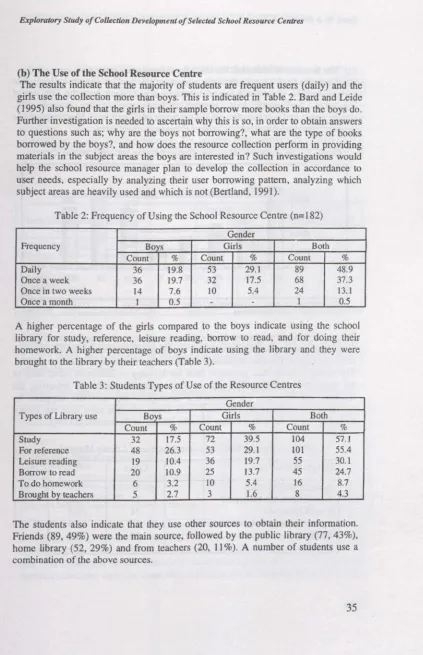
[image:5.443.11.434.37.692.2]The results indicate that the majority of students are frequent users (daily) and the girls use the collection more than boys. This is indicated in Table 2. Bard and Leide (1995) also found that the girls in their sample borrow more books than the boys do. Further investigation is needed to ascertain why this is so, in order to obtain answers to questions such as; why are the boys not borrowing?, what are the type of books borrowed by the boys?, and how does the resource collection perform in providing materials in the subject areas the boys are interested in? Such investigations would help the school resource manager plan to develop the collection in accordance to user needs, especially by analyzing their user borrowing pattern, analyzing which subject areas are heavily used and which is not (Bertland, 1991).
Table 2: Frequency of Using the School Resource Centre (n=182)
Gender
Frequency 80 s Girls Both
Count % Count % Count %
Daily 36 19.8 53 29.1 89 48.9
Once a week 36 19.7 32 17.5 68 37.3
Once in two weeks 14 7.6 10 5.4 24 13.1
Once a month 1 0.5
-
-
1 0.5A higher percentage of the girls compared to the boys indicate using the school library for study, reference, leisure reading, borrow to read, and for doing their homework. A higher percentage of boys indicate using the library and they were brought to the library by their teachers (Table 3).
Table 3: Students Types of Use of the Resource Centres
Gender
Types of Library use Bo s Girls Both
Count % Count % Count %
Study 32 17.5 72 39.5 104 57.1
For reference 48 26.3 53 29.1 101 55,4
Leisure reading 19 10,4 36 19.7 55 30.1
Borrow to read 20 10.9 25 13.7 45 24.7
To do homework 6 3.2 10 5.4 16 8.7
Brought by teachers 5 2.7 3 1.6 8 4.3
(c) The Sources of Materials for the School Resource Centres
Most schools in Sri Lanka depend on government funding. Figure 1 shows that more than 90% of resource centre collections are obtained from the Ministry of Education. An equally large amount of funds are obtained through gifts, organizations and purchase through the school development fund. Most respondents (resource managers) indicate using more than one sources listed.
Figure I: The Sources of Materials Obtained by the School Resource Centres
ST
TE
OR GI SDFTable 3 indicates the persons involved in the selection of materials listed by the frequency counts given by respondents. Similarly, respondents may indicate more than one type of persons or institutions involved in the resource selection process. The results indicate that, personnel from the Ministry of Education select most of the resources centrally. When the resource managers makes the selection, the majority (43.7%) use the publisher's catalogues and booklists supplied by bookshops (41.6%) as their selection tools. Other selection tools used are journal reviews (20.8%) and lists obtained from the Ministry of Education (25.0%).
ME NI.. PA
PA=Parems ST=Students SDF=School Development Fund ME=Ministry of Education NL=National Library
TE=Teachers OR=Organisations GI=Gifts
Table 3: Persons Involved in the Selection of Library Materials
PersonslInstitutions Count %
Ministry of Education 35
72.9
School Resource Managers 35 72.9
School Principals 34 70.8
Special Book Selection Committee
13
27.0
Teachers
06
12,5
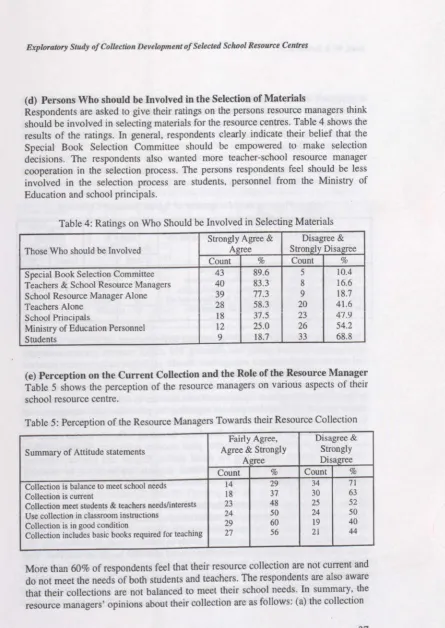
(d) Persons Who should be Involved in the Selection of Materials
[image:7.464.13.458.15.643.2]Respondents are asked to give their ratings on the persons resource managers think
should be involved in selecting materials for the resource centres. Table 4 shows the
results of the ratings. In general, respondents clearly indicate their belief that the
Special
Book Selection
Committee
should be empowered
to make selection
decisions.
The respondents
also wanted more teacher-school
resource manager
cooperation
in the selection process. The persons respondents feel should be less
involved in the selection process are students, personnel from the Ministry of
Education and school principals.
Table 4: Ratings on Who Should be Involved in Selecting Materials
Strongly Agree
&Disagree
&Those Who should be Involved
A! ree
Strongly Disagree
Count
%Count
%Special Book Selection Committee
43 89.6 5 10.4Teachers
&School Resource Managers
40 83.3 8 16.6School Resource Manager Alone
39 77.3 9 18.7Teachers Alone
28 58.3 20 41.6School Principals
18 37.5 23 47.YMinistry of Education Personnel
12 25.0 26 54.2Students
9 18.7 33 68.8(e) Perception on the Current Collection and the Role of the Resource Manager
Table 5 shows the perception of the resource managers on various aspects of their
school resource centre.
Table 5: Perception of the Resource Managers Towards their Resource Collection
Fairly Agree,
Disagree
&Summary of Attitude statements
Agree
&Strongly
Strongly
Agree
Disagree
Count
%Count
%Collectionis balanceto meetschoolneeds
14 29 34 71Collectionis current
18 37 30 63Collectionmeetstudents
&teachersneeds/interests
23 48 25 52Usecollectionin classroominstructions
24 50 24 50Collectionis in goodcondition
29 60 19 40Collectionincludesbasicbooksrequiredfor teaching
27 56 21 44is perceived as not balanced to meet their user's needs; (b) the materials are not current; (c) the collection fairly meets the interests of both students and teachers; (d) the collection is generally in good condition; (e) teachers generally use the collection in classroom instructions; and (f)the collection does provide basic books required for teaching.
The resource managers also indicate their oprrnon about the planning and management of the school resource collection (Table 6 summarises the findings).
Table 6: Planning and Management of School Resource Collection
Fairly Agree. Disagree & Statements concerning the planning and managing the Agree & Strongly school resource centres Strongly Agree Disa_g_ree
Count % Count %
Needappropriatestandardas a developmentguide 48 100
-
-Needto cooperatewith teachersin collectionselection 46 96 2 4
Needto formulatecriteria for acceptingor rejectinggifts 45 94 3 6
Needto design,plan, produceresourcesfor instructionaluse 48 100 -
-Needto formulatepolicyon weedingand maintenance 47 98 I 2
The resource managers evidently accept that there is a need for a proper collection management standard, policy and planning. The school resource managers strongly feel that the school resource management should: (a) follow an appropriate standard to guide and evaluate resource collection so that it achieves balance in subject distribution, currency and relevance; (b) design, plan and produce specific resources for instructional purposes; (c) cooperate with teachers in evaluating and developing resources; and (d) formulate policies regarding the promotion and maintenance of the collection. The need to cooperate when developing collections is also pointed out by Smithson (1997). Smithson found that the strong influence teachers exert on the selection process helps to promote good resource collection. Smithson finds a correlation between good rating for social studies, English and science collection when the teachers who are teaching these subjects are involved in selecting resources and using the resources as instructional materials.
(f)
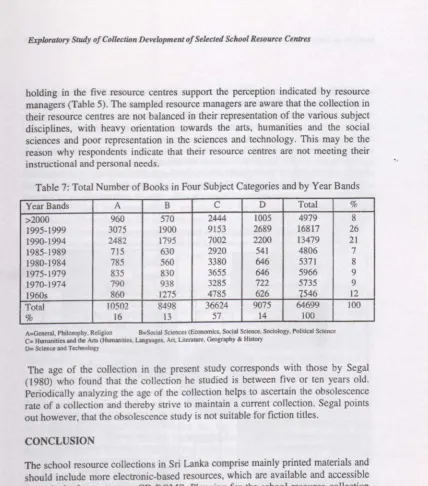
The Average Age of CoUection in the School Resource Centres
holding in the five resource centres support the perception indicated by resource managers (Table 5). The sampled resource managers are aware that the collection in their resource centres are not balanced in their representation of the various subject disciplines, with heavy orientation towards the arts, humanities and the social sciences and poor representation in the sciences and technology. This may be the reason why respondents indicate that their resource centres are not meeting their instructional and personal needs.
Table 7: Total Number of Books in Four Subject Categories and by Year Bands
Year Bands A B C D Total %
>2000
960
570
2444
1005
4979
8
1995-1999
3075
1900
9153
2689
16817
26
1990-1994
2482
1795
7002
2200
13479
21
1985-1989
7]5
630
2920
54]
4806
7
1980-1984
785
560
3380
646
5371
8
1975-1979
835
830
3655
646
5966
9
1970-1974
790
938
3285
722
5735
9
1960s
860
]275
4785
626
1546
12
Total
10502
8498
36624
9075
64699
100
%
16
13
57
14
100
A=General, Philosophy, Religion B=Social Sciences (Economies, Social Science, Sociology, Political Science e= Humanities andtheArts (Humanities, Languages, Art, Literature, Geography &History
D= Science and Technology
The age of the collection in the present study corresponds with those by Segal (1980) who found that the collection he studied is between five or ten years old. Periodically analyzing the age of the collection helps to ascertain the obsolescence rate of a collection and thereby strive to maintain a current collection. Segal points out however, that the obsolescence study is not suitable for fiction titles.
CONCLUSION
are: 400 students or less should have access to 50 full text titles; 401800 students -75 full-text titles and 800 or more student - 100 full-text titles. The Association also recommended that non-print resources should be equal to one percent of total print collection and facilities should be acquired to enable their use. This include connection to local and wide area networks; computer workstations of 8 for 400 or less student population, and 16-20 workstations for more than 400 students. The recommendation also spells out criteria for technical training for both resource managers and teachers. The school resource centres in Sri Lanka should at least aim to provide the minimum number of volumes recommended. Figure 2 indicates the proposed ideal environment that supports quality collection development in school resource centres.
Figure 2: Ideal Collection Development Environment
The results from the survey indicate that books are the main resource in Sri Lankan school resource centres. The collection in the five schools studied indicates a bias for the arts and literature. This imbalance should be corrected to include more current and curriculum related books in science and especially technology. It is recormeoded the collectioo be improved to include the folbwing; a more varied fiction
School
Adn1i.niS1b'ati!Support
• AcqJt colleetkn
policy
• Hlysical sup(X)lt • Soliciteotherfunding
• Trainingfor teachers &
Maintain
current,
balanced, coIlectioo~bq:eraJ~·' Ie selection
For Students
• Adequate rraterial
• Current & balanced collection • Receiveinstructions to use • Assistancefrom librarians
For Teachers
• Adequate collect fer
• Current
collectionforreference
collection that includes the various types of creative works; subscribing to newspapers and periodicals; and the inclusion of pamphlets, charts and government publications. There should be a move to allow the acquisition of electronic resources and the equipments necessary for their use.
Acquiring the necessary types and volumes of resources is possible, if the appropriate funding is available. Presently, the Ministry of Education disburses funds through the school library development programme funded by the World Bank. Through this fund, each resource centre should receive an annual allocation depending on the number of users. The resource managers are required to prepare an annual budget and estimate the requirements for books, other resources and equipments. Nevertheless, the resource centres are still expected to face inadequate funding. In most cases the resource centres in Sri Lanka exist in isolation. Perhaps a collaborative network should be established to enable resource centres share purchases and collections not only among schools resource centres but also with public and academic libraries.
Focus should also be given to training the human resources needed to manage the school resource centres. In a number of schools in Sri Lanka, students keep the books in bundles in a comer of the principal's room or in rooms not easily accessible. The books are neither classified nor arranged and no catalogues are provided to inform users of the availability of items. The existing resource managers should also be given in-service training on cataloguing, acquisition, user education and the management of source promotional programmes continuously.
chool m diu policy development.
Littleton.
01.:
ibr
e
n und
ide, J
hn E. 1995.Library
tud nt
in Hawaii.
Library
and
Information
pm nt.
'n
lw
III ed,
II
egal, Jo eph P. 1980.
Evaluating and weeding collections in small and
medium-size
public
libraries:
the
REW
method.
Chicago:
Am rican
Library
A celation.
mnhson,
M.
1997.
ut ourcing
by you, for you, or in
pile of you.
Th
ommunicator,
J.
nuary:
22-24.
Van rd n,