Rules, tools and networks
P O L I C Y P R E S S R E S E A R C H
URBAN FOOD SHARING
Policy Press North America office: University of Bristol Policy Press
1-9 Old Park Hill c/o The University of Chicago Press
Bristol 1427 East 60th Street
BS2 8BB Chicago, IL 60637, USA
UK t: +1 773 702 7700
t: +44 (0)117 954 5940 f: +1 773 702 9756 [email protected] [email protected]
www.policypress.co.uk www.press.uchicago.edu
© Policy Press 2019
The digital PDF version of this title is available Open Access and distributed under the terms of the Creative Commons Attribution-NonCommercial 4.0 license (http://creativecommons. org/licenses/by-nc/4.0/) which permits adaptation, alteration, reproduction and distribution for non-commercial use, without further permission provided the original work is attributed. The derivative works do not need to be licensed on the same terms.
British Library Cataloguing in Publication Data
A catalogue record for this book is available from the British Library.
Library of Congress Cataloging-in-Publication Data A catalog record for this book has been requested.
ISBN 978-1-4473-4982-2 (hardback) ISBN 978-1-4473-4984-6 (ePub) ISBN 978-1-4473-4985-3 (Mobi) ISBN 978-1-4473-4986-0 (OA PDF)
The right of Anna R. Davies to be identified as author of this work has been asserted by her in accordance with the Copyright, Designs and Patents Act 1988.
All rights reserved: no part of this publication may be reproduced, stored in a retrieval system, or transmitted in any form or by any means, electronic, mechanical, photocopying, recording, or otherwise without the prior permission of Policy Press.
The statements and opinions contained within this publication are solely those of the author and not of the University of Bristol or Policy Press. The University of Bristol and Policy Press disclaim responsibility for any injury to persons or property resulting from any material published in this publication.
Policy Press works to counter discrimination on grounds of gender, race, disability, age and sexuality.
Cover design by Policy Press
Front cover image: Rooftop Farm at Raffles City, by Edible Garden City
Printed and bound in Great Britain by CPI Group (UK) Ltd, Croydon, CR0 4YY
List of tables vi
List of abbreviations vii
About the author viii
Acknowledgements ix
one Introduction: the significance of food sharing 1
two New contexts: mapping contemporary urban food sharing 11
three Rules: governing urban food sharing 29
four Tools: socio-technologies of urban food sharing 49
five Networks: connections and interactions 69
six Conclusion: food-sharing futures 85
References 99
1 List of 100 urban areas 12
2 Typology of urban food sharing 17
FAO Food and Agriculture Organization
ICT information and communications technology
SELC Sustainable Economies Law Centre
UK United Kingdom
ONE
Introduction: the significance
of food sharing
Food sharing is a fundamental form of cooperation that … is particularly noteworthy because of its central role in shaping human life history, social organization, and cooperative psychology. (Jaeggi and Gurven, 2013: 186)
more surprising is that one in every five meals is eaten in a car (NPD, 2014). This is concerning when considered alongside analyses that have found that children who do not regularly eat with their parents are significantly more likely to have behavioural issues at school and in later life, and are more likely to be overweight. Meanwhile, children who do eat with their family experience less trouble with drugs and alcohol, exhibit healthier eating patterns, show better academic performance and report being closer with their parents (CASA, 2012).
for while foraging as a primary means of food provisioning is increasingly rare and far removed from many contemporary experiences, the majority of human history is dominated by such food provisioning systems, with agriculture emerging only in the last 10,000 years. These reflective studies are certainly important for providing insights into the evolutionary dimensions of food sharing, most particularly with respect to the ways in which sharing performs highly socialised forms of interaction; but are they relevant to contemporary urban food sharing?
Psychologists and anthropologists, extending the work of behavioural ecologists, have also sought to explain how sharing systems persist or transform over time as norms around sharing are negotiated. Here, studies of transitional moments dominate, for example when foraging systems intersect with systems of settled agriculture and waged labour activities (Kaplan et al, 2012). In this context, geographical and cultural diversity are seen as key to the evolution of sharing systems as sharers seek to elevate gains from cooperation and minimise risks from free riding through sharing practices. This is important because such research begins to flesh out the dimensions of complex socio-political and economic phenomena also found in contemporary food sharing, identifying the range of different objectives that sharing fulfils for diverse actors and recognising a dialectical relationship between individuals and structures in how sharing is performed. Despite this, sharing studies are primarily still focused on small-scale and isolated communities functioning on the edge of or outside global trade systems, leaving much of the contemporary landscape of food sharing unexamined.
or tablet), websites and social media. These mediators offer new ways to stretch sharing beyond immediate kinship and friendship networks quickly and conveniently, provided you are able to access them. Such has been the optimism surrounding these information and communications technology (ICT)-mediated forms of sharing more widely, particularly in the mobility and accommodation sectors, that some advocates have heralded them as key foot-soldiers of a new societal revolution (Botsman and Rogers, 2010). While others remain critical of this recent appropriation of sharing by commercial tech start-ups and their venture capital-funded initiatives (Belk, 2010), there is still an underlying optimism about the pro-social dimensions of sharing for creating more sustainable communities, leading to calls for a new paradigm of sharing (McLaren and Agyeman, 2015). Yet, beyond interesting case studies of particular food-sharing initiatives, there are few examples that engage broadly with contemporary practices and performances of food sharing. This leaves a gap in our understanding of contemporary food sharing, its impacts and its potential to improve the sustainability of food systems. It is the aim of this book to begin closing this gap, first by exploring a specific cohort of contemporary food sharing, that which is mediated by ICT and which occurs within urban areas, and second by establishing a research framework to further extend this exploratory study into new arenas.
of such initiatives, but it also provided an open-access online resource. This has enabled the database to function as a site of inspiration for those wishing to get involved in food sharing, as a means to identify what food-sharing initiatives are active and as a direct link to initiatives to promote access to sharing. Key findings of this phase of research are detailed in Chapter Two.
The remainder of the book combines insights from the database with those from a suite of ethnographies conducted in London, Berlin, New York, San Francisco, Dublin, Athens, Barcelona, Melbourne and Singapore. In each urban area interviews were conducted with those who were pivotal in setting up the sharing initiatives and those who are charged with regulating them. Alongside these formal interviews were a suite of engagements with those who shared as they grew, cooked, ate or redistributed food, and it is this research that forms the basis for the remainder of the book: the social, political and legal rules that both shape food sharing and are reshaped by its practices (Chapter Three); the particularities of socio-technical configuration that mediating urban food sharing with ICT creates (Chapter Four); and the connections and interconnections that result from the emergence of ICT-mediated urban food sharing (Chapter Five). The final chapter establishes a set of trends that can be distilled from the research and presents a framework for future research. However, before delving into the empirical data it is important to set out some answers to key questions that shaped the framing of the research: What counts as food sharing? Why focus on urban food sharing? And why focus on ICT-mediated urban food-sharing initiatives?
Defining parameters of ICT-mediated urban food sharing
What is food sharing?
such as ‘collaborative consumption’, ‘solidarity economies’ or ‘sharing economies’ (Martin, 2016). High-profile advocates of these activities, such as Botsman and Rogers (2010), see sharing as a means to liberate under-utilised assets for monetary or non-monetary benefits, which in the food realm might include the selling of surplus food via online communities or gifting it to food banks. It might include person-to-person marketplaces that facilitate the sharing and direct trade of assets built on peer trust (for example, homemade food sales). Others argue that sharing qualifies as ‘true’ sharing only when socio-cultural dimensions are emphasised, thereby excluding the commercial transactions of large-scale sharing platforms or apps (Belk, 2014). Given this lack of agreement, and to initiate an open examination of the field, a dictionary definition of sharing is used as a lexicological foundation and expanded to focus specifically on food as follows:
having a portion [of food] with another or others; giving a portion [of food] to others; using, occupying or enjoying food [and food related spaces to include the growing, cooking and/or eating of food] jointly; possessing an interest in food in common; or telling someone about food. (Cambridge University Press, 2017)
Adopting this broad definition as a foundation allows for diverse food-sharing practices to be considered and compared. It provides an expansive opening gambit from which interrogation of what it means to share can be undertaken.
Why urban food sharing?
Our struggle for global sustainability will be won or lost in cities. (Ban, 2012)
big and small, to help construct urban food systems that will be sustainable and resilient in the face of changing climates. In an epoch of planetary urbanisation, cities are significant sites of production, consumption and innovation, not least around food (Davies and Legg, 2018). Certainly, urban food systems will require radical transformation if they are to contribute to the Sustainable Development Goals of zero hunger and sustainable communities and cities, as agreed by the 194 countries of the UN General Assembly in 2015.
Why ICT-meditated food sharing?
Digital technologies are an increasingly visible part of everyday life for many people, with internet penetration globally reaching 50% in 2016. The proliferation of content accessible through these mechanisms has grown exponentially and provides new subjects, objects and networks – essentially new landscapes – for research, as well as new conceptual and methodological challenges for researchers (Hine, 2005). In this book ICT refers to diverse forms of technology, from digital devices to software packages, that make it possible for people to access information and communicate globally (UNESCO, 2002), including website, social media (Facebook, Twitter, Meetup) and apps that can be utilised to share skills, spaces or stuff (for example, food itself, meals, seeds, compost, devices, utensils, tools and so on) related to growing, preparing or eating food. These mechanisms offer possibilities to share food with wider communities far beyond the kinship food sharing that formed the very bedrock of human civilisation in hunter-gatherer communities. Essentially, ICT is stretching the spaces over which food sharing can occur, but how exactly it is affecting the practice of sharing remains unclear.
Sharing as a social practice
Sharing is not just what people do, it is a coordinated entity, ‘a temporally unfolding and spatially dispersed nexus of doings and sayings’ (Schatzki, 1996: 89) and a performance – a process of doing – through which sharing as an entity is perpetuated and potentially reshaped. While the benefits of adopting a practice orientation in relation to eating, cooking or growing food is relatively well established (see Warde, 2013; Davies et al, 2014; Meah, 2016), this approach has not been applied explicitly to food sharing. Yet, as outlined above, food sharing is undertaken for and with others; reshaping relations with both human and non-human entities and tangible and intangible resources (Agyeman et al, 2013). It is, as a result, overflowing with habits, routines, tools and technologies; essentially embodying an archetypal practice that is both entity and performance. Food sharing demonstrates routinised ways ‘in which bodies are moved, objects are handled, subjects are treated, things are described and the world in understood … [It is] … a “type” of behaving and understanding that appears at different locales and at different points of time and is carried out by different body/ minds’ (Reckwitz, 2002: 250), with the performative element of food-sharing practice occurring around its enactment. It is only through the performance of food sharing that the interdependencies between elements of food sharing (that is, food sharing as an entity) are sustained or changed. In essence, food sharing is a complex assemblage ‘of body-minds, things, knowledge, discourse, and structures carried by agents such as individuals, organizations and institutions’ (Jones and Murphy, 2010: 371).
to share in different contexts and to the rules and forms of power and control that shape the ways in which food sharing takes place. This is exemplified by the mundane practices of government, for example through land-use planning that dictates where and what types of food-sharing activities can take place. It is also visible in the ways in which environmental health and food safety regulations shape legal architectures for how food can be processed, prepared and delivered for consumption.
Conclusion
TWO
New contexts: mapping contemporary
urban food sharing
ICT-mediated urban food-sharing landscapes in 100 cities and constructed an open-access interactive database to share the results online (see Davies et al, 2017a; 2017b for further details of the method and results of this endeavour). Table 1 details the cities, countries and regions involved in this study and provides the number of initiatives uncovered and a ranking of cities according to the number of initiatives present.
Table 1: List of 100 urban areas
Region Country City Activities Ranking
Africa Kenya Nairobi 10 91
South Africa Johannesburg 23 68
Senegal Dakar 6 98
Asia China Beijing 17 81
Shanghai 11 90
Hong Kong Hong Kong 40 40
India Bengaluru 27 59
Chennai 14 85
Mumbai 17 78
Indonesia Jakarta 16 82
Japan Tokyo 45 28
Malaysia Kuala Lumpur 45 29
Singapore Singapore 50 26
Philippines Manila 25 64
South Korea Seoul 42 37
Toyama 9 93
Australasia Australia Adelaide 62 14
Canberra 37 46
Melbourne 144 3
Sydney 108 5
New Zealand Christchurch 50 27
Region Country City Activities Ranking Central and
South America ArgentinaBrazil Buenos AiresPorto Alegre 704 9100
Rio de Janeiro 9 92 Sao Paulo 24 66
Chile Santiago 39 41
Colombia Bogota 23 69
Medellin 17 80
Ecuador Quito 17 79
Mexico Mexico City 32 54
Europe Austria Vienna 42 36
Belgium Brussels 31 56
Czech Republic
Prague 20 73
Denmark Copenhagen 23 67
UK Birmingham 24 65
London 201 1
France Paris 40 39
Germany Berlin 133 4
Cologne 67 11
Frankfurt 54 21
Greece Athens 15 84
Thessaloniki 11 89
Hungary Bucharest 13 87
Ireland Dublin 45 30
Italy Milan 43 34
Naples 22 71
Rome 38 43
Poland Warsaw 18 77
Portugal Lisbon 36 50
Russia Moscow 13 88
Spain Barcelona 106 6
Region Country City Activities Ranking
Sweden Gothenburg 14 86
Stockholm 26 61
Switzerland Zurich 42 35
The Netherlands
Amsterdam 29 57
Nijmegen 15 83
Rotterdam 18 74
Turkey Istanbul 36 48
Middle East Qatar Doha 6 99
UAE Dubai 8 95
Israel Tel Aviv 18 76
North America Canada Montreal 38 45
Toronto 43 32
United States Ann Arbor 36 49
Asheville 39 42
Atlanta 52 23
Austin 62 13
Berkeley 44 31
Bloomington 27 60
Boston 55 20
Boulder 35 52
Chicago 72 8
Cleveland 26 62
Dallas 31 55
Denver 59 15
Detroit 41 38
Elora 9 94
Gulfport/ Biloxi 18 75
Hartford 21 72
Houston 43 33
Ithaca 23 70
Region Country City Activities Ranking
Long Beach 29 58 Los Angeles 57 18 Louisville 33 53
Media 7 97
New York City 185 2
Oakland 52 24
Philadelphia 81 7 Pittsburgh 38 44
Portland 51 25
Rochester 25 63 San Francisco 57 17 Santa Cruz 37 47
Seattle 53 22
St. Louis 36 51 Vancouver 68 10 Washington DC 58 16
Total: 4003
Source: Adapted from Davies et al (2017b) Key:
Dark grey = top 10 cities Light grey = bottom 10 cities
Collating digital traces
ICT-mediated urban food sharing. This is because it incorporates initiatives with a range of organisational forms, some of which are informal and many of which are not included in either company or charitable registers. Recognising this complexity requires a system of identification that is both robust and flexible enough to make meaningful statements about the ways in which urban food-sharing initiatives operate within and across cities. For, while technical tools for scraping data from the internet are available (see Russell, 2014), these rely on the existence of common search terms. The open and contested concept of food sharing demands a more creative process in order to capture the patterns and grammars of sharing.
The initial goal of building a database was to provide a platform on which learning could develop around the practice and potential of diverse food-sharing initiatives to contribute to more sustainable urban food systems; to throw light into the black box of ICT-mediated food sharing. The database was assembled by a core interdisciplinary team of international coders and a supportive social media network of collaborators who assisted by publicising our calls for submissions. First, a typology of food sharing was developed to frame the identification, classification and analysis of initiatives according to what was shared and how it was being shared (Table 2).
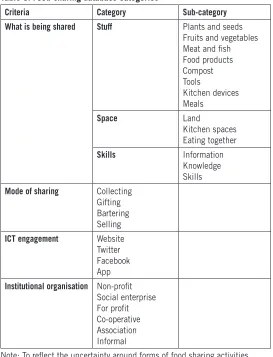
Each initiative identified was then coded according to: its location; the goals of sharing (for example, social, economic, environmental); what was shared (for example, the qualities of materials or information); how it was shared (for example, the mode of sharing such as bartering, gifting or selling); the institutional form of the initiative itself (for example, whether it is formally registered as a for-profit or not-for-profit initiative) and the type of ICT used to mediate sharing (see Table 3).
Table 2: T
ypology of urban food sharing
What is shared
Mode of sharing
Collecting
Gifting
Bartering
Selling (Not-for
-profit)
(For
-profit)
Stuff From seeds, to unprocessed and processed foodstuffs including utensils, food waste or compost
Sharing food that has been ‘liberated’, foraged or gleaned, eg, 510 fruits, USA Providing food for free, eg, FoodCloud, Ireland & UK Swapping food and food devices, eg, Adelaide Hills Produce Swap, Australia Providing affordable food on a not-for
-profit basis, eg, 4th Street Food co-op, USA Selling home cooked food that generates income beyond the costs of production, eg, Homemade, Australia
Spaces Shared growing spaces, shared food preparation or shared eating spaces
Guerrilla gardening of public open spaces, eg, Elephant and Castle roundabout, London, UK Providing spaces for growing for free, eg, The Monroe Sharing Gardens, USA Providing spaces where food can be exchanged for labour
, eg,
Community Shop, London Providing spaces for people to grow food on a not-for
-profit
basis, eg, Milwaukee Urban Gardens, USA Providing spaces for supper clubs or dining experiences, eg, Eat With, Global
Skills The sharing of knowledge and experiences around food from growing to eating and food waste disposal
Identifying places where gleaning or foraging might occur
, eg, Fallen
Fruit, Los Angeles, USA Providing skills around growing, eg, 3000 acres, Australia Providing opportunities to learn about growing food, swap seeds and produce, eg, Grow
stuff,
Australia
Providing workshops around nutrition or growing, eg, Hunger mountain co-op, Montpellier
, USA
Providing opportunities for travellers
to
experience
home cooked meals with locals, eg, Viz Eat, Global
Table 3: Food-sharing database categories
Criteria Category Sub-category
What is being shared Stuff Plants and seeds
Fruits and vegetables Meat and fish Food products Compost Tools
Kitchen devices Meals
Space Land
Kitchen spaces Eating together
Skills Information
Knowledge Skills
Mode of sharing Collecting
Gifting Bartering Selling
ICT engagement Website
Twitter Facebook App
Institutional organisation Non-profit Social enterprise For profit Co-operative Association Informal
while it is commonly assumed that food sharing is predominantly about gifting, there are many social enterprises that involve an element of monetary exchange around their sharing practices, even if often on a not-for-profit basis. As seen with the rise of sharing economies more broadly (Davies et al, 2017c), there are also for-profit initiatives that call the exchanges they facilitate ‘sharing’ even though they seek to make a profit from them and focus more on optimising resource use than the dimensions of care or commensality found in many readings of sharing. Another challenging arena was how to describe the mode of sharing found in activities like gleaning, skip surfing, dumpster diving and foraging. These activities do not fit easily into gifting or bartering categories and certainly are not selling. In response, a distinct mode of sharing – collecting – was developed to capture these activities.
Searching for sharing initiatives was structured by a list of 28 keywords. These terms were translated for country-specific searches, although it was recognised that the food-sharing arena presents significant issues of cultural translation (Bhabha, 1994). Searches were conducted systematically via country-specific Google search engines, social networking sites such as Twitter and Facebook and networks of food activists (for example, Boston Food Systems listserv, Food Surplus Entrepreneurs
Network, municipal and national Community Garden
databases), sharing networks (for example, Shareable), solidarity economy organisations (for example, Solidarity NYC, US Solidarity Network) and international research networks (for example, Community Economies Research Network). This was a reflexive process, with additional information collected about the food-sharing activities that suggested ambiguities or boundary issues related to the established coding and classificatory categories.
person-hours of labour. Even so, the resulting database represents only a snapshot of ICT-mediated food sharing in the urban areas examined. Following a review of the database one year from the initial collection, there was a 5% erosion rate, with approximately 200 initiatives no longer active online. Such dynamism is not surprising, particularly with new initiatives, and also occurs in mainstream economic activities. It is not unusual for many start-ups to fail within the first two years of operation, and commonly at rates much higher than this (Cantamessa et al, 2018).
understandings. The process was performative (Law, 2004) and generative. It created a space for attending to sharing as the unit of analysis, drawing together initiatives from across other conceptual categories such as solidarity economies, alternative food movements, cooperative movements, the non-profit or third sector, as well as for novel activities that are not captured by these existing framings. Essentially, creating the database allowed each of the ICT-mediated food-sharing initiatives to be made more visible both individually and collectively, locating initiatives alongside others that use similar modes or focus on similar arenas of food sharing. The collective aspect is important, for while in isolation individual initiatives may be dismissed as too niche to contribute to reconfiguring urban food systems, collectively they create a landscape of activity in which a host of analysis about food sharing can be undertaken.
Urban food-sharing landscapes
and growing social anomie (Botsman and Rogers, 2010). That there are initiatives with establishment dates far earlier than this indicates the continuities of current sharing practices with those of the past, and the ability of initiatives to adapt their activities to emerging contexts and technologies.
Motivations
Establishing the motivations for sharing was relatively straightforward, as many initiatives had clear mission statements or descriptions of goals on their online profiles. It was the social dimensions of food sharing that were most commonly emphasised by initiatives, followed by environmental and economic concerns. Just over a third of initiatives explicitly sought to attend to all three of these dimensions, or explicitly invoked a ‘sustainability’ goal.
Location
are predominantly large, populous metropolitan areas with high levels of GDP (at least compared to the global average) and high levels of internet penetration, if the number of initiatives is examined per capita, the ranking looks very different. In terms of the number of initiatives per capita, the highest-ranked urban area with a population of over one million is Cologne (31st), while London falls to a mid-table position (54th), with one food-sharing initiative for every just under 43,000 people.
(Rio de Janeiro, Porto Alegre) and the Middle East (Dubai, Doha), as well as smaller urban areas in North America (Elora, Jackson, Media). There is far more diversity within this cohort in relation to population, GDP and internet penetration, although figures are consistently lower across these metrics than for the top 10 cities, particularly in relation to internet connectivity. As statistics do not exist at the city level for internet penetration for the cities in the database, country-level statistics are used as a proxy, which means that these figures are likely to be an under-estimation, as the density of connections in urban areas in these countries is presumed to be higher.
What is shared?
A suite of categories was developed for classifying what was being shared by initiatives (see Davies and Legg, 2018 for further details of the process). Broad categories of spaces (for example, shared kitchens, eating spaces or gardens), skills (the sharing of knowledge and information) and stuff (material foodstuff and growing, storing and cooking devices that can be shared) were further sub-divided into: land, kitchen space, plants and seeds, fruits and vegetables, meat and fish, food products, compost, tools, kitchen devices, knowledge and skills, meals, eating together – to systematically code the initiatives in the database. However, more than two-thirds of food-sharing initiatives in the database shared multiple things and more than a third of initiatives shared three or more things. For example, the Skip Garden and Kitchen in London, which is part of Global Generation, provides knowledge and skills around community growing and cooking to local planners and businesses as well as involving local residents in food growing in its sites. Its sharing therefore involves food, land, tools, kitchen spaces and meals in addition to skills and knowledge. It is an archetypal multifunctional food-sharing initiative, involving a collection of actions intended to build resilience and reach multiple communities. Often, food sharing in this context is seen as a social accelerant for achieving wider societal changes.
information about how to forage in urban settings, as articulated in Lots of Food in Louisville, United States (US) and Espigar En Madrid in Madrid, Spain.
However, the apparent dominance of knowledge and skills sharing around food requires further unpicking, for rarely did initiatives communicate where the bulk of their efforts were allocated in their online profiles. So, while initiatives might post ‘how-to’ guides for shared growing – thereby sharing information – that might make up just a small proportion of their efforts around food sharing, which might also include shared growing spaces and the sharing of seeds or garden tools. Also, there are many more categories of material foodstuff that were coded than for other types of sharing. If the nine food ‘stuff’ categories are combined, for example, knowledge and skills then comprises only a quarter of activities across the 100 areas, while with the combined sharing of material, food stuff makes up 63% of everything that is shared.
What is shared where?
Examining the database regionally, general patterns of what is shared are remarkably similar, particularly when examined through the broader lens of skills, spaces and stuff. For example, while sharing skills is lowest in the Asian urban areas covered by the database, it is just 1% lower than levels in European urban areas and 2% lower than those found in North American areas. Meanwhile, in the Middle Eastern urban areas nearly a third of initiatives involve skills sharing, which is the largest proportion of all regions. Reasons for these variations need to be further unpicked, although hypotheses might start by examining the availability of physical and technical infrastructures, or land-governance systems.
this form of sharing. Explanatory analyses here could examine patterns of population density and land enclosure systems. For example, Australian and New Zealand-based urban areas tend to have the highest incidence of space sharing and low population densities. The greatest regional divergence (10%) occurs within the food stuff category. Here it is the Middle Eastern areas that exhibit the least sharing of food stuff, with both the European and North American urban areas topping the field.
Conclusion
The food-sharing database discussed in this chapter provides, for the first time, the capacity to conduct consistent analysis and identify patterns and trends within ICT-mediated urban food sharing across diverse cities, countries and continents. It makes food sharing more visible within and beyond individual urban foodscapes, potentially enacting a process of scalecraft (Fraser, 2010). There are conceptual and pragmatic reasons for considering the performance of social practices such as urban food sharing at scales beyond the local when seeking to inform systems of governance that routinely privilege quantitative and large-scale studies over individual qualitative cases. The database functions as a tool to reveal, quantify and further understand the range of ICT-mediated food-sharing practice across 100 diverse cities.
THREE
Rules: governing urban food sharing
Sharing food with another human being is an intimate act that should not be indulged in lightly. (M.K. Fisher, 1954)
Food sharing is replete with rules; rules around when, how and with whom it is socially, politically and legally acceptable to share. These rules are not fixed, they can change over time, space and in relation to the actors, materials and entities involved in sharing. While formal rules, for example around land-use planning or food safety, are generally explicit (even if not necessarily intimately known by citizens), social rules of sharing are largely unspoken and, as a result, can be difficult to navigate and easy to transgress (Fitzmaurice and Schor, 2018). This chapter interrogates just some of these rules through analysis of ICT-mediated food-sharing initiatives that operate in different urban contexts and are subject to diverse governing regimes.
identifying, codifying and regulating both food sharing activities and the urban spaces in which those activities take place operate. First, examples are given from the US of how particular food-sharing practices – such as direct selling from producer to consumer through farmers’ markets or marketplaces for home-cooked food, seed sharing and surplus food redistribution – can come into tension with, resist or reinforce these governing frameworks. Attention is then paid to the internal governance choices made by food-sharing initiatives and the ways in which the rules that initiatives set for themselves emerge and change over time in relation to initial goals and subsequent impacts. It is in this section that the social rules around sharing are considered – although, of course, these permeate all moments of sharing. This is followed by a more considered examination of salient governance issues that particularly affect the redistribution of food surplus within the EU.
Governing urban food sharing: cases from the US
which were being spearheaded by New York City’s mayor at the time (Dawsey, 2015). In the same year Airbnb responded to state efforts in San Francisco to restrict short-term rentals with a multimillion-dollar campaign against the proposals (Somerville, 2015). However, the legal challenges for these companies came once they were already powerful players in their sectors, as is indicated by the significant funds that they were able to invest in lobbying. This has led to concerns bring raised about a differentiated system of justice where successful sharing platforms like Airbnb and Uber can develop their own regime of privilege that gives them significant power and influence in decision making (Pasquale and Vaidhyanathan, 2015); although of course, uneven access and influence over others is nothing new in the policy world (see Davies, 2001). Others have called for legislation to be designed expressly for experimental activities like sharing that might be applied temporarily while the impacts of activities are demonstrated (Kessler, 2016). In other situations there have been calls for mandated requirements (sometimes called sunset provisions) for legislative bodies to actively undertake reviews of existing policies over time in order to reflect on their relevance in the light of emerging technologies (Doménech-Pascual, 2016). While these regulatory debates are most heated around how best to govern commercial sharing-economy activities, food-sharing initiatives with a range of organisational structures are also being shaped by and seeking to reshape governing landscapes. The following section draws out a few cases to exemplify these ongoing processes.
Scale matters (1): the Underground Market
Market was established in 2009 as a reaction to the exclusionary requirements to starting a food business in the area. Initially the monthly Underground Market operated from a private house, with seven vendors and around 150 eating participants. It was recognised by the city’s health department as a private event, with the participants required to become members and to accept that events involved the sale of uncertified food. By 2011 the market had grown to incorporate more than 400 vendors and more than 50,000 members. It had become undeniably visible and, in the eyes of the health department, therefore public and thus subject to the full procedural requirements of a food business. In July of that year the Underground Market was closed down by the city health department. It reopened in June 2012 to celebrate the raising of $150,000 through the Kickstarter crowdfunding platform, which was used to open a professional shared kitchen described as an incubator for food crafters.
The Underground Market was explicitly selling food, albeit artisanal, home-cooked or small-batch cooking, so it is not hard to see why the public health officers felt that they had to intervene when the event scaled up dramatically. In other areas, however, such as community seed swaps, the relevance of applying regulation designed for commercial activities to small-scale not-for-profit initiatives is less obvious.
Scale matters (II): community seed sharing
California signed into law the Seed Exchange Democracy Act, exempting non-commercial seed sharing from onerous testing and labelling requirements. This represents a significant step in policy realignment, recognising the qualitative and quantitative differences between the activities and goals of community seed swaps and multinational agri-food companies. Scale certainly matters in this case, but the regulatory changes are also a reflection of the scope and intention of the community-level activities involved. The combined efforts of community groups and skilled advocacy organisations in championing the benefits of local seed swapping have created the possibility of enhanced food democracy, at least among those who are able to participate.
Scale matters (III): selling your wares
The exchange of home-cooked food for money faces similar challenges to those posed to both the farmers’ markets and the seed savers: essentially, commercial legislative frameworks are applied to small-scale industries. For example, selling food of any sort in California requires you to have a suite of specified kitchen facilities, requiring significant financial investment. Meanwhile, even commercial shared kitchens can be out of financial reach for entrepreneurial home cooks looking to test the waters for their products. While many states in America have some variant of a cottage food law to meet the needs of home cooks looking to sell their wares, many restrict such sales to designated foods such as baked goods, dried fruits and popcorn, which are considered to be low risk or non-hazardous.
personal accountability. For Josephine Cooks, a San Francisco meal-distribution platform for home cooks, the uniqueness of home cooking was fundamentally about these relationships. However, from the perspective of public regulators, inspecting the activities of a burgeoning number of small businesses was seen as creating a legislative headache, and city officials informed Josephine Cooks that its operations (and the cooks who participated) were breaking the law. In a similar fashion to the Underground Market, Josephine Cooks then required people to become members of its initiative before buying a meal, emphasising the origins of the food in home kitchens on its web platform and calling for cooks to use commercial kitchens for meal preparation while the initiative explored permitting options with local authorities. However, health regulators at the local level had no authority to compromise with Josephine Cooks and no legal discretion about whether to enforce the law. As the company attempted to roll out its activities across the country it faced a range of local legal challenges, encountering variations of cottage food laws from state to state. Frustrated, Christina Oatfield, the non-profit’s policy director, asked ‘[h]ow can we decriminalize neighbourhood-based sales of homemade meals in a way that disrupts corporate control of the food system … rather than simply adding a few tech giants to the map of corporate control of the food system?’ (Oatfield, 2016).
section the organisational rules that initiatives adopt in order to share food are considered. This includes examining the diverse modes of sharing that they adopt, from gifting to selling, the institutional models they create in order to do this and the social, cultural and ideological rules that shape the decisions about how they wish to function.
Internal governance of food sharing
While it is the commercial end of the sharing spectrum that has caught media attention in other arenas of sharing such as mobility and accommodation, gifting has been shown to dominate many urban food-sharing landscapes (Davies et al, 2017b). The same research indicates that selling remains a common form of exchange for food-sharing initiatives, with around a third engaged in monetary transactions of some sort. However, these transactions occur in familiar mainstream markets as well as in alternative settings occupied by social enterprises and cooperatives. Certainly, at present, commercial for-profit market transactions do not dominate the food-sharing exchanges and interactions, with the exception in the database being urban areas in Asia, which show 43% of initiatives selling their sharing experiences, as compared to 41% gifting. Across the study, only 9% of sharing initiatives involve collecting food through processes of gleaning or foraging and just 7% adopt barter as their mode of sharing. These lower levels of activity might be explained, in part, because they tend to be territorially delimited and therefore less open to the scaling benefits of ICT mediation.
have a charitable or non-profit tax status (for example, 501 C3 organisations, one of 29 types of non-profit organisation classified in the US). The goal of such organisations is not to generate profit, so donations and grants often form a large portion of their operating budgets while labour is often provided by volunteers alongside a limited number of waged employees. Clubs, associations and networks, which account for just under a quarter of sharing, were defined as organisations that require membership, while cooperatives include formally registered consumer, worker and producer cooperatives as well as businesses that self-identify as cooperatives. While only 5% of all sharing is conducted by cooperatives, more than half of these cooperatives are also associations. In contrast, for-profits, which made up just over a fifth of sharing activities, are formally registered businesses. Informal initiatives, which make up a considerable 17% of all sharing activities in the database, comprise of loose networks of people. They are not formally registered entities and, as a result, their activities may go unnoticed and therefore unregulated. Social enterprises, meanwhile, tend to adopt a business model and organisational form that blurs the boundaries of traditional business, state or non-profit approaches because they explicitly seek to generate social and environmental benefits from their activities. They may, for example, apply commercial strategies such as selling to reach social and environmental goals. Globally, the definition and associated legislation around social enterprise is still in development and social enterprise status is available in only a handful of countries, such as the United Kingdom (UK) and Australia, which explains why only 5% of sharing collated in the database is currently conducted through this organisational form.
(for example, non-profits and cooperatives) as a means to provide multiple ways to access funding and resources and to overcome legal restrictions on certain types of activities. For example, in some jurisdictions charities are required to be independent of political parties. In the UK a charity cannot be established for a political purpose, but a charity may engage in political activity or campaigning to achieve its purposes.
Even acknowledging that the database provides only a snapshot of the food-sharing landscape, it is clear that mainstream market transactions do not dominate. While for-profit food-sharing platforms and apps are present, including a few venture capital-funded start-ups, the vast majority of initiatives and their exchanges are more easily accommodated into what have been variously called alternative market, alternative capitalist, non-market or non-capitalist economic activities – collectively captured under the umbrella concept of diverse economies (Gibson-Graham, 2008).
the waste created by aesthetic criteria for food and redistributes aesthetically imperfect produce that is currently unacceptable to the market in order to demonstrate its edible qualities, reduce food waste and promote the consumption of fresh produce for all.
In some cases, as with Himmelbeet, a community garden in Berlin, initiatives have explicit internal rules for participants. Himmelbeet is a signatory to the Urban Gardening Manifesto, which was developed by a collective of gardening activists within the city to explicitly state personal, social and political commitments to the importance of freely accessible public spaces in the city, as well as to flag the importance of urban nature in creating positive ecological and inclusive urban environments. In particular, the manifesto sought to stimulate greater social discourse on the significance of community gardens and to highlight to decision makers in politics, planning and public administration the lack of legislative protection for their activities. Certainly, community gardens in many jurisdictions face challenges in terms of their lack of fit with standard urban government departments. Community gardens offer opportunities for recreation, including mental and physical exercise, but they are rarely designated as public parks or leisure facilities. They offer diverse opportunities for learning, but they are rarely seen as part of the educational department’s remit. The implications of this governance gap are illustrated further in Chapter Five.
needs and to offer help when needed (although Himmelbeet notes that it is legitimate to accept or politely refuse such offers). Most importantly for the inclusive intercultural dimension of Himmelbeet’s mission, the code of conduct calls for acceptance of difference among participants and for everyone to embrace the learning that can emerge from interacting with people who have different life experiences. In the spirit of inclusivity and learning, the code of conduct also allows for rules to be changed and new rules added.
structural inequalities in class, race and gender in such settings is, of course, no easy matter (Fitzmaurice and Schor, 2018).
Redistributing free food
While the gifting of food to others has long been a key feature of food sharing when it occurs beyond the confines of friends and family, it is a practice that is not free from regulatory oversight. Indeed, in August 1988 nine volunteers from the informal food-gifting movement Food Not Bombs were arrested by the entrance of Gold Gate Park in San Francisco, California as they were about to share lunch with others (Spataro, 2016). By September of that year nearly 100 arrests had been made for such publicly displayed food-sharing practices, with police intervention highlighting that those involved in the public gifting did not have the required licence for their actions (Parson, 2015). This led to a string of legislative processes to establish a system of temporary permits, including health permits. However, only a legal challenge by Food Not Bombs brought the process of defining the terms of such a permit to an end so that the initiative could demonstrate its compliance with the requirements and seek a health permit. A health permit was subsequently issued in September 1989, with another permit to operate being issued six months later, in March 1990. However, by July of that year (1990) the San Francisco Recreation and Parks Department had deleted the permit process for sharing free food in the city’s parks. The city government then granted an injunction against Food Not Bombs, banning the group from sharing food without a permit. Yet the initiative’s multiple applications for a permit were not being progressed. Frustrated by these regulatory obstacles, Food Not Bombs food sharers continued to gift food in public places, and hundreds were arrested.
as simultaneously ‘street demonstration, political theatre, grassroots organizing, and community meal all in one ritual use of public space’ (Spataro, 2016: 192). As Heynen (2010), among others, has noted, Food Not Bombs employed a deliberately public spatial strategy to flag concerns about food injustice, poverty and violence. Food Not Bombs felt that it was these political dimensions of its actions that underpinned its struggles to serve free food legally, rather than the concerns stated by public officials that focused on food safety or the appropriate use of public parks. As a result, since 1995 the initiative has adopted a policy of not applying for or accepting a permit for the gifting of public food, stating that the sharing of food should be an unregulated gift of compassion (Henry, 2018).
Thirty years after the first arrests of Food Not Bombs food sharers, new legislation for public food gifting is being considered in San Francisco so as to formally recognise such practices, termed limited service charitable feeding operations. This provides for a new category of regulated food facility exempt from the many requirements of other commercial food operations. However, concerns remain among groups focused on hunger, regarding how the legislation would restrict the operation of volunteer-run initiatives and how local officials could potentially utilise the legislation to shut down community efforts to feed people who are hungry.
the EU, consider all activities that redistribute food to be ‘food business operators, placing food on the market’ (EC, 2017: 6), irrespective of their institutional models or the sharing modes adopted. Redistribution activities are seen as engaging in retail, and charities that receive food are considered to be conducting mass-catering activities and, therefore, have the same obligations as commercial operators (EC, 2017). Both redistributors and charities are required to record the suppliers of products that they receive (one step back) and the recipients of the products they redistribute (one step forward), except with respect to the final consumer. This system for traceability occurs under the auspices of technical systems of food risk and safety governance, such that the beneficiaries of surplus food redistribution are afforded the same procedural protection as consumers in mainstream marketplaces. So, while redistributing surplus food has been flagged as one potential means of generating improved access to food for those in need, the food is still required to be of sufficient quality and quantity to meet needs in ‘sustainable’ ways (UNESCO, 1999: 3). Similarly, the EU food donation guidelines published in 2017 make it clear that food is to be traceable and edible, although they do not specify the relative roles and responsibilities of the various actors involved in ensuring that this happens. As detailed elsewhere (Davies, 2019), questions remain about who should provide and pay for the new logistics infrastructures required for the expanded volumes of surplus food redistribution, and who should evaluate the qualities of surplus food and its appropriateness for consumption. With no clear answers to these questions, activists and scholars alike are concerned that lubricating the flow of surplus food through legislation is currently focused primarily on limiting the liability of donors rather than on resolving the underlying causes of either food poverty or food waste (Caraher and Furey, 2017).
are emerging. Many of these revolve around the coincidence of technical approaches to food risk and safety with procedural assumptions about the locus of power and responsibility. One such example is the phenomenon of public fridges, envisaged as open-access spaces where food can be freely and anonymously shared (see Dowdall, 2017 and Morrow, 2018). However, while the concept of public fridges is straightforward, their operation varies widely and, despite their admirable goals of reducing waste and hunger, they have been labelled unhygienic and a threat to personal and public health (Zurek, 2016).
views and practices of food commoning, but it is also practical. As a volunteer-run organisation, Foodsharing.de has no paid staff and therefore has limited capacity to resource, monitor and check the numerous sites that the public fridges occupy. It is not that the initiative is disorganised, however. It operates a rules-based, hierarchical system of volunteer registered users or food sharers (around 200,000 in 2018) and trained food savers (just under 38,000 in 2018), and a number of store coordinators and ambassadors who liaise with the original founding group. Each step up the organisational ladder requires further commitment and attendance at training events so as to ensure that participants understand the initiatives, goals and methods around food safety and responsibility.
As detailed by Morrow (2018), the public fridges of Foodsharing.de were intended to be exemplars of open-access commons, being accessible to everyone, and the food inside owned by no one. However, herein lies the crux of anxiety for regulators. If no one owns the fridge or the food, who should be held accountable if the food inside is unsafe and if someone becomes sick as a result of eating it? For governing actors, food risk is managed legally and institutionally, with rules guiding behaviour in relation to food, procedures for identifying the causes of any food-related incidences and systems for assigning blame to individuals as a result. Collective forms of ownership and responsibility are, at least as far as food-safety authorities are concerned, inherently risky.
and scanners to detect the cleanliness of hands working with food. Essentially, the Internet of Things (IoT), including ICT, is being increasingly enrolled to support the current food-safety system. Indeed, industry stakeholders are suggesting that policy developments, such as the US Food Safety Modernization Act, may demand that the use of the IoT for food safety moves from being a niche innovation to a mandatory requirement. However, such technological fixes are designed to support and extend the current food risk-regulation framework rather than to challenge its internal logics. Extending such demands to voluntary and not-for-profit initiatives that handle and seek to redistribute donated food would require them to develop or acquire additional technical capabilities and devices. Many of the food-sharing initiatives would simply be unable to meet such demands, pushing their activities into the realm of illegality and confrontation with enforcement officers, as with Food Not Bombs, or simply forcing them out of operation. Any technologically augmented legislation would need to carefully consider the implications of such demands for grassroots innovation and food democracy within the urban food system.
Conclusion
and financial barriers for initiatives ranging from seed swaps to community kitchens and from farmers’ markets to those selling home-cooked food. These barriers are significant, with the activities of many grassroots, non-profit initiatives being considered illegal under existing regulations; but these initiatives have little ability to change their activities to fit the legislation, and limited power and influence to demand regulatory review. Food risk and safety regulations are not the only formal rules that affect sharing initiatives. Planning policies that relate to access and security of tenure with respect to urban spaces also affect many shared growing and eating initiatives, and some illustrative cases of this are elaborated in Chapter Five.
FOUR
Tools: socio-technologies of
urban food sharing
of these remain underdetermined. Drawing on case studies of initiatives from contrasting urban settings, this chapter explores the diverse ways in which ICT is helping to construct new sites, moments and experiences of food sharing.
Outlining a landscape-level analysis of ICT-mediation across the database initiatives, this chapter also presents a deeper dive into the ways in which ICT is being used by food-sharing initiatives. It focuses first on a number of initiatives that have integrated more complex forms of ICT such as websites, interactive platforms and apps into their activities, as it is the functionality of these tools that has been touted as holding the most transformative potential for sharing activities and that has gleaned the most media attention. Examples are drawn from contrasting initiatives that provide the technological means to map excess urban harvests and those that utilise complex ICT to provide opportunities to eat together with others. The third section focuses on surplus food redistribution, which has seen considerable attention from policy actors concerned with food waste and activists concerned with ongoing food insecurity. It presents a critical analysis of the disruptive potential of such ICT-mediated surplus food sharers, particularly drawing on the experiences of an initiative established in Dublin that has scaled internationally.
ICT-mediation in urban food-sharing initiatives
2014). Websites dominate the sample of urban food-sharing initiatives in the database, with 9 out of 10 initiatives using this form of ICT mediation. Websites are used to mediate every form and mode of sharing. Far fewer, but still more than half of the initiatives, have a Facebook page, and just over a third operate a Twitter account. Given the level of technical knowledge and skills required to construct them, and also the investment required to develop the critical mass of users to drive the necessary network effects for sustaining activity, it is unsurprising to find that only 1 in 10 of the initiatives utilises an app to share around food. It is also the case that food-sharing apps have struggled to replicate the successes of sharing ventures in other sectors, such as accommodation-sharing and shared-mobility platforms, despite several receiving venture-capital investment. A number of high-profile, commercial first-mover food-sharing initiatives, such as Cookisto and Grub With Us, have been wound down or repurposed.
Given their high levels of internet penetration, it is unsurprising that North American and European food-sharing initiatives account for two-thirds of all app-based activities. Within the 100 urban areas covered in the database, New York City is the most app-mediated food-sharing territory, followed by Seattle and Barcelona. Only 14 urban areas in the database have no app-mediated food-sharing initiatives whatsoever, although this is primarily due to the presence of transnational food-sharing initiatives, such as VoulezVousDiner and Mealsharing, that list many cities as sites for meal sharing but do not detail the level of activity within them. Such translocal, even transnational, networks sit alongside similar but more place-based initiatives such as Wats Cooking in Chennai, India. Apps are also used to connect producers directly to consumers, facilitating shorter food value chains and promoting local produce, as exemplified by SEND in Tokyo.
together across large distances. As such, they are particularly useful for knowledge exchange, mapping and dissemination. However, engaging with strangers in this way is also the newest form of social interaction and many app-reliant initiatives deteriorate rapidly if they fail to develop a critical mass of users in the short term. Research indicates that a third of initial mobile app engagements last less than a minute, with people being intolerant of poor user experiences (Segrist, 2015). So, while apps are the most novel form of ICT mediation, they are also the most resource intensive to develop, maintain and successfully operationalise. The high start-up costs and concerns about risk may explain the predominance of monetary-exchange business models when apps are used for food sharing. Despite this, still more than a quarter of app-based sharing initiatives in the database operate a gifting mode of sharing, and a handful of initiatives use apps to facilitate collecting or bartering. For example, Wild Food in Houston shares information about edible plants and Byhøst (City Harvest) in Copenhagen uses its app to share knowledge about urban foraging and wild plants.
Examining the online profiles of sharing activities can provide a useful overview of the stated goals and activities of initiatives (see Davies et al, 2018b), but it is often impossible to discern how initiatives operate in practice from online profiles alone. Experiential detail is needed to flesh out practices and impacts, and the remainder of this chapter draws on ethnographic research that sought to do just this.
Mapping Melbourne: Ripe Near.Me
posting element of the process is free and the person posting can decide whether to gift, swap or sell the goods they post. The locational posting is then pinned on the searchable map, providing for online foraging. As noted on the website, Ripe Near.Me aims to be ‘all about community and ultra-local food, mapped across the globe. You can find what’s growing in your neighbourhood to get in touch with folks nearby, or see what’s growing half way around the world.’ Produce listings are coded red or green to indicate if the food is growing or ripe, in order to let online foragers know when it is available. The online dimension means that sharers can subscribe to produce listings and receive notifications when the harvest is ripe for collection or when the grower posts a comment or update. Primarily funded through the crowdfunding website Start Some Good, the initiative has developed a partnership with Australian food manufacturer Continental, a subsidiary of Unilever.
Alongside the goals of utilising excess food for human consumption, the founders also hope that the site might act as a disruptive force leading to more edible urban landscapes:
We imagine an edible urban landscape, overflowing with food for all. What keeps us up at night is a feeling that we have an opportunity to really shake up the food system, and put food back in the hands of people. If we encourage and incentivize people to grow food we can have an entirely different (edible) urban landscape. One where you get to pick fruit and veg off the plant – not a shelf! And where your fresh food comes from a micro-farm, window garden, or fruit tree in your neighbour’s [sic] backyards. (Ripe Near.Me, 2018)
its platform. As a result, in 2016 participatory research was conducted in Melbourne to uncover more details of the activities that the web platform generates (Edwards and Davies, 2018). This revealed that while posts of food can appear plentiful at an urban scale when one enters the mapping tool, postings are not equally dispersed across the city and not all posts have food ready to be exchanged (or ripe, as the system classifies them), meaning that there may be far fewer options within particular localities at any time. Analysis of posts in Melbourne also revealed that some were uploaded more than two years earlier, with no clear indications of whether or not the post was still available. An intense period of engagement with the website was required to dig beneath the maps and understand more clearly how the app functions in practice. During research, participants who posted within the Melbourne area were contacted, and exchanges were organised when responses were received. Sharers were engaged during the subsequent meetings, and reflections on the use of the map and the logistics of engaging with Ripe Near.Me were documented.
site. She simply thought the concept was interesting, but was not highly invested in the outcome of her social experiment.
While moments of deep connection are not required by Ripe Near.Me, they can emerge. In one case a connection generated an invitation to a local food swap, which in turn revealed a whole layer of community food swaps that were not ICT mediated and therefore not visible to researchers online. In this way such sharing sites may provide a useful way into further activities and connections with others, but their efficacy in this regard is hard to track, even through ethnographic research. Many of those who had posted food to share were contacted during the research, but most had received few contacts through the website and even fewer actual exchanges of food. One participant had been on the site for two years and had experienced only two exchanges through the website. Where interactions were forthcoming, the food providers were all enthusiasts about the qualities of home-grown food and about increasing the capacity of urban areas around food; essentially, they were all supporters of creating more edible cities.
for feedback, but users were uncertain to whom this feedback would go and for how long it would be held. Overall, social rules for online-to-offline engagements were thinly developed.
While the global mapping of excess food in Ripe Near.Me is staggering in its reach, the usability of the system (which remains a beta version, according to the website) could be improved. While it is simple in concept, the practicalities of exchanging excess food are multi-layered, with details required for listing, contacting people, replying to responses, following up with non-respondents and subscribing to posts or friending people. All of these steps to share involve considerable time and labour and create additional e-mail or phone-based traffic. It seems that while it demonstrates the potential reach of a global ICT mapping tool, Ripe Near.Me has not yet managed to acquire sufficient local network effects, at least within Melbourne, to establish the kinds of impacts experienced by other sharing-economy platforms. These network effects would enable more people to see more food available in their locality, encouraging more posting and subscribing. This in itself would encourage participants to be more active posters of food and managers of their posts online than seems currently to be the case. Other forms of highly ICT-mediated sharing, such as meal-sharing platforms, have had more success generating participation, and some of the implications of this are considered below.
Come dine with me: Eat With and viz Eat
with creative, open-minded and interesting people’ (Eat With, 2018). Before its acquisition, Eat With identified 650 hosts (cooks) in 20 cities across 50 countries, creating 1,500 menus for 11,000 dinners and more than 80,000 diners. Whereas Eat With emphasised the creative connections to be made through a foodie sub-culture, Viz Eat has focused on connecting local hosts with travellers seeking off-the-beaten-track experiences. Both initiatives emphasise the social dimensions of eating together and the cultural benefits that accrue from it, with Viz Eat explicitly seeking an immersive food experience and ‘authentic’ dining experiences, cooking classes and food tours for participants.
The apparent scale of Viz Eat’s activity is impressive, with its website claiming more than 20,000 hosts and 150,000 Viz Eaters by 2018, and with localised versions of its app available in English, French, German, Italian, Spanish and Chinese. Its acquisition of Eat With, which itself had already raised around $8 million from financial backers, was seen as a way to further expand its global offering by bringing global tourism partners into the mix for Eat With hosts. So, rather than relying on bespoke dinner parties made up of individual strangers, the Viz Eat model uses travel and tourism agents to provide block bookings for hosts, guaranteeing numbers of diners and taking some of the logistical uncertainty out of the process. Viz Eat’s acquisition of Eat With by was also not its first. In 2015 it acquired Cookening, a French-based early pioneer in the space of shared dining experiences.