Counseling and Psychological Services Dissertations
Department of Counseling and Psychological Services
8-8-2017
Cultural and Linguistic Competence in
Organizations Serving People with Disabilities:
Recommendations and Exploration of Training
Practices
Rachel LaFleur
Follow this and additional works at:http://scholarworks.gsu.edu/cps_diss
This Dissertation is brought to you for free and open access by the Department of Counseling and Psychological Services at ScholarWorks @ Georgia State University. It has been accepted for inclusion in Counseling and Psychological Services Dissertations by an authorized administrator of ScholarWorks @ Georgia State University. For more information, please [email protected].
Recommended Citation
LaFleur, Rachel, "Cultural and Linguistic Competence in Organizations Serving People with Disabilities: Recommendations and Exploration of Training Practices." Dissertation, Georgia State University, 2017.
This dissertation, CULTURAL AND LINGUISTIC COMPETENCE IN ORGANIZATIONS
SERVING PEOPLE WITH DISABILITIES: RECOMMENDATIONS AND EXPLORATION
OF TRAINING PRACTICES, by RACHEL C. LAFLEUR, was prepared under the direction of
the candidate’s Dissertation Advisory Committee. It is accepted by the committee members in
partial fulfillment of the requirements for the degree, Doctor of Philosophy, in the College of
Education and Human Development, Georgia State University.
The Dissertation Advisory Committee and the student’s Department Chairperson, as
representatives of the faculty, certify that this dissertation has met all standards of excellence and
scholarship as determined by the faculty.
______________________________ ______________________________
Stephen Truscott, Psy.D. Emily Graybill, Ph.D.
Committee Chair Committee Member
______________________________ ______________________________
Daniel Crimmins, Ph.D. Andrew Roach, Ph.D.
Committee Member Committee Member
______________________________ ______________________________
Date Cirleen DeBlaere, Ph.D.
Committee Member
______________________________ Brian Dew, Ph.D.
Chairperson, Department of Counseling and Psychological Services
______________________________ Paul A. Alberto, Ph.D.
Dean
By presenting this dissertation as a partial fulfillment of the requirements for the advanced degree
from Georgia State University, I agree that the library of Georgia State University shall make it
available for inspection and circulation in accordance with its regulations governing materials of
this type. I agree that permission to quote, to copy from, or to publish this dissertation may be
granted by the professor under whose direction it was written, by the College of Education and
Human Development’s Director of Graduate Studies, or by me. Such quoting, copying, or
publishing must be solely for scholarly purposes and will not involve potential financial gain. It is
understood that any copying from or publication of this dissertation which involves potential
financial gain will not be allowed without my written permission.
All dissertations deposited in the Georgia State University library must be used in accordance
with the stipulations prescribed by the author in the preceding statement. The author of this
dissertation is:
Rachel C. LaFleur
Department of Counseling and Psychological Services College of Education and Human Development
Georgia State University
The director of this dissertation is:
Stephen Truscott, Psy.D.
Department of Counseling and Psychological Services College of Education and Human Development
Rachel Cymber LaFleur
ADDRESS: 1205 Metropolitan Avenue, Southeast, Apartment 115
Atlanta, GA 30316
EDUCATION:
PROFESSIONAL EXPERIENCE:
2016-Present Research Assistant, Center for Leadership in Disability, Georgia State University, Atlanta, GA
2015-2016 Pre-doctoral Intern, Nebraska Internship Consortium in Professional
Psychology, Boys Town Center for Behavioral Health(APA Accredited),
Boys Town, NE
2014-2015 Trainee, Georgia Leadership Education in Neurodevelopmental and Related Disabilities, Georgia State University, Atlanta, GA
2013-2014 Advanced Practicum Student, Coweta County Schools, Newnan, GA
2012-2014 Research Assistant and Program Evaluator, Georgia Leadership Education in Neurodevelopmental and Related Disabilities, Georgia State University, Atlanta, GA
2013 Summer Fellow, Center for Leadership in Disability, Georgia State University, Atlanta, GA
2012-2013 Practicum Student, Rockdale County Public Schools, Conyers, GA 2012 Instructor of Career Development and Life Planning, Georgia State
University, Atlanta, GA
2011-2012 Instructor of General Psychology, LaGuardia Community College, Long Island City, NY
2010-2012 Research Assistant CUNY Graduate Center/Queens College, New York, NY 2005-2008 Research Assistant, Binghamton University, Binghamton, NY
2007 Intern and Research Assistant, FPI Attention Disorders Clinic, Endicott, NY 2006 Intern, St. Joseph’s Villa, Rochester, NY
2005 Paraprofessional, START Program at Monroe #1 BOCES (now O’Connor Academy), Fairport, NY
SELECT PRESENTATIONS AND PUBLICATIONS:
LaFleur, R. C., Truscott, S., Graybill, E., Crenshaw, M., & Crimmins, D. (2017). Improving culturally congruent healthcare for children with disabilities: Stakeholder perspectives of cultural competence training in an interdisciplinary leadership training program. Journal of Transcultural Nursing. Advance online publication. doi:10.1177/10436596176990
Graybill, E., Esch, R., Vinoski, E., Truscott, S., Torres, A., Daniel, K., Crenshaw, M., &
Crimmins, D. (2016). Including the family in interdisciplinary team meetings: An analysis of communication trends. Small Group Research, 47, 3-27.
Ph.D. 2017 Georgia State University, School Psychology
Ed.S. 2016 Georgia State University, School Psychology
M.Ed. 2015 Georgia State University, School Psychology
using student- and school-level factors: An ecological perspective. School Psychology Quarterly. Advance online publication. doi:10.1037/spq0000152
Crimmins, D., Roach, A., Graybill, E., Esch, R., & Price, G. (December, 2016). Developing a
leadership curriculum for UCEDDs, LENDs and their partner organizations. Presented as a concurrent session at the Association for University Centers on Disabilities Annual Conference, Washington, DC.
Graybill, E., Crenshaw, C., Tucker, M., Esch, R., Vogel, K., & Labbe-Webb, E. (December,
2016). Inclusion using universal design for learning: Reflections from Georgia Leadership Education in Neurodevelopmental Disabilities. Presented as a concurrent session at the Association for University Centers on Disabilities Annual Conference, Washington, DC.
Esch, R., Graybill, E., Truscott, S., Ingraham, C., Mesa, D., Martinez, D., Jones, J., Raines, T., Berzins, A., Miranda, A., McCabe, P., Hughes, A., & Rubinson, F. (2016, February). Infusing cultural competence into school psychology training programs, consultation, and professional development.Symposium presented atthe National Association of School Psychologists Annual Convention, New Orleans, Louisiana.
Graybill, E., Vinoski, E., Esch, R., Truscott, S., Crenshaw, M., & Crimmins, D. (2015,
November). Cultural competence training in disability leadership programs: Perceptions and recommendations. Poster presented at the Association for University Centers on Disabilities Annual Conference, Washington, DC.
Esch, R., Graybill, E., & Truscott, S. D. (2015, February). Incorporating diverse stakeholder values when developing cultural competence training initiatives. Paper presented at the National Association of School Psychologists Annual Convention, Orlando, Florida. Esch, R., Graybill, E., Truscott, S., Torres, A., Daniel, K., Crenshaw, M., Vinoski, E., &
Crimmins, D. (2014, November). A LEND program’s case-based simulation approach to measuring interdisciplinary communication in the context of family-centered care. Poster presented at the Association of University Centers on Disabilities (AUCD) 2014 Annual Conference, Washington, D.C.
Graybill, E., Truscott, S., Esch, R., Torres, A., Daniel, K., Arroyo, M., Crenshaw, M., Vinoski,
E., & Crimmins, D. (2012, December). Lending credence to LEND Evaluation:
Innovative strategies to identify and measure interdisciplinary leadership competencies and behaviors. Poster presented at the Association of University Centers on Disabilities (AUCD) 2012 Annual Conference, Washington, D.C.
Proctor, S. L., Graves, S. L., & Esch, R. C. (2012). Assessing African American students for
specific learning disabilities: The promises and perils of Response to Intervention. The Journal of Negro Education, 81, 268-282.
WITH DISABILITIES: RECOMMENDATIONS AND EXPLORATION OF TRAINING
PRACTICES
by
Rachel C. LaFleur
Under the Direction of Dr. Stephen Truscott
ABSTRACT
People with disabilities from culturally and linguistically diverse (CLD) backgrounds experience
discrimination related to their multiple cultural identities. Complex organizational responses and
workforce training are needed to effectively address the resulting inequalities they experience.
Yet, there is little guidance about effective practices for organizations serving people with
disabilities from CLD backgrounds. Similarly, little research exists about effective cultural and
linguistic competence (CLC) training provided by such organizations. Chapter 1 details a
scoping review study that identified 29 documents related to CLC for organizations supporting
people with disabilities from CLD backgrounds. Frequency counts and a qualitative thematic
documents attended to the intersection of disability and race/ethnicity, exhibited methodological
rigor, or included perspectives of diverse people with disabilities. Often, recommendations in the
identified documents lacked clarity and detail, and were therefore not easily translatable into
interventions. In most documents, little attention was paid to standards or methods that could be
used to evaluate the recommended CLC initiatives. A series of tables present the documents,
their qualities, and 24 recommendation themes. Chapter 2 is an exploratory, holistic, and
retrospective single-case study of CLC training provided by an interdisciplinary leadership
training program. Multi-source interviews and review of archival data were used to research
evidence of the presence of activities, content, and structure of infused CLC training in a
year-long training program designed to develop leadership abilities in an interdisciplinary group of
disability-serving professionals and advocates. Interviews were conducted with three course
faculty and three trainees of the 2015-2016 training year. Archival data from the 2015-2016
training year contributed triangulation across type of data. Qualitative analysis and interpretation
were performed by a diverse research team. The results and discussion are presented via thick
description and illustrate a model of CLC training that seeks to acculturate trainees to a
collaborative culture of humility, inclusion, and social justice via a learning community
mechanism.
DISABILITIES: RECOMMENDATIONS AND EXPLORATION OF TRAINING PRACTICES
by
Rachel Cymber LaFleur
A Dissertation
Presented in Partial Fulfillment of Requirements for the
Degree of
Doctor of Philosophy
in
School Psychology
in
Department of Counseling and Psychological Services
in
the College of Education and Human Development
Georgia State University
Copyright by Rachel C. LaFleur
This dissertation is dedicated to my family. Your model of perseverance and integrity
(and some of your genes!) made me the person that I am. Your many sacrifices contributed to the
privilege that has allowed me to pursue a meaningful career. And your love taught me about the
importance of belonging. Thank you for being patient as I “dared to be great;” I am looking
forward to spending more time with all of you.
Mom – thanks for being my anchor and for setting an example as a woman in a
professional leadership position who demonstrates forward thinking, resilience, and dedication to
family. Dad – thanks for being one of my best friends, cheering me through my psychology
obstacle course, and teaching me to seek the joy. Mariel – thanks for being a phone call away
when things are tough and I need someone to help strategize and rah-rah. Nona and Grandpa –
everything that happened at 27 Kohlwood Drive taught me so much about what matters and how
to be. And your stories, those shared and kept secret, helped me to discover my passion for social
justice. Niece and nephews – you remind us all to be what we want more of in the world and I
am sorry for the important moments that I missed. Susan – thanks for your relentless positivity
about what lies ahead in life. Irv, Alice, Mike, and Lauren – thanks for making Atlanta a home.
Holly and Andrea – thanks for being chosen family and bringing connectedness to my
life no matter the distance. You know exactly who I am and assure me that I am wonderful. Tom
– thanks for your endless patience, support, flexibility, and willingness on this journey. You
remind me that our financial plan can handle the “do what you love tax” and that there is so
much outside of one’s career to invest in. When I think about this last chapter of my life, I see
that our partnership reflects my greatest achievements. Moose and Mowgli – thanks for being my
ii
ACKNOWLEDGMENTS
Thank you, Dr. Steve Truscott, my doctoral advisor and dissertation chair. You took a
risk in taking a transfer student and your advocacy for me has been life changing. I recognize
that there are opportunities that have and will be available to me that would have been
unimaginable before I joined you at Georgia State. And there are ways that I think about and
navigate the world that I attribute to you and to the experiences you guided me toward.
Thank you to my Center for Leadership in Disability and School Psychology
communities. Thanks especially to my dissertation committee members, who were constructive,
influential, and dedicated: Drs. Emily Graybill, Andy Roach, Dan Crimmins, and Cirleen
DeBlaere. Your scholarship and example served as a foundation for my dissertation. Many
thanks to my dissertation research team who lead busy lives and still found the time to meet all
over Atlanta and/or by phone to help me make it happen: Laura Wood and Ayla Rose Wood,
Rebecca Wells, Ramatu Muhammad, Breanna Kelly, and Toni-Marie Bryan. A huge thank you
to Mark Crenshaw, Dr. Graybill, Dr. Truscott, Akilah Heggs, Dr. Crimmins, and others of the
Georgia Leadership Education in Neurodevelopmental Disabilities Program who allowed me to
join their team, run with so many of their ideas, build on their work, and grow. I am grateful to
participants, who allowed me to share their stories about a program they care so much about.
Thanks to Drs. Donna Kreskey, Lisa Quick, Catherine Perkins, Joel Meyers, and Kris Varjas,
who have each been a great support and influence. Thanks to Dr. Lindsey Hauser and my Boys
Town intern cohort and community who supported me through a transformative experience.
Sarah Kiperman and Laura Wood – thanks for adopting me. Your exuberance,
intelligence, camaraderie, thoughtfulness, and giggles have carried me through these years.
iii
TABLE OF CONTENTS
LIST OF TABLES ... iv
LIST OF FIGURES ... v
1. A SCOPING REVIEW OF THE LITERATURE RELATED TO CULTURAL AND LINGUISTIC COMPETENCE FOR ORGANIZATIONS SERVING PEOPLE WITH DISABILITIES FROM CULTURALLY AND LINGUISTICALLY DIVERSE BACKGROUNDS ... 1
Method ... 19
Results ... 24
Discussion... 28
Funding ... 37
References ... 38
2. EXPLORING CULTURAL AND LINUISTIC COMPETENCE TRAINING INFUSED INTO AN INTERDISCIPLINARY LEADERSHIP TRAINING PROGRAM IN DISABILITY ... 67
Method ... 88
Results and Discussion ... 104
Funding ... 149
iv
LIST OF TABLES
Table 1.1 Search Terms Utilized in the Scoping Review Protocol ... Error! Bookmark not
defined.3
Table 1.2 Document Type ... 255
Table 1.3 Inclusion of Diverse Disability Perspectives ... 266
Table 1.4 Description of Target Population’s Disability Status... 266
Table 1.5 Description of Target Population’s Cultural and Linguistic Diversity ... 277
Table 1.6 Description of Target Population’s Age ... 277
Table 1.7 Characteristics of Included Documents ... 54
Table 1.8 Organization- and System-Level Recommendations for CLC ... 58
Table 1.9 Recommendations for Service Organizations’ CLC Training ...64
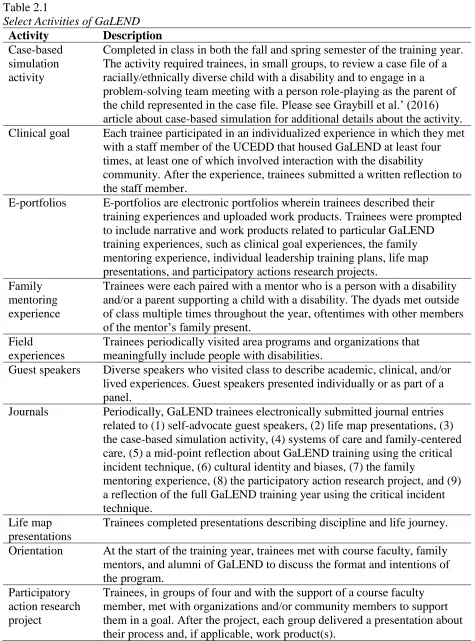
Table 2.1 Select Activities of GaLEND ...92
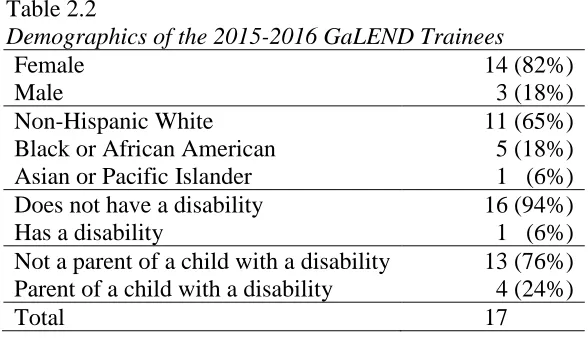
Table 2.2 Demographics of the 2015-2016 GaLEND Trainees ...93
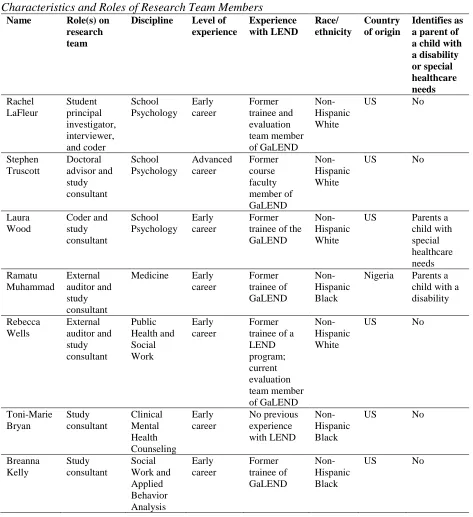
Table 2.3 Characteristics and Roles of Research Team Members ...94
Table 2.4 Interview Protocol ...98
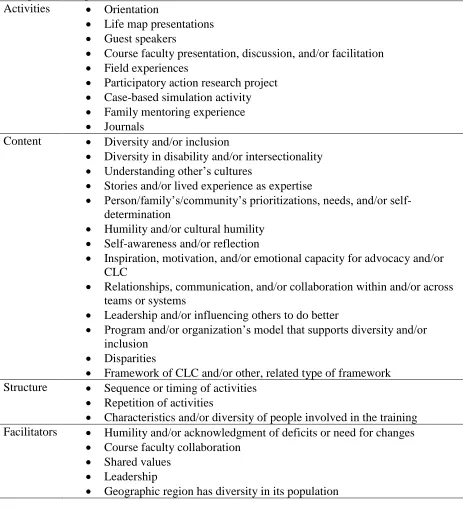
Table 2.5 Coding Tree Categories ...101
v
LIST OF FIGURES
Figure 2.1 Model of CLC Infused into GaLEND ... 105
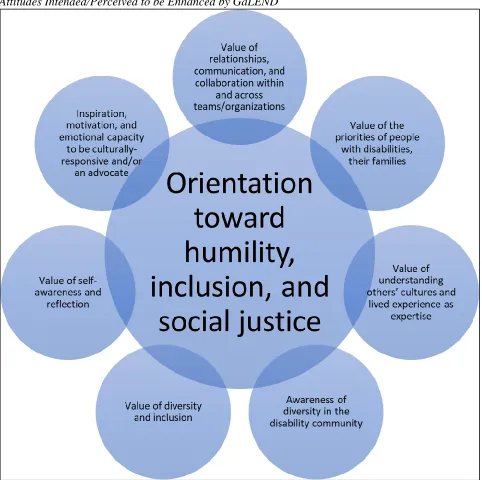
Figure 2.2 Attitudes Intended/Perceived to be Enhanced by GaLEND ... 120
1
1. A SCOPING REVIEW OF THE LITERATURE RELATED TO CULTURAL AND
LINGUISTIC COMPETENCE FOR ORGANIZATIONS SERVING PEOPLE
WITH DISABILITIES FROM CULTURALLY AND LINGUISTICALLY
DIVERSE BACKGROUNDS
Organizations in the US that support people with disabilities from culturally and
linguistically diverse (CLD) backgrounds1 serve populations that can contribute greatly to
society, yet face discrimination and disparity on multiple fronts. Several of these populations,
including people with disabilities from underserved racial/ethnic groups, experience
discrimination related to their multiple cultural identities. Complex organizational responses are
needed to effectively address the resulting inequalities in health, education, employment, and
socioeconomic status. Yet, there is little guidance for effective organizational behavior for
organizations that serve clients who experience discrimination in general, let alone guidance for
effectively serving people with disabilities from CLD backgrounds. To assess and describe the
parameters of that gap in the literature and to consolidate relevant guidance, this chapter details a
scoping review study that identified documents related to cultural and linguistic competence
(CLC) for organizations supporting people with disabilities from CLD backgrounds, especially
those from underserved racial/ethnic groups.
Disparities
Disparities refer to persistent, avoidable, and unjust differences between two or more
population groups in (1) the services, supports, or resources they receive and/or (2) their life
outcomes (Artiga, 2016). Differences related to services, supports, and resources include
differences in groups’ access to them and differences in their level of quality (Artiga, 2016).
1 For the sake of brevity, “people with disabilities from CLD backgrounds” is used to mean people with disabilities
2
Differences related to life outcomes include differences in groups’ educational- (e.g., level of
education), employment- (e.g., maintenance of employment), health- (e.g., wellness and
premature death), and economic-related (e.g., socio-economic status) outcomes. Disparities in
services, supports, and resources contribute to disparities in life outcomes (e.g., Artiga, 2016),
which represent costs to individuals and groups and contribute to social costs (e.g., LaVeist,
Gaskin, & Richard, 2011; Rumberg & Losen, 2016). Disparities represent a social justice issue
due to unjust and avoidable factors contributing to certain groups being less likely than others to
achieve equitable and meaningful participation in society.
Underserved racial/ethnic groups. As of July 2015, an estimated 38% of Americans
identified as being from one or more underserved racial/ethnic groups (U.S. Census Bureau,
n.d.). The barriers experienced by underserved/racial ethnic groups in accessing effective
healthcare, education, and other wellness-promoting systems are longstanding and well
documented (e.g., Centers for Disease Control and Prevention, 2013; Mead et al., 2008; U.S.
Department of Education, National Center for Education Statistics, 2010; U.S. Department of
Education, Office for Civil Rights, 2016). In relation to healthcare, these barriers include not
having a usual source of care; encountering logistical barriers (e.g., office hours that conflict
with work schedules, lack of appointment availability, lack of transportation); having difficulty
affording care; and lacking adequate health insurance (e.g., Cristancho, Garces, Peters, &
Mueller, 2008; Doescher, Saver, Fiscella, & Franks, 2001; Flores, 2006; Ngo-Metzger et al.,
2003; Smedley, Stith, & Nelson, 2003). Barriers to healthcare for underserved racial/ethnic
groups continue even after gaining access. For example, people from underserved racial/ethnic
3
that are not culturally acceptable to them (e.g., Johnson, Roter, Powe, & Cooper, 2004; Smedley,
et al., 2003; Tucker et al., 2003).
Costs to people and groups. Barriers to healthcare, education and other
wellness-promoting systems contribute to the disparities that people from underserved racial/ethnic groups
experience in educational-, employment-, health-, and economic-related outcomes (e.g.,
Arango-Lasprilla et al., 2011; Centers for Disease Control and Prevention, 2013; Mays, Cochran, &
Barnes, 2007). For example, people from underserved racial/ethnic groups, when compared to
non-Hispanic Whites, are more likely to experience dropout, unemployment, poverty, disease,
and premature death (Centers for Disease Control and Prevention, 2013).
Social costs. The disparities experienced by underserved racial/ethnic groups also lead to
costs for society. Researchers have identified that racial/ethnic health disparities encumber both
public programs and purchasers of private health insurance. Waidmann (2009) estimated that in
2009, racial/ethnic health disparities cost the health care system $23.9 billion, with Medicare
burdened by an extra $15.6 billion in costs and private insurers by an extra $5.1 billion.
Waidmann (2009) estimated that, even without taking projected growth in healthcare spending
into account, annual costs will double by 2050 due to the increasing representation of
underserved racial/ethnic groups in the American population. LaVeist et al. (2011) also
examined the social costs of racial/ethnic health disparities and identified that in the years
2003-2006, racial/ethnic health disparities in the US led to an estimated $230 billion in direct medical
care expenditures and more than $1 trillion in indirect costs due to lack of workforce
4
People with disabilities. Though an estimated 9% of children (U.S. Department of
Education, National Center for Education Statistics, 2010) and 22% of adults in the US have
disabilities (Courtney-Long et al., 2015), our current health, education, and other
wellness-promoting systems are not equipped to provide equitable services for this population (e.g.,
Henning-Smith, McAlpine, Shippee, & Priebe, 2013; Krahn, Walker, & Correa-De-Araujo,
2015; Tyler, Schramm, Karafa, Tang, & Jain, 2011). This is evidenced by the barriers that people
with disabilities experience in healthcare, such as logistical issues (e.g., inconvenient office
hours, lack of appointment availability, lack of transportation); architectural barriers; cost and
insurance barriers; poor provider-client communication; difficulties navigating the healthcare
system; providers with lack of knowledge related to their disabilities; and discrimination,
negative attitudes, and lack of respect (e.g., Chevarley, Thierry, Gill, Ryerson, & Nosek, 2006;
Drainoni, Lee-Hood, Tobias, Bachman, & Andrew, 2006; O’Halloran, Hickson, & Worrall,
2008; Scheer, Kroll, Neri, & Beatty, 2003; Smith, 2009).
Costs to people and groups. Barriers to healthcare, education, and other
wellness-promoting services and supports contribute to the disparities that people with disabilities
experience in educational-, employment-, health-, and economic-related outcomes (e.g., Balogh,
Lake, Lin, Wilton, & Lunsky, 2015; Centers for Disease Control and Prevention, 2013; Giannini
et al., 2010; Sulewski, Zalewska, & Butterworth, 2012). For example, as reported by Krahn et al.
(2015), people with disabilities are more likely than people without disabilities to experience
dropout, unemployment, poverty, disease, and violence.
Social costs. Little research examines the ways that disparities experienced by people
with disabilities relate to social costs. This may be due, at least in part, to the added complexity
5
small number of studies have used the more advanced research methods needed to tease out the
extent to which differences in health are related to preventable conditions as opposed to the
underlying conditions that lead to disability (Krahn et al., 2015). As reported by Krahn et al.
(2015), studies using these methods have found evidence of health disparities related to
preventable conditions experienced by people with disabilities. Therefore, while we know that
disparities exist for the disability population, it can be difficult to determine the extent to which
these disparities impact life outcomes, such as health, and this information is necessary for
determining the social costs related to those disparities. For example, in fiscal year 2015, the US
Social Security Administration provided an estimated $144 billion to 10.8 million Americans
with disabilities (Social Security Administration, Office of the Inspector General, 2015). Due to
difficulties measuring preventable conditions amongst people with disabilities, it is not clear how
many of these 10.8 million Americans would not have needed these benefits if they had received
more equitable health, education, and wellness-promoting services and supports over their life
course.
Intersectionality: People with disabilities from culturally and linguistically diverse
backgrounds. Intersectionality is a term used to describe the interconnected nature of multiple
cultural identities, especially those that are oppressed (Crenshaw, 1991). Any factor of culture
(e.g., beliefs, values, norms, language, experiences, gender, sexual orientation, gender identity or
expression, age, class, education) can intersect with one or more other cultural factors and lead to
intersectionality (e.g., Abrams & Moio, 2009; Hancock, 2007; Powell Sears, 2012). The term
was first introduced by Crenshaw (1991), who, when considering the intersectional identities of
women of color and their experiences of violence, recognized that intragroup differences are
6
discrimination due to their multiple cultural identities. Intersectional invisibility describes the
experience of intersectional groups not fitting the prototypes of their respective identity groups
and therefore existing as marginal members of already marginalized groups (Purdie-Vaughns &
Eibach, 2008).
Multiple oppressed identities are experienced simultaneously and may be mutually
reinforcing (Powell Sears, 2012). They cannot be teased apart. According to Crenshaw (1991), to
understand and respond to the experiences of people with multiple, oppressed cultural identities,
it is ineffectual to attempt to understand and respond to the discrimination related to each identity
separately and/or through an additive process. As such, Crenshaw (TED, 2016) believes that
“trickle down approaches to social justice,” which aim to address the needs of singular oppressed
groups, will not adequately meet the needs of people with multiple, oppressed identities.
Responses to discrimination, including CLC training, therefore, may require the illumination of
and response to the discrimination occurring at specific intersections of cultural identities
(Hancock, 2007; Powell Sears, 2012).
Intersectionality is consistent with critical race theory, a framework that grew out of
legal scholarship during the civil rights movement and recognizes the reality and unceasing
nature of discrimination and oppression perpetuated by individuals, organizations, and systems
(Abrams & Moio, 2009; Delgado & Stefancic, 2001). Intersectionality draws attention to the
discrimination experienced by groups at particular intersections of cultural identities and calls for
organization- and system-level approaches (Abrams & Moio, 2009; Hancock, 2007). Through
the lenses of critical race theory and intersectionality, people with disabilities from CLD
backgrounds, such as people with disabilities from underserved racial/ethnic groups and/or
7
disparities – disparities that require organizational- and system-level responses that are unique to
these groups’ unique circumstances and experiences.
For this scoping review, I concentrated on the intersection between having a disability
and being from an underserved racial/ethnic group. Race/ethnicity is a cultural factor that is
especially salient in both academic literature and literature produced outside of traditional
commercial or academic publishing channels, which is known as grey literature. For this scoping
review, focusing on race/ethnicity’s intersection with disability provided an intersectional focus
while also balancing the need to narrow the scope of the literature to a manageable size with the
need to identify relevant documents for analysis.
People from underserved racial/ethnic groups are overrepresented in the disability
community and this overrepresentation occurs across the lifespan. A 2010 report by the US
Department of Education’s National Center for Education Statistics specified that 12.2% of
Black students and 14.4% of American Indian/Alaska Native students receive special education
services as compared to 8.5% of Non-Hispanic White students. In 2015, Courtney-Long et al.
reported that among adults in the US, 29% of Blacks and 26% of Hispanics reported having a
disability as compared to 21% of non-Hispanic Whites. Members of underserved racial/ethnic
groups experience disability at a disproportionately high rate (Waldrop & Stern, 2003), at least in
part, because they receive fewer resources over the lifespan (e.g., Latham, 2012) and preventive
care at lower rates (e.g., Bonito, Eicheldinger, & Lenfestey, 2005; Flores & Tomany-Korman,
2008).
Some researchers have found that people with disabilities from underserved racial/ethnic
groups have a “double burden,” meaning they experience disparities at greater levels than
8
have a disability (e.g., Jones & Sinclair, 2008). This may be because people with disabilities
from underserved racial/ethnic groups experience unique sets of barriers to accessing services
and supports that contribute to the disparities they experience in educational-, employment-,
health-, and economic-related outcomes (e.g., Magaña, Parish, Rose, Timberlake, & Swaine,
2012; Peterson-Besse, Walsh, Horner-Johnson, Goode, & Wheeler, 2014; Scott & Havercamp,
2014; Zea, Belgrave, Garcia, & Quezada, 1997). Peterson-Besse et al. (2014) conducted a
scoping review of the academic literature pertaining to barriers to healthcare among people with
disabilities who are members of underserved racial/ethnic groups. They concluded that people
with disabilities who are members of underserved racial/ethnic groups experience barriers that
are unique to their multiple, intersecting identities. For instance, a person with a disability from
an underserved racial/ethnic background might experience barriers expressly related to
race/ethnicity, such as mistrust of the medical establishment, as well as barriers related to having
a disability, such as inaccessible transportation, and barriers related to both disability and
race/ethnicity, such as lack of insurance (Peterson-Besse et al., 2014). Additional research is
necessary to determine whether people with disabilities from underserved racial/ethnic
backgrounds experience barriers that are additional to those experienced by people with
disabilities and people from underserved racial/ethnic groups.
Social costs. There is a lack of research concerning how disparities experienced by
groups with multiple identities relate to social costs. In addition, the added complexities of
measuring preventable inequalities for the disability population (Krahn et al., 2015) also effects
the measurement of disparities experienced by people with disabilities from underserved
9
Though data about the social costs of disparities experienced by people with disabilities
from underserved racial/ethnic groups are unavailable, consideration of other social cost data is
illustrative. Students with disabilities (Grad Nation, 2016), students from underserved
racial/ethnic groups (U.S. Department of Education, National Center for Education Statistics,
2016), and students with disabilities from underserved racial/ethnic groups (Sullivan, Van
Norman, & Klingbeil, 2014) experience discipline and dropout at disproportional rates. Rumberg
and Losen (2016) examined the social costs of discipline and dropout in the US educational
system and identified that suspension in 10th grade, across all groups, generates social costs
estimated at $35 billion. Rumberg and Losen (2016) posited that addressing disproportionality in
discipline and dropout for students of underserved racial/ethnic groups would reduce these social
costs. However, Rumberg and Losen (2016) did not address these disparities in relation to
students with disabilities and students with disabilities from underserved racial/ethnic groups.
Because students with disabilities from underserved racial/ethnic groups are “double burdened”
in relation to disparities in discipline and dropout (Sullivan et al., 2014), strategies that take
intersectionality into account may be especially potent in reducing social costs associated with
discipline and dropout. Alleviating the “double burden” experienced by people with disabilities
from underserved racial/ethnic groups, across all systems, would likely contribute to the
reduction of the social costs.
Reducing2 Disparities through CLC
Origins and definitions of cultural competence and linguistic competence. CLC is a
framework grounded in models of practitioner (e.g., attitudes, knowledge, and skills) and/or
2 Throughout this dissertation, in relation to both barriers and disparities, “reduce” is used instead of “eliminate” to
10
organizational factors (e.g., structures, policies, and partnerships) that is intended to promote
behaviors that are responsive to the needs of CLD populations. In theory, these
culturally-responsive behaviors 1) reduce the barriers that limit underserved groups’ access to high quality
services, supports, and resources, and therefore, 2) reduce disparities (Betancourt, Green,
Carrillo, & Park, 2005; U.S. Department of Health and Human Services, 2000; U.S. Department
of Health and Human Services, 2013). CLC is composed of cultural competence and linguistic
competence.
Cultural competence. As a framework, cultural competence is used across disciplines to
address the many factors that contribute to disparities. Its origins are rooted in disciplines that
provide health and human services, such as medicine, psychology, education, and social work
(Suh, 2004). Because these disciplines commonly interface directly with clients, for nearly two
decades the development of cultural competence focused almost solely on advancing the
attitudes, knowledge, and skills of individual practitioners (Suh, 2004). Cultural competence as
the attitudes, knowledge, and skills of individual practitioners was challenged by Georgetown
University’s National Center for Cultural Competence (NCCC; Suh, 2004), which recognized
the need for models that also account for organizational structures, norms, and behaviors. In
1989, the NCCC’s Cross, Bazron, Dennis, and Isaac provided a disruptive definition of cultural
competence that is now widely accepted: “Cultural competence is a set of congruent behaviors,
attitudes, and policies that come together in a system, agency or among professionals and enable
that system, agency or those professions to work effectively in cross-cultural situations” (p. 13).
Despite the widespread acceptance of Cross et al.’s (1989) definition, Goode’s (2010)
11
expressly to organizational cultural competence and reflects both the historical and current
academic dialogues about cultural competence. Per Goode (2010, p. 22), cultural competence:
…requires that organizations: have a defined set of values and principles, and
demonstrate behaviors, attitudes, policies, and structures that enable them to work
effectively cross-culturally; have the capacity to (1) value diversity, (2) conduct
self-assessment, (3) manage the dynamics of difference, (4) acquire and institutionalize
cultural knowledge, and (5) adapt to the diversity and cultural contexts of the individuals,
families, and communities they serve; [and] incorporate the above in all aspects of policy
making, administration, practice, service delivery and systematically involve consumers,
families, and communities.
Linguistic competence. The NCCC was one of the first organizations to consider
linguistic competence as a construct that is separate from but related to cultural competence
(Suh, 2004). Goode (2010) provided the following definition of linguistic competence, which I
elected to use due to its inclusion of people with disabilities and its acceptance across recent
academic CLC literature:
The capacity of an organization and its personnel to communicate effectively, and convey
information in a manner that is easily understood by diverse audiences including persons
of limited English proficiency, those who have low literacy skills or are not literate,
individuals with disabilities, and those who are deaf or hard of hearing.
The promise of using CLC to support people with disabilities from CLD
backgrounds. Disability organizations, such as Association of University Centers on Disabilities
(AUCD), TASH, The Arc of the United States, American Association on Intellectual and
12
Disabilities, Statewide Independent Living Councils, Centers for Independent Living, and
self-advocacy and disability rights groups commonly lead and support initiatives designed to promote
equity for people with disabilities by minimizing barriers to healthcare, education, and other
wellness-promoting services and supports. These initiatives typically include training, services,
research, information dissemination, and/or advocacy efforts. Because of disability
organizations’ capacities for addressing the disparities experienced by people with disabilities,
they are uniquely suited to lead efforts designed to address those experienced by people with
disabilities from CLD backgrounds. Exploring and promoting CLC in disability organizations
may serve to address the unique barriers experienced by people with disabilities from CLD
backgrounds, including those from undeserved racial/ethnic groups.
Limitations of CLC
CLC has promise as a framework for disability-focused and other organizations striving
to reduce the disparities experienced by people with disabilities from underserved racial/ethnic
groups. Despite this promise, there are critical limitations to CLC, including gaps in the CLC
literature, shortcomings in the development of the CLC framework, and a lack of evidence of
positive client outcomes from CLC interventions.
Gaps in CLC literature. There are several gaps in the academic and grey CLC
literatures that may impact disability organizations’ abilities for reducing the disparities
experienced by people with disabilities from underserved racial/ethnic groups.
Intersectionality. Intersectional frameworks are largely absent from both academic and
grey literatures about CLC (e.g., Abrams & Moio, 2009; Peterson-Besse et al., 2014) and this
absence extends to the intersection of disability and underserved racial/ethnic groups (e.g.,
13
racial/ethnic groups experience unique sets of barriers to accessing healthcare, education, and
other wellness-promoting services and supports (e.g., Peterson-Besse et al., 2014). Members of
the academic community have asserted that exploration of intersectionality is necessary for
reducing disparities in healthcare, education, and other wellness-promoting services and supports
(e.g., Abrams & Moio, 2009), including those experienced by people with disabilities from
underserved racial/ethnic groups (Peterson-Besse, 2014). However, as a framework, CLC may
not adequately attend to intersectionality (Abrams & Moio, 2009). To respond to clients’
differences, some CLC theorists suggest person-centered care, including professionals getting to
know and respond to each client’s dynamic and intersecting cultural backgrounds (e.g., Powell
Sears, 2012). While this approach attempts to address intersectionality at a patient level, some
theorists believe that it falls short (Abrams & Moio, 2009). In seeking to promote a model that
can be applied across populations (e.g., to the “multicultural umbrella”), there may be a lack of
attention to promoting knowledge of and skills for serving populations that experience the
greatest disparities (Abrams & Moio, 2009), including those experiencing multiple burdens due
to intersectionality.
Organizational CLC. People with disabilities from underserved racial/ethnic groups
often have complex needs that require intersecting and overlapping care from multiple providers
and agencies. Many disability organizations have responded to these needs by working across
disciplines and partnering with both communities and agencies in their research, advocacy, and
clinical initiatives. Given the collaborative and systematic nature of their work, disability
organizations may be more effective in their service to the needs of people with disabilities from
undeserved racial/ethnic groups by considering not only the ways that individual staff members
14
can be structured to support these behaviors. Put another way, organizations have the capacity to
reduce disparities.
Consistent with critical race theory, contemporary and commonly accepted definitions of
cultural competence and linguistic competence are responsive to institutional discrimination by
acknowledging the roles of organizations in addressing it. Despite this shift, there is a
longstanding dearth of academic and grey literature that outlines organizational responses to
disparities experienced by CLD backgrounds (Abrams & Moio, 2009; Montalto & Hasnain,
2011; Truong, Paradies, & Priest, 2014) and this extends to organizational responses for
supporting specific intersectional groups, such as people with disabilities from underserved
racial/ethnic groups. For example, in the academic literature, only a few CLC theorists and
researchers have explicitly have explored interdisciplinary relations (e.g., Pecukonis, Doyle, &
Bliss, 2008), policies and structures (e.g., Balcazar, Suarez-Balcazar, & Taylor-Ritzler, 2009;
Taylor-Ritzler et al., 2008; Tervalon & Murray-Garcia, 1998), and partnerships (e.g., Balcazar,
Suarez-Balcazar, & Taylor-Ritzler, 2009, Hernandez, Nesman, Mowery, Acevedo-Polakovic, &
Calejas, 2009; Lie, Boker, & Cleveland, 2006; Tervalon & Murray-Garcia, 1998).
Shortcomings in the development of the CLC framework. CLC also faces
shortcomings in the way it was developed, including the lack of inclusion of CLD perspectives,
overreliance on theory, and the limited scope of the CLC framework.
Lack of inclusion of CLD perspectives. The perspectives of people from disability and/or
underserved racial/ethnic groups are seldom included in the CLC models and initiatives designed
to support them. One exception is LaFleur, Truscott, Graybill, Crenshaw, and Crimmins (2017),
who included the perspectives of parents of children with disabilities from underserved
15
perspectives about CLC. Because the CLD disability community is expert in the barriers they
face, academic and grey CLC literature that takes their perspectives into account may lead to
more effective initiatives.
Overreliance on theory and resulting lack of clarity and difficulty translating CLC into
intervention. Per Shen (2015), who conducted a literature review examining more than 30 years
of academic nursing, social science, medical, and psychological literature, most CLC models are
derived from theory or meta-theory rather than data. Shen (2015) also noted the difficulty of
translating CLC models into measurable outcomes, and this has contributed to a lack of clarify in
the recommendations proposed in academic and grey CLC literatures.
To illustrate this lack of clarity, consider Suh’s (2004) model of CLC, which was
developed from a concept analysis of CLC that examined over 20 years of academic literature.
Suh’s model includes:
(1) Attributes: ability, openness, and flexibility
(2) Antecedents: cognitive, affective, behavioral, and environmental domains
(3) Consequences: receiver-based, provider-based, and health outcome variables
Suh’s (2004) model identifies 10 factors, many of which are complex in nature, lack clarity, and
are difficult to translate into interventions. As a result, CLC’s overreliance on theory has
contributed to complications in translating CLC into practice.
Scope is limited to health and human services. Because CLC’s origins in the health and
human services disciplines (Suh, 2004), CLC models and initiatives derived from them are
seldom responsive to factors that are outside of the scope of health and human services. For
example, CLC models and initiatives do not provide solutions to residential segregation and
16
2009; Krieger & Higgins, 2002). This limited scope means that effective implementation of the
current CLC framework may not fully resolve the disparities experienced by people with
disabilities from underserved racial/ethnic groups and other CLD backgrounds.
Lack of evidence of positive client outcomes. A critical measure of CLC’s success is its
effects on client outcomes, such as improvement in satisfaction, wellness-promoting behaviors,
indicators of wellness, utilization of services, or disparities. Truong et al. (2014) conducted a
systematic meta-review of interventions utilizing the CLC framework in healthcare. Though this
meta-review had a broad CLC focus, most of the 13 reviews that reported on client outcomes
examined practitioner focused-CLC interventions: the effects of CLC training initiatives and the
effects of adapting direct interventions to meet the needs of CLD clients. Only three reviews
included organizational components. Truong et al. (2014) observed an overall lack in quality,
quantity, and robustness in client outcomes.
Practitioner-focused CLC interventions. As demonstrated by Truong et al. (2014),
interventions with a practitioner focus are especially popular in the CLC academic literature.
Practitioner-focused CLC interventions include training programs and adaptations of
interventions for specific CLD populations. Academic literature reviews examining the effects of
CLC training each acknowledge, for a variety of reasons and to varying degrees, that there is
limited evidence to support its positive effects on client outcomes (e.g., Chipps, Simpson, &
Brysiewsicz, 2008; Govere & Govere, 2016; Lie, Lee-Rey, Gomez, Bereknyei, & Braddock,
2010; Renzaho, Romios, Crock, & Sonderlund, 2013). Some academic literature reviews
examining the effects of adaptations of interventions for CLD clients have identified significant,
17
However, this evidence is limited because the referenced studies lack methodological rigor
(Truong et al., 2014).
Organizational CLC interventions. CLC interventions that include organizational CLC
components are less commonly represented in the academic literature (Truong et al., 2014).
Reviews by Fisher, Burnet, Huang, Chin, and Cagney (2007), Henderson, Kendell, and See
(2011), and Anderson, Scrimshaw, Fullilove, Fielding, and Normand (2003) demonstrate a lack
of evidence of positive client outcomes for organizational CLC interventions.
Fisher et al.’s (2007) systematic review of CLC interventions in academic healthcare
literature, included 14 access interventions, such as screening programs, patient navigators, and
client educators recruited from the target population. Fisher et al. (2007) concluded that there is a
lack of evidence of positive client outcomes for access interventions.
In their systematic literature review of the academic literature, Henderson et al. (2011)
categorized CLC interventions aimed to support people with chronic disease from CLD
backgrounds as: (1) using community-based bilingual practitioners, (2) providing CLC training
to practitioners; (3) using interpreter services, (4) using multimedia and videos, and (5)
expanding community-based services. Henderson et al. (2011) observed that the interventions
that incorporated bilingual practitioners demonstrated sufficient evidence of positive client
outcomes and reported that evidence for the other types of interventions was significantly less
robust.
In the systematic review of the academic literature conducted by Anderson et al. (2003),
the researchers examined the effects of interventions that (1) promoted a diverse work force, (2)
used interpreter services or bilingual practitioners, (3) provided CLC training, (4) used culturally
18
settings. Anderson et al. (2003) explained that the lack of quantity and quality of studies impeded
their determination of the effectiveness of these interventions.
Statement of the Problem
Barriers to accessing healthcare, education, and other wellness-promoting systems
contribute to costs that encumber CLD people and groups and the American society. People with
disabilities from underserved racial/ethnic groups experience “multiple burdens,” which are
reflected in their heightened risk of experiencing barriers to effective care and adverse life
outcomes. Despite this “double burden,” there is a dearth of academic and grey literature
intended to reduce barriers to effective care for people with disabilities from CLD backgrounds.
Further, few documents that outline organizational responses are available to inform groups that
seek guidance in this area. Identifying documents in these gaps would be useful in supporting
work aimed at reducing the disparities experienced by people with disabilities from underserved
racial/ethnic groups.
The Current Scoping Review
Disability organizations recently began several initiatives designed to support efforts to
cultivate organizational CLC. For example, AUCD has awarded several grants to University
Centers for Excellence in Developmental Disabilities to facilitate their production of CLC action
plans for the network. The current study was designed to support two such projects and to
contribute to literature related to CLC for disability organizations. The current study was
designed as a scoping review, a literature review strategy that supports the broad exploration of
literature to identify documents relevant to a given topic. This methodology, which is described
in greater detail in the Method section, helped me to find the small number of studies related to
19
Purpose. The purpose of the current scoping review was to (1) identify documents in
both the academic and grey literatures that were intended to promote organizational CLC and
improve the lives of people with disabilities from CLD backgrounds, especially those from
underserved racial/ethnic groups and (2) examine those documents’ qualities and the
organizational practices, structures, strategies, policies, and partnerships they recommended.
Method
Scoping reviews utilize an exploratory literature review procedure to map literature
(Arksey & O’Malley, 2007). They are unlike other types of literature reviews in that they do not
seek to answer narrow research questions (Arksey & O’Malley, 2007). The current study used a
scoping review procedure to identify literature that addresses organizational CLC and is relevant
to organizations serving people with disabilities from CLD backgrounds, including underserved
racial/ethnic groups. Given the lack of research regarding organizational CLC, and especially
organizational CLC for supporting people with disabilities from CLD backgrounds, this broad
search and mapping was necessary to support disability organizations’ understanding of the
resources and recommendations that may be pertinent to their CLC initiatives. In addition, the
use of a scoping review procedure provided a systematic and efficient method to review the
literature and allowed for the inclusion of grey literature. The inclusion of grey literature
promoted inclusivity, facilitated the identification of documents with potentially greater
relevance to disability organizations, and helped to identify nearly half of the scoping review’s
included documents.
Protocol
The current scoping review utilized a protocol based on those described by Arksey and
20
the Georgia State University Center for Leadership in Disability (“GSU CLD”) and the NCCC.
The protocol for this scoping review facilitated the identification and inclusion of documents that
fit the purpose of the current study.
Information Sources and Search Strategy. The first stage of a scoping review is to
identify and carry out a search strategy (Arksey & O’Malley, 2007; Tricco et al., 2016). In
addition to collaborating with experts in disability and CLC, input from an information scientist
at Georgia State University informed the search strategy for the current scoping review.
Academic literature. Due to the interdisciplinary nature of disability organizations and
the intent to be inclusive in this scoping review, all databases available through EBSCOhost
were searched. The electronic database search strategy was not limited by type of document or
year. Due to my lack of proficiency in languages other than English and the limited personnel
and financial resources available for this study, search results were confined to those in English.
I carried out the search on October 24, 2016.
Grey literature. Given the variety and number of organizations that serve the disability
population, the search strategy for the grey literature relied upon Google Search as opposed to
the review of specific disability organizations’ websites. In the first Google search, conducted on
November 16, 2016, I used search terms approximating those used for the EBSCOhost search. I
conducted a second search on November 17, 2016 to ensure thoroughness. Given the previous
search’s focus on including terms similar but not equivalent to CLC, this second search used the
terms “organizational cultural competence disability” to verify the completeness of the previous
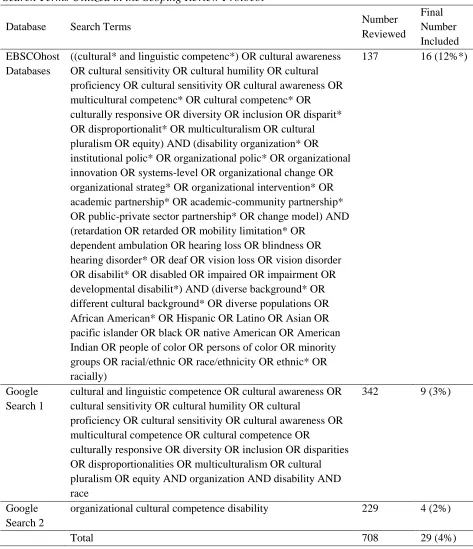
search and to capture several additional, non-duplicate documents. Please refer to Table 1.1 to
21
Identifying documents for inclusion. The next stage in a scoping review is to determine
which documents identified in the search will be included or excluded from analysis (Arksey &
O’Malley, 2007; Tricco et al., 2016). I completed a two-step process in concert with a research
associate from the GSU CLD to determine the inclusion and exclusion of the documents
identified using the EBSCOhost search.
Developing criteria for inclusion. With consultation from experts in disability and CLC,
I identified an initial set of criteria a priori to ensure that included documents were relevant to
the purpose of this study. In addition, these criteria were further refined during the academic
literature selection process, which is described in the section below. The final criteria were:
• Document identifies, recommends, and/or utilizes organizational practices,
structures, strategies, policies, and/or partnerships to promotes organizational
CLC
• Document is intended to improve the lives of people with disabilities and people
who are from underserved racial/ethnic groups
Academic literature selection. The review of the documents identified in the academic
literature occurred in a two-step process. In the first step, we reviewed titles and abstracts using
the criteria set a priori to identify potentially relevant documents in the academic literature.
When document titles or abstracts were unavailable, the documents were preliminarily included.
To ensure reliability and to determine whether the criteria were adequate, inter-rater reliability
was measured by dividing the number of documents agreed upon by the total number of
documents (Schensul & LeCompte, 1999). When we were discrepant in our identification of
relevant documents, we refined the criteria. After two rounds of reviewing the titles and abstracts
22
criteria were considered final. Afterward, I worked independently to apply the criteria to the
titles and abstracts of the documents identified in the academic literature search. For all
preliminarily-included documents, full text was retrieved using Georgia State University’s
library resources and inter-library loan program.
The second step of the document selection process for the academic literature involved
our review of the documents full text using the finalized criteria. As a training exercise, we
determined document inclusion using a randomly sampled 10% of available full text. After one
round of reviewing full text, our inter-rater reliability exceeded 90% and afterward, I worked
independently to examine the documents’ full text for inclusion.
Grey literature selection. I also used the finalized criteria to determine which full text
documents identified in the grey literature would be included in the analysis. For each Google
search, the Google search results were reviewed, in order, until 100 consecutive documents were
excluded. To ensure that browsing history would not affect the results, I was not logged in to
Google when completing the searches. For each search, the number of reviewed documents, the
number of included documents, and the percentage of the reviewed documents that the included
documents represent can be viewed in Table 1.1.
Data items and data collection process. I extracted the following from documents’ full
text: author(s), author(s) institutions, year of publication, country, type of document, whether the
perspectives of people with disabilities from diverse cultural and linguistic backgrounds were
explicitly included, target groups/organizations, target population, specific disability focus/foci,
other demographic focus/foci, aim, and recommended organizational practices, structures,
strategies, policies, or partnerships. To increase the reliability of data extraction, I completed
23 Table 1.1
Search Terms Utilized in the Scoping Review Protocol
* Represents the percentage of the number reviewed for each search.
Database Search Terms Number
Reviewed Final Number Included EBSCOhost Databases
((cultural* and linguistic competenc*) OR cultural awareness OR cultural sensitivity OR cultural humility OR cultural proficiency OR cultural sensitivity OR cultural awareness OR multicultural competenc* OR cultural competenc* OR culturally responsive OR diversity OR inclusion OR disparit* OR disproportionalit* OR multiculturalism OR cultural pluralism OR equity) AND (disability organization* OR institutional polic* OR organizational polic* OR organizational innovation OR systems-level OR organizational change OR organizational strateg* OR organizational intervention* OR academic partnership* OR academic-community partnership* OR public-private sector partnership* OR change model) AND (retardation OR retarded OR mobility limitation* OR
dependent ambulation OR hearing loss OR blindness OR hearing disorder* OR deaf OR vision loss OR vision disorder OR disabilit* OR disabled OR impaired OR impairment OR developmental disabilit*) AND (diverse background* OR different cultural background* OR diverse populations OR African American* OR Hispanic OR Latino OR Asian OR pacific islander OR black OR native American OR American Indian OR people of color OR persons of color OR minority groups OR racial/ethnic OR race/ethnicity OR ethnic* OR racially)
137 16 (12%*)
Google Search 1
cultural and linguistic competence OR cultural awareness OR cultural sensitivity OR cultural humility OR cultural
proficiency OR cultural sensitivity OR cultural awareness OR multicultural competence OR cultural competence OR
culturally responsive OR diversity OR inclusion OR disparities OR disproportionalities OR multiculturalism OR cultural pluralism OR equity AND organization AND disability AND race
342 9 (3%)
Google Search 2
organizational cultural competence disability 229 4 (2%)
24
data from a random sample of 10% of the documents, inter-rater reliability exceeded 90%. When
the data extraction procedures were finalized, I independently extracted data from the
documents’ full text.
Synthesis
The scoping review procedure included both quantitative and qualitative analyses.
Quantitative analysis included frequency counts and facilitated the analysis of the documents’
qualities. Qualitative analysis was used to support the analysis of the documents’
recommendations and led to the identification recommendation themes, which are themes
representing the practices, structures, strategies, policies, and partnerships recommended across
the documents. The qualitative analysis used to identify recommendation themes involved open
and axial coding (Strauss & Corbin 1998). Open coding facilitated the creation of categories that
contained each of the discrete recommendations retrieved from the documents and axial coding
revealed relationships between these categories which facilitated their combination into
recommendation themes. I completed both open and axial coding independently. Because
scoping reviews typically report findings using frequency counts and descriptive narratives based
on general observation (Arksey & O’Malley, 2007; Tricco et al., 2016), the use of a systematic
qualitative analysis procedure by a single coder was considered sufficient.
Results
The purpose of this scoping review was to identify documents that (1) provide
recommendations for organizational CLC and (2) seek to improve the lives of people with
disabilities from CLD backgrounds, especially those from underserved racial/ethnic groups. I
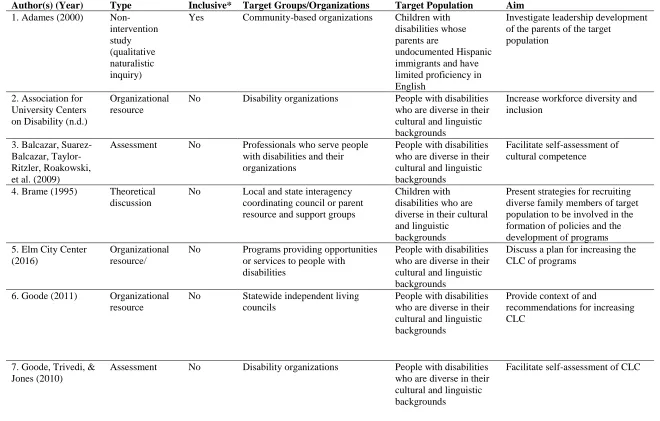
reviewed 708 documents and included 29 for analysis. These documents are described in Table
25
facilitate readers’ identification of information and resources that may be useful when
developing initiatives to promote organizational CLC.
Types of Documents, Country, and Inclusion of Diverse Disability Perspectives
Documents were sorted into 5 categories: (1) theoretical discussions, which were defined
as non-empirical academic literature, (2) organizational resources, which included tools and
reports created by and for organizations and systems, (3) intervention studies, which were
defined as studies that had an active intervention component, (4) non-intervention studies, and
(5) assessments. Each document type, and the number and percentage of documents that were
categorized as each type can be viewed in Table 1.2.
Table 1.2 Document Type
Theoretical discussion 11 (38%)
Organizational resources 9 (31%)
Non-intervention studies 4 (14%)
Assessments 3 (10%)
Intervention studies 2 (7%)
Most of the documents were generated by authors and organizations in the United States
(24/29) and the remaining documents were generated by authors and organizations in Australia
(5/29; Harris, 2004; Robertson & Travaglia, 2015; NSW Department of Family & Community
Services, 2012; 2013; Rhoades, Price, & Perigoe, 2004). The search strategy’s exclusion of
non-English documents may account for the lack of variability in the documents’ origins.
Documents were examined to determine whether their authors consulted with people with
disabilities from CLD backgrounds when developing frameworks and recommendations and
these results are included in Table 1.3. This scoping review identified only a few documents
(6/29) that explicitly noted the inclusion of the perspectives of members of this group (e.g.,
26
and organizations though it is not clear whether those acknowledged included people with
disabilities from CLD backgrounds. Such ambiguous acknowledgements were categorized as not
including diverse disability perspectives.
Table 1.3
Inclusion of Diverse Disability Perspectives
Did not include 23 (79%)
Did include 6 (21%)
Target Population Demographics
Documents’ descriptions of target populations’ disability status are summarized in Table
1.4. Most documents described initiatives intended to support people with disabilities generally
(24/29). A small number of documents focused on types of disabilities (5/29), such as “limited
mobility and cognitive impairment” (Hau et al., 2016), “mental disabilities” (Mehl-Madrona &
Mainguy, 2015), “hearing loss” (Rhoades et al., 2004), “serious emotional disturbance”
(Running Wolf, Soler, Manteuffel, Sondheimer, Santiago, & Erickson, 2002), and “special
healthcare needs” (Telfair, Bronheim, & Harrison, 2009).
Table 1.4
Description of Target Population’s Disability Status
Has a disability 24 (83%)
Has a specific type or class of disability 5 (17%)
Documents’ descriptions of target populations’ cultural and linguistic diversity are
summarized in Table 1.5. Most documents were intended to improve outcomes for diverse
groups generally (20/29), though several narrowed their focus to race/ethnicity and sometimes
also immigration/refugee status (4/29; e.g., Lamar-Dukes, 2009) or to specific racial/ethnic
groups: African American, Chinese, Hispanic, and Native American (5/29; e.g., Running Wolf et