Georgia State University
ScholarWorks @ Georgia State University
Public Management and Policy Dissertations Department of Public Management and Policy
12-15-2016
The Implementation of 311 Technology in Local
Government and the Impact on Citizen-initiated
Contacting
Emefa Sewordor
Follow this and additional works at:https://scholarworks.gsu.edu/pmap_diss
This Dissertation is brought to you for free and open access by the Department of Public Management and Policy at ScholarWorks @ Georgia State University. It has been accepted for inclusion in Public Management and Policy Dissertations by an authorized administrator of ScholarWorks @ Georgia State University. For more information, please [email protected].
Recommended Citation
Sewordor, Emefa, "The Implementation of 311 Technology in Local Government and the Impact on Citizen-initiated Contacting." Dissertation, Georgia State University, 2016.
ABSTRACT
THE IMPLEMENTATION OF 311 TECHNOLOGY IN LOCAL GOVERNMENT AND THE IMPACT ON CITIZEN-INITIATED CONTACTING
By
EMEFA SEWORDOR
DECEMBER 2016
Committee Chair: Dr. John Clayton Thomas Major Department: Public Management and Policy
(Denver, Minneapolis and Kansas City) to conduct a pre- and post-311 implementation analysis of contacting patterns. It focuses on determining whether contacting rates change and whether there are equity implications of the patterns generated as a result of 311 use.
This dissertation finds that the cities faced several challenges during implementation, including managing the internal culture change associated with introducing 311 into local government. It also finds some evidence of higher contacting rates and increased equity
associated with 311 use. These findings have two main policy implications. First, they highlight the importance of designing a variety of participation options to ensure that participation is open to various cross-sections of the population and to equalize access to government across venues. Second, more consideration needs to be given to the design features of an implementation plan for an innovation such as 311, ensuring a clear link between the features and specific desired outcomes, given the unique conditions of the implementation context.
THE IMPLEMENTATION OF 311 TECHNOLOGY IN LOCAL GOVERNMENT AND THE IMPACT ON CITIZEN-INITIATED CONTACTING
BY
EMEFA SEWORDOR
A Dissertation Submitted in Partial Fulfillment of the Requirements for the Degree
of
Doctor of Philosophy in the
Andrew Young School of Policy Studies of
Georgia State University
Copyright by Emefa Sewordor
ACCEPTANCE
This dissertation was prepared under the direction of the candidate’s Dissertation Committee. It has been approved and accepted by all members of that committee, and it has been accepted in partial fulfillment of the requirements for the degree of Doctor of Philosophy in Public Policy in the Andrew Young School of Policy Studies of Georgia State University.
Dissertation Chair: Dr. John Clayton Thomas
Committee: Dr. Ann-Margaret Esnard Dr. Gregory Lewis Dr. Christine Roch Dr. Gregory Streib
Electronic Version Approved: Mary Beth Walker, Dean
Andrew Young School of Policy Studies Georgia State University
iv DEDICATION
v ACKNOWLEDGMENTS
There are so many people who, in their unique way, made the completion of this piece of work and my doctoral degree possible. Left to my own devices, I would never have completed this journey. I will attempt to give you the acknowledgment you deserve, but I know that my few words here will never suffice in conveying how indebted I feel to you.
I wish to thank each committee member for serving so diligently on my committee and for guiding me through this dissertation process. Thank you, Dr. Gregory Streib, for your feedback and your commitment to this project, even in the face of some difficult circumstances. I am grateful that you never once considered leaving me hanging. Dr. Christine Roch, thank you for challenging me to think through the hard questions and for all the advice you gave as
program coordinator about navigating the doctoral experience successfully.
Dr. John Thomas, my committee chair, there would be no “311 dissertation” without you. Period. You have been an integral part of this process from the very beginning: from inspiring me through your lively doctoral seminars and your insightful book (Citizen, Customer, Partner), to patiently guiding me through every aspect of this project. It has been an honor to work under your supervision.
Dr. Ann-Margaret Esnard, the universe knew I needed you when it brought you to GSU in 2013. You helped shape my doctoral experience in fundamental ways and I am eternally grateful. Without the experience of working on your qualitative research project for my graduate research assistantship, I would never have had the confidence to venture on a mixed methods dissertation. Finally, thank you for the mentoring and the pep talks whenever I needed them.
vi caring mentor, a thorough reviewer, and an advocate for the overall well-being of your students. I am grateful for your “open door,” which made me feel at ease about dropping by to ask my methodological “question” of the day and for administrative advice whenever I needed it.
I would like to acknowledge the various sources of financial support that made my doctoral studies possible. I wish to thank the Fulbright program for their sponsorship. I am also grateful to the Andrew Young School for the Carolyn McClain Young Fellowship. I also benefited from Georgia State University’s Second Century Initiative (2CI) University Doctoral Fellowship for my last two years of study.
The content of this research is greatly enriched by those who agreed to participate in the study in one capacity or another. I owe Ms. Cory Fleming of the International City/County Management Association a debt of gratitude for opening up the world of 311 to me and for assisting me with my initial data collection efforts. I would also like to acknowledge the employees of the three cities who were kind enough to take time out of their busy schedules to respond to data requests from a lowly doctoral student. I wish to thank and acknowledge the contribution of the 14 interviewees across my three study cities who took the time to share their knowledge and insights about their 311 systems with me. I hope they and other practitioners would find some value in this piece of work.
Special thanks to those within PMAP who contributed to making my doctoral experience successful and memorable. Komla Dzigbede, Yuriy Davydenko and Christopher Wyczalkowski, thank you so much for your unfailing friendship, for your reassurances that this was really
vii thank you to PMAP office staff, Elsa Gebremedhin, for your logistical help, support and
encouraging words, especially during that intense writing phase and my final days in Atlanta. I owe a big thank you to my Epworth family for providing me with a spiritual home and welcoming me so warmly into your hearts. You were a refuge in the midst of all the stresses. Thank you for the spiritual and physical nourishment. I grew more as a person from my time with you than from any other experience I had during my sojourn in Atlanta. I only wish I had discovered you sooner.
viii TABLE OF CONTENTS
ACKNOWLEDGMENTS ... v
LIST OF TABLES ... xi
LIST OF FIGURES ... xii
CHAPTER I: INTRODUCTION ... 1
A Primer on 311 as an Innovation in Local Government ... 4
Contribution of the Study ... 9
Research Questions ... 10
Structure of the Dissertation ... 11
CHAPTER II: PUBLIC PARTICIPATION ... 13
What Constitutes Public Participation? ... 14
Classifying Public Participation Types ... 15
Patterns and Trends in Public Participation ... 16
Evolving Effects and Trends ... 17
Citizen-Initiated Contacts as a Mode of Public Participation ... 18
Models of Citizen-Initiated Contacts ... 19
Factors Associated with Citizen-Initiated Contacting of Local Government ... 21
Conceptual Framework and Hypotheses ... 25
Summary ... 33
CHAPTER III: DATA AND METHODS ... 34
Research Design ... 34
Step I: Case Selection ... 36
Step II: Data Collection, Analysis and Interpretation Strategy ... 40
Step III: Cross-Case Analysis Strategy ... 58
CHAPTER IV: FINDINGS ON DENVER ... 59
Qualitative Findings ... 59
Goals of Denver’s 311 System ... 60
Steps in the Implementation Process ... 62
Marketing the 311 System ... 63
Challenges in the Implementation Process ... 65
Summary ... 68
Quantitative Findings ... 69
ix
Logistic Regression Analysis ... 77
Summary ... 84
Interpretation: Discussion of the Quantitative and Qualitative Findings ... 87
CHAPTER V: FINDINGS ON MINNEAPOLIS ... 89
Qualitative Findings ... 89
Goals of Minneapolis 311 ... 90
Steps in the Implementation Process ... 92
Marketing the 311 System ... 94
Challenges in the Implementation Process ... 96
Summary ... 101
Quantitative Findings ... 102
Descriptive Statistics for Minneapolis ... 102
Logistic Regression Analysis ... 109
Summary ... 115
Interpretation: Discussion of the Quantitative and Qualitative Findings ... 118
CHAPTER VI: FINDINGS ON KANSAS CITY ... 121
Qualitative Findings ... 121
Goals of Kansas City’s 311 System ... 123
Steps in the Implementation Process ... 124
Marketing the Kansas City 311 System ... 126
Challenges in the Implementation Process ... 128
Summary ... 134
Quantitative Findings ... 136
Descriptive Statistics for Kansas City ... 136
Logistic Regression Analysis: 311 Contacting in 2008 ... 139
Summary ... 142
Interpretation: Discussion of the Quantitative and Qualitative Findings ... 142
CHAPTER VII: DISCUSSION ... 144
Summary of Qualitative Findings from the Three Cases ... 144
Summary of Quantitative Findings from the Three Cases ... 153
Cross-Case Analysis ... 157
CHAPTER VIII: CONCLUSION... 160
Summary ... 160
x
Policy Implications ... 163
Further Work ... 165
APPENDIX A: THE CITY OF DENVER 2005 AND 2008 CITIZEN SURVEY QUESTIONS ... 168
APPENDIX B: MINNEAPOLIS 2005 AND 2008 RESIDENT SATISFACTION SURVEY QUESTIONS ... 171
APPENDIX C: CITY OF KANSAS CITY, MISSOURI CITIZEN SURVEY QUESTIONS .. 176
APPENDIX D: IRB STUDY APPLICATION APPROVAL LETTER ... 178
APPENDIX E: RECRUITMENT EMAIL TO PROSPECTIVE INTERVIEWEES ... 180
APPENDIX F: INFORMED CONSENT DOCUMENT ... 181
APPENDIX G: INTERVIEW QUESTIONS ... 183
APPENDIX H: MULTINOMIAL LOGIT MODEL FOR CONTACT TYPES IN DENVER USING 2008 DATA ... 184
APPENDIX I: MULTINOMIAL LOGIT MODEL FOR CONTACT TYPES IN MINNEAPOLIS USING 2008 DATA ... 185
BIBLIOGRAPHY ... 186
xi LIST OF TABLES
Table 1 Study Cities’ Characteristics (Year 2010) ... 39
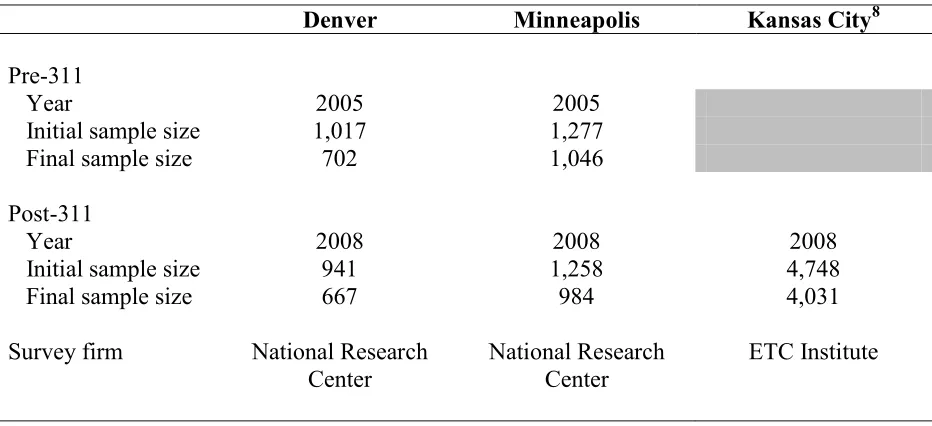
Table 2 Overview of Cities’ Citizen or Resident Survey Data ... 42
Table 3 Variable Descriptions for Denver Quantitative Data ... 43
Table 4 Variable Descriptions for Minneapolis Quantitative Data ... 45
Table 5 Variable Descriptions for Kansas City Quantitative Data ... 47
Table 6 Interview Characteristics ... 55
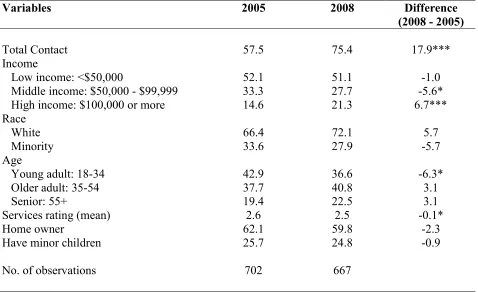
Table 7 Denver Survey Respondent Characteristics, Pre- and Post-311 Implementation (%) ... 71
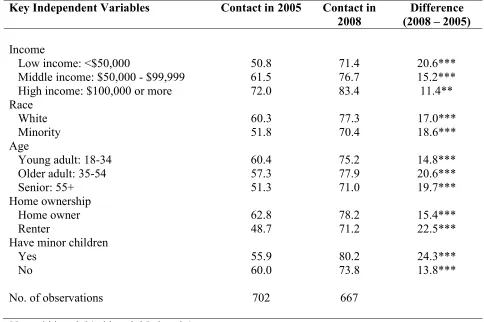
Table 8 Contacting Rates within Groups in Denver, Pre- and Post-311 Implementation (%) ... 73
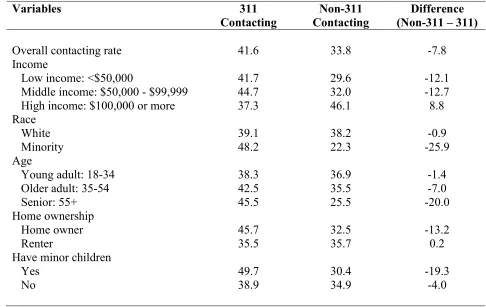
Table 9 Contacting Rates within Groups in Denver for 311 and Non-311 Contacting (%) ... 76
Table 10 Factors Influencing Total Contact in Denver in 2005 and 2008, Logistic Regression Results ... 80
Table 11 Factors Influencing 311 and Non-311 Contacting in Denver in 2008, Logistic Regression Results ... 83
Table 12 Summary Results on Hypotheses from Quantitative Phase (Denver Case)... 85
Table 13 Minneapolis Survey Respondent Characteristics, Pre- and Post-311 Implementation (%)... 103
Table 14 Contacting Rates within Groups in Minneapolis, Pre- and Post-311 Implementation (%)... 106
Table 15 Contacting Rates within Groups in Minneapolis for 311 and Non-311 Contacting (%) ... 108
Table 16 Factors Influencing Total Contact in Minneapolis in 2005 and 2008, Logistic Regression Results ... 111
Table 17 Factors Influencing 311 and Non-311 Contacting in Minneapolis in 2008, Logistic Regression Results ... 114
Table 18 Summary Results on Hypotheses from Quantitative Phase (Minneapolis Case) ... 116
Table 19 Kansas City Survey Respondent Characteristics (%) ... 137
Table 20 311 Contacting Rates within Groups in Kansas City (%) ... 139
Table 21 Factors Influencing 311 Contacting in Kansas City in 2008, Logistic Regression Results ... 141
Table 22 Comparison of Qualitative Findings across the Three Case Studies ... 147
Table 23 Assessment of Implementation Processes across the Three Case Studies ... 151
Table 24 Comparison of Quantitative Findings across the Denver and Minneapolis Case Studies ... 155
xii LIST OF FIGURES
Figure 1. Integrated contacting framework. ... 31
Figure 2. Conceptual framework for implementation analysis of 311 case study. ... 32
1 CHAPTER I: INTRODUCTION
This study examines public engagement and participation in the administrative process, through the lens of the 311 non-emergency center technology. The inaugural launch of the 311 non-emergency system in Baltimore, Maryland in 1996 ushered in a new era for local
government administration. In the ensuing years, the innovation has been adopted by many jurisdictions (O'Byrne, 2015), potentially expanding citizens’ participation in public
administration and influencing local governments’ approach to serving the public as customers (Thomas, 2012). According to a 2012 survey by the International City/County Management Association (ICMA), as many as 263 local governments have established 311 or 311-related systems in the country, in a diversity of local contexts (C. Fleming, personal communication, April 29, 2014).
Three-one-one was conceptualized in a time when its emergency equivalent – the well-known 911 number – was being subjected to a wide variety of non-urgent calls, often adding to the strain on operators (Tracy & Tracy, 1998). Cities initially established the 311
non-emergency number system to provide relief to their 911 non-emergency systems, which were being inundated with these non-urgent calls (U.S. Department of Justice, 2007). The magnitude of the problem is noted by Mazerolle et al. (2002, p. 98), who cite nationwide statistics on the rate of non-emergency calls to 911 systems as between 40 and 80 percent.
2 and Streib (1999, p. 326) note, in the 1990s, a confluence of factors (such as budgetary pressures, legislative restrictions and increasing mandates to sub-national governments) brought public performance back to the fore in local governments. There is evidence that governments are finding new ways to make increasing use of technologies in public administration (Anthopoulos & Reddick, 2016). Developments in technology have allowed governments to advance this agenda.
Overall, the use of 311 systems has gone beyond providing citizens with basic information about government services. They are now being used in areas such as disaster management (Holmes, 2007; Phelan, 2009; Schellong & Langenberg, 2007) and performance management (Behn, 2005; Reddick, 2010; Schwester, Carrizales, & Holzer, 2009). Arguably, 311’s most important role is making government more accessible and facilitating public contact and participation in local governance (Reddick, 2011; Schwester et al., 2009).
The type of government-public relationship that technologies such as 311 facilitate is somewhat “unique” in the public participation literature (Hirlinger, 1992, p. 555; Sharp, 1984; Thomas, 1982; Verba & Nie, 1972). This type of interaction, termed citizen-initiated contacting, is unique due to the fact that it is motivated by an individual’s need - whether objective or
“perceived” - for a particular service provided by the government (Jones, Greenberg, Kaufman, & Drew, 1977; Sharp, 1984; Thomas, 1982, 2012; Thomas & Melkers, 1999) and thus
3 The literature is even more sparse when it comes to assessing the impact of technologies on citizen-initiated contacting. However, studies in e-government have contributed to our understanding of technology use in government, particularly the Internet. There is no consensus on what constitutes “e-government” but most definitions stress the use and role of computer and Internet technologies (see, for example, Marche & McNiven, 2003; Roy, 2006), thereby
effectively precluding first generation 311 telephone systems. In the 1990s, e-government was characterized by government-to-citizen (G2C) communication (Cavallo, Lynch, & Scull, 2014), whereas 311 was always designed to facilitate, citizen-to-government or C2G communication. Furthermore, the focus in the e-government literature has overwhelmingly been on how the technologies have impacted government’s level of responsiveness and accountability to the public as customers; that is, the focus is on change at the government’s end (Behn, 2005; Reddick, 2010; Schwester et al., 2009). Researchers pay less attention to the changes that these new technologies cause at the users’ - that is, the public’s - end. Some studies that have
examined the impact of Internet technologies on public participation focused on whether they result in representativeness or if there is a digital divide in usage patterns (for example, Best & Krueger, 2005; Clark et al., 2013; Schlozman, Verba, & Brady, 2010; Thomas & Streib, 2003).
As use of the 311 technology continues to grow and evolve, it is important to examine its impact on the user end. The reach of 311 technology means that a larger segment of the
4
A Primer on 311 as an Innovation in Local Government
Much of our understanding about the 311 innovation in local government relies primarily on non-academic studies and industry reports on best practices. Two decades after Baltimore implemented the first 311 call center system, little in the way of academic literature explains the phenomenon of 311 systems in local government, particularly with a focus on its impact on the administrative side of government. This section offers a brief review of the history of 311, discusses some of the main developments in usage and how the concept of 311 now refers to a sophisticated technology that is, in many cases, intimately tied to the functions and performance of local governments.1
The 311 non-emergency number is one in a series of specially designated “N-1-1”
telephone codes used for accessing information or various types of social or government services (Mid-America Regional Council, n.d.). The origin of the 311 number is tied to the best known of these N-1-1 numbers: the 911 emergency number. According to the National Emergency Number Association (NENA), deliberations about instituting an emergency number date back to the 1950s when fire safety professionals recommended a designated number for fire services (NENA, 2013-14a). This discussion subsequently broadened to include considerations for a comprehensive number for all emergencies and, in 1968, 911 came into effect (NENA, 2013-14a). However, as NENA (2013-14a) and the Industry Council for Emergency Response Technologies (2015) note, this was mainly based on a telecommunications industry agreement and was not immediately institutionalized. Although the 911 number became widely accepted, formal legislative support would only follow 30 years later with the Congressional Wireless Communications and Public Safety Act of 1999, whose intent was “to promote and enhance
5 public safety through use of 9-1-1 as the universal emergency assistance number” ("Wireless Communications and Public Safety Act of 1999," 1999). The 911 number gained popularity and spread across the country, reaching almost full coverage of the American population by the end of 2015 (NENA, 2013-14b).
With 911’s popularity came the unintended consequence of misuse of the number, creating pressures on the emergency response systems as the system was often subjected to a wide variety of non-urgent calls (Tracy & Tracy, 1998). Concerns over the strain on 911 systems, particularly from non-emergency calls, led officials in search of alternative or parallel systems to handle these calls (Mazerolle et al., 2002; Purdum, 1996). The US Department of Justice applied to the Federal Communications Commission (FCC) for 311 to be a national number for non-emergency calls (U.S. Department of Justice, 2007, The COPS Office Responds to a National Crisis section, para. 3). In comments submitted to the FCC prior to its final ruling, several organizations opposed the request (FCC, 1997). For example, NENA feared that the public would confuse “N-1-1” codes for emergency and non-emergency, while various associations of 911 operators and administrators feared that the implementation of a
non-emergency number would harm efforts to achieve full coverage for the non-emergency number (FCC, 1997, p. 21). In 1997, the FCC approved the application (FCC, 1997).
Despite its availability nationwide, some jurisdictions that already had seven-digit non-emergency numbers in place have not transitioned to using 311. This study will focus only on the three-digit systems since, as noted by Mazerolle et al. (2002, p. 119), these tend to
6 The innovation and diffusion literature provides some possible explanations for the spread of 311 systems and the mechanisms via which the systems spread across the country (O'Byrne, 2015). One hypothesized reason for the spread of innovation, which is likely to be applicable to the case of 311 adoptions, is “social learning theory,” which explains the diffusion of ideas as the result of a process in which officials learn from the experiences of their peers in other juridictions as they seek solutions to problems (Boehmke & Witmer, 2004, pp. 39-40). Officials in jurisdictions that are considering their own policy adoption are likely to look to leaders or “pioneers in the adoption of a policy” as part of the learning process, in what is known as a “leader-laggard model” of diffusion (Berry & Berry, 2007, p. 230). The transmission of innovative ideas is posited to take place within forums or “policy networks” where officials interact with each other (Mintrom & Vergari, 1998, p. 128). Mintrom and Vergari (1998, p. 130) note that, particularly within these “policy networks,” there are key, well-connected individuals - known as “policy entrepreneurs” and defined as “people who seek to promote policy
innovations” - who help to transmit and push the innovation process along.
O’Byrne (2015, pp. 63-64, 116) finds that mayors, particularly of big cities such as Baltimore and Chicago, played a significant role as political policy entrepreneurs by providing strong leadership that facilitiated both local adoption and the spread of 311 systems. This finding lends support for the “leader-laggard” thesis. O’Byrne (2015, p. 64) also finds that various associations of local governments served as policy networks that encouraged the adoption of 311 technologies.
7 is the addition of customer relationship management (CRM) systems to the 311 system. CRM systems “facilitate collection and analysis of data on contacts for use by the sponsoring
government or agency” (Thomas, 2012, p. 62). See Nam (2012) for a thorough review of the history and literature on 311/CRM systems. Other technological developments have also been previously detailed elsewhere. For example, in his dissertation, O’Byrne (2015) provides an in-depth discussion of several significant developments in 311, related to both technologies as well as their changing uses in local government. In many jurisdictions, 311 technologies now
facilitate contacting via a variety of communication modes, including cellular phones and social media, among others (O'Byrne, 2015). For example, in Chicago “about 1/3 of the calls placed to 311 are now made using a cellular phone,” (City of Chicago, 2010-2016a,
http://www.cityofchicago.org/city/en/depts/311/supp_info/faq.html). An Internet search for “311 call center” returns hits for many cities’ 311 Web pages, which provide most of the same
services available via the telephone system.2
The significance of these changes is that evolving 311 technologies extend the reach of 311 and thereby broaden the set of participants in this aspect of local government administration. David Moody of KANA (a 311 software company) claims that
‘The starting point was always channel shift – getting people to use mobile devices rather than make a phone call… The reality is that’s not what’s happening anymore. You’re actually opening up a new demographic. You’re not shifting channels, but you’re actually getting more people to contact you’ (cited in Verton, 2012, Lessons Emerging, para. 7).
2 The Web hits include, for example, City of Columbus (http://311.columbus.gov/); City of New York (http://www1.nyc.gov/311/); District of Columbia (http://311.dc.gov/); City of Pittsburgh
8 Engagement of a broader range of people speaks to the potential transformative power of 311 technology on public participation (Fountain, 2013), perhaps with the promise of a more equitable pattern of participation than is offered by more traditional modes of public participation.
Three-one-one’s success in achieving its goals depends on how the implementation process for the innovation is managed. Of critical importance to a successful implementation strategy for 311 in city government is understanding that “local government lacks a unified culture” (Edwards & Thomas, 2005, p. 370) and the implications of this for managing the organizational change that ensues when 311 is introduced. Edwards and Thomas (2005) find that the decentralized and diversified nature of local government was an important consideration for the city of Atlanta when it implemented an innovation (the Atlanta Dashboard) into city government. The authors note differences across departments in areas such as customer service orientation, technologies and personnel (Edwards & Thomas, 2005, p. 371). Strategies for dealing with the unique implementation context in local government would be important for understanding the outcomes of a 311 implementation process as well.
Drawing on the organization theory literature, Fernandez and Rainey (2006, pp. 169-173) offer insights into eight key factors that influence the success of an implementation in
9
Contribution of the Study
This study contributes to public administration research by focusing specifically on contact with the administrative side of government. In this context, the focus then is on the public’s role in public management primarily as customer, although the other two roles – citizen and partner - identified by Thomas (2012) may also come into play, though to a limited extent. As Thomas (2012, p. 9) notes, the customer role may be the most common role that the public takes on and thus is of no less significance than the public’s other two roles as citizen and partner, and warrants attention as a legitimate participatory role in modern public management.
This dissertation examines how the introduction of 311 technology affects who contacts local government and who participates in the public administration process, with particular emphasis on its impact on representation—that is, equity. Public participation is important in a democratic society (Carpini, Cook, & Jacobs, 2004; Checkoway & Van Til, 1978, p. 27; Lijphart, 1997). As political scientists express concern over what they view as the declining participation of citizens in public affairs (for example, Lijphart, 1997; Putnam, 1995) and disparities in representation (for example, Lijphart, 1997; Strolovitch, 2006; Verba, Schlozman, Brady, & Nie, 1993), it is a matter of policy relevance whether innovations in public
administration – such as 311 systems that affect participation in the administrative process – improve or worsen these patterns. Furthermore, as a direct means of public participation, it is important to understand who has access to the administrative side of government and
consequently gains access to local government services.
10 local government operations are affected by citizen contacts. As Sharp notes of such contacts, it is “a dynamic that should drive the allocation of urban bureaucracies’ resources toward areas where problem solving is most needed” (Sharp, 1984, p. 669).
The 311 system is a preferred lens for studying public participation in the administrative process, given that telephone service is more pervasive than Internet penetration in the United States. By 2008, 95 percent of households had telephones (FCC, 2010, p. 16 - 3), but by June 2013, only about 70 percent of residential households had a fixed Internet connection with speed of at least “200 kilobits per second in at least one direction” (FCC, 2014, p. 12).
Research Questions
Citizen-initiated contacting has been studied since the 1970s but 311 as a technological innovation in government has only recently gained attention in the academic literature. There remains a large area ripe for academic exploration where these two strands of literature intersect. In an attempt to contribute to the scholarship that links the political science literature on
participation with the public administration literature on contacting via 311, I will explore the following research questions: How has 311 technology affected citizen behavior? Has the introduction of a 311 system produced a more equitable pattern of participation in the administrative process by changing the profile of citizens who contact local government?
11 contact their local government. I then conduct a qualitative study involving document review and telephone interviews with 311 experts. The qualitative analysis provides the necessary contextual information to assist with the interpretation of the quantitative results.
Structure of the Dissertation
This dissertation has eight chapters. Chapter two begins with a review of the literature on public participation more broadly and then narrows down to focus more specifically on the theoretical and empirical literature on citizen-initiated contacting as a mode of public
participation. This review of the literature shapes the conceptual framework that guides the rest of the study and informs the hypotheses.
Chapter three describes the components and features of the mixed methods research design. The design is heavy on the quantitative component, with the qualitative component serving a supporting role. I describe the case (that is, city) selection procedures, the data collection procedures for the quantitative data (local governments’ survey data), interviewee sampling procedures and procedures for collection of the qualitative data (document and interview data). I also provide an overview of the data collected and outline my methods for quantitative and qualitative analysis. I discuss my approach for mixing the quantitative and qualitative components.
12 Chapter seven synthesizes the research findings from the three preceding chapters
13 CHAPTER II: PUBLIC PARTICIPATION
The concept of “public participation” covers a diversity of “publics” and acts or behaviors. Verba and Nie (1972, p. 2) define political participation as acts “directly aimed at influencing the selection of governmental personnel and/or the actions they take.” Public participation encompasses slightly more than political participation, as the former includes a broader set of publics, such as traditional interest groups (Thomas, 2012, pp. 122-123). Rowe and Frewer (2005, p. 253) define public participation broadly as “the practice of involving members of the public in the agenda-setting, decision-making, and policy-forming activities of organizations/institutions responsible for policy development.” Because of its
comprehensiveness, I will use the term “public participation” in this study. Despite the recognition of the importance of public participation, there is disagreement over how that participation should take place - encapsulated in the “politics-administration dichotomy,” which calls for the separation of politics (where public involvement “should” take place) and
administration (Thomas, 2012, p. 15).
Despite the debate as to whether the public should be engaged in the affairs of
government, when scholars note a decline in indicators of activity among the public, the reaction is often one of alarm. For the last few decades, researchers have documented a decrease in public participation, citing, for example, low voter turnout and voter apathy, and the potentially detrimental consequences of lack of involvement on society (Putnam, 1995).
14 half of the chapter, I delve into the literature on citizen-initiated contacts specifically, discussing theoretical and empirical contributions to this literature. These inform the development of the research framework and hypotheses.
What Constitutes Public Participation?
As Thomas (2012, p. 19) notes, the public participation movement in America of the 1960s was a response to criticisms that public administration was unresponsive to the public, and to accusations of pervasive prejudice within the public sector. According to Denhardt and Denhardt (2000, pp. 551-552), the old public administration model focused on neutral competence, direct service provision, top-down program implementation and narrow citizen participation. In the 1960s, President Johnson’s War on Poverty federal programs called for public involvement, through “maximum feasible participation” by program beneficiaries in the planning and administration of programs, thereby spawning the “citizen participation” movement (Langton, 1978, p. 14; Thomas, 2012, p. 20). Over time, the move for more public participation at the federal level influenced state and local governments.
Providing a clear and precise definition for public participation is difficult since the term is often confused with a number of other related terms and concepts, including citizen
15
citizen (Langton, 1978; Thomas, 2012, pp. 122-123; Yang & Callahan, 2005, p. 193). Public participation is also a broader concept than political participation (Yang & Callahan, 2005, p. 193), the latter of which, according to Langton, “stresses the state (polis)” (Langton, 1978, p. 20). The second part of these related concepts, participation, covers a broader set of acts that occur in the engagement between the public and the state. Langton notes that the distinction between (citizen) participation and (citizen) involvement lies in who controls the interaction process – the state or citizens or both (Langton, 1978, pp. 20-21). With (citizen) participation control could be shared between the two parties or be vested in only one side, whereas with (citizen) involvement, all control lies with the state (Langton, 1978, p. 21). This study focuses on the broadest and most inclusive of these concepts: public participation.
Classifying Public Participation Types
16 meaningful participation has occurred.” Tritter and McCallum (2006, p. 161) offer several criticisms of Arnstein’s (1969) ladder, including its rigid hierarchy, and lack of
acknowledgement of other possible goals of participation. As such, Tritter and McCallum (2006, p. 164) call for a variety of ladders to represent the diversity of participation.
With the critiques of earlier one-dimensional typologies, more recent scholars have developed richer multi-dimensional frameworks that better reflect different objectives and the contextual factors surrounding the participation (Bishop & Davis, 2002; Fung, 2006; Rosener, 1978; Thomas, 1990, 2012). These newer frameworks consider a variety of goals or purposes for participation and therefore embrace a much wider set of participation efforts and activities. They are therefore better able to represent the state of the field of actual participation initiatives and mechanisms, and can inform the design of participatory mechanisms. These proposed frameworks include, for example, the “democracy cube” (Fung, 2006) and the “design science approach” (Thomas, 2012).
Patterns and Trends in Public Participation
Studies such as Lijphart (1997) highlight troubling trends in participation levels and their potential consequences for democracy. The United States experienced high levels of public participation in the 1960s and 1970s, followed thereafter by declines. Scholars, including Putnam (1995), have noted declines in a wide range of public participation acts such as voting and attendance at public meetings.
17 rates remained about 10 percentage points below 1964 and 1968 voting rate levels (U.S. Census Bureau, 2012). Apart from the secular decline in participation, there is the additional concern that those who participate may not be representative of the wider society (see, for example, Lijphart, 1997). There may be equity implications of non-representative participation.
Evolving Effects and Trends
The most common finding in studies on participation patterns is that socioeconomic status affects participation (Brady, Verba, & Schlozman, 1995; Jones et al., 1977; Vedlitz, 1980; Verba & Nie, 1972; Verba et al., 1993). Earlier studies tended to find the link between
participation and socioeconomic status to be direct (e.g., Verba & Nie, 1972; Verba et al., 1993), while later studies find the link to be less direct. Later studies find the existence of mechanisms that attenuate the link between socioeconomic status and participation - one of the most
significant mechanisms being through “needs” in the case of the contacting mode of participation (Hirlinger, 1992; Marschall, 2004; Sharp, 1984; Thomas, 1982; Thomas & Melkers, 1999).
As noted by Fiorina, (2001, pp. 4-5), some scholars argue that the debate over declining participation is altogether misguided, because it views participation too narrowly. For example, Dalton (2008, pp. 85-86) finds that, as opposed to declining, participation is moving away from traditional “duty-based” modes (such as voting) toward increased engagement in more “direct” modes (for example, contacting). This line of argument is important for ensuring that research captures all forms and mechanisms of participation, especially as new forms are introduced through innovations such as new technologies.
18
Citizen-Initiated Contacts as a Mode of Public Participation
Over the last few decades, studies have approached public participation as a complex concept with many facets and nuances (Claggett & Pollock, 2006; Sharp, 1984; Thomas, 1982; Verba & Nie, 1972; Verba et al., 1978). As Claggett and Pollock (2006, p. 593) note, the frameworks for organizing participation proposed by Verba, Nie and their co-authors are amongst the first to use empirical evidence to identify several forms of participation, including contacting (Verba & Nie, 1972; Verba et al., 1978). According to the authors, there are five dimensions that are useful for defining the sphere of participation acts: the influence exercised, outcome scope, conflict level, the initiative required on the part of the participant (Verba & Nie, 1972, p. 47) and the degree of cooperation (Verba et al., 1978, p. 312). These studies make a significant contribution to the study of contacting behavior, not just by recognizing it as a mode of participation in and of itself, but by also identifying two forms of it. On the one hand,
“contacts with broad referent” are contacts whose outcomes have the potential to impact the lives of a large segment of the community (Verba & Nie, 1972, p. 66). On the other hand, “contacts with particularized referents” tend to have a limited impact, usually on the contactor and/or their family (Verba & Nie, 1972, p. 66).
Scholarship progressed with studies that focus on the attitude that characterizes contacting as a unique type of participation, with most scholars focusing on empirically
analyzing local contacting data to explore this (for example, Hero, 1986; Hirlinger, 1992; Jones et al., 1977; Peterson, 1986; Sharp, 1984; Thomas, 1982; Thomas & Melkers, 1999). As Thomas (1982) notes, research on contacting advanced with the contribution by Jones et al. (1977)
19 initiative to make contact with government because they need something from government (such as a city service) (Thomas, 1982). This makes contacting out to be different from traditional acts of participation, such as voting, where the motivation to act is based on some sense of civic obligation (Dalton, 2008).
Thomas (1982, p. 504) notes that contacting is a unique type of participation because of its “instrumental” ends. Thomas (1982, pp. 510-511) sharpens the focus on needs in his “clientele participation” model by explaining that what is essential in motivating contacting is not the objective needs of prospective participants, as proposed by Jones et al. (1977), but rather their subjective assessment or perception that they have some need from government. This leads Sharp (1984) to theorize that a different philosophical motivation drives contacting than most types of participation. Sharp (1984) postulates that an “ethic of government responsiveness on demand” (p. 654), in which individuals show a preference for turning their problems into public problems, drives contacting in municipal governments (p. 664). By this, Sharp (1984) is
emphasizing the uniqueness of contacting as a mode of participation in that it is motivated by some situation that the individual faces – one the individual deems his or her local government can or should assist with.
Models of Citizen-Initiated Contacts
20 complexity to achieve richer modeling of the phenomenon of contacting. Moreover, these
updated models offer deeper insights into the place and effect of the socioeconomic status variables in contacting models (Sharp, 1984; Thomas, 1982). For example, Sharp (1984, p. 662) concludes that, “perceived need is crucial to understanding contacting behavior, in part because it is a significant predictor of contacting and in part because the importance of socioeconomic variables is contingent upon it.”
The traditional socioeconomic model has a long record but it is a weak model for explaining contacting activity, as Thomas (1982) notes. The SES model is a “resource model,” by arguing that social status confers resources such as “time, money and civic skills” that make participation feasible (Brady et al., 1995, p. 271). With respect to contacting behavior - an example of what Brady et al. (1995, p. 282) classify as a “time-based act” - the results for the effect of socioeconomic variables are mixed. For example, Brady et al. (1995, p. 283) report that income has no impact and education has little effect. Thomas (1982), for example, finds weak support for the SES model in his study of Cincinnati contacts, with a positive association between income and contacting in only some of the services included in the study and no statistically significant relationship in the remaining services.
21 The subsequent “need” models of contacting were developed in response to the
unsatisfactory performance of the SES and parabolic models. Thomas (1982, p. 511) critiques the parabolic model, highlighting the failure of Jones et al. (1977) in capturing an objective measure of need, based on SES, rather than capturing the belief (from the perspective of the potential contactors) that they have some need from government. This subjective measure of need for some assistance that government can provide, for example, trash pickup or filling potholes – measured from the contactor’s perspective – is known as “perceived need” (Thomas, 1982). Perceived need became the dominant measure of need in models of contacting (Hirlinger, 1992; Sharp, 1984; Thomas, 1982; Thomas & Melkers, 1999).
Factors Associated with Citizen-Initiated Contacting of Local Government
Because of its long history, the SES model is the most tested model of contacting. SES variables remain important in the participation literature as researchers continue to test the
applicability of the SES model or control for these factors in their participation models (Leighley, 1995). As such, this study includes SES variables to test the resource theory underlying the elaborated SES model of Brady et al. (1995). Following Thomas and Melkers (1999), this study groups into three main categories the key explanatory variables that potentially mediate the effects of antecedent variables, specifically SES and demographic characteristics: perceived need, other involvement, and psychological engagement. This study also includes measures of
22 Researchers usually operationalize SES with some measure of income, education and occupation, usually in the form of an index that incorporates some or all of these three variables (Brady et al., 1995; Hirlinger, 1992; Verba & Nie, 1972). Verba and Nie (1972, p. 132) use all three in a summative measure of SES in their baseline model and find that particularized contacting is unrelated to SES, but note that there is a significant difference between the lowest and highest SES groups, with the latter being more active. They determine that the SES
framework does a poor job of modeling particularized contacting (Verba & Nie, 1972, p. 136). Subsequent research extend the standard or baseline SES model to analyze the impact of socioeconomic variables in models that include a broader set of determinants of participation. Brady et al. (1995) propose a resource model, which analyzes the paths from SES to the
necessary civic skills that aid in participation. Income has no bearing on the level of those skills but directly impacts those acts that require money (Brady et al., 1995). With respect to
contacting acts specifically, which take up time, Brady et al. (1995) find that civic skills, that are fostered through work and schooling, have a significant positive impact on activity, while family income and education do not. Hirlinger (1992) finds his SES scale to be insignificant in
contacting.
23 The next most important set of explanatory variables in empirical studies of contacting is needs. Jones et al. (1977) measure objective need, but most scholars measure perceived need, often using survey questions about local conditions (for example, poor road conditions or rundown buildings) (Hirlinger, 1992; Marschall, 2004; Sharp, 1984; Thomas, 1982; Thomas & Melkers, 1999) or services (for example, Hero, 1986). Marschall (2004) finds that people who perceive problems in their neighborhood are more likely to contact. Thomas and Melkers (1999) find perceived need increases the likelihood of contacting city departments; that is, people who gave lower ratings to services were more likely to contact the responsible service department. Thomas and Melkers (1999) also present an interesting result for the effect of SES in a need model, that is, SES is a weak factor in contacting. Hirlinger (1992) initially finds no relationship between perceived need and contacting, but he does find that for those who have needs, having political connections increases the likelihood of particularized contacting.
“Civic attitudes,” as a potential mechanism through which SES impacts participation (Verba & Nie, 1972, pp. 13-14), remain relevant in contacting research (Brady et al., 1995; Hero, 1986; Hirlinger, 1992; Marschall, 2004; Peterson, 1986; Thomas & Melkers, 1999). According to Verba and Nie (1972, p. 19) these attitudes include “attitudes such as a sense of efficacy, of psychological involvement in politics, of an obligation to participate, and so on.” These attitudes are essential for motivating people to take the initiative to contact (Hirlinger, 1992; Thomas & Melkers, 1999). These diverse attitude factors have been measured in varying ways across
studies and so have been found to have differing effects. For example, Brady et al. (1995, p. 283) find that interest in public affairs and civic skills (the latter of which tend to be positively
24 and neighborhood safety issues. Hero (1986) finds that efficacy has a significant negative effect on contacting. Hero (1986, p. 634), citing Verba and Nie (1972), explains that this counter-intuitive finding may possibly be due to higher efficacy people choosing to participate in other ways. Thomas and Melkers (1999) find that political efficacy is not related to contacting. They find interest in public affairs has a significant positive effect on contacting behavior in some cases and other involvement has a significant positive effect in most of the cases they study (Thomas & Melkers, 1999).
In addition to SES, one of the earliest set of factors analyzed in participation studies, especially by scholars interested in equity, are demographic factors, particularly race. Researchers have faced challenges in their attempts to identify the unique contribution of
demographics - particularly race - to contacting; this is due in part to how closely these variables tend to be intertwined with other variables, such as SES and psychological engagement
(Leighley, 1995; Thomas & Melkers, 1999; Verba & Nie, 1972). As Verba and Nie (1972, pp. 151-152) note, minorities tend to score low on SES, thereby reducing their propensity to participate even though their disadvantaged position should serve as a mobilizing force to seek amelioration. Verba and Nie (1972) find that blacks are less likely to engage in contacting and posit that the possible reasons for this finding include lower levels of efficacy. Several
subsequent studies have found evidence to support the finding that minorities are less likely to engage in contacting behavior (Hero, 1986; Hirlinger, 1992; Thomas & Melkers, 1999).
25 (see, for example, Hirlinger, 1992; Thomas & Melkers, 1999). Verba and Nie (1972, pp. 138-139) state that there is no relationship between particularized contacting and stage of life. Because the age effect is sometimes interpreted in connection to community ties, age is sometimes considered part of another set of variables in this study’s framework: stakeholding (Thomas & Melkers, 1999). Stakeholding is usually operationalized through a variety of
measures, such as home ownership, having minors in the household and residency tenure, among others, and there is no consensus on the effect of this set of factors (Thomas & Melkers, 1999, pp. 669-670). For example, Marschall (2004) includes home ownership in modeling contacting about both education and neighborhood safety issues and finds mixed results, while Clark et al. (2013) and Thomas and Melkers (1999) find strong evidence that this measure positively impacts some forms of contacting. Leighley (1995, p. 184) notes that females’ voting rates have become similar to men’s; however, there remain some gender disparities across different modes of participation.
Conceptual Framework and Hypotheses
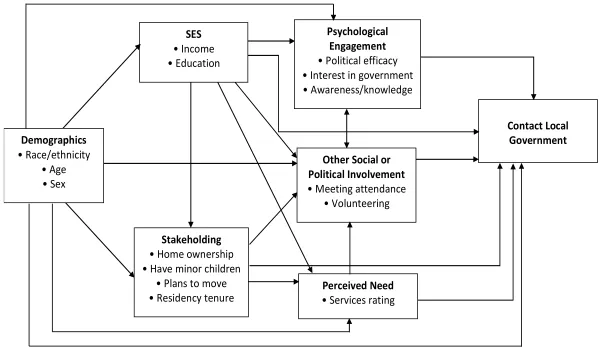
This study is guided by the following conceptual framework (Figure 1), with factors that influence citizen-initiated contacts informed by the literature discussed above, particularly the needs model of Thomas and Melkers (1999).
26 mediating force in the presence of factors that historically have produced inequitable
participation, while facilitating the public’s participation in the public administrative process. First, I establish whether the introduction and availability of the 311 technology to facilitate contacting local government changes the overall amount of this form of participation in the city. I expect that the availability of 311, which is widely accessible (particularly in the case of multi-channel 311 systems that offer several easy-to-use options for contacting) and relatively inexpensive, to stimulate contacting. The technology’s ease of use should appeal to potential users, particularly those intimidated by more complex, pre-311 methods of contacting. I examine total contacting rates and hypothesize the following:
H1:Post-311 contacting rates will be higher than pre-311 contacting rates.
Historically, SES variables influence other factors such as skills, civic orientations and other types of resources or factors that affect participation. Lower SES groups have historically had lower levels of those resources. Given this link, I expect 311 to play a moderating role that makes it easier for low SES groups to contact their local government. For instance, I posit that the technology should mitigate the effect of low levels of such factors as political efficacy and awareness that are traditionally found among low SES groups. “Other contacting” or “non-311 contacting” is contacting that takes place outside of the 311 technology and includes such
contacts as direct contact with city council members, among others. Without the 311 technology to facilitate contact, non-311 contacting should not exhibit the same patterns (in terms of
27 H2:Patterns of participation via citizen-initiated contacts will be more equitable after adopting 311.
More specifically,
H2a:The association between SES and contacting will be weaker after adopting 311. H2b:The association between SES and 311 contacting will be weaker than the association between SES and non-311 contacting.
H2c:The association between demographic characteristics and contacting will be weaker after adopting 311.
H2d:The association between demographic characteristics – race, age and sex – and 311 contacting will be weaker than the association between demographic characteristics and non-311 contacting.
As previous literature has shown, perceived need can be a powerful explanatory variable in understanding contacting behavior. I expect the same result in this study and hypothesize that as 311 reduces the barriers traditionally associated with lower SES, perceived need will become an even stronger motivating factor for initiating contact with local government.
H3a:Perceived need will have a strong positive association with contacting, especially after 311.
28 Because of the strong connection between 311 and the provision of local services, I expect having a stake in the local community to motivate residents to initiate contact with their local government for services that impact their lives within their communities. As such, I hypothesize the following:
H4:Having a stake in the community will have a stronger association with contacting via 311 than with non-311 contacting.
The success of an innovation such as 311 depends heavily on factors such as political, administrative and other support in the implementation process. Also important for success is how much the innovation is promoted among the public and other stakeholders to bring awareness to the new avenue for contacting their government in order to encourage its use. I conducted an analysis of the implementation process for the 311 systems to examine the
organizational culture and dynamics within city government to understand the context in which the implementation process took place (Nightingale & Rossman, 2010, p. 329). I expect that local governments that implement 311 using a strategy that incorporates management of the change process, and that actively promote their 311 systems will see a greater impact on their citizens’ contacting behavior.
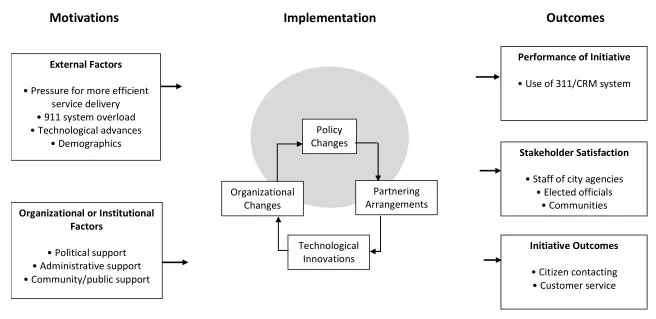
29 (see Figure 2).3 This framework helped determine what impact the implementation process had on the contacting behavior observed after 311 implementation. In this framework, I explored the motivations or factors that influenced the implementation process. I also examined the
components of the implementation itself, including the policy changes associated with the decision to have a 311 system. These changes interplay with other components that developed during the implementation process. The implementation process involves the relationships between 311, and the city agencies and other stakeholders (such as city council members’ ward offices) who partner with 311. The process also involves the technological changes that were introduced, not only at the 311 center itself but also at the implementing partners (city
departments) because of their interrelationships with 311. The implementation process analysis also examines how these technological innovations introduced organizational/internal culture changes within the implementing agencies and partners, which needed to be managed to ensure that the policy change was implemented successfully. At the other end of the conceptual framework is a look at the outcomes that resulted from this implementation process, including the facilitation or easing of citizen access to government to encourage citizen contacting. Therefore, I explore the following proposition about the implementation process:
P1:311-related outcomes (contacting rates and patterns) will reflect the effectiveness of the implementation of the 311 innovation.
I assess the “effectiveness” of each city’s management of its 311 implementation change process using the eight factors for managing implementation of change proposed by Fernandez and
30 Rainey (2006) as a set of evaluative criteria. The factors (criteria C1-C8) are as follows
(Fernandez & Rainey, 2006):
1. C1: “Ensure the need” – leaders develop a clear vision that convincingly explains that the proposed change is necessary (p. 169)
2. C2: “Provide a plan” – leaders outline a coherent strategy for executing the change (pp. 169-170)
3. C3: “Build internal support for change and overcome resistance” – leaders work with internal partners and stakeholders to ensure buy-in for the initiative (pp. 170-171) 4. C4: “Ensure top-management support and commitment” – there is high level political
and/or administrative support for the initiative (p. 171)
5. C5: “Build external support” – leaders work with external partners and stakeholders to ensure support for the initiative (pp. 171-172)
6. C6: “Provide resources” – make adequate financial and other resources available to support the implementation (p. 172)
7. C7: “Institutionalize change” – leaders ensure changes take root and become a permanent part of the organization’s operations and procedures (pp. 172-173)
31 Figure 1. Integrated contacting framework. Based on the model developed by Thomas and Melkers (1999).
SES
• Income • Education
Demographics
• Race/ethnicity • Age
• Sex
Psychological Engagement
• Political efficacy • Interest in government • Awareness/knowledge
Stakeholding
• Home ownership • Have minor children
• Plans to move • Residency tenure
Other Social or Political Involvement
• Meeting attendance • Volunteering
Perceived Need
• Services rating
32 Figure 2. Conceptual framework for implementation analysis of 311 case study. Adapted from the conceptual frameworks in
Martinson and O’Brien (2010, p. 167), and Rossman et al. (1999), cited in Nightingale and Rossman (2010, p. 330).
Motivations
Implementation
Outcomes
External Factors
• Pressure for more efficient service delivery • 911 system overload • Technological advances
• Demographics
Organizational or Institutional Factors
• Political support • Administrative support • Community/public support
Performance of Initiative
• Use of 311/CRM system
Stakeholder Satisfaction
• Staff of city agencies • Elected officials
• Communities
Initiative Outcomes
• Citizen contacting • Customer service Policy
Changes
Organizational
Changes Arrangements Partnering
33
Summary
Public participation refers to a wide range of acts and involves a variety of different participants. The range of acts that qualify as public participation has grown over the last few decades. Theoretically, the participation sphere is defined by a number of dimensions that allow us to group participatory activities into modes or mechanisms of participation. The focus of this study is one of these modes: contacting. Citizen-initiated contacting differs from most types of participation because of its instrumental value – the contactor takes the initiative to act because he or she perceives there to be some need for a good or service that can be met by government. Empirically, the study of participation generally, and of contacting behavior specifically, has been heavily influenced by the socioeconomic status (SES) model, though the success of the traditional SES model has been mixed. Despite some well-known critiques of the SES model (see, for example, Leighley, 1995), researchers continue to see the utility of SES variables in models of contacting behavior (see, for example, Thomas & Melkers, 1999). However, these more recent studies stress the indirect role of the SES variables and focus on the explanatory mechanisms behind participation and, as such, highlight the primary effects of other factors such as perceived need (see, for example, Thomas & Melkers, 1999). This dissertation study seeks to empirically analyze what impact the introduction of the 311 technology has had on these
34 CHAPTER III: DATA AND METHODS
This dissertation adopts a mixed methods research design that uses both quantitative and qualitative research methodologies to study the 311 phenomenon in local governments. Johnson and Onwuegbuzie (2004, p. 17) define mixed methods research as “the class of research where the researcher mixes or combines quantitative and qualitative research techniques, methods, approaches, concepts or language into a single study.” This approach to research is informed by what Creswell (2009, p. 10) calls a “pragmatic philosophical worldview,” which has value for “focusing attention on the research problem in social science research and then using pluralistic approaches to derive knowledge about the problem.” Mixed methods users “look to the what
and how to research” (Creswell, 2009, p. 11, emphasis in original). Mixed methods research gives the researcher freedom in that it has the advantage of benefiting from the strengths of both quantitative and qualitative approaches, while limiting the weaknesses of both (Creswell, 2009; Johnson & Onwuegbuzie, 2004). Additionally, combining the two research paradigms produces more comprehensive knowledge (Johnson & Onwuegbuzie, 2004, p. 21).
Research Design
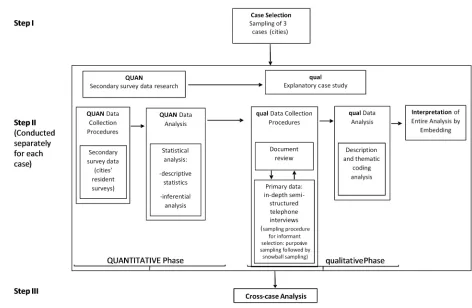
I applied the framework developed by Creswell et al. (2003), cited in Creswell (2009, p. 209), to develop a sequential explanatory mixed methods design with multiple cases (see Figure 3). The sequential design includes the mixing strategy of “embedding” to combine the
36
Step I: Case Selection
First, I defined my unit of analysis to be a city that has implemented 311. I selected three American cities as cases for a multiple-case study to ensure robustness of my results (Yin, 2003a, p. 135). As Miles, Huberman, and Saldana (2013) state,
Multiple-case sampling adds confidence to findings. By looking at a range of similar and contrasting cases, we can understand a single-case finding, grounding it by specifying
how and where and, if possible, why it carries on as it does. We can strengthen the precision, validity, stability and trustworthiness of the findings.
(p. 33, emphasis in original).
There is no standard recommendation as to the number of cases to include in a multiple-case research project (Miles et al., 2013, p. 34; Yin, 2003b). However, I posited that three well-chosen cases could provide the richness of contexts to allow meaningful comparisons while keeping the dissertation manageable.
As O’Byrne (2015) notes, there is no current, comprehensive data set on 311 systems. As such, I was unable to compile a sampling frame that consists of the universe of 311 systems in the country. I employed a strategy whereby I developed a set of criteria that would allow me to sample local governments to compile a variety of cases (Martinson & O’Brien, 2010, p. 171). My criteria for the local governments were as follows:
1. Must have been operating 311 systems for at least a few years to have an established history of use (at least two years); and
37 As previously mentioned, notable studies on 311 include Nam (2012), O'Byrne (2015) and a series of reports by the ICMA. Of key importance to this study is the ICMA, which has conducted a number of case studies on 311, mostly geared toward a practitioner audience.4 I made contact with Ms. Cory Fleming, who is the 311/CRM program director at the ICMA and co-author of several of the Association’s studies. I held an informal Skype meeting with Ms. Fleming on April 28, 2014 to discuss the ICMA’s work on 311 and the data needs of my study. Ms. Fleming, whose position with the ICMA gives her access to several networks of local governments, and 311 practitioners and scholars, agreed to assist with the data collection.
Ms. Fleming conducted brief surveys at meetings of two professional associations for 311 directors and managers held in May of 2014 to gather data that helped in determining which local governments met the two criteria. The two associations were the Association of
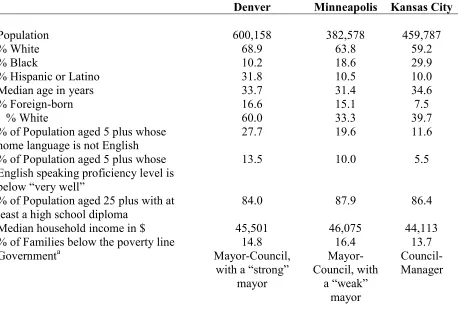
Government Contact Center Professionals (AGCCP) and the 311 Synergy Group. Ms. Fleming’s surveys yielded 19 responses, of which nine met both criteria. Analysis of the survey responses showed that several of the represented local governments were medium-sized cities, all of whom implemented 311 in the early to mid-2000s. Attempts to contact these jurisdictions for data access were successful in three cases. These cities were the City and County of Denver, Colorado, Minneapolis, Minnesota, and Kansas City, Missouri. Table 1 provides a summary overview of the three study sites.5 Each of the cities implemented 311 in 2006 and so faced similar external economic and other environmental conditions. Furthermore, the three cities were similar in terms of other economic characteristics—such as median household income, household poverty rates—and their populations’ educational attainment (see Table 1). However,
4 The ICMA operates a Center for Sustainable Communities, which runs a project dedicated to 311/CRM Consulting Services: http://icma.org/en/results/sustainable_communities/projects/technical_assistance
39 Table 1
Study Cities’ Characteristics (Year 2010)
Denver Minneapolis Kansas City
Population 600,158 382,578 459,787
% White 68.9 63.8 59.2
% Black 10.2 18.6 29.9
% Hispanic or Latino 31.8 10.5 10.0
Median age in years 33.7 31.4 34.6
% Foreign-born 16.6 15.1 7.5
% White 60.0 33.3 39.7
% of Population aged 5 plus whose
home language is not English 27.7 19.6 11.6
% of Population aged 5 plus whose English speaking proficiency level is below “very well”
13.5 10.0 5.5
% of Population aged 25 plus with at
least a high school diploma 84.0 87.9 86.4
Median household income in $ 45,501 46,075 44,113
% of Families below the poverty line 14.8 16.4 13.7
Governmenta Mayor-Council,
with a “strong” mayor
Mayor-Council, with
a “weak” mayor
Council-Manager
Note. Data sources: Population to median age: US Census Bureau, 2010, Profile of general population and housing characteristics. % Foreign-born to % of Families below the poverty line: US Census Bureau, 2006-2010 American Community Survey, Selected characteristics of the native and foreign-born populations.
40
Step II: Data Collection, Analysis and Interpretation Strategy
Given that the focus was on determining the quantitative effects first and then
determining what role the implementation process may have had on those outcomes, a sequential design was used in Step II of the framework (Figure 3). In the version of the sequential design represented in Figure 3, the quantitative (“QUAN”) phase (including both data collection and methods) comes first–both in time and weight–before the qualitative (“qual”) phase of the study (Creswell, 2009, pp. 206-207).6 The “mixing” of the quantitative and qualitative data occurs only during the interpretation phase, where I “embed” the latter data type within the broader study (Creswell, 2009, pp. 207-208). This process is discussed in detail below. In Step II of the design, I outline my strategy for inquiry at the case level, which was executed separately for each city. In the strategy, the quantitative phase, which includes its data collection and data analysis using quantitative methods, is discussed before the qualitative phase, which includes the qualitative data collection and data analysis using qualitative methods.
Quantitative phase.
The purpose of the quantitative phase in this study is to determine the underlying mechanisms that explain the phenomenon of citizen-initiated contacts. Quantitative research methodology offers several benefits to a study. It produces numerical estimates, facilitates testing hypotheses, and has strong claims to external validity if appropriate sampling techniques are used (Johnson & Onwuegbuzie, 2004, p. 19).