Efficient Wireless Image Transmission With Wavelet
Based Polyomine Compression
Ms.Santha devi.P* M.C.A., M.Phil.,
Mr.Sivakumar.M** M.C.A.,
Dr.Arthanariee A.M** M.Sc., M.Phil., Ph.D, PGDCA., M.S.,
*Doctoral Research Scholar, Mother Teresa Women’s University, Kodaikanal, Tamilnadu, India. **Doctoral Research Scholar, Anna University, Coimbatore, Tamilnadu, India.
** Dean, Department of Science and Humanities, Nehru Institute of Technology, Kaliyapalayam, Coimbatore – 105, Tamilnadu, India.
*Email: [email protected], **Email: [email protected], **Email: [email protected]
Abstract- With increasing growth in wireless multimedia image
communication, the topics related to be handled are resource consumption and quality of the image being transmitted without noise. In this paper we propose a novel method to compress the image using improved wavelet based polyomino’s lossless compression technique which increases the quality of image at receiving end. The compressed image is transmitted by Energy Efficient High Quality Image Transmission scheme (EEHQIT) to achieve energy efficient image transmissions in Wireless Sensor Networks (WSNs). However the existence of noise makes the imaging system is a complicated task. In this scenario reducing noise using filter technique for achieving high quality compression image transmission is desired. To avoid noise in the compressed image, a scheme of spatial averaging filter is presented and tested on the transmitted compressed image. This approach removes the noise from the transmitted image by way of rebuilding the image to obtain the original image without loss of information. Experiments were conducted using the natural and real images collected by our-selves shows that our approach, spatial averaging filter improves the image quality of the compressed image at the receiver side. Simulation results show up to 85% reduction in the total power consumption and higher PSNR value is achieved using the proposed noise filtering strategy. In this approach, the wireless image transmission is efficiently implemented from the source to designation via the router.
Index Terms- Wireless communication, Image compression,
Image quality, Interactive transmission
I. INTRODUCTION
fficient Spatial Averaging Filter for High Quality Compressed Image Transmission facilitates many useful applications such as surveillance which reduces the occurrence of noise in the images and analyzing health and environmental data in wireless multimedia image communication. The current specification of image transmission lacks a mechanism to determine energy efficient protocols and filtering techniques to reduce the noise involved in images. When people transmit image they usually face the problem of noise included in images. In order to transmit high quality images the work focus on using novel spatial average filtering technique to alleviate the above problems. In this technique, the image transmission from the sending side to the receiving side is done with the router.
[image:1.612.121.493.624.708.2]Researchers have introduced several mechanisms to provide solutions by way of transmitting the data via forward error correction. Subsequently the price aid for lossless transmission over a lossy medium is extremely lengthy in terms of transmission time which occurs due to retransmissions of lost packets. Henceforth redundancy increases the amount of information to be transmitted. Figure 1 shows some examples of image collected for performing high quality compressed image transmission. The images are collected from various natural and real data sets. In this work we employ EEHQIT scheme.
The basic idea behind the scheme is to use energy efficient considerations in order to be suitable for wireless multimedia image communication. Here the images are divided into packets and the source sensor transmits the packet with the highest priority and continues the process with the next highest priority and so on. While transmitting images (in terms of packets)
[image:2.612.53.550.152.525.2]noise is included in the transmitted images. To remove the noise from the transmitted images in the receiving side spatial average filtering technique is proposed. Experimental results also show the improvement in the quality of image being compressed at receiver side.
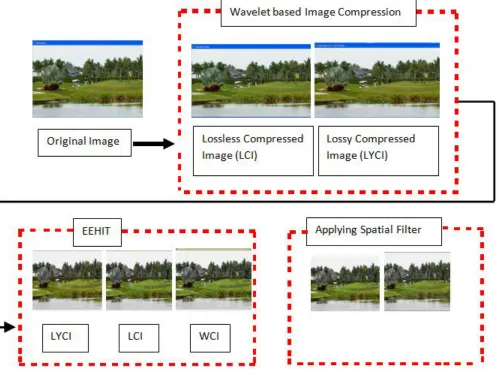
Figure 2 Overview of our method
An overview of the method is shown in figure 2. The main task of removing noise from images is decomposed into wavelet based image compression, energy efficient high quality image transmission and finally in to spatial average filtering for producing high quality compressed image transmission at the receiver side. Moreover the wavelet based image compression is formulated using improved Polyomino Lossless Compression Techniques (PLCT) on the lossless compressed image format. This improved PLCT is used to compress and decompress an image any number of times by retaining and without lowering the image’s quality.
The compressed image is proven to be energy efficient using enhanced open-loop scheme (based on the work of Vincent Lecuire et al.). Many researchers have derived energy-efficient data transmission schemes. In this work we present energy efficient image transmission in the receiving side using
enhanced open-loop scheme model , which is implemented by way of 2D DWIT scheme. Additionally the transmitted images are proven to be energy efficient by adopting priority-based packet technique in which the packets of subsequent priorities are forwarded having the highest priority and next the second highest prioritized packet and so on. Finally noise produced in the images at the receiving end is removed using the filtering techniques and results in high quality images.
II. RELATED WORK
Many methods related to image transmission using filtering techniques of multimedia applications over wireless sensor network have been proposed by researchers. Pinar Sarisaray Boluk et al. [1] presented two techniques for robust image transmission over wireless sensor networks. The first technique uses watermarking whereas the second technique is based on the Reed Solomon (RS) coding which considers the distortion rate on the image while transmission for wireless sensor networks.
Renu Singh et al. [8] proposed wavelet based image compression using BPNN and Lifting based variant wherein optimized compression percentage is arrived using these two adaptive techniques. Pinar Sarisaray Boluk, et al. [2] studied image quality distortions occurred due to packet losses using two scenarios, considering watermarked and raw images to improve the Peak-Signal-to-Noise-Ratio (PSNR) rate.
In digital image processing Zhang Xiao-hong and Liu Gang [5] proposed SPIHT (Set Partitioning In Hierarchical Tree) coding scheme to reduce the distortion in images. In [6] the authors Wenbing Fan and Jing Chen, Jina Zhen proposed an improved SPIHT algorithm to gain high compression ratio. The recent development in image processing is the application of geometric wavelet. Garima Chopra and A. K. Pal [15] presented binary space partition scheme which is compared with Embedded Zero Tree Wavelet (EZTW), Set Partitioning in Hierarchical Trees (SPIHT) and Embedded Block Coding with Optimized Truncation (EBCOT). Experiments conducted shows outperforming results using binary space partition scheme. Weeks. M.and Bayoumi. M.A. [4] made comparison study on 3D and 2D DWT. Two architectures has been designed which has a central control on the low pass and high pass filters. Reichel, J et al. [3] proposed integer wavelet transform (IWT) for lossy image compression instead of discrete wavelet transform (DWT) where rounding operations are modeled as additive noise. One of the main factors to be analyzed in Wireless Sensor Networks (WSNs) is to reduce the transmission energy consumption. Rajani Muraleedharan et al. [7] modeled energy efficient protocols for wireless sensor networks using meta-heuristic combinatorial algorithm.
Once the image being transmitted, any noise embedded in the images have to be removed using filtering techniques. K. Vishwanath et al. [9] presented image filtering techniques on larger DCT block which speed ups the operation by eliminating certain elements. Bert Geelen et al. [10] presented an analysis of spatial trade-offs under various resource requirements by obtaining optimality while localization. James R. Carr [11] applied spatial filter theory to kriging for remotely sensed digital images. The method proposed improved image clarity. Syed Muhammad Monir and Mohammed Yakoob Siyal [12] presented an iterative scheme by applying spatial filtering for noise suppression using novel similarity measure. In addition to the above iterative scheme the author used functional similarity of voxels to preserve the shapes.
Wavelet transforms are used to analyze signals and images. Yansun Xu et al. [13] proposed selective noise filtration technique based on the spatial correlation method. The filtration technique used in this work reduces noise contents
in signals and images. Giacomo Boracchi and Alessandro Foi [14] considered the restoration of images by using two techniques called uniform motion blur and Poissonian noise. An analysis is also presented with variation of root mean squared error with respect to time which results in optimal exposure time.
III. WAVELET BASED IMAGE COMPRESSION FOR WSN The two types of image compression for producing high quality images are lossless and lossy techniques. After decompression the original image is recovered. Compressing an image is entirely different process than compressing raw binary data. Lossless compression involves the process wherein after compression in the post-processing when decompressed the image obtained will be an exact replica of the original image. As illustrated in figure 2, given with image(natural or real data set) energy efficient image transmission proceeds with the decomposition of the process in to three models. Initially the image is compressed using wavelet based improved polyomino compression technique. The image being sent should be energy efficient in order to be suitable for wireless sensor network which is achieved using priority-based packet technique. Finally the images while performing post-processing is proven to be noise-free using spatial filtering technique.
3.1. Wavelet-based Improved Polyomino Compression Technique
The image transmission principle for wireless communication is based on 2D discrete wavelet image transform and improved polyominos lossless compression technique to achieve energy conservation. S. Mallat et al. employed 2D Discrete Wavelet-based Image Transform which decomposes the signal into series of samples which are again passed through two filters called as low-pass filters and high-pass filters with impulse response r0 and r1.
Wavelet based lossy compression using adaptive techniques were proposed by Renu Sigh et al[8]. As mentioned above, the aforementioned techniques are limited to Certain images Compared with the above two techniques, our scheme is more robust and accurate.
3.1.1. 2D Discrete Wavelet-based Image Transform (DWIT)
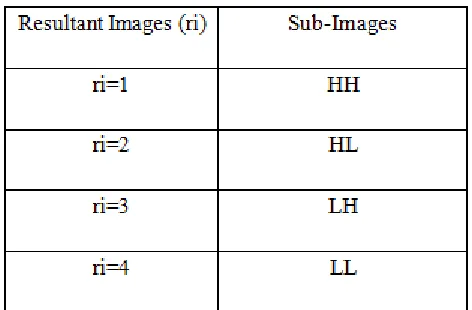
The image transmission principle to produce high quality images is based on 2D Discrete Wavelet-based Image Transform. At every iteration of DWIT the lines of input image are low-pass filtered or high-low-pass filtered having impulse response r0 and r1 respectively. The lines of two images achieved at the output of two filters are decimated based on the factor of 2. The columns are low pass filtered and high pass filtered with r0 and r1 respectively. The columns of four images are decimated based on the factor of 2. In this way four new sub-images are generated. The first sub-image retrieved is named as approximated image or LL image. The other three sub-images are called as detail sub-sub-images or LH, HL and HH. The LL image obtained act as the input for the next iteration. The process is repeated for the remaining sub-images. The coefficient of 2D DWIT is represented by the following equation 1.
Where ‘i’ denotes the image whose DWIT is to be computed,‘ind’ represents the iteration index level and ‘ri’ denotes the resultant images (four sub- images) obtained as shown in table 1 and ‘Ψ’ denotes the wavelet form.
Table 1 Resultant and Sub-Images The factorization of wavelets is given below in the equation 2.
Ψ indri,a,b (A1,A2) = ρ indri,a,b (A1) * τ indri,a,b (A2) (2)
The factors (two) are computed using the scale function α (A) and β (A) given by the following equations 3 and 4.
(3)
(4)
3.1.2. Improved Polyominos Lossless Compression Technique (IPLCT)
The two types of image compression techniques in wireless communication are lossless and lossy techniques. The original image is of recovered after decompression.
Figure 3 Conceptual Framework of Wavelet-based Image Compression
In order to implement the forward and inverse wavelet transforms, Quadrature Mirror Filter model (QMF) is used. The QMF model filters comprises of low-pass filter (LP) and high-pass filter (HP). The relationship between filters LP and HP is given in equation 5.
HP (n) = (-1) ^ m * (LP) (1 - m) (5)
The implementation of forward wavelet transform is done using LP_b and HP_b. The implementation of inverse wavelet transform is done using LP and HP. The relationship between LP_b and LP and HP_b and HP is derived from the equation 6 and 7.
HP (n) = HP_b * (-n) (6)
LP (n) = LP_b * (-n) (7)
3.2. Energy Efficient High Quality Image Transmission
Provided with an input image the image being sent should be energy efficient in order to be suitable for
wireless sensor network. This principle is achieved using priority-based packet technique which is based on energy efficient image transmission principle, suitable for wireless sensor networks. Energy efficient high quality image transmission is attained through the use of 2D Wavelet Image Transform as discussed in 3.1.1. The 2D DWIT provides data disintegration in terms of multiple levels of resolution. In this way the image is further segmented into packets having different priorities. Results show up to 90% reduction in the energy-efficient image transmission compared to non energy efficient image transmission.
3.2.1. Priority-based Packet Technique (PPT)
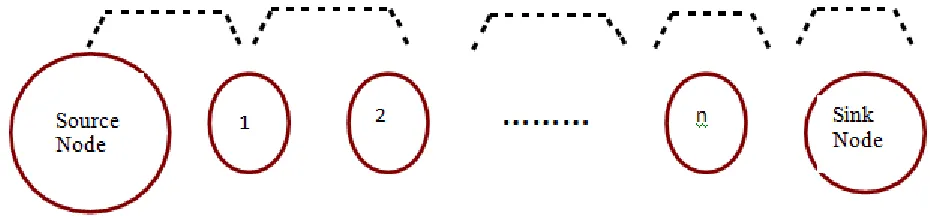
Once the raw images are divided into packets consisting of different priorities the packets are ready to be sent to the other side in wireless sensor network. The source transmits the packet with the highest priority and then the next highest priority and so on as shown in figure 4. The image transmitted from the source node in wireless sensor network selects and sends the first highest prioritized packet, next the second highest prioritized packet and so on to the sink node.
Figure 4 Path representations in Enhanced open-loop scheme
PPT uses hop-by-hop transmission which is conceded to be reliable since the data packet sent is based on the hand-shaken model. This model utilizes the acknowledgement scheme wherein the packets are retransmitted if lost by using the enhanced open-loop scheme which is discussed in the following section.
3.2.2. Enhanced Open-loop scheme
[image:5.612.67.532.505.614.2]open-loop scheme for reliable transmission uses a 3-byte-long packet header as illustrated in figure 5. It consists of the image tag to identify the image, data to be sent, ‘AP’ represents the amount of priority mode assigned totally and ‘PL’ represents the priority level of the corresponding packet. We refer to the source node as ‘source’ and destination node as ‘sink’. The first and second fields of the packets are used by the sink. In case of missing data the sink node replaces the packets with ‘0’ due to loss of packets.
Figure 3-byte-long packet headers
The enhanced open-loop scheme is based on hand-shaken model where the images are sent to one-hop neighbor and the acknowledgement is provided immediately which is the basis for reliable scheme.
3.2.3. Energy model for enhanced open-loop scheme
In order to evaluate the benefits of enhanced open-loop scheme energy utilization is analyzed. The energy model for EEHQIT is tested using two scenarios where the images are either transmitted or dropped. Let us consider the first scenario where the images are transmitted using enhanced open-loop scheme. Let Prob (PL,m) be the probability that packets with priority PL are transmitted from the source node to the sink node, henceforth (m+1) hops are implemented which is performed by the following equation 8.
Prob ( PL,m) = (1 - β PL) m
(8) With 0 < PL < AP -1
Let us consider the second scenario where the images are dropped. Let Prob (PL,i) denote the probability where the packets are dropped before reaching the sink node denoted by the equation 9.
Prob (PL,i) = β PL * ( 1 - β PL ) (9) With 1 ≤ i ≤ m and 1 < PL < AP -1
From equations 5 and 6 the energy utilized by packets of priority ‘PL’ is given in equation 7. Let ‘nl’ denote the number of packets which transmits all data with priority ‘p’ and ‘al’ denote the average size. The average number of hops completed by packets of priority level is denoted by ‘i’ if they are dropped at node ‘i’; otherwise it is (m + 1) in case of image being transmitted and is denoted by equation 10 and 11 respectively for the node being blocked and the node being transmitted.
(10)
(11)
From equations 10 and 11 the total energy required to transmit the entire image is given below.
ET = Σ [nl * E(al) * Prob ( PL,m) * (m + 1) +
Σ Prob (PL, i ) * i ] (12)
Where Prob (PL,m) and Prob (PL, i ) is already given in equation 8 and 9 respectively.
3.3. Spatial Average Filtering for High Quality Compressed Image Transmission
While transmitting images we focus on spatial average filtering scheme, to produce high quality images by removing the noise present in the images. In order to remove the noise from the transmitted image by EEHQIT scheme box filtering techniques are used. The idea behind smoothing filters is straight forward. The value of the pixels in an image is replaced by the average of the levels in the neighborhood of the filter mask. The results of the filter mask produces image with sharp transitions.
3.3.1. Box Filtering for High Quality Compressed Image Transmission
The process for producing high quality compressed image transmission comprises of proceedings of the filter mask from one point to another for a given image. At each point (a,b) the filter mask at that corresponding point is calculated. For producing high quality compressed image transmission in the receiving side we concentrated on 3 * 3 masks (where ‘mask’ represents the sub image in main image). The result of 3*3 masks is given in following equation 13.
Res = W(-1,-1) f(a-1,b-1) + W(-1,0) f(a-1,b) + ……… + W (1,1,) f(a+1,b+1) (13)
Equation 10 shows the sum of products for 3 * 3 mask where f refers to linear filtering of size 3 * 3.
IV. EXPERIMENTAL RESULTS
The experimental evaluation on image transmission is carried out with JPEG images comparing the noise level with and without using filtering technique and comparing energy performance of image transmission schemes in various scenarios.
A monochrome image of 128 X 128 pixels is used as a test image. Numerical values adopted for the input parameters of energy models are described below. Then, we present the results of numerical application. To get a reference, we evaluated the consumed energy by transmitting the whole image (37249 bytes) reliably without applying WT or compression algorithms. In the following, we call that the "the original scenario". The amount of energy dissipated to transmit the original image is 15J per hop. Afterwards, we applied WT once and then twice without compression. When WT is applied once, we obtained a resolution 0 of 4106 bytes and a resolution 1 of 12288 bytes. Similarly, when WT was applied twice, we obtained 1034, 3072 and 12288 bytes for resolutions 1, 2 and 3 respectively. Figure 1 shows some examples of collected images.
image compression technique applied.
4.1. Results of Wavelet based Image Compression
In our implementation, simulations are made with lossless compression and lossy compression. Results show that although the size of the bytes has been reduced considerably the resultant image obtained after the compression algorithm have not been changed. The image is same as to the original image. In our experiment as the value of the quality increases in lossless compression we obtain 117331 bytes in
[image:7.612.94.533.181.262.2]lossy compression we attained 97744 bytes and in wavelet compression we gained 105422 bytes. The result of the comparison shows that from the three compression techniques as shown in figure 6 wavelet compression results with the reduction of bytes without changing the original image. As though we compress the image and then transmit, considerable amount of energy is utilized. This energy consumption is also reduced to the maximum possible and then the image after being compressed is transmitted.
Figure 6 Three Compression techniques
(a) Original image
(b) Lossless Compression(Quality rate 50%) (c) Lossy Compression (Quality rate 50%) (d) Wavelet Compression (Quality rate 50%)
4.2. Energy efficiency in WSNs
In this section, we apply the energy consumption models to evaluate and compare energy performance of \image
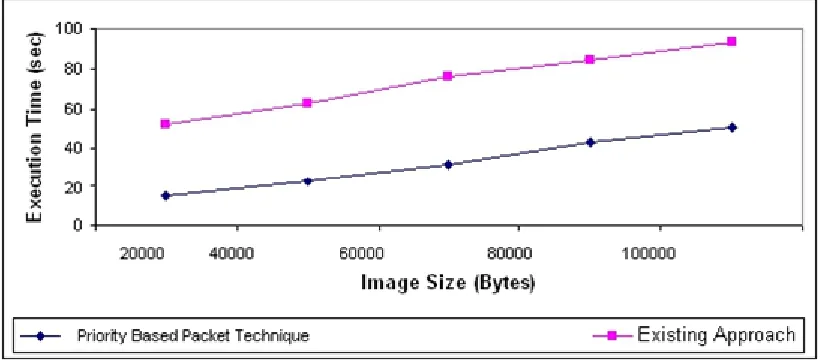
[image:7.612.101.513.418.598.2]transmission schemes in various scenarios. Figure 7 show the average consumed energy per node as a function of the number of intermediate nodes. When 2D DWIT is applied we see that the consumed energy is clearly lower compared to the case without 2D DWIT.
Figure 7 Energy Consumption using Priority-based Packet Technique
Figure 7 shows the comparison of our proposed priority based packet technique with existing approach. For simulation the image size is taken as bytes and for experimentation purpose five images are taken (24249, 53753, 75173, 115331). An increase in the image size causes the energy level to get increased. When compared to existing approach enhanced open loop scheme consumed lower energy.
4.3. Image Transmission in Receiver Side
Figure 8 Image size Vs PSNR
Figure 8 depicts the performance comparison graph showing the result of PSNR value at sender side and receiver side which is measured in terms of decibel. In order to reconstruct the image at the receiving side DC and AC components are used. By using spatial average filtering technique the PSNR value at receiver side is nearly equal to the sender side.
CONCLUSION
In this work, a novel method spatial filtering techniques and 2D DWIT is proposed to remove the noise present in the images in the receiving side via enhanced open loop scheme. An enhanced wavelet based inductive methods using 2D DWIT for lossless image compression, lossy image compression and the wavelet image compression is developed by us while transmitting images via the router in wireless communication . Our main objective is to show better quality of image on decompression. With our extension of priority based packet technique and enhanced open loop scheme the image produces energy efficient high quality image transmission in wireless sensor networks. We simulated the proposed approach using Java. The simulation results shows 85% reduction in total energy consumption achieved by adopting packet prioritized enhanced open loop scheme. More importantly, to reduce the noise involved in the images in the receiving side we designed an efficient spatial average filtering using box filter technique which significantly reduces the noise in receiving side. Experiments show that the proposed approach produces high quality compressed image transmission in the receiving side using 3 * 3 mask.
REFERENCES
[1] Pinar Sarisaray Boluk, Sebnem Baydere, A. Emre Harmanci, “Robust Image Transmission Over Wireless Sensor Networks “, Mobile Networks and Applications, ACM Apr 2011, Vol. 16 .
[2] Pinar Sarisaray Boluk, Kerem Irgan, Sebnem Baydere, A. Emre Harmanci, “Image Quality Estimation in Wireless Multimedia Sensor Networks: An Experimental Study”, Broadband Communications, Networks and Systems, Springer March 2012, Vol. 66.
[3] Reichel, J. , Lausanne Menegaz, G., Nadenau, M.J. , Kunt, M. ,” Integer wavelet transform for embedded lossy to lossless image compression”, IEEE Transactions on Image Processing, Vol.10, Mar 2001. [4] Weeks,M.,Bayoumi,M.A.,”Three-dimensional discrete wavelet transform
architectures”, IEEE Transactions on Signal Processing, Vol. 50 , Aug 2002.
[5] Zhang Xiao-hong, Liu Gang,” Research of the SPIHT Compression Based on Wavelet Interpolation Matching Image”, Communications in Computer and Information Science, Springer 2011 Vol. 225 .
[6] Wenbing Fan, Jing Chen, Jina Zhen,” SPIHT Algorithm Based on Fast Lifting Wavelet Transform in Image Compression “, Computational Intelligence and Security, Springer 2005 Vol. 3802.
[7] Rajani Muraleedharan, Lisa Ann Osadciw, Yanjun Yan,” Resource ptimization in distributed biometric recognition using wireless sensor network”, Multidimensional Systems and Signal Processing, Springer June 2009 Vol. 20.
[8] Renu Singh, Swanirbhar Majumder, U. Bhattacharjee, A. Dinamani Singh,” BPNN and Lifting Wavelet Based Image Compression”, Information and Communication Technologies, Springer 2010 Vol. 101. [9] K. Viswanath, Jayanta Mukherjee, P.K. Biswas,” Image filtering in the
block DCT domain using symmetric convolution”, ACM Feb 2011 Vol. 22 [10] Bert Geelen, Vissarion Ferentinos, Francky Catthoor, Gauthier Lafruit,
Diederik Verkest, Rudy Lauwereins, Thanos Stouraitis,” Modeling and exploiting spatial locality trade-offs in wavelet-based applications under varying resource requirements”,ACM Feb 2012 Vol. 9
[11] James R. Carr, “Application of spatial filter theory to kriging”, Mathematical Geology, Springer Nov 1990 Vol. 22 .
[12] Syed Muhammad Monir, Mohammed Yakoob Siyal, “Iterative adaptive spatial filtering for noise-suppression in functional magnetic resonance imaging time-series”, ACM Sep 2011 Vol. 21.
Filtration Technique”, IEEE Transactions on Image Processing Nov 1994 Vol.3 .
[14] Giacomo Boracchi and Alessandro Foi, “ Uniform Motion Blur in Poissonian Noise: Blur/Noise Tradeoff”, IEEE Transactions on Image Processing Feb 2011 Vol. 20.