Model Discovery from Motor Claim Process Using
Process Mining Technique
P.V.Kumaraguru
*, Dr.S.P.Rajagopalan
** *Dr. MGR Educational and research Institute University Chennai India
**
Dr. MGR Educational and research Institute University Chennai India
Abstract- All the insurance industries are facing the great challenge to find the ways and means to handle the huge digital data of the event logs, which were automatically generated for every business activity. It is a great challenge before the solution providers to find a solution to manage this data explosion. Merely providing a solution to hold these digital data is not wise enough, instead converting this digital data as a boon to trace the foot prints of the process and then convert it into visual models. These models can further be enhanced, which leads to process evolution. Machine learning and data mining are the only solutions to handle this challenge properly. This paper has made an attempt to convert the event logs in to a tangible visual model.
Index Terms- Business intelligence, Data explosion, Digital universe, Event logs, process model.
I. INTRODUCTION
he downpour of business data of event logs has grown and become unimaginably huge and triggers many challenges not only for data handling but also for data mining, particularly for process mining. The main goal of process mining is to use event logs to extract process related information. For example, by modeling a business process and analyzing it, management may get ideas on how to reduce costs while improving service levels.
II. PROCESS MINING
Process mining is a bridge between data mining and business process management. Process mining is applicable to a wide range of systems. These systems may be pure Information systems or systems where the hardware plays a more prominent role. The only requirement is that the system produces Event Logs, thus recording the actual behavior. Process mining is practically relevant and the logical next step in Business Process Management. Process mining provides many interesting challenges for scientists, customers, users, managers, consultants, and tool developers.
Discovery: Traditionally, process mining has been focusing on discovery i.e., deriving information about the organization context, and execution properties from enactment logs. An example of a technique addressing the control flow perspective is the alpha algorithm, which constructs Petri net model describing the behavior observed in the event logs. Process mining is not limited to process models and resent process mining techniques are more and more focusing on other
perspectives e.g., the organizational perspective, performance perspective or data perspective. For example, there are approaches to extract social networks from event logs and analyze them using social network analyzer. This allows organizations to monitor how people, groups or software/system components are working together. Also there are approaches to visualizes performance related information e.g., there are approaches which graphically shows the bottlenecks and all kinds of performance indicators e.g., total flow time or the time spent between two activities.
Conformance: There is an a-priori model. This model used to check if reality conforms to the model. For example there may be a process model indicating that purchase orders for very huge amount require two checks . Another example is the checking of the so-called “four-eyes” principle. Conformation checking may be used to detect deviation, to locate and explain these deviations, and to measure the severity of these deviations. Extension: There is an a-priori model. This model is extended with a new aspect or perspective, i.e., the goal is not to check conformance but to enrich the model with the data in the event log. An example is the extension of a process model with performance data, i.e., some a-priori process model is used on which bottlenecks are projected.
ISSN 2250-3153
III. MODEL DISCOVERY FROM MOTOR CLAIM PROCESS
Consider the processing of motor claims in an insurance company [7]. First the customer registers the claim with the insurance company (task register the claim). The loss is recorded in the claim register (task examine) and a claim form is issued to the customer. The insurance company then verifies the policy records to see if the policy is in force and also confirms 64VB clause of the Insurance Act, 1938 of India (task Check 64 VB confirmation). The insurance company then decides (task decide) and either accepts the claim (task Honour the claim) or rejects the claim (task Repudiate the claim).
The insured is required to submit a detailed estimate of repairs from any repairer of his choice. Generally, these repairs are acceptable but at times the insurance company asks the
customer to obtain repair estimate from another repairer, if they have reason to believe that the competence, moral hazard or business integrity of the first repairer is not satisfactory (task Panel assessment).Verification of all the claim documents by the approved loss assessor or the surveyor is the task Check documents.
Note: Section 64 VB of the Insurance Act, 1938 of India stipulates that no risk can be assumed without prior payment of full premium except when
(i) The entire amount of the premium is guaranteed to be paid by a bank before the end of the first calendar month after the month in which the risk is assumed, or
[image:2.612.85.534.259.729.2](ii) An advance deposit is made with the insurer to the credit of the Insured sufficient to cover the payment of the entire amount of premium
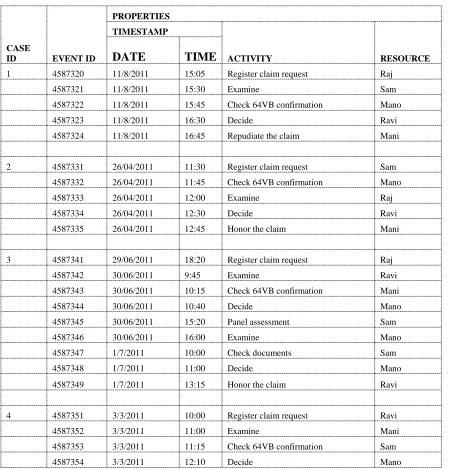
Table 1: A fragment of insurance event log : each line corresponds to an event
CASE
ID EVENT ID
PROPERTIES
TIMESTAMP
ACTIVITY RESOURCE
DATE
TIME
1 4587320 11/8/2011 15:05 Register claim request Raj
4587321 11/8/2011 15:30 Examine Sam
4587322 11/8/2011 15:45 Check 64VB confirmation Mano
4587323 11/8/2011 16:30 Decide Ravi
4587324 11/8/2011 16:45 Repudiate the claim Mani
2 4587331 26/04/2011 11:30 Register claim request Sam
4587332 26/04/2011 11:45 Check 64VB confirmation Mano
4587333 26/04/2011 12:00 Examine Raj
4587334 26/04/2011 12:30 Decide Ravi
4587335 26/04/2011 12:45 Honor the claim Mani
3 4587341 29/06/2011 18:20 Register claim request Raj
4587342 30/06/2011 9:45 Examine Ravi
4587343 30/06/2011 10:15 Check 64VB confirmation Mani
4587344 30/06/2011 10:40 Decide Mano
4587345 30/06/2011 15:20 Panel assessment Sam
4587346 30/06/2011 16:00 Examine Mano
4587347 1/7/2011 10:00 Check documents Sam
4587348 1/7/2011 11:00 Decide Mano
4587349 1/7/2011 13:15 Honor the claim Ravi
4 4587351 3/3/2011 10:00 Register claim request Ravi
4587352 3/3/2011 11:00 Examine Mani
4587355 3/3/2011 15:25 Panel assessment Sam
4587356 3/3/2011 17:00 Check documents Mano
4587357 3/3/2011 17:45 Examine Sam
4587358 4/3/2011 9:30 Decide Mano
4587359 4/3/2011 10:15 Honor the claim Mano
5 4587391 17/09/2011 11:30 Register claim request Sam
4587392 17/09/2011 11:45 Examine Mano
4587393 17/09/2011 12:30 Check 64VB confirmation Mano
4587394 17/09/2011 12:45 Decide Ravi
4587395 17/09/2011 15:30 Panel assessment Mani
4587396 17/09/2011 14:10 Check documents Raj
4587397 17/09/2011 15:00 Examine Ravi
4587398 17/09/2011 15:30 Decide Ravi
4587399 17/09/2011 15:45 Repudiate the claim Mani
The above table represents the information in an event log. The bare minimum requirements for process mining are that an event can be related to both a case and an activity.
[image:3.612.325.546.381.623.2]With the information from the above table we obtain the more compact information representation of the event log as shown below.
Table 2 :Trace of the event log
CASE
ID TRACE
1 (a,b,c,d,h)
2 (a,c,b,d,g)
3 (a,b,c,d,e,b,f,d,g)
4 (a,b,c,d,e,f,b,d,g)
5 (a,b,c,d,e,f,b,d,h)
In the above table, the case is represented by a sequence of activities referred to as trace and the activity names are represented by single letter labels. The various labels mentioned in the table denotes as
a – Register claim request
b – Examine
c - Check 64VB confirmation
d – Decide
e - Panel assessment
f – Check documents
g – Honor the claim
h – Repudiate the claim
The information given in the above table can be transformed into a process model.
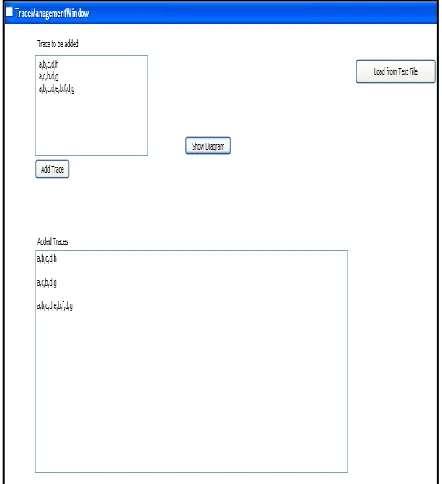
IV. MODEL GENERATOR OF THE TRACE TABLE
ISSN 2250-3153
V. CONCLUSION
In this paper we discussed the challenges in handling digital data by the insurance companies and the suitability of process mining techniques to handle situation was also discussed. The trace table of the motor insurance claim process has been converted into a graphical model which is tangible visual model and may be used to identify the deviations, overlap and deadlock. By eliminating this, the process may be enhanced or reengineered so as to achieve the improved throughput of the process.
REFERENCES
[1] Wil M.P. Van der Aalst, 2010,Process Mining, Springer
[2] W.M.P. Van der Aalst 1998 The applications of Petri Nets to work flow management , The journal of Circuits, Systems and computers
[3] W.M.P. Van der Aalst and K.M.Van Hee. Workflow Management: Models, Methods , and system. MIT press, Cambridge, MA, 2002. [4] S.Kumaran and K.Raja, Modeling and simulation of Projects with Petri
Nets. American journal of applied Sciences, 2008.
[5] A.J.M.M Weijters and W.M.P Van der Aalst, Process Mining : 2001 Discovering workflow Models from Event based Data, 13th Belgium- Netherlands Conference on Artificial intelligence(BNAIC 2001).
[6] W.M.P van der Aalst A.J.M.M. Weijters, and L. Maruster. 2004, Work flow Mining: Discovering process models from Event Logs. IEEE Transactions on Knowledge and Data Engineering
AUTHORS
First Author – P V Kumaraguru is a Research scholar of Dr.
MGR Educational and research Institute University Chennai 600095 India ([email protected])