Lecture Timetable Scheduling Software
BY
Ebieto, C. E
Department of Mechanical Engineering, University of Port Harcourt, Port Harcourt, Nigeria. Email: [email protected]; Phone: 08037728846
DOI: 10.29322/IJSRP.8.9.2018.p8155
http://dx.doi.org/10.29322/IJSRP.8.9.2018.p8155
ABSTRACT
In this paper, computer software is designed for optimum scheduling of timetable for courses in educational institutions. This system uses Dynamic Slot Algorithm (DSA) with the application of Constraint Satisfaction Programming. The algorithm was transformed into a program using Microsoft Excel-visual basic for application (Excel-VBA). It has been used for the timetable of the Faculty of Engineering, University of Port Harcourt. Results obtained are better than those generated manually by the human timetabler as they show a much higher space and time utilization, apart from the great speed associated with computer productions.
Key words: Excel Add-Ins, Computer software, Excel-VBA, Constraint Satisfaction Programming, Timetable.
INTRODUCTION
Timetable scheduling is the problem of assigning courses or examinations to periods
and to classrooms. Although the course and examination timetables are related to each other, they can be quite different. For example, generally, it is possible to have more than one examination on in a large examination hall at any particular time, whereas it would be extremely unlikely that lectures (courses) on more than one course would take place in the same hall, no matter how large that hall is. This means that, practically, the examination timetable scheduling process must be carried out centrally by the institution. Therefore the examination timetabling problem is a subset of the course timetabling problem.
The automatic timetable construction is within the sphere of combinatorial search algorithms [1]. Particular techniques which have been used to deal with the search problems include integer programming [2]; genetic or evolutionary algorithms [3,4]; and simulated annealing [5]. However, each of these techniques plagued by a shortcomings ranging from performance unreliability, blurred search landscapes, and high resource utilization [6,7,8].
optimization problems but was still considered to be a good problem solving technique [12]. Evolutionary algorithms (EAs) are a class of direct, probabilistic search and optimization algorithms gleaned from the model of organic evolution. It is a problem solving and optimization method that uses genetics as its model problem and applies the rules of reproduction, general crossover and mutation to pseudo-organizations so that those organizations can pass beneficial and survival-enhancing traits to the new generation [3]. It is claimed that Genetic Algorithms have a greater capacity than any other search method in finding the largest number of possible solutions and depict the best possible results [4]. However, GAs still fall short in the choice of control parameters, the exact roles of crossover and mutation, and the characterization of search landscapes for optimization and convergence characteristics [7].
Constraint Satisfaction Programming (CSP) is a relatively new technique for dealing with search problems [13,14]. It involves searching for the values of problem variables subject to constraints on their feasible combinations. In some cases, the satisfaction of the constraints leads to conflicts with the problem objectives. Thus, only the solution of the sub-problem (by satisfying a subset of the constraints) is possible, if the problem objectives must be met; this is the case of Partial Constraint Satisfaction Programming (PCSP). PCSP with dynamic slot algorithm (DSA) is a particular application of CSP which is an algorithm where the process of finding solution to a problem is dependent on the strategy chosen. Therefore, it involves the theory of multistage decision process where the overall problem with n variables is sub-divided into n sub-problems, each sub-problems being a decision making problem in one variable. The optimal solutions of these sub-problems can now be used to find an optimal solution to the overall problem. The major advantages are as follows: (i) constraint propagation reduces the search space so it takes less time to search thus
minimizing backtracking; (ii) memory requirement is smaller since the search space has been reduced; (iii) all available resources are represented in the form of constraints and hence user preferences and requirements can be easily satisfied.
This paper, therefore presents an Excel-VBA based computer software for scheduling lecture timetable in educational institutions by partial constraint satisfaction programming with dynamic slot algorithm. It is then applied for the special case of lecture timetabling of the Faculty of Engineering lectures at the University of Port Harcourt.
METHODOLOGY
The Timetabling Problem
The timetabling process consists of two distinct phases:
• The curricula, that is, lists of courses, are defined for each class and various resources (manpower and/or equipment) are assigned to them.
• A detailed timetable is composed which is compatible with the previously defined requirements and with some additional constraints as well.
The second phase is the one which is usually referred to as the timetabling problem. Due to the complexity of this problem, it is worthwhile trying to solve it by a computer instead of tackling it manually.
The timetabling problem involves scheduling some relations that can be obtained between finite specific resources such as lecturers, students, classrooms, hours, and courses with the respect to some hard and soft constraints. The main differences between the hard and soft
Some examples of hard constraints are:
• A lecturer can only teach in a single place at a time.
• A lecturer can only give one lecture at a time.
• A venue can only host one lecture at a time.
• A student can only attend one lecture at a time.
• Class room capacity must be respected. • Not more than one lecturer is scheduled
to hold in a classroom at a time.
• Each course is scheduled in a proper room (for example, a laboratory course needs proper laboratory).
Some examples of soft constraints are:
• A lecturer should not teach more than 6 hours a day.
• A student should not have more than 8 hours a day.
• There should not be unnecessary gaps in the activity of the lecturers.
• There should not be unnecessary gaps in the activity of the students.
• The courses should be scheduled in the morning and laboratories in the after-noon.
• Some lectures are scheduled a priori.
• As much as possible the preferences of the lecturers and the ones of the students should be respected.
• Launch break should be respected.
LTSS – A Timetable Construction System
LTSS (Lecture Timetable Scheduling Software) uses a Dynamic Slot Algorithm (DSA) which is a method for reducing the runtime of algorithms exhibiting the properties of overlapping sub-problems (that is the same sub-sub-problems are used to solve many different larger problems) and optimal substructures (that is, the optimal solutions of sub-problems can be used to find the optimal solutions of the overall problem).
DSA also apply memoization which involve saving the solution to problems that have already been solved so that if we need to solve the same problem later, we can retrieve and reuse our already computed solution. A number of assumptions and constraints have been taken into consideration to meet the requirement of the Faculty of Engineering University of Port Harcourt.
More specifically, four main assumptions have been considered:
• Each course is split into two or more lecture time depending on its credit unit • Each course can be lecture, practical or
both; lecture Courses are taught in class rooms, whereas practical courses are performed in laboratories or workshops. Each course (lecture or practical) assumed to have a fixed class size. • Each course belongs to a specific level
of study (year) and falls under one out of five separate levels (year 1, year 2, year 3, year 4, and year 5); and the courses in each year are further classified as General, Interfaculty, Faculty, or Departmental in that order of priority. • General courses are done by only year 1
students; and all Departments take the same courses in year 1.
Apart from these conditions, five main constraints have been taken into consideration:
• No two lectures can be scheduled the same day and period of time in the same venue.
• No two courses belonging to the same level of study should overlap if they are for the same Department or the entire Faculty.
• The lecture venues allocated for a particular course should be large enough to fit the student class size. • If a faculty course has been
scheduled in a particular time, no other departmental course of the same level should be scheduled at that time.
Three basic criteria have been set in LTSS, which of course can be easily expanded and improved:
• In other to achieve the best utilization of each venue, it is desirable that each course is scheduled in a venue with enough capacity to accommodate the number of students attending this course. • It is desirable that all courses belonging
to the same level, if scheduled in the same day, should be taught in periods of time with minimum gaps between them as possible.
Solution Generation
The problem depicts each department as offering several courses per semester and each course having a specific period/duration in hours per week (corresponding to the credit units). Each of the specified periods can thus be defined as the contact hours between lecturers and students from a specified time and at a particular venue.
The timetabling problem can thus be defined as an assignment of time tj, 1≤ j≤m and venues vk, 1≤k≤ pto courses S(i), 1≤i≤n taught by lecturers L[S(i)] such that all constraints C[S(i)] are satisfied; where L[S(i)] and C[S(i)] are lecturers of and constraints on courses, respectively; m, p, and n are integer variables. Thus, generally, the CSP for a timetabling problem is as follows:
1. A finite set of variables, X1---Xn 2. For each variable Xi a set of domains
D1---Dn containing possible values of Xi.
3. A finite set of constraints, C1 ---Cq representing relations between variables.
A solution to the constraint satisfaction programming (CSP) involves assigning values from domains of all variables such that all constraints are satisfied.
These values for the domains are generated using a Random function as shown below:
(
)
(
* +0)
= v rndX (1)
where:
v is the number of venues and the days available
rnd is the generated random number The following function was constructed for this work to test the value of the timetable. The value of a timetable V(t) is given by:
Q P N t
V( )= − − (2) where:
N is the number of classes assigned to the available venues (excluding the unconstraint venues).
P is the number of classes with conflict.
Q is the number of classes that could not be schedule.
This function, although discrete, will have a maximum value equal to C, the number of lecture scheduling that need to be made. Its minimum value must necessarily be greater than -C. when the function V(t)is applied to the timetable scheduling; the value of the function continually drops as C increases.
than 50% of the available courses (at 50%, )
(t V =0).
Implementation
The software LTSS (Lecture Timetable Scheduling Software) is quite flexible and it provides the user with a windows environment interface which is designed so that it can be easily handled by a non-expert. The user create the database for courses, lecture venues and laboratories that will be included in the timetable or create his/her own data by modifying (i.e. adding, removing or changing) some of the data’s that is already in the database. He/she is also required to set the constraints concerning the availability of lecture venues (i.e. define the days and periods of time in these days in which they are available) if applicable to any of the venues while venues that are not constraints are given all the days of the week. As soon as the creating of the database stage has been completed, you will be required to choose if there is any preferential course you will want to schedule (i.e. these are General or Inter-Faculty courses with a fixed time and days of the week. These courses can not be altered).when you are true if any preferential course, the main process starts which includes the following:
• You select a particular Department (according to priority) to schedule which automatically displays the courses offered by that department then you select a course to schedule and enter the class size.
• The system checks with the available venues for that department, the venues that meet that class size and select a venue from the list and also checks if that selected venue is a constraint venue or not.
• The program traverse through the search spaces via recursion with backtracking upon constraint failure until there is an optimum solution. However, if it cannot find a solution due to lack of venue, the program terminates notifying the user that there is no venue for that course.
When all these steps have been successfully completed for all unscheduled courses, the solution is displayed on an Excel spreadsheet and printed on a printer device.
RESULTS AND DISCUSSION
For a timetable scheduling software to be complete, a flexible user interface should be provided, so that the specific requirement of the problem can be stated (courses, venue available, etc.). LTSS provides such an interface.
The LTSS interface has been developed using Microsoft excel-visual basic for application (Excel-VBA). The interface allows the user to define the software parameters as preferred. Not only does it make it possible for the user to enter the particular courses, etc. that are to be
Scheduled, it also enables the dynamic slotting of the course.
Figure 1: Excel worksheet showing the start drop menu
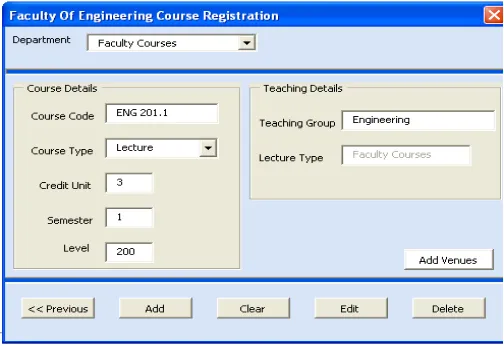
[image:6.612.54.298.74.181.2]By clicking on the start button of the Time-Table menu we see the window of figure 2. click proceed to move to the next window (figure 3) where you will be required to enter the session, semester, and faculty (this is because we intend to expand the scope to the university at large but for this case you click on Engineering) you are scheduling the timetable for. You first click on Database (figure 3) to build your database (figure 4) if there is no existing database or if you want to make any changes to an existing database. When through with building the database, you click previous to return to the formal environment (figure 2) and click Build timetable to move to the final stage (figure 5) where you carry out the scheduling. However if there are preferential courses to schedule, you can either move from figure 2, depending on how you responded to the questions on clicking Build Timetable or you can move from figure 4 by clicking Go to preference on the environment to get to the preference Environment (figure 6).
Figure 2: LTSS Welcome Interface
Figure 3: LTSS Initializing Interface
[image:6.612.324.576.309.415.2] [image:6.612.324.576.463.636.2]Figure 5: LTSS Interface
Figure 6: Preference Interface
Data set from the Faculty of Engineering University of Port Harcourt was used for scheduling the Timetable. With regard to the performance of the software at run-time, LTSS has been tested and has yielded most satisfactory results, not only at respecting the user preferences that had been entered but also
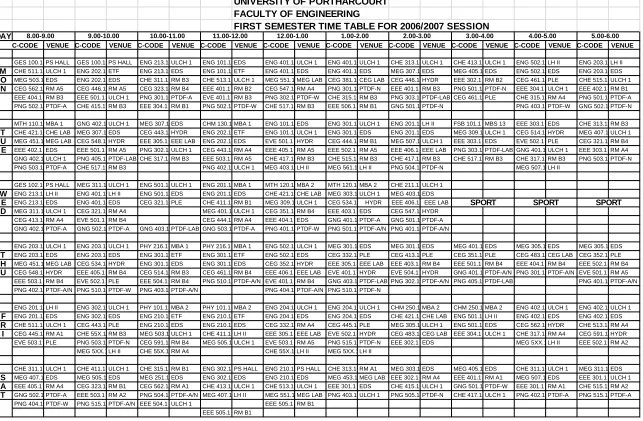
at reaching an optimum solution to the specific timetabling problem. Figure 7 shows an example timetable generated for 2006/2007 academic session.
[image:7.612.62.302.347.579.2]FACULTY OF ENGINEERING
FIRST SEMESTER TIME TABLE FOR 2006/2007 SESSION DAY
C-CODE VENUE C-CODE VENUE C-CODE VENUE C-CODE VENUE C-CODE VENUE C-CODE VENUE C-CODE VENUE C-CODE VENUE C-CODE VENUE C-CODE VENUE
GES 100.1 PS HALL GES 100.1 PS HALL ENG 213.1 ULCH 1 ENG 101.1 EDS ENG 401.1 ULCH 1 ENG 401.1 ULCH 1 CHE 313.1 ULCH 1 CHE 413.1 ULCH 1 ENG 502.1 LH II ENG 203.1 LH II
M CHE 511.1 ULCH 1 ENG 202.1 ETF ENG 213.1 EDS ENG 101.1 ETF ENG 401.1 EDS ENG 401.1 EDS MEG 307.1 EDS MEG 405.1 EDS ENG 502.1 EDS ENG 203.1 EDS
O MEG 503.1 EDS ENG 202.1 EDS CHE 311.1 RM B3 CHE 513.1 ULCH 1 MEG 551.1 MEG LAB CEG 381.1 CEG LAB CEG 446.1 HYDR EEE 302.1 RM B2 CEG 461.1 PLE CHE 515.1 ULCH 1
N CEG 562.1 RM A5 CEG 446.1 RM A5 CEG 323.1 RM B4 EEE 401.1 RM B2 CEG 547.1 RM A4 PNG 301.1 PTDF-N EEE 401.1 RM B3 PNG 501.1 PTDF-N EEE 304.1 ULCH 1 EEE 402.1 RM B1 EEE 404.1 RM B3 EEE 501.1 ULCH 1 PNG 301.1 PTDF-A EVE 401.1 RM B3 PNG 302.1 PTDF-W CHE 315.1 RM B3 PNG 303.1 PTDF-LAB CEG 461.1 PLE CHE 315.1 RM A4 PNG 501.1 PTDF-A PNG 502.1 PTDF-A CHE 415.1 RM B3 EEE 304.1 RM B1 PNG 502.1 PTDF-W CHE 517.1 RM B3 EEE 506.1 RM B1 GNG 501.1 PTDF-N PNG 403.1 PTDF-W GNG 502.1 PTDF-N
MTH 110.1 MBA 1 GNG 402.1 ULCH 1 MEG 307.1 EDS CHM 130.1 MBA 1 ENG 101.1 EDS ENG 301.1 ULCH 1 ENG 201.1 LH II FSB 101.1 MBS 13 EEE 303.1 EDS CHE 313.1 RM B3
T CHE 421.1 CHE LAB MEG 307.1 EDS CEG 443.1 HYDR ENG 202.1 ETF ENG 101.1 ULCH 1 ENG 301.1 EDS ENG 201.1 EDS MEG 309.1 ULCH 1 CEG 514.1 HYDR MEG 407.1 ULCH 1
U MEG 451.1 MEG LAB CEG 548.1 HYDR EEE 305.1 EEE LAB ENG 202.1 EDS EVE 501.1 HYDR CEG 444.1 RM B1 MEG 507.1 ULCH 1 EEE 303.1 EDS EVE 502.1 PLE CEG 321.1 RM B4
E EEE 402.1 EDS EEE 501.1 RM A5 PNG 302.1 ULCH 1 CEG 443.1 RM A4 EEE 405.1 RM A5 EEE 502.1 RM A5 EEE 406.1 EEE LAB PNG 303.1 PTDF-LAB GNG 401.1 ULCH 1 EEE 303.1 RM A4 GNG 402.1 ULCH 1 PNG 405.1 PTDF-LAB CHE 317.1 RM B3 EEE 503.1 RM A5 CHE 417.1 RM B3 CHE 515.1 RM B3 CHE 417.1 RM B3 CHE 517.1 RM B3 CHE 317.1 RM B3 PNG 503.1 PTDF-N PNG 503.1 PTDF-A CHE 517.1 RM B3 PNG 402.1 ULCH 1 MEG 403.1 LH II MEG 561.1 LH II PNG 504.1 PTDF-N MEG 507.1 LH II
GES 102.1 PS HALL MEG 311.1 ULCH 1 ENG 501.1 ULCH 1 ENG 201.1 MBA 1 MTH 120.1 MBA 2 MTH 120.1 MBA 2 CHE 211.1 ULCH 1
W ENG 213.1 LH II ENG 401.1 LH II ENG 501.1 EDS ENG 201.1 EDS CHE 421.1 CHE LAB MEG 303.1 ULCH 1 MEG 403.1 EDS
E ENG 213.1 EDS ENG 401.1 EDS CEG 321.1 PLE CHE 411.1 RM B1 MEG 309.1 ULCH 1 CEG 534.1 HYDR EEE 406.1 EEE LAB
D MEG 311.1 ULCH 1 CEG 321.1 RM A4 MEG 401.1 ULCH 1 CEG 351.1 RM B4 EEE 403.1 EDS CEG 547.1 HYDR CEG 413.1 RM A4 EVE 501.1 RM B4 CEG 444.1 RM A4 EEE 404.1 EDS GNG 401.1 PTDF-A GNG 501.1 PTDF-A GNG 402.1 PTDF-A GNG 502.1 PTDF-A GNG 403.1 PTDF-LAB GNG 503.1 PTDF-A PNG 401.1 PTDF-W PNG 501.1 PTDF-A/N PNG 401.1 PTDF-A/N
ENG 203.1 ULCH 1 ENG 203.1 ULCH 1 PHY 216.1 MBA 1 PHY 216.1 MBA 1 ENG 502.1 ULCH 1 MEG 301.1 EDS MEG 301.1 EDS MEG 401.1 EDS MEG 305.1 EDS MEG 305.1 EDS
T ENG 203.1 EDS ENG 203.1 EDS ENG 301.1 ETF ENG 301.1 ETF ENG 502.1 EDS CEG 332.1 PLE CEG 413.1 PLE CEG 351.1 PLE CEG 483.1 CEG LAB CEG 352.1 PLE
H MEG 451.1 MEG LAB CEG 534.1 HYDR ENG 301.1 EDS ENG 301.1 EDS CEG 352.1 HYDR EEE 305.1 EEE LAB EEE 403.1 RM B4 EEE 501.1 RM B4 EEE 404.1 RM B4 EEE 502.1 RM B4
U CEG 548.1 HYDR EEE 405.1 RM B4 CEG 514.1 RM B3 CEG 461.1 RM B4 EEE 406.1 EEE LAB EVE 401.1 HYDR EVE 504.1 HYDR GNG 401.1 PTDF-A/N PNG 301.1 PTDF-A/N EVE 501.1 RM A5 EEE 503.1 RM B4 EVE 502.1 PLE EEE 504.1 RM B4 PNG 510.1 PTDF-A/N EVE 401.1 RM B4 GNG 403.1 PTDF-LAB PNG 302.1 PTDF-A/N PNG 405.1 PTDF-LAB PNG 401.1 PTDF-A/N PNG 402.1 PTDF-A/N PNG 510.1 PTDF-W PNG 403.1 PTDF-A/N PNG 404.1 PTDF-A/N PNG 510.1 PTDF-N
ENG 201.1 LH II ENG 302.1 ULCH 1 PHY 101.1 MBA 2 PHY 101.1 MBA 2 ENG 204.1 ULCH 1 ENG 204.1 ULCH 1 CHM 250.1 MBA 2 CHM 250.1 MBA 2 ENG 402.1 ULCH 1 ENG 402.1 ULCH 1
F ENG 201.1 EDS ENG 302.1 EDS ENG 210.1 ETF ENG 210.1 ETF ENG 204.1 EDS ENG 204.1 EDS CHE 421.1 CHE LAB ENG 501.1 LH II ENG 402.1 EDS ENG 402.1 EDS
R CHE 511.1 ULCH 1 CEG 443.1 PLE ENG 210.1 EDS ENG 210.1 EDS CEG 332.1 RM A4 CEG 445.1 PLE MEG 305.1 ULCH 1 ENG 501.1 EDS CEG 562.1 HYDR CHE 513.1 RM A4
I CEG 445.1 RM A1 CHE 55X.1 RM B3 MEG 503.1 ULCH 1 CHE 411.1 LH II EEE 305.1 EEE LAB EVE 502.1 HYDR CEG 483.1 CEG LAB EEE 304.1 ULCH 1 CHE 317.1 RM A4 CEG 591.1 HYDR EVE 503.1 PLE PNG 503.1 PTDF-N CEG 591.1 RM B4 MEG 505.1 ULCH 1 EVE 503.1 RM A5 PNG 515.1 PTDF-N EEE 302.1 EDS MEG 5XX.1 LH II EEE 502.1 RM A2
MEG 5XX.1 LH II CHE 55X.1 RM A4 CHE 55X.1 LH II MEG 5XX.1 LH II
CHE 311.1 ULCH 1 CHE 411.1 ULCH 1 CHE 315.1 RM B1 ENG 302.1 PS HALL ENG 210.1 PS HALL CHE 313.1 RM A1 MEG 303.1 EDS MEG 405.1 EDS CHE 311.1 ULCH 1 MEG 311.1 EDS
S MEG 407.1 EDS MEG 505.1 EDS MEG 251.1 EDS ENG 302.1 EDS ENG 210.1 EDS MEG 453.1 MEG LAB EEE 302.1 RM A4 EEE 401.1 RM A1 MEG 507.1 EDS EEE 301.1 ULCH 1
A EEE 405.1 RM A4 CEG 323.1 RM B1 CEG 562.1 RM A1 CHE 413.1 ULCH 1 CHE 513.1 ULCH 1 EEE 301.1 EDS CHE 415.1 ULCH 1 GNG 501.1 PTDF-W EEE 301.1 RM A1 CHE 515.1 RM A2
T GNG 502.1 PTDF-A EEE 503.1 RM A2 PNG 504.1 PTDF-A/N MEG 407.1 LH II MEG 551.1 MEG LAB PNG 403.1 ULCH 1 PNG 505.1 PTDF-N CHE 417.1 ULCH 1 PNG 402.1 PTDF-A PNG 515.1 PTDF-A PNG 404.1 PTDF-W PNG 515.1 PTDF-A/N EEE 504.1 ULCH 1 EEE 505.1 RM B1
EEE 505.1 RM B1
9.00-10.00 10.00-11.00 11.00-12.00 12.00-1.00 1.00-2.00 2.00-3.00 3.00-4.00 4.00-5.00 5.00-6.00 8.00-9.00
[image:8.792.79.722.60.481.2]SPORT SPORT SPORT
CONCLUSIONS
This paper has examined the timetable scheduling problem and a specific system called LTSS, which constructs optimum timetables for university courses, is presented. The timetabling problem being a constraint satisfaction one is mapped naturally to the constraints provided by the faculty of Engineering. moreover, the modeling of the problem under consideration profits a lot from the declarative style of programming which is supported by Excel Visual basic for application
The performance of LTSS is quite satisfactory, considering that it is a program that has to run once or twice a year for the construction of the timetable of an educational organization. Some improvements which are currently under development will certainly enhance the system's functionality. On a positive final note, there would appear to be almost no training issues to be addressed.
ACKNOWLEDGMENT
My sincere gratitude goes to my undergraduate project supervisor, Late Prof. C.O.C. Oko for his support and guidance during this work.
REFERENCES
[1] de Werra, D. (1985), An Introduction to
Timetabling. European Journal of
Operational Research, 19:151-162.
[2] Makower, M. S. and Williamson, E.
(1975), Operational Research – Teach
Yourself Book
[3] Chambers L. (1995), Practical Handbook
of Genetic Algorithms: Applications
[4] Maxfield, C. (1997), Genetic
Algorithms: programs that boggle the
mind. EDN.
[5] Abramson, D. (1991), Constructing
School Timetable Using Simulated
Annealing, Sequential and Parallel
Algorithms Management-Science.
[6] Taha, T. R. (1987), Numerical schemes
for nonlinear evolution equations, The
College Journal of Science and
Technology (Jerusalem).
[7] Srinivas, M. and Patnik, L. M. (1994),
Genetic Algoriths: a survey. Dordrecht
Kluwer Academic Publishers.
[8] Dikmann, R., Luling, R. and Simon, J.
(1993), Problem independent distributed
simulated annealing and its
applications. Technical Report –
Paderborn Center for Parallel
Computing.
[9] Schaerf, A. (1996), Tabu search
techniques for large high-school
timetabling problems. Proceedings of the
Thirteenth national Conference on
Artificial Intelligence and the Eighth
Innovative Applications of Artificial
Intelligence Conference. MIT Press.
[10] Osman, I. H. and Kelly, J. P. (1996),
Meta-Heuristics: Theory and
Applications. Kluwer Academic
[11] Wren, A. (1996), Scheduling,
timetabling and rostering - a special
relationship? Practice and Theory of
Automated Timetabling. First
International Conference. Selected
Papers. Springer-Verlag, Berlin,
Germany.
[12] Zoints, S. (1974), Linear and Integer
Programming. Prentice-Hall Inc.
[13] Tsang, E. P. K., Mills, P., Williams, R.,
Ford, J. and Borrett, J. (1999), A
computer aided constraint programming
system, The First International
Conference on The practical Application
of Constraint Technologies and Logic
Programming (PACLP), London.
[14] Deris, S., Omatu, S., Ohta, H. and
Abd-Samai, P. (1997), Object-oriented
constraint logic programming for
timetable planning, International Journal