Middle and Secondary Education Dissertations Department of Middle and Secondary Education
5-11-2018
Navigating Reform in Mathematics Teacher
Education: Teacher Educators' Responses to
edTPA and Professional Organizations' Initiatives
Alesia Mickle Moldavan Georgia State University
Follow this and additional works at:https://scholarworks.gsu.edu/mse_diss
This Dissertation is brought to you for free and open access by the Department of Middle and Secondary Education at ScholarWorks @ Georgia State University. It has been accepted for inclusion in Middle and Secondary Education Dissertations by an authorized administrator of ScholarWorks @ Georgia State University. For more information, please [email protected].
Recommended Citation
Moldavan, Alesia Mickle, "Navigating Reform in Mathematics Teacher Education: Teacher Educators' Responses to edTPA and Professional Organizations' Initiatives." Dissertation, Georgia State University, 2018.
ACCEPTANCE
This dissertation, NAVIGATING REFORM IN MATHEMATICS TEACHER EDUCATION: TEACHER EDUCATORS’ RESPONSES TO EDTPA AND PROFESSIONAL
ORGANIZATIONS’ INITIATIVES, by ALESIA MICKLE MOLDAVAN, was prepared under the direction of the candidate’s Dissertation Advisory Committee. It is accepted by the
committee members in partial fulfillment of the requirements for the degree, Doctor of Philosophy, in the College of Education and Human Development, Georgia State University. The Dissertation Advisory Committee and the student’s Department Chairperson, as
representatives of the faculty, certify that this dissertation has met all standards of excellence and scholarship as determined by the faculty.
_________________________________ David W. Stinson, Ph.D.
Committee Chair
_________________________________ Janice B. Fournillier, Ph.D.
Committee Member
_________________________________ Pier A. Junor Clarke, Ph.D.
Committee Member
_________________________________ Joyce E. Many, Ph.D.
Committee Member
_________________________________ Date
_________________________________ Gertrude Tinker Sachs, Ph.D.
Chairperson, Department of Middle and Secondary Education
_________________________________ Paul A. Alberto, Ph.D.
AUTHOR’S STATEMENT
By presenting this dissertation as a partial fulfillment of the requirements for the advanced degree from Georgia State University, I agree that the library of Georgia State University shall make it available for inspection and circulation in accordance with its regulations governing materials of this type. I agree that permission to quote, to copy from, or to publish this
dissertation may be granted by the professor under whose direction it was written, by the College of Education and Human Development’s Director of Graduate Studies, or by me. Such quoting, copying, or publishing must be solely for scholarly purposes and will not involve potential financial gain. It is understood that any copying from or publication of this dissertation which involves potential financial gain will not be allowed without my written permission.
NOTICE TO BORROWERS
All dissertations deposited in the Georgia State University library must be used in accordance with the stipulations prescribed by the author in the preceding statement. The author of this dissertation is:
Alesia Mickle Moldavan 106 Brickworks Circle NE
Atlanta, GA 30307
The director of this dissertation is:
David W. Stinson, Ph.D.
Department of Middle and Secondary Education College of Education and Human Development
CURRICULUM VITAE
Alesia Mickle Moldavan ADDRESS: 106 Brickworks Circle NE
Atlanta, GA 30307 EDUCATION:
Ph.D. 2018 Georgia State University, Atlanta, GA
Teaching and Learning – Mathematics Education Certificate 2018 Georgia State University, Atlanta, GA
Qualitative Research
Certificate 2016 Georgia State University, Atlanta, GA International Education
M.Ed. 2014 Georgia State University, Atlanta, GA Mathematics Education
B.S.Ed. 2011 University of Georgia, Athens, GA Mathematics Education
PROFESSIONAL EXPERIENCE:
2014–2018 Graduate Research Assistant
Georgia State University, Atlanta, GA 2015–2016 University Supervisor
Georgia State University, Atlanta, GA 2015 Graduate Teaching Assistant
Georgia State University, Atlanta, GA 2011–2014 Mathematics Instructor
Rockdale Magnet School for Science and Technology, Conyers, GA 2014 STEM Saturday Enrichment Program Instructor
Georgia State University, Atlanta, GA 2011 Summer School Mathematics Instructor
Centennial High School, Roswell, GA
2011 Pathways Credit Recovery Mathematics Instructor Clarke Central High School, Athens, GA
PUBLICATIONS (selected):
Junor Clarke, P. A., Moldavan, A. M., & Porter, E., II. (in press). Exploring co-planning and co-teaching strategies in preservice secondary mathematics teachers’ clinical experiences.
Proceedings of the 11th annual meeting of the Georgia Association of Mathematics
Teacher Educators.Eatonton, GA.
Moldavan, A. M. (in press). Unraveling the mathematics of Ndebele beadwork: Transformations on an indigenous Cartesian plane. In I. C. Chahine & J. De Beer (Eds.), Evidence-based
inquiries in ethno-STEM research: Embodied, situated and distributed knowledge systems.
Emerson, J. M., Junor Clarke, P., & Moldavan, A. M. (2018). Bridging pedagogy and practice: From coursework to field experiences in a teacher preparation program. Georgia
Educational Researcher, 14(2), 24–35.
Junor Clarke, P. A., Mickle, A. D., & Porter, E., II. (2016). Modeling co-teaching approaches to enhance preservice mathematics teachers’ knowledge and skills for teaching. In M. B. Wood, E. E. Turner, M. Civil, & J. A. Eli (Eds.), Proceedings of the 38th annual meeting of the North American Chapter of the International Group for the Psychology of
Mathematics Education (p. 943). Tucson, AZ: The University of Arizona.
Mickle, A., & Junor Clarke, P. (2015). Using TI-Nspire to engage preservice mathematics teachers in an exploratory geometry module. Proceedings of the 9th annual meeting of the
Georgia Association of Mathematics Teacher Educators (pp. 13–40). Eatonton, GA.
PRESENTATIONS (selected):
Moldavan, A. M. (2018, April). (Re)defining access and equity in preparing for the edTPA. Paper presented at the National Council of Teachers of Mathematics Research Conference, Washington, D.C.
Junor Clarke, P., & Moldavan, A. M. (2018, February). Preservice secondary mathematics
teachers exploring a co-teaching model during their clinical experiences. Paper presented
at the 22nd annual meeting of the Association of Mathematics Teacher Educators, Houston, TX.
Junor Clarke, P., Mickle, A., & Calder, E. (2016, October). A MUST in your toolbox: Exploring
geometry classroom-based situations. Presentation conducted at the 58th annual meeting of
the Georgia Council of Teachers of Mathematics, Eatonton, GA.
Junor Clarke, P., & Mickle, A. (2016, April). Promoting proactive preparation and learning of
the edTPA’s assessment task across the curriculum. Presentation conducted at the
National edTPA Implementation Conference, Savannah, GA.
Alexander, M., & Mickle, A. (2016, March). Introduction to ethnomathematics. Presentation conducted at the 28th International Conference on Technology in Collegiate Mathematics
(ICTCM), Atlanta, GA.
Mickle, A. (2015, October). STEM project-based learning: Increasing students’ motivation and
academic achievements. Presentation conducted at the 9th annual meeting of the Georgia
Association of Mathematics Teacher Educators, Eatonton, GA.
Mickle, A., Holihan, J., & Junor Clarke, P. (2015, October). Prove it: Using TI-Nspire in
geometry problem-solving tasks. Presentation conducted at the 57th annual meeting of the
Georgia Council of Teachers of Mathematics, Eatonton, GA.
Chahine, I., & Mickle, A. (2013, April). Integrating ethnomathematics in mathematics teaching.
Presentation conducted at The University System of Georgia Teaching and Learning Conference, Athens, GA.
PROFESSIONAL SOCIETIES AND ORGANIZATIONS (selected): American Educational Research Association
Association of Mathematics Teacher Educators
Georgia Association of Mathematics Teacher Educators Georgia Council of Teachers of Mathematics
NAVIGATING REFORM IN MATHEMATICS TEACHER EDUCATION:
TEACHER EDUCATORS’ RESPONSES TO EDTPA AND PROFESSIONAL
ORGANIZATIONS’ INITIATIVES
by
ALESIA MICKLE MOLDAVAN
Under the Direction of Dr. David W. Stinson
ABSTRACT
Teacher education reform is a controversial and highly politicized issue, especially when addressing ways to improve teacher quality, performance, and accountability (Cochran-Smith, Piazza, & Power, 2013). With national efforts to adopt more rigorous standards and
comprehensive assessments (e.g., National Commission on Excellence in Education, 1983; U.S. Department of Education, 2011), teacher performance assessments and other reform
In September 2015, the state of Georgia mandated that all prospective teachers attempt the edTPA during their teacher preparation programs and successfully pass to receive their teacher certification (GaPSC Rule 505-2-.26 Certification and Licensure Assessments, 2016). The policy forced not only prospective teachers to respond to the assessment but also teacher educators. This study uses a qualitative case study framed within a sociopolitical perspective to critically examine how nine secondary mathematics teacher educators from various institutions (i.e., large public, medium public, small private, and Historically Black Colleges and
Universities) in Georgia respond to the edTPA and professional organizations’ reform initiatives (e.g., AMTE, 2017; NCTM, 2000, 2014) when preparing their prospective secondary
mathematics teachers for teacher certification. Additionally, the study explores how the participants develop their prospective teachers’ understandings of the social contexts of mathematics teaching and learning while navigating such reform efforts.
Data collection included multiple interviews with and artifact elicitation from each
participant. Data analysis identified eight resonating themes that revealed the edTPA as a catalyst for: (a) motivating program modifications; (b) accommodating edTPA preparatory assignments; (c) altering awareness and discourse in teacher preparation; (d) perpetuating beneficial and detrimental teaching messages; (e) threatening academic freedom; (f) escalating stress and anxiety; (g) developing as a potential gatekeeper; and (h) dehumanizing and deprofessionalizing mathematics education. Additional insight into the participants’ efforts to address social contexts with respect to equity revealed strengths and areas for improvement. Implications for
mathematics teacher education are discussed.
NAVIGATING REFORM IN MATHEMATICS TEACHER EDUCATION: TEACHER EDUCATORS’ RESPONSES TO EDTPA AND PROFESSIONAL
ORGANIZATIONS’ INITIATIVES by
ALESIA MICKLE MOLDAVAN
A Dissertation
Presented in Partial Fulfillment of Requirements for the
Degree of
Doctor of Philosophy
in
Teaching and Learning – Mathematics Education
in
Department of Middle and Secondary Education
in
the College of Education and Human Development Georgia State University
Copyright by Alesia Mickle Moldavan
ACKNOWLEDGMENTS
I would like to thank my doctoral committee for encouraging me to formulate my ideas into words and my words into scholarly research and writing. To my academic advisor, Dr. David Stinson, thank you for taking me under your wing to learn how to navigate academia. You gave me the space to grow as a critical researcher and writer with the Journal of Urban Mathematics
Education. You cared for me, challenged me, and nurtured the skills that enabled me to gain
confidence in my future as a mathematics teacher educator and researcher. To Dr. Janice
Fournillier, I am appreciative of your faith in my work and the shared “bag of tricks” to solidify my methodology. To Dr. Pier Junor Clarke, my academic mommy, I am thankful for the
opportunities to collaborate with grants and research projects and to co-teach secondary mathematics methods courses. Each experience helped me mold my research agenda and teaching philosophy. To Dr. Joyce Many, I am grateful for your shared expertise of the edTPA and the assistantship opportunity that enabled me to work with the edTPA on a more personal level with teacher educators and teacher candidates. I also acknowledge Dr. Gertrude Tinker Sachs, Dr. Caroline Sullivan, and the rest of the faculty in the Department of Middle and
Secondary Education for encouraging me to serve as a university supervisor and capitalize on my learning at Georgia State University. As for my family and friends, I am eternally grateful for my parents, Linde and Michael Mickle, who sacrificed more than I will ever know to love and provide for me. I especially thank my mother and mother-in-law, Dr. Carla Moldavan, for their words of encouragement and meticulous reviews of the dissertation. I am also appreciative of my sister and her husband, Jillian and Nathan Lyles, for their love and support. Most of all, I
TABLE OF CONTENTS
LIST OF TABLES ... vii
LIST OF FIGURES ... viii
CHAPTER 1: INTRODUCTION ... 1
The Journey in Mathematics Education ... 5
Understanding the edTPA Hurdle ... 8
Purpose of the Study ... 12
Research Questions ... 13
CHAPTER 2: LITERATURE REVIEW ... 14
Teacher Performance Assessments ... 16
Teacher Work Sample ... 16
Teacher Performance Assessments in California ... 17
A National Teacher Performance Assessment ... 18
Teacher Certification Requirements in Georgia ... 22
Researching Teacher Performance Assessments ... 25
Teacher Preparation Program Curricula ... 25
Faculty Members ... 30
Teacher Candidates ... 33
edTPA as a Gatekeeper to the Teaching Profession? ... 37
Professional Organizations’ Initiatives in Mathematics Education ... 38
National Council of Teachers of Mathematics ... 38
Association of Mathematics Teacher Educators ... 48
CHAPTER 3: THEORETICAL FRAMEWORK ... 54
A Brief Historical Review of Mathematics Education Research ... 54
The Social Turn in Mathematics Education ... 57
A Sociocultural Perspective ... 59
A Sociopolitical Perspective ... 61
Curriculum Through a “New” Lens ... 66
Mapping My Research Lens ... 69
An Assemblage of Theoretical Frameworks ... 71
Felton-Koestler’s What, Who, and How Framework ... 72
Gutiérrez’s Equity Framework ... 81
Mathematics Education as Political? ... 85
CHAPTER 4: METHODOLOGY ... 87
Purpose for Qualitative Case Study Methodology ... 87
Reflecting on My Subjectivity and Positionality ... 89
Philosophical Underpinnings of Stake and Yin ... 93
Defining and Selecting a Case... 97
Case Study Type and Design ... 98
Developing Research Questions ... 102
Research Settings and Participants ... 104
Data Collection and Management ... 110
Data Analysis ... 118
Ethical Concerns ... 122
CHAPTER 5: RESULTS ... 127
Participants and Institutions ... 128
Participants from Large Public Institutions ... 128
Participants from Medium Public Institutions ... 136
Participants from Small Private Institutions ... 139
Participants from HBCU Institutions ... 145
edTPA as a Catalyst for Eight Resonating Themes ... 148
Motivating Program Modifications ... 148
Accommodating edTPA Preparatory Assignments ... 162
Altering Awareness and Discourse in Teacher Preparation ... 173
Perpetuating Beneficial and Detrimental Teaching Messages ... 180
Threatening Academic Freedom ... 193
Escalating Stress and Anxiety ... 196
Developing as a Potential Gatekeeper ... 200
Dehumanizing and Deprofessionalizing Mathematics Education ... 209
Professional Organizations’ Initiatives and the Future of Mathematics Education .... 216
Equity in Mathematics Education ... 223
CHAPTER 6: DISCUSSION ... 240
Reflecting Back to Move Forward ... 240
Limitations ... 249
Suggestions for Further Research... 251
Concluding Remarks ... 253
LIST OF TABLES
LIST OF FIGURES
CHAPTER 1
INTRODUCTION
Teacher education reform is a controversial and highly politicized issue, especially when addressing ways to improve teacher quality, performance, and accountability (Cochran-Smith & Fries, 2001; Cochran-Smith, Piazza, & Power, 2013). In response to national reports initiating the need for reform in education (e.g., National Commission on Excellence in Education [NCEE], 1983; U.S. Department of Education, 2011), policymakers, state departments of education, institutions of higher education, professional organizations, and other stakeholders began to shift their attention to the adoption of more rigorous standards and comprehensive assessments. As an alternative to traditional paper-and-pencil assessments, teaching portfolios were introduced to showcase prospective teachers’1 teaching performance and assessment (Au, 2013). With the advancement of portfolio-type teacher performance assessments used as accountability tools by state legislation and institutions of higher education (e.g., California’s legislation SB 2042, Georgia Professional Standards Commission Rule 505-2-.26 Certification and Licensure Assessments, Western Oregon University’s Teacher Work Sample), teacher educators must determine how they prepare their prospective teachers for such assessments in an era of teacher education reform.
The various ways teacher performance assessments are used within teacher preparation programs and tied to teacher certification has left stakeholders fighting for power. Greenblatt
1 I use “prospective teachers” and “teacher candidates” interchangeably to describe students enrolled in teacher
(2015) described this fight with “teacher performance assessments” as nothing more than “taking power away” (p. 103). Those who wish to turn a blind eye to the dispute prolong a solution from rising out of the turmoil. As Freire (1985) wrote, “washing one’s hands of the conflict between the powerful and the powerless means to side with the powerful, not to be neutral” (p. 122). Thus, I introduce this study as a means of exploring the good, the bad, and the ugly of one state’s adoption of a teacher performance assessment through the lens of secondary mathematics teacher educators’ experiences.
In particular, this study reports on the first nationally available, educator-designed teacher performance assessment for P–12 prospective teachers known as the edTPA®. The edTPA was designed and developed by the Stanford Center for Assessment, Learning and Equity (SCALE) to provide an accountability tool to measure prospective teachers’ readiness to teach (SCALE, 2014a). To aid with edTPA’s continued development and implementation, SCALE partnered with the American Association of Colleges for Teacher Education (AACTE). Additionally, SCALE recruited the Evaluation Systems of Pearson to provide an infrastructure for submitting, scoring, and reporting results. With approximately 40 states using the edTPA and/or other similar teacher performance assessments in varying ways (SCALE, 2014a), such as program completion/graduation, teacher certification, and/or program approval/accreditation, there is much needed research in secondary mathematics teacher educators’ experiences and discourse pertaining to teacher performance assessments (e.g., edTPA) and the messages such assessments send regarding what is privileged and valued in preparing mathematics teachers for twenty-first century classrooms.
Darling-Hammond & Hyler, 2013; Ledwell & Oyler, 2016; Peck, Singer-Gabella, Sloan, & Lin, 2014) and those who warned of its possible harm and deprofessionalization of the field (e.g., Cochran-Smith et al., 2013; Jordan & Hawley, 2016; Madeloni & Gorlewski, 2013). Some researchers have described teacher performance assessments as blueprints to reform teacher preparation programs in institutions of higher education (e.g., Ledwell & Oyler, 2016; Liu & Milman, 2013; Peck, Gallucci, & Sloan, 2010). While some good may come out of program realignment to address “good”teaching practices2 as identified in such assessments, several researchers have feared what programs privilege and the implications that result, such as narrowed and
depersonalized teaching pedagogy (e.g., Dover & Schultz, 2016; Lachuk & Koellner, 2015; Lit & Lotan, 2013; Madeloni & Gorlewski, 2013), the redesign of methods courses and student teaching field experiences (e.g., An, 2016; Barron, 2015), and prospective teacher academic oppression and gatekeeping (e.g., Ratner & Kolman, 2016). Additionally, insight into the perspectives and experiences of teacher educators and prospective teachers engaging with teacher performance assessments have revealed mixed responses to the various ways they have been influenced and affected by the assessments (e.g., Chung, 2008; Guaglianone, Payne, Kinsey, & Chiero, 2009; Meuwissen, Choppin, Shang-Butler, & Cloonan, 2015; Ratner & Kolman, 2016). These examinations, in many ways, have sparked further questioning and critique.
2 The word “good” is placed in quotation marks to recognize that I continue to trouble the concept in regard to what
is identified as a good teaching practice. I also contemplate who speaks on behalf of defining good teaching practices (and for whom) as well as how the implications influence the teaching profession.
In addition to teacher performance assessments, professional mathematics education organizations3 have contributed their own reform initiatives to the teaching and learning of mathematics. For example, the National Council of Teachers of Mathematics (NCTM) initiated standards-based school mathematics to identify significant mathematical concepts and skills, which continues to guide the teaching, learning, and assessment of K–12 mathematics. Recently, NCTM published Principles to Actions: Ensuring Mathematical Success for All (2014) to
address the necessary actions required by teachers and stakeholders to ensure equitable access to high-quality mathematics instruction. One of NCTM’s guiding principles (i.e., access and equity) identified what an “excellent mathematics program” requires for all students to maximize their learning potential. On a similar front, the Association of Mathematics Teacher Educators
(AMTE) published Standards for Preparing Teachers of Mathematics (2017) initiating standards aimed at improving mathematics teacher preparation programs, informing accreditation,
influencing policies, and encouraging discourse on how to advance the preparation of future mathematics teachers.
As secondary mathematics teacher educators prepare the next generation of teachers, they must navigate4 the various reform initiatives proposed by teacher performance assessments (e.g., edTPA) and professional organizations (e.g., AMTE, NCTM). They must not only familiarize
3 Although several professional organizations contribute to mathematics education (e.g., American Mathematical
Society, Georgia Council of Teachers of Mathematics, Mathematical Association of America, National Council of Supervisors of Mathematics, School Science and Mathematics Association), I focus my research (unless otherwise identified) on two particular organizations, which include the National Council of Teachers of Mathematics (NCTM) and the Association of Mathematics Teacher Educators (AMTE).
4 I use the term navigate to examine the course of action secondary mathematics teacher educators take to
understand and respond to reform efforts in mathematics teacher education. Although I contemplated using other terms (e.g., negotiate), I recognize that state mandates and accreditation policies require teacher preparation
themselves with the various initiatives but also grapple with what these initiatives communicate both socially and politically about mathematics teaching and learning. Then, they must determine the ways they respond to the initiatives when preparing, instructing, and assessing prospective teachers in their methods courses. Next, I reveal why this study is of personal interest to me and how the examination of secondary mathematics teacher educators’ responses to various reform initiatives can provide insight into the focus and discourse used to prepare future teachers embarking on the journey in mathematics education.
The Journey in Mathematics Education
People take different roads seeking fulfillment and happiness. Just because they’re not on your road doesn’t mean they’ve gotten lost.
—Dalai Lama Teaching is a specialized skill that must be nurtured, respected, and embraced by those passionate and determined to uphold the responsibilities that come with its undertaking. Teachers must be knowledgeable not only about the content but also proficient in pedagogy that captivates those with inquisitive minds and those awaiting sparks to ignite their interests. I became
interested in teaching as a young child, where I spent numerous hours teaching arithmetic computations to whomever would listen. When my little sister became tired of answering
questions and watching me solve problems, I turned to my Barbie dolls. While in school, I would emulate my teachers and use my creativity to design mathematics-related games and projects to practice newly learned content. Although the mathematics content did not always come easy for me, my dedication to its daily practice and my satisfaction of grasping new concepts stimulated my fascination to further engage with learning mathematics.
mathematics studies. I made it my mission to make mathematics content interesting, relevant, and achievable. I also used my personality, energy, and enthusiasm to excite those I tutored. I hoped to break the cycle of those who disliked the content and believed they could not be successful. My desire to tutor mathematics quickly flourished into my dream career of being a mathematics teacher (and later mathematics teacher educator). With encouragement from my family and the perseverance to make my dream a reality, I enrolled at one of the top mathematics teacher preparation universities in the nation—the Department of Mathematics and Science Education at the University of Georgia (UGA).
The mathematics and mathematics education courses at UGA challenged me to
continuously question and reflect on my evolving understanding of mathematics as a discipline and a teaching profession. As I wrote pages of mathematical proofs, designed lessons to visually represent the division of fractions, and modeled the moon’s elliptical orbit using Geometer’s Sketchpad, just to name a few, I envisioned how my experiences using mathematics could be used in my future classrooms. Interwoven throughout my methods courses were opportunities to engage with the mathematics content as well as conceptualize ways to differentiate and use multiple representations to guide the teaching and learning of mathematics. Some course assignments included working with national and state mathematics standards, writing lesson plans, developing project-based assessments, modeling mathematics with technology, and reflecting on teaching strategies. In addition, I implemented my assignments in both small and large-scale teaching settings. My methods courses coupled with my clinical field experiences represented several guiding pit stops on my journey in mathematics education.
my student teaching experience. More specifically, the exit teaching portfolio included a document addressing the unit’s overview, four extensive lesson plans, and post lesson
reflections. Given my placement in a Math III (precalculus) classroom, I taught eleventh-graders a unit on conic sections. For the unit’s overview, I addressed the unit’s main goals, a daily topic’s outline, and a summary of the assessments. From the daily topic’s outline, I selected four lessons to build the bulk of my portfolio. For each lesson, I had to submit a detailed lesson plan that addressed the lesson’s objectives, materials, Georgia Performance Standards, classroom set-up, and lesson procedures, including the lesson’s opener, time-stamped activities, structure of discussion and questions, extension, assessments, and closure. Throughout the activities and assessments, I addressed issues of equity and diversity with respect to differentiating to learners’ strengths and needs. All instructional materials, differentiated assessments, and examples of student work with teacher feedback were also attached.
I made comments in the margins of each lesson plan to describe my rationale for specific actions (e.g., grouping students, questions asked to highlight misconceptions, strategies used to address learners’ strengths and needs) based on readings and information addressed in the program’s methods courses. As a follow-up to the lesson, I also included detailed reflections of the lesson’s implementation, including how the students responded to the lesson and what I would do differently next time. The assignments made me justify and reflect on my teaching abilities and readiness for the classroom.
prospective teacher given that the professor also served as my university supervisor. Not only did I learn from the exit teaching portfolio and the one-on-one conference feedback but also I used my teaching portfolio to acquire a mathematics teaching position right after graduation.
I realized that my journey in mathematics education was uniquely shaped by my university’s teacher preparation program, including the required tasks and expectations.
However, my understanding of the different paths along the journey was evident after I learned of other colleagues’ experiences. While teaching, I interacted with colleagues who completed teacher preparation programs at institutions of higher education, like myself, and others who took alternative teacher certification routes to become second- and third-career teachers. My interest in the journey of preparing mathematics teachers as well as expanding my knowledge of teaching pedagogy led me to graduate school to seek additional degrees and opportunities to explore a career in mathematics teacher preparation. With engagement in the initial teacher preparation program at my graduate school, I further confirmed that my mathematics teaching journey was only one path of many in mathematics education. When mathematics teachers have varied journeys, the intersection of the unique journeys enables opportunities for colleagues to collaborate and learn from one another’s experiences. I began to wonder how mathematics education might change in response to reform efforts to standardize the journey.
Understanding the edTPA Hurdle
served as the program coordinator, to plan, instruct, and assess the prospective secondary mathematics teachers in both courses. The new cohort of prospective teachers began the
program’s designed sequence of courses during the summer semester. Thus, I not only co-taught two of the prospective teachers’ first methods courses but also I introduced them to program expectations, including the edTPA.
Prior to the start of the program, the cohort of prospective teachers met with the initial teacher preparation coordinator to discuss the state-mandated policy that required all prospective teachers to submit the edTPA to satisfy program requirements for graduation. The policy also required prospective teachers to pass the edTPA to receive their teaching licenses. Although I was not in this meeting, the prospective teachers had several questions regarding the assessment that were later communicated to their program coordinator with whom I co-planned the summer courses. To address the questions and ensure prospective teachers felt comfortable with the Secondary Mathematics edTPA, my co-instructor and I strategically planned the methods courses syllabi and activities to review information pertaining to the assessment’s expectations, including the tasks, commentary prompts, and terminology (i.e., academic language).
Given that I was new to the Secondary Mathematics edTPA, I had to read through the handbook and supplemental materials, such as Making Good Choices: A Support Guide for
edTPA Candidates (SCALE, 2016b), Understanding Academic Language in edTPA: Supporting
Learning and Language Development (SCALE, 2016c), and Understanding Rubric Level
Progressions: Secondary Mathematics edTPA (SCALE, 2016d). I learned about the edTPA
of the curriculum given that it was continuously referred to and, for practice purposes, embedded into the course activities. For example, the format of a written lesson plan was reorganized to include information pertaining to academic language (i.e., discourse, language function, syntax, and vocabulary). Additionally, one of the course’s field component required the prospective teachers to video themselves teaching, practice cutting a clip, and reflect on the piece using timestamps to answer commentary prompts similar to those found in edTPA’s Task 2: Instruction.
Although I observed the edTPA dominate the discourse in the methods courses, my co-instructor and I still made intentional efforts to address other pertinent concepts (e.g., access, culturally relevant pedagogy, equity, social justice). With knowledge of professional
organizations’ initiatives (i.e., AMTE and NCTM), we purposefully embedded social justice and equity issues in class readings, discussions, and reflections. Topics of concern addressed
strategies for holding students to high expectations and for providing access to excellent and equitable mathematics programs that were responsive to students’ prior mathematical
knowledge, personal interests, and intellectual abilities. My co-instructor and I shared beliefs that mathematics should be related to students and their lives and consider the social as well as
political aspects of teaching and learning, which were ideas echoed throughout the methods courses. Besides our efforts to address the social contexts of mathematics teaching and learning while simultaneously preparing prospective teachers for the edTPA, I wondered if other teacher educators in other teacher preparation programs were doing the same and in what ways.
clinical field experiences, I provided feedback on their assignments. These assignments mirrored edTPA’s expectations and required prospective teachers to complete a mock-edTPA Context for Learning, 3-to-5 days of consecutive lesson plans, and other various requirements addressed in edTPA’s tasks, including practice responses to the commentary prompts. The clinical field experience seminars strategically factored in time to review edTPA’s handbooks and the associated tasks’ commentary prompts and rubrics. Additional efforts were made to review academic language and sample edTPA submissions as well as provide technical support (e.g., appropriate file formats, video file trimming and compression, videotaping techniques).
I worked with my assigned prospective teachers to provide feedback and support throughout their edTPA preparation. I witnessed first-hand how prospective teachers, mentor teachers, teacher educators, and university supervisors responded to the edTPA. Despite shared frustration from all involved, the edTPA, as described by SCALE (2014a), brought awareness to “good” teaching. I reflected on my own initial teacher preparation program at UGA and felt that my exit portfolio assignment, with tasks similar to those of the edTPA, made me reflect on good teaching practices without the high-stakes stress. I began to wonder if the extra pressure of a teacher performance assessment was “beneficial” to preparing quality teachers and at what stake. Concerns of how the edTPA might impact initial teacher preparation from both the perspectives of teacher educators and prospective teachers further sparked my research interest.
Implementation Conference on how to support prospective teachers for the Secondary Mathematics edTPA during urban student teaching experiences. The discussed experiences, among others, drew my attention to the need for research on teacher educators’ experiences navigating the edTPA along with other professional mathematics education organizations’ reform initiatives. More specifically, I turned my focus to the state of Georgia, one of the nation’s states requiring a passing score on the edTPA to receive a teaching license.
Purpose of the Study
In September 2015, the state of Georgia mandated that all prospective teachers attempt the edTPA during their teacher preparation programs and successfully pass to receive their teacher certification (GaPSC Rule 505-2-.26 Certification and Licensure Assessments, 2016). The policy required Georgia’s stakeholders and 63 participating institutions to implement the edTPA (AACTE, n.d.-b). Thus, the policy forced not only prospective teachers to respond to the assessment but also teacher educators. Gurl and colleagues (2016) reported that edTPA’s high-stakes ramifications in other states have pressured some teacher preparation programs to divert their attention away from their missions and alter their focus to what the assessment deems “good” teaching. Additionally, edTPA as a top-down, one-size-fits-all assessment is argued as potentially doing more harm than good, especially when viewed from the standpoint of those working with and taking the assessment (e.g., Au, 2013).
organizations’ initiatives (e.g., AMTE, 2017; NCTM, 2000, 2014) when preparing prospective secondary mathematics teachers for teacher certification. I also examine how the secondary mathematics teacher educators develop prospective secondary mathematics teachers’
understandings of the social contexts of mathematics teaching and learning while navigating such reform efforts.
Research Questions
The following three research questions guide the study:
1. How do secondary mathematics teacher educators respond to the edTPA as a state-mandated initiative to reform teacher assessment and readiness for the classroom? 2. What are secondary mathematics teacher educators’ experiences using the Secondary
Mathematics edTPA and professional mathematics education organizations’ initiatives to prepare, instruct, and assess prospective secondary mathematics teachers?
3. How do secondary mathematics teacher educators develop prospective secondary
CHAPTER 2
LITERATURE REVIEW
With teacher education in the political spotlight, stakeholders and policymakers continue to focus their attention on professionalizing teaching and teacher education in hopes to “fix” the broken system (Cochran-Smith & Fries, 2001; Cochran-Smith et al., 2013). Even the former Secretary of Education Arne Duncan echoed similar concerns in a 2009 speech depicting a need for “revolutionary change” in teacher preparation programs given that they were “doing a mediocre job of preparing teachers for the realities of the 21st century classroom” (Duncan, 2009, para. 3). Cochran-Smith and colleagues (2013) attributed the highly politicized debates surrounding teacher education to social institutions being sites of political disagreement with policy-making of teacher quality and preparation regarded as a political enterprise. They asserted that contemporary teacher reform initiatives were focused on raising expectations for teacher performance and administering accountability measures. Institutions of higher education,
national and regional accreditors, and professional organizations are just a few contributors who address these reform initiatives by proposing, piloting, and implementing such policies. In the following literature review, I describe several recent efforts to address reform in teacher
education with particular emphasis on teacher performance assessments, state initiatives, and the work of professional mathematics education organizations.
Risk: The Imperative for Educational Reform (NCEE, 1983). When comparing American schools with other advanced nations, the report revealed “disturbing inadequacies” in the
educational process that contributed to the decline in educational performance (Findings section, para. 1). To reverse the perception that American schools were failing, the Commission
recommended strengthening content requirements, adopting higher expectations and measurable performance standards, improving the preparation of teachers, and holding elected officials and educators responsible to enforce the reform solutions. States enacted such recommendations by initiating mandates that closely monitored school performance reports and student achievement on state assessments.
Meanwhile, Darling-Hammond and the National Commission on Teaching and America’s Future (NCTAF) led efforts to professionalize teaching and teacher education (Cochran-Smith & Fries, 2001). Additional support from the National Council for the Accreditation of Teacher Education (NCATE), the American Association of Colleges for
accomplishments. Teacher performance assessments would serve as one solution to address the professional performance and accountability standards of the new generation of teachers.
Teacher Performance Assessments
Beginning in the 1980s, teacher preparation programs implemented teaching portfolios as a form of performance assessments (Gurl et al., 2016). Teaching portfolios were used as a tool to formatively facilitate growth, summatively assess readiness, meet certification requirements, and communicate teacher candidates’ abilities to employers (Zeichner & Wray, 2001). The teaching portfolio not only addressed the call for a “bar exam” for teachers (Lipsky, 1988) but also it provided more trustworthy evidence of teacher readiness in comparison to a “paper-and-pencil test” (Au, 2013). Teacher candidates could demonstrate their conceptual understanding through performance while also reflecting on their own practice and the complexities of teaching (Wolf, 1996). With efforts to move beyond isolated assessments to more authentic measures of teacher quality and readiness (Darling-Hammond, 2000), state legislation and institutions of higher education adopted various portfolio-type teacher performance assessments (e.g., Teacher Work Sample, California Teaching Performance Assessment, Performance Assessment for California Teachers, Fresno Assessment of Student Teachers, edTPA) to gauge teacher preparation.
Teacher Work Sample
their preparation programs to demonstrate their effectiveness to foster student learning in Oregon’s standards-based model of schooling (Schalock, 1998; Schalock & Myton, 2002). The TWS prompts required teacher candidates to address unit goals and objectives tied to state standards, describe students in the classroom and the community, design lesson plans, generate assessments, provide analyses of student learning, and reflect on teaching practices (Schalock & Myton, 2002). As the TWS quickly gained the attention of teacher preparation programs
throughout the United States, several states adopted their own versions of the TWS (e.g., the Louisiana Components of Effective Teaching, the Iowa Teacher Quality Project, the Ohio Resident Educator Summative Assessment) to evaluate teacher effectiveness and readiness for the classroom.
Teacher Performance Assessments in California
Similarly, the state of California approved legislation SB 2042 (1998) that required teacher preparation programs to adopt teacher performance assessments to assess teacher candidates’ readiness to enter K–12 classrooms with proficient teaching skills. The state’s
Commission on Teacher Credentialing proposed a teacher performance assessment model known as the California Teaching Performance Assessment (CalTPA). The Commission would use the teacher performance assessment as a credential measure to ensure teacher candidates
demonstrated the ability to assist student success meeting and exceeding state content and performance standards. Teacher preparation programs could develop an alternative teacher performance assessment model as long as it was approved by the Commission (California Teaching Performance Assessment, n.d.).
Instruction, the Assessing Learning, and the Culminating Teaching Experience tasks. All but one of the tasks required teacher candidates to work with K–12 students. Teacher preparation
programs embedded the tasks in their course sequences and self-scored the assessment. Meanwhile, Stanford University and California State University developed a state-approved Performance Assessment for California Teachers (PACT) and Fresno Assessment of Student Teachers (FAST), respectively. The PACT consisted of Embedded Signature
Assessments throughout the teacher preparation program and a subject-specific Teaching Event during prospective teachers’ student teaching field experiences that addressed four tasks: planning, instruction, assessment, and reflection (PIAR) with a focus on academic language across the tasks (Pecheone & Chung Wei, 2007; SCALE, 2014b). For scoring purposes, the four tasks and the academic language component were comprised of specific rubrics that were scored on a scale of one to four (i.e., five rubrics for planning, two rubrics for instruction, three rubrics for assessment, two rubrics for reflection, and one rubric for academic language; Pecheone & Chung Wei, 2007). Similarly, the FAST addressed four tasks, which included the
Comprehensive Lesson Plan Project, the Site Visitation Project, the Holistic Proficiency Project, and the Teaching Sample Project (Torgerson, Macy, Beare, & Tanner, 2009). Both models required teacher candidates to consider students with special needs, including English language learners, and reflect on professional practice. Following the assessments, teacher candidates received feedback on their teaching performance from trained evaluators within the university who scored the assessment.
A National Teacher Performance Assessment
Association of Colleges for Teacher Education (AACTE) and the Evaluation Systems of Pearson to develop the first nationally available, educator-designed teacher performance assessment known as the edTPA (SCALE, 2014a). The creators drew from the National Board for
Professional Teaching Standards, the InTASC Standards portfolio, and the PACT to design the edTPA. With help from the Teacher Performance Assessment Consortium to guide the effort, more than 1,000 teacher educators from 29 states and the District of Columbia and
approximately 450 institutions designed, piloted, refined, and field-tested the edTPA over 6 years (AACTE, n.d.-a). In 2013, the edTPA was declared operational and ready for use across the United States (AACTE, n.d.-a).
Roughly 775 teacher preparation programs in 40 states and the District of Columbia currently use the edTPA and/or other similar teacher performance assessments in varying degrees, such as program completion/graduation, teacher certification, and/or program approval/accreditation (AACTE, n.d.-b). SCALE (2014a) described edTPA’s purpose as an educational opportunity for teacher candidates to demonstrate and receive feedback on their teaching performance and assessment, which aids in improving teacher candidates’ readiness for the classroom and reforming the teaching profession. AACTE endorsed edTPA for its authentic teaching materials that gave teacher preparation programs “access to a multiple-measure
assessment system aligned to state and national standards—including Common Core State Standards and the Interstate Teacher Assessment and Support Consortium (InTASC)—that [would] guide the development of curriculum and practice around the common goal of making sure new teachers [were] able to teach each student effectively and improve student
The structural design of the edTPA is said to incorporate 80% general pedagogical constructs (i.e., integrating concepts of planning, instruction, and assessment) and 20% subject-specific pedagogy that aligns with content and pedagogical standards from national
organizations, such as NCTM (Pecheone, Whittaker, & Klesch, 2016; Tanguay, 2018). The edTPA differs from other performance assessments in that it requires teacher candidates to compile artifacts (e.g., lesson plans, samples of student work, video segments) that reveal teacher candidates’ abilities to plan, instruct, and assess 3-to-5 days of consecutive learning segments (SCALE, 2014a). Additionally, teacher candidates answer commentary prompts that encourage them to justify their instructional and assessment decisions, analyze their teaching effectiveness with reference to specific evidence, reflect on their use of academic language, and assess data to inform student learning and future instruction (SCALE, 2016b; Tanguay, 2018).
Once teacher candidates submit the edTPA, trained edTPA evaluators then score the assessment using specified rubrics. The edTPA evaluators are comprised of teacher educators and P–12 teachers with subject-area and grade-level expertise that demonstrate consistent scoring on multiple portfolios (Tanguay, 2018). Teacher candidates receive their score in the form of a number, which indirectly ranks the candidate, his or her teacher educators, and the institution of higher education. Thus, teacher candidates’ futures are at the hands of trained, yet distant, strangers. Nevertheless, advocates for the edTPA highlight its “common set of
The edTPA Secondary Mathematics Assessment Handbook (SCALE, 2016a) is one of 27 handbooks linked to individual content areas for teacher licensure. Despite SCALE having authorship and copyright to the handbook, the edTPA handbook notes that over 600 teachers and teacher educators from various organizations (e.g., NCTM), contributed to its production.
Furthermore, the handbook states that it is “consistent with the [NCTM’s] Principles and
Standards for School Mathematics” and addresses areas of conceptual understanding, procedural
fluency, mathematical reasoning and problem-solving skills, and precise communication skills (SCALE, 2016a, p. 1). The handbook consists of three tasks (i.e., Task 1: Planning, Task 2: Instruction, and Task 3: Assessment) and sections on professional responsibilities, secondary mathematics context for learning information, secondary mathematics evidence charts, and a secondary mathematics glossary. Each task corresponds with 5 rubrics for a total of 15 rubrics, where a score of 0 to 5 can be made on each rubric.
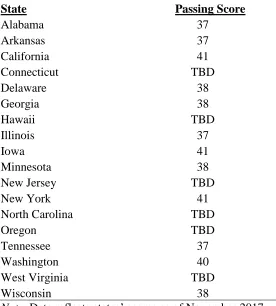
The developers of the edTPA recommend a passing score of 42 out of 75 for the 15-rubric edTPA (AACTE, 2017); however, the state of adoption has the discretion to set different passing scores. Table 1 shows a list of states5 as of November 2017 with passing scores for the
15-rubric edTPA (SCALE, 2017). Of particular interest is the state of Georgia with a passing score of 38 out of 75. This score is calculated as “-1/2 Standard Error of Measurement (SEM)
5 The noted states are at various stages of implementing the edTPA as statewide-performance assessment
requirements for initial teacher certification. Some states (e.g., Alabama, Connecticut, Hawaii, New Jersey, North Carolina, Oregon, West Virginia) are still in the early stages of piloting the edTPA and establishing future passing scores. Other states with established passing scores (e.g., Georgia, Illinois, Tennessee) may (or have plans to) increase future passing scores. New York plans to lower the score to a 38 in years 2018 and 2019, increase the score to a 39 in years 2020 and 2021, and then increase the score again to 40 in years 2022 and beyond. Washington plans to incorporate student-voice rubrics, which will increase the score to 43. Table 1 is meant to reveal current states
below the national edTPA recommendation” (SCALE, 2018a). Next, I discuss how the state of Georgia adopted the edTPA.
Table 1
Passing edTPA Scores by State
State Passing Score
Alabama 37
Arkansas 37
California 41 Connecticut TBD
Delaware 38
Georgia 38
Hawaii TBD
Illinois 37
Iowa 41
Minnesota 38
New Jersey TBD
New York 41
North Carolina TBD
Oregon TBD
Tennessee 37
Washington 40 West Virginia TBD
Wisconsin 38
Note. Data reflects states’ scores as of November 2017.
Teacher Certification Requirements in Georgia
In September 2015, the state of Georgia mandated that all prospective teachers enrolled in initial teacher preparation programs in Georgia pass the edTPA to receive teacher certification (GaPSC Rule 505-2-.26 Certification and Licensure Assessments, 2016). Prior to the state’s adoption of the edTPA, teacher preparation programs recommended certification upon completing program degree requirements (Teaching Certification, 2016). Additionally,
In the education category, prospective teachers were required to complete a state-approved (or out-of-state-state-approved) teacher certification program in the field of their
certification. Regardless of the path leading to their teacher certification programs, prospective teachers had to have a minimum of a bachelor’s degree. The state of Georgia also mandated special requirements in the subcategory of teacher preparation coursework and field experience. Prospective teachers seeking certification had to complete special education coursework and meet the recency-of-study rule. This rule required prospective teachers to obtain at least 6
semesters or 10-quarter hours of college credit within 5 years of applying for their certificate. For the field experience component, prospective teachers would be assigned to student teaching in a grade and content area that corresponded with their area of certification. Prospective teachers could have also taught out of the state for at least 1 year within 5 years of applying for their certificate or hold a National Board for Professional Teaching Standards certificate.
In the examination category, prospective teachers had to meet specific testing
requirements set by the state. Regardless of the certification’s grade level and content area, all prospective teachers had to take and meet a minimum score on the Georgia Assessments for the Certification of Educators (GACE) Basic Skills Tests in Reading, Writing, and Mathematics. Prospective teachers could be exempt from the GACE Basic Skills Test if they met a minimum score on other assessments such as the SAT, ACT, or GRE. In addition, prospective teachers had to pass corresponding GACE Content Assessments in the area they wished to be certified.
preparation providers (Georgia Professional Standards Commission, 2014). Several major revisions and additions were made in the new Certification Rules such as the creation of a four-tiered certification structure, the elimination of the recency-of-study requirement, the
introduction of GACE Content Assessments’ passing levels, and the addition of a new certification assessment called the edTPA.
All prospective teachers who completed student teaching and applied for induction on September 1, 2015 or later would now be required to receive a passing score on the edTPA during their teacher preparation program (Georgia Professional Standards Commission, 2014). For out-of-state applicants with less than one year of teaching experience, prospective teachers would have to pass a portfolio-based content pedagogy assessment (e.g., edTPA) during their teacher preparation program or pass the Praxis Performance Assessment for Teachers. Prospective teachers enrolled in non-traditional programs would also be required to pass the edTPA.
The GaPSC with input from the edTPA advisory and standard setting committees adopted an initial passing score of 35 on the 15-rubric edTPA for the first 2 years of
provide insight into the influence teacher performance assessments have during an era of teacher education reform.
Researching Teacher Performance Assessments
Over the last few decades, teacher preparation programs throughout the United States adopted teacher performance assessments to assess teacher candidates’ readiness to enter P–12 classrooms with proficient teaching pedagogy. These performance assessments, such as the California Teaching Performance Assessment (CalTPA), the Performance Assessment for California Teachers (PACT), the Teacher Work Sample (TWS), and the Fresno Assessment of Student Teachers (FAST), served as capstone portfolios for prospective teachers seeking graduation from teacher preparation programs. As previously discussed, states are now tying teaching certification to passing a teacher performance assessment known as the edTPA. This section presents a review of empirical research on how teacher performance assessments6 have
impacted teacher preparation program curricula, faculty members, and teacher candidates. I disclose the observed benefits and learning gains of teacher performance assessments as well as the shared challenges and concerns. Additional research on the possible gatekeeping response to teacher performance assessments is also addressed. I hope to bring awareness to current and future research needed in the field of teacher preparation and education.
Teacher Preparation Program Curricula
Some researchers have described teacher performance assessments as blueprints to reform teacher preparation programs in institutions of higher education (e.g., Ledwell & Oyler, 2016; Liu & Milman, 2013; Peck et al., 2010). While some good may come out of program
6 I find it important to note that the following research on teacher performance assessments includes studies on
realignment to address “good” teaching practices as identified in such assessments, several researchers have expressed concerns about what programs privilege as a result, such as the narrowing and depersonalization of pedagogy (e.g., Dover & Schultz, 2016; Lachuk & Koellner, 2015; Lit & Lotan, 2013; Madeloni & Gorlewski, 2013) and the redesign of curriculum (e.g., An, 2016; Barron, 2015). In the following section, I review how teacher preparation programs have responded to embedding (or not) teacher performance assessments in their programs. In
particular, I report on program changes, faculty member collaboration, and the design and evaluation of program curricula.
Ledwell and Oyler (2016) utilized practitioner research to interview 19 teacher educators and program coordinators from 12 programs at New York’s Teachers College, Columbia
University to evaluate program changes in response to the edTPA. Three levels of program change were identified. In the first level, edTPA work remained external to the program’s
curriculum. Programs falling in this level disliked the idea of teacher candidates feeling as if they paid for test preparation and consequently kept edTPA support to a minimum. In level two, programs acknowledged revisions made to their curriculum. Specific topics addressed in the edTPA were strictly reinforced. In the third level, programs replaced valued content with edTPA content to focus curriculum on edTPA’s cycle of planning, instruction, and assessment. Thus, this study showed the varying ways programs responded to curriculum changes when
accommodating for the edTPA.
a teacher performance assessment, teacher educators met to discuss their concerns. Through collective efforts from the program’s teacher educators, the program increased the engagement of the faculty members in joint activities, increased the program’s alignment of concepts and practices, and reimaged the program’s identity. Thus, the adoption of a teacher performance assessment impacted program changes in curriculum and faculty member collaboration.
Darling-Hammond and Snyder (2000) suggested teacher preparation programs integrate teacher performance assessments into curriculum and instruction instead of treating the
assessments as program add-ons. Heeding this advice, some institutions of higher education embedded elements of teacher performance assessments (e.g., edTPA) into their methods courses. Barron (2015) conducted a study at Austin Peay State University in Tennessee that first implemented the edTPA in 2011. From the start of the teacher preparation program, “pre-service candidates were given opportunities during their earliest field experiences to practice planning, teaching, assessing, and reflecting, as they would in the edTPA” (p. 70). During the first
foundation course, teacher candidates learned about the edTPA’s Context for Learning form. In their instructional strategies course, teacher candidates practiced academic language and lesson planning that was inclusive of all students’ needs. Teacher candidates also learned how to record, cut, and upload videos of instruction and student engagement during their technology course.
were key factors addressed in the edTPA. Overall, the program provided opportunities for teacher candidates to practice the edTPA as part of the curriculum.
Okhremtchouk and colleagues (2009) reported mixed feelings from teacher candidates when teacher preparation programs at a campus of the University of California embedded aspects of the PACT into their coursework. Several teacher candidates stated that the PACT was not helpful and negatively impacted their university coursework. They identified stress and time constraints as contributors influencing their views. However, some teacher candidates did find the PACT to be helpful in that it encouraged them to focus on instructional strategies and engage in reflection. Additionally, teacher candidates noted that PACT-related coursework provided them with opportunities to learn about the PACT requirements prior to their student teaching semester. A suggestion was made that “program administrators, professors, and teacher
educators [could] help their students by scaffolding the PACT process into their coursework and by providing formative feedback throughout the process” (p. 58). Thus, teacher preparation programs should consider when and how they introduce and prepare teacher candidates for teacher performance assessments.
Performance assessments can provide teacher preparation programs with insight into teacher candidates’ performance on various aspects of teaching (Barron, 2015). Knowing how well teacher candidates score on planning, instruction, assessment, and reflection can guide program curricula changes (Darling-Hammond, 2010). In a study by Peck and McDonald (2013), three California universities were examined for how they used PACT data for program
“develop more comprehensive and collaborative approaches across the program” to fill “the holes in the data” (p. 17). Additionally, samples of teacher candidate work were “particularly powerful in motivating faculty engagement and action” (p. 18). Not all programs used the data the same way, but the PACT data aided in making decisions about program structure,
curriculum, and practice.
When teacher preparation programs determine the ways in which to embed teacher performance assessments within their programs’ curricula, time restraints leave some content privileged over others. Gurl and colleagues (2016) reported that teacher preparation programs in New York had to revise course and fieldwork requirements for a secondary mathematics
program with the introduction of the edTPA requirement. In their methods course, modifications were made to the teaching of how to write a lesson plan. To address the expectations of the edTPA, technical aspects such as objectives, development, and summary were added to the lesson plan. Additionally, the student work analysis added components such as tabulating correct and incorrect answers, identifying common mistakes and misconceptions, and planning for the next steps. Readings about language function and the edTPA rubrics were also added to the methods course. Overall, the methods course made time to address information pertaining to the edTPA, which “[sacrificed] class time previously used for mathematical and pedagogical
learning opportunities” (p. 57).
students access curriculum, and identifying students’ socioeconomic and cultural contexts. Although teacher candidates shared that the PACT “supported transfer of theory to practice in becoming more intentionally reflective teachers,” critical reflection was not the primary objective of the PACT’s documents (p. 132). Liu and Milman recommended that “educators must [capitalize] on ways such assessments prepare teacher candidates for diverse classrooms, while also ‘filling in the gaps’ where TPAs or other standardized assessments may not address multicultural education objectives sufficiently” (p. 138).
Faculty Members
The perceptions and experiences of faculty members engaging with teacher performance assessments can offer additional insight to better understand the influence of such assessments on teacher preparation. The following literature explores faculty members’ responses, including the benefits, challenges, and concerns of accommodating for teacher performance assessments. In particular, I report on faculty members’ perceptions of the assessments and the ways in which faculty members navigate the assessments’ demands, modify their academic discourse, and adopt different levels of support for teacher candidates.
use of “student learning in assessment, reflection, culturally relevant pedagogy, or program improvement via cross-program dialog about curriculum alignment and collaboration” (p. 32).
Similarly, Guaglianone and colleagues (2009) gathered survey responses from 19 California State University (CSU) administrators to learn of their perceptions toward teacher performance assessments (i.e., the CalTPA, the FAST, and the PACT) and the ways they planned and implemented the assessments at each campus. The reports identified faculty members’ perceived benefits and concerns with funding, training, collaboration, scoring, technology support, and lessons learned. From a beneficial perspective, faculty members
commented on the increased communication and collaboration within and across campuses. As a result, program improvements were made that focused on designing a strong outcome-based program. In turn, survey responses revealed that both teacher candidates and faculty members benefited from the changes in the program curricula.
Conversely, Guaglianone and colleagues’ (2009) survey results also addressed the challenges in the implementation of teacher performance assessments across CSU’s campuses. All campuses shared concerns for staffing teacher performance assessment coordinators, providing adequate training to assessors, and arranging technology support for both faculty members and teacher candidates. However, the overarching challenge dealt with funding issues. On average, depending on the size of the campus, the implementation of the assessments cost each campus roughly $200,000 annually. The funds considered training, technology purchases, staff wages, and other various needs. This study asserted that the demand on faculty members negotiating teacher performance assessments could be beneficial yet challenging.
examined how 10 full-time faculty members at a California State University adopted a “common language” that aligned with the California Commission for Teacher Credentialing (CCTC) standards of a state-mandated teacher performance assessment. The faculty members reported increased use of “technocratic” discourse that reflected a shift in the way they spoke with other faculty members and teacher candidates. The faculty members also expressed how the teacher performance assessments impacted their conceptualization of teacher education aligning with standards, which narrowed their thinking about instruction.
On a similar note, faculty members’ views toward teacher performance assessments can also influence the type and amount of support they provide to teacher candidates. Ratner and Kolman (2016) conducted an exploratory case study of nine faculty members’ stances toward the edTPA in New York. The study determined that the faculty members’ stances influenced the level of support delivered to teacher candidates during the edTPA process. Despite a document listing the guidelines for acceptable candidate support, the faculty members interpreted support differently in response to ethical, pedagogical, and logistical dilemmas.
Ratner and Kolman (2016) grouped faculty members into categories of “breakers,” “benders,” and “obeyers.” The breakers were concerned with edTPA’s hasty implementation, financial demands, and resistance to offering teacher candidates support when teachable learning moments occurred. The benders were apprehensive of edTPA’s battle with social justice issues. If faculty members believed that their teacher preparation program failed to communicate or facilitate assessment requirements given condensed timelines, challenges with school
placements, or monetary issues, the faculty members adjusted their support to teacher candidates as per the need. For the obeyers, faculty members acknowledged edTPA’s challenge but