EFFECT OF SOLUTION TREATMENT ON MICROSTRUCTURE,
MECHANICAL AND WEAR CHARACTERISTICS OF GRAVITY
DIE CAST ALUMINIUM ALLOY
Radha. R, Jafferson J. M
and Darshan G
School of Mechanical and Building Sciences, Vellore Institute of Technology University Chennai Campus, Tamil Nadu, India Email: [email protected]
ABSTRACT
Non-ferrous materials are widely used in industries, especially because of its corrosion resistance property. Among them Aluminium alloys are widely used because of its ease of machinability, good thermal Conductivity, less weight etc. Presently Aluminum is more used by industries than steel. Further Aluminium with alloy elements like copper, nickel, magnesium, tin etc. will enhance the properties of the materials and these alloyed elements have more industrial applications. Solution Treatment enhances the properties of these aluminium alloys. This work is focused on synthesis and characterization of hexenary aluminium Alloy (Al-Cu-Sn-Ni–Mg-Fe) by gravity die casting technique. The microstructure and wear behavior of as cast, solution treated alloys were elucidated by optical microscopy, pin-on-disc wear test. The mechanical properties were assessed by the tensile test, hardness test and compressive test. Solution treated aluminium alloy showed the remarkable improvement in wear resistance, hardness and tensile strength. The uniformly dispersed thermally stable θ and Ω phases in the aluminium matrix are one of the predominant factor in improving the hardness and tensile properties. The increase in hardness was achieved with solution treatment significantly reduced the wear rate.
Keywords: hexenary aluminium alloy, solution treatment, microstructure, mechanical properties, wear.
1. INTRODUCTION
The demand for aluminium alloy products is increasing primarily because of the larger amounts of castings being used in automotive and aerospace applications. A wide range of cast aluminium alloys is available for commercial use. The current research trend to develop the aluminium alloys with higher strength, higher ductility, less weight, and higher wear resistance. The heat treated aluminium alloys are exhibiting higher strength by a series of solutionising at higher temperature, water quenching to room temperature and followed by ageing with some suitable preferred temperature [2]. The CuAl2 (Precipitate) phase was observed as the main hardening phase in Al-Cu-Mg alloys. This attributes the strength of the aluminium alloys during ageing [2]. The uniformly distributed finer CuAl2 phase is formed in the Al-Cu alloys with the little alloying of Mg and Ag [3]. Al-Cu-Mg alloy is strengthened with the addition of Ag which is attributed by the formation of homogeneously distributed dominant strengthening phases such as orthorhombic face centered cubic Ω phase and tetragonal structure θ phase [4]. The tensile strength, wear resistance and hardness of Al-5Cu alloy were refined with the addition of master alloy Al-5Ti-0.75Cu. The grain refinement, uniform dispersion of secondary phases and higher amount of finer θ precipitates are attained with the master alloying revealed the enhancement in the mechanical properties of Al-5Cu alloy [5]. The alloying of Ce up to 0.45% improved the tensile properties of Al-Cu-Mg-Ag alloy at room and elevated temperatures which are attributed by the formation of thermally stable Ω phase [6]. The higher wear resistance was achieved in the thixoformed A319 alloy which is due to the finer grains, increase in hardness and homogenous dispersion of secondary phases [7]. With the higher contact pressure of 100 MPa and sliding speed 1.5 m/s, the
2. EXPERIMENTAL PROCEDURES
2.1 Alloy synthesis
The melting of pure aluminium ingot along with the micro alloying elements (Cu - 5%, Sn - 4%, Ni - 3%, Mg - 2%, Fe - 1%., Al - Balance) are carried out in the induction furnace. The melt was stirred well for 10 mins at a temperature of 6800 C and degasser tablets were used for degassing the melt. The molten metal was super-heated and held at the temperature of 7000C for 5 mins and then the melt was transferred to steel mould of gravity die casting. The specification and photograph of the furnace is given in Table 1 and Figure 1. The cast alloy is shown in Figure 2. The cast hexenary alloy was then machined as per ASTM standards for mechanical characterization.
2.2 Solution treatment
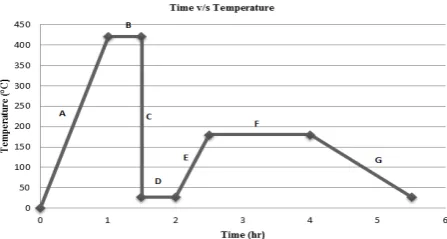
Solution treatment is carried out by heating hexenary aluminium alloy at 4300 C (Figure-3) below solidus temperature (A) with a holding time of 30 mins (B). The alloy was water quenched to room temperature to achieve maximum supersaturated alloying elements for subsequent ageing (C) and allowed to stay in room temperature for 30 mins (D). Then the alloy was age hardened at the temperature of 1900 C for 3 hours to achieve maximum strength and allowed to cool to room temperature by natural convection (E-G).
3. MECHANICAL CHARACTERIZATION Brinell hardness test (BHN), tensile test and compression tests were carried out as per ASTM standards ASTM E 10-08, ASTM E 8M -04 and ASTM E 9-09 respectively. The Brinell hardness test was performed using a steel ball indenter of 1.5 mm diameter for 60 sec. Vickers hardness test is performed on the specimen of diameter 20mm using a diamond cone indenter with a load of 25gf for 60 sec. The specimen of 12.5 mm diameter and 75 mm gauge length used for tensile test before and after fracture is shown in Figures 4 & 5. The specimen of diameter 20mm (l/d ~1) used for the compression test is shown in Figure-6.
4. WEAR MEASUREMENTS
The wear studies were carried out using pin on disc teeter as per ASTM G99 standard. The Pin-On-Disc machine is a versatile unit designed to evaluate the wear and friction characteristics on a variety of materials exposed to sliding contacts in dry or lubricated environments. The sliding friction test occurs between a stationary pin stylus and a rotating disk. Normal load,
aluminium alloy was estimated by weight loss in the specimen after each test shown in equation (1 and 2)
Wear rate =
Nm
mm
dist
slid
load
d
wear
5 2 3.
.
10
(1)Co-efficient of friction =
)
(
)
(
P
load
F
force
frictional
(2) [image:2.595.308.545.300.448.2]5. MICROSTRUCTURAL CHARACTERIZATIONS The specimen was prepared by polishing using water proof emery sheets ranging from 600- 1000 grits and then polished with Al2O3 abrasives, and finally etched using Krolls reagent (92 ml distilled water + 6ml nitric acid + 2ml hydrofluoric acid).
Figure-1. Induction furnace.
[image:2.595.310.549.476.609.2] [image:2.595.316.540.638.757.2]Figure-4. Tensile test specimen.
Figure-5. Tensile test specimen after fracture.
Figure-6. Compression test specimen after deformation.
6. RESULTS AND DISCUSSIONS
6.1 Mechanical properties
The tensile strength improved from 114 MPa to 117 MPa after solution treatment and elongation increased from 4.75% to 5.47%. This may be due to the evolution of new interdentritic networks of CuAl2 and the homogeneous dispersion of residual phases of additive elements Cu, Mg, Sn, Ni, Fe in the α-Aluminium matrix during solution treatment [1]. The tensile test graphs are shown in Figures 7 & 8. At solution treatment of 4300 C, the ultimate tensile strength and hardness was improved. The solution time was maintained at 30 min which will not allow excess dissolving of residual phases in α-Al matrix so that the strength won’t be compromised because if the solution time is greater than 60 mins there will be grain growth which significantly affects the tensile strength. The increase in tensile strength is due to the alloying composition and structure of the script morphology phases. The addition of tin favors for the transformation of platelet phase like structure to script morphology phase attributed for enhancing the strength of the alloy. BHN test was conducted at three different untreated specimens and there values are 76.5, 74.2, and 78.1 which resulted in an average value of 76.25. BHN test was conducted at three different solution treated specimens and there values are 93.6, 94.4, and 96.8 which resulted in an average value of 94.93. The vickers hardness of hexenary alloy was 82 Hv BST and 118 Hv AST. During quenching, the time for dissolution of alloying elements in the solid solution was insufficient at the higher temperature [2]. The super saturated alloy matrix exhibits the internal stresses due to the very low dissolution at the room temperature. The increase in hardness was observed in the water quenched alloys due to its rapid cooling rate phenomenon.
Hexenary Alloy Hexenary Alloy Al-6.2Cu-0.6Mg Al-6.2-0.6Mg-0.02Sn Al-6.2Cu-0.6Mg-0.04Sn A-6.2Cu-0.6Mg-0.06Sn Al-6.2Cu-0.6Mg-0.08Sn Al-6.2Cu-0.6Mg-0.1Sn Al-6.2Cu-0.6Mg Al-6.2Cu-0.6Mg-0.06Sn Al-6.2Cu-0.6Mg-0.1Sn Al-5Cu Al-5Cu-0.2(Al-5Ti-0.3C) Al-5Cu-0.2(Al-5Ti-1B) Al-5Cu-0.2(Al-5Ti-0.75C)
as c
as
t
So
lu
ti
on
tr
ea
ted
Ho
m
o
g
en
is
ed
wate
r
q
u
en
ch
ed
as c
as
t
Figure-7. Tensile test stress strain graph for BST.
Figure-8. Tensile test stress strain graph for AST.
Figure-9. Compression test load vs elongation graph for BST.
Figure-10. Compression test load vs elongation graph for AST.
6.2 Microstructure
6.2.1 As cast condition (BST)
The optical microstructure (Figure 11) shows the primary solid solution (brighter areas) are uniformly dispersed along the region of grain boundaries and the non-equilibrium eutectic solid solution between the grains (dark areas) showing script type morphology [2]. It reveals the presence of α-Aluminium matrix, secondary phases such as (Al-Cu-Mg, Al-Cu-Sn, Al-Cu-Ni, Fe, and Al-Mg-Sn) and its intermetallic compounds. The dendritic structures are revealed in the as cast condition.
6.2.2 Solution treated condition (AST)
Figure-11. Microstructure BST.
Figure-12. Microstructure AST.
6.3 Wear behavior and morphology
The Wear behavior of hexenary aluminium alloy was analyzed with the variation of the wear loss data with respect to load and time in (Figure-13). The optical microscopes of worn surfaces of aluminium alloy BST and AST are shown in (Figures 14 & 15). The worn surface shown deep well separated grooves and it is found that the grooves are along the sliding direction, but not many cracks are seen. However, crack propagation is observed along the same sliding direction. It was shown those wear depths and wear rate of as cast hexenary aluminum alloy is increased with increase of sliding time and load applied BST. The increase in wear rate of as cast alloy are due to the increase in abrasive scoring marks due to the higher depth of penetration caused by the application of higher contact pressure [9]. The adhesive wear was noticed with the solid phase of welding of particles from one surface to another, when as cast alloy is subjected to the sliding load of 10N as shown in Figure-14 (a) [10].
0 20 40 60 80 100 120 140 160
We
ar
(Mi
cro
n
s)
Wear (microns) 10 N BST & AST
Before After
0 50 100 150 200 250
W
e
ar (Mi
cro
n
s)
Wear (microns) 20 N BST & AST
Before After
Figure-13. Wear under different loading conditions.
It was observed that the depth of wear and wear rate was decreased after solution treatment. The reduction in wear loss was due to the improvement in hardness of aluminum alloy achieved with solution treatment [2]. The worn surface shown deep well separated craters. Cracks are also observed which are spread perpendicular to the
sliding direction. It is found that the craters are along the sliding direction, but not many cracks are seen. However, crack propagation is seen along the same direction as sliding. Figure-15 (c) depicted the mechanism of oxidative and abrasive wear in the solution treated alloy subjected to the sliding load of 30 N.
Load at 10N
Load at 20 N 0
50 100 150 200 250 300
0 2 4 6 8 10 12
W
e
ar (Mi
cro
n
s)
Time (min)
Wear (microns) 30 N before BST & AST
BeforeBST AfterAST
(a)
a
a
Load at 30 N
Figure-14. wear morphology of hexenary alloy BST (a) 10N (b) 20N and (c) 30 N.
Figure-15. wear morphology of hexenary alloy AST (a) 10N (b) 20N and (c) 30 N.
(c)
(c)
(b)
a
a
(b)
0 5 10 15 20 25 10 N 20 N 30 N 10 N 20 N 30 N 10N 100 N 10 N 100 N 10 N 20 N 30 N 10 N 20 N 30 N 10 N 20 N 30 N 10 N 20 N 30 N as c ast Sol u ti o n t re at e d as c ast th ixoform e d H e xe n ar y Al loy A31 9 A31 9 Al -12S i-4 Mg Al -12S i-4 Mg-2 Ce Al -12S i-4 Mg-3 Ce Al -12S i-4M g-5C e
Wear rate 10
-5mm
3/Nm
7. CONCLUSION AND FUTURE WORK
The following conclusions are drawn from the study of as cast and solution treated hexenary aluminium alloy:
a) It is evident that the wear resistance of solution treated alloy improved by 13%, Hardness increased by 24% and tensile strength increased by about 3%. Whereas compressive strength decreased by 7 %.
b) A solution treatment at 4300 of 30 min causes coarsening of grains and eutectic phases dissolved in aluminium matrix are most important to the improvement in tensile strength and hardness.
c) The presence of alloying elements Cu,Sn,Mg,Ni in the solid solution of aluminium significantly promotes the grain refinement.
d) It was observed as the strengthening effect was beneficial with the limitation in the addition of alloying elements.
e) It was found that improvement in tensile strength is attributed by the uniform dispersion of dominant strengthening Al2Cu phases in aluminium matrix through solution treatment.
f) The solution temperature and aging temperature can be varied and we can examine the change in properties with respect to both the temperatures.
g) The wear rate was reduced significantly with the formation of oxide layer and hardness is one of the significant factors in wear resistance.
h) The precipitation studies to be carried out which are essential for analyzing the formation of precipitates when the aluminium alloy is subjected to the solution treatment and ageing conditions.
REFERENCES
[1] Li B, Pan Q, Chen C, Wu H, Yin Z. 2016. Effects of solution treatment on microstructural and mechanical properties of Al-Zn-Mg alloy by microalloying with
corrosion cracking of Al-4.6 Cu-0.3 Mg alloy. Mater. Chem. Phys. 91(2): 454-62.
[4] Min S, Chen KH, Huang LP. 2006. Effects of Ag addition on mechanical properties and microstructures of Al-8Cu-0.5 Mg alloy. Trans. Nonferrous Met. Soc. China. 16(4): 766-71.
[5] Wang T, Gao T, Zhang P, Nie J, Liu X. 20114. Influence of a new kind of Al-Ti-C master alloy on the microstructure and mechanical properties of Al-5Cu alloy. J. Alloys Compd. 589: 19-24.
[6] Xiao DH, Wang JN, Ding DY, Yang HL. 2003. Effect of rare earth Ce addition on the microstructure and mechanical properties of an Al-Cu-Mg-Ag alloy. J. Alloys Compd. 352(1): 84-8.
[7] Alhawari KS, Omar MZ, Ghazali MJ, Salleh MS, Mohammed MN. 2015. Evaluation of the microstructure and dry sliding wear behaviour of thixoformed A319 aluminium alloy. Mater. Des. 76:169-80
[8] Ruiz-Andrés M, Conde A, De Damborenea J, García I. 2015. Wear Behavior of Aluminum Alloys at Slow Sliding Speeds. Tribol. T. 58(5): 955-62.
[9] Anasyida AS, Daud AR, Ghazali MJ. 2010. Dry sliding wear behaviour of Al–12Si–4Mg alloy with cerium addition. Mater. Des. 31(1):365-74