The Effect of Information Technology - Based Game
on Fifth Graders’ Critical Thinking Skill
Selvia Nendy Afriliana, Waspodo Tjipto Subroto, Nasution
Primary Education, Postgraduate, State University of Surabaya DOI: 10.29322/IJSRP.9.07.2019.p9197
http://dx.doi.org/10.29322/IJSRP.9.07.2019.p9197
Abstract- This study aims to describe the effect of information technology-based game media on critical thinking skill of fifth graders on social studies subject under the theme of the Indonesia’s struggle for independence. The research subjects were 26 fifth graders of SDN Lakarsantri III/474 Surabaya, 2018/2019. The research subjects were divided into 2 groups of control and experimental groups. Data collection was carried out through tests, observations, and validation of learning devices with information technology-based game media. Information technology -based game media significantly affected students' critical thinking skill. This result is based on Normalized gain (N-gain) or Gain Score and t test. The results of the Gain score calculation for the experimental group indicated an increase in students' critical thinking skills of 0.81 (High). T test analysis resulted in the Sig. (2-tailed) of 0,000 with a significant level of 0.05. in conclusion, information technology-based game media had a significant effect on students' critical thinking ability.
Index Terms- Game, Critical Thinking Ability
I. INTRODUCTION
mprovement of learning quality is developed with the right learning strategies that encourage students to be active in learning activities. Students’ activitiveness in the learning process is expected to improve their critical thinking skills. In this case, the role of the teacher in determining learning strategies becomes highly important to make learning process run well. Learning process is a process in which there is an activity of interaction between teacher-student and reciprocal communication that takes place in an educative situation to achieve learning goals. Stated that learning resources are all things that contain information, ideas, concepts, and can facilitate, concretize, and simplify material so that students can understanding learning material faster and easier [1]. A conducive learning environment is able to create an effective and efficient learning process by utilizing everything that can channel messages and deliver messages from sources in a planned manner in the form of media.
Media is all forms of intermediaries that are used by humans to convey or spread ideas and the expressed ideas reach the intended recipient [2]. Games are structured or semi-structured activities that are usually aimed at entertainment and can sometimes be used as educational facilities [3]. Games containing educational content are usually known as educational games. This game aims to attract students' interest in material. Information Technology (IT) is defined as any technology that can help
humans in creating, changing, storing, communicating and disseminating information. Information technology brings together high-speed computing and communication for data, voice and video. Examples of information technology in adition to personal computers are telephone, television, electronic household appliances, and modern handheld devices [4].
Critical thinking is an intellectual process that actively and skillfully conceptualizes, implements, analyzes, synthesizes, and evaluates information collected or generated from observation, experience, reflection, reasoning or communication to guide beliefs or actions. Critical thinking requires effective communication and the ability to solve problems as well as a commitment to overcome the potentials of the state of egocentrism and sociocentrism of the perpetrators themselves. Interactive games developed as learning media can improve students' critical thinking skills. Based on the observations of researchers in January 2019 towards fifth grade students at Lakarsantri III Elementary School in Social Studies learning on theme 7, teachers still used conventional learning with the lecture method. Students were not active in the class because they only saw and listened to the lecture teacher during learning. From this observation, the researchers chose this problem to be used as an initial source of research to create new breakthroughs in the application of learning media that are in line with technological developments in the form of information technology-based game to improve critical thinking skills of elementary school students.
II. IDENTIFY, RESEARCH AND COLLECT IDEA
III. RESULTS AND DISCUSSION
A summary of the results of lesson plan validation, Game Media, and Learning Outcomes Test that has been performed by
[image:2.612.97.516.131.208.2]validator 1 (V1) and validator 2 (V2) is presented in the following table.
Table 1. Recapitulation of the Validation of Lesson plan, Game Media, and Learning Outcomes Test
No. Learning Media Score Avergae Category R (%)
V1 V2
1. Lesson plan 3,1 3,3 3,2 Valid 80,0
2. Game media 3,7 3,6 3,65 Valid 91,3
3. Learning Outcomes Test 3,3 3,4 3,35 Valid 83,8
Average 3,37 3,43 3,4 Valid 85,03
[image:2.612.106.509.285.594.2]Table 1 shows that the two validators concluded that lesson plan, Game Media, and Learning Outcomes Test were valid and suitable for use in learning information technology-based game media. The efficiency or practicality of information technology-based game media in improving students' critical thinking skills can be assessed through classical completeness assessment shown in table 2.
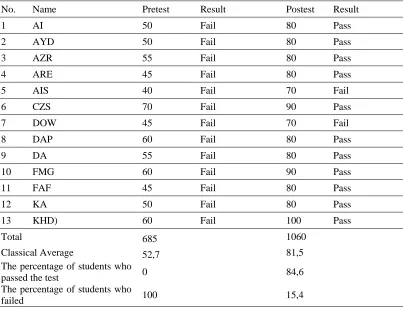
Table 2. Pretest and Post-test scores of Control Group Students
No. Name Pretest Result Postest Result
1 AI 50 Fail 80 Pass
2 AYD 50 Fail 80 Pass
3 AZR 55 Fail 80 Pass
4 ARE 45 Fail 80 Pass
5 AIS 40 Fail 70 Fail
6 CZS 70 Fail 90 Pass
7 DOW 45 Fail 70 Fail
8 DAP 60 Fail 80 Pass
9 DA 55 Fail 80 Pass
10 FMG 60 Fail 90 Pass
11 FAF 45 Fail 80 Pass
12 KA 50 Fail 80 Pass
13 KHD) 60 Fail 100 Pass
Total 685 1060
Classical Average 52,7 81,5
The percentage of students who
passed the test 0 84,6
The percentage of students who
failed 100 15,4
[image:2.612.101.510.673.739.2]Table 2 also shows the posttest results of students who experienced a significant increase. A total of 11 (84.6%) students scored above 75 and passed the test. Only 2 (15.4%) students scored below 75 and failed the test.
Table 3. Pretest and Post-test scores from experimental group students
No. Name Pretest Result Postest Result
14 MFA 45 Fail 80 Pass
15 MA 60 Fail 90 Pass
17 MGA 50 Fail 100 Pass
18 MAH 60 Fail 90 Pass
19 NCL 60 Fail 90 Pass
20 NFI 50 Fail 100 Pass
21 RSA 40 Fail 80 Pass
22 RAK 45 Fail 90 Pass
23 RDA 40 Fail 80 Pass
24 RR 75 Pass 100 Pass
25 SAR 70 Fail 100 Pass
26 VNP 75 Pass 100 Pass
Total 715 1190
Classical Average 55 91,5
The percentage of students who
passed the test 15,4 100
The percentage of students who
failed the test 84,6 0
[image:3.612.92.523.402.696.2]Table 3 shows the posttest results of students who experienced a significant increase. A total of 13 (100%) students in the experimental group scored above 75 and passed the test. This means that the information technology based- game was efficiently applied on social studies subject with the theme of Indonesia’s stuggle for independence in fifth graders of elementary school. The influence of information technology-based game media on students' critical thinking skills can be determined by assessing the effectiveness of the game media and through the t test.
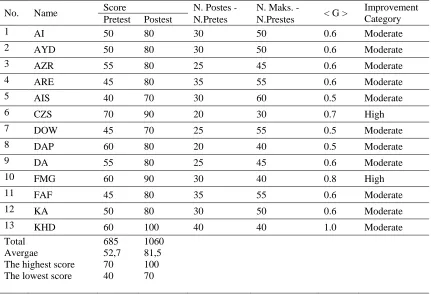
Table 4. Improvement of Critical Thinking Ability of Experimental Group
No. Name Score N. Postes - N. Maks. - < G > Improvement Category Pretest Postest N.Pretes N.Prestes
1 AI 50 80 30 50 0.6 Moderate
2 AYD 50 80 30 50 0.6 Moderate
3 AZR 55 80 25 45 0.6 Moderate
4 ARE 45 80 35 55 0.6 Moderate
5 AIS 40 70 30 60 0.5 Moderate
6 CZS 70 90 20 30 0.7 High
7 DOW 45 70 25 55 0.5 Moderate
8 DAP 60 80 20 40 0.5 Moderate
9 DA 55 80 25 45 0.6 Moderate
10 FMG 60 90 30 40 0.8 High
11 FAF 45 80 35 55 0.6 Moderate
12 KA 50 80 30 50 0.6 Moderate
13 KHD 60 100 40 40 1.0 Moderate
Total Avergae
The highest score The lowest score
685 52,7 70 40
1060 81,5 100 70
𝐺𝐺𝑠𝑠𝑠𝑠𝑠𝑠𝑠𝑠𝑠𝑠 =(81,5 (100 −− 52,7) = 52,7) 28,847,3 = 0,61
[image:4.612.92.521.161.451.2]The results of the Gain score calculation for the control group showed an increase in students' critical thinking skills of 0.61 (moderate). This means that conventional learning has the effect of increasing the critical thinking skills of class V students on the concept of the material of Indonesian’s struggle for independence with moderate level of improvement
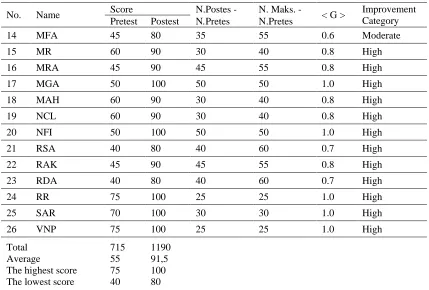
Table 5. Improved Critical Thinking Abilities of the experimental group
No. Name Score N.Postes - N. Maks. - < G > Improvement Category Pretest Postest N.Pretes N.Pretes
14 MFA 45 80 35 55 0.6 Moderate
15 MR 60 90 30 40 0.8 High
16 MRA 45 90 45 55 0.8 High
17 MGA 50 100 50 50 1.0 High
18 MAH 60 90 30 40 0.8 High
19 NCL 60 90 30 40 0.8 High
20 NFI 50 100 50 50 1.0 High
21 RSA 40 80 40 60 0.7 High
22 RAK 45 90 45 55 0.8 High
23 RDA 40 80 40 60 0.7 High
24 RR 75 100 25 25 1.0 High
25 SAR 70 100 30 30 1.0 High
26 VNP 75 100 25 25 1.0 High
Total Average
The highest score The lowest score
715 55 75 40
1190 91,5 100 80
The calculation of G Score for the Experiment Group is as follows: 𝐺𝐺𝑠𝑠𝑠𝑠𝑠𝑠𝑠𝑠𝑠𝑠 = (91,5 – 55,0)
(100 − 55,0) = 36,5
45,0 = 0,81
The results of the Gain score calculation for the experimental group showed an increase in students' critical thinking skills of 0.81 (High). This means that learning with information technology-based game media could improve the critical thinking skills of class V students on the concept of Indonesia's struggle for independence with a high level of improvement.
Table 6. Results of Pretest Normality Test for Control and Experimental Group
One-Sample Kolmogorov-Smirnov Test
Pretest of control group
Pretest of experimental
group
N 13 13
Normal Parametersa,b Mean
52.69 55.00
Std. Deviation 8.321 12.583 Most Extreme Differences Absolute .165 .193
Positive .165 .193
Negative -.118 -.117
Test Statistic .165 .193
Asymp. Sig. (2-tailed) .200c,d .200c,d
a. Test distribution is Normal. b. Calculated from data.
c. Lilliefors Significance Correction.
d. This is a lower bound of the true significance.
[image:5.612.129.481.95.245.2]Table 6 shows the results of the normality test in the Control and Experiment Group, each of which had a significance value of 0.200. This value is far greater than the alpha value (α) = 0.05. In conclusion, students’ pretest data in this study were normally distributed.
Table 7. Results of Postes Normality Test for Student of Control and Experimental Groups One-Sample Kolmogorov-Smirnov Test
PostesKK PostesKE
N 13 13
Normal Parametersa,b Mean
81.54 91.54 Std. Deviation 8.006 8.006 Most Extreme Differences Absolute .345 .239
Positive .345 .192
Negative -.270 -.239
Test Statistic .345 .239
Asymp. Sig. (2-tailed) .148c .240c
a. Test distribution is Normal.
b. Calculated from data.
c. Lilliefors Significance Correction.
d. This is a lower bound of the true significance.
Table 7 shows that the normality test in the Control Group and Experimental Group had a significance value of 0.148 and 0.240, respectively. The values are far greater than the alpha value (α) = 0.05. In conclusion, students’ posttest data in this study were normally distributed.
Table 8. Pretest Homogeneity Test Results of Students in both groups ANOVA
Experimental Group Pretest
Sum of Squares df Mean Square F Sig.
Between Groups 350.000 5 70.000 .316 .888
Within Groups 1550.000 7 221.429
Total 1900.000 12
Table 8 shows the results of the homogeneity test on the pretest scores of both groups is Fcount (0.316) <F-table (1.782) with significance of 0.888. This is far greater than the alpha value (α) = 0.05. In conclusion, the pretest data of students in the two groups in this study were homogeneous.
Table 9. Homogeneity of Postes Test Results for Students of Control and Experimental Groups ANOVA
Experimental Group Pretest
Sum of Squares Df Mean Square F Sig.
Between Groups 181.731 3 60.577 .928 .466
Within Groups 587.500 9 65.278
Total 769.231 12
[image:6.612.126.489.450.599.2]Table 9 shows the results of the homogeneity test on the posttest scores of the students of the two groups with F-count (0.928) <F-table (1.782) and significance of 0.466. This value is greater than alpha value (α) = 0.05. In conclusion, posttest data of students in both groups in this study were homogeneous. Students’ posttest hypothesis test in both groups is shown in table 10.
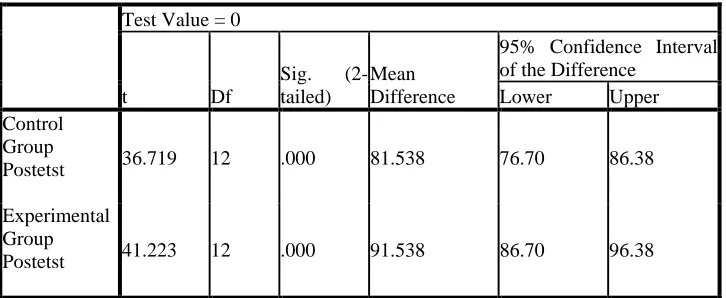
Table 10. t Test Results
Test Value = 0
t Df
Sig. (2-tailed)
Mean Difference
95% Confidence Interval of the Difference
Lower Upper Control
Group
Postetst 36.719 12 .000 81.538 76.70 86.38
Experimental Group
Postetst 41.223 12 .000 91.538 86.70 96.38
From the results of students’ posttest data analysis in both groups the value of Sig. (2-tailed) was 0,000 with a significant level of 0.05. The value is 0,000 <0,05 means Ho is rejected and Ha is accepted.
The results of this study concluded that information technology-based game had a significant effect on students' critical thinking skills which empirically supported the results of Anggraini et al. (2016), Panggayudi et al. (2017), and Wulandari et al. (2017). Anggraini et al. (2016) concluded that students were more enthusiastic and more motivated to study with the use of
educational games. Approach with game in learning can stimulate emotions, intellectual, and psychomotor.
significant effect on the critical thinking skills of fifth grade elementary school students on social studies subjects with the theme of Indonesia's struggle for independence.
IV. CONCLUSIONS AND SUGGESTIONS Information technology- based game media significantly affected students' critical thinking skill. This result is based on Normalized gain (N-gain) or Gain Score and t test. The results of the Gain score calculation for the experimental group showed an increase in students' critical thinking skills of 0.81 (High). T test analysis resulted in the Sig. (2-tailed) of 0,000 with a significant level of 0.05. In conclusion, information technology-based games had a significant effect on students' critical thinking ability. Based on the results of the research and conclusions, teachers are expected to use interesting learning media that students are motivated to take part in learning; for example using game media to improve students’ learning outcomes and critical thinking skills. Future research can use the results of this study as a reference source for conducting further research on information technology-based game media.
ACKNOWLEDGMENT
We are especially grateful to the Surabaya city government, Surabaya State University postgraduate lecturer, Lakarsantri iii/474 Surabaya elementary school students, and all those who directly and indirectly helped us in this research.
REFERENCES
[1] Suyatno, Menjelajah Pembelajaran Inovatif. Sidoarjo: Masmedia Buana Pustaka, 2009.
[2] A. Arsyad, Media Pembelajaran. Jakarta: Radja Grafindo Perkasa, 2012. [3] R. S. Wahono, “Multimedia Technology,” 2007. [Online]. Available:
http://www.dinus.ac.id/download/romi-multimedia-udinus-1Desember2007.Pdf .
[4] B. . Williams and S. . Sawyer, Using information teknologi : A Practical introduction to computer & communication (9thgrade). Newyork: McGraw-Hill, 2011.
AUTHORS
Firs Author – Selvia Nendy Afriliana, Postgraduate Students, Primary Education Study Program, State University of Surabaya, e-mail: [email protected]
Second Author – Waspodo Tjipto Subroto, Doctorate, Primary Education Study Program, State University of Surabaya, e-mail: [email protected]
Third Author - Nasution, Doctorate, Primary Education Study Program, State University of Surabaya,
e-mail: [email protected]