ScholarWorks @ Georgia State University
Business Administration Dissertations Programs in Business Administration
Spring 5-5-2019
Corporate Sustainability: The Impact of Corporate
Leadership Gender On Year-Over-Year
Performance
Jennoa R. Graham Georgia State University
Follow this and additional works at:https://scholarworks.gsu.edu/bus_admin_diss
This Dissertation is brought to you for free and open access by the Programs in Business Administration at ScholarWorks @ Georgia State University. It has been accepted for inclusion in Business Administration Dissertations by an authorized administrator of ScholarWorks @ Georgia State University. For more information, please [email protected].
Recommended Citation
Graham, Jennoa R., "Corporate Sustainability: The Impact of Corporate Leadership Gender On Year-Over-Year Performance." Dissertation, Georgia State University, 2019.
PERMISSION TO BORROW
In presenting this dissertation as a partial fulfillment of the requirements for an advanced degree from Georgia State University, I agree that the Library of the University shall make it available for inspection and circulation in accordance with its regulations governing materials of this type. I agree that permission to quote from, copy from, or publish this dissertation may be granted by the author or, in her absence, the professor under whose direction it was written or, in his absence, by the Dean of the Robinson College of Business. Such quoting, copying, or
publishing must be solely for scholarly purposes and must not involve potential financial gain. It is understood that any copying from or publication of this dissertation that involves potential gain will not be allowed without written permission of the author.
NOTICE TO BORROWERS
All dissertations deposited in the Georgia State University Library must be used only in accordance with the stipulations prescribed by the author in the preceding statement.
The author of this dissertation is: Jennoa R. Graham, Ph.D.
165 Courtland St NE, A-130 Atlanta, GA 30303
The director of this dissertation is:
Dr. Danny Bellenger
J. Mack Robinson College of Business
Georgia State University
Corporate Sustainability: The Impact of Corporate Leadership Gender On Year-Over-Year
Performance
by
Jennoa R. Graham, Ph.D.
A Dissertation Submitted in Partial Fulfillment of the Requirements for the Degree
Of
Executive Doctorate in Business
In the Robinson College of Business
Of
Georgia State University
GEORGIA STATE UNIVERSITY
ROBINSON COLLEGE OF BUSINESS
Copyright by Jennoa R. Graham, Ph.D.
ACCEPTANCE
This dissertation was prepared under the direction of the JENNOA R. GRAHAM
Dissertation Committee. It has been approved and accepted by all members of that committee,
and it has been accepted in partial fulfillment of the requirements for the degree of Doctor of
Philosophy in Business Administration in the J. Mack Robinson College of Business of Georgia
State University.
Richard Phillips, Dean
DISSERTATION COMMITTEE
Dr. Danny Bellenger (Chair)
Dr. Karen Loch
ACKNOWLEDGEMENTS
I first want to thank God for allowing me the grace to pursue and achieve a second
doctorate degree. Thank you to my Pastor Thomas A. Pulliam Sr, of Heavens Harvest Ministries
for providing the spiritual encouragement launching this educational journey. I want to also
thank my committee chair, Dr. Bellenger and subcommittee mentors Dr. Karen Loch and Dr.
Wesley Johnston for their support and guidance. To my cohort lifeline Irina Kogan, Yves
Belmont, Esther Chance, Alvin Glay and Simoon Cannon, thank you for making this second
TABLE OF CONTENTS
ACKNOWLEDGEMENTS ... iv
LIST OF TABLES ... vii
LIST OF FIGURES ... viii
I CHAPTER ONE: INTRODUCTION ... 1
I.1 Background ... 8
I.2 Statement of the Problem ... 11
I.3 Framework ... 12
I.4 Purpose... 13
I.5 Significance ... 15
I.6 Method Summary ... 17
I.7 Assumptions and Limitations ... 19
I.8 Organization ... 20
II CHAPTER 2. LITERATURE REVIEW ... 21
II.1Corporate Social Responsibility ... 21
II.2Corporate Sustainability ... 25
II.3Holistic Concentric Circles Model ... 31
II.4Upper Echelons Theory ... 33
II.5SocialRole Theory ... 34
II.6Corporate Sustainability and Firm Performance ... 36
III CHAPTER 3. METHODOLOGY ... 37
III.1 Data and Sample Selection ... 37
III.2 Data Coding and Analysis ... 38
IV.1 Dataset A ... 46
IV.2 Dataset B ... 51
IV.3 Hypotheses ... 63
V CHAPTER 5. DISCUSSION AND IMPLICATIONS ... 70
V.1 Research Questions and Hypotheses ... 72
V.2 Conclusion and Recommendations ... 76
APPENDICES ... 79
Appendix A: Definitions ... 79
Appendix B: Example Sustainability Key Performance Indicators ... 81
Appendix C: Average Scores by Industry ... 87
Appendix D: Average Scores by CEO Gender and Industry ... 89
Appendix E: Correlations of Independent and Dependent Variables, 2014 through 2017 ... 91
REFERENCES ... 96
LIST OF TABLES
Table 1. Variables for Analysis ... 19
Table 2. CSR Defined by Prominent Scholars ... 22
Table 3. Principles of Stakeholder Management ... 26
Table 4. Coding for GICS Industries ... 40
Table 5. Coding for Female Representation in C-Suites and Boards of Directors ... 42
Table 6. Dependent Variables for Analysis, 2017 ... 46
Table 7. Descriptive Statistics for Industries with Abnormal Distributions, 2017 ... 47
Table 8. Chi-Squared Distribution Chart ... 48
Table 9. Dependent Variables for Analysis, 2014–2017 ... 52
Table 10. Descriptive Statistics for the Abnormal Distributions, 2014–2017 ... 53
Table 11. Friedman Test Results After Significant Changes ... 56
Table 12. Wilcoxon Signed-Rank Test (Friedman Test) Results... 57
Table 13. Mann–Whitney U Test (Friedman Test) Results ... 57
Table 14. Mann–Whitney U Test Results (CEO Gender) ... 58
Table 15. Kruskal–Wallis Test Results (Gender of C-Suite and Board of Directors) ... 59
Table 16. Correlations of Significant Relationships ... 60
Table 17. Correlations of Directional Impact... 61
Table 18. Correlations of Firm Performance ... 62
Table 19. CEO Impact on Overall and Component Performance by Industry, Dataset A ... 65
Table 20. CEO Impact on Overall and Component Performance by Industry, Dataset B ... 65
Table 21. CEO Impact on Firm Performance by Industry, Dataset B ... 69
LIST OF FIGURES
Figure 1. Corporate leadership gender impact on year-over-year corporate sustainability
(1A) and Performance outcomes categorized by stakeholder value (1B). ... 6
Figure 2. Stakeholder value, investor value, and community-welfare interest.. ... 28
Figure 3. The evolution of the concentric circles model. ... 31
Figure 4. Corporations and CEO gender, by industry. ... 39
Figure 5. Coding for female representation in C-suites and boards of directors. ... 41
Figure 6.Combination female representation, 2017... 43
Figure 7. Average environmental, social, and governmental (ESG) performance and overall corporate social responsibility (CSRO) by industry, 2017 ... 49
Figure 8.Average overall, governance, environmental, and social performance by CEO gender and industry, 2017. ... 50
ABSTRACT
Corporate Sustainability: The Impact of Corporate Leadership Gender On Year-Over-Year
Performance
by
Jennoa R. Graham, PhD
May 2019
Chair: Danny Bellenger
Major Academic Unit: Executive Doctorate in Business
Women continue to be underrepresented in corporate leadership positions in the global
market. There has been limited research on the impact of female leaders’ influence on corporate
sustainability over time. This paper contributes to the literature addressing leaders’ gender,
corporate sustainability, and business ethics. Previous scholars have suggested the long-term
effectiveness of corporate sustainability improves when females are in corporate leadership
positions because of gender differences in business strategy and ethical considerations influenced
by social roles. In this quantitative study, the relationships between corporate leaders’ gender and
their companies’ financial, environmental, social, and governance performance over 4 years were
examined. Such an examination of how leaders’ genders influence financial and nonfinancial
constructs is unprecedented in a single study. In this research, I also introduce a paradigm shift in
defining and analyzing corporate sustainability constructs to create a holistic view of equal
consideration of financial and nonfinancial performance. The evidence suggests the impact of
female leaders on year-over-year sustainability is significantly greater than that of their male
counterparts across several performance outcomes, industries, and time periods. Due to the small
hypotheses with the proposed holistic approach. The results indicate that corporate sustainability
is an area of competitive advantage for female leaders in multinational corporations and other
large corporations. Future longitudinal research opportunities focusing on female leadership and
corporate sustainability performance in the global market are needed and encouraged.
CHAPTER ONE: INTRODUCTION
Worldwide, there are limited opportunities for women to advance to corporate leadership
positions in multinational corporations and other large corporations. Such large corporations
have the power, people, and resources to significantly impact global and domestic economic
systems. To have a positive impact on economic systems, more leaders and more positive results
are needed. Chasan (2015) stated,
If a corporation is run by ethical, equitable, socially responsible and environmentally
conscious management with a highly functional governance structure for eco-social
benefit, and is supported by like-minded shareholders and customers, a corporation can
do great good in the world. (p. 1)
The results in the existing literature indicate that corporate sustainability could be an area in
which female corporate leaders are advantaged over their male peers.
Corporate sustainability, also known as sustainable development, was defined by the
World Commission on Environment and Development (WCED, 1987) as a corporation’s ability
to meet business needs “without compromising the ability of future generations to meet their
own needs” (p. 43). Sustainability is a continuous process analyzing the performance outcomes
of economic, environmental, and social business activities over time (Elkington, 1997; Gao,
2008; Müller & Pfleger, 2014; Wu, He, & Duan, 2013). The interpretation and application of
sustainability has changed over the years due to perception (Carroll, Lipartito, Post, & Werhane,
2012; Shaw, Nemer, Vail, & Gamer, 2012; Wang, 2015), but the foundational concept remains
unchanged. To build trust and brand equity in their communities, corporations must consider the
Corporations must establish trust in their communities of operations to achieve long-term
business sustainability (Idowu & Louche, 2011). Establishing trust means proving the ability to
interact responsibly with people and the local and global environments. Responsible interactions
will increase brand equity over time. Corporate social responsibility (CSR) is a business strategy
designed to incorporate economic, legal, ethical, and philanthropic activities into the business’s
vision (Geva, 2008; Müller & Pfleger, 2014). It is the means to establish corporate sustainability.
Carroll (1979) defined CSR as the corporation’s inclusion of societal expectations into
economic, legal, and ethical considerations at a given point in time. The current study defines
CSR as an overarching principle aligning strategic business activities with society’s expectations
to conduct a profitable yet ethically considerate business (Brusseau, 2017). These activities
provide performance outcomes CEOs can track, measure, and analyze to increase brand equity,
build trust, and improve leaders’ effectiveness. As primary leaders, CEOs are responsible for
influencing the corporation’s direction and ultimately the quality of its interactions with people
and the environment (Elsaid, 2014; Glick, 2011).
The evidence suggests that men and women influence corporations in different ways and
for different reasons. According to Glass, Cook, and Ingersoll (2016), female leaders are more
focused on obtaining long-term results by building relationships and strengthening the
community, and male leaders are focused on short-term financial gains. Building relationships is
key to establishing trust and interacting responsibly with the community. The underlying reasons
females are more focused on relationships and community are not definitive; however, the
reviewed literature offered three suggestions.
The first reason is female leaders demonstrate communal characteristics, such as
and overall board effectiveness (Green & Cassell, 1996; Mattis, 1993). Communal characteristics
positively influence relationship building and trust by generating a sense of togetherness and
holistic well-being for all stakeholders. Female leaders are also given professional
encouragement to continue behaviors producing successful outcomes. Per Gilligan (1982), the
second reason is that communal behavior is based on socialization, which indicates that a given
behavior is expected and rewarded accordingly. Rewards for behaving as expected can include
recognition, promotion, or general acceptance.
A third reason could be professional contribution. Females are more likely to hold
leadership positions in nonprofit and service organizations contributing to a focus on community
(Glass et al., 2016; Hillman A, Cannella A Jr, & I, 2002; Singh V, Terjesen S, & S., 2008) and
philanthropy (Ibrahim & Angelidis, 1994; Konadu, 2017). Burke (1993) found that, in Fortune
500 companies, 20% of female directors had previous service experience in some type of social
service organization, including foundations. Burke also noted relatively high female
representation in public-policy and CSR committees, which are formed to promote long-term
sustainability.
The evidence presented suggested that female leaders actively engage in the community
to build long-term relationships and secure stakeholders more often than male leaders do. The
primary purpose of this study is to answer research questions addressing the effectiveness of
female corporate leaders on performance outcomes supporting sustainability. Female leaders are
women who hold the job title of any position in the C-suite (e.g., CEO, CFO, COO) or on the
board of directors. According to the 2014 Accenture study, “female CEOs continue to be
Although the number of female CEOs is small compared to the number of their male
counterparts (Catalyst, 2016; Hernandez Bark, Escartín, Schuh, & van Dick, 2015; Kim &
Starks, 2016; Vanderbroeck, 2010), current research efforts must continue to provide visibility of
their contribution to executive leadership (Adler, 1997; Bunch, 1991). This study’s research
questions are designed to add to the body of knowledge of historical literature on leadership
gender by providing additional visibility of the support to increase the number women in
corporate leadership positions in multinational and large corporations. Aspiring female corporate
leaders may leverage effective business strategies, such as CSR, to promote long-term business
(corporate) sustainability and compete in the global business market.
In the context of the study, corporate sustainability is a performance outcome of the
overarching principle of CSR, which provides the guiding principles on how to conduct business
responsibly at a given point of time, and corporate sustainability provides the ongoing
check-and-balance process to ensure the long-term vision is met and no harm comes to future
generations. Aspiring female corporate leaders understanding CSR balance may be competitively
positioned to increase brand equity, build trust, and improve leaders’ effectiveness. Although
men greatly outnumber women in leadership positions, the universal relationship between
leaders’ gender and effectiveness remains ambiguous.
Some scholars have indicated that gender alone has no practical influence on leaders’
effectiveness (Butterfield & Grinnell, 1999; Eagly & Jahannesen-Schmidt, 2007; Hoffman,
2013; Jonsen, Maznevski, & Schneider, 2010; Vecchio, 2003). Others have included factors such
as personality traits (Bass, 1990), leadership styles (Eagly & Jahannesen-Schmidt, 2007), ethical
sensitivity (Ford & Richardson, 1994; Ho, Li, Tam, & Zhang, 2014), and social behaviors (Esser,
leadership gender studies are inconsistent across time, cultures, and organizational circumstances
(Butterfield & Grinnell, 1999; Jonsen et al., 2010), but more recent scholars have focused on
firm performance, with gender as a significant influence (Jalbert, Jalbert, & Furumo, 2013; Khan
& Vieito, 2013; Na, 2017). Such contradictory ideas can be frustrating for researchers who are
unfamiliar with gender studies.
The current study also proposes four additional goals subsequent to the primary focus,
which will be introduced and discussed as appropriate. The first of those goals is to present a
concise literature review on the history, purpose, and value of corporate sustainability. Due to the
abundance of literature, it is necessary to streamline foundational information for clarity. The
literature review also shows financial sustainability performance outcomes are typically analyzed
separately from environmental, social, and governance outcomes, also known as ESG
performance (RobecoSAM, 2016). The impact of CEOs’, C-suites’, and board of directors
members’ genders on year-over-year sustainability performance outcomes (financial,
environmental, social, governance, and overall sustainability ranking) will be presented in a
primary model for analysis (Figure 1a).
Performance outcomes are categorized according to stakeholder value to receive equal
consideration, creating a holistic view of sustainability (Figure 1b). Chapter 2 provides more
detail on categorizing constructs according to stakeholder value (investor value and community
welfare) in preparation for a holistic analysis of sustainability. The holistic concentric circles
model is an innovative combination of the original pyramid model presented by founding
corporate sustainability theorist Archie B. Carroll (1991) and the 1971 concentric circles notion
provides details on the holistic concentric circles model, pyramid model, and concentric circles
[image:19.612.73.539.126.636.2]notion with illustrations.
Figure 1A
Figure 1B
Figure 1. Corporate leadership gender impact on year-over-year corporate sustainability (1A) and Performance outcomes categorized by stakeholder value (1B). Stakeholder value, investor value, and community-welfare interest. CSRO = overall corporate social
The impact of corporate leaders’ gender will be demonstrated within the frameworks of
the upper echelons theory (Hambrick, 2007) andsocial role theory (Koenig & Eagly, 2014). The
upper echelons theory will demonstrate how personal perceptions of corporate leaders influence
corporate performance. The social roles theory as applied to sustainability will explain how
gender-role stereotypes influence corporate performance. The resulting year-over-year analysis
will incorporate financial and nonfinancial constructs and provide meaningful contributions to
previous studies on leaders’ gender, corporate sustainability, and business ethics. The tools used
to measure annual sustainability performance begin with an assessment of data collected by
RobecoSAM (2016).
The Corporate Sustainability Assessment (CSA) is an industry-trusted tool used to collect
data from over 3,400 multinational and large publicly traded companies. RobecoSAM used the
CSA to assign a score to each performance and released the information to approve sources for
research and analysis purposes. One organization listed as an approved source is S&P Dow Jones
Indices, LLC, a joint venture corporation providing global financial market indices to industry
professionals (S&P_Dow_Jones_Indices, 2018). The Dow Jones runs a proprietary rule-based
ranking algorithm on the CSA sustainability scores to calculate the “top 10% most sustainable
market caps per industry” (RobecoSAM, 2016). Dow Jones scores are then published with
Bloomberg, LP, a privately held financial, software, data, and media company headquartered in
New York City (Bloomberg_L.P., 2018).
A second example of an approved source is Sustainalytics, a privately held financial
services company headquartered in Amsterdam (2018). As a trusted partner of Dow Jones since
2000 and Bloomberg, LP since 2014, Sustainalytics remains a reputable resource for analyzing
asset-weighted ranking algorithm on 70 factors by level of importance and industry peers (Hale,
2016). Although Dow Jones and Sustainalytics analyze the same data, their methodologies are
different. In the next section, I provide background on corporate social responsibility and
affiliated theories for performance construct development.
Background
The first goal of this study is to provide a concise literature review illustrating the
progressive position of corporate sustainability. The topic has been evolving for over 80 years,
and the vast amount of literature is interpreted based on perception and application. See
Appendix A for related topics and definitions. The background presented in the current section
will provide the content structure needed for the review of sustainability literature presented in
Chapter 2. To successfully implement corporate sustainability or transformation, the entire
organization must transform core operational processes and human-resource interaction
(Borland, 2009; Droll, 2013; Muja, Appelbaum, Walker, Ramadan, & Sodeyi, 2014).
Transformation begins with a unified acceptance of corporate social responsibility strategy into
everyday business operations. Leaders must champion the strategy and push the ideology
throughout the entire corporation.
The concept of CSR is an overarching principle used as a guideline for conducting a
profitable yet ethically considerate business (Brusseau, 2017). A corporation’s actions today
must consider the consequences of tomorrow. Consequences refer to the intentional or
unintentional results of interactions with surrounding people and the environment. The purpose
of CSR is to minimize negative consequences by showing a corporation understands the needs of
stakeholders (customers, shareholders, suppliers, employees, and the surrounding community)
social concerns into their vision, governance, and daily operations to be successful. Integrating
social concerns in key areas promotes responsible interactions in overall business operations to
build brand equity, establish trust, and improve leaders’ effectiveness.
Corporations must also consider the impact of decisions and actions on internal and
external operations. Internal operations refers to a corporation’s daily business cycle. Employees
put in the labor required to complete daily operational tasks. Decisions or actions impacting the
fair treatment of employees must be considered. Employees maintaining a negative view of the
corporation may interrupt or even stop business operations (e.g., with a union strike). External
operations refers to a corporation’s public image or brand and the actions taken to protect it. To
maintain a positive public image, a corporation may incur higher production costs to avoid harm
to nearby communities.
CSR is the driving strategy producing outcomes (decisions or actions) considering
stakeholders, operational impacts, and future generations. As an overarching principle covering a
vast number of responsibilities, CSR led to multiple theories further narrowed over time. Three
primary theories are now used to create practical operational actions for sustainability
measurement. The first theory, the stakeholder theory, states corporations must create value for
stakeholders and build strong relationships (Freeman & Dmytriyev, 2017). Strong relationships
give stakeholders an influential voice in the actions or decisions the corporation makes.
In a normative application, stakeholder theory interprets the moral and philosophical
guidelines for practical actions in a corporation’s operations (Donaldson & Preston, 1995).
Practical actions are developed and measured according to corporate goals and the identified
stakeholders for corporate goals (Crane et al., 2008). The second theory, the triple bottom line
conscious, and environmentally protective (Hammer, 2015; Jeurissen, 2000). TBL theory is
financially driven so as to attract and retain long-term investors. Practical actions are developed
according to three performance constructs: financial, social, and environmental (Elkington, 1997;
Gao, 2008).
The third theory, the CSR theory, tends to cause confusion because it carries the same
title as the overarching principle of CSR strategy. The CSR theory states corporations must make
profits while positively contributing to the welfare of local and global communities (Idowu &
Louche, 2011). The profit and welfare position of CSR theory differs from the other two theories
because the position is driven by morality to demonstrate a corporate consciousness and not
specifically to create value. Practical actions for CSR theory are developed according to four
nonfinancial constructs: environmental, legal, ethical, and philanthropic (Brusseau, 2017).
Philanthropy is considered a social construct, and legal and ethical constructs are grouped
together under governance. The result is referred to as ESG performance, which contains three
constructs: environmental, social, and governance.
According to Shaw et al. (2012), to achieve the WCED’s definition of corporate
sustainability of meeting business needs today without sabotaging future generational needs,
corporate leaders must gain a holistic understanding of the interconnection between society,
economy, and ecology (p. 40). The second goal of this study is to include concepts from each of
the three primary theories, stakeholder value creation (stakeholder theory), investor value
creation (TBL theory), and community welfare (CSR theory), to build a holistic view of
corporate sustainability. Financial and governance constructs determine investor value creation,
and environmental and social constructs determine community welfare. Local vs. global
All four constructs (financial, environmental, social, and governance) are analyzed to
achieve stakeholder value through overall corporate sustainability performance. Analysis of
corporate sustainability results may be used to modify a corporation’s overall CSR strategy and
related business activities according to long-term goals. Corporate leaders must leverage
analytical results and their position of power to make decisions that increase effectiveness of
corporate sustainability (Li, Li, & Minor, 2016). Due to the level of community consideration,
sustainability is considered an area of opportunity for aspiring female corporate leaders to gain a
competitive advantage in a male-dominated global business market.
Statement of the Problem
Corporate sustainability has been an ever-evolving topic of interest since the earliest
discussions of corporate social responsibility in the 1930s (Carroll et al., 2012; Shaw et al., 2012;
Wang, 2015). Aspiring female corporate leaders seeking to compete in a male-dominated global
market must know corporate sustainability is an ongoing process and understand how their
decisions impact effectiveness year-over-year (Marshall & Hopfl, 2007; Müller & Pfleger, 2014;
Ribera, 2010). As of October 2016, the proportion of female CEOs representing Fortune 500
companies has held steady at 4% since 2011 (Javidan, Bullough, & Dibble, 2016). A higher
percentage of corporations may have more opportunities for women on their board of directors.
Current research examining female leaders’ influence on corporate sustainability over
time is limited. Prior leadership gender studies addressed CEOs and boards of directors’ impacts
on financial performance (Feng, Wang, & Kreuze, 2017; Ho et al., 2014; Jalbert et al., 2013;
Ribera, 2010; Roberts, 2017; Tay, 2019), overall corporation performance (Khan & Vieito,
2013), and leadership characteristics (Hoffman, 2013). The results of those studies show the need
On September 5, 2018, the state of California enacted Senate Bill 826 Sections 301.3 and 2115.,
which mandates more females in the boardroom (SB-826_Corporations, 2018):
This bill, no later than the close of the 2019 calendar year, would require a domestic
general corporation or foreign corporation that is a publicly held corporation, as defined,
whose principal executive offices, according to the corporation’s SEC 10-K form, are
located in California to have a minimum of one female, as defined, on its board of
directors, as specified. No later than the close of the 2021 calendar year, the bill would
increase that required minimum number to 2 female directors if the corporation has 5
directors or to 3 female directors if the corporation has 6 or more directors. (p. 2)
This study will analyze the impact of corporate leadership gender on year-over-year
corporate sustainability performance outcomes and contribute to previous leadership gender
studies. In the next section, I provide an overview of the framework used to construct the
analysis around solving a gender-centric problem.
Framework
Although prior research has provided insights into the benefits of female leadership in
financial and operational performance, it is necessary to increase the amount of empirical
evidence for sustainability. The current study examines the relationships of corporate leadership
gender and financial and nonfinancial (ESG) corporate sustainability performance outcomes.
Female leadership refers to women who hold the job title of any C-suite position (e.g., the CEO,
CFO, and COO) or board of director membership in a corporation. I used the theoretical
frameworks of upper echelons theory (Hambrick, 2007) and social role theory (Koenig & Eagly,
The upper echelons theory states organizational performance may be predicted partially
by leaders’ perception of values. CEOs and executive leaders make decisions based on personal
and professional experiences (demographic characteristics), influencing value creation,
community welfare, and the actions producing corporate performance outcomes (Hambrick &
Mason, 1984; Jeong & Harrison, 2017; Nielsen, 2009). Social role theory states societal beliefs
define acceptable gender roles (gender stereotypes) and assign value through the characteristics
of the accepted roles. Eagly (1987) indicated that, if current gender-based behavior is consistent
with previously observed gender-based behavior, observers are more likely to approve of the
behavior.
As mentioned previously, communal behavior is expected and accepted of female leaders
and is prevalent in nonprofit service and philanthropy. Communal behavior crosses professional
experience (upper echelons) and gender stereotypes (social role). This study tests the viability of
decisions already in place. If previous empirical evidence presented in the upper echelons theory
and the social role theory are sound, the study’s results will indicate differences in sustainability
results when controlled for gender.
The conceptual framework of the holistic concentric circles model is a four-point
elliptical model creating a holistic view of financial and ESG performance constructs. The model
uses the foundational concept of leveraging stakeholder values to assign equal consideration to
all four constructs: finance, environmental, social, and governance. Chapter 2 addresses model
origin, evolution, and application details.
Purpose
The primary purpose of the research is to determine the impact of corporate leadership
limited research linked the long-term effectiveness of corporate leadership gender to corporate
sustainability performance. The study will include a year-over-year quantitative analysis to
determine relationships between corporate leadership gender, financial performance,
environmental performance, social performance, and governance performance. Analysis results
will be incorporated into the holistic concentric circles model to propose a holistic view of
corporate sustainability performance.
The following research questions and hypotheses are explored to achieve the objectives
for the study. Research Question 1 is “What is the impact of CEO gender on year-over-year
corporate sustainability in North American organizations?” For this question, I formulated the
following hypotheses:
• H1: CEO gender has a positive impact on year-over-year corporate sustainability.
• H2: Female CEOs have a more positive impact than male CEOs on
year-over-year corporate sustainability.
Research Question 2 is “What is the impact of C-suite gender on year-over-year
corporate sustainability in North American organizations?” For this question, I formulated the
following hypotheses:
• H3: Female C-suite presence has a positive impact on year-over-year corporate
sustainability.
• H4: Female C-suites have a more positive impact than male C-suites on
year-over-year corporate sustainability.
Research Question 3 is “What is the impact of female board members on year-over-year
corporate sustainability in North American organizations?” For this question, I formulated the
following hypotheses:
• H5: Female board-member presence has a positive impact on year-over-year
corporate sustainability.
• H6: Female board-member presence has a more positive impact than male-only
board-member presence on year-over-year corporate sustainability.
• H7: A positive relationship exists between year-over-year firm performance and
The research questions are designed to add to the body of knowledge of historical
literature on leadership gender. The first research question determines the impact of CEOs’
gender on year-over-year corporate sustainability. Hypothesis 1 assumes a relationship between
CEO gender and corporate sustainability and that the relationship is positive over time.
Hypothesis 2 states female CEOs are more impactful than their male peers over time.
The second research question determines the impact of C-suite positions on year-over
year-corporate sustainability. The definition of C-suite for the study is CEO, CFO, COO and
other executive positions in the corporation. Hypothesis 3 concerns differences between the
presence and absence of female C-suite representation. Hypothesis 4 claims females have more
impact. The third research question determines the impact of female board members on
year-over-year corporate sustainability. Hypotheses 5 and 6 claim the same differences as Hypotheses
3 and 4 and apply to them to board of director positions. Hypothesis 7 proposes a direct
relationship between firm performance and corporate sustainability. In the next section, I explore
why this study may be significant in improving the structure of corporate leadership such that
companies can be more competitive in the global market.
Significance
If the study’s results show the hypotheses are true, businesses may be encouraged to
increase female presence in corporate leadership positions, and other states may proactively
adopt California’s SB-826. This study’s third goal is to provide meaningful contributions to
previous literature. Positive effects of corporate leaders’ gender would add to existing studies,
providing evidence that female corporate leadership has a relatively strong positive influence on
Nielsen, & Hagen, 2009; Ibrahim & Angelidis, 1994), as compared to the leadership of their
male peers.
This study is significant because it is the first to address corporate leaders’ gender across
all executive positions and in relationship with year-over-year corporate sustainability. As a hot
topic of diversity, gender studies are increasingly popular because of male-dominated presence
leadership in the global business market (Adler, 1997; Chen, 2001; Hoffman, 2013; Marshall &
Hopfl, 2007). Kapoor (2011) defined diversity as an avenue to provide opportunities for
minorities and women in the workplace. Over time, the focus of diversity shifted from individual
mindsets to a broader spectrum of organizational culture.
According to studies conducted by Kapoor (2011), diversity has evolved from simply
black vs. white and male vs. female to become inclusive of every way people can be different (p.
286). As the primary decision makers, corporate leaders must be aware of employee differences
and understand how to leverage diversity in the global business market. Studies have shown that
women in general are globally not considered for international business management even
though they may be more qualified than their male counterpart (Doerre, 2001; Hutchings,
Metcalfe, & Cooper, 2010). The study may offer helpful information to tip the scales in favor of
including more women in leadership.
California’s Senate Bill 826 Sections 301.3 and 2115 references a series of studies,
suggesting a significant number of publicly traded companies have no female presence on their
boards of directors (SB-826_Corporations, 2018). Annalisa Barrett (2017), indicated 25% of
publicly traded companies in the state of California have no female presence on their boards of
directors. Accentuating the need for female board members, the bill also referenced a 6-year
leadership on overall business performance. In the same study, the women outperformed the men
by 26% in the global market: “Companies with three or more women in senior management
functions score even more highly, on average, on the organizational performance profile, than
companies with no women on boards or in the executive ranks” (SB-826_Corporations,2018,p.
6). Corporate sustainability is included in overall trends of organizational performance.
Corporate sustainability is a moving target that continues to define business models,
strategy, business processes, and reporting structures (Klettner, Clarke, & Boersma, 2014) to
achieve four known CSR benefits: cost reduction, competitive advantage, synergistic value
creation, and trustworthy reputation (Crane et al., 2008). The preceding benefits are
complimentary to the earlier mentioned goals of building brand equity, establishing trust, and
improving leadership effectiveness. The study will attempt to show for the selected sample,
corporate leadership gender has a direct impact on year-over-year corporate sustainability. The
results are anticipated to achieve the study’s fourth goal, offering sustainability as an area of
competitive advantage for aspiring female corporate leaders. I hope to start a new trend in global
studies by focusing on female leadership and corporate sustainability performance over time.
Method Summary
I conducted a quantitative analysis to determine the relationships between corporate
leaders’ gender and year-over-year sustainability performance outcomes from 2014 to 2017. I
selected a sample of 99 multinational (or otherwise large) corporations from the S&P 500 Dow
Jones Sustainability North American Composite Index. The index represents the “top 20% of the
largest 600 North American companies in the S&P Global BMI based on long-term economic,
sample from Bloomberg, an approved source of RobecoSAM and a mutual third-party partner of
Dow Jones and Sustainalytics.
The hypotheses associated with the research questions examined corporate leadership
impact at three levels—CEO, C-suite, and board of directors—moderated by the global industry
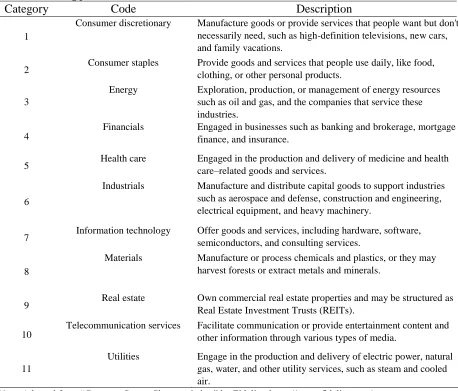
classification standard (GICS), which contains eleven categories.
GICS was developed in response to the global financial community’s need for one
complete, consistent set of global sector and industry definitions, thereby enabling asset
owners, asset managers and investment research specialists to make seamless company,
sector, and industry comparisons across countries, regions, and globally. (RobecoSam,
2016)
The independent variable is CEO gender, utilizing a dummy variable of 1 for female and
0 for male. The other independent variables, C-suite and board of directors are represented by the
number of people in the positions and the percentage of representation. The four dependent
variables—governance, environmental, social, and financial—will be tested along with overall
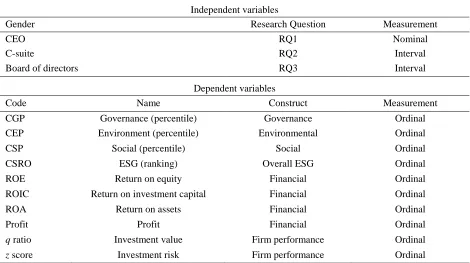
sustainability ranking (Table 1). Additional metrics such as q ratio (overall investment value) and
z score (overall investment risk) add value to the holistic perception of corporation health
(Elsaid, 2014). I used a test of normality to determine the distribution of the data and so that I
could choose between the parametric and nonparametric methods. The normality-test results
indicate that the nonparametric method is the appropriate analytical approach.
I used the Friedman test to determine the significant changes in the dependent variables
from 2014 to 2017. I used the Wilcoxon signed-rank test to determine the significant changes’
effect sizes and the Mann–Whitney U test to determine whether the significant changes crossed
(H2). I used the Kruskal–Wallis test to determine differences across the C-suite and board of
director groups (H4 and H6). The correlations, descriptive statistics, and other illustrative graphs
[image:32.612.72.542.171.434.2]provide evidence for the remaining hypotheses (H1, H3, H5, and H7).
Table 1. Variables for Analysis
Independent variables
Gender Research Question Measurement
CEO RQ1 Nominal
C-suite RQ2 Interval
Board of directors RQ3 Interval
Dependent variables
Code Name Construct Measurement
CGP Governance (percentile) Governance Ordinal
CEP Environment (percentile) Environmental Ordinal
CSP Social (percentile) Social Ordinal
CSRO ESG (ranking) Overall ESG Ordinal
ROE Return on equity Financial Ordinal
ROIC Return on investment capital Financial Ordinal
ROA Return on assets Financial Ordinal
Profit Profit Financial Ordinal
q ratio Investment value Firm performance Ordinal
z score Investment risk Firm performance Ordinal
Note. CGP = corporate governance performance; CEP = corporate environmental performance; CSP = corporate social performance; CSRO = corporate social responsibility–overall.
Assumptions and Limitations
The first limitation is the sample, which is restricted to North American multinational
corporations and other large corporations that participated in the CSA, which RobecoSAM
conducted and reported in the S&P 500 Dow Jones Sustainability North American Composite
Index for 2014 through 2017 (consecutively). To gain a holistic view of sustainability
performance I selected outcomes from Dow Jones, Sustainalytics, and financial data from
originating source’s completeness and timeliness. I assumed that the data collected for the full
research period of 2013 to 2017 is complete as of July 7, 2018.
The third limitation is the fact that the analysis methodology is unprecedented and is
subject to heavy scrutiny. The literature review did not produce existing research addressing a
holistic view of corporate leaders’ impact on financial, environmental, social, and governance
performance outcomes of sustainability. In the future, it is uncertain whether the study will begin
a new trend in global studies focusing on female leadership and corporate sustainability
performance over time.
Organization
Chapter 1 provides background and foundational information pertaining to the study,
including statement of the problem, conceptual framework, and other relevant details. Chapter 2
presents a concise literature review on the progressive position of corporate sustainability by
illustrating its history, purpose, and value over time. Key concepts, models, and definitions
presented in the previous chapter will be thoroughly discussed. Chapter 3 provides intricate
detail on the data source, reporting structure, and analysis methodology for the study. Chapter 4
CHAPTER 2. LITERATURE REVIEW
This research’s primary purpose is to determine corporate leadership gender’s impact on
yearly financial and nonfinancial (ESG) corporate sustainability performance outcomes. The first
goal of this study is to provide a literature review presenting a concise depiction of the history,
the purpose, and the value of corporate sustainability. To achieve this goal, the depiction begins
with a closer look at the origin of corporate social responsibility.
Corporate Social Responsibility
Corporate social responsibility (CSR) is defined as an overarching principle that aligns
strategic business activities with society’s expectations to conduct a profitable yet ethically
considerate business (Brusseau, 2017). Society expectations represent positive or negative
perceptions of business activities implemented during a given period. Over time, increasingly
positive perceptions of a corporation will drive society’s expectations higher (Poolthong &
Mandhachitara, 2009). The expectation of mutual benefit for the society and the corporation is
considered a contract.
In earlier definitions of CSR, scholars were more focused on managing the needs and
perceptions of society and stakeholders, and they gave less consideration to profit (Bendell,
2009; Carroll, 1979). As part of a 6-decade analysis, Rahman (2011) and Dahlsrud (2008)
discovered that historical definitions of CSR shifted according to the dynamics (needs) related to
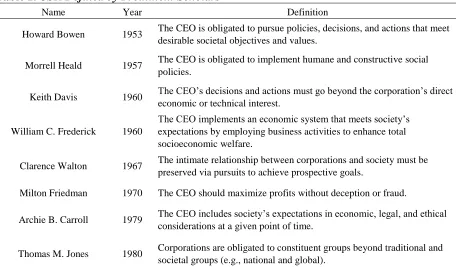
social welfare and the environment during a given period. The time progression in Table 2 shows
the definitions provided by prominent scholars evolving from a philanthropic doctrine to a
Table 2. CSR Defined by Prominent Scholars
Name Year Definition
Howard Bowen 1953 The CEO is obligated to pursue policies, decisions, and actions that meet desirable societal objectives and values.
Morrell Heald 1957 The CEO is obligated to implement humane and constructive social policies.
Keith Davis 1960 The CEO’s decisions and actions must go beyond the corporation’s direct economic or technical interest.
William C. Frederick 1960
The CEO implements an economic system that meets society’s expectations by employing business activities to enhance total socioeconomic welfare.
Clarence Walton 1967 The intimate relationship between corporations and society must be preserved via pursuits to achieve prospective goals.
Milton Friedman 1970 The CEO should maximize profits without deception or fraud.
Archie B. Carroll 1979 The CEO includes society’s expectations in economic, legal, and ethical considerations at a given point of time.
Thomas M. Jones 1980 Corporations are obligated to constituent groups beyond traditional and societal groups (e.g., national and global).
Note. Adapted from “Evaluation of Definitions: Ten Dimensions of Corporate Social Responsibility,” by S. Rahman, World Review of Business Research, 1(1), p. 167-169. Copyright 2011 by Macquarie University. Adapted with permission.
CSR was born from early 19th-century U.S. ideals of philanthropy and fraternity
reinforced by Christian views of humanitarianism (Heald, 1970). Christianity provided the
United States with virtues and values needed to create a foundational sense of common good for
society. During an industrial revolution, corporations created a sense of common good for local
communities by focusing on internal business operations such as employee welfare, labor
conditions, and compensation, resulting in increased productivity and profits (Brusseau, 2017;
Crane et al., 2008; Heald, 1970; Kotler & Lee, 2005). The success of internal operations
expanded to external concerns such as public health, education, and clean environments (Carroll
et al., 2012).
In the late 1800s and early 1900s, community welfare and social programs began to fuel
philanthropy across the country. Hospital clinics, educational institution endowments,
communities (e.g., the Pullman experiment) were heavily influenced by society’s perceptions of
corporations (Crane et al., 2008). Such bold social initiatives led to the Community Chest
Movement, an early form of CSR in which corporations received regular education on social
problems and on how agencies address community concerns (Crane et al., 2008, p. 22–23).
As corporations became educated on social issues, corporate leadership became more
aware and more connected with the community. The new connectivity between corporations and
communities increased philanthropic opportunities, paved the way for analyzing the root cause
of social distress, and increased corporations’ local footprints (Heald, 1970). Corporations’
engagement with communities shifted from a reactive position of donating time and resources to
a proactive position of prevention and problem solving. As more resources were allocated to new
initiatives, corporate leaders determined an urgent need to find ways to balance society’s
expectations with profitability goals (Elkington, 1997; Gao, 2008). The search for balance
provided the foundation for TBL theory.
TBL theory, one of the three primary CSR theories, states that corporations must create
value for long-term investors by being profitable, socially conscious, and environmentally
protective (Hammer, 2015; Jeurissen, 2000). Corporate leaders develop practical actions
according to three performance constructs: financial, environmental, and social (Elkington, 1997;
Gao, 2008). Scholars such as Friedman (1970) and Arrow (1985) have critiqued the
philanthropic foundations of CSR and only support strategies focused on maximizing profits and
meeting shareholder desires. Their argument indicates that the CEO represents the corporation,
and CSR initiatives should not impede core business goals (profits).
Stakeholder theory, another primary CSR theory, interprets the moral and philosophical
profits while violating moral and philosophical guidelines requires deliberate consideration.
Practical actions are developed and measured according to corporate goals and identified
stakeholders (Crane et al., 2008). Despite scholarly critiques, societal expectations remained a
prominent consideration in CSR initiatives well into the next century.
During the middle to late 1900s, corporations began focusing on large high-profile social
issues beyond the local community. The intention of this shift was to find scalable ways to
significantly impact society while maintaining financial stability. Participating in high-profile
causes can provide opportunities to increase positive perceptions of the corporation, strengthen
financial performance, and gain access to new markets (Bendell, 2009). Pollution, racism, and
poverty are large-scale issues that are addressed on regional levels and that when addressed
transcend the global market (Crane et al., 2008).
As corporations began expanding international operations in the late 1900s and beyond,
community welfare, employee welfare, and environmental issues were evident. In developing
countries, CEOs discovered impoverished communities, cheap labor, and abundant natural
resources. Economic, legal, and political conditions were also vastly different than in the United
States, allowing room for individual interpretations of processes, unregulated business activities,
corporate greed, and scandals (Shaw et al., 2012).
To protect the interests of developing countries and to regulate the business behaviors of
multinational corporations, companies have introduced a CSR business strategy for pursuing new
markets (Allouche, 2006). These corporations’ shift from a reactive position of donating time
and resources to a proactive position of global prevention and problem solving provided the
a profit while positively contributing to the welfare of local and global communities (Idowu &
Louche, 2011).
Profit and welfare positions are driven by morality to demonstrate a corporate
consciousness and ultimately increase community value. Practical actions for CSR theory are
developed according to four nonfinancial constructs: environmental, legal, ethical, and
philanthropic (Brusseau, 2017). Philanthropy is a social construct, and legal and ethical
constructs are grouped together under governance. The result is ESG performance containing
three constructs: environmental, social, and governance.
This study proposes to include the concepts of stakeholder value creation, investor value
creation, and local and global community welfare from the three primary CSR strategy theories
to build a holistic view of corporate sustainability. CSR strategy provides the guiding principles,
while corporate sustainability ensures business longevity and generational security.
Corporate Sustainability
Corporate sustainability has multiple definitions, ranging from very broad to very specific
depending on the context framework, the historical period, and the scholar of reference (Rezaee,
2016). Sustainability is a moving target that continues to define business models, strategies,
business processes, and reporting structures (Klettner et al., 2014) to achieve four CSR benefits:
cost reduction, competitive advantages, synergistic value creation, and a trusting reputation
(Crane et al., 2008).
The preceding benefits are complimentary to the goals mentioned earlier of building
brand equity, establishing trust, and improving leadership’s effectiveness. In this study,
sustainability is reviewed as a continuous process of analyzing performance outcomes (financial
2013). WCED initiated the foundations of a continuous process in 1987 to ensure that future
generations are not adversely affected or killed by the actions of forefathers.
Understanding stakeholder needs is a key element in building long-term relationships.
Stakeholders are customers, shareholders, suppliers, employees, and the community surrounding
a corporation. Freeman and Dmytriyev (2017) stated that stakeholder interests must be
incorporated into the valuation, and trade-offs between stakeholders must be avoided (p. 4).
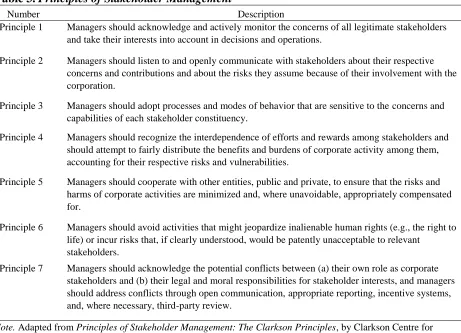
Table 3 lists seven principles of stakeholder interests by the Clarkston Center for Business Ethics
(1999). The seven principles are applied within the CSR initiative to identify business activities
that align with society’s expectations. CEOs must position themselves and the corporation for
[image:39.612.78.539.357.690.2]regular communication with stakeholders to understand needs and expectations.
Table 3. Principles of Stakeholder Management
Number Description
Principle 1 Managers should acknowledge and actively monitor the concerns of all legitimate stakeholders and take their interests into account in decisions and operations.
Principle 2 Managers should listen to and openly communicate with stakeholders about their respective concerns and contributions and about the risks they assume because of their involvement with the corporation.
Principle 3 Managers should adopt processes and modes of behavior that are sensitive to the concerns and capabilities of each stakeholder constituency.
Principle 4 Managers should recognize the interdependence of efforts and rewards among stakeholders and should attempt to fairly distribute the benefits and burdens of corporate activity among them, accounting for their respective risks and vulnerabilities.
Principle 5 Managers should cooperate with other entities, public and private, to ensure that the risks and harms of corporate activities are minimized and, where unavoidable, appropriately compensated for.
Principle 6 Managers should avoid activities that might jeopardize inalienable human rights (e.g., the right to life) or incur risks that, if clearly understood, would be patently unacceptable to relevant
stakeholders.
Principle 7 Managers should acknowledge the potential conflicts between (a) their own role as corporate stakeholders and (b) their legal and moral responsibilities for stakeholder interests, and managers should address conflicts through open communication, appropriate reporting, incentive systems, and, where necessary, third-party review.
Szwajkowski (2000) states that the flow of information between the corporation and
stakeholders is crucial, as “honest disclosure breeds control of information, control of behavior
empowerment on stakeholder issues, and perhaps most important, trust” (p. 389). Forbes author
Dina Medland (2015) suggests implementing private industry tools to identify social issues
relevant to stakeholders and creating a matrix-based network for priorities. Corporations must
establish trust within their community of operations to achieve long-term business sustainability
(Idowu & Louche, 2011).
Once trust is established and CEOs understand stakeholder needs and societal
expectations, the next step is identifying strategic business activities to support stakeholder
valuation for overall corporate sustainability. Corporate leaders created strategic business
activities to produce performance outcomes to be measured over time. The four constructs of
stakeholder valuation for overall corporate sustainability are financial performance,
environmental performance, social performance, and governance performance (RobecoSAM,
2016).
To eliminate overlap of environmental and social performance outcomes within the TBL
and CSR theories, the four constructs of stakeholder valuation are split into two categories for
further literary review: investor value (financial and governance) and community welfare
(environmental and social). Figure 2 illustrates how the four constructs represent community
welfare and investor value within stakeholder valuation. Each construct will be reviewed in the
context of investor value creation or community welfare, as previously indicated for a holistic
view of stakeholder valuation and corporate sustainability. Examples of the key performance
Figure 2. Stakeholder value, investor value, and community-welfare interest. CSRO = overall corporate social responsibility.
Corporate governance performance (CGP) is an investor value-driven performance
indicator that the International Federation of Accountants Committee (2003) defined as “the set
of responsibilities and practices exercised by the board and executive management with the goal
of providing strategic direction, ensuring objectives are achieved, ascertaining risks are managed
appropriately and verifying the organization’s resources are used responsibly” (p. 6). Corporate
leaders and various other gatekeepers are responsible for corporations’ financial stability, trust,
and investor confidence (Brockett & Rezaee, 2012). The Sarbanes–Oxley Act of 2002 and the
Dodd–Frank Act of 2010 are regulatory policies that were put in place to increase gatekeepers’
accountability to both investors and the public. Each was created following a financial scandal in
which unethical practices resulted in a widespread crisis.
CGP includes business ethics as a mandate of organizational accountability for moral
principles, standard business practices, and internal controls. Governance also provides
transparency through monitoring and incentives aligning with investor interests (Henriques &
organizational culture of integrity. Ethics, integrity, and transparency build trust and increase
brand equity, important features for creating value for investors. Businesses fail to exist when
CEOs and others within the company fail to make thoughtful, intelligent, wise, and ethical
decisions (Carroll et al., 2012). KPIs assigned to governance provide internal and external
controls to maintain organizational integrity (Table B1).
Corporate environmental performance (CEP) is a community welfare-driven
performance indicator that the U.S. Environmental Protection Agency (2011) defined as “the
measurable results of the environmental management system, related to an organization's control
of its environmental aspects, based on its environmental policy, objectives, and targets” (p. 1).
Environmental change is a shared problem, and the corporations that control the surrounding
environment are responsible for protecting future generations. Such actions are considered
external business operations, so they are included in public-image and brand-protection
initiatives. Brockett and Rezaee (2012) stated that society has greatly benefited from corporate
environmental policies since the early 2000s.
As natural and business disasters occur, corporations take steps to prevent reoccurrence
or to mitigate further damage. Prevention led to the development of environmental programs
with KPIs (Table B2) designed to preserve natural resources (Duckworth & Moore, 2010) and
minimize harm (Henriques & Richardson, 2004). The U.S. Environmental Protection Agency
has special programs for corporations that take early action on various environmental issues.
Corporations that participate in environmental programs receive public recognition and take
proactive positions for preventing environmental harm and problem-solving. Participation adds
Corporate social performance (CSP) is a community welfare–driven performance
indicator that is defined as fulfilling a corporation’s mission by aligning business activities with
society’s interests and by accepting accountability based on societal values (Brockett & Rezaee,
2012). In other words, CSP means finding goals that share the needs of the community while
conducting business with integrity, even when the corporation is not at fault for causing an event
that produces a need (e.g. natural disaster). To understand the community’s needs and reduce
reputational risks, the corporation must engage and interact with the community (Herriott, 2016;
Medland, 2015).
KPIs assigned to CSP address internal and external business operations to protect basic
human rights (Table B3). Participation in global social concerns depends upon the overall CSR
set by each corporate leadership. Like CEP, participation in social concerns adds value to
community welfare by increasing brand equity and building trust while taking a proactive
position for prevention and problem solving.
Corporate financial performance (CFP) is an investor value-driven performance
indicator that Karlson (2016) defined as a “measurable value that indicates how well a company
is doing regarding generating revenue and profits” (p. 1). As with CGP, corporations must
establish trust and financial stability through external compliance with the Sarbanes–Oxley Act
of 2002 and the Dodd–Frank Act of 2010 to attract capital investors. Karlson (2016) identified
29 traditional financial KPIs that determine financial stability (Table B4). Financial reliability is
essential for investor confidence and efficient capital markets (Brockett & Rezaee, 2012). To
improve transparency and gatekeeper accountability, internal controls such as executive
In preparation for applying the upper echelons theory and the social-role theory, the
holistic concentric circles model will demonstrate how financial, environmental, social, and
governance constructs work together to provide a holistic analysis of year-over-year corporate
sustainability performance.
Holistic Concentric Circles Model
The current study’s third goal is introducing a paradigm shift in defining and analyzing
corporate sustainability constructs to create a holistic view that considers financial and
nonfinancial performance equally. As mentioned previously, a sustainability analysis typically
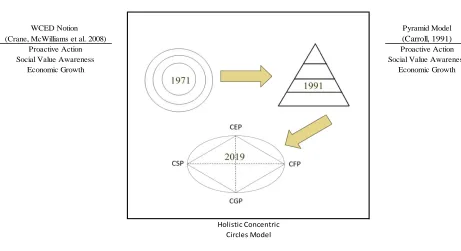
does not include financial performance. The shift evolves from concentric circles (WCED, 1971)
and hierarchal pyramids (Carroll, 1991) to create a holistic view illustrating the shared value and
the equal consideration of all four constructs: financial performance, environmental performance,
[image:44.612.73.534.409.660.2]social performance, and governance performance (see Figure 3).
Figure 3. The evolution of the concentric circles model.
WCED = World Commission on Environment and Development; CGP = corporate governance performance; CEP = corporate environmental performance; CSP = corporate social performance; CFP = corporate financial performance.
WCED Notion Pyramid Model
(Crane, McWilliams et al. 2008) (Carroll, 1991)
Proactive Action Proactive Action
Social Value Awareness Social Value Awareness
Economic Growth Economic Growth
The evolution of the concentric circles model begins with WCED’s 1971 introduction of
the concentric circles notion of social responsibility (Crane et al., 2008), in which corporations,
to meet societal needs, must induce satisfaction with the quality of services rendered. The three
circles (economic growth, social value awareness, and proactive action) represent the first set of
performance outcomes (constructs) related to CSR and sustainability.
Geva (2008) defined the concentric circles model as a shared environment where a
business’s and a society’s responsibilities are integrated and aligned with common a goal. In the
format, the performance outcomes (constructs) do not reflect dependency or hierarchy, which
encourages an inclusive and holistic view of sustainability. Each construct is placed on a shared
circle, with the innermost layer representing the core foundational principle of the corporation
(profitability) and the outermost layer representing shared values (societal norms).
In the pyramid model, founding sustainability theorist Archie B. Carroll (1991)
expounded upon the WCED’s notion and grouped business responsibilities into a hierarchal
structure. Carroll removed the integration of constructs to provide a rigid, procedure-based
approach with high-priority responsibilities at the base. Like Maslow’s hierarchy of needs for the
human condition, the upper levels of the pyramid are not addressed until the lower levels are
completely satisfied. Carroll added philanthropy as a discretionary category because this factor
was gaining momentum in the late 1800s and early 1900s (Geva, 2008). Although helping others
adds value to businesses, participation was voluntary and not considered a high priority.
The holistic concentric circles model takes the four constructs of sustainability and
applies the WCED’s all-inclusive integration. Each point of the diamond within the circle
represents a performance outcome, including CFP, CEP, CSP, and CGP. The all-inclusive