BIROn - Birkbeck Institutional Research Online
Carter, Andrew and Riley, T. and Hillenbrand, C.-D. and Rittner, M. (2016)
Widespread Antarctic glaciation during the Late Eocene. Earth & Planetary
Science Letters , ISSN 0012-821X.
Downloaded from:
Usage Guidelines:
Please refer to usage guidelines at
or alternatively
Contents lists available atScienceDirect
Earth
and
Planetary
Science
Letters
www.elsevier.com/locate/epsl
Widespread
Antarctic
glaciation
during
the
Late
Eocene
Andrew Carter
a,
∗
,
Teal R. Riley
b,
Claus-Dieter Hillenbrand
b,
Martin Rittner
caDepartmentofEarthandPlanetarySciences,Birkbeck,UniversityofLondon,MaletStreet,LondonWC1E7HX,UK
bBritishAntarcticSurvey,HighCross,MadingleyRoad,CambridgeCB30ET,UK
cDepartmentofEarthSciences,UniversityCollegeLondon,GowerStreet,LondonWC1E6BT,UK
a
r
t
i
c
l
e
i
n
f
o
a
b
s
t
r
a
c
t
Articlehistory: Received 29 June 2016
Received in revised form 21 October 2016 Accepted 23 October 2016
Available online xxxx Editor: H. Stoll
Keywords:
Eocene–Oligocene transition Antarctica
glaciation IRD provenance
Marine sedimentary rocks drilled on the southeastern margin of the South Orkney microcontinent in Antarctica (Ocean Drilling Program Leg 113 Site 696) were deposited between ∼36.5 Ma to 33.6 Ma, across the Eocene–Oligocene climate transition. The recovered rocks contain abundant grains exhibiting mechanical features diagnostic of iceberg-rafted debris. Sand provenance based on a multi-proxy approach that included petrographic analysis of over 275,000 grains, detrital zircon geochronology and apatite thermochronometry rule out local sources (Antarctic Peninsula or the South Orkney Islands) for the material. Instead the ice-transported grains show a clear provenance from the southern Weddell Sea region, extending from the Ellsworth–Whitmore Mountains of West Antarctica to the coastal region of Dronning Maud Land in East Antarctica. This study provides the first evidence for a continuity of widespread glacier calving along the coastline of the southern Weddell Sea embayment at least 2.5 million yrs before the prominent oxygen isotope event at 34–33.5 Ma that is considered to mark the onset of widespread glaciation of the Antarctic continent.
©2016 The Author(s). Published by Elsevier B.V. This is an open access article under the CC BY-NC-ND license (http://creativecommons.org/licenses/by-nc-nd/4.0/).
1. Introduction
The periodleading up to the glaciation ofAntarctica remains poorly understood. Whilst there is a general consensus that the onset ofcontinent-wide glaciation in Antarctica occurred around theEocene–OligoceneTransition(EOT)duringaprominentoxygen isotope excursion at34–33.5 Ma it isdebatable asto whether a single orcombination ofdrivers andfeedbacks collectively drove theclimatetransition. Theoxygen isotopeeventismanifested by asharp transient increase indeep-seabenthicforaminiferal
δ
18O valuesreflectingcooling andamajorgrowthinglobalicevolume (Coxalletal.,2005; Zachosetal.,2001),asignificantsea-levelfall that impliesmajorice build-upinAntarctica (Miller etal., 2005; Stocchi etal., 2013), deposition of icerafted debris (IRD) on the seabed around Antarctica (Zachos et al., 1992) and geochemical (BasakandMartin,2013; Passchieretal.,2013),andclayand min-eralogicalchanges(EhrmannandMackensen,1992; Houbenetal., 2013) that show a shift fromchemical tophysical weatheringof terrigenous detritussupplied fromthe Antarcticcontinent to the SouthernOcean.*
Corresponding author.E-mailaddress:[email protected](A. Carter).
WorkbyScheretal. (2014)onMiddletoLateEocenesediments from Ocean Drilling Program (ODP) Site 738 on the Kerguelen Plateau (Fig. 1) produced a high-resolution benthic foraminiferal
δ
18O recordalongside a Nd isotoperecord, for the clayand silt-sized (<
63 μm) terrigenous fraction. The data identified a tran-sient rise in benthicδ
18O values at c. 37.3 Ma that the authors interpreted as a possible episode of icesheet expansion and re-ferred to as the PrOM event (Priabonian oxygen isotope maxi-mum).Duringthisexcursionradiogenicε
Nd valuesofterrigenous sediment were lower andconsistent withan increased contribu-tion of fine-grained sediment from old source terrains such as PrydzBayand/orWilkesLand (Fig. 1).Itwasproposed thatthese sedimentsweremostlikelyofglaciofluvialoriginandthereforeice was presentin EastAntarcticdrainage basinsatthat time. How-ever, thenature of theseproxydata cannot tie the sedimentsto specificsourceareasandthereisnodirectevidencetocompletely rule out fluvial transport, e.g. along the Lambert Graben (Fig. 1) and/ortransportbybottomcurrents.Despite some evidence for Eocene ice, it is clear that con-siderable uncertainties remainaboutthe natureandgeographical extent of the earliest ice on Antarctica due to the limitations of geochemicalproxyrecordsindefining icevolumeandoffar-field proxyrecords inlocating ice-sheet build-up. Thishas steered re-searchers to explore sediment lithologies, grain sizes and micro-texture data in more proximal records along the Antarctic
mar-http://dx.doi.org/10.1016/j.epsl.2016.10.045
JID:EPSL AID:14150 /SCO [m5G; v1.190; Prn:8/11/2016; 12:43] P.2 (1-9)
2 A. Carter et al. / Earth and Planetary Science Letters•••(••••)•••–•••
Fig. 1.Present-day locations of areas, where major studies on marine sediments have been undertaken for reconstructing Antarctic ice-sheet history during the Palaeogene and/or Neogene.
gin. The studies have found evidence of glacigenic components in marine sediments,such asdiamictons deposited on the shelf, glacial microtextures on sand grains in shelf sediments and IRD in deep-sea sediments, that predate the EOT (e.g. in Prydz Bay, onMaudRiseandKerguelenPlateau (Fig. 1)(Barronetal., 1991;
Breza and Wise, 1992; Ehrmann and Mackensen, 1992; Strand
et al., 2003). Based on these findings the authors argued for mountainousglaciersreachingsealevelduringtheMiddletoLate Eocene,i.e.significantlypriortothemarkedshiftinoxygenisotope values,butsomeoftheevidencewasdisputedbecauseof ambigu-ous depositional settings (e.g. interpretation of diamictons either assubglacialtillsordebrisflowdeposits),agemodeluncertainties (e.g.thebiostratigraphicageusedinStrandetal. (2003)areloosely givenaslowerOligocenetoupperEocene)andpossibledown-hole contaminationofIRDrecordswithsignificantlyyoungerIRD.
Themostrecentproximaldataforthestate ofearly icecomes fromtheCapeRobertsDrillingProject (CRP)whichinvestigateda shallow-water glaciomarine sedimentary succession in the Victo-riaLandBasin(CRP-3onFig. 1)onthewesternRossSeashelfand found a major increase in glacially derived sediments at around 33Ma (Barrett, 2007). Thewell-dated CRP-3drillcoresuggestsa stablecontinental-scaleWestAntarcticIceSheet(WAIS)calvingat the coastline only after 32.8 Ma (Galeotti et al., 2016). There is evidencefororbitalpacingofglacialadvanceandretreatcycles be-tween34and31Ma,indicatingthatthenascentAntarcticicewas strongly sensitive to local insolation forcing. The stabilization of continentalscaleWAISat32.8Maappearstohavebeensensitive to crossing a CO2 threshold, although the precise CO2 threshold foriceexpansion issubjectto huge uncertainties(Anagnostou et al.,2016; Gasson etal., 2014).Furthermore,thestudyby Galeotti etal. (2016)onlyconstraineda partoftheWAISproximal tothe coastlineinthe westernRossSea.Consequently, thelocation and extentofLatePalaeogeneglacialiceinAntarctica,andtheorigins ofthe much larger EastAntarctic IceSheet (EAIS) remains unre-solved.
To improve understanding of the state of the Antarctic cryospherewestudiedtheprovenanceofLateEocenetoOligocene marinesedimentsfromODPLeg113Site696drilledonthe south-easternmarginoftheSouthOrkneyMicrocontinent(SOM;Fig. 2). Paleolatitude reconstructions based on a reference frame
rela-tive to the Earth’s spin axis (van Hinsbergen et al., 2015) show that in the Late Eocene the SOM was 600–800 km south of its present-day location andpart of the northern tip of the Antarc-tic Peninsula arc-fore-arc terrane (Fig. 3) before Eocene rifting and opening of the Powell and Jane Basins (Fig. 2) caused the geographic isolation of the SOM (Eagles and Livermore, 2002; EaglesandJokat,2014).WhilstthechangesinlocationoftheSOM arereasonablywell constrainedthisisnotthecaseforDrake Pas-sage opening which involved the dispersal of a mosaic of small continental blocks that once formed the land bridge connecting SouthAmericawiththeAntarcticPeninsula.
ThisEocene riftingresulted intheopeningofa newly formed riftbasincapturingthebulkoftheterrigenousdetritusshedfrom the northern Antarctic Peninsula,confining sedimentationon the SOM shelf to local sources and potentially iceberg-rafted debris (IBRD) fromdistalsources. The latterislikely becauseatpresent the SOM is located within ‘iceberg alley’. Today icebergs calved from theEast AntarcticIce Sheet andreleased intothe Antarctic Coastal Current, a comparatively fast, shallow westward current, mix with icebergs derived from West Antarctica in the cyclonic Weddell Gyre,whichtransportsthe icebergsnorthwardsinto the Scotia Sea (Fig. 2). A similar circulation system with a proto-Weddell Gyre, similar to today, probably existed already during the Eocene. This is suggested by general circulation model ex-periments of Eocene paleoceanographic circulation that replicate the spatial distribution andrelative abundance patterns and en-demism amongst fossil Transantarctic flora (Huber et al., 2004; Bijletal.,2011).
2. Material
Site 696was drilled during ODP Leg113 in1987. Located on the southeastern margin ofthe SOM ata water depthof 650 m drillingpassedthroughasequenceofhemipelagic,andpelagic ter-rigenous sediments deposited between the Late Eocene and the Quaternary (Barkeret al., 1988; WeiandWise, 1990). Despiteof only 27% corerecoverytheoldest part ofthe drilledsequence is wellrepresented.Thisstudyfocusesontheshallowmarine, sandy-silty mudstones from the lowermost lithological sub-Units VII C andDbetween577 mbelowseafloorandthebaseoftheholeat 646m.b.s.f.(Fig. 4).Ageconstraintswereestablishedthrough cal-careous nannofossil stratigraphyduring thetime ofdrilling (Wei
and Wise, 1990) and recently updated by Houben et al. (2013)
(Fig. 5). Based on the first consistent occurrence of Isthmolithus recurvus andpresenceof
Reticulofenestra bisecta
thelatterauthors conservatively estimated the base of the drilled interval to be 36.5 Ma old although the sequence could be as old as 37.6 Ma. The youngest samplesexamined inthis study(52Rand51R) are belowcore55Rat569.4mbsf,whichisdatedto33.6Mabasedon the first consistent occurrenceof the dinocyst Malvinia escutiana. Sample 51R yieldedMiddle Miocene diatoms (Denticulopsis lauta, Denticulopsis hustedti,Denticulopsis sp, Denticulopsis maccolummii). Totestforalocalsourceofterrigenous materialdepositedatSite 696wealsoanalysedbedrocksamplesfromCoronationandPowell Island(Fig. 3).3. Methodsandapproach
Fig. 2.A) Geography of the Weddell Sea sector and the provenance locations (coloured) referred to in the text. B) Bathymetry of the South Orkney microcontinental shelf, location of Site 696 geology and of Coronation Island and Powell Island and sample sites after Flowerdewetal. (2011).
graingeochronological(zirconU–Pb)andthermochronological (ap-atitefissiontrack)dating.Populationsofsinglegrainagesareused tofingerprintandidentifythesandsourcesby comparingthe
JID:EPSL AID:14150 /SCO [m5G; v1.190; Prn:8/11/2016; 12:43] P.4 (1-9)
[image:5.612.319.521.57.380.2]4 A. Carter et al. / Earth and Planetary Science Letters•••(••••)•••–•••
Fig. 3.Paleogeographic reconstruction adapted from EaglesandJokat (2014) show-ing (A) the position of the South Orkney Microcontinent durshow-ing the Middle to Late Eocene. Paleolatitude is from van Hinderbergenetal.(2015). (B) For comparison the present day location is also shown.
[image:5.612.35.286.57.462.2]approach has been successfully tested in Antarctica where such ages reliably record the geological composition of source areas (Pierceetal.,2014).
Fig. 4.Stratigraphy and age control for samples from ODP 113 Site 696B.
Thesandgrainsmayhavecomedirectlyfrommeltingicebergs that have calved from ice streams and outlet glaciers into the sea. Sedimentsdeposited atSite 696 contain evidenceof coarse-grained (up to 3 cm size) ice-rafted detritus and dropstones in the coresdown toa depth of570m.b.s.f. (i.e. core54Rwhich is poorly datedasLateOligocenetoearlyMiocene).Totestwhether the finer grained older sediments at Site 696 also contain IRD, we examined microfeatures ofquartz grainsin thesand fraction 0.1–0.5 mm.Highpressureglacialfracturingandabrasionproduces grains with high degrees of angularity and relief along with di-agnostic microfeatures such as gouges, conchoidal fractures and steps (Mahaneyetal., 1996).AlthoughIBRD-derivedicewouldbe expectedtobethemainsourceofclasticmaterialdeliveredto
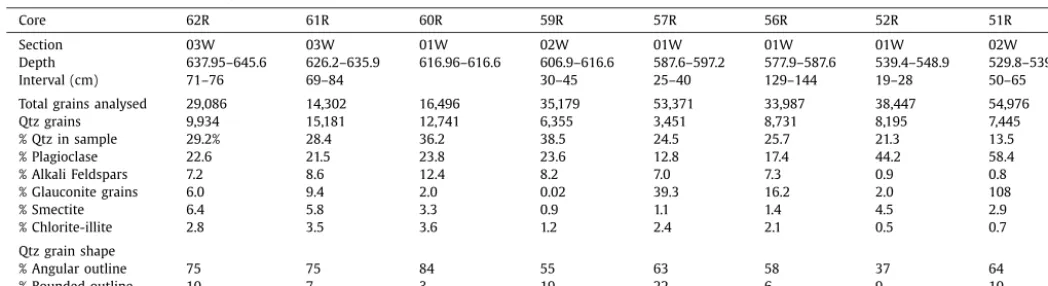
[image:5.612.156.431.556.721.2]Table 1
Summary of grains scanned for composition. Grain outline is based on Powers (1953)classification.
Core 62R 61R 60R 59R 57R 56R 52R 51R
Section 03W 03W 01W 02W 01W 01W 01W 02W
Depth 637.95–645.6 626.2–635.9 616.96–616.6 606.9–616.6 587.6–597.2 577.9–587.6 539.4–548.9 529.8–539.4
Interval (cm) 71–76 69–84 30–45 25–40 129–144 19–28 50–65
Total grains analysed 29,086 14,302 16,496 35,179 53,371 33,987 38,447 54,976
Qtz grains 9,934 15,181 12,741 6,355 3,451 8,731 8,195 7,445
% Qtz in sample 29.2% 28.4 36.2 38.5 24.5 25.7 21.3 13.5
% Plagioclase 22.6 21.5 23.8 23.6 12.8 17.4 44.2 58.4
% Alkali Feldspars 7.2 8.6 12.4 8.2 7.0 7.3 0.9 0.8
% Glauconite grains 6.0 9.4 2.0 0.02 39.3 16.2 2.0 108
% Smectite 6.4 5.8 3.3 0.9 1.1 1.4 4.5 2.9
% Chlorite-illite 2.8 3.5 3.6 1.2 2.4 2.1 0.5 0.7
Qtz grain shape
% Angular outline 75 75 84 55 63 58 37 64
% Rounded outline 10 7 3 19 22 6 9 10
talmarinelocationssuch asthenorthernWeddellSea,theremay alsobeacontributionfromseaice(sea-ice-rafted debrisorSIRD). Quartzgrainscarriedbyseaicehaveroundededgeslowreliefand chemicalfeatures associatedwithsilicadissolutionand reprecipi-tationduetogreaterlevelsofchemicalweathering(Dunhill,1998; St Johnetal.,2015).Fromeachsample, 20–30quartzgrainswere randomly selected for analysis of surface microtextures under a ScanningElectronMicroscope,andthepresenceorabsenceofkey featureswasrecorded(Dunhill,1998; St Johnetal.,2015).Further methodologicaldetailsareprovidedinthesupplementarymaterial.
4. Resultsandinterpretation
The investigatedsamples have grain sizes comprising siltand coarse sand, with the modal grain size being fine sand. Qem-scan analysiscountedbetween14,000 and55,000 mineralgrains in each sample (Table 1) of which 60–72% of the grains were quartzandfeldspar.Theonlyexceptionisasamplefromcore57R, whichisrichinglauconite.Thehigh(20–59%)feldsparcontentsin allsamples indicateimmature, mechanicallyproducedsediments. The abundanceof feldspar fluctuates across the stratigraphicage rangeandisgenerallymirroredby amountsofsmectiteand, toa lesserextentillite–chlorite.Chlorite andilliteareboth influenced bystrongphysicalandweakchemicalweathering.Smectiteis gen-erallylinked to weatheringof feldspars so some correspondence istobeexpected.Detailedgeochemicalandclaymineralogical in-vestigationson the Eocene sedimentsat Site 696by Robertand Maillot (1990)havepreviously shownthat mostofthesediments areofdetritaloriginandthat theirsmectitesresemble those typ-ically found in soils formed in (sub-)tropical regions and/or on parent-rocksofbasalticorigin.Someofthesmectitesrevealed fea-turescharacteristic foran early diageneticorigin, but thesewere interpretedtohaveformedduring
in situ
recrystallizationof smec-titewithin the interstitial sedimentary environment andwithout anysignificantchemicalormineralogicalchange(Robertand Mail-lot,1990).The ubiquity(39%ofgrains)ofglauconiteincore57R, andtoalesserextent(16%)in56R,supportsashallow-water en-vironmentenrichedinFeandK.Quartzandfeldspargrainshapes aremainlyangular.Quartzgrainmicrofeaturesfromtheoldestsamplesfromcores 62R–59R of Site 696 display high relief, angular mechanical fea-turesconsistentwithIBRD,seenclearlybySEMimaging(Fig.S1A). We also detected some grains with rounded low relief features consistentwithSIRDfeatures (Figs.S1B andS1C)butsincesome grainswithin each sample havemicrofeatures ofboth IRDtypes we regard the estimated proportions of SIRD or IBRD as indica-tive only. It is clear though that grainswith IBRD features form thelargestpopulationandaccountfor37–84%ofallquartzgrains basedonabundancesofhighreliefangulargrainsthatshow
break-age blocks, conchoidal and step-like fractures, gouges and stria-tions(TableS2).Someofthesegrainsshowedgeabrasions,which may result from glaciomarine current reworking or from trans-portintheglacialenvironment(Strandetal.,2003),with current-reworkedgrainsbeingsubroundedtosubangular,ofmediumrelief and having dissolution features. The remaining grains show fea-tures consistent with SIRD (sub angularto well rounded, low to medium relief, highabundance of breakageblocksand microlay-ering, widespread dissolution features).Some ofthese grainsare fluvialinoriginandcouldbederivedfromerosionofexposedparts ofthe SOM orby longer distanceIRD transport fromthecoastal shelfareasborderingtheWeddellSea.
Thepresenceofabundantquartz,feldsparandmicaatSite696 isconsistentwithcontinentalmargin sourcesandsothesimplest explanation is that during the early rifting stages of the Powell Basinat c.40–30 Ma(Eagles andJokat,2014) theSOM was still proximalenough totheAntarcticPeninsulatoreceivesome ofits detritus (Barkeretal., 1988), and/or thesediment camefrom ex-posedpartsoftheSOM.Comparisonofheavymineralassemblages from this study with modern marine sediment samples in the WeddellSearegion(DiekmannandKuhn,1999) pointstosources withinEastAntarctica(Fig.S2).GarnetiswidespreadinSOMrocks but is rare (
<
0.5%) in the Site 696samples (Table S5). This dif-ferenceisalsoindicatedbythefissiontrackandzirconU–Pbdata fromSouthOrkneybedrock.Apatite fission track (AFT) analyses of bedrock samples from South Orkney (Table S3)gave reset central ages between33 Ma (H.1181.1: biotite schist of the Permian–Triassic Scotia metamor-phic complex) and 56 Ma (H.2113.2: JurassicPowell Island Con-glomerate). The lattersample showsoverdispersion ofgrain ages with a sub-population at 44
±
3 Ma and a smaller group at 82±
1 Ma. Although none of the data yielded sufficient track lengthsfor thermalhistory modelling theyoungest ages indicate onset ofcooling from c.50–30 Ma, which overlaps withthe on-set ofrifting andextension during early openingof PowellBasin (EaglesandJokat,2014).Thebedrock AFTdatalimitthedepth of post30Madenudationto<
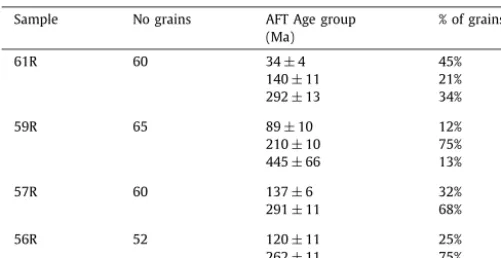
1.5–2 kmsinceanylargerdenudation would normallyhave produced younger AFT ages unless the ex-humationwas extremelyrapid.By contrast,thedetrital AFTages fromSite696aredifferent;coresample61Rrevealedaminor pop-ulationofvolcanicapatiteswithanageof34±
4Ma andabundant oldergrainswithmeanagesbetween140±
11 and 292±
13Ma. Similar age modeswere found insamples 56R and57R (Fig. S3;Table 2).
JID:EPSL AID:14150 /SCO [m5G; v1.190; Prn:8/11/2016; 12:43] P.6 (1-9)
[image:7.612.33.284.88.217.2]6 A. Carter et al. / Earth and Planetary Science Letters•••(••••)•••–•••
Table 2
Summary of detrital apatite fission track age modes at Site 696. Accompanying ra-dial plots can be found in the supplementary data.
Sample No grains AFT Age group (Ma)
% of grains
61R 60 34±4 45%
140±11 21%
292±13 34%
59R 65 89±10 12%
210±10 75%
445±66 13%
57R 60 137±6 32%
291±11 68%
56R 52 120±11 25%
262±11 75%
history modelling of the oldest apatite fission track age compo-nent (Fig. S4) show the ages were produced by a Carbonifer-ous cooling event. This rules out the Antarctic Peninsula as a source since the oldest rapidAFT cooling eventfrom thisregion dates to the Late Cretaceous andEarly Cenozoic(Barbeau,2011; Guenthneretal.,2010).The onlyknownLateCarboniferousevent is in Dronning Maud Land of East Antarctica (Jacobs and Lister, 1999; Meier,1999; Emmeletal.,2007).TheyoungerFTagemode in the Site 696 samples relates to an early Cretaceous cooling event which has been recorded from Antarctic basement rocks surroundingtheWeddellSea,extendingfromtheEllsworth Moun-tains(Fitzgerald andStump,1991, 1992)to theShakletonRanges and coastal areas of Dronning Maud Land (Emmel et al., 2007; Meier,1999) (Fig. 2).
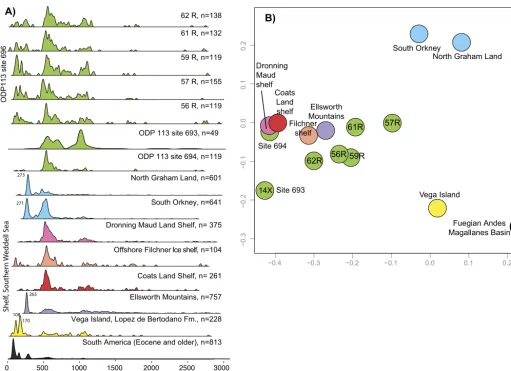
DetritalzirconU–Pbdataalsoshowsimilardifferences.AllLate Eocene samples from Site 696 gave nearly identical age spectra (Fig. 6).Therangeofagepeaksisdissimilartodatafrombedrock of the South Orkney Islands and Graham Land on the Antarc-ticPeninsula, moststrikingly by the absenceof zircons fromthe Permian arc (270 Ma peak), which are ubiquitous amongst the rocks of South Orkney and sedimentary successions of northern andeastern GrahamLand (Barbeau,2011). TheU–Pb ages ofthe zircons in the Site 696 samples alsoreveal Early Cretaceous age peaksandasignificantcomponentofgrainsbetweenc.1.0–12Ga that are essentially absent in rocks fromnorthern Graham Land andrareonSouthOrkney.
Totest rigorouslytherelationship betweenlikelysource areas multidimensionalscaling(MDS)(Vermeesch,2013) wasappliedto thezircon U–Pbresults anddata fromareasborderingthe entire WeddellSearegion(Fig. 6),includingtheshelfofDronningMaud Land,CoatsLand,theEastAntarcticdrainagebasinofthemodern FilchnerIceShelf,theEllsworthWhitmoreMountains,the Antarc-ticPeninsula,theSouthOrkneyIslands aswellastheMagellanes BasinandtheFuegianAndes,becausetheSOMwaslocatedcloser to South America prior to its separation from Antarctica during theEocene(EaglesandJokat,2014) (Fig. 3).TheMDSmapclearly showsa strongdissimilaritybetweenSite 696samplesandSouth America, the Antarctic Peninsula andSouth Orkney, buta signif-icant similarity to the Ellsworth Whitmore Mountains, drainage basin of the Filchner Ice Shelf, the shelf regions of Coats Land andDronning MaudLand. We also comparedSite 696data with Pliocene sediments from ODP Leg 113 Site 694 on the Weddell Seaabyssalplain.Thesedimentsdepositedatthislocation during thePlioceneareentirelyhemipelagicinorigin(KennettandBarker, 1990) and, giventhe westwarddirectionsoftheAntarcticCoastal CurrentandtheWeddellGyre,musthavebeensourcedfromEast Antarctica. We also analysed one middleOligocene sample (core 14)fromSite 693Bonthecontinentalmargin oftheWeddellSea, proximal to Coats Land and Dronning MaudLand. In both cases
the zircon ages are similar to the LateEocene zircon dates from Site696(Fig. 6).
5. Discussion
The detrital zircon U-Pb andapatite thermochronometry data showthatthebulkoftheLateEocene(
∼
36.5–33.6 Ma)sediments deposited at ODP Leg 113 Site 696 do not originate from local sources (Antarctic Peninsula andSouth Orkney) butinsteadwere supplied fromdistalsources. Thisfindingtogether withthe com-monoccurrenceofquartzgrainswithmechanicallyinduced micro-textures,whicharediagnostic ofsubglacialerosionandtransport, suggeststhatmostofthedetrituswassuppliedbyice-rafting.The provenanceof thesesand grainsbestmatchessources within the Ellsworth–Whitmore MountainsofWest Antarcticaandthe Wed-dell Sea coastal region of East Antarctica (Fig. 2). However the significance of these results and implications for understanding the development of the early stages of the Antarctic cryosphere depends on whetherthey were deposited by directly by melting icebergs, seaiceorwerere-depositedby otherprocesses,suchas gravityorcurrentflows.Opening of the Weddell Sea and formation of new oceanic lithosphere initiated in the south at around 147 Ma (Konig and Jokat, 2006) andthe maindepocentre hasremained thereto the present-day(Huangetal.,2014).Giventhatcontinental-scaleriver systemsdrainedtheAntarcticinteriorwellintotheEocene(Strand et al., 2003) and delivered sediment through the Filchner-Ronne rift basin to thisdepocentre (Jamieson etal., 2014) it is reason-able to consider that sediment deposited on the SOM shelf may havebeenre-workedanddeliveredbylong-distancegravityflows that originated along the southern Weddell Sea margins. Today, thiswouldrequiresandtotravelover1200 km,acrosstheabyssal plainsbeforeflowinguphillfromwaterdepths
>
4000 montothe SOM shelf that has a water depth of 650 m. Reconstructions of Weddell Sea paleobathymetry based on the thermal subsidence historyoflocaloceancrust(Huangetal., 2014)showthata simi-lardepthrangeexistedintheLateEocene,althoughtheSOMshelf was shallower, c.100 m (withan uncertainlyofa similar order), based onbenthicforaminifera diagnostic ofa neritic,slightly hy-posaline inner shelf environment (Wei andWise, 1990) and the presenceofglauconite.Moreproblematicisthatduringthe Paleo-gene,tothesouthwestoftheSOM,theEndurancesubductionzone (Fig. 2) would have trapped any sediment transported by flows fromthesouth.Given that gravity flows are an unrealisticmode of transport, the LateEocenesedimentsdeposited atSite696 musthavebeen transportedtotheSOMbyice.Althoughquartzgrainmicrofeatures are mostly consistent with IBRD some 15–45% of the observed grainsshowmicrofeaturesconsistentwithsea-icetransportand/or afluvial reworking.Whethersea-iceofanysignificanceexistedat least during the winter months inthe late Eocene is unclear al-though climate modelling studies show it was certainly possible (DeContoetal.,2007).If(seasonal)seaicewaspresentbecausethe AntarcticshelfwasstillshallowduringtheLateEocene(Wilsonet al.,2013) itcouldhaveeasilypickedupandtransportedbeach sed-iments. Regardless,the key point isthat the glacial derived sand grainsweretransportedtotheSOMbyice,mainlybymelting ice-bergs,andthat alloftheicesources musthaveoriginatedinthe southern WeddellSeabecausetheir provenance(zirconU–Pband apatite FTages)doesnot matchthe AntarcticPeninsula orSouth Orkney.
Fig. 6.A). Kernel density plots of detrital zircon ages for samples analysed in this study (South Orkney, Site 696) and compiled datasets for potential source regions (see supplementary data for sources). B). Multidimensional Scaling Maps (Vermeesch,2013) comparing the age spectra in A. Dissimilar samples (South Orkney, Graham Land, Fuegian Andes, Vega Island) plot far apart. The cluster of similar samples includes Sites 696 and 694, modern sediments from offshore Dronning Maud and Coats Land, the hinterland of the modern Filchner Ice Shelf and bedrock ages from the Ellsworth Mountains (for locations see Fig. 2).
(Barronetal.,1991; CooperandO’Brien,2004).Also,the geochem-ical proxy data from middle-late Eocene sediment deposited on theKerguelen Plateau found evidence consistent withephemeral glaciationsinEastAntarctica(Scheretal.,2014).Thesestudies as-sumed that the glacial debris came fromnearby sources, or was reworked. More directevidence from thework by Galeottiet al. (2016)onthewell-dated CRP-3drillcoreatCapeRobertshas re-vealedevidenceoflocalglacialadvanceandretreatcyclesthatdate tobetween34–31 Ma.DuetothelowrecoveryatSite696sample ourdatasetdoesnothavethetemporalresolutiontodetectorbital scaleglacial–interglacialcyclesandso cannot demonstrateglacial icewas permanentlypresentthroughouttheLateEocene.The re-centstudyby Galeottietal. (2016),suggestedthatuntil 32.8Ma mostofthe glacialicedisappeared during peakinterglacials.But, significantly, our new data do reveal an older and much wider distribution of glacial ice in Antarctica than any previous work hassuggested.Theremusthavebeensignificanticepresentacross Antarctica inthe Late Eocene to enable it to reach low-altitudes andtocalveicebergsalongthecoastlinesofthesouthernWeddell Seabyc.36.5Maorslightlyearlier.
The iceberg-rafted grains with both East and West Antarctic provenanceprovideanunambiguousrecordforwidespreadglacial icearoundtheWeddellSeaembaymentbetween
∼
37and34Ma. Whethertheseareas were the precursors forgrowthof theEAIS andWAISis an open question. Mostof theAntarctic topographywas establishedbefore theLateEocene (Wilsonetal., 2012), and theglaciers inthemainly inlandmountainousareasin the Gam-burtsev Mountains, Dronning Maud Land and the Transantarctic Mountains(Fig. 1)canbeexpectedtohaveservedasthemain nu-cleifortheicesheets.InsimulationsofAntarcticice-sheetgrowth underhigh PalaeogeneCO2 concentrations theloci ofthe largest nucleiare closetothe regions that werethe sources formostof theIBRD-grainsfoundatSite696(DeContoetal.,2007).However, the lociof ice sheet growth insuch modelsimulations can vary considerably underdifferent precipitation,air andocean temper-ature,paleolatitude,lapserateandsea levelboundary conditions (cf.vanHinsbergenetal., 2015), allofwhichhaveserious uncer-taintiesfortheLateEocene.
realis-JID:EPSL AID:14150 /SCO [m5G; v1.190; Prn:8/11/2016; 12:43] P.8 (1-9)
8 A. Carter et al. / Earth and Planetary Science Letters•••(••••)•••–•••
tic boundary conditions and a dynamical approach based on an ensembleofmechanisms,thepreciseroleofatmosphericCO2 con-centrationscannotbefullydefined.
6. Conclusions
Muchemphasis hasbeenplacedonclimatemodels toexplain the glaciationof Antarctica during the EOT.Sensitivity modelling consistentlyshowsCO2declinewassufficienttodrivepolarcooling butthelocationandextentofearlyicehasadependencyonmodel boundaryconditions that are oftenpoorly known andhavelarge uncertainties.Realisticmodelpredictionsmustbeconsistent with geologicalobservationsandinthiscontextthedatafromthisstudy aresignificant astheyprovidethe firstevidenceforthepresence andcontinuityofwidespreadiceinthelateEocenethatextended fromthe mountainous interiors to the coastal areas fringing the southernWeddellSea.Wenotethatpaleotemperature reconstruc-tions derived fromproxydata (e.g.,Douglas etal., 2014) suggest relatively warmconditions inthe WeddellSeaandtherefore ice-bergsintheregionmaynothavesurvivedforlong.Theapparent paradox between thereconstructed temperatures and theresults presentedinthisstudy,however,canbe reconciled,ifthe full er-ror bars in proxy-based temperature reconstructionsfor the Late Eocenearetakenintoaccount and/orifthewestwardcurrentsin theWeddellSeaduring theLateEocenewereofsimilarvigour to thepresent-day.Giventhatcurrentstrengthlargelydependson lo-calpaleogeographicandatmosphericconditionsmodeltestingthat includeseddy-resolvingsimulationswillneedtoadoptafinerscale thantodatetoexplorethelatterexplanation.
Acknowledgements
TheresearchusedsamplesprovidedbytheOceanDrilling Pro-gram (ODP)fromLeg113 Site 696.Thisresearch didnot receive anyspecific grant from fundingagencies in the public, commer-cial,or not-for-profitsectors. TRR andCDH aresupported by the NaturalEnvironmentResearchCouncil(NERC).WethankPeterBijl andtwo anonymousreviewersfortheir constructivethough criti-calsuggestion.
Appendix A. Supplementarymaterial
Supplementarymaterialrelatedtothisarticlecanbefound on-lineathttp://dx.doi.org/10.1016/j.epsl.2016.10.045.
References
Anagnostou,E.,John,E.H.,Edgar,K.M.,Foster,G.L.,Ridgwell,A.,Inglis,G.N.,Pancost, R.D.,Lunt, D.J.,Pearson,P.N.,2016. ChangingatmosphericCO2 concentration
wastheprimarydriverofearlyCenozoicclimate.Nature 533,380–384. Anderson,J.B.,Warny,S.,Askin,R.A.,Wellner,J.S.,Bohaty,S.M.,Kirshner,A.E.,Livsey,
D.N.,Simms,A.R.,Smith,T.R.,Ehrmann,W.,Lawver,L.A.,Barbeau,D.,Wise,S.W., Kulhanek,D.K.,Weaver,F.M.,Majewski,W.,2011.ProgressiveCenozoiccooling andthedemiseofAntarctica’slastrefugium.PNAS 108,11356–11360. Barbeau,D.L.,2011.ExhumationhistoryofthemarginsofDrakePassagefrom
ther-mochronologyandsedimentprovenance.In:Anderson,J.B.,Wellner,J.S.(Eds.), Tectonic,Climatic,andCryosphericEvolutionoftheAntarcticPeninsula. Ameri-canGeophysicalUnion,Washington,D.C.,p. 63.
Barker,P.F.,Kennett,J.P.,et al.,1988.ProceedingsoftheOceanDrillingProgram, InitialReports,113.OceanDrillingProgram,CollegeStation,Texas.
Barrett,P.J.,2007.Cenozoicclimateandsealevelhistoryfromglaciomarinestrata offtheVictoriaLandcoast,CapeRobertsProject,Antarctica.In:Hambrey,M.J., Christoffersen,P.,Glasser,N.F.,Hubbard,B.(Eds.),GlacialSedimentaryProcesses andProducts.In:InternationalAssociationofSedimentologistsSpecial Publica-tion,vol. 39,pp. 259–288.
Barron,J.,Larsen,B.,Baldauf,J.G.,1991.EvidenceforLateEocenetoEarlyOligocene Antarctic Glaciation and Observations on Late Neogene Glacial History of Antarctica:ResultsfromLeg119.ProceedingsoftheOceanDrillingProgram, Scientific Results, vol. 119. Ocean Drilling Program, College Station, Texas, pp. 869–891.
Basak,C.,Martin,E.E.,2013.Antarcticweatheringandcarbonatecompensationat theEocene–Oligocenetransition.Nat.Geosci. 6,121–124.
Bijl, P.K., Pross, J., Warnaar, J., Stickley, C.E., Huber, M., Guerstein, R., Houben, A.J.P., Sluijs, A., Visscher, H., Brinkhuis, H., 2011. Environmental forcings of Paleo-gene Southern Ocean dinoflagellate biogeography. Paleoceanography 26, PA1202. http://dx.doi.org/10.1029/2009PA001905.
Breza,J.R.,WiseJr.,S.W.,1992.LowerOligoceneicerafleddebrisontheKerguelen Plateau:evidenceforglaciation.In:Wise Jr.,S.W.,Schlich,R.,etal.(Eds.),Proc. ODPSci.Res.,vol. 120,pp. 161–178.
Cooper,A.K.,O’Brien,P.E.,2004.Leg188synthesis:transitionsintheglacialhistory ofthePrydzBayregion,EastAntarctica.In:ProceedingsoftheOceanDrilling Program,ScientificResults,188.OceanDrillingProgram,CollegeStation,Texas, pp. 1–42.
Coxall,H.,Wilson,P.A.,Palike,H.,Lear,C.H.,Backman,J.,2005.Rapidstepwiseonset ofAntarcticglaciationanddeepercalcite compensationinthe PacificOcean. Nature 433,53–57.
DeConto, R., Pollard, D., Harwood, D.D., 2007. Sea ice feedback and Cenozoic evolution of Antarctic climate and ice sheets. Paleoceanography 22, PA3214. http://dx.doi.org/10.1029/2006PA001350.
Diekmann,B.,Kuhn,G.,1999.Provenanceand dispersalofglacial-marine surface sedimentsintheWeddellSeaandadjoiningareas,Antarctica:ice-raftingversus currenttransport.Mar.Geol. 158,209–231.
Douglas, P.M.J., Affek, H.P., Ivany, L.C., Houben, A.J.P., Sijp, W.P., Sluijs, A., Schouten, S., Pagani, M., 2014. Pronounced zonal heterogeneity in Eocene southern high-latitude sea surface temperatures. PNAS 111 (18), 6582–6587. http://dx.doi.org/ 10.1073/pnas.1321441111.
Dunhill,G.,1998.ComparisonofSea-IceandGlacial-IceRaftedDebrisGrainSize, SurfaceFeatures,andGrainShape.USGSOpenFileRep.98-367.
Eagles,G.,Livermore,R.A.,2002.OpeninghistoryofPowellBasin,Antarctic Penin-sula.Mar.Geol. 185,197–207.
Eagles,G.,Jokat,W.,2014.TectonicreconstructionsforpaleobathymetryinDrake Passage.Tectonophysics 611,28–50.
Ehrmann,W.U.,Mackensen,A.,1992.Sedimentologicalevidencefortheformation ofanEastAntarcticicesheetinEocene/Oligocenetime.Palaeogeogr. Palaeocli-matol.Palaeoecol. 93,85–112.
Emmel,B.,Jacobs,J.,Crowhurst,P.,Daszinnies,M.C.,2007.Combinedapatite fission-trackandsinglegrainapatite(U–Th)/Heagesfrombasementrocksofcentral DronningMaudLand(EastAntarctica):possibleidentificationofthermally over-printedcrustalsegments?EarthPlanet.Sci.Lett. 264,72–88.
Fitzgerald,P.G.,Stump,E.,1991.EarlyCretaceousupliftintheEllsworthMountains ofWestAntarctica.Science 254,92–94.
Fitzgerald, P.G.,Stump,E.,1992. Earlycretaceousupliftofthe southernSentinel range,EllsworthMountains,WestAntarctica.In:Yoshida,Y.,etal.(Eds.), Re-centProgressinAntarcticEarthScience.TerraScientific PublishingCompany (TERRAPUB),Tokyo,pp. 331–340.
Flowerdew,M.J.,Riley,T.R.,Haselwimmer,C.E.,2011.GeologicalMapoftheSouth Orkney Islands,Antarctica, 1:150 000 scale, 1edition.BAS GEOMAP2series, vol. 3.
Galeotti, S., DeConto, R., Naish, T., Stocchi, P., Florindo, F., Pagani, M., Barrett, P., Bo-haty, S.M., Lanci, L., Pollard, D., Sandroni, S., Talarico, F.M., Zachos, J.C., 2016. Antarctic Ice Sheet variability across the Eocene–Oligocene boundary climate transition. Science. http://dx.doi.org/10.1126/science.aab0669.
Gasson,E.,Lunt,D.J.,DeConto,R.,Goldner,A.,Heinemann,M.,Huber,M.,LeGrande, A.N., Pollard,D., Sagoo,N., Siddall, M.,Wingut, A.,Valdes, P.J.,2014. Uncer-taintiesinthemodelledCO2thresholdforAntarcticglaciation.Clim.Past 10,
451–466.
Guenthner,W.R.,BarbeauJr.,D.L.,Reiners,P.W.,Thomson,S.N.,2010.Slabwindow migrationandterraneaccretionpreservedbylow-temperature thermochronol-ogy of a magmatic arc, northern Antarctic Peninsula. Geochem. Geophys. Geosyst. 11(3),Q03001.
Houben,A.J.P.,Bijl,P.K.,Pross,J.,Bohaty,S.M.,Passchier,S.,Stickley,C.E.,Rohl,U., Sugisaki,S.,Tauze,L.,vandeFlierdt,T.,Olney,M.,Sangiori,F.,Sluijs,A.,Escutia, C.,Brinkhius,H.,theExpedition318Scientists,2013.Reorganizationof South-ernOceanplanktonecosystemattheonsetofAntarcticGlaciation.Science 340, 341–344.
Huang,X.,Gohl,K.,Jokat,W.,2014.VariabilityinCenozoicsedimentationand paleo-waterdepthsoftheWeddellSeabasinrelatedtopre-glacialandglacial condi-tionsofAntarctica.Glob.Planet.Change 118,25–41.
Huber, M., Brinkhius, H., Stickley, C.E., Doos, K., Sluijs, A., Warnaar, J., Schellen-berg, S.A., Williams, G., 2004. Eocene circulation of the Southern Ocean: was Antarctica kept warm by subtropical waters? Paleoceanography 19, PA4026. http://dx.doi.org/10.1029/2004PA001014.
Jacobs,J.,Lister,F.,1999.PostPermiantectono-thermalevolutionofwestern Dron-ning MaudLand, East Antarctica: anapatite fission-track approach.Antarct. Sci. 11,457–460.
Jamieson, S.R.R.,Stokes, C.R., Ross,N., Rippin, D.M., Bingham, R.G., Wilson,D.S., Marigold,M.,Bentley,M.J.,2014.TheglacialgeomorphologyoftheAntarctic icesheetbed.Antarct.Sci. 26,724–741.
Per-spective.ProceedingsoftheOceanDrillingProgram,ScientificResults,vol. 113. OceanDrillingProgram,CollegeStation,Texas,pp. 637–960.
Konig,M.,Jokat,W.,2006.TheMesozoicbreakupoftheWeddellSea.J.Geophys. Res. 111,B12102.
Mahaney, W.C., Claridge, G., Campbell, I.A., 1996. Microtextures on quartz grains in tills from Antarctica. Palaeogeogr. Palaeoclimatol. Palaeoecol. 121 (1–2), 89–103. http://dx.doi.org/10.1016/0031-0182(95)00069-0.
Meier,S.,1999.PaleozoicandMesozoictectono-thermalhistoryofcentralDronning MaudLand,EastAntarctica–evidencefromfission-trackthermochronology.In: BerichtezurPolarforschung(ReportsonPolarResearch),p. 337.
Miller,K.G.,Kominz,M.A.,Browning,J.V.,Wright,J.D.,Mountain,G.S., Katz,M.E., Sugarman,P.J.,Cramer,B.S., Christie-Blick, N.,Pekar,S.F., 2005.The Phanero-zoicRecord of Global Sea Level Change,vol. 310.Science, New York, N.Y., pp. 1293–1298.
Passchier,S.,Bohaty,S.M.,Jimenez-Espejo,F.,Pross,J.,Roehl,U.,vandeFlierdt,T., Escutia,C.,Brinkhuis, H.,2013.EarlyEocenetomiddleMiocenecoolingand aridificationofEastAntarctica.Geochem.Geophys.Geosyst. 14,1399–1410. Pierce,E.L.,Hemming,S.R.,Williams,T.,vandeFlierdt,T.,Thomson,S.N.,Reiners,
P.W.,Gehrels,G.E.,Brachfeld,S.A.,Goldstein,S.L.,2014.Acomparisonofdetrital U–Pbzircon,40Ar/39Arhornblende,40Ar/39Arbiotiteagesinmarinesediments
offEastAntarctica:implicationsforthegeologyofsubglacialterrainsand prove-nancestudies.Earth-Sci.Rev. 138,156–178.
Pirrie,D.,Rollinson, G.K.,2011. Unlockingthe applicationsofautomatedmineral analysis.Geol.Today 27,235–244.
Powers,M.C.,1953.Anewroundnessscaleforsedimentaryparticles.J.Sediment. Petrol. 23(2),117–119.
Robert, C., Maillot, H., 1990. Palaeoenvironments in the Weddell Sea area and Antarcticclimates,asdeducedfromclay mineralassociationsand geochemi-caldata,ODPLeg113.In:Barker,P.F.,Kennett,J.P.,etal.(Eds.),Proceedingsof theOceanDrillingProgram,ScientificResults,113,pp. 51–66.
Scher, H.D., Bohaty, S.M., Smith, B.W., Munn, G.H., 2014. Isotopic interrogation of a suspected late Eocene glaciation. Paleoceanography 29, 628–644. http://dx.doi. org/10.1002/2014PA002648.
StJohn,K.,Passchier,S., Tantillo,B.,Darby,D.,Kearns,L.,2015.Microfeaturesof modernsea-ice-raftedsedimentandimplicationsforpaleo-sea-ice reconstruc-tions.Ann.Glaciol. 56,83–93.
Stocchi,P.,Escutia,C.,Houben,A.,Vermeersen,B.,Bijl,P.,Brinkhuis,H.,DeConto, R.,Galeotti,S.,etal.,2013.Relativesea-levelrisearoundEastAntarcticaduring Oligoceneglaciation.Nat.Geosci. 6,380–384.
Strand,K.,Passchier,S., Nasi,J.,2003. Implicationsofquartzgrainmicrotextures foronsetEocene/OligoceneglaciationinPrydzBay,ODPSite1166,Antarctica. Palaeogeogr.Palaeoclimatol.Palaeoecol. 198,101–111.
van Hinsbergen, D.J.J., de Groot, L.V., van Schaik, S.J., Spakman, W., Bijl, P.K., Sluijs, A., Langereis, C.G., Brinkauis, H., 2015. A paleolatitude calculator for paleoclimate studies. PLoS ONE 10 (6), e0126946. http://dx.doi.org/10.1371/ journal.pone.0126946.
Vermeesch,P.,2013.Multi-samplecomparisonofdetritalagedistributions.Chem. Geol. 341,140–146.
Wei,W.,Wise,S.W.,1990.MiddleEocenetoPleistocenecalcareousnannofossils re-coveredbyOceanDrillingProgramLeg113intheWeddellSea.In:Proceedings oftheOceanDrillingProgram,ScientificResults,113,vol. 188.OceanDrilling Program,CollegeStation,Texas,pp. 639–666.
Wilson,D.S.,Pollard,D.,DeConto,R.M.,Jamieson,S.S.R.,Luyendyk,B.P.,2013. Initia-tionoftheWestAntarcticIceSheetandestimatesoftotalAntarcticicevolume intheearliestOligocene.Geophys.Res.Lett. 40,4305–4309.
Wilson,D.S.,Jamieson,S.S.R.,Barrett,P.J.,Leitchenkov,G.,Gohl,K.,Larter,R.D.,2012. AntarctictopographyattheEocene–Oligoceneboundary.Palaeogeogr. Palaeocli-matol.Palaeoecol. 335–336,24–34.
Zachos, J.C., Breza, J.R., Wise, S.W.,1992. EarliestOligocene ice-sheet expansion onEast Antarctica:stableisotope andsedimentological datafromKerguelen plateau.Geology 20,569–573.