N A N O E X P R E S S
Open Access
Electrical Characterization of Amorphous
Silicon MIS-Based Structures for HIT Solar
Cell Applications
Héctor García
1, Helena Castán
1*, Salvador Dueñas
1, Luis Bailón
1, Rodrigo García-Hernansanz
2, Javier Olea
2,
Álvaro del Prado
2and Ignacio Mártil
2Abstract
A complete electrical characterization of hydrogenated amorphous silicon layers (a-Si:H) deposited on crystalline silicon (c-Si) substrates by electron cyclotron resonance chemical vapor deposition (ECR-CVD) was carried out. These structures are of interest for photovoltaic applications. Different growth temperatures between 30 and 200 °C were used. A rapid thermal annealing in forming gas atmosphere at 200 °C during 10 min was applied after the metallization process. The evolution of interfacial state density with the deposition temperature indicates a better interface passivation at higher growth temperatures. However, in these cases, an important contribution of slow states is detected as well. Thus, using intermediate growth temperatures (100–150 °C) might be the best choice.
Keywords:Hydrogenated amorphous silicon, Photovoltaics, Interfacial state density, Deposition temperature dependencies, Electron cyclotron resonance chemical vapor deposition
Background
Amorphous silicon layers are of particular interest for photovoltaic applications [1]. In fact, as thin amorphous silicon (a-Si) layers saturate the crystalline silicon (c-Si) surfaces, the formation of recombination centers is avoided, and high quality interfaces are formed, which is of great interest for heterojunction with intrinsic thin layer (HIT) cells [2]. This kind of solar cell consists of a crystalline/amorphous silicon heterojunction, and be-tween both layers, a very thin film (~5 nm) of intrinsic amorphous silicon (i-a-Si:H) is introduced. The i-a-Si:H layer saturates the silicon surface dangling bonds, and therefore, this surface is passivated. Based on this tech-nology, Panasonic achieved the efficiency world record with 25.6 % for silicon-based solar cells [3]. Plasma-enhanced chemical vapor deposition (PECVD) is the most extended technique used to deposit a-Si:H [4, 5]. In this technique, the substrate and the plasma are very close, thus the substrate surface could be damaged by plasma bombardment. In this work, we used the
electron cyclotron resonance chemical vapor deposition (ECR-CVD) technique to deposit the a-Si:H, which is a remote plasma procedure [6] that could reduce the dam-age to the c-Si surface. Other advantdam-ages of ECR-CVD are the possibility of in situ substrate plasma pre-treatment [7] and low processing pressure, which per-mits minimizing the contamination of the growing film [8]. The possibility for scaling-up makes the ECR-CVD a very attractive technique for commercial solar cell fabrication.
As the aim of the intrinsic a-Si:H is the c-Si surface passivation, an interface study in depth is desirable. Pre-vious works showed that the intrinsic amorphous silicon behaves as an insulator at low bias [9], and therefore, it is possible to apply the metal-insulator-semiconductor (MIS) characterization techniques in order to extract in-formation from the a-Si:H/c-Si heterointerface. The density of interface defects can be related to the silicon surface dangling bonds, and its analysis is desirable in order to improve the a-Si:H quality [10].
In this work, we present a characterization of the interface between a-Si:H and c-Si. The results presented in this work support the use of a-Si:H thin films in HIT solar cells.
* Correspondence:[email protected]
1Department of Electronics, University of Valladolid, Paseo Belén, 15, 47011
Valladolid, Spain
Full list of author information is available at the end of the article
Methods
Metal—intrinsic amorphous silicon—semiconductor structures were fabricated as follows: 100 nm of intrinsic a-Si:H was deposited by ECR-CVD with an Astex-4500 reactor on n-type <100> silicon wafers with a resistivity of 1–10Ωcm. Before deposition, the substrates were cleaned by a standard Radio Corporation America (RCA) cleaning [11] process, followed by a dip in diluted HF. The microwave power supply generator was 100 W. The precursor gas used was 19 sccm of 95 % Ar + 5 % SiH4. Four different deposition temperatures were used
(30, 100, 150, and 200 °C). Metal electrodes (100 nm Ti + 200 nm Al) were deposited by e-beam evaporation. An annealing treatment was performed in forming gas atmosphere at 200 °C during 10 min by using RTP-600S equipment from Modular Process Technology Corp. The area of measured devices was 1.7 × 10⁻⁴cm2. Fourier transform infrared spectroscopy (FTIR) mea-surements were performed by using a Nicolet Magna-IR 752 spectrometer, in a wave number range from 340 to 4000 cm−1.
As it was said before, due to its low carrier density, a-Si layers behave like insulator layers, so fabricated structures exhibit a similar behavior to MIS capacitors. Therefore, their study was carried out by using the electrical characterization techniques developed for MIS structures. Electrical measurements were carried out putting the sample in a light-tight, electrically shielded box. In order to record electrical parameters at temperatures from liquid nitrogen temperature (≈77 K), samples were cooled in an Oxford DM1710 cryostat. An Oxford ITC 502 temperature controller was used to keep the temperature constant while the electrical measurements are carried out. Current-voltage (I-V) curves were mea-sured using the HP-4155B semiconductor parameter analyzer. Capacitance-voltage (C-V) and conductance-voltage (G-V) measurement setups involved a Keithley 4200SCS semiconductor analyzer. The experimental setup of the conductance transient technique consisted of an HP 3310A function generator to apply the bias pulses, an EG&G 5206 two-phase lock-in analyzer to measure the conductance, and an HP 54501A digital oscilloscope to record the complete conductance transients. Interface trap density (Dit) was measured by deep-level transient
spec-troscopy (DLTS). These measurements were performed using a Boonton 72B capacitance meter, an HP 54501A digital oscilloscope to record the capacitance transients, and an HP 8112A pulse generator to bias the samples from inversion to accumulation. Finally, to obtain the flat-band voltage (VFB) transients, a feedback system varied the
applied gate voltage accordingly to keep the capacitance at its flat-band value. An Agilent N6700B bias source, a Keithley 6517A electrometer, and a Boonton 72B capaci-tance meter were used for recordingVFBtransients.
Results and Discussion
In Fig. 1, the characteristic FTIR spectrum of samples de-posited at room temperature is shown. Two bands are ob-served at 640 and 2090 cm−1, corresponding to the Si-H wagging mode [12] and the Si-H2 stretching mode,
re-spectively, as well as the Si-H2bending mode in 850 cm−1
and the Si-H2 scissor mode in 894 cm−1[13]. The
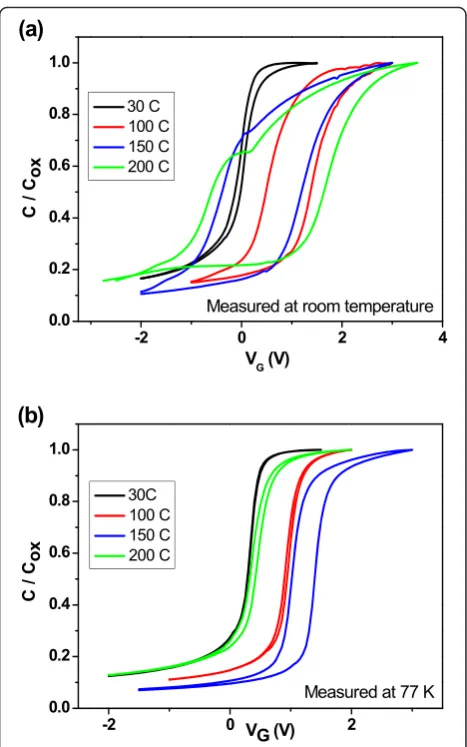
pres-ence of only Si-H-related bonds reveals high purity film composition. Figure 2a showsC-Vmeasured at room and low temperatures for a sample grown at 100 °C. At room temperature, there is a clear hysteresis, which nearly van-ishes at 77 K, thus indicating that the border traps, i.e., the defects located into the insulator in the region close to the interface insulator/oxide, are thermally activated. The same curves are shown in Fig. 2b for a sample grown at 200 °C. In this case, hysteresis at room temperature is even greater than that observed in the sample grown at 100 °C. Also, a“shoulder”-shaped feature is clearly seen. Samples grown at the lowest temperatures do not exhibit such fea-ture (see Fig. 3a), so this seems to appear only in samples grown at the highest temperatures, and it is similar to the kink in theC-Vresponse reported in other works [14, 15]. As growth temperature increases, hysteresis effect and stretch-out of C-V curves increase as well. C-V curves measured at 77 K (Fig. 3b) show much lower hysteresis than those obtained at room temperature, thus indicating that some traps in the material are frozen at low tempera-tures [16]. Sample grown at 150 °C still exhibits appre-ciable hysteresis at 77 K. As for flat-band voltage values, they increase with growth temperature, reach the max-imum value at 150 °C, and then return to the lowest value, as it is shown in Fig. 3b.
Interfacial state densities measured by DLTS are shown in Fig. 4. This technique is time sensitive, so con-tributions with different time constants are separated and the fast contributions of interface states are clearly
[image:2.595.307.539.536.703.2]distinguished from the slow ones corresponding to defects in the oxide bulk. To obtain the interfacial trap distribu-tion within the band gap, the MIS capacitor is biased just at the limit between depletion and weak inversion, and a pulse high enough to drive the capacitors into the accu-mulation regime is then applied in order to fill all inter-facial traps. The use of a digital oscilloscope allows recording the entire capacitance transients, and therefore, the entire energy spectrum is processed with only one temperature scan. The lowest value of Dit (2–3 ×
1011 cm−2 eV−1) corresponds to the sample grown at 200 °C. For intermediate growth temperatures, 100 and 150 °C,Ditvalues are around 7 × 10¹¹–1 × 1012cm−2eV−1.
These values can be considered acceptable. When growth temperature is 30 °C, Dit increases until it reaches values
near 1 × 1013cm−2eV−1. This value is too high for techno-logical applications. For comparison, Fig. 4 also depicts the Ditprofile corresponding to a sample grown at 30 °C
with-out a previous cleaning stage by RCA. In this case, Dit
values are even higher.
Fig. 2Capacitance-voltage curves measured at room temperature and at 77 K corresponding to a temperature deposition of 100 °C (a)
and 200 °C (b) Fig. 3Capacitance-voltage curves obtained for all deposition
temperatures, measured at room temperature (a) and at 77 K (b)
Fig. 4Interfacial state densities measured by DLTS corresponding to all deposition temperatures.Ditprofile obtained for a sample grown at
[image:3.595.305.539.85.459.2] [image:3.595.58.293.88.444.2] [image:3.595.304.539.499.693.2]Border trap densities obtained by means of conduct-ance transient analysis are of the same order of magni-tude for the samples grown at 100, 150, and 200 °C. As an illustration, Fig. 5 shows the three-dimensional plot of disorder-induced gap state density (NDIGS) as a
func-tion of the energy and the spatial coordinate for the sample grown at 100 °C. It can be seen thatNDIGSvalues
are in the range of standard MIS devices. On the other hand, for the sample grown at 30 °C, conductance tran-sient amplitudes are below the experimental resolution, so we can conclude that its border trap density is lower than 1 × 1010cm−2eV−1. This result agrees well with the high value of Dit measured in this sample, because in
general, when border trap density (NDIGS) is high,
inter-facial state density (Dit) is low [17]. So, for the sample
grown at 30 °C, fast traps are preferentially located at the insulator/semiconductor interface, whereas for sam-ples grown at 100–200 °C, fast traps are defects located both at the interface and in the insulator.
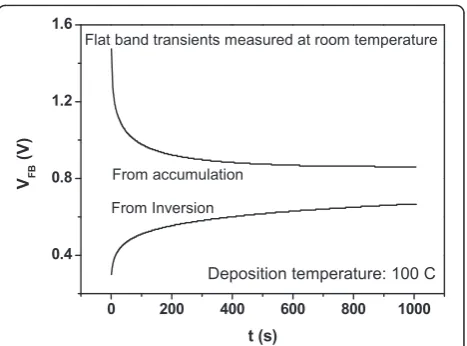
Figures 6, 7, and 8 are related to flat-band transient re-cordings. Figure 6 demonstrates for the sample grown at 100 °C that there are flat-band transients at room temperature when the sample is previously biased in ac-cumulation or in inversion for a few seconds. In both cases, it is possible to obtain an Arrhenius plot by re-cording transients at different measurement tempera-tures. Measurements were carried out at a voltage bias of 0 V, keeping the capacitance at its flat-band value. The flat-band voltage transients are due to trap charging and discharging of defects inside the oxide layer. This mechanism gives rise to variations in flat-band voltage value due to changes in the oxide charge density [18]. As the charge trapping or detrapping inside the oxide is usually tunneling assisted, states located deeper in the oxide capture carriers after those located near the semi-conductor/oxide interface, so theVFBtransients obtained
are expected to be slower than the DLTS transients. In Fig. 7, we can see that the transient amplitudes initially increase with growth temperature, reach their maximum value at 150 °C, and then diminish while transients be-come faster. In Fig. 8a, we show the flat-band voltage transients recorded at temperatures varying between 195 and 275 K for the sample grown at 200 °C. The ampli-tude of transients is thermally enhanced, and the temperature dependence of the transient amplitude fol-lows an Arrhenius plot (Fig. 8b). The linear fit provides an activation energy value of 88 meV. Similar values are obtained for all the samples. In the case of high-k dielec-trics, the activation energy has been found to be similar to the soft optical phonon energies [19].
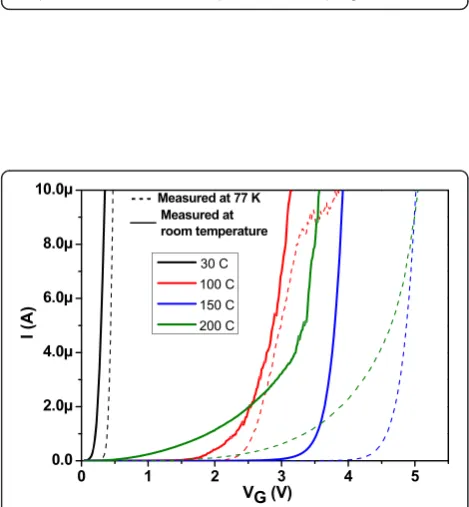
Figure 9 shows current-voltage curves corresponding to the accumulation regime, measured at room temperature and at 77 K. The best behavior corresponds
Fig. 5Border trap three-dimensional distribution of a sample grown at 100 °C
Fig. 6Flat-band transients measured at room temperature from accumulation and from inversion, corresponding to a sample grown at 100 °C
[image:4.595.306.540.86.259.2] [image:4.595.306.538.538.703.2] [image:4.595.57.291.541.702.2]to the 150 °C-deposited sample, with breakdown electric field values corresponding to 2 mA/cm2of around 0.35 and 0.45 MV/cm, at room temperature and 77 K, respectively.
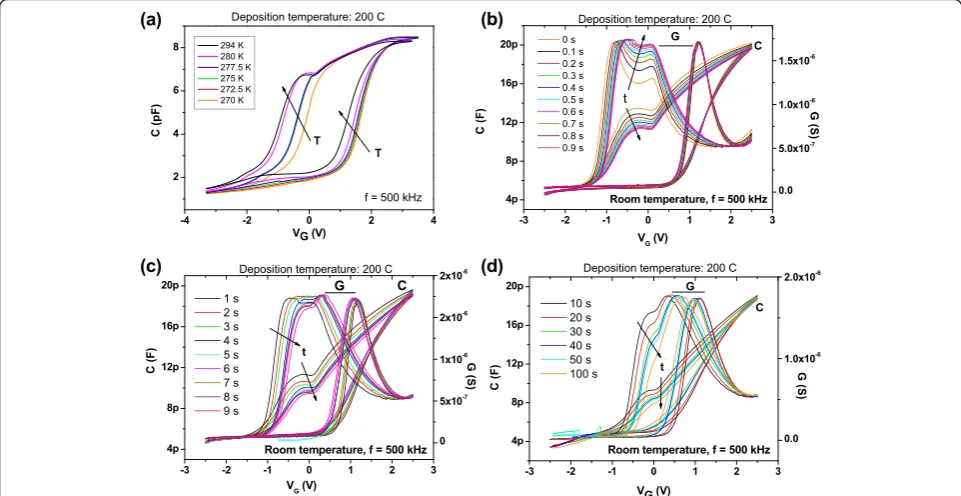
Finally, to study in depth the “shoulder”-shaped fea-ture showed in Fig. 2b, some additional measurements have been carried out. When measurement temperature diminishes, the feature also diminishes (see Fig. 10a). In fact, at temperatures lower than 270–280 K, it com-pletely disappears. Focusing on the C-V and G-V curves at room temperature, in the next experiment (Fig. 10b–d), a stair-shaped voltage was used instead of a voltage ramp, with different values of the step width, from 0 s (which corresponds to the voltage ramp) until 100 s. The absolute value of the increment of the voltage bias was 20 mV in all measurements. Both capacitance and conductance signals exhibit a very different behavior if voltage goes from accumula-tion to weak inversion or vice versa. In the former case,C-Vand G-Vcurves indicate that generation and recombination through interface trap levels dominate the loss. On the contrary, when voltage bias passes from negative to positive values, C-V curves show a kink and G-Vcurves show two peaks instead of only one. One of these peaks remains nearly in the same voltage position when measurement conditions are changed. The second one appears at lower values of the voltage and clearly moves to higher values when the measurement time increases. Also, this peak di-minishes and nearly disappears for time values of around 100 s.
The shape of C-V and G-V curves when voltage bias values increase can be attributed to the discharge process of slow states located far from the interface, which need high temperature or longer time to release their positive charge. When charge emission takes place, flat-band voltage moves towards more positive values, and so the hysteresis width ofC-Vcurves diminishes. At the same time, the shoulder-shaped feature vanishes. As for G-Vcurves, the second peak moves to the right and its height diminishes. So, when the samples are driven from weak inversion to accumulation, the loss is due to the generation and recombination through both bulk and interfacial trap levels.
As indicated in Fig. 3a, these phenomena do not ap-pear in samples grown at low temperatures, so the pres-ence of slow traps in the a-Si layer bulk seems to be related to the growth processes carried out at tempera-tures above 150 °C.
Conclusions
Interfacial state density values for samples grown at temperatures of 100 °C and above are in the range of standard devices. Border trap densities and activation
Fig. 8Flat-band transients from accumulation measured at different temperatures (a) and Arrhenius plot (b) of a sample grown at 200 °C
[image:5.595.57.291.87.428.2] [image:5.595.56.291.451.705.2]energy values are in the standard values as well. From our experimental results, the optimal amorphous/crys-talline silicon interface is achieved for the highest growth temperature value. However, in samples grown at temperatures of above 150 °C, a significant presence of slow traps in the a-Si layer is detected. In conclu-sion, to use these kinds of structures in the HIT solar cell application field, growing a-Si layers at 100–150 °C seems to be the most adequate choice.
Abbreviations
a-Si:H, hydrogenated amorphous silicon layers; c-Si, crystalline silicon;C-V, capacitance-voltage;Dit, interface trap density; DLTS, deep-level transient
spectroscopy; ECR-CVD, electron cyclotron resonance chemical vapor deposition; FTIR, Fourier transform infrared spectroscopy;G-V, conductance-voltage; HIT, heterojunction with intrinsic thin layer; i-a-Si:H, intrinsic amorphous silicon;I-V, current-voltage; MIS, metal-insulator-semiconductor; NDIGS, disorder-induced gap state density; PECVD, plasma-enhanced chemical
vapor deposition; RCA, Radio Corporation America;VFB, flat-band voltage
Acknowledgements
The study has been supported by the Spanish TEC2014 under Grant Nos. 52152-C3-3-R and TEC2013-41730-R, funded by the Ministerio de Economía y Competitividad, and the P2013/MAE-2780 funded by the Comunidad de Madrid.
Authors’Contributions
HC and IM conceived this study. RGH grew the samples with the help of JO and AP. HG, SD, and LB characterized the samples. HC wrote the manuscript with the input from all the authors. All authors read and approved the final version of the manuscript.
Competing Interests
The authors declare that they have no competing interests.
Author details
1
Department of Electronics, University of Valladolid, Paseo Belén, 15, 47011 Valladolid, Spain.2Dpto. Física Aplicada III, Universidad Complutense de
Madrid, CEI Campus Moncloa, UCM-UPM, Madrid, Spain.
Received: 26 May 2016 Accepted: 5 July 2016
References
1. Meiling H, Brockhoff AM, Rath JK, Schropp REI (1998) Hydrogenated amorphous and polycrystalline silicon TFTs by hot-wire CVD. J Non-Crystalline Solids. doi:10.1016/S0022-3093(98)00298
2. Tanaka M, Taguchi M, Matsuyama T, Sawada T, Tsuda S, Nakano S, Hanafusa H, Kuwano Y (1992) Development of new a-Si/ e-Si heterojunction solar cells: ACJ-HIT (artificially constructed junction-heterojunction with intrinsic thin-layer). Jpn J Appl Phys 31:3518–22
3. Masuko K, Shigematsu M, Hashiguchi T, Fujishima D, Kai M, Yoshimura N, Yamaguchi T, Ichihashi Y, Yamanishi T, Takahama T, Taguchi M, Maruyama E, Okamoto S (2014) Achievement of more than 25 % conversion efficiency with crystalline silicon heterojunction solar cell. IEEE J Photovoltaics. doi:10.1109/JPHOTOV.2014.2352151
4. Rech B, Kluth O, Repmann T, Roschek T, Springer J, Müller J, Finger F, Stiebig H, Wagner H (2002) New materials and deposition techniques for highly efficient silicon thin film solar cells. Sol Energy Mater Sol Cells 74:439–42
5. Santos JD, Cárabe J, Gandía JJ (2015) Silicon thin-film solar cells at high growth rate under constant power-to-flow ratio plasma conditions. Thin Solid Films. doi:10.1016/j.tsf.2015.11.011
6. Flewit AJ, Milne WI (2005) Low-temperature deposition of hydrogenated amorphous silicon in an electron cyclotron resonance reactor for flexible displays. Proceed of the IEEE. doi:10.1109/JPROC.2005.851533
7. Redondo E, Mártil I, González-Díaz G, Castán H, Dueñas S (2001) Influence of electron cyclotron resonance nitrogen plasma exposure on the electrical characteristics of SiNx:H/InP structures. J Vac Sci Technol B.
doi:10.1116/1.1339010
[image:6.595.57.538.89.337.2]pressure sputtering for amorphous silicon deposition. Mater Res Express. doi:10.1088/2053-1591/3/3/036401
9. García-Hernansanz R, García-Hemme E, Montero D, Del Prado A, Mártil I, González-Díaz G, Olea J (2015) Amorphous/crystalline silicon interface characterization by capacitance and conductance measurements. 10th Spanish Conference on Electron Devices Proceedings (IEEE Conference Publication). INSPEC Accession Number: 15060343. doi:10.1109/CDE.2015. 7087502
10. Schulze TF, Beushausen HN, Leendertz C, Dobrich A, Rech B, Korte L (2010) Interplay of amorphous silicon disorder and hydrogen content with interface defects in amorphous/crystalline silicon heterojunctions. Appl Phys Lett. doi:10.1063/1.3455900
11. Kern W, Puotinen D (1970) Cleaning solutions based on hydrogen peroxide for use in silicon semiconductor technology. RCA Rev 31:187–206 12. Mahan AH, Gedvilas LM, Webb JD (2000) Si-H bonding in low hydrogen
content amorphous silicon films as probed by infrared spectroscopy and x-ray diffraction. J Appl Phys. doi:10.1063/1.372073
13. Girginoudi D, Tsiarapas C, Georgoulas N (2011) Properties of a-Si:H films deposited by RF magnetron sputtering at 95 °C. Appl Surf Sci. doi:10.1016/j. apsusc.2010.11.115
14. Masson P, Autran JL, Houssa M, Garros X, Leroux C (2002) Frequency characterization and modeling of interface traps in HfSixOy/HfO2gate
dielectric stack from a capacitance point-of-view. Appl Phys Lett 81:3392–4 15. Stesmans A, Afanas’ev VV (2003) Si dangling-bond-type defects at the
interface of (100)Si with ultrathin HfO2. Appl Phys Lett 82:4074–6
16. Dueñas S, Castán H, Barbolla J, Kukli K, Ritala M, Leskelä M (2003) Conductance transient, capacitance–voltage and deep-level transient spectroscopy characterization of atomic layer deposited hafnium and zirconium oxide thin films. Solid State Electron 47(2003):1623–9 17. García H, Dueñas S, Castán H, Bailón L, Kukli K, Aarik J, Ritala M, Leskelä M
(2008) Identification of spatial localization and energetic position of electrically active defects in amorphous high-k dielectrics for advanced devices. J Non-Crystalline Solids 354:393–8
18. Dueñas S, Castán H, García H, Gómez A, Bailón L, Kuli K, Aarik J, Ritala M, Leskelä M (2008) Comparative study of flatband voltage transients on high-k dielectric-based metal–insulator–semiconductor capacitors. J Electrochem Soc. doi:10.1149/1.2975828
19. Dueñas S, Castán H, García H, Bailón L, Kukli K, Hatanpää T, Ritala, Leskelä M (2007) Experimental observations of temperature-dependent flat band voltage transients on high-k dielectrics. Microelectron Reliab. doi:10.1016/j. microrel.2007.01.080
Submit your manuscript to a
journal and benefi t from:
7Convenient online submission
7Rigorous peer review
7Immediate publication on acceptance
7Open access: articles freely available online
7High visibility within the fi eld
7Retaining the copyright to your article