BIROn - Birkbeck Institutional Research Online
Paterson, Maura B. and Stinson, D.R. and Upadhyay, J. (2013) A coding
theory foundation for the analysis of general unconditionally secure
proof-of-retrievability schemes for cloud storage. Journal of Mathematical Cryptology
7 (3), pp. 181-277. ISSN 1862-2976.
Downloaded from:
Usage Guidelines:
Please refer to usage guidelines at or alternatively
A coding theory foundation for the analysis of general
unconditionally secure proof-of-retrievability schemes for cloud
storage
Maura B. Paterson
Department of Economics, Mathematics and Statistics
Birkbeck, University of London, Malet Street, London WC1E 7HX, UK
Douglas R. Stinson∗
David R. Cheriton School of Computer Science
University of Waterloo, Waterloo, Ontario, N2L 3G1, Canada
Jalaj Upadhyay
David R. Cheriton School of Computer Science
University of Waterloo, Waterloo, Ontario, N2L 3G1, Canada
October 29, 2012
Abstract
There has been considerable recent interest in “cloud storage” wherein a user asks a server to store a large file. One issue is whether the user can verify that the server is actually storing the file, and typically a challenge-response protocol is employed to convince the user that the file is indeed being stored correctly. The security of these schemes is phrased in terms of an extractor which will recover or retrieve the file given any “proving algorithm” that has a sufficiently high success probability.
This paper treats proof-of-retrievability schemes in the model of unconditional security, where an adversary has unlimited computational power. In this case retrievability of the file can be modelled as error-correction in a certain code. We provide a general analytical framework for such schemes that yields exact (non-asymptotic) reductions that precisely quantify conditions for extraction to succeed as a function of the success probability of a proving algorithm, and we apply this analysis to several archetypal schemes. In addition, we provide a new methodology for the analysis of keyedPORschemes in an unconditionally secure setting, and use it to prove the security of a modified version of a scheme due to Shacham and Waters under a slightly restricted attack model, thus providing the first example of a keyed POR scheme with unconditional security. We also show how classical statistical techniques can be used to evaluate whether the responses of the prover are accurate enough to permit successful extraction. Finally, we prove a new lower bound on storage and communication complexity of PORschemes.
∗
1
Introduction to Proof-of-retrievability Schemes
In a proof-of-retrievability scheme (POR scheme) [3, 6, 8, 12], a user asks a server to store a (possibly large) file. The file is divided into message blocks that we view as elements of a finite field. Typically, the file will be “encoded” using a code such as a Reed-Solomon code. The code provides redundancy, enabling erasures or corrupted message blocks to be corrected.
In order for the user to be ensured that the file is being stored correctly on the server, a challenge-response protocol is periodically invoked by the user, wherein the server (the Prover) must give a correct response to a random challenge chosen by the user (theVerifier). This response will typically be a function of one or more message blocks. We do not assume that the user is storing the file. Therefore, in the basic version of a POR scheme, the user must precompute and store a sufficient number of challenge-response pairs, before transmitting the file to the server. After this is done, the user erases the file but retains the precomputed challenge-response pairs. Such schemes are termedbounded-useschemes in [6]. An alternative is to use akeyed(orunbounded-use) scheme, which permits an arbitrary number of challenges to be verified (i.e., the number of challenges does not need to be pre-determined by the user). We will discuss these a bit later. Finally, the user could retain a copy of the file if desired, in which case the responses do not need to be precomputed. This might be done if the server is just being used to store a “back-up” copy of the file.
We wish to quantify the security afforded the user by engaging in the challenge-response protocol (here, “security” means that the user’s file can be correctly retrieved by the user). The goal is that a server who can respond correctly to a large proportion of challenges somehow “knows” (or can compute) the contents of the file (i.e., all the message blocks). This is formalised through the notion of anextractor, which takes as input a description of a “proving algorithm”P for a certain unspecified file, and then outputs the file. Actually, for the schemes we study in this paper, the extractor only needs black-box access to the proving algorithm. The proving algorithm is created by the server, who is regarded as the adversary in this game. It should be the case that a proving algorithm that is correct with a probability that is sufficiently close to 1 will allow the extractor to determine the correct file. The probability that the proving algorithmP gives a correct response for a randomly chosen challenge is denoted bysucc(P). We assume thatP always gives some response, so it follows that P will give an incorrect response with probability 1−succ(P).
To summarise, we list the components in a PORscheme and the extractor-based security defi-nition we use. Note that we are employing standard models developed in the literature; for a more detailed discussion, see [3, 8, 12].
• The Verifierhas a message m∈(Fq)k which he redundantly encodes asM ∈(Fq)n.
• M is given to theProver. In the case of a keyed scheme, theProvermay also be supplied with an additional tag, S.
• The Verifier retains appropriate information to allow him to verify responses. This may or may not include a keyK.
• Some number of challenges and responses are carried out by the Proverand Verifier. In each round, theVerifier chooses a challenge c and gives it to theProver, and theProver computes a response r which is returned to the Verifier. The Verifier then verifies if the response is correct.
• The success probability of P is the probability that it gives a correct response when the challenge is chosen randomly.
• The Extractor is given P and (in the case of a keyed scheme) K, and outputs an unencoded message ˆm. Extraction succeeds ifmb =m.
• The security of thePORscheme is quantified by proving a statement of the form “theExtractor
succeeds with probability at leastδwhenever the success probability ofPis at least”. In this paper, we only consider schemes whereδ= 1, that is, where extraction is always successful.
1.1 Previous Related Work
Blum et al [2] introduced the concept of memory checking. They formalized a model where per-forming any sequence of store and request operations on a remote server behaves similarly to local storage. Two seminal papers important to the development of PORschemes are [9, 11]. Lillibridge
et al. [9] first considered the problem of creating a backup of a large file by redundantly encoding the using an erasure code and distributing pieces of the file to one or more servers. Naor and Rothblum [11] studiedmemory checkerswhich use message authentication techniques to verify if a file is stored correctly on a remote server. They also consider authenticators, which allow a verifier to interact with the server and reconstruct the file provided that a sufficient number of “audits” are all correct.
The concept ofproof-of-retrievabilityis due to Juels and Kaliski [8]. APORscheme incorporates a challenge-response protocol in which a verifier can check that a file is being stored correctly, along with an extractor that will actually reconstruct the file, given the algorithm of a “prover” who is able to correctly respond to a sufficiently high percentage of challenges.
There are also papers that describe the closely related (but slightly weaker) idea of a proof-of-data-possession scheme(PDPscheme), e.g., [1]. APDPscheme permits the possibility that not all of the message blocks can be reconstructed. Atieniese et al. [1] also introduced the idea of using
homomorphic authenticatorsto reduce the communication complexity of the system. Shacham and Waters [12] showed that the scheme of Ateniese et al.can be transformed in to a PORscheme by constructing an extractor that extracts the file from the responses of the server on audits.
Bowers, Juels, and Oprea [3] used error-correcting codes, in particular the idea of an “outer” and an “inner” code (in much the same vein as concatenated codes), to get a good balance between the server storage overhead and computational overhead in responding to the audits. A paper that discusses a coding-theoretic approach in the setting of storage enforcement is [7]; this paper makes use of list-decoding techniques, but it concentrates on the storage requirements of the server.
Dodis, Vadhan and Wichs [6] provide the first example of an unconditionally secure POR
scheme, also constructed from an error-correcting code, with extraction performed through list decoding in conjunction with the use of an almost-universal hash function. We discuss this partic-ular paper further in Section 1.3.
1.2 Our Contributions
a certain code (which we term a “response code”). Previously, error-correcting codes have been used in specific constructions of POR schemes; here, we propose that error-correcting codes constitute the natural foundation to construct as well as analyse arbitrary PORschemes.
There are several advantages of studying unconditionally secure POR schemes. First, the schemes are easier to understand and analyse because we are not making use of any additional cryptographic primitives or unproven assumptions (e.g., PRFs, signatures, bilinear pairings, MACS, hitting samplers, random oracle model, etc.). This allows us to give very simple exact analyses of various schemes. Secondly, the essential role of error-correcting codes in the design and analysis of PORschemes becomes clear: codes are not just a method of constructingPOR schemes; rather, everyPOR scheme gives rise to a code in a natural way.
The success of the extraction process usually depends on the distance of the code used to initially encode the file; when the distance of this code is increased, the extraction process will be successful for less successful provers, thus increasing the security afforded the user. As we mentioned earlier, we quantify the security of aPOR scheme by specifying a value and proving that the extraction process willalwaysbe able to extract the file, given a proverP with success probabilitysucc(P)> . (In some other papers, weaker types of extractors are studied, such as extractors that succeed with some specified probability less than 1, or extractors that only recover some specified fraction of the original data.) This allows us to derive conditions which guarantee that extraction will succeed, and to compute exact (or tight) bounds, as opposed to the mainly asymptotic bounds appearing in [6].
We exemplify our approach by considering several archetypal PORschemes. We consider keyed schemes as well as keyless schemes. In Section 2, we first consider the fundamental case where the server is just required to return one or more requested message blocks. Then we progress to a more general scheme where the server must compute a specified linear combination of certain message blocks. Both of these are keyless schemes.
In Section 3, we investigate the Shacham-Waters scheme [12], which is a keyed scheme, modified appropriately to fit the setting of unconditional security. For this scheme, we note that uncondi-tional security can be achieved only if the prover does not have access to a verification oracle. It is also necessary to analyse the success probability of a proving algorithm in the average case, over the set of keys that are consistent with the information given to the prover. This new analytical approach is the first to allow the construction of a secure keyedPORscheme in the unconditionally secure setting.
In Section 4, we look more closely at the numerical conditions we have derived for the various schemes we studied and we provide some useful comparisons and estimates.
We desire that successful extraction can be accomplished whenever succ(P) exceeds some pre-specified threshold. But this raises the question as to how the user is able to determine (or estimate)
succ(P). In many practicalPORschemes, the only interaction a user has with the server is through the challenge-response protocol. We show in Section 5 that classical statistical techniques can be used to provide a systematic basis for evaluating whether the responses of the prover are accurate enough to permit successful extraction.
information-theoretic lower bound on storage and communication requirements of POR schemes. Our new bound is an improvement of the information-theoretic lower bound for memory checkers and authenticators proven in [11].
We note that our goal is not to identify a single “best” POR scheme, but rather to provide a useful new methodology to analyse the exact security of variousPORschemes in the unconditionally secure setting. ThePORproblem is one that lends itself naturally to analysis in the unconditionally secure model; the schemes we consider are natural examples of POR protocols that do not require cryptographic building blocks depending on computational assumptions.
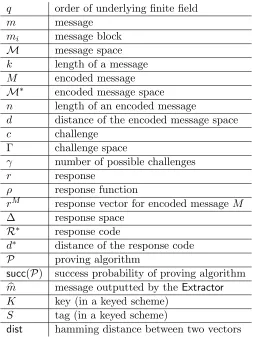
For reference, we provide a list of notation used in this paper in Table 3 in the Appendix.
1.3 Comparison with Dodis, Vadhan and Wichs [6]
Our work is most closely related to that of Dodis, Vadhan and Wichs [6]. In [6], it is stated that “there is a clear relation between our problem and the erasure/error decoding of error-correcting codes”. Our paper is in some sense a general exploration of these relations, whereas [6] is mainly devoted to a specific construction for a PORscheme that is based on Reed-Solomon codes.
We can highlight several differences between our approach and that of [6]:
• In the setting of unconditional security, the paper [6] only provides bounded-use schemes. Our scheme is the first unbounded-use scheme in this setting.
• The paper [6] mainly uses a (Reed-Solomon) code to construct a specific POR scheme. In contrast, we are studying the connections between an arbitraryPORscheme and the distance of the (related) code that describes the behaviour of the scheme on the possible queries that can be made to the scheme. Stated another way, our approach is to derive a code from a
POR scheme, and then to prove security properties of the POR scheme as a consequence of properties of this code.
• The paper [6] uses various tools and algorithms to construct their POR schemes, including Reed-Solomon codes, list decoding, almost-universal hash families, and hitting samplers based on expander graphs. We just use an error-correcting code in our analyses.
• We base our analyses on nearest-neighbour decoding (rather than list decoding, which was used in [6]), and we present conditions under which extraction will succeed with probability equal to 1 (in [6], extraction succeeds with probability close to 1, depending in part on properties of a certain class of hash functions used in the protocol).
• The “POR codes” in [6] are actually protocols that consist of challenges and responses in-volving a prespecified number of message blocks; we allow challenges in which the responses depend on an arbitrary number of message blocks.
• All our analyses are exact and concrete, whereas the analyses in [6] are asymptotic.
2
Analysis of Several Keyless Schemes
2.1 A Basic Scheme
Figure 1: Basic Scheme
initialisation
Given a message m ∈ M, encode M as e(m) = M ∈ M∗. Themessage encoding
function e :M → M∗ is a public bijection. We will assume that M= (Fq)k and M∗ ⊆ (Fq)n, where q is a prime power and n ≥ k. We write M = (m1, . . . , mn),
where the components m1, . . . , mn are termed message blocks.
The Verifiergives the encoded message M to the Prover. The Verifier also generates a random challenge c∈ {1, . . . , n} and storesc and the message blockmc.
challenge-response
TheVerifiergives the challengecto theProver. TheProverresponds with the message blockr=mc. TheVerifierchecks that theresponserreturned by theProvermatches
the stored value mc.
server as the Prover. The basic scheme is presented in Figure 1.
Here is the adversarial model we use to analyse the security of a keyless POR scheme: 1. The Adversaryis given the set of encoded messagesM∗.
2. The Adversaryselectsm∈ M.
3. The Adversaryoutputs a deterministic1 proving algorithm form, denotedP. The success probabilityof P is defined to be
succ(P) =Pr[P(c) =mc],
wheree(m) = (m1, . . . , mn) and this probability is computed over a challengec∈ {1, . . . , n}chosen
uniformly at random.
Now we wish to construct an Extractor that will take as input a proving algorithmP for some unknown messagem. TheExtractor will output a message mb ∈ M. We say that the PORscheme issecure provided that mb =m whenever the success probability ofP is sufficiently close to 1.
The Extractor for theBasic Scheme is presented in Figure 2.
Theorem 2.1. Suppose that P is a proving algorithm for the Basic Scheme for which succ(P) >
1−d/(2n), where the hamming distance of the set of encoded messagesM∗ isd. Then theExtractor
presented in Figure 2 will always output mb =m.
Proof. Let M0 be the n-tuple of responses computed by P and denote δ = dist(M, M0), where
M =e(m). Denote =succ(P). Then it is easy to see that = 1−δ/n. We want to prove that
c
M =M. We have that Mc is a vector inM∗ closest to M0. Since M is a vector inM∗ such that
dist(M, M0) =δ, it must be the case thatdist(M , Mc 0)≤δ. By the triangle inequality, we get
dist(M,Mc)≤dist(M, M0) +dist(M , Mc 0)≤δ+δ = 2δ. 1
Figure 2: Extractor for theBasic Scheme
1. On input P, compute the vector M0 = (m01, . . . , m0n), where m0c = P(c) for all
c∈ {1, . . . , n}(i.e.,m0cis the response computed byP when it is given the challenge
c).
2. FindMc∈ M∗so thatdist(M0,Mc) is minimised, wheredist(·,·) denotes the hamming
distance between two vectors.
3. Outputmb =e−1(Mc).
However,
2δ= 2n(1−)<2n
d
2n
=d.
Since M and Mc are vectors in M∗ within distance d, it follows that M = Mc and the Extractor
outputsm=e−1(M), as desired.
2.2 General Keyless Challenge-Response Schemes
In the simple protocol we analysed, a response to a challenge was just a particular message block chosen from an encoded message M. We are interested in studying more complicated protocols. For example, we might consider a response that consists of several message blocks from M, or is computed as a function of one or more message blocks. In this section, we generalise the preceding extraction process to handle arbitrary keyless challenge-response protocols.
In general, a challenge will be chosen from a specified challenge space Γ, and the response will be an element of aresponse space ∆. Theresponse function ρ:M∗×Γ→∆ computes the response r=ρ(M, c) given the encoded messageM and the challengec.
For an encoded message M ∈ M∗, we define the response vector
rM = (ρ(M, c) :c∈Γ).
That is,rM contains all the responses to all possible challenges for the encoded messageM. Finally, define theresponse code (or more simply, thecode) of the scheme to be
R∗ ={rM :M ∈ M∗}.
The codewords inR∗ are just the response vectors that we defined above.
The Generalised Scheme is presented in Figure 3. Observe that R∗ ⊆ ∆γ, whereγ =|Γ|. We will assume that the mappingM 7→rM is an injection, and therefore the hamming distance of R∗
is greater than 0 (in fact, we make this assumption for all the schemes we consider in this paper). We now describe the generalised adversarial model.
1. The Adversaryis given the response codeR∗.
Figure 3: Generalised Scheme
initialisation
Given a message m ∈ M, encode m as e(m) =M ∈ M∗. The Verifier gives M to
the Prover. The Verifier also generates a random challenge c ∈ Γ and stores c and
ρ(M, c).
challenge-response
The Verifier gives the challenge c to the Prover. The Prover responds with r =
ρ(M, c). The Verifier checks that the value r returned by the Prover matches the stored value ρ(M, c).
Figure 4: Extractor for theGeneralised Scheme
1. On input P, compute the vector R0 = (rc0 :c ∈ Γ), where rc0 = P(c) for all c ∈ Γ (i.e., for everyc,r0cis the response computed byP when it is given the challenge c).
2. Find Mc∈ M∗ so thatdist(R0, rMc) is minimised.
3. Outputmb =e−1(Mc).
3. The Adversaryoutputs a deterministic proving algorithm for m, denoted P. The success probabilityof P is defined to be
succ(P) =Pr[P(c) =ρ(M, c)],
where M = e(m) and this probability is computed over a challenge c ∈ Γ chosen uniformly at random.
Now we construct anExtractorthat will take as input a proving algorithmP for some unknown message m. The Extractor will output a message mb ∈ M. We say that the PORscheme is secure
provided thatmb =mwhenever the success probability ofP is sufficiently close to 1. The Extractor
for theGeneralised Scheme is presented in Figure 4.
The following theorem relates the success probability of the extractor to the hamming distance of the response code. Its proof is essentially identical to the proof of Theorem 2.1.
Theorem 2.2. Suppose thatP is a proving algorithm for theGeneralised Schemefor whichsucc(P)>
1−d∗/(2γ), where the hamming distance of the response code R∗ is d∗ > 0. Then the Extractor
presented in Figure 4 will always output mb =m.
Proof. Let R0 be the γ-tuple of responses computed by P and denote δ = dist(rM, R0), where
M =e(m). Denote =succ(P). Then it is easy to see that = 1−δ/γ. We want to prove that
c
M = M. We have that rMc
is a codeword inR∗ closest to R0. Since M is a codeword such that
dist(rM, R0) =δ, it must be the case that dist(rMc, R0)≤δ. By the triangle inequality, we get
dist(rM, rMc
)≤dist(rM, R0) +dist(rMc
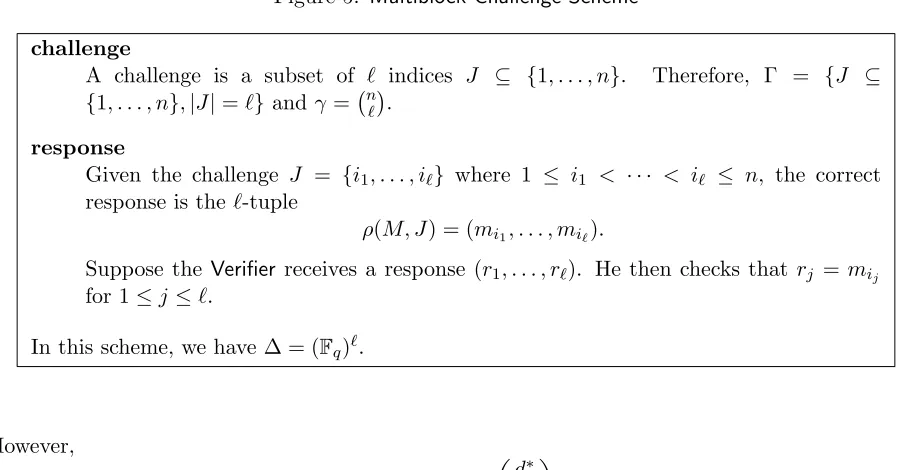
Figure 5: Multiblock Challenge Scheme
challenge
A challenge is a subset of ` indices J ⊆ {1, . . . , n}. Therefore, Γ = {J ⊆ {1, . . . , n},|J|=`} and γ = n`.
response
Given the challenge J = {i1, . . . , i`} where 1 ≤ i1 < · · · < i` ≤ n, the correct
response is the `-tuple
ρ(M, J) = (mi1, . . . , mi`).
Suppose the Verifier receives a response (r1, . . . , r`). He then checks that rj = mij
for 1≤j≤`.
In this scheme, we have ∆ = (Fq)`.
However,
2δ= 2γ(1−)<2γ
d∗
2γ
=d∗.
Since rM and rMc are codewords within distance d∗, it follows that M = c
M and the Extractor
outputsm=e−1(M), as desired.
Observe that the efficacy of this extraction process depends on the relative distance of the response code R∗, which equals d∗/γ. In the next subsections, we look at some specific examples of challenge-response protocols.
2.3 Multiblock Challenge Scheme
We present a POR scheme that we term the Multiblock Challenge Scheme in Figure 5 (this is the same as the “Basic PoR Code Construction” from [6]).
Lemma 2.3. Suppose that the hamming distance of M∗ is d. Then the hamming distance of the response code of the Multiblock Challenge Schemeis d∗= n`
− n−`d
.
Proof. Suppose that M, M0 ∈ M∗ and M 6=M0. Denote dist(M, M0) =δ, M = (m1, . . . , mn) and M0= (m01, . . . , m0n). It is easy to see thatrMJ =rJM0 if and only ifJ ⊆ {i:mi=m0i}. From this, it
is immediate that dist(rM, rM0) = n`
− n−`δ
. The desired result follows because δ≥d.
Theorem 2.4. Suppose thatP is a proving algorithm for theMultiblock Challenge Schemefor which
succ(P)> 1
2+
n−d `
2 n` ,
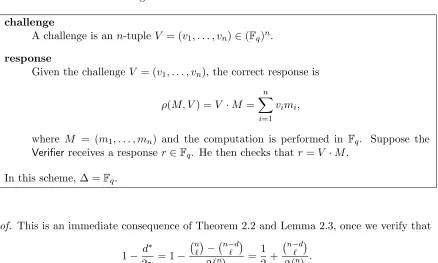
Figure 6: Linear Combination Scheme
challenge
A challenge is ann-tupleV = (v1, . . . , vn)∈(Fq)n.
response
Given the challengeV = (v1, . . . , vn), the correct response is
ρ(M, V) =V ·M =
n X
i=1 vimi,
where M = (m1, . . . , mn) and the computation is performed in Fq. Suppose the
Verifier receives a responser ∈Fq. He then checks thatr =V ·M.
In this scheme, ∆ =Fq.
Proof. This is an immediate consequence of Theorem 2.2 and Lemma 2.3, once we verify that
1− d ∗
2γ = 1− n `
− n−`d
2 n` = 1 2+
n−d `
2 n` .
Remark: When we set`= 1 in Corollary 2.4, we obtain Theorem 2.1.
2.4 Linear Combination Scheme
In this subsection, we consider the Linear Combination Scheme, in which a response consists of a specified linear combination of message blocks (this could perhaps be thought of as a keyless analogue of the Shacham-Waters scheme [12]). The scheme is presented in Figure 6. We will study two versions of the scheme:
Version 1
Here, the challenge V is any non-zero vector in (Fq)n, so γ=qn−1.
Version 2
In this version of the scheme, the challenge V is a vector in (Fq)n having hamming weight
equal to`, soγ = n`
(q−1)`.
2.4.1 Analysis of Version 1
Lemma 2.5. Suppose that the hamming distance ofM∗isd. The hamming distance of the response
code of version 1 of the Linear Combination Schemeis d∗ =qn−qn−1−1.
Proof. SupposeM, M0 ∈ M∗ and M 6=M0. ThenV ·M =V ·M0 if and only ifV ·(M−M0) = 0.
Since M 6=M0, there areqn−1 solutions for V, given M and M0. There areqn−1 choices for V,
We observe that d∗ is independent of d (the hamming distance of M∗) in version 1 of the
scheme.
Theorem 2.6. Suppose that P is a proving algorithm for version 1 of the Linear Combination Scheme for which
succ(P)> 1
2 + 1 2
qn−1 qn−1
.
Then the Extractor presented in Figure 4 will always output mb =m.
2.4.2 Analysis of Version 2
Lemma 2.7. Suppose thatr≥1and X∈(Fq)r has hamming weight equal tor. Then the number
of solutionsV ∈(Fq)r to the equationV ·X= 0 in which V has hamming weight equal tor, which
we denote by ar, is given by the formula
ar = q−1
q ((q−1)
r−1−(−1)r−1). (1)
Proof. We prove the result by induction on r. When r = 1, there are no solutions, so a1 = 0, agreeing with (1). Now assume that (1) gives the number of solutions forr =s−1, and consider
r=s. LetX = (x1, . . . , xs) and defineX0 = (x1, . . . , xs−1). By induction, the number of solutions
to the equation V0·X0 = 0 in whichV0 has hamming weights−1 is as−1. Each of these solutions V0 can be extended to a solution of the equation V ·X = 0 by setting vs = 0; in each case, the
resultingV has hamming weight equal tos−1. However, any other vectorV0 of weights−1 can be extended to a solution of the equationV ·X = 0 which has hamming weight equal tos. Therefore, we have
as = (q−1)s−1−as−1
= (q−1)s−1−
q−1
q ((q−1)
s−2−(−1)s−2)
= (q−1)s−1
1−1 q
+q−1
q (−1) s−2
= q−1
q ((q−1)
s−1−(−1)s−1).
Remark. An alternative way to prove (1) is to observe thatar is equal to the number of codewords
of weight r in an MDS code having length r, dimension r−1 and distance 2. Then (1) can be derived from well-known formulas for the weight distribution of an MDS code. For example, in [10, Ch. 6, Theorem 6], it is shown that the number of codewords of weight w in an MDS code of lengthn, dimensionk and distanced=n−k+ 1 overFq is
aw=
n w
(q−1)
w−d X
j=0
(−1)j
w−1
j
If we substituten=w=r,d= 2 into this formula, we get
ar =
r r
(q−1)
r−2 X
j=0
(−1)j
r−1
j
qr−2−j
= q−1
q r−2 X
j=0
r−1
j
(−1)jqr−1−j
= q−1
q r−1 X j=0
r−1
j
(−1)jqr−1−j−(−1)r−1
= q−1
q (q−1)
r−1−(−1)r−1 ,
which agrees with (1), as proven in Lemma 2.7.
We will now compute the distance d∗ of the response code M∗. Here is a lemma that will be
of use in computing d∗.
Lemma 2.8. Suppose that M, M0 ∈ M∗ and M 6=M0. Denote δ=dist(M, M0). Let rM and rM0
be the corresponding vectors in the response code of Version 2 of the Linear Combination Scheme. Then
dist(rM, rM0) = (q−1)`
n ` −
n−δ ` −X w≥1 δ w n−δ `−w
(q−1)`−waw, (2)
where theaw’s are given by (1).
Proof. Suppose that M, M0∈ M∗ and M 6=M0. Denote
M = (m1, . . . , mn) andM0 = (m01, . . . , m 0 n),
and letδ =dist(M, M0). Let
J ={i:mi =mi0} and J0={1, . . . , n} \J.
Observe that |J|=n−δ and |J0|=δ. For anyV = (v1, . . . , vn) having hamming weight equal to `, define
JV ={j ∈J :vj = 06 }and JV0 ={j ∈J 0
:vj 6= 0}.
Denotew=|JV0 |; then |JV|=`−w.
Supposew≥1. Then, givenJV andJV0 , the number of solutions to the equationV·M =V·M 0
is precisely (q−1)`−waw. When w= 0, the number of solutions is (q−1)`. Summing overw, and
considering all possible choices for JV and JV0 , we see that the total number of solutions to the
equation V ·M =V ·M0 is
n−δ
`
(q−1)`+X
w≥1
δ w
n−δ `−w
(q−1)`−waw. (3)
We can obtain a very accurate estimate for d∗ by observing that
aw ≈
(q−1)w
q
is a very accurate approximation. After making this substitution, it is easy to see that the quantity (3) is minimised when δ=d. This minimises (2), so we obtain
d∗≈
n `
(q−1)`−
n−d `
(q−1)`−X w≥1
d w
n−d `−w
(q−1)`
q . (4)
We have X w≥1 d w n−d `−w
(q−1)`
q =
(q−1)`
q X w≥1 d w n−d `−w
= (q−1)
` q n ` −
n−d `
.
Therefore, from (4), we get
d∗ ≈(q−1)`
n ` −
n−d `
−(q−1) ` q n ` −
n−d `
= (q−1)
`+1 q n ` −
n−d `
. (5)
The following theorem uses the estimated value for d∗ derived in (5).
Theorem 2.9. Suppose that P is a proving algorithm for version 2 of the Linear Combination Scheme for which
succ(P)> 1
2+ 1 2
1
q +
(q−1) n−`d
q n` !
,
where the hamming distance of M∗ is d. Then the Extractor presented in Figure 4 will always output mb =m.
3
Analysis of a Keyed Scheme: the Shacham-Waters Scheme
The Shacham-Waters Scheme [12] is a keyed proof-of-retrievability scheme. This means that the
Verifier has a secret key that is not provided to the Prover. This key is used to verify responses in the challenge-response protocol, and it is also provided to an extraction algorithm as input. The use of a key permits an arbitrary number of challenges to be verified, without the Verifier having to precompute the responses.
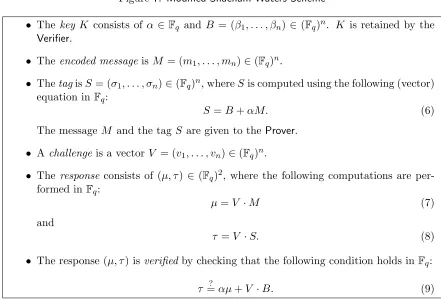
We discuss a variation of the Shacham-Waters Scheme [12], modified to fit the unconditional security setting. The main change is that the vector (β1, . . . , βn) (which comprises part of the key)
is completely random, rather than being generated by a pseudorandom function (i.e., a PRF). This scheme, presented in Figure 7, is termed the Modified Shacham-Waters Scheme.
Figure 7: Modified Shacham-Waters Scheme
• The key K consists of α ∈ Fq and B = (β1, . . . , βn) ∈(Fq)n. K is retained by the
Verifier.
• The encoded messageisM = (m1, . . . , mn)∈(Fq)n.
• ThetagisS = (σ1, . . . , σn)∈(Fq)n, whereSis computed using the following (vector)
equation in Fq:
S=B+αM. (6) The message M and the tagS are given to the Prover.
• A challengeis a vector V = (v1, . . . , vn)∈(Fq)n.
• The response consists of (µ, τ) ∈ (Fq)2, where the following computations are
per-formed inFq:
µ=V ·M (7) and
τ =V ·S. (8)
• The response (µ, τ) is verifiedby checking that the following condition holds inFq:
τ =? αµ+V ·B. (9)
the challengeV is a vector in (Fq)nhaving hamming weight equal to`, soγ = n`
(q−1)`. In both versions, ∆ = (Fq)2.
The information held by the various parties in the scheme is summarised as follows:
Verifier Prover Extractor
K= (α, B) M, S K,P
We first observe that, from the point of view of theProver, there areq possible keys.
Lemma 3.1. Given M and S, the Provercan restrict the set of possible keys(α, B) to
Possible(M, S) ={(α0, S−α0M) :α0∈Fq}.
Proof. Suppose that α=α0. Then equation (6) implies that B=S−α0M.
We will define a response (µ, τ) to beacceptable if (9) is satisfied. A response is authenticif it was created using equations (7) and (8). Note that an authentic response will be acceptable for every keyK ∈Possible(M, S). In the case of an acceptable (but perhaps not authentic) response, we have the following useful lemma.
Proof. Suppose K1, K2 ∈Possible(M, S), where K1 = (α1, B1), K2 = (α2, B2) and α1 6=α2. We
have B1 =S−α1M and B2 =S−α2M. Now consider a response (µ, τ) to a challengeV that is
acceptable for both of the keys K1 and K2. Then
τ =α1µ+V ·B1 =α2µ+V ·B2.
Therefore,
(α1−α2)µ+V ·(B1−B2) = 0.
However, we haveB1−B2 = (α2−α1)M, so
(α1−α2)(µ−V ·M) = 0.
We have α1 6=α2, so it follows thatµ=V ·M. Then we obtain
τ = α1µ+V ·B1
= α1V ·M +V ·(S−α1M) = V ·S.
Therefore the response (µ, τ) is authentic.
The verification condition (9) depends on the key, but not on the message M. It follows that theProvercan create acceptable non-authentic responses if he knows the value ofα(which in turn uniquely determines the key, as shown in Lemma 3.1). This leads to the following attack.
Theorem 3.3. If the Proverhas access to a verification oracle, then the Modified Shacham-Waters Scheme is not unconditionally secure.
Proof. For every key K ∈ Possible(M, S), the Prover can create a response (µ, τ) to a challenge
V that will be acceptable if and only if K is the actual key (this follows from Lemma 3.2). The
Prover can check the validity of these responses by accessing the verification oracle. As soon as one of these responses is accepted by the verification oracle, the Proverknows the correct value of the key. Hence the Prover can now create a proving algorithm P that will output acceptable but non-authentic responses. This algorithmP will not allow the correct message to be extracted.
In more detail, after the Prover has determined the key K = (α, B), he chooses an arbitrary (encoded) message M0 6=M and constructsP as follows:
1. Given a challengeV, defineµ=V ·M0.
2. Then define τ =αµ+V ·B.
Suppose the Extractor is run on P. It is easy to see that dist(R0, rM0) = 0, so the Extractor will computeMc=M0, which is incorrect.
SupposeP is a (deterministic) proving algorithm for a messageM = (m1, . . . , mn)∈(Fq)n. For
each challenge V and for every key K = (α, B) ∈Possible(M, S), defineχ(V, K) = 1 ifP returns an acceptable response for the key K given the challenge V, and defineχ(V, K) = 1, otherwise.
Since there areγqchoices for the pair (V, K), we define theaverage success probabilitysuccavg(P)
to be
succavg(P) =
X
V∈Γ,K∈Possible(M,S)
χ(V, K)
γq . (10) Lemma 3.4. Suppose there are D challenges V for which P returns an authentic response, and hence there are C=γ−D challenges for which P returns a response that is not authentic. Then
succavg(P)≤1−
C(q−1)
γq . (11)
Proof. If V is a challenge for which P returns an authentic response, then χ(V, K) = 1 for every
K. IfV is a challenge for whichP does not return an authentic response, then Lemma 3.2 implies thatχ(V, K) = 1 for at most oneK. Therefore,
X
V∈Γ,K∈Possible(M,S)
χ(V, K)≤C+qD =γq−C(q−1).
The desired result now follows from (10).
Let’s now turn our attention to the response code. Even though a response is an ordered pair (µ, τ), it suffices to consider only the values ofµin the extraction process (this follows because µ,
K and V uniquely determine τ; see (9)). So we will define the response vector for a messageM to be rM = (M·V :V ∈Γ). Observe that this response vector is identical to the response vector in
theLinear Combination Scheme.
Lemma 3.5. Suppose thatP is a proving algorithm for the message M in the Modified Shacham-Waters Scheme. Let rM = (M ·V :V ∈Γ) and let R0 be the γ-tuple of responses computed by P.
Then
dist(rM, R0)≤ (1−succavg(P))γq q−1 .
Proof. Define C as in Lemma 3.4. Since a co-ordinate of rM differs from the corresponding co-ordinate ofR0 only when the response is non-authentic, it follows thatdist(rM, R0)≤C. Equation (11) implies that
C≤ (1−succavg(P))γq q−1 , from which the stated result follows.
Theorem 3.6. Suppose that
succavg(P)>1−
d∗(q−1)
2γq , (12)
where d∗ is given by equation (2). Then the Extractor presented in Figure 8 will always output
Figure 8: Extractorfor the Modified Shacham-Waters Scheme
1. On inputP, compute the vector R0 = (µV :V ∈Γ), where (µV, τV) =P(V) for all V ∈Γ.
2. Find Mc∈ M∗ so thatdist(R0, rMc) is minimised.
3. Outputmb =e −1(
c M).
Proof. Denote = succavg(P), let R0 be the γ-tuple of responses computed by P, and denote δ=dist(rM, R0), whereM =e(m). We showed in Lemma 3.5 that
δ≤ (1−)γq q−1 .
We want to prove thatMc=M. We have thatrMcis a codeword inR∗ closest toR0. SinceM
is a codeword such thatdist(rM, R0) =δ, it must be the case thatdist(rMc, R0)≤δ. By the triangle
inequality, we get
dist(rM, rMc
)≤dist(rM, R0) +dist(rMc
, R0)≤δ+δ= 2δ.
However,
2δ≤ 2(1−)γq q−1 < d
∗ ,
where the last inequality follows from (12). Since rM and rMc are codewords within distance d∗
(which is the distance of the response code), it follows that M = Mc and the Extractor outputs m=e−1(M), as desired.
4
Numerical Computations and Estimates
We have provided sufficient conditions for extraction to succeed for severalPORschemes, based on the success probability of the proving algorithm. Here look a bit more closely at these numerical conditions and provide some useful comparisons and estimates for the different schemes we have studied.
We will consider three schemes. We have the following observations, which can be verified in a straightforward manner:
1. For theMultiblock Challenge Scheme, extraction will succeed if
succ(P)> S0= 1 2 +
n−d `
2 n` .
2. For theLinear Combination Scheme (Version 2), extraction will succeed if
succ(P)> S1 =
q−1
q
S0+ 1
q.
This follows from Theorem 2.9.
3. For theModified Shacham-Waters Scheme, extraction will succeed if
succavg(P)> S2 =
q−1
q 2
S0+ 2
q −
1
q2.
This follows from Theorem 3.6, using the estimate ford∗ given in (5).
It is clear thatS0, S1 and S2 are extremely close for any reasonable value ofq (such asq ≥232, for example). Therefore we will confine our subsequent analysis to S0 and state our results in terms
of the Multiblock Challenge Scheme. The formula forS0 is relatively simple, but it is complicated somewhat by the binomial coefficients. Therefore, it may be useful to define an estimate that does not involve binomial coefficients.
Theorem 4.1. Denote= 1−succ(P). Suppose that the following inequality holds in theMultiblock Challenge Scheme:
`d n >ln
1 1−2
. (13)
Then the Extractor will always succeed.
Proof. From (13), we obtain
ln (1−2)>−`d n.
Now−x >ln(1−x) for 0< x <1, we obtain
ln (1−2)> `ln
1− d n
.
Exponentiating both sides of this inequality, we have
1−2 >
1− d n
` .
It is easy to prove that
1−d n
` >
n−d `
n `
,
so it follows that
1−2 > n−d
`
n `
.
From this, we obtain
succ(P)> 1
2+
n−d `
` d succ(P) n(Thm. 2.4) n(Thm. 4.1) ` d succ(P) n(Thm. 2.4) n(Thm. 4.1)
10000 10000 0.6 62143493 62133493 10000 1000 0.6 6218850 6213349
0.7 109145666 109135666 0.7 10919066 10913566
0.8 195771518 195761518 0.8 19581651 19576151
0.9 448152011 448142011 0.9 44819701 44814201
0.99 4949841645 4949831645 0.99 494988664 494983164
1000 10000 0.6 6218850 6213349 1000 1000 0.6 622334 6213349
0.7 10919066 10913567 0.7 1092356 10913567
0.8 19581651 19576152 0.8 1958614 19576152
0.9 44819700 44814201 0.9 4482419 4481420
0.99 494988664 494983164 0.99 49499315 49498316
100 10000 0.6 626398 621334 100 1000 0.6 62684 62133
0.7 1096413 1091357 0.7 109685 109135
0.8 1962669 1957615 0.8 196311 195761
0.9 4486471 4481420 0.9 448691 448142
0.99 49503366 49498316 0.99 4950381 4949831
50 10000 0.6 315719 310667 50 1000 0.6 31594 31068
0.7 550718 5456783 0.7 55093 545678
0.8 983840 9788076 0.8 98406 978807
0.9 2245736 2240710 0.9 224599 224071
0.99 24754183 24749158 0.99 2475440 2474916
10000 100 0.6 626398 621334 10000 10 0.6 67272 62133
0.7 1096413 1091356 0.7 114216 109136
0.8 1962668 1957615 0.8 200808 195761
0.9 4486471 4481420 0.9 453165 448142
0.99 4950336 49498316 0.99 4954838 4949832
1000 100 0.6 62684 62133 1000 10 0.6 6731 6213
0.7 109685 109135 0.7 11425 10914
0.8 196311 195761 0.8 20084 19576
0.9 448692 448142 0.9 45320 44814
0.99 4950381 4949831 0.99 495488 494983
100 100 0.6 6313 6213 100 10 0.6 677 621
0.7 11013 10913 0.7 1146 1091
0.8 19675 19576 0.8 2012 1958
0.9 44913 44814 0.9 4536 4481
0.99 495082 494983 0.99 49552 49498
50 100 0.6 3181 3106 50 10 0.6 341 311
0.7 5531 5456 0.7 576 546
0.8 9862 9788 0.8 1009 979
0.9 22481 22407 0.0 2270 2240
[image:20.612.74.580.119.617.2]0.99 247565 247492 0.99 24779 24749
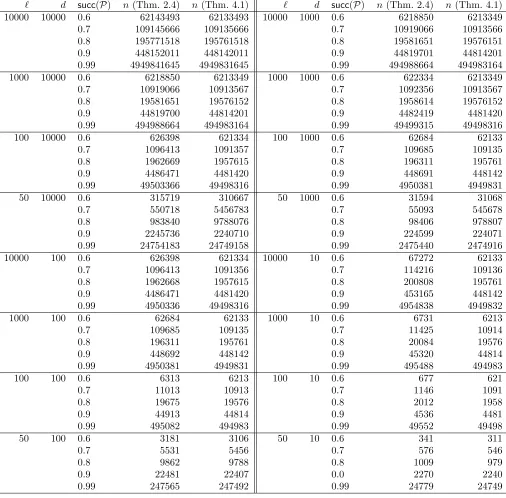
Table 1 presents values of n (the length of an encoded message), for different values of ` (the hamming weight of the challenge), d(the distance of the code) and the success probability of the proving algorithm, such that the Extractor is guaranteed to succeed. We tabulate the value of n
as specified by Theorems 2.4 and 4.1. We see, for a wide range of parameters, that the estimate obtained in Theorem 4.1 is very close to the earlier value computed in Theorem 2.4.
5
Estimating the Success Probability of a Prover
5.1 Hypothesis Testing
The essential purpose of a POR scheme is to assure the user that their file is indeed being stored correctly, i.e., in such a manner that the user can recover the entire file if desired. We have considered several schemes for testing whether this is the case, but in order to use these schemes appropriately it is also necessary to pay attention to how we interpret the results of these tests. Theorem 2.1 tells us that extraction is possible for the Basic Scheme whenever succ(P) is at least (n− bd2c+ 1)/n, hence the information we would like to obtain from using the Basic Scheme is whether or not succ(P) exceeds the necessary threshold. Similarly, for the Multiblock Challenge Scheme or the Linear Combination Scheme, we can compute a value ω such that extraction is possible whenever succ(P) > ω−1γ . We can calculate succ(P) for a given proving algorithm P if we know the values of P’s response P(c) for every possible challenge c ∈ Γ. However, the whole purpose of aPORscheme is to provide reassurance thatsucc(P) is sufficiently large without having to request allP(c) for allc∈Γ. Given the prover’s responses to some subset of possible challenges, the user wishes to make a judgement as to whether he/she is satisfied that succ(P) is acceptably high. This takes us straight into the realm of classical statistical techniques such as hypothesis testing[4, 5].
Suppose the prover has given responses P(c) to t challenges c chosen uniformly at random without replacement from Γ, and thatgof these responses are found to be correct. We are concerned that the prover’s success rate may not be high enough, so we are looking for evidence to convince us that in fact it is sufficiently high to permit extraction. In other words, we wish to distinguish the null hypothesis
H0: succ(P)≤ ω−1γ ;
from the alternative hypothesis
H1: succ(P)≥ ωγ.
Suppose thatH0 is true. Then the probability that the number of correct responses is at leastg is
itself at most
t X
i=g ω−1
i
γ−ω+1 t−i
γ t
. (14)
Alternatively, if we choose the challenges uniformly at random with replacement, then the condition for rejecting the null hypothesis becomes
t X
i=g
t i
ω−1
γ i
γ−ω+ 1
γ
t−i
<0.05.
Example 1. Suppose that for theBasic Scheme n= 1000, and that the minimum distance of the response code is 400. Then by Theorem 2.1 we find that extraction is possible wheneversucc(P) is greater than 0.8. Suppose the prover responds to 100 challenges that have been chosen uniformly with replacement, and that 87 of the responses were correct. We find that
100 X i=87 100 i
0.8i0.2100−i ≈0.047<0.05.
Thus, in this case there is sufficient evidence to reject the null hypothesis at the 5% significance level, and so we conclude that the file is in fact being stored correctly.
On the other hand, if only 86 of the responses were correct, we observe that
100 X i=86 100 i
0.8i0.2100−i ≈0.08>0.05.
In this case there is not enough evidence to reject the null hypothesis at the 5% significance level, and so we continue to suspect that the server is not storing the file adequately.
The benefit of this statistical approach is that given the observed responses to the challenges, for any desired value ofαwe can construct a hypothesis test for which the probability of inappropriately rejecting the null hypothesis (and hence failing to catch a prover that does not permit extraction) is necessarily less thanα.2 This is the case regardless of the true value of succ(P), and we do not need to make any a priori assumptions about this value.
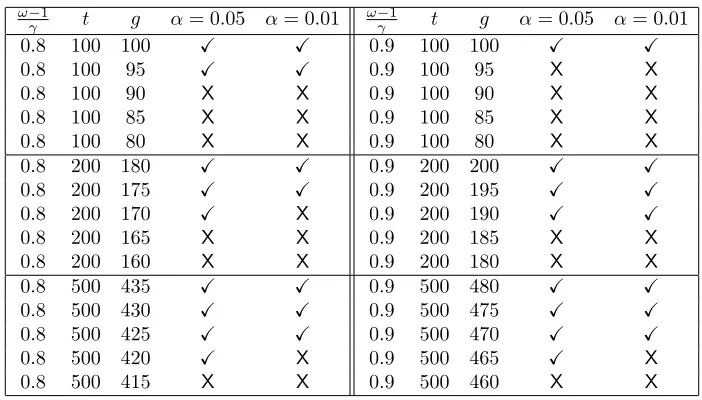
In Table 2 we give examples of a range of possible results of the challenge process and the corresponding outcomes in terms of whether the null hypothesis is rejected at either the 5% or 1% significance level.
5.2 Confidence Intervals
Another closely-related way to portray the information provided by the sample of responses to challenges is through the use of confidence intervals. We define a 95% lower confidence bound θL
by
θL= sup θ t X
i=g
t i
θi(1−θ)t−i<0.05
This represents the largest possible value for succ(P) for which the probability of obtaining g or more correct responses in a sample of size t is less than 0.05. Then the decision process for the hypothesis test described in Section 5.1 consists of rejecting the null hypothesis whenever ω−1n < θL,
2
since if ω−1n is less than the critical value we know that the probability of a prover with success rate at most ω−1n providing g or more correct responses is less than 0.05.
The interval (θL,1] is a 95% confidence interval for succ(P): if a large number of samples of
size t were made and the corresponding intervals were calculated using this approach, then you would expect the resulting intervals to contain the true value of succ(P) at least 95% of the time. The hypothesis test can be expressed in terms of the confidence interval (θL,1] by stating that we
rejectH0 whenever ω−1n does not lie in this interval.
Example 2. Suppose we have n= 1000 andd= 400 as in Example 1, and suppose that 90 of the responses are correct. Then
θL= sup (
θ
t X
i=90
t i
θi(1−θ)t−i <0.05
)
≈0.836
Then a 95% confidence interval for succ(P) is (0.836,1], and hence we reject the null hypothesis, as ω−1n = 0.8 does not lie in this interval.
ω−1
γ t g α= 0.05 α= 0.01 ω−1
γ t g α= 0.05 α= 0.01
0.8 100 100 X X 0.9 100 100 X X
0.8 100 95 X X 0.9 100 95 X X
0.8 100 90 X X 0.9 100 90 X X
0.8 100 85 X X 0.9 100 85 X X
0.8 100 80 X X 0.9 100 80 X X
0.8 200 180 X X 0.9 200 200 X X
0.8 200 175 X X 0.9 200 195 X X
0.8 200 170 X X 0.9 200 190 X X
0.8 200 165 X X 0.9 200 185 X X
0.8 200 160 X X 0.9 200 180 X X
0.8 500 435 X X 0.9 500 480 X X
0.8 500 430 X X 0.9 500 475 X X
0.8 500 425 X X 0.9 500 470 X X
0.8 500 420 X X 0.9 500 465 X X
[image:23.612.130.481.330.530.2]0.8 500 415 X X 0.9 500 460 X X
Table 2: Outcomes of hypothesis testing for a range of responses. The columns headed by values of α contain a tick ifH0 is rejected at the corresponding significance level, and a cross otherwise.
5.3 Reacting to a Suspect Prover
use that server, or with switching to another storage provider. For example, if a server is simply being used as a backup service for non-critical data and there is a high overhead associated with switching storage providers, then a user will not want to be overhasty in taking action against a possibly innocent server. In this case an appropriate action in the first instance might be to seek more responses to challenges in order to avoid the possibility that the earlier set of responses were unrepresentative of the reliability of the prover in general.
5.4 Comparison with Approaches Followed in the Literature
Ateniese et al. [1] observe that if succ(P) ≤ gγ (with g ∈Z) then when P is queried on t possible challenges chosen uniformly at random without replacement then the probabilityPrbad that at least
one incorrect response is observed is given by
Prbad= 1− g t
γ t
,
and they note that
1−
g γ
t
≤Prbad ≤1−
g+ 1−t γ−t+ 1
t .
As examples of parameters, they point out that if succ(P) = 0.99 then to achieve Prbad = 0.95
requires t = 300, and Prbad = 0.99 requires t = 460. They comment that the required number t
is in fact independent of γ, sinced it is based instead on the required threshold for succ(P) -this observation applies equally to our analysis.
Dodis, Vadhan and Wichs [6] use a similar approach to Ateniese et al., but in addition propose the use of a hitting samplerthat amounts to choosing which t elements to sample from a specified distribution that contains fewer than nt
possible sample sets but still guarantees that Prbad is
higher than some specified value for a given value of succ(P) that is less than 1.
This analysis can be interpreted in the context of a hypothesis test to distinguish the null hypothesis
H0: succ(P)≤0.99;
from the alternative hypothesis
H1: succ(P)>0.99.
If 300 challenges are made and all the responses are correct, then a 95% confidence interval for
succ(P) is (0.99006,1], so there is enough evidence to reject the null hypothesis at the 5% significance level. However, a 99% confidence interval for succ(P) is (0.977,1], so there is insufficient evidence to reject the null hypothesis at the 1% significance level. If, on the other hand, 460 challenges were made and all the responses were correct then a 99% confidence interval for succ(P) is (0.99003,1] and so in this case there is enough evidence to reject the null hypothesis at the 1% significance level.
While this does result in the smallest number of challenges for which there is still the potential to reassure the user as to the appropriate behaviour of the prover, it has the drawback that even a single incorrect response results in failure to reject the null hypothesis, regardless of whether it is true. Taking a larger sample size has the benefit of increasing the probability that a false null hypothesis is rejected, without adversely affecting the probability that a trueH0 fails to be rejected.
For example, from Table 2 we see that if 90 correct responses out of 100 are observed then there is insufficient evidence to reject the hypothesissucc(P)≤0.8 at the 5% significance level. However, if 180 correct responses out of 200 are observed then there issufficient evidence to reject this null hypothesis at the 5% significance level (in fact we even have enough evidence to reject H0 at the 1% significance level).
6
A Lower Bound on Storage and Communication Requirements
In this section, we prove a bound that applies tokeyed PORschemes. Suppose thatMis a random variable corresponding to a randomly chosen unencoded message m. Let V be a random variable denoting the information stored by the Verifier (i.e., the key), and let R be a random variable corresponding to the computations performed by an extractor. It is obvious that the probability that m can correctly be reconstructed is 2−H(M|V,R). Now, from basic entropy inequalities, we have
H(M|V,R) = H(M,V,R)−H(V,R)
≥ H(M,V,R)−H(V)−H(R)
≥ H(M)−H(V)−H(R).
Suppose that the message can be reconstructed by the extractor with probability 1. Then we have
H(M|V,R) = 0. The inequality proven above imples that
H(M)≤H(V) +H(R). (15)
Now suppose that the extractor is a black-box extractor. In this situation, we have that
H(R)≤γlog2|∆|, (16)
since there are γ possible challenges and each response is from the set ∆. The message m is a random vector in (Fq)k, so
H(M) =klog2q. (17) Therefore, combining (15), (16) and (17), we have the following result.
Theorem 6.1. Suppose we have a keyed POR scheme where the message is a random vector in
(Fq)k, there are γ possible challenges and each response is from the set∆. Suppose that a black-box
extractor succeeds with probability equal to 1. The the entropy of the verifier’s storage, denoted
H(V), satisfies the inequality
H(V)≥klog2q−γlog2|∆|.
We mentioned previously that Naor and Rothblum [11] proved a lower bound for a weaker form of POR-type protocol, termed an “authenticator”. As noted in [6], the Naor-Rothblum bound also applies to PORschemes. Phrased in terms of entropy, their bound states that
which is a weaker bound than (15).
In the case of an unkeyed scheme, the extractor is only given access to the proving algorithm. Therefore, H(M|R) = 0 if a black-box extractor succeeds with probability equal to 1. From this, it follows that H(M)≥H(R) in this situation.
7
Conclusion
We have performed a comprehensive analysis of the extraction properties of unconditionally secure
POR schemes, and established a methodology that is applicable to the analysis of further new schemes. What constitutes “good” parameters for such a scheme depends on the precise application, but our framework allows a flexible trade-off between parameters. One direction of possible future interest would be to consider the construction of further keyedPORschemes with a view to reducing the user’s key storage requirements.
Acknowledgements
Thanks to Andris Abakuks and Simon Skene for some helpful discussions of statistics.
References
[1] G. Ateniese, R.C. Burns, R. Curtmola, J. Herring, L. Kissner, Z.N.J. Peterson and D.X. Song. Provable data possession at untrusted stores. ACM Conference on Computer and Communi-cations Security(2007) 598–609.
[2] M. Blum, W.S. Evans, P. Gemmell, S. Kannan, and M. Naor. Checking the correctness of memories.Algorithmica12 (1994), 225–244.
[3] K.D. Bowers, A. Juels and A. Oprea. Proofs of retrievability: theory and implementation.
Proceedings of the first ACM Cloud Computing Security Workshop(2009), 43–54.
[4] G. Casella and R.L. Berger. Statistical Inference, Duxbury Press, 1990.
[5] F. Daly, D.J. Hand, M.C. Jones, A.D.Lunn, K.J. McConway. Elements of Statistics, Addison-Wesley, 1995.
[6] Y. Dodis, S. Vadhan and D. Wichs. Proofs of retrievability via hardness amplification. Lecture Notes in Computer Science5444(2009), 109–127 (TCC 2009).
[7] M. I. Husain, S. Ko, A. Rudra and S. Uurtamo. Storage enforcement with Kolmogorov com-plexity and list decoding. ArXiv report 1104/3025, 2011,http://arxiv.org/abs/1104.3025.
[8] A. Juels and B.S. Kaliski Jr. PORs: proofs of retrievability for large files.ACM Conference on Computer and Communications Security(2007), 584–597.
[9] M. Lillibridge, S. Elnikety, A. Birrell and M. Burrows. A cooperative internet backup scheme.
[10] F.J. MacWilliams and N.J.A. Sloane.The Theory of Error-Correcting Codes, North-Holland, 1977.
[11] M. Naor and G.N. Rothblum. The complexity of online memory checking.Journal of the ACM
56(2009).
[12] H. Shacham and B. Waters. Compact proofs of retrievability. Lecture Notes in Computer Science5350(2008), 90–107 (ASIACRYPT 2008).
[image:27.612.180.433.259.596.2]Appendix
Table 3: Notation used in this paper
q order of underlying finite field
m message
mi message block M message space
k length of a message
M encoded message
M∗ encoded message space n length of an encoded message
d distance of the encoded message space
c challenge Γ challenge space
γ number of possible challenges
r response
ρ response function
rM response vector for encoded message M
∆ response space
R∗ response code
d∗ distance of the response code
P proving algorithm
succ(P) success probability of proving algorithm
b
m message outputted by theExtractor
K key (in a keyed scheme)
S tag (in a keyed scheme)